Threading the Needle(mouse): Sonic the Hedgehog 3

Sonic the Hedgehog has become a hit movie franchise, and that fact is still kind of mind-boggling. Even putting aside the widely-panned promotional images from the first movie that resulted in the CG being completely redone, there were many years where Sonic was the butt of endless jokes. Now, the third movie features Shadow the Hedgehog, the ultra edgy character who has been mocked by the internet since his debut…and he’s great. The movie’s great. 

My inner child, the one that used to imagine himself as Sonic, is thrilled. The more critical adult that I am now is satisfied as well. Sonic the Hedgehog 3 has broad appeal while being faithful to the spirit of the source material and telling a good story, and that’s a balance many studios are failing miserably to achieve right now.

The story of Sonic the Hedgehog 3 is basically an adaptation of Sonic Adventure 2 on the Dreamcast, but pared down to 90-ish minutes in a way that keeps the essence of the story and the narrative benchmarks. For example, the film pulls out the iconic theme, “Live and Learn,” at just the right moment. This is indicative of something the Sonic movies have been able to pull off that I think has helped their success: They know what to prioritize in the source material. When the Sonic games themselves have accrued a ton of bloat over time, and making films for Hollywood often means trying to cater to mainstream assumptions and expectations, this is a powerful skill.

Characters retain their core traits even when certain aspects of their personalities might differ from game portrayals, such that they can be given more broadly relatable/entertaining traits and quirks without being unrecognizable, like Sonic’s occasional vulnerable awkwardness is charming juxtaposed with his general smart-aleck nature. Knuckles lack of self-awareness balances out his portrayal as a stoic warrior. Jim Carrey as Robotnik is a scenery-chewing goof more reminiscent of The Adventures of Sonic the Hedgehog than anything else, but it works because the movie captures his frustrated antagonism towards his nemesis. 

With Shadow too, the creators understood that you have to play his brooding nature pretty straight because he needs to come across as powerful but burdened by trauma. Keanu Reeves also performs Shadow almost perfectly, especially in the way he differentiates his voice from a similar character in John Wick. 

As I was watching the movie, I wondered where they might go next with any sequels. Sonic Adventure 2 is probably the last time any character has really cemented themselves in pop culture, and a lot of the games after that are filled with odd experimental gimmicks or rely on nostalgia. When the post-credits teasers hit, they took me by complete surprise. Now I really want to see Sonic 4.

Marvel Rivals and the Ever-Changing Nature of the Invisible Woman

Marvel Rivals has recently introduced the Fantastic Four to its roster, and like the other heroes and villains, they’ve received designs meant to capture the spirits of the characters while giving them a modern game-oriented feel. Among them is the Invisible Woman, and thanks to the game’s behind-the-back camera, one thing is clear: Susan Storm-Richards has quite a butt.

Big buttocks and thick thighs are popular these days, so this isn’t particularly surprising in and of itself. However, the fact that they would give Sue a body in that direction makes me realize something: Perhaps no other character in superhero comics more thoroughly reflects the evolution of trends in female beauty standards than the Invisible Woman.

In my look at VTuber Takanashi Kiara’s 1980s-inspired aerobics outfit, I mentioned that its emphasis on a more voluptuous lower body does not match the dominant thin aesthetic that existed back then. The Invisible Woman goes back even further in time, to the introduction of The Fantastic Four in 1961. And while she’s not alone in that regard (there are female heroes who have been around far longer than her), the difference is that Susan has very few specific iconic features that define how she’s “supposed” to look.

The Invisible Woman is meant to be very attractive (enough that Namor is constantly infatuated with her), but not to the extent of a manslayer like the Enchantress. Other than being blonde, she’s not associated with specific physical features, like Power Girl and her large chest or She-Hulk and her muscular green physique. Her costume isn’t particularly iconic or defining, like with Supergirl or Psylocke. And her powers are actually less conducive to establishing her visual identity compared to most others, including her teammates—”stretchy with graying temples,” “man entirely on fire,” and “big rock guy” are instantly identifiable in a way Sue isn’t.

So over the course of six decades, Sue’s look has changed over and over. Her hairstyles have included long, short, straight, curly, simple, coiffed, Mary Tyler Moore, mullet, and everything in between. Her costumes have ranged from conservative to astoundingly daring: form-fitting, skin-tight, that famous design from the 1990s with the cleavage-exposing “4” on her chest. While she’s generally thin, fairly busty, and pretty, her proportions have all fluctuated a bit. To some extent, this can be chalked up to individual artists’ tastes, but I think it’s notable that they can play around this much with her design compared to other female superheroes.

In the context of Marvel Rivals, the Invisible Woman seems to be influenced by two factors aside from “big butts are in.” First, there’s Sue’s status in the Marvel Universe as a kind of matron of superheroes due to her age and experience. Second, Marvel Rivals is clearly trying to be the next Overwatch, and that includes its reputation for sexy characters who are arguably more famous than the games themselves. In other words, the Invisible Woman is very 21st-century MILF-coded, not unlike Elastigirl from The Incredibles—a series that itself clearly draws a lot of inspiration from the Fantastic Four.

If the Invisible Woman is getting attention again in ten years’ time, I wonder how she’ll look then.

Reflecting on the Passing of Rachel Lillis

Rachel Lillis, one of the main voice actors of the original Pokémon dub, passed away recently. She was 55.

I don’t hold that original 4Kids dub in special regard—their voices do not necessarily define the characters for me, even though I think they played the characters well. That said, I feel that they are an important part of my life, and something that took me from kid who liked anime to full-on otaku. 

I think Lillis’s ability comes through in the range of characters she played. As the voice of both Misty and Jessie, she was in virtually every episode talking to herself, and she really sounded like two entirely different people. If I didn’t know they were voiced by the same person, I might not have ever realized. Her performances resonate clearly in my memory—I used to watch the show every day for years and years, I had the 2BA Master CD, the whole nine yards. Whatever my potential misgivings about the dub’s censorship choices, I find that Lillis’s voice work actually felt entertaining and faithful to her characters.

In terms of her influence, I especially remember an early Pokémon fansite, the Team Rocket Headquarters. It was filled with people who absolutely adored Jessie, James, and Meowth, and Lillis’s tragic and arrogant goofball of an agent played a major part in bringing them to be Pokémon die-hards. Also, it apparently still exists????

Pokémon switched English actors in the mid-2000s, which means that virtually everyone who grew up with Lillis’s performances are now full-grown adults. There’s no doubt she brought a lot of smiles to fan’s faces, and I hope those who aren’t familiar with her work can go back and appreciate it too.

What if an RTS Race Had to Deal with Bureaucracy?

I used to be really into watching Starcraft and Starcraft II, before falling off around ten years ago. However, over the past year or so, I’ve become aware of the many attempts to breathe new life into the real-time strategy genre through a variety of new games: Battle Aces, Stormgate, and so on. I’m uncertain as to whether we’ll end up seeing another renaissance, but it has me recalling the age-old question concerning RTS: How important should execution be?

I think the obvious answer everyone can agree on is that it should at least matter a little. That’s what makes it a real-time strategy game, and the degree of importance is where people will debate endlessly. But I wonder whether you can design a race within a game to be less execution-intensive without making them either too balanced or unfair. Essentially, what if this “low input” race tested different skills that were neither better nor worse than the others, but also had an inherent flaw in that it couldn’t rely on execution as much as others could?

I started to imagine a race that would basically be an empire with a huge and powerful army that is encumbered by its sheer size and maybe a bit of bureaucracy. What if there was a race whose units could be amassed more easily while also being stronger individually, but there was some drawback that kept the player from being able to control them more precisely? 

For example, maybe there is a cap on how many actions could be executed in a given period. This could resemble playing a commander who can only oversee the broader strokes of their forces, and has to leave the details to subordinates.

Perhaps the cap could be over a longer chunk of time (like 700 actions every five minutes?), so there can be moments where you can control your forces more directly, but you end up sacrificing the ability to respond more quickly a minute or two down the line. You’d have to choose when you can execute effectively, knowing that you’ll be more vulnerable at other times, or you could choose to play at a steady pace.

Another possible way to mimic a slow and convoluted chain of command would be to actually introduce a purposeful input delay. This could simulate you giving orders from on high that take time to get through to the lowest levels of the army. Maybe it has to do with controlling your forces, or it could be that upgrades or switching unit compositions take a longer while to happen.

In all these cases, the idea would be that this race can be effective and can be difficult to play in its own right, but it doesn’t hinge on physical execution as much. At the same time, it would allow other players and races who do want to use their honed macro and micro skills to defeat this race if they manage to hit hard at vulnerable moments. I have no idea whether something like this could ever work out, but I think there’s a way to have a reasonable and enjoyable compromise between those who want the high APM and real-time tactics and those who want to be methodical strategists.

I Want a Punch-Out!! Soulslike

I started playing Elden Ring recently, and it’s my first time with a Soulslike of any kind. Having to make my character stronger while also improving my own skills, all while interacting with an unfriendly world full of giant boss monsters has been a fun and frustrating experience.

It also made me really want to see a Punch-Out!! Soulslike.

Think about it: Punch-Out!! is a franchise that’s all about fighting enemies twice your size, where you have to figure out their quirks and tells, strike them during brief moments of vulnerability, and not overextend lest Mike Tyson send you to the mat with one uppercut. 

What if your player character started from scratch and had to train up? It could be a series of boss fights, but what if it were more like an Elden Ring open world, and you could visit different gyms to practice or spar with others? What if other fighters (CPU or human) could come to your gym? Established major boxers you could face in more official or formal settings, but maybe there are also bad actors who want to fight dirty and jump you in an alley?

It’s been over 15 years since the last Punch-Out!!, for the Wii. I would love to see something that would capture the spirit of the franchise, but if Nintendo wanted to take a different angle, I think this would be a welcome and interesting change. 

An Elden RING, if you will.

Ultimate Character Combo: Idols, Gals, and the Jougasaki Sisters

As character types, the “idol” and the “gal” (or gyaru) have both been around in Japanese media for decades. However, they seem to have hit even greater notoriety in recent times. On the idol side, there’s been heavy hitters like Oshi no Ko and Love Live! Then there are works like Hokkaido Girls are Super Adorable and An Otaku Who’s Kind to Gals, where gals are the main heroines or the central focus.

The idol is an idealized symbol of pure devotion to the fans, for better or worse. Fan support is why she’s able to grow as a performer. The gal is attractive, forward, and runs up against traditional Japanese beauty standards. When portrayed with a heart of gold (or as someone who’s secretly a virgin), she transforms into dork kryptonite. 

What happens when the two are combined? Naturally, it would make for a powerful character.

In thinking about the relative success of both archetypes, I began to wonder if there are any examples of such a convergence. Then I remembered that there are indeed a couple of characters who occupy that intersection: sisters Jougasaki Mika and RIka from The iDOLM@STER.

I am by no means an expert or even a dedicated fan of The iDOLM@STER. What I do understand, based on my limited knowledge, is that 1) Mika and Rika were introduced in the Cinderella Girls mobile game in 2011, and 2) I’ve been seeing their fanart for what seems like forever—Mika’s especially. In all instances, they exude “gal” energy. According to the popularity polls, Rika was initially ranked higher, but Mika emerged as more of an enduring mainstay. As if to reflect Mika’s notoriety, the Cinderella Girls anime portrays Mika not as one of the main characters, but an established idol whom others look up to.

One thing I don’t know is whether Mika and Rika have been merely a reflection of the two trends or if they actually contributed to their presence in significant ways. In other words, while I can guess that their popularity has come from being gal idols, how often is it the case that the Jougasakis are the reason people got into one or both sides? Gal subculture has been around for a long time, but I don’t recall them being nearly as prominent as characters in 2011—at least, not in the way they are today, and not in terms of their cultural presence around in the 90s and early 2000s.

While one can hardly attribute the increased visibility of idols to primarily Jougasaki Mika or Rika (they are from games where nearly everyone is an idol, after all), I can’t help but wonder if they’re significantly responsible for shining a greater spotlight on “gal characters” in a way that has persisted over a decade later. If the sisters have played a large role, it would make them influential in a way few other characters can match.

And if there are any other examples of gal idols, I’d like to learn about them.

Bad Dudettes, Good Fighting: Holo X Break

When I first tried the hololive fan game Holocure, I was stepping into a recent video game genre that I had never experienced. But things were different with the developer’s new hololive-themed title: the side-scrolling beat-em-’up Holo X Break. In it, players take control of the members of NePoLaBo (hololive’s 5th generation) and brawl their way through waves of goons in order to defeat Secret Society holoX (hololive’s 6th generation) and rescue the CEO of hololive, Yagoo.

Beat-’em-ups are near and dear to my heart. I remember being a small kid, barely able to reach the joystick at my local Blimpie’s arcade section, staring in awe at games like Final Fight and Teenage Mutant Ninja Turtles. They were once the games that best showed off the heights of video game graphics, eventually becoming a decidedly “retro” genre as the decades passed. 

A big part of the appeal of Holo X Break is, naturally, getting to indulge in hololive fandom. All four initial playable characters have their own strengths, weaknesses, and unique abilities based on their personas. Nene is a peppy girl from another world who throws beetles and can heal herself and others. Polka is a witty clown who has a balanced moveset and can create objects out of thin air. Lamy is an alcohol-loving snow elf who can magically freeze enemies. And Botan is a lion girl whose  skill in FPS games translates into a specialization in ranged weaponry. Everyone is voiced by the VTubers themselves, and numerous cute references and cameos are also strewn throughout.

The gameplay stands on its own quite well, though I found that I had to get used to its pecuilarities. Holo X Break is a curious mix of genres, built on the straightforward nature of beat-em’ups but also adding in randomized power-ups in the vein of rogue-like descendants such as Holocure. But unlike Holocure, a lot of the extra things you can do are not just automatic, and have to be actively selected. Between the core movesets featuring both basic and special techniques and an ultimate, five item slots you can fill with weapons and healing that you have to cycle through in real time, and the equipment that you can pick up and wear (or store for later)—all while being attacked by throngs of enemies—and it can feel overwhelming.

With time, I got the hang of things, especially when I realized how the game wants to be played. I wanted to hoard items, but Holo X Break discourages that, and intends for you to use your weapons liberally. It wants you to spend coins to upgrade your equipment in between stages as much as possible rather than trying to “save more for later,” even punishing you by taking away all coins upon death. Different enemies require different tactics, and figuring out who to prioritize when they gang up on you is part of the challenge. According to the developer, Holo X Break is heavily inspired by the game Little Fighters 2, but given that I’ve never played that, I find that it feels more like the older Technos games: Double Dragon, River City Ransom, etc.

Speaking of enemies, I’ve always loved fighting bosses in video games, and having them be the members of holoX (a group I adore) only adds to the charm. Just like with NePoLaBo, they’re voiced by the actual talents, and their identities have been adapted in fun and interesting ways. Fighting against them feels a little more akin to taking on a Mega Man robot master, with the way you have to take into account their different abilities and movement tendencies. Getting to see La+ Darknesss shoot orbs of dark energy and summoning bolts of obsydian lightning is nothing short of rad.

While I had some setbacks (Lui in particular can be a real skill check), I did beat the game within a day. When I went online to check out other opinions, I found that its reception is a lot more mixed than holocure’s, and much of it seems to come from simple unfamiliarity with older beat-’em-ups, as well as the modern belief that gameplay should be a more streamlined experience. The game currently has no save system and unlimited continues, which brings me back to my childhood while being a source of frustration for others. 

In light of this, the developer plans on adding saves. I’ve also seen comments about not being able to get past the first boss, Koyori, despite playing for hours, and it made me realize just how difficult stepping into an unfamiliar genre can be, especially with a game that doesn’t pull its punches. One review complained that they were tired of just hitting the same button over and over—something that didn’t really bother me in the least, and hadn’t even realized was an issue in the first place. I actually don’t necessarily enjoy when games have all the fat and excess shaved off, so to speak, and I appreciate Holo X Break for not taking that route. 

I haven’t gone through everything Holo X Break, but I hope to savor every piece of it. And while I’m still looking forward to seeing holoX in Holocure, I’m happy to see them here. Now, if only I could play some co-op for the true beat-em’up experience.

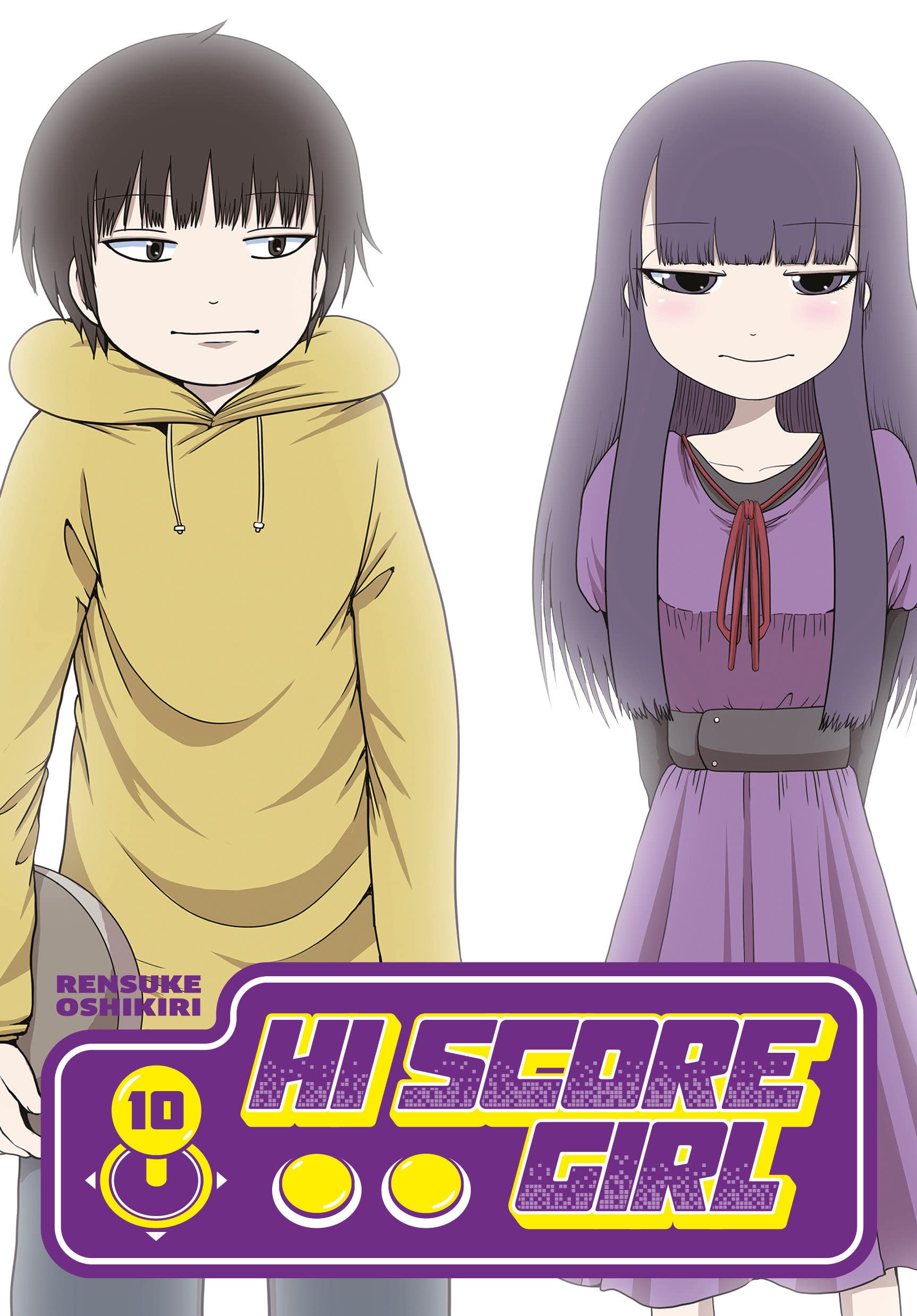
Boy Meets Girl Meets Tick-Throw Spinning Piledriver: Hi Score Girl

I’m happy and grateful that the full Hi Score Girl manga series by Otoi Rekomaru is out in English. It’s one of those manga where, once upon a time, a US release would have been a pipe dream. A nostalgic nerd love story premised around Street Fighter II and the 90s Japan arcade scene? As significant as that era was in Japanese gaming history, it’s a niche among niches. And yet, here we are.

I first discovered the series eight years ago, and was immediately won over by two things. First, there was the eccentric nature of its main duo: the obnoxiously loud gamer kid Haruo and his friend/rival/love interest, the reticent and rampaging Akira. They initially meet at an arcade and feud over a Guile vs. Zangief matchup, and though they never stop butting heads, it’s silly and sweet how they essentially communicate through gaming. That’s not metaphorical either; Akira pretty much never talks. Second, the portrayal of the 90s games and the way Haruo based his very outlook on life on them could have only come from a genuine place. Otherwise, jokes like “messing up the secret select code for Akuma” and “Akira having sympathy for big grappler characters because she feels bad about how little they get chosen” wouldn’t land so well.

The characters age over the course of the 11 volumes, going from elementary to high school and growing alongside the rapid developments in gaming technology. Their transition into adulthood is concurrent with continuous upgrades to Street Fighter II, the advent of 3D fighting games like Virtua Fighter, and so on. A nice narrative device to be sure, but it’s actually surprising seeing how much Haruo actually matures as he comes to understand responsibility in his own way. He’s not the sharpest tool in the shed, but his convictions are real.

Hi Score Girl reminds me a lot of one of my all-time favorites, 81 Diver. The art is similarly rough, and the core relationship is as much a rivalry as it is a love story (if not moreso). That’s actually pretty rare in manga focused on het romance, and is usually the domain of fujoshi-adjacent works. But it’s convincing here because of how Otoi portrays the genuine desire for connection, and the way that gap is bridged through gaming. Sure, the premise of a boy meeting an ultra rich mega gamer girl is unrealistic in many ways, but the portrayal makes me want to believe in their love.

In addition to the authenticity of the passion for fighting games, I think what ultimately makes Hi Score Girl work is that while Haruo kind of exists primarily in his gaming-obsessed mental space, the life lessons he draws from games are ultimately his own. He’s a guy with an imaginary friend who gives him pep talks and acts as his conscience, and that friend is often just Guile. Haruo and Akira imbue greater meaning into games, and the games reciprocate by providing them the thrill of victory, the agony of defeat, the comfort of friendship, and the joy of love.

Interview: Super Robot Wars’ Terada Takanobu (Otakon 2023)

Terada Takanobu is a veteran game producer, and has been involved with the Super Robot Wars franchise since the 1990s. This interview as conducted at Otakon 2023 in Washington, DC.

Hello, it’s great to meet you. I’ve been a long-time fan of the Super Robot Wars series, and I’m very glad that is finally easy for people to play around the world.

My first question: You recently announced that you were becoming a freelancer. How has that change been for you? Have there been any particular advantages or challenges that come with it?

There were lots of interests I wanted to pursue, so I decided to step down from the producer role to become a supervisor, and use that time to do the things I’d like to do.

I want to make toys and plastic models, and original robot animations—ones that are not Super Robot Wars OG.

Do you have any all-time favorite anime or even tokusatsu works?

My favorite super robot is Mazinger Z. As for tokusatsu, Ultraman and also Masked Rider. And more and more. 

Original Kamen Rider, or…?

It would have to be the first Masked Rider, fundamentally.

One signature element of SRW is the continued use of very creative 2D attack animations. What are the reasons you have stuck with this style even though so much has changed about video games over time?

In Super Robot Wars DD, we’re doing 2D animations and something between 2D and 3D too, so we’re diversifying. 

In SRW DD, the idea behind going for 3D animation is to better capture the original. But more than when I was a producer, I can now better create the content I make compared to before 

What has it been like developing mobile games, as well as having multiple games out there? Is it part of a broader strategy?

With regard to the overall strategy of creating mobile games, that lies with the publisher, Bandai Namco, so I can’t really speak to it. However, as for challenges in mobile games specifically, I’d say one that having a deadline every month is a bit challenging. For example, before, if it was for a console, you had three years to get the battle animations and the scenarios and put everything into one package. But now, with the mobile games, you have everything packaged every month.

You started at Banpresto in the 90s. Are there any staff from that era still at [its successor] BBSoft?

There are some.

Do you have any specific series or character units that you thought turned out especially well in terms of their presence in SRW? Or do you think there were any storylines that were executed very well?

It’s a bit difficult, because all of them are a lot of work, and I’m mainly putting effort into making what’s there. It’s a cyclic process of making and releasing and making. More than myself, it’s ultimately the users who decide what’s good.

Are there any titles you are especially proud of being able to obtain for SRW or thought you’d never get for the series?

Space Battle Yamato, aka Star Blazers. As for recently, too many. Hmm…recently, Gridman, Mobile Suit Victory Gundam, and Gun x Sword. In SRW DD, Devilman and Koutetsu Jeeg. What’s it called in English?

Translator: [Steel] Jeeg. 

Oh, just that directly.

Ogiue Maniax: There isn’t much of a Jeeg presence in America.

Ah, I see. Oh, and there are two Jeegs now: [Steel] Jeeg and [Steel God] Jeeg

The impression I have about SRW is that there are the “main” games—Alpha, F, F Final, V, X, T, 30, etc.—and then there are smaller ones that tend to be a little more daring with game mechanics and what series they include. One title I think of is SRW Neo, with Jushin Liger. Is there any truth to the idea that you see the smaller games as more experimental?

Before, yes, there was a difference with the more experimental ones. But now, SRW DD is the only one out, and in there, we try all sorts of things like Jushin Liger and Granzort. SRW DD does embrace the style of SRW, such as the game stages and the scenarios and everything.

I know that you cannot reveal any unannounced information, but has there ever been any consideration to include giant robots from non-Japanese media?

I’m not allowed to say what it was, but there were past attempts. There’s lots I would like to license, but it didn’t work out.

Do you receive feedback from the directors and other staff involved with the titles included in SRW? For example, have you ever had to interact with directors Tomino or Anno?

Yes, there has been some feedback—and actually, there have been some ideas that came from Tomino-san and Anno-san. And actually, I came across some suggestions that Kawamori-san of Macross had earlier. But I had to tell him that’s not something I have control over.

One last question: Over the years, you’ve worked with many voice actors, and unfortunately, some have passed away. Sometimes, they are replaced by new actors, and other times, you re-use existing voice clips. Do you have any say in who gets recast in SRW, or is it outside your control?

If it’s stated by the original source material, I will do as the source material requests. Otherwise, I have the freedom to choose.

Thank you very much!

Street Fighter 6 and the History of “Modern Controls”

Street Fighter 6 has succeeded in its goal of bringing in new players through a simplified control scheme labeled “Modern.” The signature special inputs that Street Fighter pioneered are basically replaced by one-button inputs and cardinal directions, with the caveat that damage dealt is reduced by 1/5. The Modern control scheme has also spiced up discussion in the community as competitive players try to figure out if having your most powerful moves be instantaneous is a worthwhile tradeoff for having fewer options overall. But this is not the first time fighting games  have included easier inputs, and I think it’s interesting to see how past games have tried to incorporate more accessible control schemes.

In the GameCube Capcom vs. SNK EO and the 3DS Street Fighter IV, the advantages their shortcuts provide is tremendous. The only thing that kept them at bay is that they were not the “main” tournament versions; if they were, high-level play would be fundamentally worse because the characters were simply not balanced with instant specials and such in mind.

Another approach comes from Granblue Fantasy Versus. In that game, players have simultaneous access to both traditional specials and simplified ones (on a cooldown timer), with the expectation that stronger players will use the former and newbies the latter. In actuality, competitive players use both, recognizing that faster inputs are more reliable in certain situations.

Then there’s Super Smash Bros., a game franchise built around more simplified controls. When traditional 2D fighter characters became playable, the big question was how they would be incorporated into the Smash system. The answer, it turns out, was to allow everything—you can use Smash-style special inputs and classic fighting game motions, the latter rewarding the player with greater damage and KO power. However, no Ryu, Ken, or Terry Bogard players worth their salt play a primarily “Modern”-esque style. And unlike Granblue, the simplified versions are only ever used when recovering offstage.

This is because the aforementioned distinction between damage and KO power is an important part of Smash. In SF6, your Shoryuken taking a bit less off might just mean you need to land one additional hit. In Smash Ultimate, it might mean not being able to finish off the opponent at all. The fighting-game characters are balanced around their ability to take stocks relatively early through their “true” specials, as they’re called by the community.

The saving grace of SF6’s Modern controls is probably the fact that they’re part of the game from the very beginning, and they make players feel powerful without going overboard. Unlike some games, you cannot have your cake and eat it too with respect to accessing both modes, and Modern comes with drawbacks that feel neither ineffectual nor overly harsh. Efficacy seems to vary from character to character, and players have to be cognizant of what they give up to obtain instant specials and supers—advantages the opponent can know about and play around. I expect them to be a staple of Street Fighter going forward, and are one big step in helping to chase the elusive specter of accessibility all while maintaining competitive integrity.