
I’ve got a new post over at the Vistas blog, this time about the differences in paid services provided by two different streaming sites with two different ideas of what its users should pay for, Crunchyroll and GOMtv.net. Feel free to comment either there or right here on Ogiue Maniax.
Category Archives: video games
Gotta Defeat M. Bison By Christmas

Ever since the Clannad side stories, there has been a small trend in dating sim and visual novel anime where, rather than trying to incorporate all of the vital elements from all of the characters into a single on-going story, adaptations would instead create smaller, alternate-path arcs. In this new model, as shown by last season’s Amagami SS and Yosuga no Sora, every few episodes would be devoted to one girl, and once her story was over, the next episode would act as if that story never existed, instead focusing on the idea of “what if the hero ended up with this girl instead?”
I’m not entirely supportive of this style of storytelling and I worry about its misuse to some extent and the way it can potentially trivialize not just the girls but the male protagonist himself, but the format has merit. In fact, I think it could be of great benefit to a genre of anime that had its heyday in the 90s but is almost non-existent today. I speak of the fighting game adaptation.

Now if you haven’t much experience with fighting game anime, it’s safe to summarize the genre by saying that most of it is very bad, to be somewhat kind. As to why the general quality of fighting game anime is so poor, the reasons are many, including budget, but much of it stems from the sheer numbers of characters that populated the source video games even as far back as Street Fighter II and its 12 warriors. Consider that fighting games have a large number of selectable characters, and that the player picks one and plays through the entire game with them. In time, every character gets their own fanbase. So if you’re making a fighting game anime you most likely want to appeal to the fans, and thus your adaptation has to include all of the characters. 12 is a lot, let alone the 16 when the actual Street Fighter II animated movie came out or the 30+ of the newest games, and inevitably what happens is that the characters don’t all get the same amount of love. Zangief fights Blanka in a ring just because. Lawrence Blood is made into a servant of Wolfgang Krauser just to fit him in.
Generally speaking, that’s fine. Characters should have different levels of focus in a story, that’s the difference between a main character and a side character after all. But while fighting games have official protagonists, your Ryus and Akira Yukis and Terry Bogards, in the context of being a video game the “main character” is whoever the player chose. So with fighting game anime having trouble with allotting enough time and attention to all of the characters, characters who are each important to someone out there, it begins to resemble the dilemma that dating sims, which are themselves video games where a variety of characters are “absolutely important” in their own paths.
That brings me to the big question. What if fighting games took a note from Amagami? What if, instead of trying to cram every character into one story, each episode or OVA was just, “what if this character won the tournament?” Each individual fighter can get their moment in the spotlight that they so rightfully deserve? Most likely this wouldn’t solve the budget issue, but it would showcase the characters in their proper glory.
Once an anime is made this way, call me. I have some very good ideas for the English voice cast.
Marvel vs Capcom 3: English vs Japanese Profiles
The other day I was looking through the Japanese Marvel vs Capcom 3 website when I noticed that a lot of the profiles were actually quite different from the ones on the official English page. I’ve translated them below so that you can compare. Though not an absolute rule, the Japanese profiles tend to talk more about personality and origin, while the English ones focus on powers and abilities.
Do note that the DLC characters do not have any Japanese profiles yet, so I’ve left placeholders for them until they do.
Amaterasu
English: The wolf incarnation of the Sun Goddess. She uses her power to restore peace and beauty to the lands.
Japanese: 100 years ago, she triumphed in the battle against Orochi, but was injured and lost her physical form. Afterwards, using spiritual energy she resurrected herself as a guardian deity, but lost all of her miraculous power. Amaterasu now travels out into the world, slowly regaining her power, in order to restore her life.
Arthur
English: Sir Arthur is a brave and valiant knight who goes into hell to save his love Princess Guinevere.
Japanese: He is the legendary knight who traveled to the demon world alone in order to rescue his princess from the Demon King. He has a courageous personality, pushing forward in spite of fiendish monsters and dangerous traps, but he also has a cute side, as shown by his favoritism towards strawberry-print underwear.
Captain America
English: A scrawny fine arts student who grew up during the Great Depression, Steve Rogers was injected with the Super Solider Serum, giving him superhuman strength and agility.
Japanese: The one and only super soldier born out of the “Super Soldier Project, his strong feelings of patriotism for his country and unmatched sense of justice earn him the highest respect even among other heroes. He works as leader of “The Avengers,” a team formed in order to protect the world.
Chris Redfield
English: Part of the S.T.A.R.S Alpha team, Chris was one of the first to see the horrors of the Umbrella Corporation. He is also one of the founders of the B.S.S.A, designed to deal with Umbrella-like threats.
Japanese: Ever since the incident in Raccoon City and the destruction of Umbrella, he has taken on biological weapons all over the world. However, as he continues to fight, more and more questions come up. He is searching for his former partner, Jill, who disappeared without a trace.
Chun-Li
English: An undercover Interpol detective with lightning fast kicks, Chun-Li seeks to avenge her father’s death.
Japanese: Clad in a China dress, she spends her days searching all over for the criminal organization Shadaloo in order to eliminate it. Though notable for her strong conviction to her professional responsibilities, she also has a contrasting feminine side; in her heart is the wish to “live like a normal girl.”
Dante
English: Dante is a mercenary dedicated to vanquishing demons, which were responsible for killing his mother and corrupting his brother. He is also half demon himself.
Japanese: Born from the union of the demon Sparda, a legendary dark swordsman, and Eva, a human woman, he is half-human and half-demon. As a child, his mother was killed by a demon attack, so in order to search for his enemies he opens up a demon-hunting service. Indicative of his skill as a Devil Hunter, his shop is named “Devil May Cry.”
Deadpool
English: The Merc with a Mouth…while he is incredibly silly, Deadpool is one of the most effective mercenaries out there
Japanese: In order to cure his terminal lung cancer, Wade participated in an experiment to grant him artificial mutant powers. As side effects, his skin gained the appearance of being covered in burns and his mind was warped. Though he enjoys running his mouth, he is absolutely and profoundly mad, making him often difficult to comprehend.
Doctor Doom
English: Victor von Doom is a genius and ruler of Latveria. Often thwarted by the Fantastic Four, he uses his incredible mind and vast resources in repeated attempts at world domination.
Japanese: He is the masked genius scientist plotting world domination. Although his physical abilities are ordinary, he uses his brilliant mind to invent a vast number of super-science weapons. Utilizing them in his elaborate operations, he has tormented many superheroes.
Dormammu
English: Dormammu rules the Dark Dimension, using his mystical powers to try and conquer other dimensions.
Japanese: Originally an energy-based lifeform from another dimension known as the Chaos Dimension, he obtained a physical form made out of metal, aspiring to enter our reality and conquer it. Currently, he is king of a mysterious dimension known as the Dark Dimension.
Felicia
English: A cat woman raised by nuns, Felicia left the convent and is on a quest to become a star.
Japanese: A cat woman found and raised by kindly nuns, she has a cheerful and gentle personality. Relentlessly pursuing her dream, she works splendidly towards granting her own wish of becoming a musical star. In order to take care of children who have experienced the same difficult circumstances as her, she also works as a nun at an orphanage.
Hulk
English: When Bruce Banner was exposed to radiation from a gamma bomb, the power of the Hulk was unlocked. Now, whenever Banner gets angry, he becomes the massively strong and powerful Hulk.
Japanese: Once a brilliant physicist, while testing a bomb he was bombarded by high doses of gamma radiation. Now, when his anger and frustration rise, he transforms into a green-skinned being possessing a power well beyond human. Hulk’s overwhelming power is the point of reference by which all other strength is compared.
Iron Man
English: Billionaire Tony Stark fights the forces of villainy in the high-tech Iron Man armor. He is one of the cornerstones of the Super Hero community and a founding member of the Avengers.
Japanese: He has the brains and the technical ability to be able to develop and modify his very own battle suit. As Iron Man, he is equipped with a variety of weapons and has mastered the ability of flight.
Jill
English: Jill was one of the members of the S.T.A.R.S Alpha team. She was also one of the few people to escape Raccoon City before it was destroyed.
Japanese: N/A
Magneto
English: With almost complete control of magnetism, Magneto is one of the most powerful mutants alive. He uses his massive powers to fight for his own mutant agenda at any cost.
Japanese: A survivor of the Auschwitz Concentration Camp and genocide in the Second World War, he strives for the salvation of mutants while embracing the idea that “mutants, being superior to humans, should lead mankind.” Ruthless, he will go to any length for his agenda.
M.O.D.O.K.
English: M.O.D.O.K., the Mental Organism Designed Only for Killing who leads Advanced Idea Mechanics, is gifted with super intelligence and psionic power, using these powers to vex the world’s Super Heroes.
Japanese: Though once a normal human, his body was experimented on and he became “M.O.D.O.K. (Mental Organism Designed Only for Killing).” Possessing the abilities of superhuman intelligence and psionic power, Modok refers to himself as a “supreme scientist” and has buried all of the researchers involved in his experiment.
Morrigan
English: A fun-loving succubus, Morrigan is very powerful and prefers to neglect her duties and spend time in the human world.
Japanese: Known as a “succubus,” or a demon who seduces men with her charm, her notable characteristics are her outstanding proportions and her bewitching outfit. She is the head of the House of Aensland, one of the three great families in the demon world, but hates the everyday tedium that comes with the position.
Ryu
English: Ryu lives only for the fight and seeks opponents stronger than himself. He fights using the art of Ansatsuken as taught to him by his master, Gouken.
Japanese: Having fought the Emperor of Muay Thai and won, his name became widely known by the warriors of the world. However, fame is of no concern to him; he travels the world, trading fists with others in order to become a “true warrior.”
She-Hulk
English: When Jennifer Walters received a blood transfusion from her cousin Bruce Banner, she gained the power to become She-Hulk.
Japanese: Cousin of Robert Bruce Banner (The Hulk), in the past she suffered a serious injury and received a blood transfusion from Dr. Banner and gained the ability to transform into She-Hulk. The transformation applies not just to her body but to her personality as well; she stops being hesitant and becomes more self-condident.
Shuma-Gorath
English: Shuma-Gorath is an ancient and terrible being who wants to enslave humanity with his supernatural powers and ability to shapeshift.
Japanese: N/A
Spencer
English: Spencer is a bionic operative for a special branch of government. However, the government betrayed him, forcing him to go rogue.
Japanese: Once a great hero from his active service in the war against the Imperial Army, he was charged with treason, imprisoned, and given the death sentence, anticipating the government’s extermination of all Bionic technology. But when the Organization for the Revival of Bionics appears, he is dispatched to resolve the issue, choosing the path of warfare once more.
Spider-Man
English: When a radioactive spider bit Peter Parker, he gained the proportionate strength and agility of the arachnid, which he now uses to fight evil.
Japanese: When a young Peter attended a science exhibition and was bitten by a radioactive spider, he gained super powers and became Spider-Man. After experiencing the murder of his beloved uncle by a burglar who he had once let escape, he took to heart the words, “With great power there must also come great responsibility.”
Super-Skrull
English: The Super-Skrull (also known as Kl’rt) was given all of the powers of the Fantastic Four. He uses these powers as a champion of the Skrull Empire.
Japanese: After the Skrull invasion of the Earth was thwarted by the “Fantastic Four,” he was created as a super warrior, genetically modified to oppose them. His choice of words and his enormous pride indicate a disdain for other lifeforms; however, this stems not from any belief in personal superiority, but a cultural characteristic common to all Skrulls.
Thor
English: The God of Thunder wields the mighty hammer Mjolnir to fight the forces of evil. He is also a founding member of the Avengers.
Japanese: Son of Odin, the king of Asgard (the land of the gods), he is referred to as “Asgard’s Greatest Warrior.” Though once arrogant, he matured greatly after being reincarnated as a human as a form of discipline. Currently, he acts as a member of Earth’s Mightiest Hero Team, “The Avengers.”
Trish
English: A woman created by a demon to seduce and destroy Dante. However, she ends up aiding Dante on his quest to vanquish demons.
Japanese: Though once a demon created to seduce Dante, she was charmed by Dante while with him and betrayed the demons. Currently, she works at Dante’s shop as his partner.
Tron
English: A pirate and mechanical genius, Tron Bonne uses her servbots to do her bidding.
Japanese: The only daughter of the Bonne family of air pirates, she is prideful and absolutely hates to lose. However, she shows adorability in her inability to be honest with those she loves, as well as a gentleness when it comes to her family. Though she goes around the world in the hopes of obtaining wealth in one shot, she always fails and only ends up increasing her debt.
Viewtiful Joe
English: Sucked into Movieland, Viewtiful Joe fights for truth and justice using the time altering powers of his V-watch, which is activated by the magical phrase “Henshin
Japanese: Before transforming into Viewtiful Joe, he’s a 17 year old guy who loves heroes and movies. He has a strong childish side to him, which make his girlfriend Sylvia get mad at him quite often.
Wesker
English: Albert Wesker was part of the S.T.A.R.S. Alpha team. However, he was secretly working for the Umbrella Corporation. He has since betrayed Umbrella and is now working for Tricell.
Japanese: Extraordinarily cool-headed, he is a dangerous human being who will not hesitate to use others if it benefits him or his goals. He plots to complete the Uroboros virus and release it into the world, creating a new world where only he and a chosen similar few exist.
Wolverine
English: This Canadian member of the X-Men is the best there is at what he does, with his healing factor and adamantium claws. But what he does isn’t very nice.
Japanese: Often mistaken for a berserker devoid of civility, he has an extremely chivalrous personality and cares greatly for his friends and loved ones. However, he also has a dry side. He gives no mercy to his enemies and will not hesitate to lift a hand, regardless of time and place.
X-23
English: A female clone of Wolverine, X-23 has all of his powers in female form.
Japanese: She is a clone created from Wolverine’s genes. Having never been named since birth, she possesses a storied past, driven to a life as a highly-trained killer. Spending every day training for battle, she was named “Laura” by the scientist she considered her mother, she is prepared to cut open a path to taking back her life.
Zero
English: Despite being created by the evil Dr. Wily, Zero fights for good and righteous causes throughout his robotic existence.
Japanese: A male reploid discovered within some ruins by Sigma, since then he has worked as an Irregular Hunter. While ordinarily cool, he has an unusually strong hatred of evil; in combat with Irregulars, his fierce and decisive blade can annihilate his opponents in an instant. He is good friends and allies with X in the 17th Elite Unit.
People Who Play to Prove Something Cause Damage to Those Switching Out
While I have had many friends over the years who were quite fond of Magic: The Gathering, for one reason or another I never quite got into it. So when I began reading about the different player types in Magic as defined by the cards’ creators, I found it so fascinating in a way that I kind of wish I had gotten into the game more. But while I do not have familiarity with Magic, I have thrown many hours into the Pokemon series, and I thought about whether or not I’d be able to determine by player type based on my experience there.
According to Mark Rosewater, the architect behind the current card creation system, players of Magic fall into one of three categories: Timmy, who “wants to experience something,” Johnny, who “wants to express something,” and Spike, who “plays to prove something.” More details can be found here. I’ve found myself unable to quite determine where I fall in the spectrum, but perhaps if I explain how I feel about one aspect of the Pokemon, maybe you can help me out.
The second generation of Pokemon games introduced an attack called “Hidden Power.” Story-wise, it was supposed to be a mysterious strength lurking deep within your Pokemon which allowed it to attack with a type element that it normally would not able to. On a technical level, it was an attack ranging in power from weak to medium strength that could be any one of the 17 Pokemon types in the game depending on your individual Pokemon’s inherent statistics. At first it came across as a move you were “lucky” to get, but its meaning and purpose changed in the context of high-level competition, where it could be manipulated to give you exactly the type and strength you wanted. Combined with the fact that nearly every Pokemon could learn it, Hidden Power became a wild card of sorts, customizable just like everything else in the game.
I did not like Hidden Power then, and even though its capacity has been a little more limited since Diamond and Pearl and the re-categorization of “physical” and “special” attacks where the move only becomes useful to “Special Attackers,” I still do not like it. As a person who really enjoys creating Pokemon teams using Pokemon that are not the cream of the crop and trying to figure out different ways to make them work even when they’re at a distinct disadvantage, the way Hidden Power has been continuously used as a near-automatic suggestion to fill a Pokemon’s move slot has always bothered me. Need your Hypno to fight a Swampert? Just give it Hidden Power Grass. Ground types giving your Jolteon trouble? Hidden Power Ice is your answer. Rather than encouraging players to really sit down and think about how a Pokemon could make the most out of its limitations, Hidden Power became a band-aid that could be applied to just about anything, the chainsaw applied to the proverbial hedge maze which just encourages laziness. While I don’t necessarily fault anyone for using the move (why ignore it if it’s there?), I would rather it never existed in the first place.
I am well aware of the counter-argument that Hidden Power is a boon to these lesser Pokemon of which I’m so fond, as it gives them diversity and the ability to compete where without it they would just have no other choice. After all, why should Dragonite get Ice, Electric, Fire, and Water attacks but not Pidgeot? I understand that side well, but I just wish the solution wasn’t as simple and widespread as Hidden Power. With Hidden Power, there’s so much less challenge in trying to get a Pokemon to work that it takes some of my enjoyment out of team-building, because I can’t just ignore that it exists because it’d inevitably be used against me.
So what do you think? I get the feeling I’m not really all that Spike, and I know hybrids can exist, but I’m not too sure where I fall between Timmy and Johnny.
As an aside, I’m quite pumped that Mewtwo finally gets its own signature attack. I’ve been hoping for this since forever because previously Mewtwo’s only distinguishing trait was that it was “really good.”
Why Are They Making Ash Ketchum’s Eyes So Huge? I’ll Tell You!
In anticipation of the latest Pokemon Black & White games, the anime of Pokemon is undergoing a revamp, and with this newest iteration comes a great amount of aesthetic change for a series which has up to this point remained fairly static in that regard (or at the very least has experienced change so gradual as to be unnoticeable). Many long-time characters are undergoing design changes, but perhaps the most prominent is that of main character Satoshi, possibly better known as Ash Ketchum, whose irises appear to have doubled in size.

Around the internet, people have been wondering what could possibly be the catalyst for this change. The truth lies with the character designer for the Pokemon games, Sugimori Ken.
Sugimori was the original Pokemon artist, drawing up all 151 of the originals as well as all of the character artwork. Even now he remains in that position, with his works being the official depictions of all humans and Pokemon in the franchise. Essentially, this means that Sugimori has been drawing for Pokemon for 15 years now, and his artistic sense and style have grown accordingly. Whereas the designs for the anime originally drew inspiration largely from Sugimori’s original designs for the first generation of Pokemon games and have remained fairly constant since, Sugimori’s own artwork has gone through a one and a half decade process of refinement.
 Left: 1995-1998, Right: 2010
When you look at the anime’s new character designs, you can see that they are simply re-aligning themselves with Sugimori’s work.
So in a way, the artwork for the Pokemon anime is pretty much ending up where it should be.
V! V! V!
Puberty is a funny thing when you’re a fan.
In some instances, a female character can enter the mind of a young boy just by virtue of being the most prominent female in his favorite show, and then stay with him as he awakens sexually. Of course it doesn’t happen to every fan, and I’d be remiss to not include female fans who carry the torch for their male childhood crushes (or varying combinations between these two areas), but as a guy who likes girls I want to focus on that area. Feel free to chime in with your own thoughts given your own sexuality.
The first examples I can think of are Sayaka from Mazinger Z and Chizuru from Combattler V. While they are obviously not applicable to me seeing as I did not grow up with either show, in Japan and Italy and other parts of the world where these shows found popularity you have a lot of devoted male fans who will sexualize them and possibly draw fanart of them, to the extent that someone unfamiliar with these series might scratch their heads, or perhaps get the wrong impression of them when they see fanart of Chizuru in an outfit that’s quite a bit tighter than canon suggests. This is not a knock on either Sayaka or Chizuru. I can easily see guys liking them for legitimate reasons, and they’re even portrayed as attractive within the contexts of their shows (e.g. shower scenes), but I think there’s more to it than that.

An even better example might be video game characters. I’m not talking about your RPG characters who get loads of development, or games that have come out more recently and have the benefit of powerful graphics to improve character design and rendering, but those old, let’s say pre-90’s video games which barely had stories to go with them. While Samus Aran has had a lot of development over the years, guys were finding her hot since the NES era. Obviously her stripping to her skivvies in the ending sequence plays a role in this, but I think what pushes that over the edge is that you play as her for so long that you get attached to her. Again, familiarity.
Of course this doesn’t happen with every fan, but being a fan makes this more likely, I think. To preserve the memories of their favorite “stories” from childhood and bring those memories with them through to their teenage years and possibly their adult life, isn’t that the kind of thing a fan does?
And then my thoughts lead towards “moe.” Modern moe shows of course don’t have that advantage of familiarity, but when I think about it, liking a video game character because of the two or three things you know about them and liking a moe girl who is a collection of moe traits aren’t that far off. So I wonder if moe in the marketing sense of the word is trying to tap into that same nostalgia reservoir, only through more “efficient” means.
I’m not here to judge what characters you like for whatever reason, but to simply put down my thoughts on the way the fan mind works, particularly for when you start thinking girls (or guys) are awfully nice-looking.
On another note, I realize my past three post titles have all been song lyrics. Yeah I don’t know either.
To Be an Electric Type is to Be One with the Speed of Light! …or Not
Ever since the first games, I have been a big fan of Pokemon, particularly when it comes to multiplayer battling. I remember the absolute Psychic dominance of Red, Blue, and Yellow, and I know well the competitive trends from sequel to sequel. And even though Pokemon as a whole is not the most balanced of games, it’s clear that the creators have tried to make some concessions to multiplayer fairness, strengthening some things while weakening others.
While this effort towards balance is much appreciated however, I feel that there has been an increasing amount of homogeneity in Pokemon moves, removing some of the individuality and uniqueness of each Pokemon type.
Since the early games the Normal type has had a certain identity associated with it. In terms of effectiveness versus other types, the Normal type is the only kind that is not super effective against any other type. On the other hand, very few things resist it, so it’s fairly neutral overall. But what made Normal type attacks so special is that they had by far the most range and utility in the game. You had kamikaze attacks in Selfdestruct and Explosion. You had Hyper Beam, a powerful technique which exhausts the Pokemon after each use. You had the purely random Metronome. You had Swift, an attack which always had perfect accuracy. You had Quick Attack, a move which lets the Pokemon hit first no matter the actual difference in speed.
And so each Pokemon type had associated with it certain strengths and weaknesses well beyond that 17 x 17 grid denoting super effectiveness. But let’s take a look at what’s happened to Quick Attack since then. You now have Extremespeed, a rarer form of Quick Attack which is twice as powerful. But then you also have Mach Punch, Aqua Jet, Bullet Punch, Ice Shard, Shadow Sneak, and Vacuum Wave, all differently typed attacks which do the same thing as Quick Attack. Where is the type identity? What happened to the time when you could say that Fighting attacks tended to be powerful yet risky, or that Grass attacks tended to be fairly weak but had their place in taking out specific threats?
I will say though that there have been some advancements. The Dragon type for example has benefited greatly in terms of becoming more pronounced in its identity. Dragon is the only type more neutral on offense in Pokemon than normal, hitting 15 of 17 types for normal damage. In the first game however, there was only one Dragon attack, and because it inflicted a set amount of damage no matter what, it was almost pointless for it to be a “Dragon” type attack. But as the games continued, Dragon gained a reputation for extreme power and the ability to end matches quickly.
I just hope that with Pokemon Black and White that we move towards more pronounced differences in Pokemon types so that each of them can shine in different ways, as opposed to the exact same glimmer.
Kamoflage
For those of you who’ve been watching the Pokemon anime for years now, you may recall the female character May (Japanese name Haruka), who was the main heroine for the entirety of the Game Boy Advance era of Pokemon games.
What you may not have noticed however is that her character design, well, changed throughout the course of the series. See if you can spot the difference below:
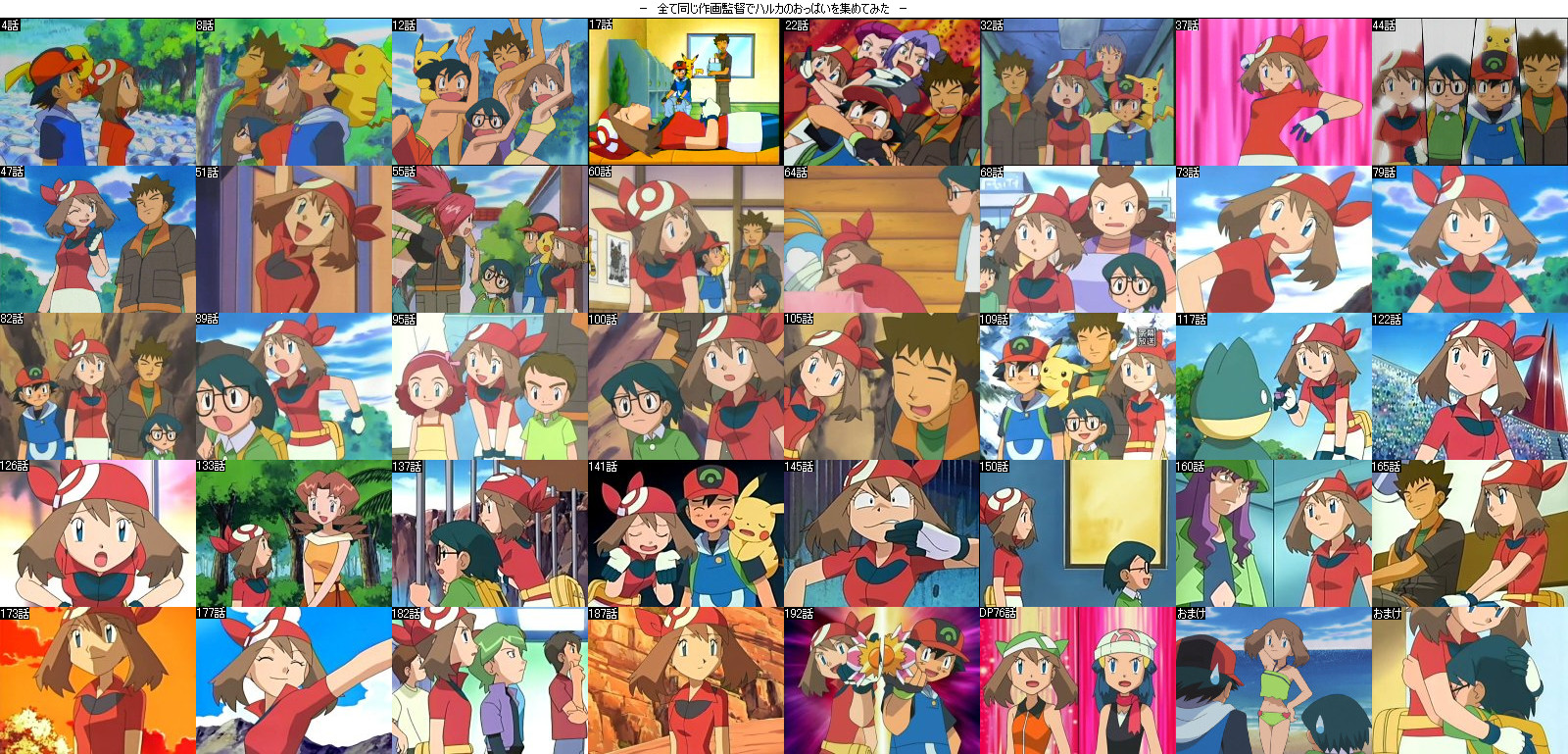 Thanks to kransom for finding this.
What in the world could be responsible for Haruka’s, shall we say, simplification? The easy knee-jerk reaction would be pressure from foreign countries to reduce the amount of eye candy in their internationally famous Japanese franchise cartoon, but something tells me that it has a little more to do with someone realizing that the girl is supposed to be ten years old.
It’s All in the Execution
Marvel vs Capcom 3 successfully captures the look a fighting game about Ryu fighting Captain America targeted towards American audiences wants to have. It’s a grittier style when compared to the one used in Tatsunoko vs Capcom, which makes perfect sense. MvC3‘s aesthetic step in the right direction however reminded me of a similar attempt not so long ago, Mortal Kombat vs DC Universe.
Mortal Kombat vs DC Universe was an aesthetic failure. Just like MvC3, the game looked to bring together two sets of characters by uniting them under a more realistic visual style, but the end product was just a series of awkwardly stiff 3-d models and jerky animations.
 What is going on with that torso?
Worse yet were the Fatalities, that classic trademark of the Mortal Kombat franchise, the violent killing blows which defined the series in the eyes of so many gamers. In MKvsDC, the Fatalities were not only toned down in brutality but also terribly uncreative regardless of the level of violence, especially when compared to the stylish Instant Kills of games like Blazblue.
My goal isn’t to just trash MKvsDC though, and of course I can’t really compare the gameplay to a game that isn’t actually out yet. I just wanted to point out that it’s amazing just how much two different projects came aim for the same basic goal and produce such different results. Marvel vs Capcom 3 is exactly what Mortal Kombat vs DC Universe wanted to be.
For comparison:
A Visual Comparison of Marvel-Style Capcom and Tatsunoko-Style Capcom
When the preliminary screenshots for Marvel vs Capcom 3 were revealed, the way the Capcom characters were portrayed really caught my eye.
Now it wasn’t too long ago that the similarly themed Tatsunoko vs Capcom saw the light of day. Both it and MvC3 portray Capcom characters using 3-D models, but you might see a notable difference between the two games.


Ryu here, despite being in two very similar games, turns out looking quite different. Against the anime characters of Tatsunoko he too looks closer to an anime character, but against the American-friendly grittiness of Wolverine and other Marvel characters, he too becomes almost equally gritty. His design is being adapted differently in order to better match with the types of opponents he’s facing.
In any crossover but especially in video games, visual consistency is important. If the characters do not look like they belong together, then it becomes extremely jarring. The Capcom vs SNK series suffered from this, as the old Alpha sprites of the Capcom characters clashed with the newly designed sprites for the SNK characters. As an opposite example however, Sakurai Masahiro purposely added realistic touches to all of the characters the later Super Smash Bros. games in order to minimize the visual discrepancies between them, so that someone like the relatively realistic Samus Aran matches up with the more cartoonish Mario. If you look at Mario actually, he has much more detailed textures on his overalls than in any other game he’s in.
One last thing that I find interesting is that the old VS games (most notably Marvel vs Capcom 2) actually leaned in the opposite direction of MvC3 by having the Marvel characters designed to better match the anime-style Street Fighter characters used at that time. Either way though, the message seems to remain the same: MUGEN is really ugly.
 OGIUE MANIAX