The Skill Mezzanine

Over the past few years, there has been an upswing in video games geared for competition (or at least modified to be competitive). Starcraft 2, Street Fighter IV, the new Mortal Kombat, the concept of “eSports” is managing to achieve more success around the world than had been seen previously, with the notable exception of South Korea where Starcraft competition already managed to achieve a good deal of competitive success.

Many of these new games are sequels, and they emerge in a gaming environment far different from their predecessors. In some cases, as with Starcraft and Marvel vs. Capcom, it’s been over a decade since their most immediate ancestors. Online play has filled the long void that was left by the death of arcades. Facebook games and other bits of entertainment which fall under the heading of “casual” have made video games a common part of many people’s lives. There are now more people playing video games than in previous decades, but many of them do not devote themselves to games, particularly ones that foster competition. One of the results of this has been a move towards easier controls, reducing the number of things to do, simplifying actions, increasing the influence of random chance, and just making games where people can more easily feel like they’re accomplishing something.

In doing so however, there is a backlash created among those communities, because what this means is that, compared to those older games, they seem a little…softer. More forgiving. This in turn can be interpreted as an affront to the competitive spirit, especially for those games which dare to call themselves competitive, because it is giving a break to the weaker players. Many times, criticism will come in the form of questioning a game’s “skill ceiling.” The argument goes that if a game is less demanding on a fundamental level, it will result in a game where the best of the best will be unable to distinguish themselves from the masses more commonly known as “the rest.” Certainly this scenario is not out of the question, but what I’d argue is that those critical of these games’ skill ceilings often misuse the term and that they’re arguing against something quite different. For if the “skill ceiling” is the absolute limits of competitive skill, and the “skill floor” is the bare minimum to even understanding the game, then what those people are really arguing against is the lowering of a kind of “skill mezzanine,” the first space up from the skill floor and the minimum amount of skill needed to compete and win matches against others who are also trying to do the same.

“One guy was clearly making more mistakes than the other but he still won. This game is awful.” Putting aside the fact that weaker competitors are often capable of beating stronger ones simply because of how “skill” is nebulous and but one of many factors in competition (mental state being an arguably more important one), such an argument can be summarized by the idea that the game is too forgiving of mistakes, and that because a weaker player is more prone to errors, it rewards them unfairly. But a game that punishes mistakes less is not the sign of a lowered skill ceiling so much as it is evidence of a lowered skill mezzanine, and this is because even if the best players are the ones who are closest to touching the ceiling, the players worse than them do not have to aim for that ceiling as well. Their goal could simply be to touch the feet of those better players, and a more forgiving game means that they can accomplish such a task more easily, no matter how high the ceiling may be.

The higher the skill mezzanine however, the tougher it is for people to reach basic competitive competency, which has the effect of weeding out less devoted players. What remains, if numbers are sufficient (and there is always the danger of that not happening for a game), is that the only people left are the ones who have been able to overcome some very unforgiving limitations.

One of the consequences of mistaking the skill mezzanine for the skill ceiling is that people conflate the concept of game limitations that were overcome through skill with the idea that game limitations necessarily generate skill. Veteran Starcraft competitor and commentator Sean “Day 9” Plott often emphasizes that imposing restrictions can be a useful method for improving one’s gameplay. In that sense, the rules of a particular game can be seen as a forced limitation rather than a self-imposed one. But it is also a mistake to believe that those specific limitations should be the standard by which all other games are judged, to confuse the concept of limitation with the particulars of execution. Soccer is the most popular sport in the world, and is praised for the amount of mental and physical skill required to play it at a high level. One of the most basic rules, the one that gives soccer its internationally more popular name of “football,” is that a player is normally not allowed to touch the ball with their hands. This simple yet profound limitation (hands being vitally important to the survival of humankind) encouraged people to find ways to move the ball with the rest of their body, and as the game has developed over the course of generations, soccer players discover new methods and refine them. But one cannot say that, because soccer developed into “the beautiful game” in part due to the limitations on hands, that all other ball sports should also ban the use of hands.

There is nothing inherently wrong with criticizing a game’s capacity for competition, because there are games that are objectively more competitive than others. Chess is far more complex than tic-tac-toe. One game can indeed have a lower skill ceiling than the other. But I think it is important for people critical of a game’s skill ceiling to be able to distinguish between it and the skill mezzanine in order to discuss a game’s competitiveness.

Showdown! At! The Internet! Pokemon Battling Nostalgia Ramblings

I’ve recently been talking to an old friend in the competitive Pokemon community, and I was surprised to find out that he and other people I knew from back in the day were still playing competitively. In fact, a bunch of them are going to the Pokemon Video Game Championships this year in Indiana, and though I definitely can’t make it, it’s kind of re-lit the fire in me to do something with Pokemon, especially when I’ve seen what he’s been up to.

Known in the Pokemon communiy as Fish, his team is the one on top, if you want to see some intense and exciting turn-based combat.

At the very least, I want to have a well-conceived team or two around in case anyone wants to battle me. I don’t know how long it’ll take me, especially because I haven’t even opened my copy of Pokemon Black yet, but I think it’ll be a worthwhile endeavor.

I definitely want to use Durant, as I’ve been waiting for an ant Pokemon since the original games.

Thinking back on my years of playing Pokemon, I began to reminisce about the original RBY era and its competitive scene. I talked a little bit about RBY-style battling here, but I’m not sure if my description did it justice in terms of how unique RBY battling turned out to be, relative to subsequent generations of Pokemon. RBY was the era where the only way to cure a status ailment was through the use of Rest, when every Pokemon could have all of its stats maxed out to their personal best. The result was a game where Pokemon were neither overly frail nor excessively defensive.

The best example I can think of is a scenario where one player is switching in a weakened Rhydon on a weakened, paralyzed Alakazam. Alakazam could have predicted a switch and thrown out a Thunder Wave to paralyze the incoming Pokemon, but because Rhydon is immune to electric attacks, it can effectively block the Thunder Wave and avoid its paralyzing effects. From there, a fight which would normally be won by Alakazam’s superior speed and nasty Psychic attack has a different consequence, as paralysis reduces Alakazam’s speed by 75%, well below Rhydon’s, and so now Rhydon has the first shot, and its superior attack does tremendous damage to Alakazam’s poor defenses, possibly to the point of knocking it out. But if Alakazam decides to switch out, Rhydon can throw down a Substitute for 1/4 of its health to take damage for it while it Earthquakes from a safe position. The permanency of paralysis is key here, as in later generations status ailments can simply be whisked away by the effects of moves such as Heal Bell and Aromatherapy.

RBY was by no means a balanced game in terms of diversity. Only about 10-15 Pokemon were considered viable for competition (barring Mewtwo and Mew, who were usually banned due to being way, way, way too good), but it had a certain kind of intensity that wasn’t quite present in later games, and it’s something I wouldn’t mind coming back, though I know it’ll never happen.

When people lament changes in sequels despite the fact that the original game’s system was the result of various limitations and oversights, I can relate to knowing that something is unreasonable and yet still feeling that it’s right. I’m not going to talk down the other generations of Pokemon Battling, though. There’s always a special place in my heart for that original 151, but I still look forward to having fun with a list that is now 646 creatures long.

A Problem-Free Philosophy

If someone asks me who I prefer to use in Street Fighter, at first I tell them, “Don’t worry about it. Really.”

But if they insist, I just say to them, “Akuma, Makoto.”

Super Smash Bros. and Non-Traditional Fighting Games

Whenever the Smash Bros. community interacts with other fighting game communities, it inevitably leads to comments that Smash Bros. is not a fighting game. More often than not, these comments are trolls meant to rile Smash fans and belittle the games they’ve spent so much time on, but I’ve also seen people argue this point in earnest, and I want to discuss some of the points that tend to get brought up, if only to make people aware that the category of “fighting game” isn’t all that sacred.

The first assertion that gets thrown out is that the Smash Bros. series is simply not good enough to be considered a fighting game. Either it’s too simplistic or it doesn’t reward competition enough, and so fails to qualify for the fighting game pantheon. But since when has competitive viability and depth of gameplay actually defined fighting games? For every fighting game that is remotely competitive, I can name twice as many that fall apart under scrutiny and are just plain bad. So why is it that a game like Rise of the Robots is allowed to be called a fighting game, while something like Smash Bros. isn’t?

The second assertion is that Smash Bros. does not qualify for the genre because it does not fulfill supposedly “fundamental” aspects of fighting games. Over the years, I’ve seen people say everything from the fact that the game doesn’t have traditional life bars to the fact that it’s four-player to the fact that items exist in the game to the presence of stage hazards. More recently, people have been saying that it’s not a fighting game, but rather a “party game,” a “platformer,” a “beat-em-up,” or any combination of those categories.

But in bringing up those genres, it must be said that there are fighting games that fall under those categories that aren’t Smash Bros. As I show examples of each, keep in mind that I am not defining the fighting game genre based on how “good” the games are, and you shouldn’t either. “Balance” is a non-issue here.

———

Fighting Vipers

Non-Traditional Life Bars

Fighting Vipers has kids dressed in armor beating each other up in a closed arena. The game has life bars, but it also has an armor system wherein shattering pieces of armor makes the opponent more vulnerable to attacks. You can see it in action at 00:52.

World Heroes 2

Non-Traditional Life Bars/Stage Hazards

A game where warriors from throughout history engage in 1-on-1 combat, while the regular gameplay in World Heroes 2 is about as conventional as it gets, there is also a special “Death Match” mode. Rather than having two distinct life bars, one large bar is shared by both players in a sort of tug-of-war battle. Also note the buzz saws and electrified ropes.

Aggressors of Dark Kombat

Beat-em-up

Aggressors of Dark Kombat actually features gameplay where characters can move up and down the stage field, reminiscent of Final Fight or Double Dragon. It is literally a beat-em-up fighting game. The female character, Kisarah Westfield, made her return in Neo-Geo Battle Coliseum.

King of the Monsters

Beat-em-up/Items/Stage Hazards

King of the Monsters also possibly qualifies for the “wrestling game” genre, and as a result, also possibly the “Non-Traditional Life Bar” because of how you need to win by pinning. Incidentally, a lot of the beat-em-up fighting games are made by SNK, though this is the only one featuring giant monsters destroying a city in the process.

The Outfoxies

Platformer/Items/Stage Hazards

Featuring assassins trying to kill each other with swords, guns, and bazookas, The Outfoxies is probably the game closest to Smash Bros. in feel and style, especially in the platformer-esque gameplay. By the way, there actually exists an Outfoxies tournament, and the game can get pretty amazing. Again though, that doesn’t really matter.

Power Stone 2

Platformer/Beat-em-up/4-Player/Items/Stage Hazards

Power Stone 2 is probably the example that best features almost all of the “not really a fighting game” categories in an actual fighting game. Like so many games in the genre, it features warriors from around the world.

———

So there we go. If you don’t consider the above examples to be fighting games either, then there really isn’t anything I can say.

By the way, I’d better not seeing any Melee vs. Brawl in the comments.

A Nerd of Circumstances, and Better for It

As I get set to return to the United States this month, almost a year since I left, I remember my birthday, where I received a copy of Anne of Green Gables. After that, I never managed to read the whole way through, which is something I’m trying to correct now, but rather than feeling any sort of guilt over not reading it all, it makes me reflect on how my habits have changed from being in a different environment.

In New York, I have the most convenient reason in the world to read a ton: the subway. Commuting to Manhattan takes up a good half-hour to an hour (or more) depending on where you come from, and it’s the perfect opportunity to catch up on manga, to read a novel, to draw, and in my younger days, to do homework. Had I still been living in New York City, I know that I would’ve definitely finished Anne of Green Gables. Same thing with my Pokemon games. I’m a long-time fan of the series, but I haven’t even touched my copy of Pokemon Black yet because of how I never finished Heart Gold, and I refuse to leave a Pokemon game unbeaten. This would’ve been a lot quicker if I had that hour or so to and from Manhattan every day, but alas.

So I ask myself a question, “What do you think of your interests when they can be swayed so easily by circumstance?” To that, I answer myself with “Who the hell is keeping count? I’m the person I always was!” Yes, I’ve taken on certain hobbies and pursued them in ways that are in line with where I was living and where I came from. In New York, I have Japanese bookstores to fuel my collection and a commute to utilize them. In Japan, due to the distances of things, I rode my bike extensively and I watched anime on TV. Here in the Netherlands, I’ve got super-powered internet and a short walk to work. Had I grown up in a mountainous region, maybe I would’ve developed a fondness for rock-climbing. All I know is that these things influence how I function as a person and as a passionate fan of media, and I’m fine with that.

A good analogy for how I’m feeling might be how manga has developed as a black and white comics medium. Manga was originally printed in black and white out of necessity. It’s cheaper than full color and thus easier to mass-produce. From that practical limitation, manga grew out, with artists figuring out ways to best utilize their monochrome palette, including strong usages of negative space and creative application of screentones. Yes, if they had the money to afford full color back then, none of this might have ever happened. But it did, and even if manga were to change to full color now, we at least have that background and history to show us that path

Circumstances exist, but what we make of them is part of what makes life wonderful.

And Then He Bunker Rushed Shabranigdo

(Don’t worry, this is from last season so it isn’t a spoiler.)

Sonya Blade is an Awful Character

With the recent release of Mortal Kombat 9, a lot of beloved figures in the Mortal Kombat franchise have been re-designed to look both modern and reminiscent of their very 90s character designs in an effort to bring the series back to its old school roots. Remembering that Sonya Blade’s design was absolutely awful in the previous game, Mortal Kombat vs. DC Universe, sporting the most ridiculous shirt ever, I wondered how they would portray her in this iteration. While the new design is an improvement, it makes me realize that Sonya is actually just a terribly-designed character.

Here is Sonya throughout her 3-D fighting game history, away from the live actor portrayals that characterized Mortal Kombats 1 through 3. If you did not tell me that they were all supposed to be the same character, I simply would not be able to tell. Nothing is consistent about her, short of the fact that she’s blonde, has big tits, and shows an exposed midriff. Sonya Blade is a terrible design because she is a non-design.

While she could be criticized for having an over-sized, unrealistic chest and ridiculously skimpy outfits, that’s not really the point here, as the scantily clad and jiggling girls of Dead or Alive share those properties in spades and yet are still distinctive even when they’re wearing 1 cm-thick bikinis and taken out of a relative comparison with each other. Nor is the problem that her design is too generic, as the Virtua Fighter series is all about cookie-cutter characters, and yet whether it’s the blocky and outdated graphics of Virtua Fighter 1 or the more recent Virtua Fighter 5, Sarah Bryant, a fellow fighting blonde, is still recognizable. Chun-Li can appear in Street Fighter Alpha younger and sporting a different outfit and still look like Chun-Li, and she also successfully made the transition to 3-D with her very iconic look and style.

On a broader scale, video game characters rely on a certain degree of iconic visualization, and though this is more easily done with a mascot like Mario or Sonic, it’s still possible with a more realistic figure. Sub-Zero and Scorpion show this, despite the fact that they both started out literally as the same character design with different colors. it’s clear that Sonya simply never had anything beyond her rack and her belly button to distinguish her. Back in Mortal Kombat 1, when she was the only female character, this arguably could have been sufficient, but as more and more girls have appeared in the franchise over time, also with large breasts and bare midsections, it really makes it obvious that she wasn’t thought through thoroughly.

For a further comparison, take a look at this image Sophitia Alexandra from the Soul Calibur series which I conveniently obtained from elsewhere. Although her design has gone off the deep-end in recent games, it’s very clear that all of the above figures are supposed to be the same person, even when drawn by different artists. If I were to make an educated guess as to what makes Sophitia work but not Sonya, I’d say that it has to do with the fact that Sophitia was designed in the first place with certain key visual elements like her sword and shield, skirt, and gentle demeanor, and even when next to her somewhat similar sister Cassandra, you can still tell the two apart by how their designs convey their personalities. It can be as simple as that, so that when they’re given makeovers in later games, a person can take one look without being told specifically who it is and say, “Aha, that’s her! …She looks terrible!”

Anime 2011: Armored Hotel Almelo

This past Saturday I found myself on the train heading towards the eastern part of the Netherlands, stopping just a few miles away from the German border. It was my actually my first time that far out east, but I wasn’t there to sight-see, I was there to attend an anime con. And not just any anime con, but Anime!

Living in a new and unfamiliar country, I had decided months ago that I would use my current situation as an opportunity to get an idea of anime fandom outside of the United States and Japan. I had previously attended Tsunacon, a relatively small one-day event held in Sliedrecht (but moving to Rotterdam starting next year), but Anime 2011 was my first time at a full-out 3-day Dutch anime convention. Though I was only able to attend Saturday, I still felt a strong sense of love for anime, manga, and video games.

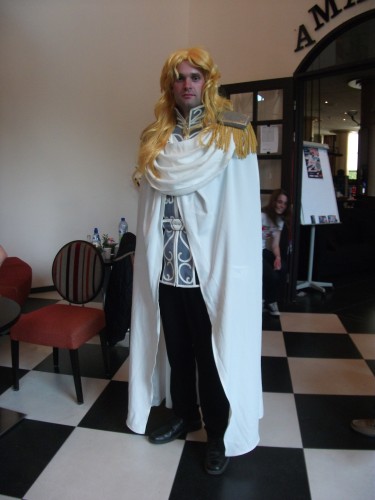
Arriving in Almelo after a nearly three-hour trip, it was a short and pleasant walk through an open-air market to Theaterhotel Almelo, called so because it actually features a theater room capable of seating hundreds, something which makes Theaterhotel Almelo a good fit for an anime convention. Benefitting tremendously from gorgeous, 80-degree weather (that’s about 27 degrees Celsius), the spacious front area of the hotel acted as a nice spot for attendees to relax, pose for photos, and take a smoke break.

At three stories tall, and a restricted maximum attendance of 2500, Anime 2011 at Theaterhotel Almelo was not quite as large as the American conventions I’m used to, with Otakon boasting over 30,000 attendees last year, the fact that it was held in a hotel made it comfortably familiar to me, as it reminded me of my early convention experiences. Though, the fact that Anime con is actually only one of three anime conventions total in the Netherlands, and considered large for a Dutch con, should give readers an of the sheer difference in scale. In fact, in the Dealers’ Room, I had struck up a brief conversation with a Dutch attendee about precisely this topic. In a way, it made Otakon and Anime Expo sound downright legendary.

Speaking of the Dealer’s Room, I heard a familiar sound there, that of the loud exclamation of “Yaoi” and how it is probably fresh and hot and available here. Was that something which this con shared with the American ones? Was it actually universal?

Not quite, it was actually doujinshi seller Hendane’s Netherlands debut. He had heard about Anime 2011 from his time in a Dealer’s Room in Denmark. Asking him what sold well here, he said it’s pretty much the same everywhere, though what varies is the amount of disposable income that the young fans have. In Denmark, they’re apparently loaded. In the Netherlands, that is significantly less the case. The guy was doing his best to push Touhou, though I get the feeling that it hasn’t quite made its mark on the fandom here, even if I did photograph a Cirno cosplayer at Tsunacon.

Going around the rest of the dealer’s room, I also asked a few of the vendor what sold best for them. The most consistent answer was Lucky Star, which I find interesting for a number of reasons, most of them having to do with the age of that show. While certainly not old, in terms of anime fan memory it’s quite a few years in, and to see it maintain some kind of longevity was a pleasant surprise. One vendor also said that One Piece sold very well for them, which was also somewhat unexpected. Was there something about Oda’s title that gave it relatively more otaku clout here than in the US?

Just like Tsunacon, the Artist’s Alley and Dealer’s Room were one and the same, and so before I left I decided to pick up a fan-made magazine. And as I said last time, the artists at the con seem to showcase their output primarily in comics form, as opposed to individual illustrations (though those were still available). In a way, it reminded me of Japanese doujin events, and it’s actually something I kind of prefer over the US Artist’s Alleys.

Having missed out on the AMV competition last time, I made an effort to go check it out here, though by the time I got to the aforementioned large theater where it was being held, it was already full and I could not stay long. The AMV competition was sponsored by Archonia, the largest distributor of anime goods in Europe, which makes them a very familiar name to those living in Europe but probably unknown outside of it. They were actually in the Dealer’s Room. Before I left, I got a glimpse of an AMV featuring Naga the White Serpent from Slayers to the tune of Lady Gaga’s “Poker Face.” Makes sense to me.

Around this time, I was feeling the need to take a break, and noticed that Anime 2011 had its very own maid cafe. Normally, I’m not big on maid cafes, but I saw one thing and I had to go: the maids were actually taking orders or serving food. Now that might not sound like a big deal, but let’s put it into perspective a little. New York Anime Festival has touted their own “maid cafe” for a few years now, except that the Jacob Javits Center in which the NYAF takes place has its own unique rules, namely that non-union workers cannot handle food. In other words, the only thing the “maids” are good for at NYAF is posing for photos, which is not to detract from their efforts in entertaining con-goers, but it’s just not quite the same. Seeing that these girls at Anime 2011 had no odd rules to deal with, and also seeing that their menu consisted of a combination of Japanese snacks and Dutch treats, I decided to sit down to some waffle and bitter lemon soft drink. As I looked around, I noticed that the customers were pretty even in terms of gender diversity.

Given the size limitations of the hotel, the convention could not have very many panels and workshops, though there were still a decent number. Of the activities at Anime 2011 though, only one of them resembled the kind of fan panel you would typically see at an American convention. Titled simply “Your Anime Sucks,” it was a guy at the front of the room doing his best to lightheartedly rag on any title you gave him. To keep it easy on everyone, primarily mainstream titles were preferred (and silly me, I thought Akagi was a mainstream title. Whoops!). Interestingly, the guy made an explicit point of using English instead of Dutch, because of the fact that he found Dutch as a language ill-equipped for the task at hand, whether it meant a lack of sufficient wordplay or just not enough derogatory phrases in the language. The guy put in a good effort, and if I had any suggestion to make to him, it is that he doesn’t dive deeply enough into the fabric of the shows to tear them apart. That, and his criticism of the Fate/Stay Night anime didn’t involve mentioning the CG dragon inside Saber’s vagina at all.

Possibly the most impressive part of this convention was its Game Room. Filled with Japanese-style sit-down arcade machines, obscure items like Evangelion pachinko and a Vectrex, all of the newest titles and consoles, and of course Dance Dance Revolution, Anime 2011’s Game Room was good enough for a con ten times its size. Wandering around, I heard an oddly familiar song, which turned out to be the Futari wa Precure opening coming out of a Taiko no Tatsujin game, and it took me back to when I was in Japan, playing that very same song on a machine in Akihabara. It made me reflect a little on how lucky I’ve been to live in so many different places in the world.

Another good feature of this game room was the fact that it was right next to the outdoors, which meant that fresh air was coming into it the whole time. If there is a cure for Game Room funk at conventions, it is actual air circulation.

I tried my hand at a little Super Smash Bros. Brawl where I was clearly rusty, moving on to an unusual Sega wrestling game, and then a couple of fighting games, where I got frustrated by the fact that I was unable to defeat the CPU Sol Badguy in Guilty Gear X. It also reminded me that I simply never got used to arcade sticks.

The last event of the evening was the concert with the convention’s guests of honor, the electronic band Aural Vampire. Sadly, I had a train to catch so I couldn’t stay for the whole concert but I actually enjoyed their music more than I thought I would. Comprised of gothic vocalist Exo-Chika and masked DJ Raveman (who I hear from good sources plays the blazin’ beat), their performance was fun and engaging, and I’d like to see them again, either here in the Netherlands or perhaps even in the United States. Photography was not allowed though, so you’ll have to settle for this picture of Clara the cow, one of two convention mascots. Its owner, not pictured here (but pictured on the official site), is a magical farm-girl named Marieke.

Overall, Anime 2011 was a different experience from both Tsunacon and the American conventions I’m used to, but still familiar enough that I could really feel that anime con atmosphere. If I have any regrets from the convention, they have to do with some necessary concessions on my part. As mentioned in the beginning, it’s a hotel con but I could only stay for one day, and I know from experience that having a convention involve commuting gives it a different impression. In that sense, I probably did not experience the true Anime 2011, especially because I could not be around for one of their signature events, the “Ecchimated Music Video” competition, i.e. an 18+ AMVs contest, which is something totally non-existent in the US as far as I know. I also could not convince anyone I knew to go to the convention with me, so it ended up being a solitary affair. Again, while still fun, conventions are made better by friends. Maybe next time I’ll go, I’ll be able to trick someone into attending as well.
Who is the Daytona USA announcer’s favorite philosopher?

Roland Barthes

Vistas: Streaming for Profit – Crunchyroll vs. GOMtv.net

I’ve got a new post over at the Vistas blog, this time about the differences in paid services provided by two different streaming sites with two different ideas of what its users should pay for, Crunchyroll and GOMtv.net. Feel free to comment either there or right here on Ogiue Maniax.