King K. Rool for Super Smash Bros.

smashbros-kingkroolmoves-revised-small

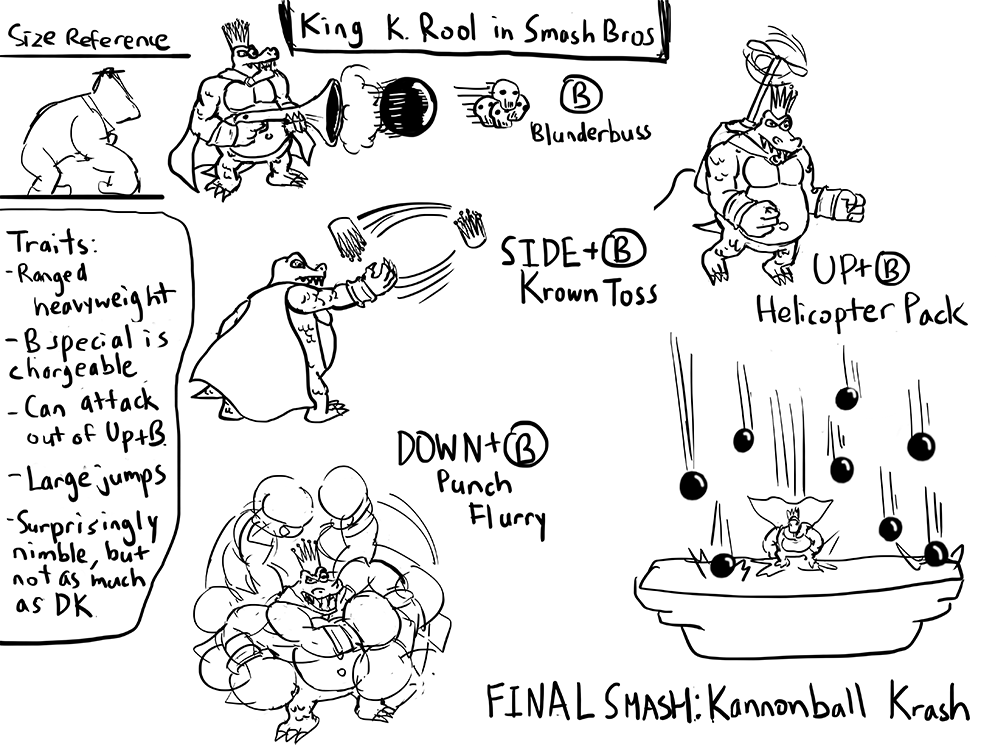
This is how I imagine King K. Rool (from the Donkey Kong Country series) would be if he were in Super Smash Bros. I’ve got at least a couple more of these on the way, so if readers are interested then they’ll have more to look forward to.

For King K. Rool, I made it so that each of his special moves references a different game in the Donkey Kong games produced by Rare, so Krown Toss = DKC, Blunderbuss = DKC2, Helicopter Pack = DKC3, and Punch Flurry = DK64. I’ve seen lots of other people come up with similar ideas, but what can I say? It makes complete sense.

While King K. Rool is much larger than Donkey Kong in a lot of the games, I wanted to make them roughly equal in size so that it comes across as more of a rivalry between two powerhouses, as opposed to the David vs. Goliath feeling of Mario vs. DK or Mario vs. Bowser. K. Rool is not quite as strong or as quick as DK, and his movements are a bit awkward, but makes up for it with some nice ranged attacks.

Krown Toss is for space control and bits of damage, while the Blunderbuss is for KO power. The longer you charge the Blunderbuss, the more (randomized) projectiles it shoots out. Helicopter Pack is highly controllable but very slow and thus an easy target for edgeguarding, while Punch Flurry is good for clearing crowds but exhausts K. Rool afterwards. He doesn’t actually punch all that much in DK64 but I figured having yet another ground pound character would be overdoing it.

His Final Smash is based on the giant leaps he takes in DKC; I imagine it being fairly similar to PK Starstorm only that K. Rool himself is also a “projectile” in this case. Of course, he would have his running attack from the first DKC.

My Dream Smash 4 Tournament Scenario

(Note: I originally posted this to reddit Smash Bros, and am putting it on the blog for posterity.)

The game has been out for over a year. During this time, it’s widely accepted by the community that Pac-Man is bottom tier. Try as people might, no one can seem to do anything with him.

EVO 2016 rolls around and it’s by far the biggest Smash tournament ever for any game in the franchise. All of the big names are there, but one by one they fall to a mysterious masked challenger who, unbelievably, is 4-stocking everyone with Pac-Man. Strangely, he appears to be much older than the average demographic for Smash.

Upon reaching the finals, the man removes his mask and reveals himself to be Billy Mitchell. Somehow, the skills that made him the first person to ever beat the Pac-Man arcade game have translated to Smash 4 almost perfectly. At this point, people are discussing if everything they knew about the game was wrong.

However, there’s another unidentified challenger in a hoodie who, while falling to the lower bracket early on, has been tearing it up. In the finals, he also reveals his true identity: Steve Wiebe.

Upon sitting down, they both set aside their mains and go straight for what counts the most for their pride: Donkey Kong mirror match. Gamers young and old start to watch. Just after the first set, people are declaring it the greatest finals ever in any competitive game, let alone Smash.

At EVO are both the crew for a new The Smash Brothers documentary, and the director of The King of Kong. The next day, they announce their collaboration for a sequel to The King of Kong in the Smash realm. The film is released internationally and is so successful, it turns the esports documentary into the most popular genre ever.

A Couple of Cool Things About Mega Man’s Final Smash

Yesterday was the Super Smash Bros. for Wii U Invitational Tournament, and during it we got to see Mega Man’s Final Smash in full. Previously, it had already been revealed that it was a combined blast from five different iterations of the Blue Bomber, but what we didn’t see is that the set up for the attack is actually the Black Hole Bomb from Mega Man 9.

I love this, because while Mega Man’s moveset in the new Smash Bros. is basically an elaborate homage to all of the games of the classic series, it was conspicuously missing attacks from the most recent retro-style games. With the Black Hole Bomb, this has been remedied. Mega Man 10 is still missing, but at least we got one step closer.

It also makes a kind of weird science fiction-esque sense that Mega Men from multiple universes and timelines would converge inside of a black hole.

As a side note, seeing Hungrybox get a kill with Kirby’s up-throw in yesterday’s final brought joy to my heart, as it means that throws have killing power at relatively decent percentages again without having to factor in elaborate follow-ups, something that’s been missing since the original Super Smash Bros. unless you count some of Mewtwo’s and Ness’s throws in Melee.

P.S. Where is Mewtwo. WHERE IS MEWTWO.


Diving Straight Into Your Heart

nicoknee-cropped-small

Are You as Excited as I am About Mega Man in Smash Bros?

Nintendo just revealed the new Super Smash Bros. today at E3, and the Villager from Animal Crossing as well as Mega Man have been confirmed as characters.

Next to NiGHTS, Mega Man was my #1 wish for Smash Bros. (and putting in a character more flight-themed than even Pit is a tall order), so I am super, super hyped. Sure, the Sonic reveal from Brawl was cool in that we got to see that console rivalry materialize in a way which was not some game about the Olympics, but Mega Man is a bigger deal to me.

We know nothing about the balance or the depth of the game outside of the fact that it seems to not be wildly different from its predecessors, so obviously this isn’t based on how great the new Smash Bros. is. Rather, it’s because Mega Man as a series is very precious to me, a piece of my childhood.

While NiGHTS into dreams… and Pokemon taught me all about being a part of a fandom, I think it was actually Mega Man which first taught me how to be a fan. By providing an exciting world with a clear template for personal input, the Robot Masters, the series allowed me to exercise my creative imagination as young as the age of 4. I still remember Cockroach Man and Glue Man to this day.

There’s a bit of information about his moveset from the trailer: He has his slide, Charge Shot, and Rush Coil, as well as the ability to access moves from a variety of Robot Masters from his own franchise. Exactly ow many weapons are available is unclear, but it looks to be quite a bit more than, say, his entry into Marvel vs. Capcom 2. Even if we didn’t know that, however, there’s something about Mega Man which makes him easy to imagine in Smash Bros., even more than in his other fighting game appearances. The run speed, the jump height, the various interactions of his attacks, it all makes sense. Perhaps the only disappointing thing is that he can’t absorb other characters’ powers it seems, so no Mega Kirby vs. Kirby Man.

I don’t have a Wii U or a 3DS yet, but this may be my incentive. Well, that and Pokemon X/Y.

Super Smash Bros. and Non-Traditional Fighting Games

Whenever the Smash Bros. community interacts with other fighting game communities, it inevitably leads to comments that Smash Bros. is not a fighting game. More often than not, these comments are trolls meant to rile Smash fans and belittle the games they’ve spent so much time on, but I’ve also seen people argue this point in earnest, and I want to discuss some of the points that tend to get brought up, if only to make people aware that the category of “fighting game” isn’t all that sacred.

The first assertion that gets thrown out is that the Smash Bros. series is simply not good enough to be considered a fighting game. Either it’s too simplistic or it doesn’t reward competition enough, and so fails to qualify for the fighting game pantheon. But since when has competitive viability and depth of gameplay actually defined fighting games? For every fighting game that is remotely competitive, I can name twice as many that fall apart under scrutiny and are just plain bad. So why is it that a game like Rise of the Robots is allowed to be called a fighting game, while something like Smash Bros. isn’t?

The second assertion is that Smash Bros. does not qualify for the genre because it does not fulfill supposedly “fundamental” aspects of fighting games. Over the years, I’ve seen people say everything from the fact that the game doesn’t have traditional life bars to the fact that it’s four-player to the fact that items exist in the game to the presence of stage hazards. More recently, people have been saying that it’s not a fighting game, but rather a “party game,” a “platformer,” a “beat-em-up,” or any combination of those categories.

But in bringing up those genres, it must be said that there are fighting games that fall under those categories that aren’t Smash Bros. As I show examples of each, keep in mind that I am not defining the fighting game genre based on how “good” the games are, and you shouldn’t either. “Balance” is a non-issue here.

———

Fighting Vipers

Non-Traditional Life Bars

Fighting Vipers has kids dressed in armor beating each other up in a closed arena. The game has life bars, but it also has an armor system wherein shattering pieces of armor makes the opponent more vulnerable to attacks. You can see it in action at 00:52.

World Heroes 2

Non-Traditional Life Bars/Stage Hazards

A game where warriors from throughout history engage in 1-on-1 combat, while the regular gameplay in World Heroes 2 is about as conventional as it gets, there is also a special “Death Match” mode. Rather than having two distinct life bars, one large bar is shared by both players in a sort of tug-of-war battle. Also note the buzz saws and electrified ropes.

Aggressors of Dark Kombat

Beat-em-up

Aggressors of Dark Kombat actually features gameplay where characters can move up and down the stage field, reminiscent of Final Fight or Double Dragon. It is literally a beat-em-up fighting game. The female character, Kisarah Westfield, made her return in Neo-Geo Battle Coliseum.

King of the Monsters

Beat-em-up/Items/Stage Hazards

King of the Monsters also possibly qualifies for the “wrestling game” genre, and as a result, also possibly the “Non-Traditional Life Bar” because of how you need to win by pinning. Incidentally, a lot of the beat-em-up fighting games are made by SNK, though this is the only one featuring giant monsters destroying a city in the process.

The Outfoxies

Platformer/Items/Stage Hazards

Featuring assassins trying to kill each other with swords, guns, and bazookas, The Outfoxies is probably the game closest to Smash Bros. in feel and style, especially in the platformer-esque gameplay. By the way, there actually exists an Outfoxies tournament, and the game can get pretty amazing. Again though, that doesn’t really matter.

Power Stone 2

Platformer/Beat-em-up/4-Player/Items/Stage Hazards

Power Stone 2 is probably the example that best features almost all of the “not really a fighting game” categories in an actual fighting game. Like so many games in the genre, it features warriors from around the world.

———

So there we go. If you don’t consider the above examples to be fighting games either, then there really isn’t anything I can say.

By the way, I’d better not seeing any Melee vs. Brawl in the comments.

Impatience and Experience and Competitive Gaming Sequels

I am, perhaps by nature, not the most competitive person around. I like to win for sure, and I like to improve my chances of winning when in competition, but I have never had that win-at-all-costs attitude which defines the most successful players in any game or activity. Still, I have spent time in and observing many communities, particularly in the area of video games, and I’ve come to notice a number of trends which all seem to stem from the same fountain of human behavior and irrationality.

When it comes to “professional gaming,” there is no example more prominent than the Korean Starcraft scene. It is by far the most refined and successful example of video game as competition. Finally however, Starcraft 2 is right on the horizon, with a beta version out. I have not had the fortune of playing this game, and in fact I have not played the original Starcraft in well over six years. But as much as I am inexperienced in the scene itself, I am still fascinated by its growth. To that end, I have been listening to podcasts about the SC2 beta, particularly the “Team Liquid Beta Podcast,” recorded by Sean “Day[9]” Plott and his friend Tristan. Sean Plott is a very famous American player who is known not only for his skills behind a keyboard, but his incredibly analytical mind. In episode 3 of the podcast, he addresses an idea which has been floating around, the idea that Starcraft 2 is less suited for competition than its predecessor, and makes too many concessions to neophytes. And it very well might, but as Sean points out, it’s rather curious that people would be so quick to jump to conclusions on a game which isn’t even officially out yet, a prototype which can very well experience drastic changes. Herein lies the logical irrationality I spoke of.

Through the hours of effort put into it by players in Korea as well as in every other country which houses competitive spirit for Starcraft, many discoveries have been made over a decade that have pushed the game to points that would seem unbelievable to fans of the past. It took time and effort and I think everybody who likes this game is likely grateful for a number of these progressions, if not all of them. But the mistake that the players of the beta make here, and it’s a mistake I can point out despite never having played the game, is sheer impatience. The error of reasoning in this situation is the idea that just because the community is so experienced with its predecessor and the process of discovering concepts and techniques to foster and push competition, that the same progress not only could happen in the sequel at an accelerated rate, but that it should happen.

This is not the only time I have seen this impatience in action. For years I was and still am a big fan of the Super Smash Bros. series, and have played every incarnation of the game. I pride myself on being fairly good at Smash, albeit not at the highest levels of competition, but I have a keen understanding of the whole deal.

While the original Nintendo 64 Super Smash Bros. did well enough, it was with its Gamecube sequel, Super Smash Bros. Melee, that a competitive community truly began to form. Like Starcraft, the players, full of desire to win, created and discovered new techniques which pushed the game to unforeseeable levels. And just like Starcraft, when a sequel in the form of Super Smash Bros. Brawl appeared, people were quick to compare it to its predecessor (as one could only expect), and just as quickly pass judgment on it, decrying it as lacking the “advanced techniques” and overall suitability for a competitive game, and making big and bold declarations after the game had only been out mere weeks. Again, the same flawed reasoning appeared. “With all of our experience in Melee, advanced techniques should be getting discovered at a fraction of the time it took originally! We have more people and we don’t have that period where people were just messing around!” In addition, players were quick to establish a set of “tournament rules” at blinding speed, stifling the idea of discovery for discovery’s sake with the desire to simply win at “legitimate” competitive venues.

Why is there such impatience when it comes to competitive sequels? I understand well the idea that a follow-up to a popular competitive game will be compared to the original. It’s all but inevitable. And I also understand that people want to make sure their skills translate from one game to the next. But still, I can’t help but feel that this impatience can only hurt a competitive scene. Discovery happens not only when you cut away the fat, but also when you expand and explore, and such things take time, even if you have years and years of experience.

There is actually a game in which I have devoted myself to competition before, and that is Pokemon. I have played Pokemon more than perhaps any other game series, participating in tournaments and discussions and spending days and nights thinking of possible teams and avenues of victory. And though my main focus is on exploration and discovery and trying to find holes in the “metagame,” I have seen the state of competition as it applies to the Pokemon series, from the early days of Red and Blue all the way up to the recent generation starting with Diamond and Pearl, and two things are always clearly inevitable as the scene transitions from one version of the game to the next. First, we bring with us all of our old ideas about what makes a team strong, and what we predict will be the vanguards of victory and competition. Second, those theories are smashed and obliterated as we realize that, as similar as the games are to each other, subtle differences can have wide-reaching effects in the most unpredictable of ways. And it’s going to happen again and again and again.

There is no specific point at which you can officially decide if a game is worthwhile for competition or not, and it is very possible that initial reactions will be validated. Still, impatience brought on by the “pride of experience” is an incredibly dangerous thing to any competitive scene, and the sooner people realize this, the better.

Easy Doesn’t Mean Boring

After having beaten and reviewed Megaman 10 on its Normal difficulty, today I revisited the game on Easy Mode, playing alongside someone who doesn’t have quite as much experience with the series and so doesn’t quite have the same tolerance for abuse built in. What I discovered was that even for someone who had already finished the game on a more difficult setting, Megaman 10 is still a very fun game and having my mind somewhat at ease (though not entirely of course!) let me more fully appreciate the finer aspects of the gameplay, particularly the controls. It just really reminded me how Megaman is known for good controls despite the titular character’s sub-par leaping abilities.

I think it’s very easy to make the mistake of thinking that the fun of Megaman games is in its challenge when the NES-hard style only plays a partial role in the overall experience. It might be the one you remember the most, but it’s the rest of the game which keeps you coming back.

The fact that easy mode is fun to play with multiple people has gotten me to thinking about other games which have tried to encourage people of varying skill levels to play together without fear of reprisal, be it from those same friends or from the computer. A recent popular example is New Super Mario Bros. Wii, which allows for 4-player simultaneous action and a unique system which allows players to “skip” sections while other players handle a particularly troublesome area should they choose to do so. It’s not perfect, but it keeps things moving along, and you can tell that they put a lot of consideration into this mechanic. A more classic example is introducing luck into a game. With just the right amount, it can make things exciting, and cries of “unfair!” can sometimes just entice those same complainers to play even more. I should know, mahjong can have that effect.

One really good example of a game that fosters play between beginners and experts is the Smash Bros. series. With its 4-player simultaneous action, you can get a lot of people in on it at once. More importantly though, its “Time” setting, which has everyone fight until a preset time limit, allows everyone, win or lose, to play the same amount per match. Contrast this with “Stock,” where once you lose all of your lives you are unable to play anymore. For a new player, this can be very boring as you watch the better players continue to have fun while you just sit there unable to participate in any manner except verbally (or blocking the TV and knocking away controllers if you want your ass kicked).

What’s kind of funny though is that a good deal of people, particularly overly competitive individuals, seem to have trouble understanding this idea of having games and game modes which allow everyone to derive enjoyment in roughly equal portions, as if they don’t comprehend enjoying the game as anything but a bloody battle to the top. While there are games which take the balancing factor too far (recent Mario Kart games are kind of notorious for this), I think overall games can benefit from just having things everyone can enjoy, even if it’s having both COMPETITIVE PRO KOREA MAPS and BIG GAME HUNTERS for Starcraft.

Speaking of competitive gamers and such, it seems like almost every community makes the same mistakes, but I’ll leave that topic for another time.