Zoma for Super Smash Bros.

smashbros-zomamoves-small

Previous Characters:

King K. Rool (Donkey Kong Country)

Princess Daisy (Super Mario Land)

Geno (Super Mario RPG)

Great Puma (NES Pro Wrestling)

Pitfall Harry (Pitfall)

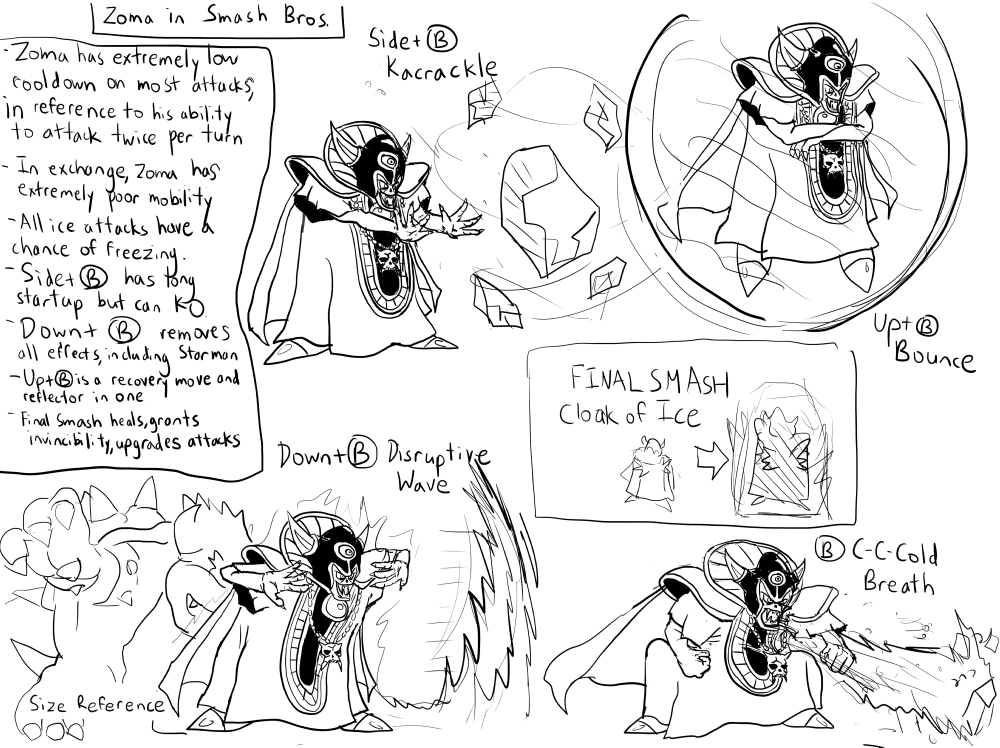
In celebration of Cloud Strife’s reveal as a new Super Smash Bros. for Nintendo 3DS & Wii U character, I have once again been drawing movesets and concept art for how famous icons of video games might work in Smash Bros. This time around, it’s Zoma, the final boss of Dragon Quest III, aka Dragon Warrior III.

Square Enix began as two rival companies, Square (later Squaresoft) and Enix. If Square’s flagship title was Final Fantasy, and its greatest success story Final Fantasy VII, then Enix’s was Dragon Quest, and its crown jewel Dragon Quest III. Having sold over 1 million copies on its first day of release in Japan in 1988, which included many students deciding to cut class just to buy it, it is one of Japan’s most beloved RPGs. Amazingly, once you beat it, you find out that it was in fact a prequel to the very first Dragon Quest, and your player character becomes the legendary hero whose equipment must be collected in the first game.

However, instead of just going with Loto (or Erdrick) as a counterpart to Cloud, I believe it would be more interesting if Enix could be represented by arguably its greatest villain. Zoma, like all Dragon Quest monsters, is drawn by Toriyama Akira of Dragon Ball fame, and strikes an imposing figure. A demon lord who rules over the land of Alefgard, according to Dragon Quest IX he actually went there because he’s extremely popular with other monsters and is trying to get away from his fans. Zoma is shown to be much larger than the heroes, but like Bowser there does not seem to be much consistency with his scale, so I figured he’d best be a large, heavy target similar to other super heavyweights. However, where Zoma differentiates himself from the rest is that his attacks are not only powerful, they’re very quick to recover.

If you’ve fought a character like Mario in Smash 4, you find that he can move very quickly out of key attacks (Up Smash, down air, back air), and that it makes him difficult to punish. Zoma would be similar. While some of his attacks would have long wind-ups, such as his Side-B Kacrackle (the strongest ice spell in Dragon Quest), it is difficult to take advantage of him if he misses, as he can quickly transition into something like a jab or a forward smash. This is meant to reference the fact Zoma is actually able to attack twice in one turn in his source material.

To balance this out, Zoma would have by far the worst mobility in the game, like if you weighed Ganondorf down with bricks. He would have decent jumps in terms of sheer distance, but would be extremely slow in terms of acceleration and max speed. His walk speed would be awful, and he wouldn’t even have a true dash. Instead, he would get a mini-teleport that still has all the restrictions of a dash. Think of him as being somewhat like Slayer in Guilty Gear.

All of Zoma’s attacks come straight from his battles across various games (he’s been a guest boss in a number of titles), and many of them are capable of freezing. C-C-Cold Breath is a super-charged version of the Ice Climbers’ Down B, and Disruptive Wave can remove status changes (both positive and negative) and even stun opponents very briefly. In one-on-one situations you won’t be able to capitalize on it, but it does travel far and is good for shifting momentum back into your favor, especially given once again how difficult Zoma’s moves are to punish. Bounce is a reflector and stage recovery move combined, making it useful for getting past projectile-based edgeguarding attempts, but is otherwise below average for a recovery, traveling far but very slowly. It is also impractical as an on-stage reflector. Kacrackle is both a powerful damage dealer and a way to seal stocks early, but can be difficult to land. At the same time, it can be thrown out similar to Meta Knight’s forward smash as a read in neutral.

Zoma’s Final Smash is a reference to the fact that Zoma originally covers himself with a protective ice barrier in Dragon Quest III that greatly augments his abilities. The only way to remove it is to use the Orb of Light, and seeing as no one has it in Smash Bros., I figured it would be better as a temporary measure.

Perhaps most important of all, Zoma would have all of the signature attack sound effects from Dragon Quest.

So that’s Zoma, one of the most infamous of JRPG villains. If anyone wants to design a Loto as well, by all means be my guest. As for the next character, it’ll be “the one I’m waiting for.”

If you liked this post, consider becoming a sponsor of Ogiue Maniax through Patreon. You can get rewards for higher pledges, including a chance to request topics for the blog.
Pitfall Harry for Super Smash Bros.

smashbros-pitfallharrymoves-small

With the surprise announcement of Cloud Strife in Super Smash Bros. for 3DS & Wii U, as well as the upcoming mysterious December Smash Bros. special report, I felt inspired to start up a new line of Smash character what-ifs. You can see the previous ones I’ve made below.

King K. Rool (Donkey Kong Country)

Princess Daisy (Super Mario Land)

Geno (Super Mario RPG)

Great Puma (NES Pro Wrestling)

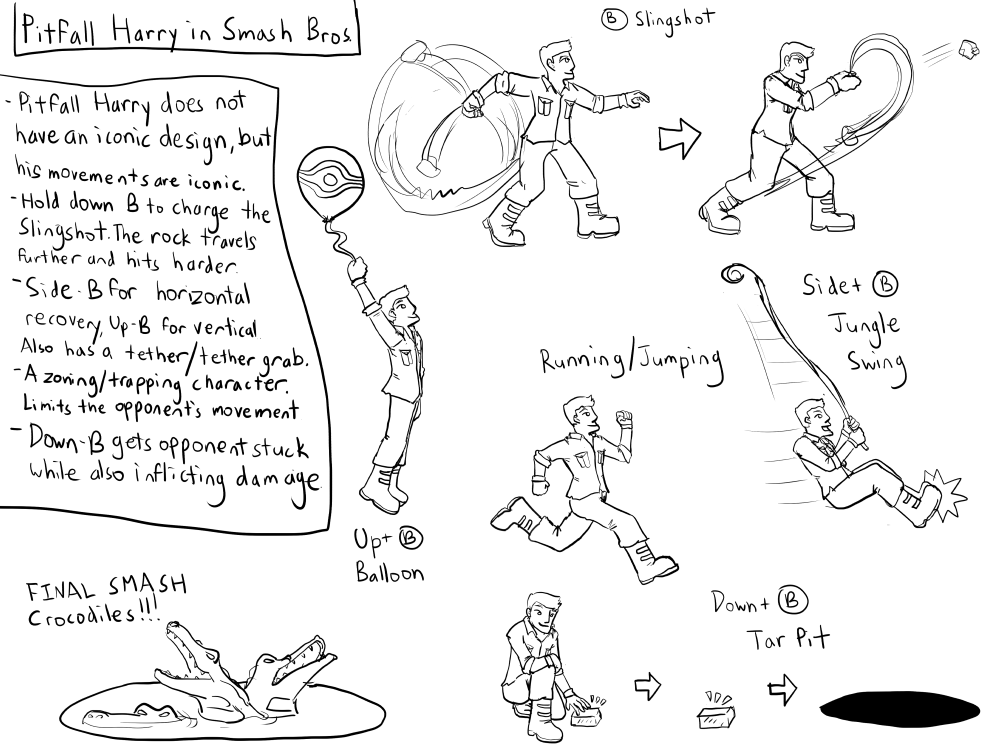
Thinking about how 3rd-party characters in Smash tend to be ones from influential or important games (Cloud), or representative of entire genres (Ryu), I decided to create a moveset and design for Pitfall Harry, the hero of the classic Atari 2600 game Pitfall. If you don’t know who Pitfall Harry is, that’s probably not surprising, as 1) the game is from 1982 and 2) even if you know the game Pitfall Harry doesn’t have much of a presence. After all, this is what he looked like:

4136802-image.num1308669893.of.world-lolo.com

Pitfall is significant in that, to my knowledge, it’s the first horizontal multi-screen platform game, and in terms of its implementation on the Atari it is a technical marvel, like creating boeuf bourguignon out of leather shoes and ketchup. Because of this, I think Pitfall Harry could reasonably have a place in a pantheon of gaming icons, however unlikely.

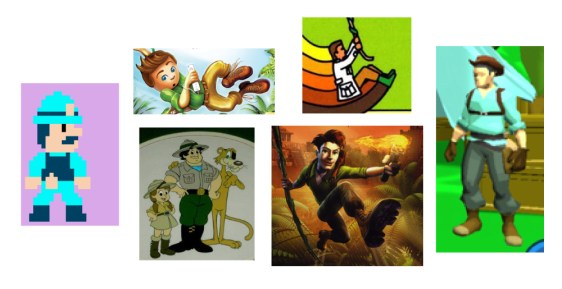
However, the first challenge that presented itself is the fact that Pitfall Harry has no consistent design. In addition to the fact that his original sprite (although amazing for its time) has no real identifiable features, Pitfall Harry across adaptations and sequels changes size, hair, clothes, musculature, personality, and more from one iteration to the next.

pitfallharries

Possible Costumes?

As mentioned on the image itself, I decided to prioritize Pitfall Harry’s movements, because they’re what’s iconic about him, while trying to keep his silhouette closer to the original sprite wherever possible. If he can for the most part capture the animations of the Atari 2600 sprite in Smash, then his identity should come through. This should also be reflected in the audio. When he jumps, he should make that distinct Atari noise (or a higher-quality version of it), and when he does his Jungle Swing Pitfall Harry should yell out like Tarzan.

As for the attacks themselves, I feel that Pitfall and Pitfall II are where most of the game franchise’s influence comes from, and so they should be prioritized. His Final Smash is his “deadliest enemy, the crocodiles,” his Balloon recovery move comes straight out of Pitfall II (and is super vulnerable so only useful as a last resort), his Tar Pit trap references both the treasure and hazard aspects of Pitfall, and the Jungle Swing is iconic. The main exception is the Slingshot neutral special, taken from Pitfall: The Mayan Adventure and other sequels. If his son can use it, I’m sure Harry can as well.

Gameplay-wise, I picture Pitfall Harry as being average in weight, average in ground speed, a little above average in air speed, and below average in racking damage and KO power. He’s not that much of a fighter (unlike Mario, jumping on enemies just kills Harry), so he would function primarily as a zoning and trapping character who controls space with his specials, but doesn’t have as much sheer recovery power as Smash 4 Villager. If anything, he’d be closer to Duck Hunt. However, his trapping game is not to be underestimated. Tar Pit works like a souped-up version of a burying attack, both getting the opponent stuck and dealing damage over time. It would also be unblockable, which somewhat makes up for his tether grab. The caveat is that it is very obvious where it is located, with the big glowing gold bar to indicate the trap, but this also means that the opponent best steer clear of the location. Essentially, Harry could cut off a portion of the stage, such as Smashville’s platform or Battlefield’s top platform, and manipulate the opponent to get hit by a Jungle Swing or a smash attack (which would mostly involve fists).

Overall, Harry would emphasize cunning and ingenuity. To succeed as Pitfall Harry requires a clear understanding of space control, as well as adapting to a somewhat unorthodox neutral game.

So, who do you think I’ll be showing next time? I’ll leave you with a hint. “Japan shut down.”

If you liked this post, consider becoming a sponsor of Ogiue Maniax through Patreon. You can get rewards for higher pledges, including a chance to request topics for the blog.
Let’s Talk About Cloud Strife’s Hair in SUPER SMASH BROS.

By this point, you’ve probably heard: against all odds, and against all predictions, Cloud Strife is in Super Smash Bros. for Nintendo 3DS & Wii U. The very symbol of Square Enix (back then Squaresoft)’s departure from Nintendo consoles, and the most popular Final Fantasy ever, now challenges Nintendo’s greatest icons. I’m not going to show you a hype reaction video (all of my hype tends to be inward), but if you want to see one, this is my favorite.

Instead, I want to talk about this:

smash-cloud-ffvii smash-cloud-adventchildren

(No, I did not purposely use the Japanese trailer, it was just up on the Japanese Smash Bros. page first.)

As you’ve probably noticed, you have the choice between Final Fantasy VII Cloud and Advent Children Cloud. However, what impresses me is that Cloud’s hair is more realistic-looking in his Advent Children model.

That was totally unnecessary to do, but it’s this kind of attention that I love about Super Smash Bros. One aspect of Advent Children is that it updated the designs of the FFVII characters, showing off in the process the advances in 3D graphics that had developed since 1997. What I find especially impressive about this is the fact that the game ends up embracing both versions. While Cloud isn’t blocky like the Akira from Virtua Fighter Mii Costume, there’s still that sense of not just a different hair style but a more polygonal one.

Then again, given Little Mac’s wireframe model, this is exactly the sort of thing I should have expected…if I had expected Cloud at all.

Who’s even left at this point? Who could even top the surprise factor of this? At this point I’m calling Pitfall Harry, the first side-scrolling platform hero.

If you liked this post, consider becoming a sponsor of Ogiue Maniax through Patreon. You can get rewards for higher pledges, including a chance to request topics for the blog.

The Comfort of Tech Skill in Competitive Games

The question of how much technical skill or physical prowess should play a factor in competitive games is an on-going debate that really puts at the forefront the tension between “games” and “sports.” I’ve discussed this divide previously in reference to Super Smash Bros. with the intent to understand both sides, but a recent comment by Starcraft and Hearthstone community leader Day[9] has me thinking about the extent to which technical refinement can contribute to the competitive viability of a game outside of the environment of competition itself.

While explaining why he believes that Counter Strike: Global Offensive is the best-designed competitive multiplayer game (emphasis on the word “design”), he organizes his argument into four key points that a lot of the best games tend to share: an engine that encourages interaction, room for strategy, variety of content, and some sort of execution skill with clear reward. In elaborating upon the idea of execution skill, Day[9] explains that it can often be difficult for players to feel a sense of improvement if the goal or evidence of improvement is too abstract. In contrast to the difficulty of tracking your decision-making, getting a basketball into a hoop has a clear goal, and the actions you take towards achieving that goal are immediately noticeable (did this help me shoot more hoops successfully or not?).

The reason why I want to focus on this idea of a high technical or execution skill is, first, that I can totally understand what he means from my own experience playing competitive games, and second, that it really opens up the idea of competitive gaming as being about so much more than just “winners and losers.”

In my time playing Japanese mahjong, I’ve run into a number of hurdles that made it difficult to truly gauge whether or not I’d improved. As much as mahjong takes skill, it’s still a game where luck is a significant factor, and when playing opponents who are equal or better than you, it’s not uncommon to go on a serious losing streak that makes you question if your previous wins were due to luck of the draw or if you’ve indeed progressed as a player. It’s only over the course of many games, as well as by facing players of lesser skill, that it becomes more obvious if your skills have improved. You begin to see the mistakes that you made in the past in the actions of other players, and you understand on a more fundamental level what made those decisions mistakes in the first place.

The big issue is that this is a painful way to go about improvement, and it would not surprise me if most people were not this masochistic about finding out whether or not they have become better players. One has to claw in the dark, finding bits and pieces of light wherever they might appear, and eventually find out if they’re now standing on something stable or a worn-out rope bridge.

Abstract thinking and decision-making are difficult to quantify, which is why something like a Training Mode in a fighting game is so appealing to players. As Day[9] mentions, even if you fall behind in terms of strategy, a game with a “high-variance execution skill band” can give players something to aim for (no Counter Strike pun intended) with very clear rights and wrongs. Compare trying to learn a high-damage combo to trying to understand intrinsically the concept of a “neutral game.” Some players are better at technical execution and others are better at grasping deep concepts, but I think both players would agree that the combo, the headshot, the waveshine are all much more tangible than what David Sirlin calls “yomi,” or reading the mind of the opponent.

This can be a problem, as explained by James Chen when he refers to fighting game players who try to master the art of complex attack patterns (mixups) that cause the opponent’s defense to falter (“opening up the opponent”) without actually understanding the fundamental goal is that you’re trying to psychologically intimidate the opponent into not blocking. James makes an important statement, which is that, while many people believe that the “neutral” (the game state where both players are fully in control and have equal dominance on the field) is all about the mixup, in fact the mixup is the reward you get out of winning the neutral. After all, what use is your amazing mixup and combo game if you never actually get to land it? It’s complex, I know, and it’s amazing that James is able to explain it so well.

Back to Day[9]’s point, what I find to be the major significance of this idea of high execution skill is that improvement becomes almost like a salve, a way of reassuring yourself that you’re not that bad, or that you see a clear path towards getting better. Unlike blaming your teammates (common to DOTA 2 and League of Legends), this isn’t merely a placebo; you’ve still gotten better at your game on some level, and the best players marry brains with brawn. When looking at discussions of competitive games, certain communities such as Super Smash Bros. Melee and Starcraft will tout their games’ “high skill ceilings” with respect to technical skill as signs of their superiority as competitive games and as esports, but the presence of a high skill ceiling also becomes a comforting warm blanket. Even if you falter in terms of strategy and abstract thinking, you have the option to continually improve without needing it because you can advance your execution skill.

When I say that this idea seems to bring competitive gaming away from the competitive environment itself, what I mean is that, even though the improvement of skills (be they mental or physical) are generally supposed to accompany you to the moment of competition (whether it’s a tournament or a ladder), the ability to look back at your progress and declare yourself better than you once were is just as important. “I am not what I was yesterday.” Unlike strategy where the personal rewards can be distant and obscure, execution skill is both a short and long-term confidence booster, bringing the competitive game to be just as much about constructing pride as it is about victory or defeat.

If you liked this post, consider becoming a sponsor of Ogiue Maniax through Patreon. You can get rewards for higher pledges, including a chance to request topics for the blog.

Respecting Choices and Garnering Respect in Fandom

A number of years ago I was in an online conversation with a friend who refused to be critical of anime. While others argued that this didn’t make sense because every person has to prioritize likes and dislikes to some degree, my friend rebutted that it was not their own role to pass judgment or to push their own taste on others. Rather, what they preferred to do was to match a show with what someone was looking for, a librarian’s approach rather than that of a critic.

While in the end this was only one person with a very particular way of viewing media, I find that it encapsulates an unspoken (or perhaps sometimes unconscious) disagreement among fans within all sorts of popular media, from games to anime to comics as to how people should view and engage with media. This philosophical disagreement can in some sense be described as “modern,” the idea of aiming progressively towards an ideal, vs. “postmodern,” the idea that there are essentially multiple truths.

I will give two examples. The first comes from the popular site Anime News Network, and the other comes from the Super Smash Bros. online community.

Anime News Network is a general anime and manga site with news, an encyclopedia, and reviews. As is typical of a review site, its writers will often talk about a specific work, list their likes and dislikes, what they might find interesting or problematic about a series, and then give letter ratings. On the forums, this inevitably leads to some strong disagreement, where people respond as if they are being personally attacked by the review, while calling the reviewer out for bias.

I’ve seen the argument that ANN forum posters do not understand what it means to a review a series, and that they should not be so close to their anime that they would feel personally offended by a harsh review, but the more I think about it the less I think it’s that simple. Rather, what happens is a difference in how engagement with anime is perceived. The reviewer will tend to state their opinion in a manner to try and convince the audience that, as a reviewer, their thoughts have significance, and while the idea that a review is an opinion is thought to be implied, it’s a tendency of “good” English writing to state things somewhat authoritatively. This results in the sense that the goal of reviews, and what anime fans should be doing, is progressively refining their tastes. The more they watch, the more discerning they should become.

However, many forum-goers see things differently. While they often look towards the review for validation and thus see the reviewer as someone of importance (and indeed when the reviewer and the posters’ opinions align they tend to express positive feelings), there’s also a strong sense that a lot of these anime fans are not trying to become more critical, to develop better taste in anime. Rather, they’re trying to find the anime that suits them on some mental or emotional level, and because some reviews will criticize some social aspect of a work (portrayal of women, for example), this becomes a point of contention because from their perspective it can seem as if the reviewer is trying to invalidate the work and its readers, when it really comes down to a difference in philosophy. From the reviewer’s side, the forum posters might appear to be people with no taste, who don’t understand what reviews are generally meant to do. It’s like two different conversations are happening.

In the case of the fandom surrounding competitive Super Smash Bros., since 2008 there has been an on-going tension between fans of different iterations of the franchise. Amidst frequent arguing over the years, there have been proposals for fans of the different games to unite under one banner and respect and support each other, but almost without fail someone will ask the following:

“Why should I support a game I don’t like/is terrible? What’s in it for me?”

This way of thinking views the Super Smash Bros. games not as different takes on a core idea with varied gameplay experiences, but a series where one game in particular is the best and the others should live up to its example. This assumes that there is one right way to make a competitive Smash game, and that, the further away you get from that approach, the less competitive and interesting a game becomes. More importantly, however, this mindset assumes, rather than bringing in more people of different tastes and opinions, it is better to cull other games in order to further refine the ideal competitive environment.

Relative to the idea of unity across the Smash franchise, it is assumed that supporting “lesser” games is insincere, thus compromising one’s own tastes and, for some fans, going against their “objectively” derived conclusion that their game is simply the best. In contrast, basis for unity, the reason why it is touted as a goal for the competitive Smash Bros. community, comes from a different place. The idea is that, not only does the idea of a fun, competitive game vary from person to person and that those with whom you disagree might see something that you don’t, but that there should also be mutual empathy. Rather than focusing on which game is the best and why fans of the others simply aren’t seeing things correctly, this unity in a sense prioritizes people and their hard work over the games, which implies that, while playing the right games are important, it’s a very individual and subjective choice.

I don’t know if these differences are simply a matter of personality, or upbringing, or just the manner in which people are exposed to their hobbies and interests, but that’s less important to me than having people be aware of these varied mindsets when talking to others. Even though we might all be called “fans” of the same things, even within specific categories there are dissimilarities as to what we consider to be fundamentally important. If you’re an anime fan, what’s more important, the anime or the fan? If you’re a gamer what’s more important, the game, or the er (this is a less effective play on words)? This is not a black or white situation, as different people might even value different aspects of particular media. For example, someone might truly believe that books are in the eye of the beholder, but that music should be held up to higher standards. While this might seem to be hypocritical, I think it’s quite possible for it to be a positive thing, as it potentially allows people to see the other perspective more clearly. Each side, although they might have different goals or motivations, aren’t automatically invalidated.

If you liked this post, consider becoming a sponsor of Ogiue Maniax through Patreon. You can get rewards for higher pledges, including a chance to request topics for the blog.

Smash Bros. Patches Value Concept and Design over Strictly Balance

Though it can be said that previous games received changes among releases in different regions, Super Smash Bros. for 3DS & Wii U is the first official game in the franchise to receive regular balance patches. With every patch that comes out, people, including tournament champions, aspiring game designers, and just fans of the series give their thoughts and opinions, and a lot of it revolves around whether or not a character is now “good” or whether or not a character who was seen as too powerful is now “fair.”

I’m not a game designer. I’m not even much of a competitor. So, take all of this with its own massive grain of salt. The way I see balance, and the directions of the buffs and nerfs that have happened to the characters in Smash, is that it’s not solely a matter of making a character viable or able to win tournaments, but rather…

1) Making their strategies clear, effective, and unique…
2) While maintaining the identity of the character
3) Allowing them to on some level fight the rest of the cast…
3) While also giving other characters an opportunity to fight back

When it comes to game design, based on what I’ve read and even what I’ve seen Smash creator Sakurai’s comments on game design, 1 and 2 are the most important. He chooses characters for Smash based on what they could bring to the series on a gameplay level, which is why, for example, Bowser Jr. fights in a clown cart and isn’t just a tiny Bowser. It gives him a variety of tools and an overall feel that you don’t get with Bowser, namely the feel of an aggressive trickster. While certain characters over the course of Smash have been “clones,” using other characters as a template with a few tweaks, they’re more time-savers in the development process than anything else, and should be judged differently.

The result is that, when buffing or nerfing characters, I believe that the thinking isn’t “How can we make them just as good as the top characters?” That’s probably not that difficult: just improve frame data, make a bunch of hitboxes bigger, make hits stronger and faster, etc. etc. Rather, it’s about “how can the characters be expressed more effectively?”

In his posts on Miiverse, Sakurai mentioned that the character Marth is meant to fight like a fencer. Thus, he was designed to be weak when fighting in-your-face but does massive damage when striking with the tip of his sword, which requires you to understand and master spacing as a concept. Ever since Super Smash Bros. Melee, the second game in the series, Marth has at his base been all about grace and positioning, and theoretically rewarding players for fighting with that fencing mentality.

However, in both previous games that Marth was featured, he could short hop through the air and do two quick swings with his sword (his forward air), and then recover quickly. The question is, then, does having a double forward-air which he could then recover quickly from upon landing follow along with this fencer archetype? While I think it might be argued either way, I think a lot of people who played and played against the character, as well as probably Sakurai himself, have seen how double forward air is less about grace and more about brute force, just bullying your way through lesser opponents and sometimes even greater ones too. Thus, it’s out, never to be seen again, and instead everything about Marth emphasizes not only being rewarded for good spacing, but HAVING to space well. That’s why his f-smash is shorter than previous games, but it kills earlier than ever. That’s why he has the end lag on key moves but even tilts can kill when spaced properly. It challenges you to be the fencer OR ELSE. All of his (and Lucina’s) buffs emphasize this game plan further.

So why then has Roy changed so drastically from Melee? Again, this is only my own thoughts on how this might have come about, but I think that Sakurai looked back at Melee Roy and what he intended Roy to be, and realized the result didn’t match the planning. He was, as we all know, mainly a worse Marth. So, in order to emphasize the whole idea of having the sword that does more damage up close, and also perhaps giving him a feel akin to Melee, he was given high movement specs, effective throw combos, etc, and in exchange he gets wrecked off-stage. Roy’s character identity becomes a swordsman who charges in and values offense over defense, and any buffs or nerfs that happen to him in the future will likely still reflect this concept.

In other words, Concept/Meaning > Viability from a game design perspective. Of course, it’s not bad if you have both, but balancing a character in the context of a video game isn’t just making them stronger or weaker but doing it in a way that allows the individuality of the character, and thus the person who plays that character, to shine through.

[Waku Waku +NYC Blog] Natural Selection and Option Selects: The EVO Championship Series

EVO finals Sunday is currently underway! I wrote a blog post for the Waku Waku+NYC blog detailing some of what I think are the more interesting aspects of EVO’s history. Here’s an excerpt below:

The Evolution Championship series, also known as EVO, is the largest fighting game tournament in the United States, and it’s set to return to Las Vegas this weekend. Having been in existence for 14 years through multiple iterations of fighting games, technological changes, and even generations of gamers, what I find most fascinating about EVO is that, true to its name, it is both a showcase of a survival of the fittest philosophy, as well as an example of change and adaptation.

[Waku Waku +NYC] Please Take a Look: The Legend of Satoru Iwata

I wrote a post on the Waku Waku +NYC blog in honor of Satoru Iwata, president of Nintendo, who passed away last Saturday at the age of 55. Here’s a sample below:

Yesterday, Nintendo announced to the world that its president, Satoru Iwata, had passed away at the age of 55 due to a bile duct growth. The weight of his death was immediately evident, as fans and industry veterans gave their condolences, but also their respect for a great man in the industry who made a difference in more ways than one.

Let’s Talk About the Smash Ballot

Ever since the April 1st Nintendo Direct, one of the biggest talking points in the gaming community has been the Smash Bros. Fighter Ballot, which asks everyone who they’d want to see duking it out with the likes of Mario, Pikachu, and Marth. You can tell it’s a big deal when actual video game companies are pushing their own characters explicitly or implicitly, whether that’s Shantae, Sol Badguy, Gunvolt, the Giana Sisters (who began as clones of the Mario Bros), or Banjo-Kazooie. My vote has been cast, and if you’re on the fence as to who might be interesting, I made a few posts last year detailing characters that I think would be cool in Smash Bros. along with their movesets.

King K. Rool

Great Puma

Princess Daisy

Geno

(Or you could vote for NiGHTS).

Readers might find it odd that I’m talking about the Smash Ballot so late after it was first announced, as all of the news sites, blogs, and forums, were on that like white on rice in Hanayo (Love Live! for Smash?! Think about it), but I intentionally delayed my post on it to emphasize one of the most surprising and noteworthy aspects of this poll. Though it began in April, the deadline is October 3rd, which is the anniversary of Super Smash Bros. for Nintendo 3DS. That’s six months for people to make a decision, which means that this isn’t some flash in the pan popularity poll that goes up for a week to gauge interest in that specific moment, but rather a genuine question as to which characters have captivated generations of Nintendo fans in such a way that we want to see them slam plumbers and princesses into the abyss.

Not only that, but it was revealed that Nintendo is willing to take even 3rd-party suggestions, which opens it up to just gamers in general. As crazy and as impossible as it likely is, could someone like Master Chief or Scorpion make it into Smash Bros.?

I think one of the reasons why being in Smash Bros. is such a big deal is not only the idea that your favorite character appears in a crossover fighting game, but that the series as a whole has done such justice to its characters, at least for the most part (seriously, Ganondorf, where are your projectiles?!). Just look at Mega Man, Solid Snake, and Sonic, all of whom are not Nintendo properties but were given so many visual, aural, and gameplay cues that make them feel as if they’d been ripped straight from their original games. Mega Man’s crisp movement feels almost just like the NES, Snake’s explosives made him a unique experience in Brawl, and Sonic drives people nuts with his spinning hit-and-run style that makes every person feel as if they were shouting, “I HATE THAT HEDGEHOG!”

Not to say that other crossover games and the like don’t give characters their due. In fact, Mortal Kombat X probably has the best portrayal of Jason in any video game ever (not that there’s much competition). However, I think what Smash Bros. epitomizes above all else is just deep respect for the characters involved. To become a Smash Bros. character is to know you’re something special, or perhaps a time-saving clone, but it’s an honor unlike any other, and if video game characters were real it’d probably be like winning an Oscar.

New Mewtwo Voice Actor for Super Smash Bros.

Upon hearing Mewtwo in Super Smash Bros. for Nintendo 3DS & Wii U for the first time, I was convinced that they had brought back the original actor, Ichimura Masachika, from the film Mewtwo Strikes Back. However, it actually turns out to be someone doing an excellent imitation (with the help of a voice filter), and whose acting chops are impressive in their own right. While the new actor Fujiwara Keiji might not have the cred of being an established theater actor like Ichimura is (he’s most famous for playing the titular character in the original Japanese Phantom of the Opera), you might know him for some of the following roles:

Ladd Russo in Baccano!

Nohara Hiroshi in Crayon Shin-chan

Kuzuhara Kinnosuke (Biker Cop) in Durarara!!

Holland Novak in Eureka Seven

Maes Hughes in Full Metal Alchemist (both original and Brotherhood)

Ali-al Saachez in Mobile Suit Gundam 00

Hannes in Attack on Titan

Jake Martinez in Tiger & Bunny

I actually had my suspicions because Mewtwo makes certain sounds in the new Smash Bros. that I don’t recall from Super Smash Bros. Melee, but I chalked it up to my own faulty memory. It’s also a lot more difficult to hear because only the Japanese version has voiced victory quotes. It was the same in Melee, except you could change the language settings there to Japanese, which is how I and a lot of other people learned that Mewtwo had victory quotes in the first place.

Here are videos of the old and new voices for you to compare:

Old (ignore the skins; they’re from a mod)

New

And for fun, here’s a video of Ichimura Masachika as the Phantom of the Opera:

If you liked this post, consider becoming a sponsor of Ogiue Maniax through Patreon. You can get rewards for higher pledges, including a chance to request topics for the blog.