One Punch Man’s Japanese and American Superhero Lineage

One Punch Man has been a hit, both with the people who have long championed the manga, and with those discovering it through its animated adaptation. The story of Saitama, an invincible superhero who literally finishes most of his fights with “one punch,” the series puts a great deal of emphasis on humanizing its Superman figure. It handily deflects the classic criticism of invulnerable protagonists as “boring” while also drawing from both Japanese and American superhero traditions, and I think it’s worth exploring what it does to make Saitama a sympathetic figure.

To talk about a Superman-type character is to also naturally bring up the Man of Steel himself. Originally conceived with incredible strength and speed and gradually transformed into a being that could move planets and reverse time, much of the past three decades’ stories concerning Superman have been finding ways to make him human. Zack Snyder’s Man of Steel film focused on the psychological and emotional struggle of having to hold back all the time, something shared with select episodes of the Justice League cartoon. Superman has been reduced to the point of being not quite so omnipotent, and also turned into a brooding teenager for Smallville. Numerous “what-if” scenarios have made him Soviet, nearing death, old and out of touch with the youth, and alternative takes on Superman-esque figures have dealt with mental problems, become amoral, and more. Even other superhero-themed series such as Tiger & Bunny and My Hero Academia will build in flaws into their Supermen, though the fact that they’re in the distance means that it’s more about how their image and reality compare.

One Punch Man ties Saitama’s ongoing turmoil to the fact that his astronomical power levels have made him unable to fulfill his heart’s desire, which is to be pushed by a powerful foe and go beyond his upper limits. He wants to feel like Son Goku being brought to the brink by Frieza. He wants to be Ryu from Street Fighter, constantly pursuing the next challenge. He draws from that popular tradition in manga and other Japanese media about the thrill of the journey, and yet while Akagi brushes with death before defying it, even that is denied when it comes to Saitama. Even if we’ll never as powerful as that, I think it’s easy to understand why this would be so painful.

Perhaps the more important element is that Saitama is kind of an idiot. The fact that Saitama doesn’t quite think through his position in the world (or perhaps choose to actively ignore it) brings a certain quality that reminds me of the earliest Superman comics and stories, back when he could only leap tall buildings in a single bound. If you look at the very first Action Comics, Superman spends a lot of it bullying the bullies. There’s a certain satisfaction in the fact that Superman’s personality and character aren’t so elaborate, that there isn’t almost a century of material exploring his psyche. One Punch Man achieves something similar by just having Saitama’s morality have good intentions but generally be kind of vague. He hasn’t thought too much about his role as a superhero other than that it’s “fun” (or at least should be), though at the same time it puts a twist on that basic desire to be so powerful that no one can stand in your way.

If you liked this post, consider becoming a sponsor of Ogiue Maniax through Patreon. You can get rewards for higher pledges, including a chance to request topics for the blog.

Thrall for Super Smash Bros.

smashbros-thrallmoves-small

When thinking about game creator Sakurai Masahiro’s desire to celebrate gaming through his Super Smash Bros. series, one significant missing piece of gaming history thus far has actually been PC gaming. Even with the plethora of third-party characters, most recently Cloud Strife, all of them have been console-based.

If there could be one character who would represent PC gaming in Smash Bros., who would it be? It’s a ridiculous question and kind of unfair to PC gaming, but ultimately I decided on Thrall, the heroic orc raised by humans, from the Warcraft franchise.

The reason why I picked Warcraft as a representative is because not only are its characters and games extremely popular, but it covers two different genres that blossomed on the PC: Real-Time Strategy and MMORPGs. Thrall, in turn, is the most iconic character of Warcraft.

I’ll admit, I never really played any Warcraft or World of Warcraft games, so I needed a good deal of help from a more knowledgeable friend. From him, I got the idea that Thrall would be kind of a mix of Robin and Dedede, a heavy hitter up-close with lots of powerful ranged attacks whose strengths are tempered by relatively poor mobility.

All of Thrall’s attacks come from Warcraft III, where he is a heroic Farseer, though the animations would be more in line with the recent Heroes of the Storm. Chain Lightning, rather than being area of effect, homes in on one opponent after the other, doing less and less damage per trip. Earthquake is similar to Bowser Bomb, except it can also trip nearby opponents. Side B would work like Zelda’s Phantom Strike, except that the recovery would be quicker and it would stun instead of damage the opponent, somewhat like a long-range Mewtwo Disable. Lastly, Windfury lifts Thrall up in the air, and before he lands his aerial attacks come out twice as quickly, replicating the higher attack speeds the move grants in other games. In a way, it functions similarly to Bowser Jr.’s Abandon Ship move, giving greater mobility and more dangerous offensive power.

Though Thrall does not learn Bloodlust in his own games, it is a representative ability of Orcs in Warcraft, so I believe it fitting to be his Final Smash. Instead of him casting it on himself, imagine Orc Shamans casting it on him instead. Bloodlust would provide a boost to movement and all melee-range attacks, with enhanced effects.

Well that’s it until Tuesday’s final Smash Direct! No matter what characters are chosen, I’ll still try to find time to do more of these, simply because I enjoy making them. I do have another PC gaming representative in mind, but we’ll see if people find it interesting. If you could put any PC gaming character into Smash, who would it be?

Previous Characters:

King K. Rool (Donkey Kong Country)

Princess Daisy (Super Mario Land)

Geno (Super Mario RPG)

Great Puma (NES Pro Wrestling)

Pitfall Harry (Pitfall)

Zoma (Dragon Quest III)

NiGHTS (NiGHTS into dreams…)

If you liked this post, consider becoming a sponsor of Ogiue Maniax through Patreon. You can get rewards for higher pledges, including a chance to request topics for the blog.

A Couple of Mewtwo Videos For Ya

I decided to make a couple of videos showing some Mewtwo things in Smash 4. Tell me what you think!

Walking, Talking, and Running: How Fighting Games Resemble Language

On an October episode of IGN Esports Weekly, the Fighting Game Community’s Mike Ross and Smash Bros. Melee statistician Tafokints briefly discussed the differences between Melee and Street Fighter. It’s an interesting comparison that’s worth watching as a whole, but what I want to focus on are the following two statements (emphasis mine):

Tafokints: A Melee player is going to really focus on mechanics, right? Concepts like stage control and footsies become second nature in the game, because you can get away with just playing fast, and getting to mid to high level. I would say you could even get to Top 32 at a national [tournament] just by being technical, and having little understanding of the fundamental concepts of competitive gaming.

Mike Ross: Learning [Street Fighter] made [Bobby Scar] a way better Melee player…. He didn’t realize how smart of a game Street Fighter was…. He had to think about his opponent so much more in Street Fighter, like you do in Melee…. You’re not running around the stage, you’re really up close to your opponent the whole time, so you’re constantly having a dialogue with your opponent…. Once you answer to yourself what can you do, the next best question is, “What does he want?”

Just to be clear, both parties believe that their respective games have technical requirements and require smart play at the highest levels. While Melee has this large mechanical wall to climb, once you’re at the summit matches between top players can be considered intriguing debates featuring the sharpest of wits. For example, take a look at top Melee player C9 Mang0’s review of a Grand Finals match versus another one of the “gods” of Melee, MVG Mew2King. In it, he goes over the intricate dialogue that occurs at super high speeds and involves rapid-fire decisions:

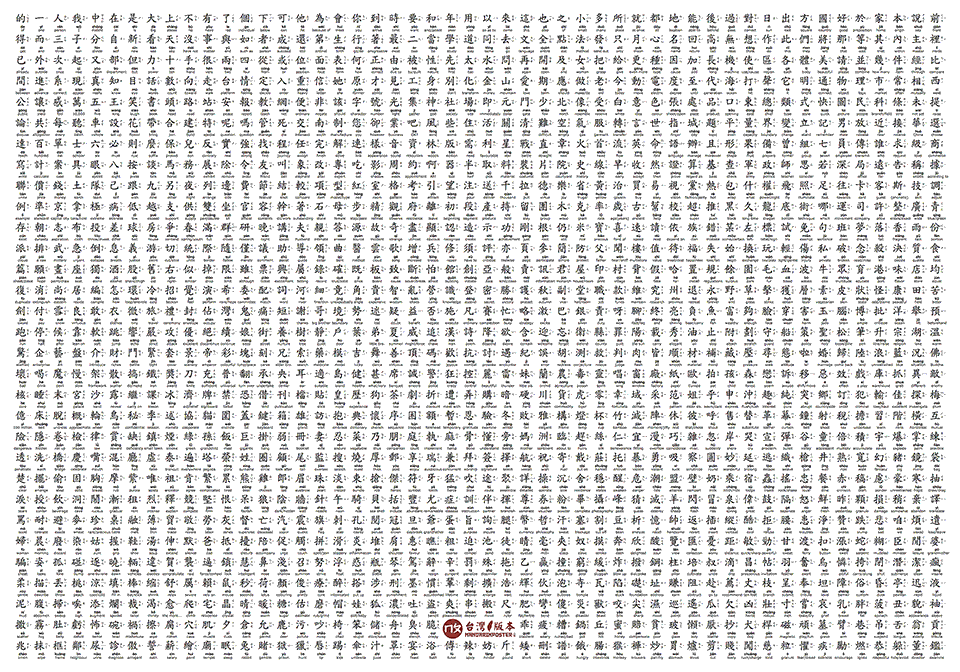
In this respect, I want to posit the following: if fighting games are like a dialogue or a debate, then learning the mechanics of a game is like learning a language in the first place, and in this respect Melee is an enormously difficult language to learn. It’s like reading written Chinese, or learning Icelandic (which I hear is quite the challenge): certainly within the realm of possibility to become fluent, but mastery requires dedicated study and practice. As you improve at a language, it’s like the world opens up to you. You go from recognizing words to being able to read sentences, then novels and poetry. You discover the intricacies of how to piece thoughts together to form more complex ideas. This, I think, is where much of Melee‘s appeal comes from. To fans, wavedashing, dash dancing, L-canceling, DI, shine canceling, Scar Jumping, and more aren’t just Smash Bros. lexicon but the very grammar and vocabulary that lead to infinite possibilities of expression.

fc063347f3c29399fe8bd70ba773cbe5Basically like learning Fox

If that’s the case, however, then many players never truly learn to debate with their opponents. Those who consider the mental aspect of the game from the start will have the opportunity, of course, and that mental interaction is pretty much required at the tip-top level of Melee, but let’s go back to what Tafokints and Mike Ross had to say. Though there’s an upper limit, in Melee you can become a decent competitive threat without ever learning the mind games, but in Street Fighter you are taught to focus on mastering the art of dialogue from the very beginning. In contrast, what Melee will more often amount to is a debate where someone who is fully fluent in its language is overpowering someone who’s still just learning how to string a sentence together.

Again, to a Melee player, this is the charm of their chosen game: it is a complex and difficult yet beautiful language. Melee is a subject worthy of aesthetic appreciation, and those who reject it or see it as unnecessarily convoluted are simply not putting in the necessary work. With that being said, where Melee in a sense falls apart is when a player or indeed a game designer wants the central goal of their game and improvement at their game to be not so much the continual mastery of grammar, but a firm focus on the thrill of the debate or dialogue itself. Even if it is a simpler language, even if it takes less to learn overall, if one is able to immediately engage in the act of dialoguing, then that competitive game has achieved something rewarding. Rather than leaving that aspect to only the most skilled and talented players, it now becomes something that more people can experience. This, indeed, is where games such as Divekick, Smash Bros. Brawl, and Smash Bros. for Wii U come into play.

In the YouTube comments of the non-extended version (I don’t recommend you actually take a look), a lot of the debate descends into whether or not Melee is a “real” fighting game or not. The worn-out arguments of it being a party game without anything in common with “true fighters” are brought out, and in turn many of the defenders of Melee fall into these old traps. They will talk about how Melee is actually this enormously difficult game to learn and master because of its technical barriers, and will wear it as a badge of pride, while simultaneously talking down the other Smash games for lacking in this quality. They have essentially cornered themselves into a position where they are playing by their opponent’s rules. Whether by ignorance or by intentional scheming (most likely the former), Melee‘s detractors attack its integrity, but many of its supporters only know how to respond with, “But look at how intricate our language truly is! Can’t you appreciate that?” while failing to take into account that what some see as the true beauty of a language is when it leads to fruitful conversation.

If you liked this post, consider becoming a sponsor of Ogiue Maniax through Patreon. You can get rewards for higher pledges, including a chance to request topics for the blog.

Love, Shogi, and World Domination: 81 Diver

greatuglymanga-81diver-020001-small

At long last, after many years and 35 volumes of manga, I have finished the exhilarating, hilarious, ugly, and beautiful shogi manga known as 81 Diver. Its bizarre narrative and even stranger art work captivated me from the very beginning, and now that I have seen this series to its end (one of the three series I followed intently that have concluded recently), I want to write to confirm that 81 Diver not only ends strong but in many ways either matched or exceeded my expectations.

81 Diver is the story of Sugata Kontarou, a failed shogi [Japanese chess] player who has taken up gambling through shogi to make ends meet and to fulfill his love of the board game. One day, he decides to order a maid service to clean up his apartment, and discovers at his doorstep an absolutely voluptuous redhead as if out of a fantasy. However, this maid has another identity as Akihabara’s strongest shougi player and a gambler just like Sugata. Known as “Ukeshi,” what translates loosely to “master of defense,” Nakashizu Soyo (as we later learn her name) has her own mission in life: to avenge her brother and father who were both killed by shogi.

As the series progresses, the characters wind up not only challenging and befriending a variety of powerful shogi players and for some reason martial arts experts (actually it’s because the author Shibata also wrote Air Master), but end up in a tournament to save the world from the Kishoukai, the “Demonic Shogi Organization.” The amounts of ridiculous twists and turns this series goes through are almost too many to count. As crazy and as strangely epic as this sounds, however, what really makes 81 Diver special is that the art looks like this:

When discussing the character Kiryuuin Satsuki in Kill la Kill, I once wrote that she has so much presence and so much inner strength that it is the very first thing you notice even as she’s wearing the most ridiculous and revealing outfit possible. I find 81 Diver‘s portrayal of Soyo to be of a similar vein. Sometimes there will be pages of her character where half of it is occupied by a shogi board and the other half is taken up by her enormous chest. At the climax of the manga, her breasts become one of the central points of conflict. And yet, her raw shogi power level is what stand out most about her.

The difference is that, while Kill la Kill achieves this through incredibly well-rendered, stylized, and intense artwork, I ended up including 81 Diver as one of the many titles at my Otakon 2015 panel, “Great Ugly Manga.” On some level, this is clearly on purpose, but it’s also clear, especially given Shibata’s guest essay manga in Gundam: The Origin, that he’s making the best out of what he has, and what he has is a lot of spirit and not a lot of conventional drawing talent.

greatuglymanga-81diver-02-small

I would not call 81 Diver an intentionally feminist or progressive work, especially given all of the attention given to girls’ bodies, but it is notably diverse in its cast. There’s an admirable homosexual character who isn’t stereotypically flamboyant, who also dresses like a tokusatsu character and shoots rocket punches. There are also numerous romances between unlikely individuals, and what stands out most is the strange romance between Kontarou and Soyo that portrays them as equals above all else.

When you look at many shounen and seinen manga, there is often something of a lopsided relationship where love interests aren’t allowed to be as prominent in the particular subject focus of the manga (be it sports, fighting, or whatever). Not so with 81 Diver. Though Soyo is dressed in maid outfits throughout the series, and though she will sometimes playfully call him “master” as a callback to how they originally met, at the end of the day they are bonded by their mutual skill and passion for shogi. In fact, when the series begins Soyo is clearly Kontarou’s superior, and when they are able to play again much later in the series, it is one of the most satisfying duels I’ve ever seen in manga.

As mentioned by the characters, the characters fight as if they’re communicating their love through the game of shogi itself. When you see the two of them play, you genuinely don’t know who’s going to win because, even if you set aside the idea of skill in favor of narrative progress, both characters have convincing reasons why they need to win. Ultimately, I love the way they resolve all of this, but I won’t say more so that it remains a surprise for readers.

I could probably write a whole series of posts on 81 Diver, and in fact I’m quite tempted to do so. Suffice it to say, 81 Diver comes highly, highly recommended from me. If you can get past or even embrace the terrible (or perhaps terribly endeaering) artwork and style, it becomes one of the funniest, surprising, and involving manga you’ll ever read.

If you liked this post, consider becoming a sponsor of Ogiue Maniax through Patreon. You can get rewards for higher pledges, including a chance to request topics for the blog.


NiGHTS for Super Smash Bros.

smashbros-nightsmoves-small

NiGHTS into dreams… is my favorite video game ever. No matter how many hours I put into Pokemon or even Smash Bros., NIGHTS always has that special place for me. Even before Melee came out, well before the start of this blog, I had begun to picture how NiGHTS as a character would function in Smash Bros.

NiGHTS into dreams… is a game about two children who fight to save the world of dreams from the evil forces of Nightmare with the help of a mysterious androgynous dream being, a rebel “Nightmaren” known as NiGHTS. The game evoked a real sense of flight while providing vivid dreamscapes for worlds. Though fairly obscure by today’s standards, you’ll still find people who love the game. For many, it was synonymous with the Sega Saturn, and even the Seha Girls personification of the console has NiGHTS-like features.

The biggest challenge with NiGHTS is that they’re a flight-based character, and I don’t even mean that they “can” fly, as is the case with Kirby or Pit. Rather, NiGHTS’ whole identity revolves around flying, and it’s pretty much the only thing they ever do during gameplay. There’s no walking, running, or jumping—it’s either flying or bouncing into things. Given Smash Bros. and its sumo-style gameplay, that wouldn’t be very fair if left unchecked.

With that in mind, I thought it best if NiGHTS did not have 10 jumps or whatever, and instead would have relatively fewer multi-jumps (4 mid-air jumps, one less than Kirby or Meta Knight) that were supremely maneuverable. As you can see in the upper right hand corner of the image, NiGHTS wouldn’t get just a small bump from each jump, but would be able to make curves, weave in and out, and more, with each successive “jump.” On the ground, NiGHTS would hover, and many moves, as well as their dash, would give NiGHTS a low profile.

NiGHTS as I picture the character is nigh-impossible to edgeguard, especially because all four of their specials are recovery moves, with some packing impressive killing potential, similar to Meta Knight. In exchange, NiGHTS would probably be the lightest character in the game, even lighter than Jigglypuff who’s usually dead last, and would have low damage per hit.

Paraloop involves NiGHTS making a quick loop, though rather than NiGHTS’ body doing damage, it creates a vortex that can suck in opponents, damage them, and even KO at high percents. I decided to localize into a single special move rather than it having a constant presence on-screen, because while it would be an interesting mechanic, it might make NiGHTS too overwhelming in that the character would be able to fight without even pressing the attack buttons.

NiGHTS’ neutral special, Somersault Throw, is an extremely versatile move. A command grab where NiGHTS boosts forward slightly, grabs the opponent, then spins around once and throws them, the tricky element of the move is that NiGHTS can activate the throw portion at any point while holding the opponent. This means that NiGHTS can throw the opponent towards the nearest blast zone, including the bottom of the screen for what is effectively a meteor attack, or into a ledge for a stage spike. Also, just having a command grab that’s so strong makes shielding against the NiGHTS that much more dangerous.

Drill Dash and Dragon Persona (taken from NiGHTS: Journey of Dreams) are more similar to typical recovery moves, but each is unique relative to the other. Drill Dash can be slightly angled similar to Meta Knight’s Drill Rush (though is slightly better this way), while Dragon Persona’s direction can be controlled like Fire Fox/Fire Bird, only with wind-immune properties. This means that, if Mario or another character tries to push NiGHTS to foil their recovery, Dragon Persona can cut straight through it. Neither move is good for KOing, however.

As for Dualize, NiGHTS’ Final Smash, it’s based on the final battle in both NiGHTS games, where both child characters simultaneously fuse with NiGHTS. This would create a clone character that mirrors NiGHTS’ moves, creating difficult traps and greater damage potential. Think of it like Morrigan’s Darkness Illusion super in Marvel vs. Capcom 3.

Not quite a “glass cannon,” NiGHTS would try to out-maneuver the opponent into making a mistake, and then capitalize on it. Overall, NiGHTS would be a graceful character capable of giving any opponent the slip, with a tricky yet effective and surprisingly powerful play style.

For next time, the character I’ll be presenting will be a representative of PC gaming.

Previous Characters:

King K. Rool (Donkey Kong Country)

Princess Daisy (Super Mario Land)

Geno (Super Mario RPG)

Great Puma (NES Pro Wrestling)

Pitfall Harry (Pitfall)

Zoma (Dragon Quest III)

Ogiue Chika + Satan = Oshino Ougi

owarimonogatari-crunchyroll

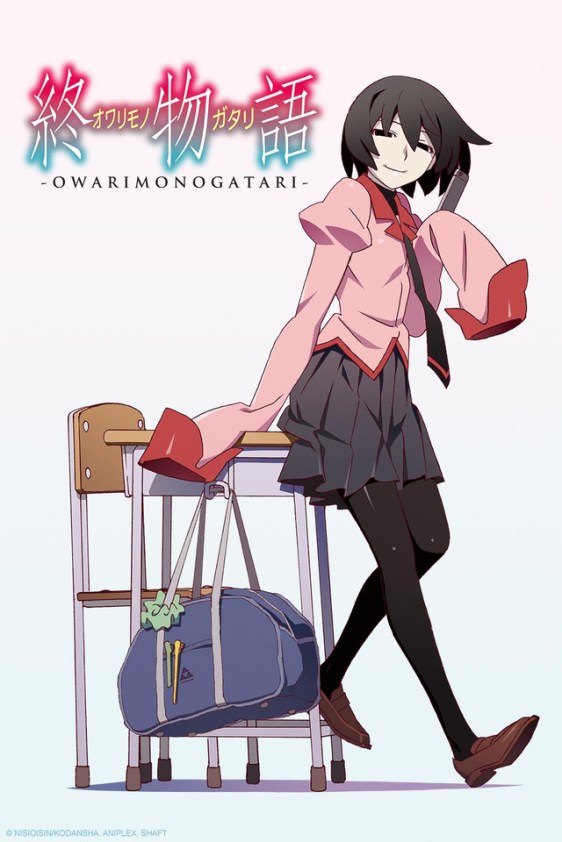
Throughout Nisio Isin’s Monogatari series there has been a mysterious character whose motivations and origins are difficult to grasp. Oshino Ougi, who purports to be the niece (and sometimes nephew) protagonist Araragi Koyomi’s Hawaiian shirt-wearing mentor, seems to come out of nowhere and has a knack for planting thoughts into people’s minds and for getting them to unconsciously open up. Is she just a manipulator or something more? Given the series and its author, the latter is more likely, though either way what Ougi reminds me most of is the biblical devil, whose half-truths are designed to deceive men into making grave errors.

074de9c41821cdc376b0ca5d7da5010c

What stands out to me most about Ougi, however, is how much she resembles Ogiue from Genshiken. She has deep, black eyes just like Ogiue’s from the first series. She has a hair style similar to Ogiue’s when she lets it down, especially Ogiue’s look during Nidaime. Ougi also has a similar chest size and overall figure, and the fact that she’s sometimes a boy (in terms of sex, gender, or something else? It’s mysterious.) reminds me of Ogiue’s overall tomboy demeanor.

mizuhashikaori-myanimelist

Drawing this comparison even closer is the fact that Ougi and Ogiue share the same voice actor, Mizuhashi Kaori (Mami in Madoka Magica, Laharl in Disgaea).

oshinoougi-dowmansayman

Check out this Ougi fanart by artist Dowman Sayman as well. Given the way they draw Ougi, especially her nose, she looks even more like Genshiken‘s fujoshi president.

Is it mere coincidence? Most likely yes. Even so, whenever I watch the currently-running Owarimonogatari and see Ougi, I can’t help but think of Ogiue Maniax’s namesake. Maybe that’s why Oshino Ougi has become my favorite character in the series.

If you liked this post, consider becoming a sponsor of Ogiue Maniax through Patreon. You can get rewards for higher pledges, including a chance to request topics for the blog.


Drifting Along: Ogiue Maniax Status Update for December 2015

Whenever I think of Christmas and anime, my mind immediately goes to Initial D: Third Stage. Does that count as a Christmas anime? I’m going to say yes, and try to make it official.

Here are this month’s Patreon supporters. As always, I’m happy that they have my back.

General:

Ko Ransom

Alex

Anonymous

Yoshitake Rika fans:

Elliot Page

Hato Kenjirou fans:

Elizabeth

Yajima Mirei fans:

Machi-Kurada

We even have a new Yajima fan aboard! Seeing as how the character’s been developing in Genshiken as of late, I wonder if more will join.

It’s a pretty subtle change, but one thing I’ve been trying to do over the past month is put out content three times a week. I used to do at least two posts a week, with a Fujoshi File every other week, but I felt that it wasn’t quite enough.

Speaking of the Fujoshi Files, at the moment they’re on a brief hiatus as I use that time to indulge in my love of Super Smash Bros. After the recent announcement that Cloud Strife is going to be a playable character (!), I’ve gone back to an old love of mine and have been designing movesets for what-if Smash characters. So far I’ve done Pitfall Harry from Pitfall and Zoma from Dragon Quest III, and there will be at least a couple more on the way.

I have more reviews this month, though as always they toe the line between review and analysis. Of course, there’s the requisite Genshiken chapter, and if you’re a Sue fan this is the one for you. I also wrote something about the use of kanji and words in Aquarion Logos, and then there’s my review of the new Digimon anime. If you haven’t heard about that last one, it’s actually a sequel to the original, with all of your favorite characters in high school. If you like giant robots, I also appeared on the Cockpit podcast to talk about Gaogaigar. I even made a new 1 Minute Review to celebrate the release of Girls und Panzer der Film!

As with every month, if you’re interested in requesting topics for me, it’s a reward for those who pledge $30+ on my Patreon. I of course don’t mind coming up with my own topics (and in many ways it’s actually kind of easier),  but I do miss being “forced” to look at something I might not have otherwise. In the meantime I’ve replaced the Ogiue Maniax Skype group reward at $2.00 with a new feature: I will include a link to whatever you want (within reason) in a special section in my sidebar. Remember, if you’re pledging already, you already have access to this, so send those requests my way!

The last thing I’d like to talk about is the whole social media thing. In the past, I’ve tried to make it so that each site I used had a different specialty. My tumblr, for example, was mainly for video clips. However, I realized that many people only look at their favorite social media platforms and rarely venture outside of them. That’s why I’ve been getting a bit more redundant with posts across different sites, to reach more people. My question is, are you someone who sticks to just one, or someone who sees different value in Twitter, tumblr, Facebook, etc.? I’d like to have a better idea of how to interact with my readers, so that I can foster interesting or even delightfully frivolous discussion.


How Important is Consistency of Character Design Across Genders?

In a 2013 podcast interview, Paul Dini, creator of the DC Animated Universe, described how a stubborn refusal to move away from traditional marketing tactics spelled the end for the popular and beloved Justice League cartoon. Esssentially, because Dini had given the female characters of Justice League equal prominence and strong character development, the higher-ups who had planned their marketing around appealing to boys told the staff to cut it out. Girls should be on the sidelines, and never as good as the boys, because boys were supposed to buy the toys and merchandise, dagnabit. It’s a sad fact that proper marketing, trying to find the demographic that’ll give you the most bang for your buck, can often lead to things like happening, especially when so much money has been invested into a project and having things go not according to plan is seen as a nightmare scenario. Gendered marketing has been around for centuries, and it likely isn’t going anywhere soon.

I began thinking about this idea relative to anime, if only because anime and manga are known for gendered marketing. While anime does on a number of occasions portray strong female characters such as in the Precure franchsie, the primary audience is indeed young girls, even if a sizable male audience is willing to shell out some big bucks to get some DVDs and nice figures. However, there’s another side of anime marketing I’ve seen, one that seemingly both defies and reinforces gendered marketing, by placing idealized male characters for women and idealized female characters for men in the same space.

One such title I reviewed for an Anime Secret Santa a couple of years back: Acchi Kocchi: Place to Place. In it, I described the main couple as consisting of the small, moe girl and the tall, quiet bishounen, resulting in a combination of two popular yet often disparate archetypes in one relationship. Series such as Aquarion EVOL and Tytania have different artists on duty to design the male and female characters separately for maximum appeal/pandering. Perhaps nowhere is this more extreme than in the currently-airing Show By Rock, which takes the cute girl/handsome guy incongruity of Acchi Kocchi to a whole other level:

Screen Shot 2015-05-23 at 11.10.10 AM

(This isn’t even taking into account the fact that Show By Rock is already a rather eclectic mishmash of styles that also includes CG cute animal anthropomorphs playing in rock concerts.)

So you have these series with various creative forces involved—Okada Mari (Lupin III: The Women Called Mine Fujiko) wrote Aquarion Evol, while Tanaka Yoshiki (Legend of the Galactic Heroes) is the original author of Tytania, for example—which means that different philosophies and beliefs are involved on various levels of production. Marketing is still at work, the creators are overall looking for you to buy their anime, and if not that, then to buy their products. Focused marketing, gendered marketing is still happening. And yet, why are these anime willing to try and bridge the gap so at least within a single work there are elements that actively appeal to men and women, boys and girls, even if it’s for the sake of hitting some basic desire buttons on the audience? And if the argument is that the merchandise is designed to reflect those gender differences as well, then why were the people responsible able to produce goods in such a way that the executives behind Justice League could not?

Of course, one recent example of a franchise that has tried to appeal to both men and women within the same films has been the Marvel cinematic universe. Thor and Captain America both have looks and personalities that garner admiration from men and women, heterosexual and homosexual, and marketing has capitalized on that. At the same time, there’s also been a bit of an uproar over the fact that what should have been a Black Widow toy became instead a Captain America one. If this were Japan, there would certainly be some figures of Black Widow, but there’s also a fair chance that those examples wouldn’t be targeting girls.

If you liked this post, consider becoming a sponsor of Ogiue Maniax through Patreon. You can get rewards for higher pledges, including a chance to request topics for the blog.


Zoma for Super Smash Bros.

smashbros-zomamoves-small

Previous Characters:

King K. Rool (Donkey Kong Country)

Princess Daisy (Super Mario Land)

Geno (Super Mario RPG)

Great Puma (NES Pro Wrestling)

Pitfall Harry (Pitfall)

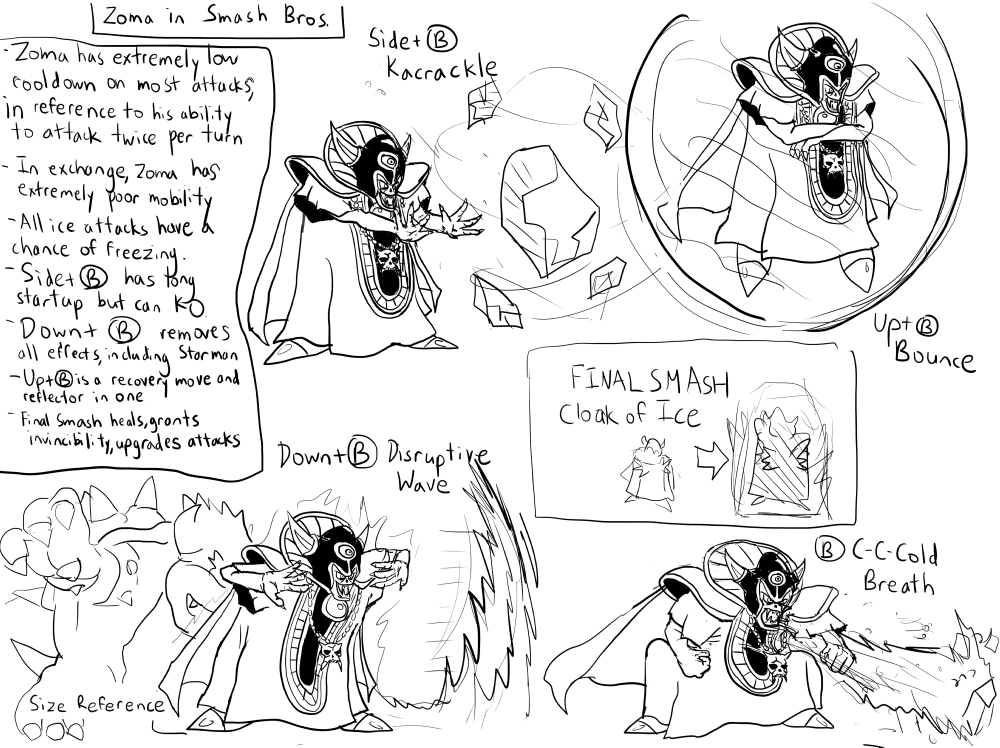
In celebration of Cloud Strife’s reveal as a new Super Smash Bros. for Nintendo 3DS & Wii U character, I have once again been drawing movesets and concept art for how famous icons of video games might work in Smash Bros. This time around, it’s Zoma, the final boss of Dragon Quest III, aka Dragon Warrior III.

Square Enix began as two rival companies, Square (later Squaresoft) and Enix. If Square’s flagship title was Final Fantasy, and its greatest success story Final Fantasy VII, then Enix’s was Dragon Quest, and its crown jewel Dragon Quest III. Having sold over 1 million copies on its first day of release in Japan in 1988, which included many students deciding to cut class just to buy it, it is one of Japan’s most beloved RPGs. Amazingly, once you beat it, you find out that it was in fact a prequel to the very first Dragon Quest, and your player character becomes the legendary hero whose equipment must be collected in the first game.

However, instead of just going with Loto (or Erdrick) as a counterpart to Cloud, I believe it would be more interesting if Enix could be represented by arguably its greatest villain. Zoma, like all Dragon Quest monsters, is drawn by Toriyama Akira of Dragon Ball fame, and strikes an imposing figure. A demon lord who rules over the land of Alefgard, according to Dragon Quest IX he actually went there because he’s extremely popular with other monsters and is trying to get away from his fans. Zoma is shown to be much larger than the heroes, but like Bowser there does not seem to be much consistency with his scale, so I figured he’d best be a large, heavy target similar to other super heavyweights. However, where Zoma differentiates himself from the rest is that his attacks are not only powerful, they’re very quick to recover.

If you’ve fought a character like Mario in Smash 4, you find that he can move very quickly out of key attacks (Up Smash, down air, back air), and that it makes him difficult to punish. Zoma would be similar. While some of his attacks would have long wind-ups, such as his Side-B Kacrackle (the strongest ice spell in Dragon Quest), it is difficult to take advantage of him if he misses, as he can quickly transition into something like a jab or a forward smash. This is meant to reference the fact Zoma is actually able to attack twice in one turn in his source material.

To balance this out, Zoma would have by far the worst mobility in the game, like if you weighed Ganondorf down with bricks. He would have decent jumps in terms of sheer distance, but would be extremely slow in terms of acceleration and max speed. His walk speed would be awful, and he wouldn’t even have a true dash. Instead, he would get a mini-teleport that still has all the restrictions of a dash. Think of him as being somewhat like Slayer in Guilty Gear.

All of Zoma’s attacks come straight from his battles across various games (he’s been a guest boss in a number of titles), and many of them are capable of freezing. C-C-Cold Breath is a super-charged version of the Ice Climbers’ Down B, and Disruptive Wave can remove status changes (both positive and negative) and even stun opponents very briefly. In one-on-one situations you won’t be able to capitalize on it, but it does travel far and is good for shifting momentum back into your favor, especially given once again how difficult Zoma’s moves are to punish. Bounce is a reflector and stage recovery move combined, making it useful for getting past projectile-based edgeguarding attempts, but is otherwise below average for a recovery, traveling far but very slowly. It is also impractical as an on-stage reflector. Kacrackle is both a powerful damage dealer and a way to seal stocks early, but can be difficult to land. At the same time, it can be thrown out similar to Meta Knight’s forward smash as a read in neutral.

Zoma’s Final Smash is a reference to the fact that Zoma originally covers himself with a protective ice barrier in Dragon Quest III that greatly augments his abilities. The only way to remove it is to use the Orb of Light, and seeing as no one has it in Smash Bros., I figured it would be better as a temporary measure.

Perhaps most important of all, Zoma would have all of the signature attack sound effects from Dragon Quest.

So that’s Zoma, one of the most infamous of JRPG villains. If anyone wants to design a Loto as well, by all means be my guest. As for the next character, it’ll be “the one I’m waiting for.”

If you liked this post, consider becoming a sponsor of Ogiue Maniax through Patreon. You can get rewards for higher pledges, including a chance to request topics for the blog.