The Boku wa Tomodachi ga Sukunai Anime Could Be Better

Earlier this year, I started to read the Boku wa Tomodachi ga Sukunai manga.

I became an instant fan.

I really enjoyed the manga because of how it showed the difficulties of making friends when inexperience and considerably flawed personalities are thrown into the mix. It’s a decidedly otaku-oriented series that hits kind of close to home in a pleasant way. So when I heard that it was getting an anime adaptation I was pretty thrilled about it. I had my fingers crossed that it would be the anime of Fall 2011. Now, a few episodes into the TV series, I find it safe to say that I am fairly disappointed with the anime adaptation of Boku wa Tomodachi ga Sukunai.

On a basic level, the anime and manga are not that different from each other. They have the same premise, a group of people who are very bad at making friends trying to help each other to humorous effect. They have the same characters with the same personalities. They both have fanservice and their fair share of otaku references. But where I find the manga to pass with high marks using this mix of ingredients, the anime by comparison falls short of the manga’s success.

I think the best place for me to begin is the art, because the character designs for the manga and anime are drawn in markedly different styles. Whereas the anime has more of what I’d call a typical light novel/visual novel-esque style to it, the manga’s artwork seems more loose and fun. The manga doesn’t feel the need to stick to its template too closely, and perhaps because it doesn’t have to devote frames of animation to consistency, it makes the comic feel comparatively more energetic. Putting aside more abstract aspects of manga such as page and panel layout, decompression, etc. (things which I think the manga does quite well and do contribute to the quality of the series), even the smiles from the characters in the manga show a lot more emotion behind them. I feel like I can understand the inner workings of the characters and I’m pleased by that. The anime on the other hand, while its designs aren’t abysmal or anything, don’t seem capable of as much expressiveness, and in general the show feels a little stiff and wooden by comparison. I understand that the anime’s designs are closer to the original light novel’s but I still like them less. On that note, I have not read the light novels, so I cannot say if either is a faithful enough adaptation to the original, but the problem isn’t faithfulness so much as it is the particulars of execution.

Another major factor is the fanservice. By that, I don’t mean that the manga is devoid of fanservice which makes it somehow automatically better. In both cases, the girls are still cute, Sena’s chest is equally impressive, and they all have a tendency to wear attractive outfits. There’s nothing particularly objectionable about this. However, the anime has significantly more fanservice, to the point that I find myself saying, “The girls are already cute enough! You don’t have to do anything more with them!” The fujoshi character Rika has scenes showing her fantasizing in both versions, but the anime’s depictions tend more towards a climax in an eroge while the manga emphasizes the extent to which it leaves her flustered. The show also has a tendency to repeatedly linger on the female characters below the belt to a degree which exceeds the yuri mahjong anime Saki. The opening video itself seems particularly dedicated to showing off the girls’ bodies and ignoring the friend-making aspect of the show, and I find myself wishing it had been done differently, perhaps something akin to the Toradora! OP. To put it simply, there’s a difference between the girls wearing a sexy bikini that shows off her figure and a shot that draws specific attention to the underboob.

Now, I understand that the series has something of a harem vibe to it. It’s an unavoidable aspect of it, for better or worse, and it’s not like I have anything against a harem series which is designed to show off its girls. I once compared Infinite Stratos to Kore wa Zombie Desuka? and while I found the latter series better and more engaging overall I thought the girls of Infinite Stratos were more attractive with better designs. That approach is fine, if a little limited in its appeal. With that said, I find the key difference to be that, based on how the two adaptations approach the categories mentioned above, the expressiveness of the characters/aesthetics in general and the approach to showing off the attractiveness of the girls, the manga does a much better job of making me think of the female characters as people first and cute girls second. While I certainly don’t mind that the girls are nice to look at, what made me love the series in the first place was that it encourages a deeper understanding of the characters, particularly their awareness of their own personal flaws. With the manga, I feel that it gives a much stronger sense that these characters really do wish they could make friends in a way that outshines the fanservice, which I think gives it far greater ability to reach otaku and other readers with that bit of warmth. With the anime however, although that aspect is still there, I think it makes it more difficult to see past that simple harem exterior and into the meat of it (no pun intended for Sena fans).

I’m not going to accuse people who really like the show of having poor taste or think they’re simply unenlightened fools. I much prefer the manga and its style, but people may choose the anime’s designs over them for whatever reason. The girls are cute and it’s okay to think that they’re cute, to be attracted to them or even obsessed with them. Perhaps most importantly, while I find the level of fanservice in the manga to be more or less acceptable, I know there are people out there who would find that the cheesecake ruins the character portrayals in the manga. Even so, I just can’t shake the feeling that the anime’s approach to Boku wa Tomodachi ga Sukunai obscures its greatest strengths too much.

The Difference in Variety in the New Genshiken

In the past, I’ve written a number of posts in response to some of the backlash that the new Genshiken receives, particularly in regards to the new cast of characters. Whether it’s pointing out how Genshiken changes throughout its run (for the better), or that the general perception of otaku has changed just enough that some are happily willing to be labeled as such, my goal has been to show that the series has never stopped being “real,” and that it most certainly still reflects otaku life. There’s nothing wrong with or invalid about liking Genshiken while disliking Genshiken II (the comic does feel somewhat different, after all), but I just find the criticism that the characters are somehow less developed to be one I can’t agree with.

So when I see the criticism that the new characters in Genshiken lack variety, I was surprised. Upon seeing the reasons, I was confused.

The argument is that the new characters are all into BL, whereas once you had a guy who was into model kits and cosplay (Tanaka), a guy who was ostensibly into drawing (Kugayama), a guy who fought hard for Otaku Life (Madarame). This supposed lack of variety potentially even labels all female otaku as BL-hungry fujoshi, a mistake that many make both in and out of the world of fiction. At first, I considered arguing from the fact that the Genshiken old guard all had fairly similar tastes in erotica and doujinshi, some more extreme than others. I realized, however, that taking such a stance wasn’t really answering the question of variety, and that it’s true that the older characters seemed to have a wider array of otaku hobbies. Among the current members, most of them are indeed into yaoi, many of them like to draw, and their conversations often lead to discussions of pairings and such. That said, there is an important difference between the old and new Genshiken in that the approach to diversity has changed.

It is true that Sasahara and the rest all have different interests as otaku, and together they show a variety of colorful personalities in part due to those interests, but at the same time they’re all different types of Awkward Nerd, Kohsaka with his good looks and upbeat personality being the only real exception. Kasukabe and Sasahara’s sister Keiko of course aren’t even otaku at all, and instead provide a very clear point of comparison, the normals as opposed to the nerds. With the current iteration of the club however, while just about all of them are into similar things like BL, they actually have widely varying degrees of awkwardness. While Hato’s crossdressing can create awkwardness, he himself does not necessarily exude it, and Yoshitake is almost impossible to label as such. Whereas once Kohsaka was the major exception, his approach to being an otaku, while not quite yet the rule, resembling this current generation more than the one before it. Moreover, between Hato’s judo training and the younger Yoshitake sister’s years of basketball you even have now, of all things, athletic individuals devoid of the physical awkwardness that is prevalent in so many portrayals of otaku.

As is explored in Chapter 58 (the drunken party chapter), part of Yajima’s character is that she feels caught in the middle of this transition. In her mind, otaku are supposed to be weird, inept people who look and possibly smell less than ideal (I’m paraphrasing), but all of the girls (and at least one guy) around her in Genshiken seem to be smart, beautiful, talented, and confident. In this regard, she is somewhat alone, her type and level of awkwardness greater than the rest, but with her ability to comfortably interact with all of them even she is a sign of the ever-changing times and identity of “otaku.”

While the new Genshiken may indeed be populated by yaoi fans (and we’re not even sure if Risa’s thing for shota is necessarily also a BL thing), it has a level of variety in characters and personalities that was previously only achieved on a much more extreme scale, one that had to even include non-otaku. Their hobbies may not be as varied, but they themselves are comprise a diverse cast of fully formed otaku-as-characters in a world where awkwardness, social or physical, is not a prerequisite.

FATE/ZERO SPOILERS I FIGURED OUT BERSERKER’S IDENTITY

Smooth Criminal: Genshiken II, Chapter 69

Last time we met what can be best described as the Luigi to Yoshitake’s Mario, Yoshitake Risa. No, seriously, think about it. She’s younger, taller, and jumps higher.

Anyway, unlike the previous little sister in Genshiken who didn’t really get a dedicated spotlight until many volumes later, we get to learn a lot more about Risa just one chapter after her introduction. She’s quite an intriguing character, so I’m all for it.

(Did you know Yoshitake has the power to snore in English?)

As the freshman drinking party concludes at Yoshitake’s place with everyone crashing for the night, we get to learn quite a bit about young Risa. She awakened to her nature as a shotacon because of a particular child star, though she prefers the timelessness of 2-D over the aging process which inevitably affects the inhabitants of the real world. Also, though she loves playing basketball (enough to attend games instead of going to doujin events), she is tired of everyone assuming that she’s going to pick a college based on her hoops prowess. Yoshitake Rika, always the loving older sister, not only buys all of Risa’s doujinshi for her, but brought her to Shiiou University to help her think things through.

When all’s said and done, Risa has one last request. Knowing that Hato began crossdressing so that he could make friends with fujoshi, Risa is curious as to just how “challenging” that process is, how far Hato has gone for the sake of meeting like-minded people. Yoshitake, who can also be a “helpful” older sister, manages to twist the situation such that it ends with a visit to Hato’s place.

There, Yoshitake wants to use the time Hato spends showering to find out all of his secrets, but Yajima stands in her way. Despite assistance from the younger sibling , Yajima manages to stop Yoshitake, though in the process they inadvertently open the door to the bathroom and both Yajima and Risa get to see that Hato is indeed a man, albeit an incredibly smooth one. Risa, with Hato’s image possibly burned into her brain, now finds a reason to take the exam for Shiiou University, much like the other Genshiken little sister.

Before I get into my thoughts on the chapter itself, I want everyone to look at this image of Risa’s body.

Risa’s figure can be described as that of a tall, slender but athletic woman with small curves. It makes sense, given the amount of time she puts into sports. It is also an incredibly uncommon body type for a female character in a manga with men as its primary audience. Sure, there are girls with small chests in shounen/seinen, and there are also plenty of athletes, but rarely are they like Risa’s. Even in most comics targeted towards girls of all ages, a body type like this is not drawn with as much focus on anatomy.

Ohno, Kasukabe, and Ogiue’s bodies were already quite different, and Yajima is of course overweight, but Yoshitake Risa’s realistically athletic figure, which doesn’t really try to adhere to typical notions of feminine appeal nor masculine portrayals of heavy musculature, makes me fully aware of just how varied the body types of the female characters are in Genshiken. It’s actually quite impressive, and I think shows that Kio Shimoku, more than ever, is trying to draw female characters for men in a way that fosters understanding of women as people.

The way this chapter is, it actually feels like a hang-out between girls (plus Hato). It’s kind of like that scene at the retreat back in Volume 7, only without the painful recollection of traumatic events from the past. Instead, they were able to create new traumatic events (again, Hato). Again, it’s not out of the blue, and when I look back on Genshiken it’s clear that it’s always been different in portraying female characters, but Chapter 69 somehow feels like a particularly strong example of this approach.

I continue to enjoy the sibling relationship between Rika and Risa for reasons touched upon in the chapter summary above. Yoshitake comes across as a person who genuinely loves and looks out for her younger sister, and it’s clear that her happy-going personality has had a positive effect on Risa’s development through the years. That Risa is comfortable with calling her older sister for advice is in itself a strong sign of their bond, as is the fact that Risa feels compelled to go along with her sister’s hair-brained schemes (crossdressing, bearhugging Yajima). Again, I have to contrast it with the Sasaharas, who eventually reached something along those lines, but only through a long and arduous process.

As for Yajima, I find that she is in this strange position where Hato’s crossdressing has taken on the opposite effect of what it used to be for Yajima. Initially, Hato’s female guise made Yajima rather uncomfortable, as it challenged certain deep-rooted feelings and beliefs in her. As they have become friendlier however, the crossdressing almost acts like a barrier preventing Yajima from thinking of him as a man, which Yajima consistently views as a kind of “other,” like so many nerds out there. This is why you see Yajima try to prevent Risa from convincing Hato to change into his male version. Poor Yajima.

Speaking of Hato, the chapter also provided some insight into his life. For one thing, we learn that the reason Hato lives so far away is that he had to find an apartment with a walk-in closet to store both his dresses and his massive amount of doujinshi. Now that’s the kind of dedication that Risa can understand.

Next chapter is the school festival, and while not quite as exciting as a ComiFest chapter, it’s still something I look forward to from Genshiken. We’ll also get to see Ogiue again. And if that’s not enough, Volume 11 is on its way in February December with a special edition and an exclusive Hato figure. I’ll probably end up owning one myself, if only because I try to get every single special edition of Genshiken that I can.

I do not intend to ever break that streak.

Gotta Stock ’em All

C: The Money of Soul and Possibility Control is a show that can ostensibly be described as Wall Street meets Pokemon. “Investors” are summoned to a mysterious “Financial District” where they use powered assistants called “Assets” to fight and take each others’ money. As I am not really familiar with how actual stocks and investing work, I cannot tell you how accurate the flow of money is within the show, other than to say that I looked up the word “mezzoflation” and that is definitely some made up mumbo jumbo original to C.

But when I think about it, what percentage of the population actually knows in great detail the ins and outs of stock exchange? We go on the news and hear about “NASDAQ rising” this or the “Nikkei Index” falling that, and while the information is out there for people to learn, it is so many levels removed from how people traditionally think of how to make money (i.e. perform a service and get paid for it) that it all begins to sound like some elaborate game involving smoke and mirrors and maybe juggling clowns.

Maybe I’m just an idiot when it comes to finances but with the sheer complexity and mystery of how the world’s finances work, it feels like a nation’s wealth might as well be decided by a Pokemon Battle, instead of the convoluted web that exists in reality.

The Fujoshi Files 28: BL-chan

Name: BL-chan (BLちゃん)
Alias: N/A
Relationship Status: Dating
Origin: Tonari no 801-chan

Information:
BL-chan is a good friend of 801-chan’s. Along with Odango-chan they often join together for “fujoshi meetups.” Though she originally declared that she can find true love because her true love is 2D, BL has been dating a younger man.

BL-chan shares similar tastes with 801-chan, such as a fondness for the Prince of Tennis musical, but will also disagree on certain aesthetic matters, such as how hairy the men should be below the belt (BL-chan prefers guys to be smooth). She is also more receptive to content that is a little more hardcore compared to her friends. Like 801-chan, BL-chan manifests her fujoshi side through the appearance of a small creature, though hers has what might be either bat wings or ears.

Fujoshi Level:
Upon being asked about her boyfriend, BL-chan responded by describing him as “a vulnerable uke (bottom) who thinks he’s a seme (top).”

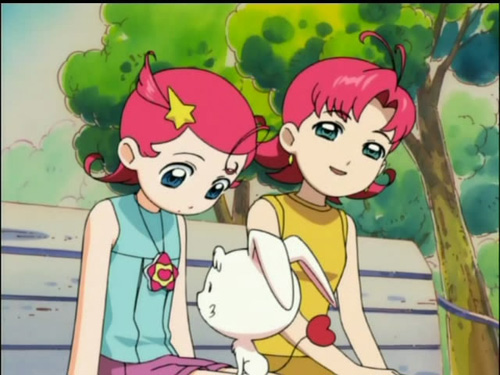
Wonderful, Everything’s Wonderful: Cosmic Baton Girl Comet-san, Revisited

When I originally wrote my Cosmic Baton Girl Comet-san review, I mentioned that I had not finished the show simply because not all of it was available at the time. In the three years since I wrote that review though, I have been able to finish the entirety of the anime (sans subtitles), and so I want to make an update, bring some closure, and tell you if my opinion has changed since then.

Pretty much everything I said in the original review still holds true. The pleasant pace, the way it makes everyday life feel worthy of discovery and appreciation, the charming characters that make you want to smile, it’s still all there from beginning to end. Comet never stops growing, Meteor shows that there’s more to her than just snooty princess-type comedy. The way the characters interact with each other shows off their personalities so well that it’s hard to find many other shows that can manage this subdued sense of wonder.

The second half does indeed bring more plot, but Comet-san never stops being an anime that you can ease yourself into. The ongoing plot points build up slowly but surely, and it has what I find to be an appropriately satisfying ending.

In considering how this show might appeal to otaku who might not necessarily be into mahou shoujo, I might compare this show to slice-of-life, but I think that would perhaps be doing Comet-san a bit of a disservice. I like slice-of-life shows, don’t get me wrong. I eagerly await the new season of Hidamari Sketch and I’m a fan of Minami-ke, but those just cover the joys of everyday life. Comet-san does that, better than those shows, but it also shows the great things and bittersweet feelings that can arise from life slowly changing, until the everyday of today is not the everyday of two months ago.

It’s somewhat of a long series at 43 episodes, but I think it’s worth it. This show is really, really good. Ojamajo Doremi good. Heartcatch Precure! good. If you have the chance, and you want to see a simple but poignant show, check out Cosmic Baton Girl Comet-san.

Reading into the Negative Responses Against Phoenix Wright in Ultimate Marvel vs. Capcom 3

Phoenix Wright was recently announced as a character for Ultimate Marvel vs. Capcom 3, and his reception from fans of MvC3 has been an interesting mix of unbridled enthusiasm and indignant anger. I find the latter to be particularly interesting because of how the criticisms from fans are being formed verbally and what it says about how a game like Ultimate Marvel vs. Capcom 3 is perceived by its audience on an aesthetic level.

Before we start though, I have to say that I do not know what percentage of fans actually dislike Phoenix Wright’s participation in this game. Whether they are a “vocal minority” or not matters little, as it is more about the reaction of that group in particular.

First off, let’s take a look at some of the comments critical of Wright as a Capcom representative:

“Im not hating at all, the game looks legit I just can’t believe that non-sense was allowed in and not a more traditional fighting game character”

“Phoenix Wright is the most awkward fighting game character I’ve ever seen. Fuck that guy. I hope he’s top tier and everyone ends up using him ’cause he’s so stupid, LMAO.

Nova on the other hand, now that’s a real character. Dude is a beast! He’s like a better Phoenix (non-Dark).”

“I agree, Phoenix Wright feels out of place here, and makes me feel like I want to throat up or something. What a crappy pick, should of been Captain Commando. We already have a Capcom joke character, his name is Frank West and he’s better than Phoenix Wrong lol.”

[In reference to a an attack Phoenix Wright uses in the trailer and the argument that Tron is a joke character too ] “Tron hits ppl, not sneezes on them”

etc.

All of them say essentially the same thing. A) character who is not a fighter an does absolutely nothing resembling combat in his own game should not be in Marvel vs. Capcom 3. B) The humor-based interpretation of his “fighting” style for UMvC3 is a slight against the game itself.

At this point, it would be easy to dismiss these statements with a couple of arguments, but those arguments have problems in and of themselves. The first is the idea that “gameplay is the only thing that really matters, so it’s not relevant if Phoenix Wright fits with the rest of the cast or not as long as he’s a strong character who can create interesting gameplay.” For Marvel vs. Capcom 3, how the game controls and whether or not it’s competitively viable are, while important to its success as a game, are obviously not the only factors in presenting it to the world and its audience. If gameplay were the only relevant component, then it wouldn’t be a crossover of a comic book company and a video game company using iconic characters from their respective libraries. Although it is easy to disagree with people who think Phoenix Wright is too ridiculous for the game (and I do disagree with them), it is besides the point to argue from a primarily theoretical game mechanics perspective.

The second is the idea that “the game is already ridiculous putting up some kung fu guys against ancient gods and beings with the power to rip the Earth in half, so why draw the line at a goofy lawyer?” But while Marvel vs. Capcom 3 (and the entire rest of the Vs. game series) does bring together a cast of characters whose powers and abilities can be horribly mismatched, it does not negate the fact that Phoenix Wright is indeed not a martial artist or in possession of superhuman abilities. A punch is a punch and can be made as strong as necessary, whereas Wright has to use something else entirely.

I think the idea that a fighting game should have “characters that fight” is an interesting one in that MvC3 becomes a sort of haven for a particular type of masculinity, a place where a (presumably male) player can feel comfortable in knowing that the setting and its character will not betray them aesthetically. This is not a coincidence, as the look of Marvel vs. Capcom 3 is masculine and powerful in a way that is particularly appealing to American audiences. This is easily seen when comparing it to its sibling, Tatsunoko vs. Capcom, whose anime influence gives a somewhat softer look to even the most square-jawed and chiseled of warriors. But Phoenix Wright apparently violates that security; to the people critical of his inclusion for the reasons outlined above, he demeans the game he’s being included in because he ends up mocking the aggressive portrayal of competition. Wright risks emasculating part of the game’s audience, somewhat like the entire Arcana Heart series minus the overt sexuality aspect that is near-unavoidable with that franchise.

Again, I do not know what percentage of people playing games feels this way, but I do have to wonder how much this affects a certain portion of gamers’ decisions in which games to pursue. Are games like Call of Duty and Halo even more indicative of this mindset? If so, it may bear taking a look at how and why men look to games to affirm their masculinity.

Thoughts on Singapore Mahjong

Ever since I wrote about the idea for a mahjong manga where the protagonist travels the world and plays various forms of the game, I’ve been eager to try out other types. Unfortunately, the best I could do was read about them and engage solely in theoryjong, which while potentially useful and certainly fun in its own way could not match the act of actually playing a game. Fortunately, I was able to find a website with not only rules for a Singapore-style of mahjong, but also an online game implemented for the enjoyment of visitors. Apparently it’s been around for a while, and I just wasn’t looking hard enough.

Before I go into my impressions of Singapore mahjong, there are two caveats I have to make. First, the online game provided by the above site is 1-player only. None of my words reflect someone who has played other human beings, and so I cannot talk much about the mental aspect of it beyond a certain solitaire-esque mindset. That said, I think a lot can be discerned just from playing the computer. Second, as I am mainly familiar with the Japanese-style riichi mahjong, I will be using that form of the game to relate my experiences. Also vital to note for those who are stumbling on this post from perhaps other mahjong sites is that I’m not even that good at Japanese mahjong, so the particulars of my “tactics” are mediocre at best.

Like all of the other forms of mahjong, the Singapore style is about creating a complete hand consisting of a number of 3-tile combinations and a pair to finish it off. 3-tile combinations consist of either three-of-a-kinds or straights. Players draw and discard tiles looking for a winning hand, with the last vital tile coming only after the rest of the hand is in a position to actually win. Like Japanese mahjong, you need at least 1 yaku/fan in order to win. However, there are three main differences (and a bunch of minor ones, but I won’t go into those too much).

1) Animal Tiles

While many forms of mahjong have “flowers,” tiles which are collected and set aside during the round that can potentially give bonuses to the player who collected them, the first and most glaring difference between Singapore Mahjong and all other forms is the additional presence of “animal tiles.” Four exist in a set: Chicken, Centipede, Cat, and Mouse, and they behave similarly to flower tiles, except that getting both the “predator” and its “prey” will net you additional points. The chicken eats the centipede, the cat eats the mouse, and should either of these happen you don’t even need to win in order to reap those benefits; you gain the points immediately. This also applies to appropriate flower tile combinations, and it means that even if you end up losing, you still kind of won.

2) Little Variation in Winning Hands

The path to winning of course lies in “fan,” or “yaku,” the predetermined combinations that are considered part of a winning hand. However, unlike Japanese mahjong, the number of fan that exist in Singapore mahjong are remarkably few in number. Whereas in riichi you get credit for hands like san shoku (either straights or triplets), chanta, junchan, chii toitsu, tanyao, ii pei kou, and san an kou, none of those I just mentioned are considered noteworthy hands in Singapore mahjong. Even Yakuman such as suu an kou, ryuu ii sou, and chuuren pooto do not get honored in this mahjong variation. Essentially, the only realistic paths are getting triplets of honor tiles, hands consisting entirely of straights (the “chicken hand” in Chinese forms of mahjong), toi toi, and either chinitsu or honitsu. If you didn’t understand any of what I just said, let me summarize by saying that Singapore mahjong has significantly fewer ways to win a game compared to Japanese mahjong, and that has a clear effect on how it plays out.

3) Everybody Pays

Another major difference with riichi mahjong is the point exchange that occurs when someone wins. In riichi, if someone draws the winning tile themselves, they get a few points from everyone else. If someone discards the winning tile, the victor takes their earnings entirely from the player who threw that tile away, with the other two players remaining untouched. Not so in Singapore mahjong, where everyone pays if a win happens on discard, and everyone pays even more when a win is achieved by self-draw. Combined with an utter lack of furiten, that lynchpin rule of Japanese mahjong that prevents a player’s discards from outright lying to the other players, it means that playing defensively as one normally would with the Japanese style does not hold anywhere near the same benefits in Singapore mahjong.

Overall

Taken all together, Singapore mahjong’s profile is that of a game where aggression is valued and tough decisions have to be made from the very start. The absence of even tanyao as a viable hand means that if your hand is half triplets and half straights, you have to make the decision to go one or the other, or to hope for some honors, flowers, or animals to give your hand the necessary minimum fan to even try to win.

The sheer lack of options can feel stifling for someone like me who is used to having many more options. Hands do not grow into one another easily; a potential san shoku cannot slowly arise from a pinfu attempt, because the gaps between hands are too stark, outside of possibly a honitsu turning into a chinitsu or vice versa. While one could argue that Japanese mahjong has too many options that make the game seem ridiculously arbitrary and tough to learn, the dearth of yaku in Singapore mahjong makes it feel less like a “flow” of tiles and more like a “hail.” That simplicity is not without its merits, but it’s something I’d have to get used to, especially coming from the defense-heavy style of riichi mahjong.

Funnily enough, a pinfu hand actually nets a whopping 4 fan (with 5 fan being the absolute limit allowed typically), but on one condition: no bonus tiles (animals, flowers) can be collected. With 12 of those suckers in a given set, it becomes a matter of avoiding “good luck” just long enough for one’s own “bad luck” to implode on itself and transform into something even more powerful.

Given that my interest in it has something to do with imagining how it would work in a comic, I have to then ask, what interesting story elements could be derived from playing Singapore mahjong? I think that for at least part of a Singapore arc, animal tiles would have to play a significant role. They’re one of the more distinct parts of this particular flavor of mahjong, and if it were something like a Fukumoto manga, the whole predator-prey thing could make for some amazing metaphors, and the immediate point exchanges upon getting a proper combination could subtly shift games.

It would also work as somewhat of a setup for a Malaysia arc, as I’ve read that 3-Player Malaysian mahjong is quite similar. I’ve yet to try that, though if someone can figure out a way for me to do so, I would very much like to hear it.

Vistas: Learning Taiwan

After a long time away from it, I’ve got a new post up on the Vistas blog, where I (sort of) talk about my recent trip to Taiwan. It has less to do with the sightseeing and more to do with realizing my own ignorance about its history. I might write up a more extensive trip post at some point for Ogiue Maniax.