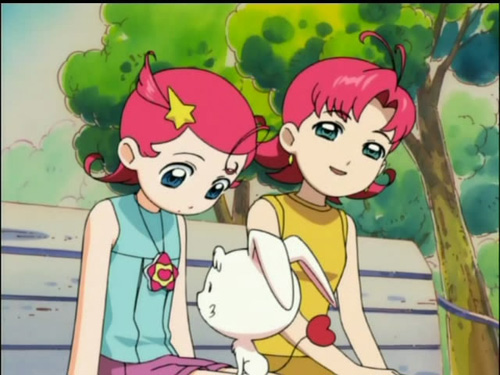
Wonderful, Everything’s Wonderful: Cosmic Baton Girl Comet-san, Revisited

When I originally wrote my Cosmic Baton Girl Comet-san review, I mentioned that I had not finished the show simply because not all of it was available at the time. In the three years since I wrote that review though, I have been able to finish the entirety of the anime (sans subtitles), and so I want to make an update, bring some closure, and tell you if my opinion has changed since then.

Pretty much everything I said in the original review still holds true. The pleasant pace, the way it makes everyday life feel worthy of discovery and appreciation, the charming characters that make you want to smile, it’s still all there from beginning to end. Comet never stops growing, Meteor shows that there’s more to her than just snooty princess-type comedy. The way the characters interact with each other shows off their personalities so well that it’s hard to find many other shows that can manage this subdued sense of wonder.

The second half does indeed bring more plot, but Comet-san never stops being an anime that you can ease yourself into. The ongoing plot points build up slowly but surely, and it has what I find to be an appropriately satisfying ending.

In considering how this show might appeal to otaku who might not necessarily be into mahou shoujo, I might compare this show to slice-of-life, but I think that would perhaps be doing Comet-san a bit of a disservice. I like slice-of-life shows, don’t get me wrong. I eagerly await the new season of Hidamari Sketch and I’m a fan of Minami-ke, but those just cover the joys of everyday life. Comet-san does that, better than those shows, but it also shows the great things and bittersweet feelings that can arise from life slowly changing, until the everyday of today is not the everyday of two months ago.

It’s somewhat of a long series at 43 episodes, but I think it’s worth it. This show is really, really good. Ojamajo Doremi good. Heartcatch Precure! good. If you have the chance, and you want to see a simple but poignant show, check out Cosmic Baton Girl Comet-san.

Reading into the Negative Responses Against Phoenix Wright in Ultimate Marvel vs. Capcom 3

Phoenix Wright was recently announced as a character for Ultimate Marvel vs. Capcom 3, and his reception from fans of MvC3 has been an interesting mix of unbridled enthusiasm and indignant anger. I find the latter to be particularly interesting because of how the criticisms from fans are being formed verbally and what it says about how a game like Ultimate Marvel vs. Capcom 3 is perceived by its audience on an aesthetic level.

Before we start though, I have to say that I do not know what percentage of fans actually dislike Phoenix Wright’s participation in this game. Whether they are a “vocal minority” or not matters little, as it is more about the reaction of that group in particular.

First off, let’s take a look at some of the comments critical of Wright as a Capcom representative:

“Im not hating at all, the game looks legit I just can’t believe that non-sense was allowed in and not a more traditional fighting game character”

“Phoenix Wright is the most awkward fighting game character I’ve ever seen. Fuck that guy. I hope he’s top tier and everyone ends up using him ’cause he’s so stupid, LMAO.

Nova on the other hand, now that’s a real character. Dude is a beast! He’s like a better Phoenix (non-Dark).”

“I agree, Phoenix Wright feels out of place here, and makes me feel like I want to throat up or something. What a crappy pick, should of been Captain Commando. We already have a Capcom joke character, his name is Frank West and he’s better than Phoenix Wrong lol.”

[In reference to a an attack Phoenix Wright uses in the trailer and the argument that Tron is a joke character too ] “Tron hits ppl, not sneezes on them”

etc.

All of them say essentially the same thing. A) character who is not a fighter an does absolutely nothing resembling combat in his own game should not be in Marvel vs. Capcom 3. B) The humor-based interpretation of his “fighting” style for UMvC3 is a slight against the game itself.

At this point, it would be easy to dismiss these statements with a couple of arguments, but those arguments have problems in and of themselves. The first is the idea that “gameplay is the only thing that really matters, so it’s not relevant if Phoenix Wright fits with the rest of the cast or not as long as he’s a strong character who can create interesting gameplay.” For Marvel vs. Capcom 3, how the game controls and whether or not it’s competitively viable are, while important to its success as a game, are obviously not the only factors in presenting it to the world and its audience. If gameplay were the only relevant component, then it wouldn’t be a crossover of a comic book company and a video game company using iconic characters from their respective libraries. Although it is easy to disagree with people who think Phoenix Wright is too ridiculous for the game (and I do disagree with them), it is besides the point to argue from a primarily theoretical game mechanics perspective.

The second is the idea that “the game is already ridiculous putting up some kung fu guys against ancient gods and beings with the power to rip the Earth in half, so why draw the line at a goofy lawyer?” But while Marvel vs. Capcom 3 (and the entire rest of the Vs. game series) does bring together a cast of characters whose powers and abilities can be horribly mismatched, it does not negate the fact that Phoenix Wright is indeed not a martial artist or in possession of superhuman abilities. A punch is a punch and can be made as strong as necessary, whereas Wright has to use something else entirely.

I think the idea that a fighting game should have “characters that fight” is an interesting one in that MvC3 becomes a sort of haven for a particular type of masculinity, a place where a (presumably male) player can feel comfortable in knowing that the setting and its character will not betray them aesthetically. This is not a coincidence, as the look of Marvel vs. Capcom 3 is masculine and powerful in a way that is particularly appealing to American audiences. This is easily seen when comparing it to its sibling, Tatsunoko vs. Capcom, whose anime influence gives a somewhat softer look to even the most square-jawed and chiseled of warriors. But Phoenix Wright apparently violates that security; to the people critical of his inclusion for the reasons outlined above, he demeans the game he’s being included in because he ends up mocking the aggressive portrayal of competition. Wright risks emasculating part of the game’s audience, somewhat like the entire Arcana Heart series minus the overt sexuality aspect that is near-unavoidable with that franchise.

Again, I do not know what percentage of people playing games feels this way, but I do have to wonder how much this affects a certain portion of gamers’ decisions in which games to pursue. Are games like Call of Duty and Halo even more indicative of this mindset? If so, it may bear taking a look at how and why men look to games to affirm their masculinity.

Thoughts on Singapore Mahjong

Ever since I wrote about the idea for a mahjong manga where the protagonist travels the world and plays various forms of the game, I’ve been eager to try out other types. Unfortunately, the best I could do was read about them and engage solely in theoryjong, which while potentially useful and certainly fun in its own way could not match the act of actually playing a game. Fortunately, I was able to find a website with not only rules for a Singapore-style of mahjong, but also an online game implemented for the enjoyment of visitors. Apparently it’s been around for a while, and I just wasn’t looking hard enough.

Before I go into my impressions of Singapore mahjong, there are two caveats I have to make. First, the online game provided by the above site is 1-player only. None of my words reflect someone who has played other human beings, and so I cannot talk much about the mental aspect of it beyond a certain solitaire-esque mindset. That said, I think a lot can be discerned just from playing the computer. Second, as I am mainly familiar with the Japanese-style riichi mahjong, I will be using that form of the game to relate my experiences. Also vital to note for those who are stumbling on this post from perhaps other mahjong sites is that I’m not even that good at Japanese mahjong, so the particulars of my “tactics” are mediocre at best.

Like all of the other forms of mahjong, the Singapore style is about creating a complete hand consisting of a number of 3-tile combinations and a pair to finish it off. 3-tile combinations consist of either three-of-a-kinds or straights. Players draw and discard tiles looking for a winning hand, with the last vital tile coming only after the rest of the hand is in a position to actually win. Like Japanese mahjong, you need at least 1 yaku/fan in order to win. However, there are three main differences (and a bunch of minor ones, but I won’t go into those too much).

1) Animal Tiles

While many forms of mahjong have “flowers,” tiles which are collected and set aside during the round that can potentially give bonuses to the player who collected them, the first and most glaring difference between Singapore Mahjong and all other forms is the additional presence of “animal tiles.” Four exist in a set: Chicken, Centipede, Cat, and Mouse, and they behave similarly to flower tiles, except that getting both the “predator” and its “prey” will net you additional points. The chicken eats the centipede, the cat eats the mouse, and should either of these happen you don’t even need to win in order to reap those benefits; you gain the points immediately. This also applies to appropriate flower tile combinations, and it means that even if you end up losing, you still kind of won.

2) Little Variation in Winning Hands

The path to winning of course lies in “fan,” or “yaku,” the predetermined combinations that are considered part of a winning hand. However, unlike Japanese mahjong, the number of fan that exist in Singapore mahjong are remarkably few in number. Whereas in riichi you get credit for hands like san shoku (either straights or triplets), chanta, junchan, chii toitsu, tanyao, ii pei kou, and san an kou, none of those I just mentioned are considered noteworthy hands in Singapore mahjong. Even Yakuman such as suu an kou, ryuu ii sou, and chuuren pooto do not get honored in this mahjong variation. Essentially, the only realistic paths are getting triplets of honor tiles, hands consisting entirely of straights (the “chicken hand” in Chinese forms of mahjong), toi toi, and either chinitsu or honitsu. If you didn’t understand any of what I just said, let me summarize by saying that Singapore mahjong has significantly fewer ways to win a game compared to Japanese mahjong, and that has a clear effect on how it plays out.

3) Everybody Pays

Another major difference with riichi mahjong is the point exchange that occurs when someone wins. In riichi, if someone draws the winning tile themselves, they get a few points from everyone else. If someone discards the winning tile, the victor takes their earnings entirely from the player who threw that tile away, with the other two players remaining untouched. Not so in Singapore mahjong, where everyone pays if a win happens on discard, and everyone pays even more when a win is achieved by self-draw. Combined with an utter lack of furiten, that lynchpin rule of Japanese mahjong that prevents a player’s discards from outright lying to the other players, it means that playing defensively as one normally would with the Japanese style does not hold anywhere near the same benefits in Singapore mahjong.

Overall

Taken all together, Singapore mahjong’s profile is that of a game where aggression is valued and tough decisions have to be made from the very start. The absence of even tanyao as a viable hand means that if your hand is half triplets and half straights, you have to make the decision to go one or the other, or to hope for some honors, flowers, or animals to give your hand the necessary minimum fan to even try to win.

The sheer lack of options can feel stifling for someone like me who is used to having many more options. Hands do not grow into one another easily; a potential san shoku cannot slowly arise from a pinfu attempt, because the gaps between hands are too stark, outside of possibly a honitsu turning into a chinitsu or vice versa. While one could argue that Japanese mahjong has too many options that make the game seem ridiculously arbitrary and tough to learn, the dearth of yaku in Singapore mahjong makes it feel less like a “flow” of tiles and more like a “hail.” That simplicity is not without its merits, but it’s something I’d have to get used to, especially coming from the defense-heavy style of riichi mahjong.

Funnily enough, a pinfu hand actually nets a whopping 4 fan (with 5 fan being the absolute limit allowed typically), but on one condition: no bonus tiles (animals, flowers) can be collected. With 12 of those suckers in a given set, it becomes a matter of avoiding “good luck” just long enough for one’s own “bad luck” to implode on itself and transform into something even more powerful.

Given that my interest in it has something to do with imagining how it would work in a comic, I have to then ask, what interesting story elements could be derived from playing Singapore mahjong? I think that for at least part of a Singapore arc, animal tiles would have to play a significant role. They’re one of the more distinct parts of this particular flavor of mahjong, and if it were something like a Fukumoto manga, the whole predator-prey thing could make for some amazing metaphors, and the immediate point exchanges upon getting a proper combination could subtly shift games.

It would also work as somewhat of a setup for a Malaysia arc, as I’ve read that 3-Player Malaysian mahjong is quite similar. I’ve yet to try that, though if someone can figure out a way for me to do so, I would very much like to hear it.

Vistas: Learning Taiwan

After a long time away from it, I’ve got a new post up on the Vistas blog, where I (sort of) talk about my recent trip to Taiwan. It has less to do with the sightseeing and more to do with realizing my own ignorance about its history. I might write up a more extensive trip post at some point for Ogiue Maniax.

Why I Think Gundam AGE Episode 1 is an Excellent First Episode

After one episode, Gundam AGE has convinced me to watch it. I don’t mean that it’s done enough that I’m willing to give it another few episodes, or even that I’m going to watch because I’m aware that Sunrise mecha series tend to take about 13 episodes for the story to “really” begin. What I am saying, rather, is that just this first episode makes me want to see the show through from beginning to end. While not perfect, in my opinion Gundam AGE has an incredibly solid first episode to the extent that even if the show turns out to be awful, I can still point to the very beginning and say, “That… was an excellent introduction.”

There are multiple reasons for why I think so highly of that first episode, but probably the biggest among them is the main character himself. As a small child, Flit is shown as having suffered a tragedy at the hands of the UE, the “Unknown Enemy.” As a 14 year old, he is clearly driven by the trauma of his past, wishing to do something to not only continue his parents’ legacy (they were Mobile Suit creators) but to never let the same thing happen again. He is motivated to act to such a degree that he creates the Gundam itself. Whereas most Gundam protagonists in the past have come across their units through a quick series of twists, Flit has been actively working towards its completion for what I can only assume has been years. He is shown to be a brilliant scientific prodigy who had to grow up a little too fast, and yet is still a kid at heart. The way he tries to convince his classmates of the impending threat of the UE shows pretty much everything about him, a mix of intelligence, dedication (possibly obsession), and the feelings and thoughts of a 14 year old boy.

Flit is a character that I can get behind. He feels like he has room to grow, and at the same time already is something of an inspirational character.

And all through this, though he has experienced tragedy, he does not feel as if he is defined as a tragic character. In fact, perhaps thanks to the show’s aesthetics, from its bright color palette to its more rounded character designs, the entire show feels fun and vibrant in a way that doesn’t negate the weight of its more serious aspects. In a way, it reminds me of the first episode of Heartcatch Precure!, which also won me over immediately. Even the shot of the space colony felt more impressive to me than it has in years;I could sense the wonder that is living in a space colony, even after being a Gundam for over a decade now. A lot happens in this first episode, both in terms of growing the story and setting up a path for Flit that feels like one he has determined for himself.

I could totally start comparing this anime to older versions of Gundam. Flit, with his seeming “paranoia” and technical skill, is like an Amuro who has discovered his motivation in life at a much younger age. Emily looks like Sayla Mass and acts like Frau Bow. The kids in Flit’s class remind me of the kids from 0080: War in the Pocket. The first activation scene takes on a significantly different meaning because of how Flit created the Gundam and so knows all of its ins and outs, and it makes me recall the scene in Char’s Counterattack where Hathaway takes about the legend of Amuro and how “he knew how to pilot it as soon as he got in.” But Gundam AGE feels so fresh and energetic that I find comparing it to other Gundam series should only be seen as a fun exercise and not as a wellspring from which to initiate constant criticism. Endlessly drawing parallels to previous iterations will only make it more difficult to see what Gundam AGE does well from the very start.

Before the series began, the promotional material stressed the generational aspect of Gundam AGE and I was actually surprised to see it hardly ever discussed among the buzz. I found it to be the most intriguing and attractive part of the concept, and while it obviously has yet to fully take effect, the generational theme has already been establishes just from this episode. The concept of the “Gundam” is passed down from Flit’s parents to himself, and I can only assume he will do the same in the future. The Gundam is spoken of in almost mythological tones, a robot from long ago that saved the world and changed everything. Seeing that scene, I could only think that, in a way, the status of the Gundam in the world of AGE mirrors the legendary status of the Gundam franchise itself. I would not be surprised if the kids watching AGE see Gundam as this piece of history that they’re told is one of the most significant pieces of anime history, but feels strangely distant, like it comes from another time. By having the Gundam take this role, Gundam AGE episode 1 really does make it seem like a Gundam for a newer generation.

Also, the robots look cool.

The Fujoshi Files 27: Naganohara Mio

Name: Naganohara Mio (長野原みお)
Alias: N/A
Relationship Status: Single
Origin: Nichijou

Information:
Naganohara Mio is a high school student and an easily excitable girl who frequently has to deal with the absurdity of others, whether it’s from her best friends Aioi Yuuko and Minakami Mai, or from her older sister Yoshino. Fairly athletic, the main thing that keeps Mio from excelling in sports is a seeming inability to channel her physical abilities in an organized fashion. Regardless, she is a fast runner, has some training in kendo (thanks to her sister being a prodigy in the sport), and is adept at pro wrestling techniques, notably the Dragon Screw. Mio is also notable for her usage of two wooden cubes as hair ties.

Mio is a skilled amateur artist who frequently ends up drawing BL content or something related to it. Though she often tries to refrain from showing that side to others, it ends up coming out whether she wants it to or not. The most frequent reference for her racier drawings is an older student named Sasahara Koujirou, a sophisticated son of a farmer on whom Mio has a crush.

Fujoshi Level:
Mio is able to use her physical skills in defense of her fujoshi lifestyle. When pushed to the limit, she is capable of defeating multiple adversaries, man or beast, in order to protect her artwork.

On NTR

I’ve been thinking recently about “netorare” or “NTR,” a porn subgenre which involves a woman being taken from her significant other by another man and forgetting about her husband/boyfriend entirely, and its rising popularity in ero anime and manga. Generally, the woman does not want to have the affair at first (and the first encounter usually involves coercion, blackmail, or rape), but is swayed by the other man’s superior sexual prowess. About the closest equivalent is a cuckolding fetish. Based on the reactions people have towards it, which is generally something like a mix of anger, frustration, and sorrow (to the extent that you have fans championing “vanilla” material as the heroic counterpart to NTR), I just have to wonder what has made it catch on.

Violence and even rape are not new to pornographic anime or manga. Go back to the 1950s and you will see those as themes in the cheaply produced porn manga that existed at the time. Same thing goes for women cheating on their men. The difference, I think, is that in those older examples, the male viewer was supposed to identify with the seducer/attacker, but in NTR that is no longer the case. The male viewer is now the hapless boyfriend or husband who means well and loves his girl, but can’t do anything about the fact that she’s tasted “better fruit.” The viewer has gone from being the holder of power to being a victim, and the fact that such a scenario has been popular makes me believe that there is a similar feeling of helplessness in those watching.

To me, it doesn’t feel like an extension of the whole “nice guy” phenomenon where girls supposedly prefer jerks, nor is it about affirming the idea that “women are sluts.” I especially don’t believe it’s what the viewers of NTR actually want in reality, and I don’t even think humiliation is the main factor for its relative popularity. Instead, I find it to be more related to perceptions of inherent or fundamental power, in this case represented by the fact that the viewer will be told that the other man has a larger, more satisfying penis that can erase even love itself. In other words, no matter what you have, you may be lacking in the one area where it matters most.

Whether they are in a relationship or not, I think guys into this sort of thing may find a strange kind of comfort in the belief that they are basically powerless or that love is balanced precariously on the fact that the girl has never experienced something better, which may even possibly relate to the appeal of the “virgin” (but we’ll put that aside for this post). To some extent, it may be similar to having a conspiracy theory confirmed or the tension from a horror movie where the main characters are inevitably doomed.

Another possible interpretation might be found in a Japanese critical line of thought concerning lolicon as it was defined back in 80s, girls drawn in a cute, round style reminiscent of Tezuka, as opposed to using a more realistic Gekiga-esque style for portraying females. Here, it is said that the men who enjoy lolicon are actually projecting themselves not onto the man having sex with the girl, but onto the girl herself. The helplessness of the girl is not a preference for weaker girls, but a source of (sexual) comfort for those who feel as weak as those girls.

If that is the case, then NTR may be a sign of men feeling weaker than before, or fearing the danger of the world around them. In this new, harsher time and place, even the comfort of identifying with the woman is taken away now that she is another thing for a man to have and lose. He is made to feel even more powerless. NTR may then be a reflection of some kind of growing discontent or discomfort.

I don’t know if either of the ideas I presented above are actually valid, let alone comprehensive, and the popularity of NTR might just stem from it having more than one type of appeal. In other words, it may have the ability to hit different people in different places, but I do think fear is a significant factor in many of them.

The “Curse” of Redline’s Aesthetic

Ever since before its actual release, Redline has been getting a lot of buzz among anime reviewers who have noted the look of the film, incredibly unique especially in today’s anime environment with a good deal of exquisite animation and attention to detail. The crowds are full of life and interesting alien designs. The vehicles used for racing are all incredibly stylish and showcase the wide array of personalities in the film. Redline oozes style and panache. However, for as refreshing as Redline‘s art is, it appears to be a double-edged sword through no fault of its own.

The “problem” with Redline‘s art is that it apparently makes people think the movie has no story, that it’s nothing but a pretty face, and has little to offer people who are interested in characterization and narrative. This is a mistake.

I’ll explain what I mean by just using the introduction to the film.

The movie begins with the Yellow Line race, a preliminary to the main “Redline” race which everyone in the galaxy looks forward to. The main character is Sweet JP, and based on the fact that it’s the start of the film, it’s easy to assume that we’ll know what will happen. If it’s a race designed to make JP look impressive, he’ll win. If he’s supposed to look like an underdog, he’ll lose. But then Redline throws us two seemingly contradictory bits of information. First, JP is a notorious for purposely throw races for profit. Second, JP really loves to race and has a passion for high-speed shenanigans. Just from that bit of information, the outcome of the race becomes ambiguous, as does JP’s character. How can a guy who fixes races enjoy himself behind the wheel that much? It gives Sweet JP a sense of mystery, and as the Yellow Line race builds up towards its climax, the question isn’t simply “will JP win or lose?” but rather “what kind of person is JP?” Would he give up money for the opportunity to enter Redline? It makes for a compelling protagonist, and it’s done with a good degree of subtlety.

I think part of the issue might be that Redline‘s frenetic, intense, and to some extent macho style makes people think that a show like that can’t have some heart, and even if the reviewers think otherwise, it doesn’t come across in the way they talk about it. While I do think that the aesthetic of Redline is such a prominent part of the film that if you dislike the way it looks you probably won’t enjoy it, I strongly believe that someone who is merely neutral towards the look of Redline can still get a ton of enjoyment out of it. Let’s not forget those potential viewers.

Ogiue Maniax on the Veef Show

I recorded a podcast over at the Veef Show just this past weekend with Andrew of Collection DX fame, and it is up for your listening pleasure.

We talk about a number of topics, but it mainly focuses on things like space travel, the state of anime, and philosophizing about that most sacred of subjects, mecha anime. For reference, my Code Geass post that we mention is this one.

Apologies for the background noise on my end. If you’re curious, that’s the sound of Leidens Ontzet.

So in summary, this:

Plus this:

Emergency Salami

For those who don’t get it: Reference #1, Reference #2.