Ogiue Maniax on the Speakeasy Podcast, Talking About Giant Robots

I recently appeared on the Reverse Thieves‘ podcast, the Speakeasy, where we discussed the topic of recommending giant robot shows for people who have had negative experiences with that genre. If you’re not sure what that means, it is not referring to fans who have simply never seen any mecha anime and are just waiting to discover the glorious territory that is giant robots, but people who may have preconceived notions about the limitations of giant robot anime based on prior exposure.

Even though that’s the main topic however, I think there’s a little something for others as well, whether you’re a  robot expert or mecha newbie. Have a listen, and make sure to comment on either the Speakeasy or the Reverse Thieves’  blog.

Show Me the Way to You: Genshiken II, Chapter 67

Chapter 67 of Genshiken II hits short and sweet, but that’s also what makes it fun.

Things are mighty awkward in Genshiken ever since Hato loudly proclaimed his BL fantasies at Comic Festival. Madarame and even Kuchiki are avoiding him. Discussing what to do, Sue points out that the loss of Madarame is the loss of Hato’s only male friend, and that there is only one solution: have Ogiue show Hato (and the other freshmen) her old Sasahara x Madarame doujinshi, so that Hato can know that his opinion, at least in the club itself, is not so unusual.

As the three freshmen are shocked by the combination of outright eroticism in Ogiue’s doujinshi and how she has depicted her own boyfriend manhandling Madarame, Hato takes “acceptance” one step further, now inspired by Ogiue’s drawings to make his own Madarame doujinshi. Just as Hato makes clear his intentions though, Madarame walks into the clubroom.

To break the awkwardness once and for all, Yajima steps up and tells Madarame that every first-year member of Genshiken saw him as an uke from their very first meeting, and that he should just treat it as the unreasonable delusions of a bunch of “rotten-minded” individuals. Kuchiki, always one to restore awkwardness to new heights however, barges in and tries to pull an anime convention move. Trying to force a kiss onto Madarame in order to please Hato, Kuchiki is neutralized by a swift palm strike from Sue and a legitimate sleeper hold from Hato’s judo skills (where according to Wikipedia it’s called a “Naked Strangle”). For the near future, Madarame is not visiting the club.

This chapter of Genshiken II initially feels a little light on content, but the more I think about it, the more I find that there is plenty of “meat” to go around, particularly in the character interactions and the bridging of gaps that occurs within them. Yajima, who has had the hardest time with Hato out of everyone, goes out of her way to make Hato feel more comfortable within the club. Though Yajima still can’t get too close to him because of the fact that Hato is indeed a man, it does feel like they have something you can call a friendship now. Then there’s Ogiue showing her doujinshi to the freshmen, which is not only the first instance of Ogiue willingly displaying it to others since Sasahara (though Sue found it on her own), but something that makes you realize the history gap between the old Genshiken and the new. To Yajima, Yoshitake, and Hato, all of this information is entirely new and exciting, in every sense of the word.

Ogiue displaying her Sasa x Mada work in front of everyone says a lot about how Genshiken, and perhaps anime fan culture has changed, at least in terms of how otaku “should” behave. We’re reminded early in the chapter that Ogiue suffered immensely for being a fujoshi, that her shame and guilt brought her to the point of an attempted suicide which Ogiue herself refers to as a “Perfect Bad End.” Even with Sasahara, she went through a lot to bring herself to show it to him. With the new members though, their reaction is only one of mild surprise, more astounded by the quality of the work itself than the fact that it actually exists. Yoshitake even wonders if Ogiue would be willing to make copies. After all, one of the first things the three first-years did as a group was think up pairings for all of Genshiken guys at a club party. Times have changed, and what was once the ultimate dark secret has become just another “thing.” As if to emphasize this contrast, Ogiue wears a flannel shirt straight out of 1980s otaku subculture during the whole presentation that makes even Yajima look more fashionable.

What’s also similarly interesting is how “Madarame as uke” became the prevailing opinion among everyone. After all, one of the first things Ohno said back when she was introduced to Ogiue’s private doujinshi was that the pairing should probably have Madarame as the aggressor and Sasahara on the receiving end. Given how they presented themselves to the world up to that point–Madarame exuded a forceful persona of “proud otaku” and Sasahara was a quiet guy who went along with the flow–it seemed to be the more “sensible” pairing, but apparently Ogiue was able to see it on a deeper level, though it might just be that Ogiue came in around the time that Madarame and Sasahara began to change, Madarame from unrequited love and Sasahara from growing a spine. Just as Ogiue’s initial impression of everyone in the club was different from that of Sasahara’s, so too have Yajima, Yoshitake, and Hato formed opinions through their own limited experience. Granted, the freshmen are also kind of a different breed of otaku, so there’s no telling what would have happened had they met Madarame a few years ago instead.

Meanwhile through all of this, Yoshitake shows what it’s like to be an anime nerd seemingly free of worry in regards to the opinions of others, all while actually being socially aware, unlike Kuchiki. If ever there was a character to show how the right kind of confidence and passion can counter any inherent awkwardness from a given topic, that would be Ed Chavez, but in his absence Yoshitake Rika is the next best thing. Reading this chapter, I found myself asking, so when does Yoshitake get her time in the spotlight, and as if to answer me directly, the preview blurb mentions that she is getting center stage next chapter.

I’m excited, how about you?

The Fujoshi Files 24: Kanbaru Suruga

Name: Kanbaru, Suruga (神原駿河)
Alias: Valhalla Combo (バルハラコンビ)
Relationship Status: Single
Origin: Bakemonogatari

Information:
Kanbaru Suruga is the basketball ace of Naoetsu Private High School who in junior high was part of the “Valhalla Combo,” a designation given to her and track star Senjougahara Hitagi (by herself) for their athletic abilities. A quick runner and capable of even delivering dunks, Her friendship with Senjougahara wanes after junior high due to a sudden change in Hitagi’s personality, as well as Kanbaru’s own confession towards her being rejected. The negative effects of this rejection are compounded when Kanbaru discovers in high school that Hitagi had begun dating one Araragi Koyomi.

Kanbaru’s most distinguishing visual feature is her bandaged left arm, which hides the furry demonic limb of a “Rainy Devil.” Originally mistaking it for a monkey’s paw, the arm still grants her wishes, only it fulfills her darkest desires instead of what she says aloud, and often does so violently. Its power is only subdued when the demon in her arm’s contract cannot be fulfilled.

Despite the seriousness of her situation, Kanbaru is quite forward and cheerful. She also identifies herself as being something of a pervert, being a self-admitted lesbian, fujoshi, exhibitionist, lolicon, and masochist.

Fujoshi Level:
Kanbaru’s room is filled with so many books that they take up the vast majority of space. Though it is unclear just how many books are BL and how many cater to her other tastes, it is a good indicator that her ability to collect and consume yaoi is nothing short of astonishing.

Half-Baked Japanese Reading

Recently I’ve been reading a Japanese book, Mangagaku Nyuumon, or Introduction to Manga Studies by Natsume Fusanosuke and Takeuchi Osamu. I won’t get into the details of what I’ve been learning from the book though, as the reason I’m mentioning this is that I find it to be a pretty good sign that my Japanese is getting better, at least in terms of literacy (speaking is another matter).

Prior to this, the only entirely Japanese book I’ve tried to read is the Genshiken novel, so my experience with non-manga texts is sparse and unreliable. This being an academic/informational text, I knew I was going to be in way over my head with a lot of kanji and terminology (and my Level 2 JLPT says I only know 1000 or so kanji out of the roughly 2000 that comprises official “literacy”), so I decided to just use a pencil to jot down on the pages themselves any words I didn’t know. If I already wrote down the meaning and pronunciation of a word previously but cannot remember it when the word appears again, then I write it down again. If I only know partial information, such as how a word is pronounced but not its meaning or vice versa, I only write down that which I do not know. If it’s a word I can only remember partially from having found its definition previously, then just the same I record only what I’ve forgotten. After that, I try and read through the whole chapter again, using my notes as reference.

The first chapter took me about 3 or 4 days to jot down all of the notes for untranslated words. Then it took me another day to read through it. Slowly but surely though, I found myself going through the chapters more quickly, and now I can “translate” and re-read through a chapter in less than a day, though it may take longer if there are more terms I don’t know. It feels good to see actual improvement in myself, and though I know that if you erased all of my notes I’d still be in a bit of trouble, I know that this progress I can take to the bank.

Let’s see if I can keep this up!

The Expanding/Contracting Anime Fanbase

Floating out there in the general discourse are what seem to be two contradictory ideas of anime fans.

1) Anime is appealing increasingly to a smaller and more niche crowd of otaku, often through devices such as loads of fanservice or active use of moe. As such, the fanbase is becoming more and more a select group of adult men who grow older and smaller in number over time.

2) Anime fans are getting younger and younger, that anime is attracting a primarily female audience. Moreover, a lot of these young fans are not able to retain their fandom as they grow older. They hit a certain age and anime stops being their obsession.

So somehow you have a fandom that is both shrinking and growing larger, while the median age rises but also lowers or remains the same, and this is all being done with the same collective pool of works we call “anime.” On the surface, something doesn’t quite add up. The more I think about it though, the more I find this isn’t necessarily an irreconcilable contradiction. I mostly have impressions and hunches from observing anime and its fans, but I can think of some possibilities as to how these two concepts can co-exist.

It might be that some fans are longing for another period of anime, a self-defined golden age where anime was at its best.  If it’s not simply a matter of nostalgia or specific tastes though, then it could be that these fans are not finding what they want in either side, the young and general, or the old and niche where they might have once been able to easily. So the anime fanbase may not necessarily be shrinking overall, but the demographic ratios may be shifting in a way that’s troubling to some. This one does not necessarily have any flaws, but it seems more to be a mix-up of personal desire for general trends.

Another possibility is that the effects of anime’s move towards extremes in its fanbase cannot be felt immediately and that it will take some number of years to really see the fallout. Perhaps it would be the age at which the current otaku base starts to literally die off, much like some of the criticism surrounding the current state of American superhero comics. This one doesn’t quite feel right through, and I can’t put my finger on why.

Similarly, while the younger fanbase is increasing, they are finding their access to anime through inexpensive means, be it through outright piracy or simply watching things streaming. “The surest” way at the moment to make reliable profit is to hit the collection/merchandise-obsessed otaku, hence all of the light novel adaptations. The amount of money being generated by anime is not what it used to be and may never be at that level ever again, even if there are new fans.

Overall, I’m not really sure. These are incomplete thoughts and I don’t think I’m going to be reaching a solid conclusion any time soon. I’d like to hear other people’s thoughts.


A Look at Fanservice Through Redline and Kanokon

The Reverse Thieves recently made a post about the level of acceptance that anime fans have for fanservice (meant here as sexual fanservice and not intricate weapon details, for instance) in their shows, where they discuss how the view towards cheesecake seems to get increasingly polarized the more extreme and perhaps fetishistic broadcast anime becomes. Having just written my own thoughts on a similar subject, I feel like the question of how fanservice is both executed and perceived, and I think the film Redline provides some good insight into the matter, especially when compared to a representative otaku fanservice show such as Kanokon.

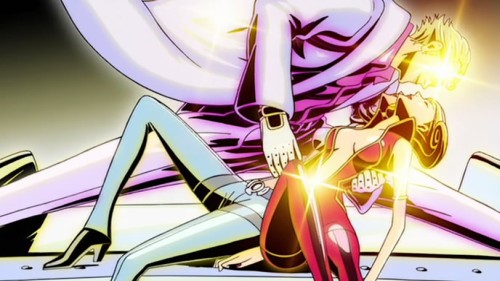
Redline is an anime very different from the norm, and especially different from what is popular with the current generation of otaku. Featuring a wild aesthetic somewhat similar to that of Dead Leaves, Gerald and Tim Maughan on Anime World Order referred to it as the anime they’d been waiting for since Akira. What that means is that Redline is a film capable of drawing in both anime fans that had left the scene long ago, as well as attract an audience similar to those people. It has a manic edge that’s got a certain dangerous appeal to it, and that extends to its fanservice as well.

The women in Redline are definitely overtly sexualized. Between two chesty music idols named the “Superboins” and the most important female character Sonoshee getting an extended topless scene, there is no argument that the film wants you to think of those characters as extraordinarily attractive. They are, to a certain extent, designed for fanservice, but compared to the fanservice from a series like Kanokon, it feels very different.

It would be easy to say that there is a “right” kind of fanservice, and to make the argument that “Kanokon’s fanservice is creepy and Redline’s isn’t. That’s not quite right, though. It’s too simple, and based on too many assumptions, like the idea that just because Kanokon is designed to sell through its harem and Redline‘s appeal lies primarily in its visual design that there is something inherently wrong with the former. Personally speaking, I vastly prefer Redline over Kanokon, but I’ll save that for a possible review in the near future. The real difference, I think, lies not in simply how the girls look (lolicon is not even a topic of discussion or possible misunderstanding with Redline), but with how they present to the viewer, particularly male viewers, what kind of qualities a man should have in order to obtain the idealized women in each respective series.

With Kouta, the main in Kanokon, the defining traits of his character and by extension the things that get the women flocking to him are his quietness, his sensitivity, and his decency. In Redline on the other hand, the portrayal of the women emphasizes “he-men, men of action,” as the old Charles Bronson Mandom commercial goes. Protagonist JP sticks up for his beliefs even if it gets him beat down, and the man he idolized in his youth can be seen in a flashback kissing two bikini babes simultaneously. Both are versions of male fantasy, the nice guy who is appreciated by all of the women and the daredevil who sets girls’ hearts aflutter, but they have a decidedly different appeal to them that doesn’t just have to do with how much Kanokon toes the line between fanservice and outright porn. They exist on somewhat opposite ends of a spectrum of male behavior, and the manner in which the women are sexualized, not just visually but also in their actions within the story, runs accordingly. With that in mind, I think it can be easy to see why there would be conflict between the two sides.

This is not an indictment on either type of male character or the series which they come from, especially with JP in Redline who is shown to be sensitive in his own way. Neither portrayal is inherently worse than the other, but problems can arise. Indeed, while both the “nice guy” and the “man of action” can be portrayed well as men of character and strength, they can also be pushed to unpleasant extremes, though the nature of that negativity can itself be different. The nice guy can be so passive as to absolve him of any mistakes he should be responsible for, and the man of action can often times be seen as a man who treats women purely as playthings to be manipulated. It is also not an indictment on the fans who identify with either character type, as the meaning of terms such as “wish fulfillment” and “role model” can get complicated. Is it better for a quiet nerd to prefer the quiet nerd character he is, or the active warrior that might wish he wants to be? I think that question lies at the heart of the difference in how fanservice is executed.

Fujoshi Characters by the Score

When I first began the Fujoshi Files, my intent was to put the spotlight on what I saw as a rising trend at the time: the appearance of the yaoi-loving female fan as a character archetype, particularly in the manga and anime targeted towards that otaku market, as well as the presence of “fujoshi-like” traits in characters who might not qualify otherwise. From what I knew, there were enough to get a decent-sized list, and as it was a burgeoning character trait, I figured if I did one every couple of months or so that I’d be able to keep up fairly easily.

That was not the case, and now I currently find myself with a backlog bigger than the amount of Fujoshi Files currently available on the site. Aware that I had been neglecting it somewhat over the past year or so, I’ve decided to start posting them more frequently. Most likely, you’ll be seeing them every other Sunday, but this is subject to change, particularly if I feel like I don’t have anything ready by then.

One problem that has faced the Fujoshi Files since very early on has been access to the works themselves, because I try to write a profile after reading as much as is available at the time. This can result in entries that are outdated, but it also makes it so that I don’t always feel I can write an accurate description of the characters themselves. Sometimes, a character’s name will be mentioned in passing in a single panel and then never again, and then when I look online and see that there are no records of a character by that name, I have to ask myself if I just imagined it. Still, the way I’m planning on posting these, I believe I will do a pretty good job of reading the source material while still posting entries regularly.

Another issue has been the sheer amount of characters that could potentially qualify. While it seems like the small “boom” of fujoshi main character may have died down recently, there are still plenty of minor fujoshi characters appearing in series, and it’s even gotten to the point where someone will make mention of a fujoshi, or there will be nameless fujoshi in the background and I can’t decided whether or not I should count such things. For example, in Baka and Test: Summon the Beasts, Himeji mentions in one episode that she has a friend who is a fujoshi. What would I even do about an image? If I counted such a “character,” would I be taking it too far? I get the feeling the answer is “yes,” but I’d like for the Files to be comprehensive.

And that’s not even mentioning Genshiken II, which has a whole new batch of characters who need profiling, or the spinoffs and alternate universes that have spawned out of Tonari no 801-chan. Those will come in due time.

What do you think? If you’ve been enjoying my little side project over these past few years, then how comprehensive should I make it? Should I include even background characters? Would you prefer I post somewhat incomplete entries and then fill them back in later?

The Fujoshi Files 23: “Onee-chan”

Name: N/A
Alias:
“Onee-chan” (お姉ちゃん), “Nee-chan” (ねーちゃん)
Relationship Status: Complicated
Origin: Fujoshi Nikushoku Hikikomori

Information:
An unnamed hikikomori, this girl is occasionally visited by a younger guy. Possessing a strong sexual appetite, she aggressively pursues a primarily physical relationship with her male friend.

Fujoshi Level:
Other than her designation as a “fujoshi,” there is little evidence of her status as such. The most relevant information available is that she treats her friend like a typical BL “uke/bottom” character.

Objectification of the Vaunted…or Something? (NSFW)

When I look at certain cheesecake-oriented American comics such as Lady Death, Vampirella, and Taboo, I find that they bother me in a way that fanservicey manga, anime, etc. do not. It’s something I haven’t entirely figured out why, but there’s an inkling somewhere in my mind that tells me to head a certain direction. This post is the exploration of that feeling.

Before I start though, I’m going to have to point out that the images used in this post may be considered not work-safe. Careful!

Continue reading

Suite Precure Transitions

I’ve been keeping up with Suite Precure since it began last February, and while it isn’t quite the masterpiece that Heartcatch Precure! is, it’s still enjoyable enough. We’ve hit roughly the middle point of Suite Precure, and quite a few things have happened along the way, including the reveal of a new Cure or two.

I’m going to discuss some of my feelings on these current episodes (as well as previous Precure series), so if you don’t want to be spoiled, turn away.

Continue reading