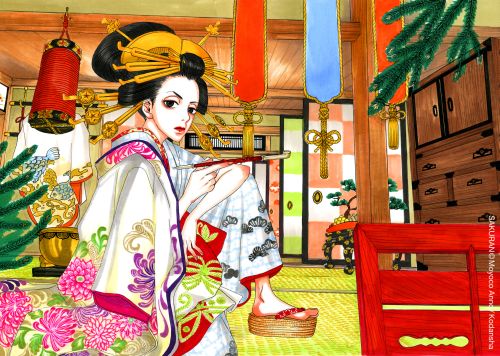
Shoujo is Good

Recently, debate about shoujo manga has centered around “girliness.” Although the word can have multiple meanings, in the context of shoujo it generally refers to pink hearts, sparkles, and school romance, all things you may very well see if you are to pick up a random volume of shoujo. Writers have been addressing how the girliness of shoujo is seen by people of all varieties, girls, guys, those intimately familiar with manga and those who hardly know anything, and any issues that arise from that perception.

The definition of shoujo manga comes into question as a result. Is shoujo defined by those aesthetic and thematic tropes, or is it something much broader? Is shoujo manga simply any comic that runs in a shoujo magazine, no matter the content? But while these are all very good questions, I feel like they are obscuring a very important idea that is more fundamental to manga and storytelling in general.

Setting aside whether or not shoujo is limited by tropes, average girls and impossibly handsome men covered in hearts and sparkles do not preclude good storytelling. It may not be someone’s cup of tea to read about the trials and tribulations of a 14 year old’s love triangle, but there is no ironclad rule stating that such a story cannot be not only entertaining but also legitimately good and able to speak to a wider audience.

Brigid Alverson equates shoujo manga with trashy romance novels, stating, “You read your chosen genre for relaxation, not literary quality.” While I do read shoujo for my own comfort, I also actively look for literary quality in it and am frequently rewarded as a result. I do not believe that it is some rare feat to find strong storytelling and strong characters in shoujo, whether it’s from the 70s or from this past decade, and that is also largely because I do not see shoujo as being limited by convention.

I’m not saying that one should just accept everything without a critical eye, but simply that when the reward is less stellar, one should not necessarily condemn the tropes from holding back shoujo, but perhaps view it as an individual story failing to use those elements in an effective manner. The potential for good, strong fiction is still there and the fact that the heroine’s parents died, conveniently leaving her to fend for herself, is not a death sentence for quality.  It is not only possible to appreciate both shoujo which has all the trappings of “girliness” as well as shoujo which eschews that aesthetic, but to appreciate both on equal levels. Just because you enjoy the unorthodox doesn’t mean that the orthodox is inherently worse or vice versa. Shoujo is both and everything in between, and in every case, whether the manga are adhering to convention or not, good stories can be told, and found, on a regular basis.

Mitsuya Yuuji Throughout Combattler V: A “Lesson” in Voice Acting

At Otakon 2010, voice acting veteran Mitsuya Yuuji (or Yuji Mitsuya) was a goldmine of valuable information about the industry and the art of voice acting, using his own experience as a complete seiyuu rookie on Choudenji Robo Combattler V as an example During the panel, he mentioned that an interesting exercise is to compare a voice actor’s performance in the first episode to their performance in the final episode.

Taking that suggestion to heart and expanding on it a little further, I’ve compiled a clip of Mitsuya’s voice acting progression from the beginning to end of Combattler V‘s 54 episodes. Not every episode is shown here, but it still gives a good indication of how much effort he put into improving.

Early on, you can hear that he’s clearly an amateur and not entirely sure what to do with the role. He also sounds much deeper, having not yet hit upon the right voice for the main hero Hyouma. You can also hear him experimenting with all sorts of ways to say Combattler V’s name, stretching this syllable, shortening that one and so on. Towards the middle around when the story starts to really ramp up, he puts a lot more intensity into his performance. Then, in the second half you’ll notice that he’s starting to find a “standard” of sorts on how to shout, “Combattler….V!” until it pretty much solidifies, for better or worse.

Remember that this was Mitsuya’s debut role, and here you can really see his growth as a voice actor. It’s no wonder he’d go on to form his own voice acting school.

At his panel, Mitsuya placed great emphasis on the fact that a lot of male voice actors these days try too hard to maintain the “coolness” of their characters and don’t put their all into their performances, citing that this probably has to do with the fact that not nearly as many voice actors these days come from a theatre background (if any at all). It’s interesting then to think about how Mitsuya’s own theatrical experience still had to be molded to fit voice acting.

As a bonus, take a look at his performance in 2000’s Super Robot Wars Alpha, where he has to perform the same line as in the above video roughly 25 years later. Skip to 0:46 to hear it (or watch the whole video, it’s cool). Amazingly, his voice appears to have gone up with age.

If Only It Were a Ra Tilt Instead

A few months ago, after many hours of intense not-actually-gambling gambling action, I managed to graduate to the next level in the online mahjong client Tenhou. Then, two weeks ago, I squandered all of that and lost so much that I got demoted. From this experience I have learned many things.

When I was telling esteemed Anime News Network columnist and mahjong co-panelist Dave about it, he said that I must be “going tilt,” which I learned was poker lingo for someone whose emotions are clouding his or her ability to play well. At first I denied that this could possibly be happening to me, but in hindsight that was exactly the problem.

It all began when I actually became aware of the points system on Tenhou. On Tenhou, in addition to the scoring in the game itself, between matches you gain or lose what are essentially experience points. The better you do, the more points you receive, until you manage to break into the next level. Lose, however, and points are deducted from you. In my situation, I was just one point away from reaching the next rank, where even barely placing 2nd in a game would have been enough. Conversely, I lost the match hard and then proceeded to lose pretty much every other match following. I kept thinking to myself, “You were so close to moving forward! Just keep at it!” This eventually turned into desperation where I was trying to just win something, which pretty much had the opposite effect. And all that while, I was constantly looking back at my points. I became too obsessed with seeing those numbers go up and it completely affected my skill and it cost me.

While my life was not on the line, from this experience I can relate to Nangou in the first episode of Akagi. Nangou is in deep, deep debt to the yakuza, and in his mahjong game against said gangsters he is desperate for any sort of win, but this desperation also prevents him from accomplishing anything. He is too afraid to take risks when he should, and so behind that even a glimmer of hope for a high-scoring hand means he’ll go for it even when he has almost no chance of accomplishing it. It is not until Akagi himself arrives that Nangou is able to break the self-induced spell and play as he should, foregoing his frantic scurryings for a confident charge forward. For me, the realization hit when I ended up dropping down a rank.

From that, I looked at myself and figured out some of the tendencies that arise in me when I’m desperate. The first is to be bothered when someone declares riichi very early in the game. When one goes into riichi, it appears a bold declaration that they are about to win. Under normal circumstances I welcome the challenge, but when I’m going tilt it becomes almost nerve-wracking, and I get so eager to finish a hand that I easily throw away tiles I shouldn’t, as opposed to when I’m right of mind and am able to alter my hand much more readily. That leads me into the second sign, which is that I get too attached to achieving certain hands, and become too unwilling to deviate. This is more than just a matter of going for high-risk hands when I shouldn’t, because even the cheaper, easier to assemble hands can result in the same trap. When you’re aiming for pinfu (a hand that is special because there is absolutely nothing special about it) no matter what, pinfu starts to feel surprisingly distant. Even my favored ikkitsuukan (full straight) does its best when my hand gradually morphs into it, as opposed to when I am consciously aiming for it.

Although this can be attributed to simple probability, I have a rather occult feeling about it, which is that fear is a big problem in mahjong. Without the ability to overcome fear, the hand is often unable to progress and transform. Sometimes I have to be able to abandon a seemingly grand potential because in reality it is a stifling noose that keeps me and my hand from growing within the game.

See 50 of Your Favorite Manga Artists Take on the History of Japan

Weekly Manga History of Japan is a magazine that launched in 2009, giving full-color comics of famous figures in Japanese history, from Kamui to MacArthur. This October, they’re set to continue the series with NEW Weekly Manga History of Japan, and when you see the list of manga artists they have doing each story, you might just flip. Though the list isn’t totally complete yet, see if you can spot your favorites!

The series begins on October 12th.

01. “Yamatotakeru” by Watsuki Nobuhiro (Rurouni Kenshin)

02. “Emperor Nintoku” by Akana Shuu (Yuugo the Negotiator)

03. “Soga no Umako” by Tateo Retsu (Full Metal Panic!)

04. “Princess Nukata” by Ninomiya Tomoko (Nodame Cantabile)

05. “Gyouki” by ???

06. “Abe no Nakamaro” by Syubuka Masamune (Neriyakanaya)

07. “Sakanoue no Tamuramaro” by Sasameyuki Jun (ZZ)

08. “Ono no Kamachi” by ???

09. “Taira no Masakado” by ???

10. “Abe no Seimei” by Sarachi Yomi (Steins’ Gate)

11. “Minamoto no Yoshinaka” by Shimotsuki Kairi (Sengoku Basara)

12. “Houjou Masako” by Shihira Tatsuya (13Club)

13. “Unkei & Kaikei” by ???

14. “Shinran” by Yoshida Satoshi (Shounan Bakusouzoku)

15. “Kusunoki Masashige” by Minamoto Yuu (Asu no Yoichi!)

16. “Yoshida Kenkou” by ???

17. “Kan’ami Kiyotsugu & Zeami Motokiyo” by ???

18. “Ikkyuu Soujun” by ???

19. “Saitou Dousan” by ???

20. “Uesugi Kenshin” by Yamada Koutarou (Fire Emblem: Champion’s Sword)

21. “Hattori Hanzou” by ???

22. “Sen no Rikyuu” by ???

23. “Hosokawa Garasha” by Amano Sakuya (Princess Arakami)

24. “Date Masamune” by Shimizu Eiichi & Shimoguchi Tomuhiro (Linebarrels of Iron)

25. “Kuroda Kanbei” by Ikegami Ryouichi (Sanctuary, Crying Freeman)

26. “Sanada Yukimura” by ???

27. “Izumo no Okuni” by Kakinouchi Narumi (Vampire Princess Miyu, Animation Director for Megazone 23)

28. “Yagyuu Munenori” by ???

29. “Kasuga no Tsubone” by ???

30. “Amakusa Shirou” by Kusaba Michiteru (Fantasista)

31. “Matsuo Bashou” by ???

32. “Kinokuniya Bunzaemon” by ???

33. “Tokugawa Yoshimune” by ???

34. “Hiraga Gennai” by ???

35. “Raiden Tameemon” by Arakawa Hiromu (Fullmetal Alchemist)

36. “Kumazawa Banzan” by Hosono Fujihiko (Crusher Joe, Gallery Fake)

37. “Takasugi Shinsaku” by Takahashi Tsutomu (Jiraishin, SIDOOH)

38. “Kondou Isami” by ???

39. “Byakkotai” by ???

40. “Atsuhime” by Ikeda Riyoko (Rose of Versailles, Oniisama e…)

41. Tokugawa Yoshinobu” by ???

42. “Ookubo Toshimichi” by ???

43. “Natsume Souseki” by Sugimoto Ikura (Variante)

44. “Nogi Maresuke” by ???

45. “Tsuda Umeko” by Mikimoto Haruhiko (Mobile Suit Gundam: École du Ciel, character designer of Macross, Gunbuster)

46. “Shibusawa Eiichi” by ???

47. “Minakata Kumagusu” by ???

48. “Takahashi Korekiyo” by ???

49. “Yamamoto Isoroku” by Ark-Performance (Blue Steel Arpeggio)

50. “Shirasu Jirou” by Oh Great! (Tenjou Tenge, Air Gear)

You can see sample illustrations here.

Why Are They Making Ash Ketchum’s Eyes So Huge? I’ll Tell You!

In anticipation of the latest Pokemon Black & White games, the anime of Pokemon is undergoing a revamp, and with this newest iteration comes a great amount of aesthetic change for a series which has up to this point remained fairly static in that regard (or at the very least has experienced change so gradual as to be unnoticeable). Many long-time characters are undergoing design changes, but perhaps the most prominent is that of main character Satoshi, possibly better known as Ash Ketchum, whose irises appear to have doubled in size.

Around the internet, people have been wondering what could possibly be the catalyst for this change. The truth lies with the character designer for the Pokemon games, Sugimori Ken.

Sugimori was the original Pokemon artist, drawing up all 151 of the originals as well as all of the character artwork. Even now he remains in that position, with his works being the official depictions of all humans and Pokemon in the franchise. Essentially, this means that Sugimori has been drawing for Pokemon for 15 years now, and his artistic sense and style have grown accordingly. Whereas the designs for the anime originally drew inspiration largely from Sugimori’s original designs for the first generation of Pokemon games and have remained fairly constant since, Sugimori’s own artwork has gone through a one and a half decade process of refinement.

Left: 1995-1998, Right: 2010

When you look at the anime’s new character designs, you can see that they are simply re-aligning themselves with Sugimori’s work.

So in a way, the artwork for the Pokemon anime is pretty much ending up where it should be.

Better Go Get Some 3G Coverage

The Passing: Satoshi Kon

Satoshi Kon, dead at age 47, will always be remembered for creating great animated films.

In writing this post, I am aware that I am nowhere near the biggest Kon fan. I’ve only seen a handful of his total output, owning none of it on physical media or in digital format, but I know that of the films I have seen, all have had a profound effect on me. To this day, I distinctly remember that scene in Millennium Actress where the titular character is moving gracefully between still paintings, stepping out of one and taking up her pose in the next. It’s visually creative in a way rarely seen in anime, even with someone like Miyazaki, who usually goes a much more orthodox route when it comes to representation of events. It’s the kind of thing that gets burned into your memories, and you’re all the better for it.

When I say that the man will be remembered for creating great animated films, you might be wondering, by whom? And the answer is nearly everyone. Not just film buffs, not just the casual movie-going audience, and especially not just anime fans who themselves come in all varieties, but just about anyone who’s had the opportunity to see one of his films. Satoshi Kon’s recurring themes of psychology, memories, and dreams have the potential to be incredibly heavy and complex to the point of driving people away, but instead Kon managed to create incredibly accessible works which get their audiences to think. Not every film is for every person, but there’s inevitably one you can show to your friends or your family and have a nice discussion afterward. You want to know how to mature your tastes as an anime fan in a short amount of time? Watch a Kon film, and see where your mind takes you.

I’ve seen around the internet that people are worried about the fate of anime and the creativity therein after all of this. To this I say, losing Satoshi Kon, especially at such a young age, is a serious blow to the heart and gut of Japanese animation, but great creators die. It’s kind of what they do, being human and all, and to dwell on what they could have done, while a worthwhile exercise, only takes you so far. A creative form of expression such as animation, Japanese or otherwise, is not so simple that it can be felled by the death of one man, great as he may have been. There is mourning, but there is also the next step.

Rest in peace, Satoshi Kon, with the knowledge that it’s impossible for you to not have inspired someone.

Review Time

How soon after you watch something should you review it?

Over the course of writing Ogiue Maniax, I’ve taken different approaches to writing reviews. Sometimes Iwrite them almost immediately after watching something, while other times I wait a day or a week. In some instances the delay is a month or more. Writing a review right after finishing something means that the experience is very fresh, that a lot of the emotions you felt in watching it are still welling up inside, but expressing your thoughts so soon after can also mean that you haven’t had time to process everything. On the other hand, the longer you wait, the more distance you give yourself in order to really chew on the work, to really see what it says. Too much time however, and you might start to forget important things. But then if you forgot those things, were they really that important in your mind?

So then you might say, “Why not rewatch it? That way you’ll have your memories of having seen it the first time, and then also it’ll be fresh in your mind.” But while I’m in no way against rewatching a show for review purposes or otherwise, I have to wonder about what the process of rewatching does to your experience with a work. In my review of Xam’d, I talk about how the series pretty much thrusts you into a very complex situation with little or no explanation to the extent that you aren’t even sure who’s on what side until a few episodes later. Going back and rewatching those episodes after having finished at least a good portion of the series means you can actually see what is happening in those early episodes, but at the same time is that a good thing? Is it a positive that you have that greater clarity, or is the loss of that rushed, turbulent feeling detrimental to your experience with it? Lost memories, indeed.

One last question for you all: The concept of “reviewing” aside, do you feel the way you talk about a show or a film or a book changing as time passes, like when you compare your conversation right after you get out of the theater to when you’re talking about it one month later?

Ogiue Maniax on the Otagal Podcast

In case you weren’t aware, I appeared on a recent episode of the Otagal podcast, talking about your favorite subject and mine, Genshiken, or at the very least Genshiken 2.

Viga was my co-host for the Ogiue panel at Otakon 2010, and we have some good discussion for this podcast.

Hope you all enjoy my distinctly non-radio voice.

V! V! V!

Puberty is a funny thing when you’re a fan.

In some instances, a female character can enter the mind of a young boy just by virtue of being the most prominent female in his favorite show, and then stay with him as he awakens sexually. Of course it doesn’t happen to every fan, and I’d be remiss to not include female fans who carry the torch for their male childhood crushes (or varying combinations between these two areas), but as a guy who likes girls I want to focus on that area. Feel free to chime in with your own thoughts given your own sexuality.

The first examples I can think of are Sayaka from Mazinger Z and Chizuru from Combattler V. While they are obviously not applicable to me seeing as I did not grow up with either show, in Japan and Italy and other parts of the world where these shows found popularity you have a lot of devoted male fans who will sexualize them and possibly draw fanart of them, to the extent that someone unfamiliar with these series might scratch their heads, or perhaps get the wrong impression of them when they see fanart of Chizuru in an outfit that’s quite a bit tighter than canon suggests. This is not a knock on either Sayaka or Chizuru. I can easily see guys liking them for legitimate reasons, and they’re even portrayed as attractive within the contexts of their shows (e.g. shower scenes), but I think there’s more to it than that.

An even better example might be video game characters. I’m not talking about your RPG characters who get loads of development, or games that have come out more recently and have the benefit of powerful graphics to improve character design and rendering, but those old, let’s say pre-90’s video games which barely had stories to go with them. While Samus Aran has had a lot of development over the years, guys were finding her hot since the NES era. Obviously her stripping to her skivvies in the ending sequence plays a role in this, but I think what pushes that over the edge is that you play as her for so long that you get attached to her. Again, familiarity.

Of course this doesn’t happen with every fan, but being a fan makes this more likely, I think. To preserve the memories of their favorite “stories” from childhood and bring those memories with them through to their teenage years and possibly their adult life, isn’t that the kind of thing a fan does?

And then my thoughts lead towards “moe.” Modern moe shows of course don’t have that advantage of familiarity, but when I think about it, liking a video game character because of the two or three things you know about them and liking a moe girl who is a collection of moe traits aren’t that far off. So I wonder if moe in the marketing sense of the word is trying to tap into that same nostalgia reservoir, only through more “efficient” means.

I’m not here to judge what characters you like for whatever reason, but to simply put down my thoughts on the way the fan mind works, particularly for when you start thinking girls (or guys) are awfully nice-looking.

On another note, I realize my past three post titles have all been song lyrics. Yeah I don’t know either.