Nandoga Nare: Let’s Get Ready for Otakon 2010

Otakon is this weekend, and I am psyched. Not only that, but if you didn’t know before, I’m doing two panels this year. You’ll find both of them on the Otakon Schedule, but just to make sure, I’ll highlight them below.

Riichi: Japanese Mahjong, Anime, and You
Time: Friday, July 30 at 9:30am
Location: Panel 4
(Hilton Key 11-12)

If you’ve watched such popular anime as Akagi and Saki, you’ve been witness to the ancient game of mahjong– and you had no clue what the players were doing. Maybe you’ve even tried the game and found the complicated rules too intimidating. We did too! But we managed, and today we’re here to show you that it can be done. Let us enlighten you on the basics of Japanese style, or “riichi” mahjong, its appearances in anime and the entire genre of manga devoted to it, and how to play this fascinating game!

Portrait of a Fujoshi: The Psychology of Ogiue Chika
Time: Friday, July 30 at 11:00pm
Location: Panel 4 (
Hilton Key 11-12)

Throughout the series “Genshiken,” the character of Ogiue Chika goes on a journey of development, tackling topics such as self-image, childhood trauma, and the many perils of being an otaku-in-denial. Come, if you want to really delve into the mind of Genshiken’s most psychologically complex character with a panel brought to you by the experts on angry fujoshi characters, Ogiue Maniax and Viga the Otagal!

Now I understand that the first panel is very early and the second panel is very late, but I think you’ll get a kick out of both, particularly if you are a fan of both Ogiue and mahjong (I’m sure there’s a lot of you out there).

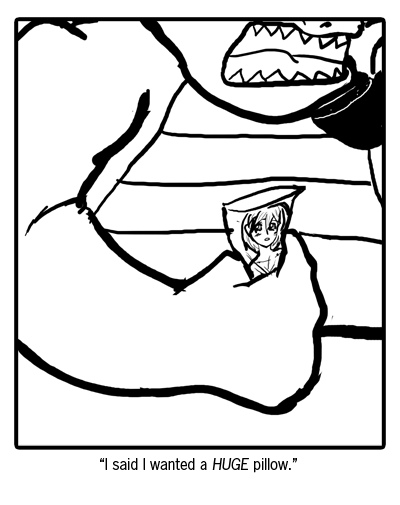
I’ll also be running around with the above image around my neck. It’s a special badge for this year that I’ve put quite a bit of thought into. You might even be wondering, “Are those a random assortment of tiles below Ogiue to reference the mahjong side of things?” But they’re not.

The hand is a Hon Itsu, or Half Flush, signifying Ogiue’s self-image of “impurity.” It also contains bamboo tiles, as the Ogi in Ogiue means “reed,” with the added benefit of the 7 of bamboo resembling Ogiue’s paintbrush hairstyle. They’re all odd numbers because Ogiue herself is odd, and the east and north tiles are in reference to the fact that Ogiue is from “Tohoku,” the northeast region of Japan. Finally, the hand is also a Chii Toitsu, or Seven Pairs, because Ogiue is a fujoshi who likes to come up with pairings.

See you in Baltimore!

Kamoflage

For those of you who’ve been watching the Pokemon anime for years now, you may recall the female character May (Japanese name Haruka), who was the main heroine for the entirety of the Game Boy Advance era of Pokemon games.

What you may not have noticed however is that her character design, well, changed throughout the course of the series. See if you can spot the difference below:

Thanks to kransom for finding this.

What in the world could be responsible for Haruka’s, shall we say, simplification? The easy knee-jerk reaction would be pressure from foreign countries to reduce the amount of eye candy in their internationally famous Japanese franchise cartoon, but something tells me that it has a little more to do with someone realizing that the girl is supposed to be ten years old.

Sho Nuff Himself Would Be Scared

When I think of western anime fanart, the first thing that pops into my mind is something I call the “Deviantart style.” Characters are usually drawn fairly realistically, their bodies becoming canvases for a psuedo-airbrushed look, every shadow and every highlight blended so softly that characters can probably be best described as “glowing.”


Artist: Yanimator

Artist: Ramy


Artist: REIQ (NSFW)

Now I am fully aware that Deviantart is home to an incredible variety of artists, and that even among the anime-style artists this is not anywhere close to the sole artistic style present. Nor am I even saying that this style is bad. However, as far as I can tell, this glowing style tends to be the most popular and ubiquitous, especially at anime conventions.

So my questions are: Why is this style so popular, and how did people learn it?

When I look at the most popular manga artists, none of them actually color their images in this manner, not Kishimoto (Naruto) nor Kubo (Bleach), and especially not Oda (One Piece). Branching out, I can only think of a handful of artists who get anywhere close to that Deviantart style, and most of them cut their teeth in the world of adult doujinshi, such as Satou (High School of the Dead), so their styles end up being closer to visual novel CG than anything else.


Artist: Satou Shouji (aka Inazuma)

One major difference is that the aforementioned Shounen Jump artists all color using real tools, and when I think about it, the Deviantart style seems born out of an almost purely digital environment, where textures can be finely tuned to almost microscopic levels, and stroke lines can be edited down with the utmost precision. It is, perhaps, a style resulting from the ability to hit ctrl-z in Photoshop and Illustrator. Of course, I’m not saying that it’s an impossible thing to overcome, but that perhaps artists who have experience with traditional media may be better at transcending limitations and making that style their own.

When it comes to anime artwork among western fans, I feel like there is an obsession with “realism.” In OEL manga for instance, a great amount of attention is put on screentones for smooth shading and for perspective in building backgrounds. With fan artists, perhaps this manifests itself into a hyper-realism where vibrant gradients rule the land. Not to pick on him again or anything, but it feels like the “five-tone shading” concept taken to the extreme, where the number of tones approaches infinity and the whole thing turns into a calculus metaphor. In a way, it reminds me of superhero comics, where musculature is emphasized greatly because they similarly harken to reality through exaggeration.

The closest artist I can think of which combines all of these elements is probably Terasawa (Space Adventure Cobra), but I get the impression that not very many artists on Deviantart take their inspiration from Terasawa.

Artist: Terasawa Buichi

But this is all speculation on my part. What do you think of the Deviantart style? Like it? Hate it? Do you use it? If so, what are you influences?

I just want to figure out how it came to be.

Man Cannot Live by Coke and Gushers Alone

With Otakon in less than a week and containing a packed schedule of activities, it can seem pretty overwhelming. Combined with the fact that Otakon panel rooms can be very far apart, you likely won’t be able to do everything. But even if you don’t succeed, you can at least try, and the best way to make sure that you have the energy to get to places quickly without tiring yourself out is to eat well.

It’s not like I’m telling you to count calories while at the con, but to remember that good, balanced nutrition goes a long way and helps you throughout the day, while fueling yourself with candy and soda only gets you so far. And when you try to replace the depleted candy and soda with more candy and soda, it compounds the negative effects, which include (but are not limited to) dehydration, lethargy, and headaches.

Water of course is a big deal, and is the essential of essentials (as it is in life in general). Think about your food groups, try to find some balance of protein, fruits, and grains. Granola bars for instance are a simple and easy way to get a boost, and it also has the added benefit of saving you money compared to eating out.

This year, my friends and I are taking things like grits and oatmeal for hot, healthy meals to start the day, cold cereals for variety, trail mix for a well-balanced boost of sugars and proteins and such, and even a bit of instant ramen because it’s not like we can be good all of the time. You don’t necessarily have to eat all of the food you bring, but it’s good to have just in case, and eating an apple when you’re feeling hungry in the middle of the day is still better than eating a Snickers bar.

Of course, you can eat an apple AND a Snickers bar too.

Last thing, check out the Reverse Thieves’ Con Survival guide, particularly their room and board section, as it also talks a fair deal about how to handle food at conventions.

It’s Been a Long Time, But Let’s Mahjong!

It’s been a few months since I’ve been able to attend, but tomorrow is another four-hour-long mahjong session with the guys over at the US Professional Mahjong League. I’ve had a whole lot of fun every time I’ve been there, and there’s nothing like playing the game in person.

If you’re in the New York City area and have some modicum of mahjong experience (having only ever played online is okay!), then you should come check it out. Don’t forget to RSVP on the official site.

Once again, it will be at:

Simple Studios
134 W. 29th Street (b/t 6th and 7th)
2nd Floor
New York, NY 10001

Map to Location

The event will be on Sunday, July 25th from 3PM to 7PM

Experience real tension with real mahjong!

Remember the Good Times

Random Robot Doodles

Scott Pilgrimage

I have never read Scott Pilgrim.

I’ve definitely heard about it, and I plan on reading it eventually, but as of this point I have never done more than glimpse a few pages. Regardless however, I know that Bryan Lee O’Malley has become a household name among geeks, and with the final volume of Scott Pilgrim out, he’s going to be well-remembered.

Imagine my surprise then when I discovered that the covers of Scott Pilgrim are not the first place I had seen Mr. O’Malley’s name.

Years ago I enjoyed reading the stories over at Improfanfic, a site dedicated to both fanfics and original stories with an anime flair. Each chapter of a story was written by a different person, providing the “improvisation” in the site’s name. Of these improfanfics, my favorite was probably Furniture Warriors, a parody  of shounen fighting tournaments and the like where all of the characters wielded chairs and tables with deadly precision. Feeling nostalgic, I decided to look at the page for Furniture Warriors at Improfanfic, where in the middle of the fanart section one name in particular caught my eye.

Could it be the same person? Could the “Bryan O’Malley” who drew these images and wrote various chapters of Improfanfic be the same Canadian whose work has had the honor of being adapted into a feature-length film?

All signs point to “yes.”

Bryan has mentioned at conventions that he is inspired by anime. Not only that, but if you look at the fanart there and compare it to the artwork in Scott Pilgrim, even though there is a markable difference in style, skill, and experience, I think you can definitely see small inklings of what the man would become.

Not only that, but going to the archive.org record of the website listed with his name and e-mail address on the FW page, it says:

In real life, incidentally, they call him Bryan L. O’Malley. And the L, of course, stands for Lunacy. He happens to be the only Canadian member of Maison Otaku.

So there you have it.

Keep in mind that my reason behind this post was not to show off my internet detective skills or anything, but to simply be amazed that the person whose artwork I saw way back would become responsible for such a phenomenon. It makes the world feel so much smaller, and yet also so much grander.

Now, time to get reading.

Heartcatch Precure Gettin’ All Self-Referential

Over the past few episodes, big things have happened in Heartcatch Precure. During this time, the show has made some references to past Pretty Cure series, and here’s a couple I’ve spotted.

Again, this is towards the end of the first half of the series, so there are spoiler-worthy things happening. I’d highly recommend you go watch the show before you read any further.

In episode 21, new fairy mascot creature Potpourri asks a number of characters if they could be the third Cure to go alongside Blossom and Marine, with one of the candidates being female soccer player Sayaka. When Sayaka mentions that her only skill is soccer, Potpourri assures her that in the past there have been Precure who were also good at soccer.

This refers to Natsuki Rin, aka Cure Rouge, the third in a line of Cures who are good at Sports (Cure Black = Lacrosse, Cure Bloom = Softball).

The bigger event of course is when Myoudouin Itsuki transforms into Cure Sunshine. Unlike Blossom and Marine who use “Heart Perfumes,” Sunshine uses a “Shiny Perfume.”

This is in reference to the character Kujou Hikari, aka Shiny Luminous, who was first introduced in Futari wa Pretty Cure Max Heart.

Further supporting this is the fact that the powers of Cure Sunshine are mainly defensive in nature, which was also the role Shiny Luminous provided to the original Pretty Cure girls.

However, the big difference here is that while Luminous never shed her protective role on the team, Itsuki comes into the team as the only trained martial artist to become a Cure, which means she balances her barriers with actual physical combat experience.

So that was just a small observation. If you’ve made it this far, congratulations on watching an excellent show and may I hope to see you once the series is over.

Enter Animefan

A couple of days ago I made a post discussing the way in which the purchase of anime-related goods often transcends the purchase of anime itself. I didn’t concentrate much on the act of buying anime, and was planning a follow-up post, but Omo over at Omonomono beat me to the punch. He brings up some good points that I want to touch upon while also elaborating on this whole idea of what it means to “buy anime.”

First, a story.

I once told someone that I pretty much only buy DVDs of things with which I’m already familiar, to which he simply responded, “Why would you buy something you’ve already seen?”

Whereas I saw my ownership of DVDs as a testament of sorts to the shows I felt were good and enjoyable enough for me to have them in my collection, the other person saw DVDs simply as a way to try new things out. In the end, we agreed to disagree.

While this person was not what you’d call a hardcore fan of any kind of media, I think his philosophy applies to a lot of how anime fandom sees anime: Why spend money to see something that isn’t new to you?

Omo hit upon a simple, yet profound idea: the act of purchasing DVDs is “meta.” Anime fans generally love anime because it presents a world to them with a story and characters to whom they can relate or from which they can derive some kind of enjoyment or escapism. They become fans of the anime, but not necessarily fans of the anime as a creative work. If most anime fans find some way of watching their favorite anime for free, and they subscribe to the idea of not paying for shows already viewed, then it is difficult to see why they would purchase a DVD of it, as that would require them seeing their favorite show not necessarily as a window into another world, but as an endeavor born out of the thoughts and efforts of its creators. In other words, on some level, they would have to appreciate their favorite anime as a work of art, which I have to ask, how often does that happen with entertainment in general, let alone anime?

Are anime fans actually less likely to appreciate their favorite shows as works of art? I believe so, and I use anime conventions as an example. When it comes to anime convention guests, the people who get by far the biggest crowds are the voice actors. On the one hand this tells us that a lot of fans can at least see past the character the actor portrays to the individual performer, but on the other hand the voice of a character is directly a part of the show itself. The influence a producer or a director or even a writer has upon a work is less readily noticeable by someone viewing a show, and as such these guests tend to get fewer sheer numbers. Is this any more or less than the audiences who see actors over directors for live-action movies? I don’t think so, but I wanted to show that as far as anime is concerned, this is the kind of thing that happens.

My words bring up another potential conflict: is there something bad about being one of those fans who sees anime purely as a window into another world? My answer is that I do not find anything necessarily wrong with not engaging one’s favorite shows on that “meta” level. Nor is seeing the strings necessarily a good thing; it’s pretty much all subjective in the end. Actually, if you want to see a good example of a fandom which balances the meta with the immersive, then look no further than professional wrestling.

In pro wrestling, there traditionally have been two terms used to describe people who enjoy it: marks and smarts. Marks are people who believe wrestling is 100% real, that the Hulk Hogan in the ring is actually who he’s supposed to be. They see pro wrestling as a venue for good to defeat evil, or at least for bad-good to defeat namby-pamby-evil. Smarts on the other hand are fans who know that wrestling is all staged. They know that there are writers and scripts and politics behind the facade of Nothern Light Suplexes and Shining Wizards, and having a keen understanding of the backstage actions is where they derive their enjoyment.

But those are the two extremes, and in this age where the cat is completely out of the bag about wrestling being “sports entertainment,” there arises a new category of fan: the “smart mark,” otherwise known as the “smark.” Like smarts, they seek the truth of what goes on with the wrestlers as actors, but are also eager to suspend their disbelief just long enough for them to cheer for the good guys and boo the bad guys.

So who is the “better” fan? Is it the mark for his genuine immersion, or is it the smart who appreciates the performance?  Or is it the smark who tries to combine both worlds, arguably at the expense of either side?

And how do you get all of them to buy your stuff to keep you afloat?