A Food Analogy to Explain the Resistance Against Diversity in Comics (and Why Diversity is a Good Thing)

Marvel placing blame for its declining sales on its push for characters outside of the white, male archeype has provided the latest arena for critics and fans to come out for and against diversity in entertainment. Looking at the online discourse, however, I find that there are many championing diversity who have difficulty seeing why anyone would resist. A major part of the problem, I believe, is that there’s a failure to understand that the two sides are coming from unique points of view built on very different foundations.

The Story of Trans Fats

Here’s a food analogy (because I love food analogies).

For years in restaurants across the US, frying oil was reused over and over by default. Then it was discovered that this process produced what came to be called trans fats, and that these fats were more harmful to health than just frying in general. Because of this, every place began changing their practices and eliminating or minimizing the presence of trans fats.

In addition to the added expense of having to rethink how food is prepared, this transition came at arguably another cost: flavor. Fried food just tastes different when old oil isn’t being reused. If the reason for eating at, say, your favorite fried chicken joint was because of what that reused oil imparts to the meat and skin, it could have felt like an unnecessary sacrifice for “health.” Even though having food be healthier is unarguably a good thing (if people could eat versions of the food they do now that tasted the same but was better for the body, they would), health benefits are not necessarily what any given person will prioritize.

The Establishment of Critical Values Among Fans

This is where I think some of the contention over diversity in comics and media lies. While the notion of “I don’t mind diversity in my entertainment, I just won’t want it to turn into some SJW hugfest,” is an argument borne out of certain biases and blindness towards privilege, it’s also on some level based in the standards established in a given circle of media consumers. In this environment, there are criteria by which a comic or television show is judged as “good” or “bad,” e.g. narrative consistency. To a different audience, narrative consistency could be important too yet still take a backseat to something accepted as a “higher priority,” such as a visceral feel to romantic interactions. Personally speaking, different groups of fans I’ve interacted with can have wildly different elements they value, to the point that it can seem as if two groups are watching completely different things despite it being actually the same product.

In other words, the push-back against diversity isn’t only about right and wrong, but about what people are accustomed to—what they’ve accepted as truisms of the medium. When a given community is built and reinforced over time, certain values become stronger in turn. If the specific reason you ate fried foods was for the savoriness that trans fats provide, then no amount of “it can increase the risk of heart attack!” will placate you.

Old vs. New Criticism

To move this away from deep frying and towards actual examples from comics and entertainment, I present two examples. The first is the changing reception over British comics writers such as Alan Moore and Grant Morrison. The second is the increasing prominence of character-over-story manga series from around the early to mid 2000s.

In years past, Alan Moore and Grant Morrison were praised by comics fans as writing incredibly intelligent and mature comics. Works such as Watchmen (Moore) and Seven Soldiers (Morrison) are genre-defying/defining creations that present complex and cerebral arguments that challenge comics readers. However, a lot of their works involve anywhere from minor to heavy doses of misogyny, so if your priority is the positive portrayal of women above all else, then it might not matter how “smart” Moore and Morrison’s comics are. On the other side, if you’re from a community space that believes the intellectual elements of their comics are what define good comics, then misogyny might be viewed as a lesser complaint or a non-issue.

Somewhat similarly, manga scholar Ito Go has written that manga criticism was historically biased against manga that emphasize character over story. When manga began coming out in the late 90s/early 2000s that focused on the stylization of its characters above all else, these were considered “bad manga” by established critics. Ito, on the other hand, argues that this because of the values that have been built and reinforced around the cult of Tezuka Osamu (the most celebrated manga artist ever), and that the visual “realness” of characters (kyara, as Ito calls it) has been just as much a part of manga all along. Essentially, the idea is that the only reason why kyara-heavy manga is considered inferior is because of the ossification of the criteria for “good” manga. Yet, for those who still want strong story above all else, Ito’s point of view holds little weight.

Whether the contention is based specifically in diversity or not, the general tendency for a group of like-minded individuals is to assume certain truths and then build around them. Disagreement can happen within these parameters, and sometimes those boundaries can even be stretched or broken, but in time certain truisms develop. Attacking that structure or praxis from the outside can appear to an insider as if you’re saying “1 + 1 = 3,” even if what you’re expressing merits consideration.

Noticing the Problem

On a certain level, I believe that the resistance against diversity in comics and other forms of entertainment is because we’re in the middle of a paradigm shift. Where once comics fandom and criticism was built on a long established marketing focus on white, male, and straight readers, other groups are making their voices heard in ways that the entrenched fanbase can’t help but take notice. The reason that they didn’t notice in the past is because they were unaffected by it, plain and simple. Many likely didn’t even know there was a problem, and this is because the values emphasized and prioritized in that community left little room for diversity to be brought up except in very broad strokes. The sand is shifting underneath them, and it’s not surprising that some would double down on what they’ve learned to be true.

Beyond the Brokeback Pose: Don’t Meddle with My Daughter

It’s obvious from the very first page that the manga Don’t Meddle with My Daughter! (“Uchi no Musume ni Te o Dasuna!” in Japanese) is 1) based on American superhero comics 2) a vehicle for constant fanservice. One aspect I’d like to talk about is how it can bring to the front of our minds the very idea of heroines as sexual ideals for men and its entrenchment in our ideas of superheroes.

Before that, a couple of points. First, to reiterate something I said in an old post, I am not against characters being drawn as sexually desirable in comics, and I’m even okay with works that are pretty much thinly veiled pornography. This is not a criticism of having everyone be unrealistically hot in fictional portrayals. Second, I am well aware of the recent steps that have been taken in American superhero comics to show women neither as strong or weak but as human and capable of growth, such as the Ms. Marvel from Marvel Comics series starring Kamala Khan and Batgirl from DC. These are not the points of this post. Rather, what I want to say is that a work like Don’t Meddle with My Daughter! can help contextualize some of the discussion that surrounds the portrayal of women in comics.

Don’t Meddle with My Daughter! comes from Tamaki Nozomu, the artist who brought us Dance in the Vampire Bund. Whereas his previous work featured a dangerously underage-looking vampire girl, this one focuses on a mother and daughter, both of whom have superpowers. The mother, who in her heyday fought as the “Eighth Wonder,” has now retired, only to find that her daughter has taken up her mantle. If you think this is basically like The Incredibles and has the room for the same sort of kid-friendly family bonding, keep in mind that not only are they drawn in really, really skintight outfits, but the good guys are called “N.U.D.E.” (like S.H.I.E.L.D.) and the bad guys are actually called “Blowjob.” It’s a work that wears its intent on its sleeve.

I think it’s safe to say that most superhero comics that are actually published in the US aren’t quite this blatant and gratuitous in its depiction of the female body. However, many are also not that far off; in a way, it’s as if the manga is actively pursuing the brokeback pose, but achieves this fanservice more through “convenient” camera angles and the refusal of tact. The reason I bring this up is because when you have discussion about the portrayal of women in comics, one common argument I’ve seen is that it’s “just the way things are.” In other words, this is simply how women are drawn in comics. However, Don’t Meddle with My Daughter!, as a manga, lacks that sort of cultural context, and is more a reflection of superheroes as cultural import. Thus it draws into question that very idea of explaining it all away with “tradition.”

It’s true that styles get replicated and imitated because of popularity, tradition, and a number of other reasons that don’t really get thought through extensively. A person new to shoujo manga might see all of these character with tiny noses and sparkles in their enormous eyes and wonder why everything looks the same, and the answer in part is indeed that it’s simply how it is. At the same time, there is room for discussion as to why that turned out to be the case, as well as an opportunity to discuss how this impacts people’s view of shoujo manga and what steps might potentially change this for the better or the worse. It’s not likely going to be the example people turn to in order to show the influence of American comics on the world, but the fact is that the fanservice Don’t Meddle with My Daughter! is clearly a choice working not from an unconscious tradition but from an active decision. This re-contextualization of superhero cheesecake can help to highlight that it’s not as simple as ignoring the highly sexual poses that have been found in comics just because it’s an established style.

Childhood Meets Adulthood: Guardians of the Galaxy Vol. 2

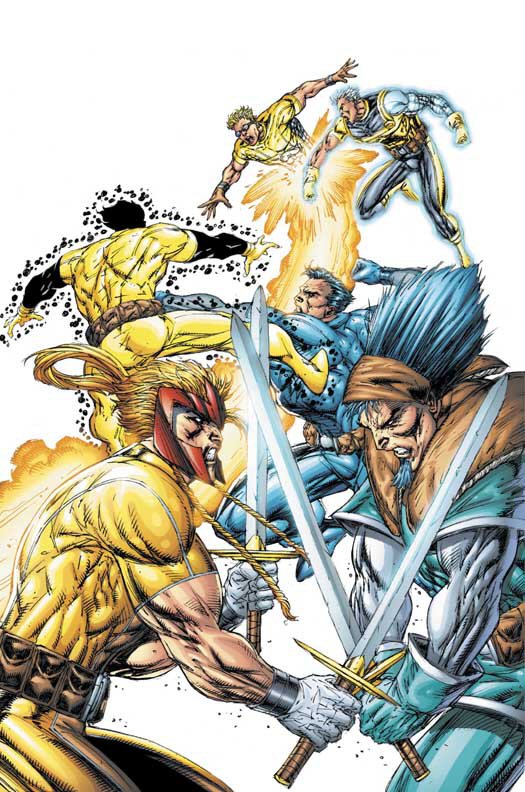
Watching the Guardians of the Galaxy films fills me with a mix of nostalgia, fondness, and appreciation. As a kid, I loved the 1990s comic series. I was amazed at how it explored the Marvel Universe in the 31st century, and I had a huge crush on the golden-clad Guardian known as Aleta (see below). While the films are based more on the 2008 Guardians of the Galaxy (starring Peter Quill and based in the present), I found both the newer comics and the films to be solid works that succeed in bringing action, levity, and even sprinklings of drama. However, because I feel a more personal connection to Guardians of the Galaxy, one aspect of the films that stands out greatly in my eyes is how different some of the characters are compared to their comics counterparts.

In the films, Yondu is a rough-around-the-edges mercenary with a telepathic connection to specially designed arrows. In the 90s comics, he was a highly religious member of a shamanistic alien race who used an actual bow and arrow. Stakar, played by Sylvester Stallone, is the tough-as-nails leader of the group to which Yondu belongs, the Ravagers. Comics Stakar is Starhawk, the One who Knows, a being of light whose cycle of death and rebirth traverses time. To say that these characters drastically different is an understatement. Even Taserface, the secondary antagonist of Guardians of the Galaxy Vol. 2 has a major change. While in the film Taserface states that his name is “metaphorical,” in the comics he can actually shoot tasers from his face. As someone who instantly recognized the name of Taserface as being one of the 90s Guardians‘ earliest villains, I felt just the slightest twinge of disappointment at a lack of face beams.

These changes are not necessarily bad. In the interest of making the Marvel Cinematic Universe more streamlined, the members of a cast as large as the one in Guardians of the Galaxy need to be unique and avoid overlapping roles. For some characters, this is simple. No one else is Groot, the giant tree alien. The gun-toting Rocket Raccoon is self-explanatory. Yet when we get to Dave Bautista’s portrayal of a powerful yet amusingly humorless Drax, that portrayal means Gamora, a character who is similar to Drax in the comics, finds herself in need of a new personality. Instead of a green Amazonian-type, Gamora is more a battle-hardened soldier. Elements of her Conan-esque “warrior speech” still exist, like when she refers to Knight Rider as a “magic boat,” but Gamora retains only about 50% of what she is in the comics, for better or worse.

Guardians of the Galaxy Vol. 2, like its predecessor, is a highly entertaining film that succeeds by being more fun than serious. However, whereas characters such as Captain America and Iron-Man are iconic figures in comics history that cannot be altered too extensively, the fact that Guardians of the Galaxy is a lesser, more obscure franchise (a description that may very well have changed thanks to the films) means its minor characters are fair game. I can’t help but wonder which classic Guardian will show up next and be someone completely different from what they were in the comics. This approach can lead to some great and memorable characters, but perhaps at the expense of losing the memory of the original.


Save

Save

Save

Kiryuin Satsuki and the Curse of Power Girl

I view the DC superhero Power Girl as being almost doomed by her appearance. If you ask anyone with even a passing familiarity with Power Girl about what defines her character, you’re very likely to get the response “boob window.” This is despite numerous attempts to revamp her character, emphasize her personality, and make her more than just eye candy first, superhero second.

This is not to say that Power Girl is an inherently bad or sexist character, whether she’s supposed to be an adult Supergirl (her original origin) or something else entirely. I don’t even think the boob window necessarily has to go. But what fascinates me about Power Girl’s situation is that, for whatever reason, it seems especially difficult for her to escape being seen almost as a character attached to a pair of breasts.

In contrast, when it comes to characters who have overcome a highly sexualized appearance, one need look no further than Kiryuin Satsuki from the anime Kill la Kill. In spite of the fact that her battle uniform looks like a sling bikini on steroids, her personality overwhelms even the sheer and unbridled sexuality of her clothing. Despite her breasts and buttocks often being in full display in numerous scenes what first comes to mind are her other attributes: scowl (with enormously imposing eyebrows), her ambition, and the fact that she literally radiates an aura of light that symbolizes her power.

I find myself wondering, what is the difference between Satsuki and Power Girl, or indeed Power Girl and other female superheroes who have been successfully redefined as more than just their eroticism (note that I did not say more than just their looks—appearance is just an essential part of superheroes, male and female)?

There are two major context points that separate Satsuki and Power Girl. First, unlike Power Girl, Satsuki is introduced in Kill la Kill in her full-body school uniform rather than in her skimpier attire. Second, whereas Satsuki’s existence is defined solely by one television series, Power Girl has been a part of comics for decades. While the circumstances of 2010s Japan and 1970s United States are substantially different, I suspect that Power Girl would be remembered very differently if she arrived on the scene the way Satsuki does in Kill la Kill: as someone grandiose and powerful. Perhaps it would even be possible for her to keep the boob window and still be thought of primarily for her superheroics and feats of strength.

Or perhaps my view of Satsuki is too charitable. Maybe the imprint she’s left on anime and its fandom, especially those who know Kill la Kill only from images, is just her near-naked body in a battle bikini.

Power Girl appears to be a victim of historical inertia. No matter what is done with her character to turn her away from a primary emphasis on her breasts, focus always returns to her iconic cleavage cut. Whether it’s possible to overturn this might require not just an amazing creative team where artist and writer are working towards this goal, but a comics fandom willing to accept this change.


New York Comic Con 2016 Essay #3: The Artist Alley vs. My Expectations

For this year’s New York Comic Con (which is now months ago, whoops!), I’m doing something a bit different with my coverage. Instead of doing a standard con report, with overviews and opinions on panels, artist alley, etc., I’m going to be writing a series of essays based on things I saw at NYCC 2016. Think of it like extended thought exercises and musings inspired by the con.

While manga is closest to my heart, I love comics in general. Even if individual titles aren’t my cup of tea at times, and even if I find myself going back to Japanese comics more often than not (for reasons both rational and irrational), I never want to stop giving different types of comics a chance. This is one of the reasons I’m generally eager to visit the Artist’s Alley at New York Comic Con. Though it’s been years since I looked forward to Wednesdays (the day when new comics in America come out), I still opened myself up to the artists of NYCC 2016 with a simple desire: I wanted to be wowed, to be drawn to them and convinced to read more.

Perhaps I set too unfair a standard for myself and for the artists there.

I want to emphasize that I think the New York Comic Con Artist’s Alley is full of incredible talent. These are hard-working artists, each of whom have their own stories when it comes to how they came to comics. Also, given that NYCC is built on American comics culture, a lot of it would be the things you’d expect: superheroes, graphic novels, and certain approaches to cartooning and anatomy that have grown out of the American tradition. I think all of these things are great and have their own unique strengths worth exploring, but when it came time to find something that, pardon the cliché, spoke to me, I just wasn’t able to.

I feel that the decision-making process I went through as I looked from booth to booth was vague, even to myself. It’s not that I had any specific criteria. For example, I enjoy seeing comics about cool girls doing cool things, but I’d find that the particular arrangements that existed in the Artist’s Alley fell into recurring categories that made them all blend together to a certain extent. If they weren’t female superheroes, they were girls who wanted to show how much they defy gender expectations. These are both very good things, but it’s as if, in the rush to seize these ideas and the momentum they carry (whether for profit, social consciousness, desire to create interesting stories, or something else entirely), they ended up collectively dulling the product in my eyes.

I believe that a lot of the problem lies with me. When you distance yourself from something as I have, you tend to look at it in broader strokes. The opposite is often true if you get too deep into something. For example, when it comes to anime I’m a long-time Gundam fan. I’ve seen nearly every series, and I appreciate the subtle nuances and varying approaches that they bring, for better or worse. To someone outside of Gundam fandom, it just all looks like robots fighting wars and characters giving speeches. Thus, when I looked at Artist’s Alley as this well of potential to bring me back into the fold, I think I was expecting it to have much more of a gravitational pull than it had any right to. After all, if you’re at an Artist’s Alley at New York Comic Con, it’s natural to assume that you should already be into the stuff. It’s not the responsibility of the artists there to “convince me” to give American comics more of a chance, only to convince me to check out their work.

I still plan on taking a similar approach to Artist’s Alley next year with some adjustments. Instead of hoping for something to call out to me and speak directly to my soul, I’ll drift towards anything that catches my fancy. I shouldn’t expect a revolution, but I should at the very least leave the door open for minor reforms.

[Apartment 507] My Hero Academia and the Spirit of Captain America

myheroacademia-captainamerica-featuredimage

Just in time for the release of Captain America: Civil War, I decided to write a short article about the similarities between My Hero Academia and Captain America.

I think there might be some additional parallels with the new movie as well, but I’m going to have to wait until I actually see the thing before I make that decision.

Is Rob Liefeld “Heta-Uma?”

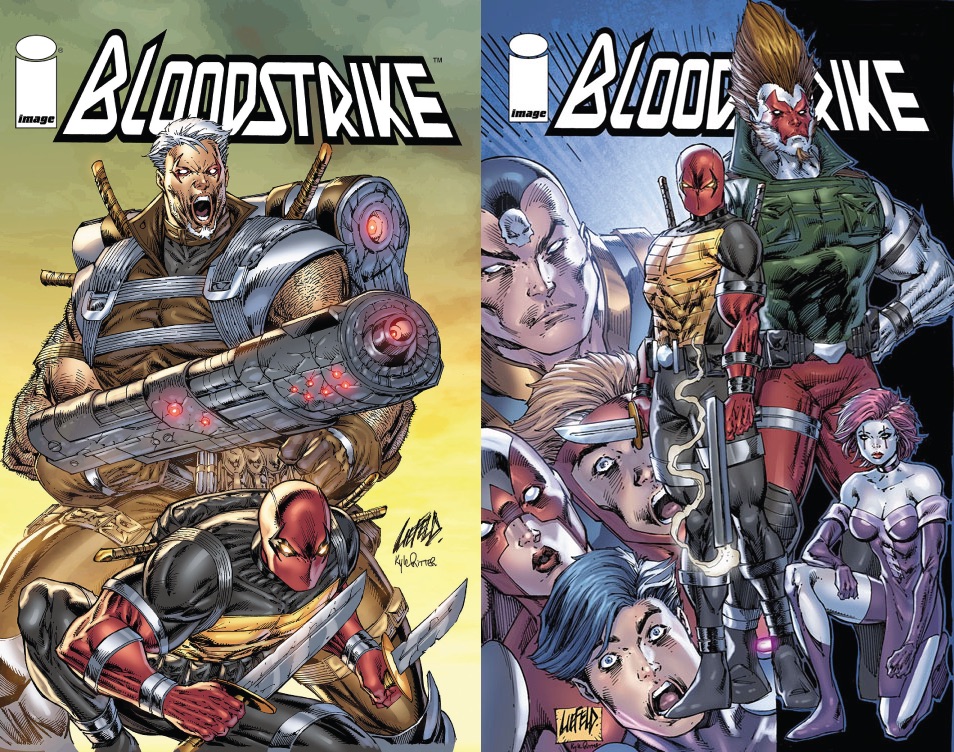
Comic artist Rob Liefeld has carried two reputations throughout his career, both of which can be considered two sides of the same coin. To many, Liefeld is the 90s comics artist, with his creation of various “extreme” characters, a move away from simple, minimalist superhero designs to ones loaded with details and accoutrements. At the same time, he has also become the poster child for “bad comic art,” mostly because those same qualities that exemplify both 90s comics and Liefeld himself are viewed as a move away from technical skill, visual clarity, and overall good character design. In looking at Liefeld’s work, though, I recently began to ask myself if he might be considered what is known in Japanese as heta-uma, literally “bad-good.”

bloodstrike-covers-123871

Last year at Otakon, I debuted a new panel called “Great Ugly Manga.” The purpose of the panel was to show how bad artwork in manga wasn’t necessarily a demerit against that manga, but that “ugliness” could be utilized in interesting ways. Ugly manga can play with expectations, carry a kind of strong emotional energy, and even change the meaning of moments compared to if they were rendered beautifully. This idea is not new, and in fact at the panel we mentioned the essential philosophy behind heta-uma. The idea, originating from Japanese artist King Terry, is that art has a technical aspect and a kind of “soulful” aspect, and that while being good in both categories is the ideal, it’s better to be bad at the technique and good at the soul, rather than good at technique at the expense of expressiveness. In fact, it was while we were gathering images for Great Ugly Manga that my co-panelist I briefly discussed the idea that Rob Liefeld might be heta-uma.

Both the notion of bad-good and good art in general are highly subjective, and the line between technical expertise and expert expressiveness is actually pretty nebulous. When I talk about Liefeld’s art being “bad,” I’m more using the idea of bad that has been presented online across various forums and articles, that his tendency to use the same poses, to ignore feet, and that his overall frenetic line work is less impressive than artists with similar yet more highly refined artists such as Jim Lee.

What I find is that Rob Liefeld’s work can’t be called bad-good in the common sense of the term, nor can it be called any of the others: it’s not good-bad, good-good, or even bad-bad. I would argue that bad-good is perhaps the closest category to fit Liefeld, but doesn’t quite fully describe his art.

greatuglymanga-81diver-birds-small

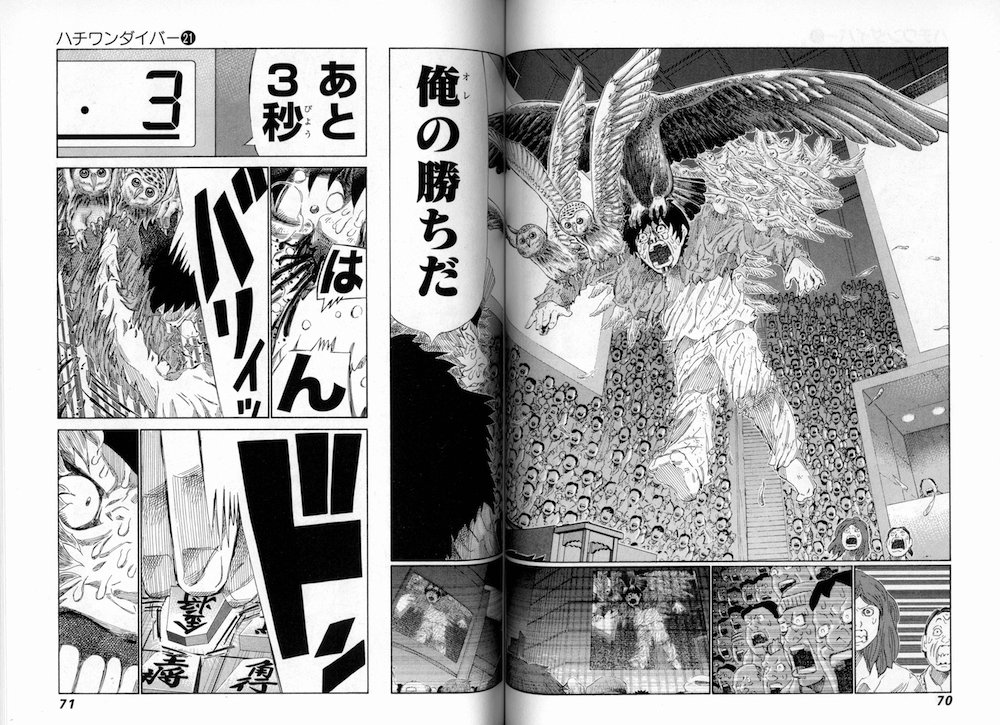
There are two characteristics of heta-uma that I think is vitally important under normal circumstances. First is the idea that the ugliness of the art has to be eminently obvious. When looking at an image from an ugly manga, there is an immediate realization that something is “wrong.” Second is the idea that this ugliness in term gives power to the page, that it creates a strong sense of energy or awkwardness that draws the reader in. Take the page above from the manga 81 Diver, which is one of the series we mentioned in “Great Ugly Manga,” where the mishmash of large word balloons, bizarrely drawn characters, and unusual situation make the scene stand out. What’s also notable about its artists, Shibata Yokusaru, is that he falls outside of the category of artists who can draw beautifully but choose not to. He has a lack of technique, but more importantly he doesn’t let that flaw get in the way of his attempts to draw complex scenes. By challenging himself, the ugliness of his art stands out even more, which is his charm.

I think that Rob Liefeld’s artwork is definitely expressive, and that its energy comes out of the particular manner in which Liefeld draws. What keeps me from calling it clearly heta-uma, however, is that often times his art seemingly masks its own ugliness. At first glance, there’s often nothing especially strange about Liefeld’s drawings, and it’s only after you start to examine them in detail that they tend to “fall apart.” While a more discerning eye can catch these aspects from the beginning, I believe that for the average reader it is not so obvious. Liefeld’s artwork is not “clearly ugly.”

xf3

And yet, once one gets past that point, and after getting over just how awkward his drawings can be, I find that Liefeld is not so different from Shibata, in the sense that he does a lot of things around his particular style that lend it a significant impact. While in some cases Liefeld is known for “playing it safe,” using the same poses repeatedly for example, he also pushes himself to draw elaborate situations designed for readers to in fact examine and re-examine them, such as large fight scenes. It’s in drawings such as those that the heta-uma of his work really shows itself, as while one can criticize the lack of realism in his characters’ musculature, or the fact that perspective doesn’t work that way, ultimately the intensity of the fight shines through. While a more skilled artist could perhaps do a better job and even keep a similar level of intensity, what I find interesting about Liefeld is that the very flaws in his work contribute to the image’s impression of strength and fury.

Overall, I think Rob Liefeld is loosely in the category of bad-good, but that he doesn’t quite fit the mold created by other heta-uma artists. However, because the term doesn’t have a rigid definition of qualifying characteristics, and because the idea of good and bad art are so personal, calling him bad-good less a solid criticism or praise of his works and more trying to get into the realm of what Liefeld art is. What I find in the end is that his style creates flimsy yet powerful illusions, and that this is definitely a place where heta-uma can thrive.

If you liked this post, consider becoming a sponsor of Ogiue Maniax through Patreon. You can get rewards for higher pledges, including a chance to request topics for the blog.

Are Comics Companies Really Learning the Importance of Diversity?

ms-marvel-9-coverIn recent years, diversity in representation of peoples has become a frequent topic of debate among fans of animation and comics. Whether it’s the rise of Steven Universe and its positive portrayals of strong female characters, or the increase in panels on women in comics, minorities in comics, and more at New York Comic Con, there has been a strong move both from fans and creators to make sure that tokenism is never a thing, and that the Rule of Three (see the video below) doesn’t stop any group from finding themselves in cartoons.

In 2014, at a Women in Comics panel at NYCC, one of the panelists mentioned the importance of learning how to communicate with the old, white men who run these companies if people want to make a difference up top. The following year at NYCC, a Diversity in Comics panel had multiple industry members talk about how management across multiple companies are realizing that other groups besides the white, male demographic are customers and are worth appealing to. Ultimately, people are communicating in the language that executives understand most of all: money.

However, while the net result seems to be in favor of a strengthening of cultural diversity, there’s a question that nags at the back of my mind as I see the talk of a changing tide. Are those executives, those old, white men, actually learning why cultural diversity in comics is important, or are they simply seeing it in terms of potential sales? Part of the reason why comics appealed to that white, male demographic for so long, aside from latent racism, was that it was seen as a reliable market, but catering too much to that aging audience has stymied its growth among the population at large. This means more attention is paid to women, LGBT, racial minorities, and more, but does it just all come down to the bottom line?

My fear is that, if diversity is simply seen as the latest ticket to profit, that if comics and animation start to be less successful, will the companies and their heads be just as quick to jettison the desire to bring different groups of people to comics? Are we ultimately beholden to entertainment media as a product of popular culture in a capitalist society?

If you liked this post, consider becoming a sponsor of Ogiue Maniax through Patreon. You can get rewards for higher pledges, including a chance to request topics for the blog.

One Punch Man’s Japanese and American Superhero Lineage

One Punch Man has been a hit, both with the people who have long championed the manga, and with those discovering it through its animated adaptation. The story of Saitama, an invincible superhero who literally finishes most of his fights with “one punch,” the series puts a great deal of emphasis on humanizing its Superman figure. It handily deflects the classic criticism of invulnerable protagonists as “boring” while also drawing from both Japanese and American superhero traditions, and I think it’s worth exploring what it does to make Saitama a sympathetic figure.

To talk about a Superman-type character is to also naturally bring up the Man of Steel himself. Originally conceived with incredible strength and speed and gradually transformed into a being that could move planets and reverse time, much of the past three decades’ stories concerning Superman have been finding ways to make him human. Zack Snyder’s Man of Steel film focused on the psychological and emotional struggle of having to hold back all the time, something shared with select episodes of the Justice League cartoon. Superman has been reduced to the point of being not quite so omnipotent, and also turned into a brooding teenager for Smallville. Numerous “what-if” scenarios have made him Soviet, nearing death, old and out of touch with the youth, and alternative takes on Superman-esque figures have dealt with mental problems, become amoral, and more. Even other superhero-themed series such as Tiger & Bunny and My Hero Academia will build in flaws into their Supermen, though the fact that they’re in the distance means that it’s more about how their image and reality compare.

One Punch Man ties Saitama’s ongoing turmoil to the fact that his astronomical power levels have made him unable to fulfill his heart’s desire, which is to be pushed by a powerful foe and go beyond his upper limits. He wants to feel like Son Goku being brought to the brink by Frieza. He wants to be Ryu from Street Fighter, constantly pursuing the next challenge. He draws from that popular tradition in manga and other Japanese media about the thrill of the journey, and yet while Akagi brushes with death before defying it, even that is denied when it comes to Saitama. Even if we’ll never as powerful as that, I think it’s easy to understand why this would be so painful.

Perhaps the more important element is that Saitama is kind of an idiot. The fact that Saitama doesn’t quite think through his position in the world (or perhaps choose to actively ignore it) brings a certain quality that reminds me of the earliest Superman comics and stories, back when he could only leap tall buildings in a single bound. If you look at the very first Action Comics, Superman spends a lot of it bullying the bullies. There’s a certain satisfaction in the fact that Superman’s personality and character aren’t so elaborate, that there isn’t almost a century of material exploring his psyche. One Punch Man achieves something similar by just having Saitama’s morality have good intentions but generally be kind of vague. He hasn’t thought too much about his role as a superhero other than that it’s “fun” (or at least should be), though at the same time it puts a twist on that basic desire to be so powerful that no one can stand in your way.

If you liked this post, consider becoming a sponsor of Ogiue Maniax through Patreon. You can get rewards for higher pledges, including a chance to request topics for the blog.

A Mission for Myself: New York Comic Con

General Thoughts

As New York Comic Con has come to rival San Diego Comic Con and become its east coast counterpart, the scope and demand of NYCC are constant points of consideration for any potential attendee. While the convention pretty much improves every year and little can be faulted for how it’s run, the guests they bring, and just the amount of stuff there is to do (aside from perhaps the inevitable over-emphasis on professional and industry panels), I find that there’s a certain evaluative process I notice my friends and me going through every year, which all boils down to the simple question: should I attend next year?

First and foremost, as an anime and manga fan I have to say that NYCC delivered, and in ways I hadn’t expected to affect me so deeply. This year, they most notably brought Naruto creator Kishimoto Masashi and Uzumaki Naruto voice actress Takeuchi Junko and premiered Boruto: Naruto the Movie for the first time outside of Japan (see my review here). Aside from some hiccups in terms of the Hammerstein Ballroom venue—the overly strict no food policy went so far as to ban bottled water, and the concert-oriented seating obscured the screen for significant portions of the viewers—it was the most memorable part of the convention for me, and it brought me back to 13 years ago when I was at the height of my own Naruto fandom.

On top of that, the announcement of a Tiger & Bunny film helmed by Ron Howard was the biggest surprise by far of NYCC, and the opportunity to get a personal drawing from Attack on Titan animator Asano Kyouji was a rare treat. While I was unable to get Asano to draw Holon from Real Drive like I hoped (to be fair that show is 10 years old), this image of Sasha from Attack on Titan is the coolest thing I brought home from New York Comic Con:

However, my experience with NYCC made me realize just how disconnected I am from a lot of current fandoms. This isn’t to say that I disliked New York Comic Con, or what it does. I’ve always enjoyed the mix that New York Comic Con brought, between the opportunity to meet professional artists, the focus on entertainment media that has extended out from the superhero movie boom, and just the general celebration of nerd culture. However, partly because I was out of the country for four years, and partly because of my own general taste for things, I haven’t been as deep into certain popular works in recent years as I might have been in the past.

What really brought this point home to me was how much I enjoyed the Justice League Reunion panel. Seeing Carl Lumbly talk about bringing his cultural heritage to the role of the Martian Manhunter as an immigrant with a traumatic past, finding out that Justice League Unlimited was a clever and creative compromise with a soulless marketing engine that wished to use the cartoon purely as an action figure commercial, and hearing Kevin Conroy sing “Am I Blue?” flooded me with so many fond memories of what made that series great. It made me recall the character of A.M.A.Z.O. and how incredibly deep and interesting his story was, and the “Ask the Justice League” portion was downright hilarious, especially Martian Manhunter’s greatest enemy being “a villain made of flaming Oreos.” It made me want to find this feeling again within more non-Japanese works.

This is certainly not a criticism of the current state of animation; many fantastic works have been and are still being created. Rather, it has made me aware of just how much a connection to the “nerd mainstream,” as it were, fuels New York Comic Con. NYCC is a for-profit convention backed by the entertainment industry, and it will aim for the works that hit the widest audience, or at least the widest audience within a niche. This is what fuels the decision for a Firefly panel, or indeed inviting a manga megastar like Kishimoto. Rather it fuels my desire to expand my interests further than where they are currently, to get a better sense of the zeitgeist of current American (and non-American!) fandoms.

Exhibitor Hall, Artist Alley, and Panels

Again, when it comes to the actual con, there was much to enjoy. In the Exhibitor Hall, I got the chance
to try Street Fighter V, say, “Domo” to Ninja Slayer, and get that cool Sasha drawing from Asano.

The Artist Alley, as always, was a great place to meet artists, find out about new works, and see the trends that fuel the creators. Superheroes are a no-brainer, anime is less prominent but if it is it’ll be something that captured the imaginations of American fans, such as Dragon Ball Z or Sailor Moon. Stylistically, I made just one purchase at Artist Alley this year, issue 1 of a comic called Henchgirl by Kristen Gudsnuk, the premise of which is exactly what it sounds like. The Artist Alley filled with everything from amateurs to industry veterans, with talent abound. However, I tasked myself with a challenge, which was to find something that spoke to me, that didn’t rely on name recognition, and that wasn’t too tempered by my own preferences for specific types of characters or heroes. Gudsnuk’s drawings resonated with me the most because of the humor and soft, cartoony style. If you’re curious, you can read the comic online for free.

The other highlight of the Artist Alley might have been seeing a small kid, probably no older than 6 or 7, hand a copy of Days of Future Past to Chris Claremont.

As for panels, it’s no secret that a for-profit con like NYCC will have a different flavor from a fan-oriented endeavor such as Otakon. I generally enjoy the latter kind more when it comes to programming, but NYCC has a pretty consistent track record of quality, possibly because it’s such a big deal now and encourages industry hosts to bring their A-Game, as seen with the Justice League Reunion.

The Kishimoto panel was a rare opportunity to get into the mind of one of manga’s most successful creators. While the questions were curated, the host did a great job of opening up Kishimoto, and I’m sure that him no longer having to keep deadlines or worry about how his answers might influence sales of Naruto allowed him to give responses that were a bit more candid than what is usually seen from Japanese guests. Probably the best thing I found out from the panel was the friendly rivalry shared by him and One Piece‘s Oda as Shounen Jump‘s two frontrunners, as well as the titles that influenced him most. That said, I hope the audience that was mostly silent after hearing Kishimoto mention Tezuka Osamu’s Phoenix get the chance to find out more.

“Push Boundaries Forward: Gender, Diversity and Representation in Comic Books,” featuring Marjorie Liu, Darryl Ayo, David Brothers, Amber Garza, Jeremy Whitley, Joey Stern, and Shannon Waters was one of many panels over the weekend that focused on addressing the changing dynamics of comics creators and readers. Both the audience questions and panelist answers showed a strong desire to move forward, to learn, and to understand that greater diversity in comics is a multifaceted challenge that never ends, and is ultimately beneficial to comics as a whole.

The Felicia Day panel was pure Q&A, and that’s exactly what the audience wanted out of it. Incredibly charismatic in that awkward way that appeals to geeks most, Felicia Day genuinely engaged her audience with an attitude that was both deeply caring and kind of flippant, bringing a realness to her answers. The best moment was when she complained that you couldn’t have sex with her character in Dragon Age 2, which her manager had ordered the studio against.

The Sunrise panel showed once again that they’re one of the direct-from-Japan studios to really get what it means to throw a panel. In addition to the surprising news about Tiger & Bunny, their announcements were varied and spoke to different portions of their audience. By the way, if you heard a couple of loud guys cheering for Giant Gorg, that was me and Patz from the Space Opera Satellite Podcast. We were serious, too. Giant Gorg is a rare series directed by the character designer of the original Gundam, and had been in licensing hell for years.

GORG!!!

Yo-kai Watch is also a thing.

Finally, I decided to attend a screening of a Love Live! concert, partly to satisfy my curiosity about this particular aspect of Love Live!‘s media mix, and to see the fan reaction. What I got out of it is exactly something I mentioned in my review of The School Idol Movie: the series is extremely malleable by fans, going from a warm, inspiring story full of interesting characters to a mountain of instant memes at the drop of a hat. As people shouted at the character Ayase Eli, “DON’T LET YOUR DREAMS BE DREAMS,” I wondered if that could somehow be parlayed into the slogan of Love Live!: “Make our dreams alive!”

Cosplay

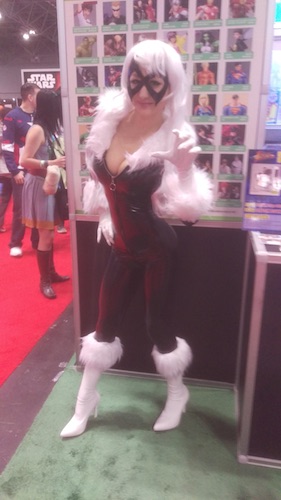
As with most con reports at Ogiue Maniax, I’d like to leave off with some cosplay. Truth be told, I wasn’t digging a lot what I saw, but Sunday really turned it around.