Appreciating Fandom at Nishicon 2011

This past month I had the opportunity to attend an entirely brand-new anime convention in the Netherlands, Nishicon.

Taking place in the city of Haarlem, Nishicon was held in a kind of sports gymnasium, which meant a few things. First, the primary form of seating was bleachers, which given the small con population (though by no means a disappointing turn-out) actually made for very convenient seating. Practically everything took place on that central floor, with workshops and video games being the only exceptions, so it was easy to move from one thing to another. If you were on the main floor, it was essentially impossible to avoid hearing the cosplay and AMV competitions, which seemed more of a close gathering of enthusiasts than the massive arena-filling extravaganzas of a large or even medium-sized American anime convention. When the AMV contest was taking place, every so often I could peer over to the other corner of the room and catch a glimpse of it.

Another feature of Nishicon was the bar and maid cafe, which like “Anime Con” in  Netherlands (and unlike New York Anime Festival) allowed the maids to serve its customers. This maid cafe is run by a different group than the one from Anime Con, and in speaking to one of the head maids I found out that they were looking to differentiate themselves from other maid cafes at Dutch anime cons by providing a more interactive experience. In addition to custom snacks (alongside the standard Dutch bar fare, beer, frikandel, kroket, etc.), they also provided a chance to play card games and board games, as well as provide a shoulder massage which only cost 2 euros.

Speaking of cost, I’ve noticed that Dutch cons seem to provide much more affordable food options than their American counterparts. While a tad pricier than just going to an automat, a broodje kroket (croquet on a roll) cost me a mere €2.50 or so. While I don’t know the exact reason for this, I have to imagine that it’s because every convention I’ve been to so far has had some sort of fully stocked bar attached to it, and they simply charge the prices they normally would. That said, if you’re coming from the United States watch out for the dollar to euro conversion rate.

I bought one piece of merchandise at this convention: a card game called “Manga Manga” (no relation). As you can see from the box, it has Action Power.

Outside of the AMVs and the cosplay, there were no big “events” or panel programming. For me, this is quite unusual, as I primarily spend my normal convention experience darting from panel to panel, with breaks for food and checking out the dealers’ room. As a result, this meant that if I were to enjoy myself at Nishicon, it would have to be at a relaxed, non-goal-oriented pace. In that regard, I think Nishicon was quite successful for me. I was able to play Go for the first time (and lose, naturally). I spoke to people at tables, asking them what they thought of the convention, one of whom mentioned that it’s fortunate for a convention to be located more towards the western side of the country). I found myself at a drawing area (run by the fine folks at mangaschool.nl) next to people I didn’t know, putting to paper whatever came to mind. It was actually the first time in a long while that I’ve drawn that much, and that made me feel good (or bad, depending on how you look at it).

What it all came down to for me was that the “lack” of major events made me participate in the convention the way I think most con-goers in general do. The point isn’t to listen to fans and creators talk about some aspect of anime and manga, nor is it to expect some “thing” out of it. That vital aspect I think people are looking for is the simple pleasure of being surrounded by others with the same passion for anime, and that is something that can be experienced by just sitting around other anime fans. Don’t get me wrong, I love attending Otakon, but I would not have ever sat down there next to other artists (aspiring and otherwise) in order to just relax with pen and paper.

Before I leave off with a barrage of photos, I want to mention something that might make some people feel a tad salty: did you know that Michiko & Hatchin was released in the Netherlands but not the United States?

The Oginyan: Genshiken II, Chapter 62 Supplement

In Chapter 62 of Genshiken, nearly all of the girls cosplay, and in my review I talked about how appropriate it was that Ogiue would cosplay as Azusa from K-On! Upon reading the more recent chapters of the K-On! manga though, it hit me that Ogiue-as-Azusa is an even better fit than I first thought.

Ogiue and Azusa are somewhat similar in personality in that they both act stubborn but are in reality actually pretty easy to persuade, but they also have similar positions within their respective clubs and within their stories. Ogiue and Azusa are both younger members who join the current incarnations of their respective clubs after they have been well-established. They then both end up taking over their clubs after the other members graduate. In either case, this seemed like a good opportunity to stop the series. Genshiken was originally complete at volume 9, and for K-On!, rarely does a moe slice-of-life show about high school girls end up going past graduation (see Azumanga Daioh). But both series continue on, showing Ogiue and Azusa in their roles as leaders while also giving face time for the older former members.

There are also a bunch of smaller things, like how both clubs are notoriously bad at getting new recruits. With how Kio Shimoku ends each chapter with some line from an anime or manga title, I am 99% confident that he picked Azusa as Ogiue’s cosplay for these reasons.

Cross Fight, Cross Fight: Genshiken II, Chapter 62

What was once fated to shine brightly for a few moments in the grand scheme of the universe now has been given new life, as Genshiken II has shed its limited-time status and has revived itself as a fully serialized title. That’s right, Genshiken is back in full force and I can only be pleased by the news. Almost as if to symbolize this new beginning for Genshiken, Chapter 62 feels almost like another introduction to the series and the madness contained therein. Let’s take a look.

As Angela returns for her third trip to Japan and Yabusaki puts the finishing touches on her Fullmetal Alchemist doujinshi, Ogiue is working frantically to complete the second half of her debut as a legit manga artist. Luckily she has the help of the current Genshiken freshman as well as Sue, but the whole situation begins to derail when Hato becomes self-conscious of the fact that his facial hair is growing in. Yajima suggests that Hato wouldn’t have this problem if he dressed like a guy, given that guys aren’t embarrassed by facial hair, but Hato has no men’s clothing with him. Fortunately(?), Ohno left everyone some cosplay outfits, but things get quickly out of hand and everyone ends up working on Ogiue’s manga while cosplaying.  Even Ogiue decides to join the “party” in an effort to take responsibility. The chapter ends with Yabusaki coming in to help Ogiue, only to lecture them for goofing off. Naturally, Ohno deeply regrets not being around for this rare occasion of cosplay goodwill.

So, this heavy chapter obviously has a ton of references, and it’s not exactly big on character development, so I think it’s a good idea to find out just who they all are. Some of them I got, some of them I needed to do some internet detective work. Here’s a list of the costumes worn by each Genshiken member.

Yajima: Yagyuu Juubee Mitsuyoshi, the rather large and voluptuous heroine of Sekiganjuu Mitsuyoshi.

Hato: Ashikaga Yuuki, the cross-dressing main character of the School Days sequel, Cross Days.

Yoshitake: Kurashita Tsukimi, the Jellyfish-obsessed protagonist of Kuragehime.

Sue: The titular character of Comic Master J, a super manga assistant.

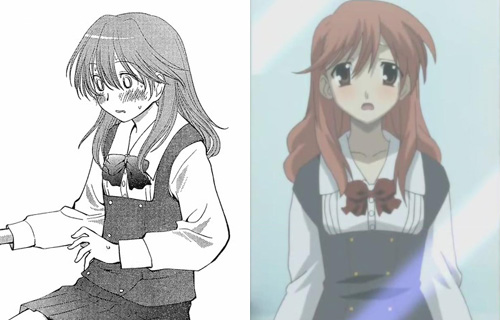
Ogiue: Nakano Azusa, underclassman guitarist from K-ON!

The entirety of Ohno’s selection for Hato consists of crossdressing characters. Though I can’t recognize all of them, at least one of them is Maria from Mariaholic. Yajima’s outfit is arguably the most embarrassing, coming from a manga series by the character designer of badonkadonk resource Real Drive, but given Yajima’s personality that must have been the most conservative outfit of the bunch. It’s interesting that Ohno would see “overweight girl” and interpret that as “cosplay as thick ladies,” though it makes sense in retrospect. Yajima’s outfit this chapter shows that she’s actually quite busty, and much like when Ogiue first cosplayed way back when though, it kind of makes you aware of the fact that Yajima’s baggy clothes are partially the result of shame. How appropriate it is then that Yoshitake is dressed as a character with a similar dilemma.

Ogiue as Azusa of course makes it own kind of sense, especially when you factor in the fact that the girls of the light music club pushed Azusa towards the Azunyan cat motif somewhat resembles Ohno’s own constant persuasion of Ogiue into cosplay. In fact, Ohno can draw a number of parallels to K-ON!‘s Yamanaka Sawako.

Interestingly, everyone except Ogiue is dressed as a main character, despite the fact that Ogiue was pretty much the central focus of the second half of the original Genshiken. If I were to be somewhat liberal with my interpretation, I’d say that this is symbolic of the direction of Genshiken II, where the new girls are starting to establish themselves as the main stars of the new series. As I’ve said before though, I’m quite okay with this, despite my fondness for Ogiue, as it feeds into one of the themes of Genshiken, that of the continuous renewal of the club.

Looking forward, with Angela around, the chances of a Sue-centric chapter rise greatly. And in the spirit of Sue, we’ll end with a fourth-wall-breaking image.

Cosplay Parallelism in Genshiken and the world of 2.5D

I like Genshiken, and I like when other people talk about Genshiken, especially when they’re able to see just how strong and fleshed out the characters are. Best of all, it gets me to think more about the title, and reminds me that as much as I have looked at the series, there’s always more to consider. So when I read Pontifus’s look at the second half of Genshiken, it not only reminded me of a post from years back, but it also made me aware that the series presents many more comparisons between 2-D and 3-D than I originally thought.

In his post, Pontifus wonders about why Madarame never felt anything for Ogiue, first pointing out that:

“Ogiue is precisely the kind of manga character he likes (literally!). When she’s finally talked into cosplay, she even dresses as Madarame’s favorite Kujibiki Unbalance character, who, in terms of broad traits, isn’t all that unlike her.”

He then goes on to describe how based on his own personal experience, the things that get you going in a fictional character don’t exactly apply to actual women, and that this seems to be the case with Madarame as well. Madarame does show a moment of piqued interest towards Ogiue’s brief debut as Kamishakujii Renge, but it seems to be more about the character than the person behind it.

However, Madarame isn’t the only one in the story whose attraction to a real woman runs opposite to his manga character fetishes; Sasahara also falls into this category. While Sasahara’s taste in pornography isn’t dwelled on as much in the latter half of the series, we are told fairly early on that his favorite female character is Ritsuko Kubel Kettengrad, the chairman in Kujibiki Unbalance, whom Kasukabe famously cosplays to save the club from doom.

So we have Kasukabe, whom Madarame likes, as the character that turns Sasahara on, with Ogiue, whom Sasahara likes, in the guise of a character that turns Madarame on. Again, given the guys’ doujinshi-buying habits and overall anime character fetishism, you might think that their taste in women has been flopped, but the series makes it clear that they have good reason for liking the girls they do, and it all has to do with how they are as people.

In addition to reminding the reader of the distinction between 2-D and 3-D, the parallels between Sasahara and Madarame (or perhaps Ogiue and Kasukabe?) affirm the overall theme of growth and maturity in Genshiken. Otaku can enter the real world and still be otaku, it just might take some help to adjust. But putting aside notions of “2-D complexes” and such aside, people’s tastes in women (and men!) change over time. You can have in your mind your concept of your “ideal partner,” or a mental checklist of all the things you like in an anime character, but you never know if something is totally going to surprise you. It’s not necessarily that they’re fickle, but more that there could always be more qualities that you love, either in a person or a character, which even you don’t realize.

There Are Two Kinds of People in This World: Winners and Trolleys

In Anime World Order’s look back at the previous decade of anime, guest Matt Alt talks about how the true successor to giant robot anime isn’t current giant robot anime, instead bestowing that title to those shows which spawn trading cards and games revolving around collecting. Essentially, the true spirit of super robots lies not in the continuation of the aesthetics of giant robot anime, but rather in their ability to push merchandise.

Considering this point, I can only think about how much more today’s anime for boys fosters a sense of competition, with trading card games and the like being at the center of children’s entertainment. The kids don’t have to be competitive “high-level” players, and they don’t even have to necessarily know the rules, and I still think these games, even if their shows talk about friendship and honor, still push the theme of competition more than anything else. Just the fact that there are  specific rules and stats and points means that, in a given activity, there will be winners and losers, even if it’s just cheap plastic being spun in an enclosed space. In contrast, that’s not really possible when you just have toy robots and the like. You can perhaps beat your friends by collecting more toys than them, or even create arbitrary rules of competition or even create fake competitions between your toys as Cobra Commander attacks with his vicious horde of My Little Ponies, but at the end of the day there’s no definitive way to become King of Make-Believe.


Well, almost no way.

This in turn got me thinking about the anime fandom and how we have figured out ways to compete via anime. The act of watching cartoons is not really an area in which you can determine winners and losers (unless you say that we’re all losers), so the community instead focuses their competitive spirits towards anime-related activities such as making music videos and cosplaying. These competitions are far more subjective in their criteria and human judgment is paramount in determining winners, but all the same we have taken a relatively passive activity and found ways to test our abilities against others.

I don’t really have a grand point I’m trying to reach, as I’m just laying down some thoughts. But be it through subjective judging or concrete goals, I don’t think an increase in competitive spirit is really a bad thing. That said, it can be taken too far.

I Went to Nintendo World and All I Got Was This Tatsunoko vs Capcom Autographed Poster

On my way to  Nintendo World’s Tatsunoko vs Capcom: Ultimate All-Stars I thought to myself, “Even though I’m getting there an hour after it started, there shouldn’t be too many people! I mean, who really knows about Tatsunoko vs Capcom anyway?” But never again will I underestimate fighting game fans.

Upon reaching the second floor, my friends and I noticed that it was packed. Not only was there a tournament about to commence with the prize on the line being an actual copy of TvC, but there was an autograph line snaking throughout the entire floor, and small groups crowded around each sample kiosk.

You could pretty much tell that almost everyone there was a fighting game fan, and in all likelihood weren’t really sure what “Tatsunoko” was. There’s something about the dress, the demeanor, the energy of the crowd that really made it obvious that they loved 1 on 1 fireball-throwing action and possibly yomi.

Another thing I noticed was that the event actually brought cosplayers. And it wasn’t even like all of them were relevant to the event at hand. While there was a Yatterman cosplayer walking around, I also spotted a Kakashi from Naruto with flack jacket and all, as well as a guy dressed as Kyon from Haruhi. Still, it wasn’t like the event was overwhelmed by anime fans in anime costume, but I was both a little nonplussed yet not surprised at all at this situation. It was an event celebrating anime characters after all.

All this time, I was on the line to get my autograph poster, and after an hour and change, I reached the signing. There, I asked the producers of the game an important question: Is Joe the Condor’s voice actor in TvC the original, Sasaki Isao, i.e. Joe’s original voice actor and famous anime singer responsible for shows such as Space Battleship Yamato, Neo-Human Casshern, Galaxy Express 999, UFO Robo Grendizer, and Getter Robo? They said “yes,” and were surprised that I even knew who Sasaki Isao was. Mission accomplished.

Afterwards I played the game a little, using Gold Lightan and seeing if he felt any different. I wasn’t that good at the game so I couldn’t really tell, but he’s still the Gold Finger Crashing Behemoth we know and love.

And then I ate udon. Mm mm.

~A Fantasy All Too Affected by Reality~

I’d like to talk today about a topic that doesn’t pop up too often on Ogiue Maniax, something that in the eyes of a number of otaku is about as far from anime fandom as you can get: sports.

Well not exactly. Recently I’ve noticed that in addition to rooting for the players they like or the teams from their hometowns, people have been watching sports a new way, the fantasy sports way.

Fantasy sports are basically online games where you build teams based on real life athletes and try to win as many games as possible in a given season. It’s kind of like an RPG, only your characters’ stats are influenced by the players’ performances in real life. If the star of your fantasy team gets injured in a real game, he’s off your roster as well.

The result is that you have people who keep up with sports not only so they can cheer for their team, but because they want to see how the events of the real world will affect their chances of winning their own game. It creates this extra agenda that while similar to just plain old betting and gambling on sports games, is actually more involved as the fantasy sports enthusiast has some level of control over his own team. If an athlete is injured, it’s up to the player to choose who to substitute. It’s an attempt to control the chaos in a way that reminds me of mahjong.

Is this really a bad way of watching sports? I don’t really think so, especially if that’s not the only reason they watch, but it does provide an interesting new dimension to the art of spectating. It’s also probably the closest thing a lot of sports fans will ever get to activities like writing fanfics and drawing fanart. The attitude and mindset of someone who watches sports with his fantasy team in mind is similar to that of an otaku watching an episode of an anime series with the intent of using whatever they find in that episode to fuel their fan works . Just as one might anticipate the latest episode of Bleach to have some fancy new outfits to inform their cosplay, so too do fantasy sports players tune in to the Nets vs the Jazz.

“Tune in.” Do people still say that?

Go Go Curry to Arrive in Singapore

I’ve spoken about my fondness for the Japan-based curry chain Go Go Curry in the past on a number of occasions, commenting on how it’s one of my favorite places to eat ever and that I’m a frequent visitor to the 38th and 8th location in Manhattan. For those of you who live in Singapore and have been eager to try this food which I so highly praise, your opportunity arrives on October 15 16.

Yes, Go Go Curry is opening up a Singapore locaton. I’m not sure where exactly in Singapore it’s going to be, but still it’s an opportunity for many people to try it out.

Now, I know you Singaporeans know a thing or two about curry, so I want to explain that Japanese-style curry is not quite the same beast as the kind you’re more familiar with. There is no coconut used, for example, and it tends to not be as spicy (though some places in Japan will intentionally make extra spicy curry). The sauce also tends to be more thick, acting more like a nice gravy. Go Go Curry meanwhile has a bolder flavor than most Japanese curries, so it’s also not exactly the indicator of the average of Japanese curry. But that’s also what makes it so good, and judging from the franchise’s success, a lot of people agree with me.

Incidentally, Go Go Curry is also currently holding an Akiba Cosplay Photo Contest. While I’m pretty sure you don’t actually get to go to Akihabara (that would be very expensive!), if you love cosplay AND you love curry, you have no reason not to participate. I’m still a little regretful I never participated in the eating competition myself.

On a side note, Akihabara was where I first fell in love with Go Go Curry, so that location holds good memories for me.

Let’s Talk WCG USA Starcraft Finals Again (They’re at an Anime Con!)

A few months back I made a post mentioning the fact that the World Cyber Games USA finals would be held at the New York Anime Festival from September 25-27. A few weeks ago, the finalists were all decided via online tournaments, and there’s quite a few recognizable names. I’ll be there to watch for sure (unless it interferes with, say, a Tomino interview or press conference), as not only am I interested in seeing who gets to fly to the WCG finals, but also because this is a rare opportunity to combine two interests into one exciting event.

Anyway, the finalists.

Jacob “LzGaMeR” Winstead
Made it to the Valor Tournament Round of 16.

Adrian “KawaiiRice” Kwong
First-time WCG USA finalist.

David “Louder” Fells
3rd Place Winner at WCG USA 2008.

Geoff “iNcontroL” Robinson
WCG USA 2007 champion and moderator for Team Liquid, iNcontroL also appeared as a contestant on WCG Ultimate Gamer.

Greg “IdrA” Fields
The ESWC Asia Masters of Cheonan 2009 Champion, Idra is the only active Non-Korean professional Starcraft player in Korea and is known for his strong Terran vs Zerg.

Daniel “Nyoken” Eidson
WCG USA 2007 2nd place finisher.

Sean “Day[9]” Plott
2005 WCG USA champion and considered by many to be the best Zerg in the United States, as well as the younger brother of Nick “Tasteless” Plott, the English caster for Gom TV.

Bryce “Machine” Bates
Former WCG USA Finalist.

David “KingDino” Kent
Former WCG USA Finalist. A former hacker who has since managed to redeem himself.

Dan “Artosis” Stemkoski
WCG 2007 3rd Place Winner and frequent WCG USA finalist, Artosis runs  SCforALL, a site dedicated to bridging the gap between American and Korean Starcraft fanbases. Known for his strong Terran vs Terran and Terran v Protoss.

I know that watching Starcraft is not every anime nerd’s cup of tea, but I hope at least some of you take the chance to watch some high-level gaming in one of the most intense games ever. And for those of you cosplaying, I will implore you to take a look, just so that when they film the audience pans will be that much more interesting.

Don’t forget to cover your faces.

Sakura-con (was) Live on Nico Nico

Sakura-con this year decided to broadcast a stream LIVE directly to Nico Nico Douga, giving Japanese viewers perhaps their first REAL glimpse at American otaku. I jumped on the stream, eager to see not only what the con itself had in store for us, but also what everyone REALLY goes on Nicovideo for: the comments.

The camera was at the con karaoke bar, and it’s amazing just how much the song selection was indicative of the American fanbase. I jumped on a little late, but highlights include the first Naruto ending theme, the first Inuyasha ending theme (TWICE!), BOTH “Simple and Clean” and “Hikari” (English and Japanese versions of the Kingdom Hearts opening respectively), the Sakura Taisen opening and the dub Pokemon 1st opening sung by almost everybody. The show stealer though was a 10 year old girl who sang the entire 1st Japanese Pokemon opening, Mezase Pokemon Master. Showing more showmanship and honest love of anime than any of the other singers, the Japanese crowd cheered her on, knowing that this was truly a fan, a fan of anime.

Of course, not all of the comments were nice, as they referred to an overweight girl as “Totoro” and “Pizza.” But they were also enamored by some of the more attractive cosplayers. And there was also a bit of a clash between Japanese viewers and non-Japanese ones such as myself, as the latter tended to send comments in English and the Japanese did not appreciate this. Still, things managed to cool down and karaoke continued.

After karaoke was over, the camera hovered over some people organizing their figure collection, which was an unusual mishmash of Warhammer, moe PVC figures and shounen action. At this point I had to stop watching, but I began to wonder if the Japanese people would want a convention like this in Japan. I asked on Nico, and at least one person said he would definitely want to see something like this. The American fanbase’s lack of shame is both its greatest weakness and its greatest strength.