Things Are Tight: Genshiken II, Chapter 96

Ohno and Yoshitake are thinking about going to a beauty salon, and try to rope Yajima along. Yajima, being the consummate otaku she is, resists to the best of her abilities but eventually concedes. (Un)fortunately, the latest fujoshi-targeted anime hit comes out and all of their plans go out the window as Ohno and Yoshitake spend all of their money on buying the blurays. Yajima gloats.

I enjoy every chapter of Genshiken that comes out, but this month in particular I found myself literally laughing out loud multiple times while reading. Even though most of it is just Yoshitake, Yajima, and Ohno sitting around and talking about whether or not they should go pretty themselves up, the combination of Yoshitake teasing Yajima and the way their conversation always re-emphasizes their identities as otaku makes the whole thing feel delightfully endearing. At one point Yoshitake suggest bringing along Kasukabe and going to a particularly expensive salon, only to be reminded by Ohno that they just all went to ComiFes and are mutually low on funds.

In a way, I find the beginning of the chapter to be kind of a fake-out even ignoring the way Ohno and Yoshitake backpedal, because the fact that it begins with Ohno talking about finally cutting her hair short brings to mind an older conversation where she mentions that the long hair can be an interview while job-hunting, and so we’re led to believe that she’s referring to finally getting serious and moving out into the adult world. It even ties a bit into Tanaka’s implicit proposal back in Chapter 83. Then we find out it’s just so that she can cosplay more character and that goes out the window. Ohno’s refusal to enter the “real world” is an interesting character flaw, to say the least.

(Also notable is the appearance of Kantai Collection references. It had to happen!)

The real focus of the chapter though is Yajima, who once again is feeling the pressure of fashion and appearance, though notably this time Hato is in no way involved outside of a mention by Yoshitake. It’s interesting seeing this topic again after so many other other developments have occurred, like the resolution of Mada/Saki and Hato’s realization about his own feelings, as I think it makes it easier to connect to Yajima who appears to feel almost lost in the madness. Yajima scoffs at the idea of going to a beauty salon initially, stating how she prefers getting 1000-yen haircuts to whatever madness other girls prefer, and it’s entirely understandable. Hell, when it comes to conversations like this, I am mostly on the side of Yajima, and I even recall recoiling in horror at seeing the price of haircuts when I lived in Japan myself.

Of course, as a guy I don’t have to deal with the same societal forces which tell me that appearance is important, and when you look Genshiken it’s clear that even though all of the guys have become more fashionable over time, it’s not nearly the same as what girls have to go through. Like the most significant pieces of fashion advice I’ve received are to not wear clothes that are too large for me, and to never wear yellow (it doesn’t match me apparently), and that’s pretty small potatoes compared to going to a beauty salon. That said, I’m reminded me of what Yoshitake had to say about fashion, which is that she dresses up not to attract men but to intimidate women. Fashion becomes a tool, rather than an identity, though that’s probably still too much for Yajima (or myself for that matter).

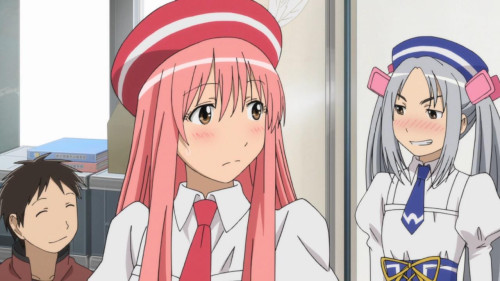
Out of all of the funny moments this chapter, the biggest one has to be the reveal of the fujoshi-bait show of the fictional in-universe Winter 2014 season of anime. Suikyuu! is an anime about water polo of all things, a kind of mix between the team competition of sports series (like volleyball manga Haikyuu!!, namely) and the lithe, well-defined fanservice of Free! It even has the exclamation point! From Yoshitake’s reactions to seeing a team of elderly men join in (and thus set up the obvious reveal that Ohno watched it too), I think this is the first time that Nidaime has its own Kujibiki Unbalance, something which is grounded in the tropes and trends of the time that can be a consistent source of discussion for the Genshiken members. At least, that’s the potential, as we’ve of course yet to see more of it.

A Message from Another Time: Genshiken Nidaime OAD

Volume 15 of the Genshiken II manga came out in Japan recently, and with it a limited edition featuring an OVA (or OAD as they call it) where they animate a couple of chapters from the original Genshiken. Covering Sue’s stay over at Ogiue’s apartment and the group’s new year’s shrine visit, it’s a part of the story that should be completely familiar territory to Genshiken fans, and watching it has made me want to both consider its role or purpose as the first Nidaime OAD and think a little about the story itself.

When you think about it, this OAD didn’t have to be the new year’s shrine visit, but it is in many ways the most appropriate given Nidaime. Ogiue’s trauma and the trip to Karuizawa would have been too long and arguably too heavy for this. The graduation in the last chapter of the original Genshiken would have been nice but is of course more of a finale than anything else. The no-dialogue chapter would have been an interesting part to adapt, but that would negate the entire new set of voice actors they’ve brought in. With the new year’s shrine visit, however, you get various threads which lead directly into Nidaime, particularly what’s been covered by the anime. Ogiue shows her softer side, which plays into her role in the second series. Sue expresses her desire to study in Japan, thus setting the stage for her increased prominence. The forlorn romance of Madarame is in full swing here, expressed almost painfully in its silence. Though Genshiken is in a sense full of turning points, this is a pretty major one in hindsight.

In terms of adaptation from manga to anime, I find it interesting that the characters were made to look like in the original series. It seems like a no-brainer but they had to do things like switch to older hairstyles and even styles of dress in order to capture the visual sense of how different the club was back then. In fact the entire mellowness of the OAD really stands out, and I imagine for anyone who watches it after having only experienced Nidaime, they would notice first and foremost the relative lack of bombastic energy. Even the references are from a different period of otakudom (“Sit, Nekoyasha!”).

One minor but noticeable change has to do with the fact that Ogiue has her default Series 1 hairstyle in the OAD, which is subtly different from the hair she wore to the shrine in the manga. There, instead of having the horizontal “antennae” on the sides of her head, Ogiue has more pronounced tufts of hair over her ears, and most likely creating another set of character design sheet just for this one-off Ogiue hair would have been too difficult or time-consuming. What’s important is that this specific hairstyle was not a fluke or a shift in judgment in the manga, as Kio Shimoku specifically drew Ogiue with that hair on the the limited edition cover of Genshiken Volume 15. Given her dress-up for Sasahara’s graduation a few chapters later, I feel like the purpose of this hairstyle was to show Ogiue trying to pretty herself up a bit (which in turn extends from a longer trend of her getting more fashionable after talking to Kasukabe).

If there’s one thing I really took away from  watching this, however, it would be a case of self-reflection, so I hope you’ll forgive me as I indulge in some introspection.

When Ogiue is drying Sue’s hair, she talks about how she’d like to be more like Sue, who isn’t afraid to be an otaku and to just be herself, which Ogiue has been trying to learn. This process Ogiue undergoes in the series is part of why she’s my favorite character, and it’s something I’ve tried to live by as well, to my benefite even, but as I get older I increasingly feel this pressure to not display my otaku-ness so openly. It’s not something I try to hide, but I realize that it’s important to know that sometimes other people won’t quite understand, and explaining who you are and why you love the things you do requires a certain sociability and deftness with words which often escape me. On some level, I worry that the essential advice of “be yourself” is something I’ve begun to creep away from even though it’s been so important to me.

Also, because I’ve managed to become more social and more comfortable over the years, I think what I basically am afraid of is becoming the very person I swore I never would, that person who passes judgment on others for being weird or socially awkward, not because I want to but because I might have lost touch with that feeling. That said, if I’m actively concerned about this, then that’s maybe for the best because it means I haven’t forgotten that idealism even if it doesn’t work out, well, ideally.

Secret Bases: Genshiken II, Chapter 95

As Yoshitake and Yajima discuss the Madarame “harem,” Hato shows that he is more accepting of all the complex facets which make up who he is. Given the issue of romance in the air, however, Yoshitake worries that it could end up breaking Genshiken apart.

One of the manga volume extras has Tanaka and Kugayama discussing the idea that romantic feelings can often destroy otaku groups, and to see that “aside” brought to the forefront in the main manga is interesting, to say the least. It’s an aspect of “nerd friendship” that has been left unexplored in Genshiken so far, for better or worse. Madarame had his thing with Saki, of course, but that was defined more by Madarame’s silence, and now that their particular subplot finished with everything out in the open, the potential drama of the current situation acts as perhaps an extension of that. It’s like every time I look at Genshiken another new arc or period is starting.

Of course, the fact that when Tanaka and Kugayama talked about otaku groups falling apart they had in mind the lone girl whom all of the male otaku fawn after, which is completely flipped with Madarame here. I think I wouldn’t be a fan of too big a swing into “club drama” in the venomous sense, as I think it might get way too far from the core of Genshiken (I’d hate to see friendships fall apart), but given where the series has been and my sense of how Kio Shimoku has advanced the story of the new generation so far, I strongly doubt that’s where it’s headed. Even if it does, I think the man has enough skill to execute it well and make it an opportunity for contemplation nevertheless.

This chapter shows once and for all that the projections have been manifestations of various conflicts in Hato. With the other Hato it’s about how he has tried to maintain this dual mental identity such that his “male” self and his “female” self are two separate entities when in fact they are, as the other Hato put it, the same person. When it comes to the Kaminaga stand, however, given what we know now it’s clear that she represents Hato’s repressed feelings for Madarame. As I’ve stated many times before, I find it interesting that these are two separate aspects. Seeing Hato accept and “absorb” them is probably the highlight of the chapter, as it show perhaps more than any other scene with Hato in the entire of the manga a kind of resolution, or should I say resolve? There’s something powerful about seeing those semi-subconscious facets of Hato disappear from the page, almost like the last time we see Madoka in the original Madoka Magica TV series. I find it also significant that Hato now wants to find an apartment closer to the school so that he doesn’t have to change at Madarame’s place. The idea is obviously that Hato’s own feelings for him make that scenario incredibly uncomfortable for Hato.

A first for Genshiken is that we get to see Sue by herself this chapter. Usually she’s with Ohno, or Ogiue, or Angela, but here Genshiken presents the lone Susanna Hopkins, and though there’s nothing surprising about her lifestyle (or the fact that her dorm is a mess!), there’s an almost melancholy feel to seeing Sue without others to bounce off of, for her actions to collide with the sensibilities of others. If it weren’t for the stuff with Hato mentioned above, I would say Sue in her dorm room would have been the most powerful image in this chapter. Also, though it’s hard to tell I think Sue lives in an on-campus dorm specifically devoted to foreign students. My clues are the bits of unreadable English (or other roman alphabet text) on a couple of plaques and the fact that the two other dorm residents portrayed are speaking something unintelligible for Sue.

I also feel the need to talk a bit about Yoshitake, if only because, as much as the old Genshiken characters were into some pretty hardcore stuff, they never spoke so openly and candidly about topics like sex. Of course, Yoshitake’s exclamations come from a place of otaku fantasy and not personal experience, so it’s not that different, but she’s a far cry from everyone else outside of maybe Angela who’s more forward and is more sexually active than Yoshitake is. I think Yoshitake’s decision to title the whiteboard list of Madarame’s faults as “Rame-senpai no koko ga ramee,” which makes it sound like a line from a porn manga, says it all. As an aside, Yoshitake makes a reference to Kamijou Touma (I’ll break that illusion apart”), which I’m sure will please at least a few.

Sadly we did not get to see Ogiue in her hometown, which I was really hoping for. That said, though this may just be my own wishful thinking, I believe that Ogiue could play an important role in all of this because she understands the emotional and relationship damage that can happen when people refuse to communicate with each other, which I think is the biggest “threat” when it comes to a club like Genshiken falling apart.

Best Anime Characters of 2013

For this year I’ve introduced an extra category to make things fair for the rest of the competition.

OGIUE CHIKA SPECIAL AWARD

This year marked the return of Genshiken to anime, and with it the re-introduction of the character whose very passion and turmoil became the cornerstone of this blog. Ogiue Chika has changed much since I deemed her the best female character of 2007, and Ogiue we see in Genshiken Second Season is not the same as the one which struggled with accepting her fandom. However, it is this very transformation within her which continues to inspire me, knowing that, as her eyes and her expression have softened over time, they increasingly reflect the growth and maturation of otaku culture, and of the positive influence of Genshiken. As Ogiue thrives, so does the club which changed her life, and it fills my heart with joy and discovery to continue to be witness to it. I would write more, but I think that I’ve already said more than enough.

BEST MALE CHARACTER

Armin Arlert (Attack on Titan)

Some of my favorite male characters are guys who are ones willing to take the supporting role, guys who defy the macho stereotypes which continue to haunt characterizations of men in media. Armin reflects this in spades, but I find that he is also great at contributing to how we perceive ideas like power, intelligence, passion, independence, and cooperation. Of the core group in Attack on Titan, Armin is clearly the “brains,” but it’s a specific type of brilliance which allows him to think on a more deeply conceptual and abstract level, and what impresses me most about Armin is this strength in combination with his weaknesses, and how he and his comrades  make up for each others’ weaknesses. Armin is highly observant, a clever strategist, and open to new ideas, but can be extremely hesitant, and to see him embrace his talents in the midst of despair and to take inspiration from Eren and Mikasa is one of my favorite qualities of his character. In a way, this is actually an award for the character interaction for Attack on Titan.

BEST FEMALE CHARACTER

Ichinose Hajime (Gatchaman Crowds)

I don’t think I’ve ever dwelled as long on a pick for best female character as I did this year, but in the end I feel there is no character more deserving than Hajime. To describe her is to engage in contradiction, a character who seems to defy all standards of anime characterization while adhering closely to them.  To talk about her role as the lead of Gatchaman Crowds is to realize that there are few who so utterly represent the concept of a main character as Hajime does, because Hajime is Gatchaman Crowds. Somehow Hajime is a protagonist who’s also a scene stealer, a presence which seemingly warps space around her and embodies all of the quirks which make the show special. Hajime shows that being positive doesn’t mean being naive, that conflict resolution through dialogue and and open mind can be just as thrilling as watching someone throw a punch, and that you can be stubborn about being open-minded. Hajime is simply a force of nature.

Final Thoughts

I find that as much as we like to think that anime is over and done, and continue to repeat that sentiment every year, that innovation (or something like it) continues to happen even in the areas most conventional. To hear that Gatchaman Crowds is ostensibly a remake of a 1970s anime classic is to bring to mind nostalgia grabs and numerous references to the old, or perhaps even a meeting of old and new generations, but Gatchaman Crowds largely defies all of those expectations. Attack on Titan is the big hit to the extent that it feels as if it has surpassed Naruto in its heyday, but even though both are of the ultra mainstream shounen battle manga demographic, Attack on Titan defies numerous trends through its bleak setting and the decidedly unglamorous position even its most important characters find themselves in, yet somehow this is also the source of its popularity. For both Attack on Titan and Gatchaman Crowds, I find that Armin and Hajime truly reflect how different and special each of their series are. Both are not the type to solve problems through violence first, but neither are they characters who are immobilized by the weight of responsibility or ones to abandon society physically or emotionally. They truly feel like characters who are a part of contemporary culture, yet will probably remain timeless.

AdviceFujoshi: Genshiken II, Chapter 94

Hato is back home in order to try and sort out his feelings. Kaminaga and Hato’s brother Yuuichirou are there too, and though Kaminaga (who now insists of being called “sister”) does her best to give advice to Hato about Madarame, her fujoshi brain interferes with her words and intent quite a bit. Eventually, thanks to a meeting with Konno and Fuji, Hato realizes that his feelings for Madarame mean he doesn’t want to leave Genshiken, and resolves to head back to Tokyo.

Chapter 94 is the first time in Genshiken that we’ve actually seen a character’s hometown life elaborated upon to this extent. Sure, there have been flashbacks, like Ogiue in junior high or Madarame discovering doujinshi for the first time, but ask yourself this: how many of the characters’ parents have we seen? The answer is just Hato’s.

Hato’s thought process shows that part of his turmoil is his desire to try and justify his own feelings, to try and compartmentalize everything internal into a consistent emotional map. It doesn’t appear to be a matter of latent homophobia, and if I had to venture a guess it might have more to do with trying to defy his past reputation when gossip spread about him reading yaoi and his classmates constantly made reference to how gay he is. It reminds me of a documentary I watched recently where a girl raised by two gay men talked about how she spent most of her life strongly insisting she was 100% heterosexual as a way of fighting back against the people who assumed that gay men would inevitably raise gay children, but eventually realized she was bisexual. Of course, I don’t know if Hato’s situation is quite the same, but I sense similarities. Kaminaga’s advice to essentially not sweat the small stuff, albeit filtered through her fujoshi self, is perhaps the moral of this chapter.

Kaminaga has grown on me more with this chapter. Her new hairstyle (did she dye it or un-dye it?) gives her a real “classical Japanese beauty” look reinforced by panels like the one above, which then clashes heavily with her ever-“rotten” personality. It’s an interesting contrast, and when I think more about it, the fact that Kaminaga is the way she is but has married (or is about to marry? it’s not entirely clear) a super normal guy in Yuuichirou speaks to something a bit different from the other relationships in Genshiken, even Kohsaka and Kasukabe’s. I think it’s because Yuuichirou and Kasukabe are different kinds of “normal.” One is a straight and narrow type, the other is socially successful, and it speaks to how “normal” is a kind of spectrum in itself.

Being Konno is suffering. Her own feelings for Hato turn this into a kind of love triangle, but Hato doesn’t even realize she likes him, and the fact that her advice of “if it’s causing you so much suffering, why not leave the club?” actually helps Hato realize that, yes, he does like Madarame after all. Not too long ago I wrote that a common form of moe we see is a normal life filled with a series of tiny tragedies, and I think that describes Konno’s situation quite well. I can only imagine how Konno would slide further into despair if she knew the person Hato likes is a guy. After all, when Konno originally learned about Hato’s crossdressing, she assumed that her responsibility as the root of all the gossip that had spread about Hato in high school had actually turned him gay, in turn sabotaging her own chances at romance. Of course, this isn’t resolved yet and Hato x Konno might actually become a thing in the end.

The best moment of the chapter in my opinion comes at the very end. We find Kaminaga drunkenly watching Yuuichirou and his old judo club buddies grapple each other under the influence of alcohol, clearly enjoying the fantasies inspired by reality. It’s unclear to what extent the redness of her face is due to alcohol versus perversion. Juxtaposed on the page next to a reference to a Whisper of the Heart reference (for Hato) and a Samurai Troopers reference (for Kaminaga’s own entertainment), it encapsulates her character pretty much perfectly, the manga panel equivalent of a bumper sticker saying “801 Fujoshi 4 Life.”

For any enterprising business folk, that one’s for free.

Speaking of business, Kio’s comments this month are about how Sue is a DLC skin for Akihabara’s Trip, a game where you search through Akiba and find witches by stripping them. Questionable qualities of the game aside, Sue is somehow incredibly appropriate for this, and would probably make the proper Those Who Hunt Elves and Doki Doki Majo Shinpan! references to boot.

Choosy Nerds Choose…: Genshiken II, Chapter 93

It’s winter break. After the old guard of Genshiken (+ Kuchiki) discuss Madarame’s sudden romantic prospects from their old school otaku perspective, Madarame finds himself being visited by Yoshitake and Yajima. Of the four potential partners (Hato, Keiko, Angela, Sue), Yoshitake recommends Keiko for Madarame due to her similarities with Saki. The chapter ends with the image of Hato visiting home, where he meets his brother Yuuichirou and Kaminaga, who are pretty much married now if not already so.

A lot of previous chapters have been some sort of closure, whether that’s with Madarame and Saki, or Hato’s feelings, but this one feels like a transition. Between the mention of Yoshitake’s sister Risa taking college entrance exams and Ogiue and Hato visiting back home on top of everything Madarame is going through, it gives me an impression of a change coming almost on the level of Ogiue’s appearance and the shift in focus over to her. Given how many chapters Genshiken II has run already this kind of makes sense, as Ogiue appeared at a similar point.

I’m really impressed with how the manga portrays Madarame handling suddenly being the center of romantic attention, because I find that his concerns and his thought process make complete sense for his character. When given time to dwell on the idea, he imagines a simultaneous arrival of all four at his doorstep, like a scene straight out of Infinite Stratos, because anime and manga are his primary “harem” imagery even more than just straight up pornography. When Madarame hesitates in choosing, his explanation is that it is such an unfathomable situation because he expected attracting even one member of the opposite sex to be a miracle, and given his self-image his words rings with the familiarity of truth. At the same time, I don’t think he’s being entirely honest because if he was really okay with any girl, he would have had some wild times with Angela (who’s gone back to America) already.

In Madarame’s situation I think we can see both the exploration of the otaku or geek mind when it comes to romance, as well as an investigation of the harem genre. Madarame’s attitude towards women is initially a kind of passive desperation, a case of “anyone will do” because just that prospect of romance is so out of reach based on his self-image. When given a choice, however, his mind has to adjust because desperation is no longer the driving force because now he has to take the others into account, as well as what he really wants. Obviously he doesn’t really want a harem ending or just sex based on his actions (or more accurately inaction), and I think he’s realizing that there’s more to consider about a love life than just whoever says “yes” first.

If you’re having trouble relating to Madarame, imagine that it’s about being unemployed (which Madarame is!) rather than about romance. In a situation where someone is unemployed for ages, there’s an increasing desperation for finding a new job, to the point that eventually anything will do. Then, one day a bunch of job offers appear and they’re all actually good jobs. Instead of it being about getting paid, there are now a bunch of new variables to consider. Which job pays the best? Which job seems the most enjoyble? Which one is best for long-term planning? Which one is a once-in-a-lifetime opportunity? If not unemployment, then college also works. Which is the best school? Which is the most affordable or convenient? Which has the subject you want to study the most? There’s a lot more to think about, and of course it’s literally impossible to choose all of them.

All of this puts the typical harem or pseudo-harem anime complaints into a different light. You might hear people say, “Why is the harem lead such a wuss? If I were him, I’d have a go with everyone.” Although many harem leads are generic and neutral characters and that lends itself to that ambiguity, I think generally harem series deep down operate under a moralistic frame which some see as over-valuing virginity or passivity, but which I find to be about not being able to fully escape a sense of empathy (this is why fans tend to have a “favorite pairing”). In order to maintain the fantasy in harem series this aspect typically isn’t terribly prominent, but with the greater realism of Genshiken it comes more to the forefront.

The rest of the chapter reinforces this feeling as well. When the guys are huddled in Madarame’s apartment reading doujinshi, Kugayama brings up the idea that even most otaku who are all into the 2-D girls and such aren’t actually against being with real women, which references an older conversation back in the earliest days of Genshiken when Saki asked about this same topic. Being between all otaku men who are aware of this, however, the conversation becomes more about that otaku image in flux. The battle lines drawn a few chapters ago between virgins and non-virgins comes up again here, as Tanaka with his steady relationship and Madarame with his new circumstances seem to flutter beyond the horizon where otaku are not supposed to reach and yet clearly have. Genshiken has become about how the concept of otaku is in flux, but we rarely get to see it from the older generation’s perspective, so I appreciate this.

Although the chapter is mainly about Madarame, it’s also a Yoshitake chapter in that she’s very prominent in the latter half of the chapter. Yoshitake’s nerdish vibrance is on full display here, whether that’s obscure history references, her now-familiar knowing glances at Yajima, or the fact that at the end of the day she’s still that girl who ignored the opposite sex in favor of debating history from a fujoshi perspective with her friends in high school. Her reaction towards Madarame’s decision and assuming he really wants a harem is maybe the highlight of the chapter as her head tilts all the way back in shock. This chapter also made me realize how differently Kio uses Yoshitake’s glasses compared to, say, Madarame, as their variable transparency helps to give Yoshitake that sense of energy and slyness.

I sometimes see people complain that Genshiken spends too much time on Hato and not enough on Yoshitake and Yajima. While I think it’s a valid criticism for the most part, I find that one of the reasons this is an issue is because even though the other two don’t get as much focus they’re still portrayed extremely well in their moments and interactions. For example, one of the most significant parts of Yoshitake’s advice is strongly hinted at in this chapter, which is that she’s watching out for her friends in suggesting Keiko as the right choice for Madarame, as she doesn’t want to hurt Yajima. Moments like these make you want to learn more about them, because if they were boring or uninteresting no one would care. Nobody ever asks about Kuchiki’s backstory, after all.

As for Yoshitake’s recommendation, I know there have always been fans of Madarame and Keiko, even going back to the days when the original Genshiken series hadn’t even finished and there was no real inkling towards this pairing. I gave my thoughts on this pairing previously, but Yoshitake’s logic that Keiko is the most like Saki in that she’s able to talk candidly is pretty interesting, especially because from what little we’ve seen of Keiko’s love life (in that she has one at all), her communication with her boyfriend at the time was pretty poor in comparison to how she talks with “Watanabe.” Madarame’s mental mix-up of Keiko and Saki aso makes me think that it may not only be a matter of personality but that she also resembles Saki in the way Keiko carries herself. If that’s the case, I wonder if this is simply down to “similarity” or if Keiko is supposed to be someone who’s actually emulating Saki. Kio’s mention of his other ongoing series in the side bar then makes me wonder if indeed Keiko x Mada is the Real Spotted Flowers.

As for Hato, he strikes an impressive figure at the end of the chapter as he works to shovel the snow off of his family home’s rooftop. There’s something about him exuding such a “masculine” aura that feels unfamiliar due to the fact that most of the time the manga shows him as crossdressing. Hato’s interactions with his brother and Kaminaga will be the focus of the next chapter. We see that Kaminaga’s changed her hairstyle, and I wonder if it has anything to do with finding out that Hato basically has a wig matching hers.

In all honesty though, what I really want to see is the other visit home mentioned this chapter, which is that Sue has accompanied Ogiue back to (I assume) her hometown in Yamagata. Not only is there something potentially wonderful about Sue interacting with Ogiue’s family, but we’ve never actually seen Ogiue’s relatives at all. The best we’ve gotten is that Ogiue once mentioned having a little brother, but it was part of a hasty explanation after being outed as a fujoshi, so we don’t even know if this little brother actually exists.

I hope we find out.

Genshiken Second Season Episode 13 is the Ribbon

When it comes to the adaptation process of Genshiken Second Season as an anime, most of the time the changes ranged from minor to medium at best. Here at the very end though, we’re presented with an actual 100% original anime episode to wrap things up. As such, for the first time I’m going to be applying the level of detailed analysis I usually reserve only for the Genshiken manga to the anime.

In the previous episode, Madarame revealed that he had decided to quit his job, and Hato has ended up blaming himself for this turn of events. Seeing that Hato has been avoiding Genshiken for weeks, the club invites Hato and Madarame to a hot springs so that they can relax and Hato can move forward, much in the way that Ogiue was able to have her own breakthrough. Hato, originally planning to stop crossdressing due to the perceived troubles it’s caused, gets some advice from Madarame: basically, just do whatever you want until you don’t want to, stop, then start up again if you feel like it. It’s no big deal. Hato decides to continue his ways.

On some level I think that this final episode is an attempt to finally get the Karuizawa arc (the point in the manga Ogiue finally learns to accept herself) into the anime. At this point, Ogiue is no longer really the focus of Genshiken, so it wouldn’t fit quite right to have them just devote around three or four episodes flashing back to the pre-Nidaime days, but it’s also such a significant part of Genshiken‘s story that its absence has been felt rather strongly both among fans and just in that something was missing from the anime the whole time. After all, for those who’ve stuck strictly to the anime adaptations, Ogiue somehow went from a frustrated and antagonistic individual to a somewhat gentle but still easily flustered mentor, and there was no explanation, at least until now. Even if it’s just a few brief glimpses, I’m glad to see part of Ogiue’s breakthrough animated.

With Ogiue’s desire to help Hato the same way that she was helped back then, not only do I see Episode 13 as a place for the Karuizawa storyline to make a “cameo appearance,” but I consider it to be a spiritual successor of sorts as well. In particular, Madarame’s advice to Hato resembles Sasahara’s words to Ogiue, that you can’t help what you like, only tailored to a less traumatic and dramatic situation. There’s no realization of love here, only the comfort of acceptance., andMadarame’s reached his own turning point in life, so he can look back and reflect for Hato. In addition, the discussions of collaborating on the next “Mebaetame” clearly point to the idea that Genshiken the club is a family of sorts, and a place for people to change through interacting with people both like-minded and otherwise.

Yoshitake’s presence in this episode is notable, as I think that as much as the show put Hato into the spotlight, Yoshitake (or should I say her voice actor Uesaka Sumire) has still ended up being a mascot of sorts for Nidaime. She’s that nerd you put out there to show how fashionable nerds can be, and I think just having a couple of scenes primarily of her geeking out over history from a fujoshi perspective is a part of the character’s position.

This is the first time that a Genshiken anime has seen fit to wrap things up with original content, though it makes sense because previously they had sort-of-okay stopping points and this time around if they had continued to just follow the manga, there would be no proper wrap-up for the series. The only thing viewers would get is more questions and perhaps the worst case of “READ THE MANGA” ever. Thankfully this isn’t the case, and even if I’m aware of the fact that there’s so much more material out there, this is a respectable bookend. Also, in what I’m sure is an intentional move, both the final episode of the anime and the latest chapter of the manga involve public baths, but the two are actually completely different in terms of narrative development and content outside of a more general theme of honestly expressing oneself, and so a comparison between them isn’t that useful.

This episode is also apparently a place for the people who made it to go wild with the references. A lot of the legwork was already done by the blogger Orezui, so I have to give ’em thanks.

1) “She’s not here! There’s no Hato-kun here!” is apparently a Patlabor: The Movie reference.

2) “Let’s go to the roof. I haven’t felt this angry in a long time,” is a line from the manga Salaryman Chintarou.

3) “But I can’t go [out] with a guy” is a direct reference to a line from Ogiue during the Karuizawa arc, also parodying the fact that Sue did something similar in Episode 1.

4) Sue’s obsession with taking pictures of everything related to the city of Tachikawa mirrors Yui and Mio’s initial reaction to London in the K-On! movie.

5) Kuchiki’s creepy run comes from Attack on Titan (that video above is highly recommended).

sue-chunli

6) Sue’s followup attacks are taken directly from Super Turbo-era Chun-Li from Street Fighter II. Specifically, the moves shown are Kikouken -> Jumping fierce -> Close standing fierce -> Senretsukyaku -> Tenshoukyaku.

7) Sue makes a Tomoko from Watamote face.

Obviously I know that this isn’t truly the end of Genshiken, and I hope those who’ve watched it are interested in following the manga to find out what happens next. In retrospect, the anime’s had its fair share of ups and downs, though mostly from the perspective of someone who notices subtle differences in tone and narrative timing, and I think that there’s something about the way Kio Shimoku frames each of his chapters and laces it with bits of characterization that I think gets increasingly lost as he continues to improve these already strong aspects of his work. At the same time, I think the anime generally captures what the new Genshiken is about, which includes an otaku generation gap, the complexities of gender and sexuality within the otaku framework, as well as the on-going process of change, development, and at least a bit of maturity that is college life. So if you’re still interested, stick around.

Besides, we still have that limited edition anime packaged with Volume 15 of the manga.

When in Rome: Genshiken II, Chapter 92

This month’s Genshiken provides what may be the best use of a pool/bath/hot springs chapter that I’ve ever seen.

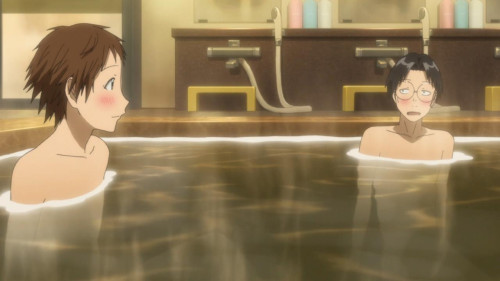
As a bunch of the guys take Madarame away to get his hand treated, the rest of Genshiken (and company) go to a public bath to relax and air things out. Angela and Keiko make their intentions regarding Madarame clear to each other, beginning a strange rivalry of sorts between the two. Meanwhile, Hato finally admits out loud that he has feelings for Madarame, while Sue continues to contradict herself every step of the way.

I get the feeling that this chapter plays a lot with standard anime and manga tropes, especially in the fact that it manages to fit in both an extended bath scene and a festival-like environment, but does so in a way which actually leaves the guy at the center of all this drama literally at home. Obviously with a chapter that takes place almost entirely in a bath there’s bound to be an element of fanservice, but I found it also to be quite enlightening. This isn’t just referring to Hato finally coming to terms with himself, but just the way everyone involved communicates so openly. It’s as if the abundance of nudity this month is a metaphor for simply baring it all: no boundaries, no restrictions, just the truth from the heart (at least in most cases).

There’s actually a lot of information and development this time around, and it’s presented in a way that I think has become characteristic Kio Shimoku, more refined than ever as he continues to improve his storytelling ability in manga. This page above caught my eye in particular, because of how well it conveys not only the fact that Ogiue and Keiko’s have gotten a bit closer (by virtue of Ogiue being Sasahara’s girlfriend) just through the page composition and their positions within it, but also how the panel with Angela gives the impression that you’re seeing her from Ogiue and Keiko’s point of view. The height and the angle of the “camera,” as well as the panel following it give this impression. The way you can see Keiko’s confidence falter as soon as she sees Angela is also a nice touch. This is only the second time that Genshiken has done one of these bath scenes, and the last time around the relationship between Ogiue and Keiko was quite a bit more antagonistic, so it’s interesting to see them getting along in a similar setting.

Similarly, Yajima, though she doesn’t do a lot this chapter, actually says a lot. With the way the manga focuses on her at key moments, it really does give the impression that she feels something for Hato, even if it might not be strictly romantic. When I think about it, the fact that Yajima isn’t being particularly body-conscious despite being around Ohno and Angela must mean that she’s so distracted by Hato’s situation that she’s ignoring her own normal worries. I also have to point out that Kio actually drew her naked, and not in a way which is directed at appealing to a chubby lady fetish.
It’s been quite a journey with Hato, and when I look back at my own musings about him from chapter to chapter, it’s interesting to see how my own views have gone. At first, I took his self-assessment in regards to things like his self-image and his sexuality at his word, but over these few years it’s become clear that even Hato himself didn’t quite understand, though it wasn’t as simple as “Hato’s BL obsession was a sign of a closet homosexual/bisexual all along.” I think there’s enough evidence so far to say that his gender, sexuality, and fantasies don’t all perfectly correlate with each other. Last chapter, I wrote about how the “Stand” versions of the female Hato and Kaminaga are meant to be two separate aspects of his psychology, and here it’s made plainly obvious by the fact that both appear simultaneously. The way I see it, the female Hato represents Hato’s fudanshi side, or rather the image of a fujoshi in his mind who can communicate with other like-minded individuals, while the Kaminaga relies on Hato’s view of the real Kaminaga as someone who is always true to herself. This is why it’s the Kaminaga who has made it impossible for him to deny his own feelings about Madarame, whereas Hato has been easily able to brush aside the female Hato’s fantasies. Though having them float above Hato just has me thinking that the two are having a “conversation” in the men’s bath the whole time. It may also be of interest that none of Genshiken takes issue with Hato on this whole matter.

I honestly don’t think there’s going to be a Hato x Mada (or Mada x Hato) ending, and Madarame’s going to be in a position where he’s not just been rejected by someone but had to reject someone himself. Overall, if this is the case it’ll be a serious change for the otaku among otaku.

At this point in Genshiken we’re already familiar with the fact that characters like Angela and Keiko don’t prescribe to the true love romance mantra that appeals to otaku so much, but it’s still kind of refreshing nevertheless. Angela is provocative in more than one sense of the word, and the more I see of her the more I get that she’s actually quite intelligent. Angela’s insistence that Madarame needs “help” after buying “all that doujinshi” and that Keiko “wouldn’t be able to satisfy him,” ends up coming across as measured and calculated. Obviously Angela knows that Madarame is not some studly he-man with an unquenchable thirst for womanly conquest, and so the idea that Keiko wouldn’t be enough for him is clearly facetious. She’s just trying to get a rise out of Keiko, though what I find funny about all of this is that I can see a definite friendship forming between the two. They both want to win out, but at the same time their smiles and even the way they decide that Sue should be the one to go visit Madarame means that neither of them are especially bothered by the idea of losing. There are more fish in the nerd sea, and a bitter competition this is not.

Speaking of Sue, for all of the attention Hato and Madarame get, I feel like in the end it’s Sue who really steals the show this chapter. Her expressions are amazing, even more than Ogiue’s (which I enjoyed immensely).

Though her own emotional turmoil is played for comedic purposes in contrast to Hato’s, I do wonder what’s in store for her. Her development throughout the new series has come in fits and starts, but it’s undeniably there.It’s interesting how Sue is normally immune to embarrassment but here it overwhelms her to the point of violence and frustration, and I feel like I want to say more about her, but I don’t know where to start.

So, I think I’ll save it for the future.

Genshiken Second Season Episode 12 and the Fanservice You May Not Have Seen

Episode 12 wraps up the school festival. If you want to read my thoughts on the events of the episode, you’ll find them as part of my analyses on Chapters 81 and 83. At this point I’ll have to assume 82 will be covered in Episode 13 or just not at all.

So with all the cosplay this episode, particularly from Ohno, there was a hefty amount of fanservice in the most obvious sense. This was magnified by the fact that they combined two disaparate chapters together to make it an almost “cosplay-themed” episode, but amidst all that more overt fanservice the anime actually added a little something for the Ogiue fans in particular.

This image is actually an anime original, and though it’s just a single frame it communicates a lot of intimacy and perhaps even eroticism between Ogiue and Sasahara. Ogiue never ever, ever has an expression like that, with the wry and suggestive smile as well as the sideways glance towards Sasahara who’s more tacitly responding in kind. The message this image communicates is that Sasahara likes what he sees out of Ogiue, and Ogiue is pleased that he likes that. While you might think that this is me reading too much into it, given their interruption by Sue previously, there’s no doubt in my mind how we’re supposed to interpret it.

However, if you want something that I consider fanservice that probably no one else does, it would be another anime-exclusive moment:

A Go Go Curry parody!

As long-time readers of the blog might know, I am a huge fan of Go Go Curry, and what’s more, the very first Go Go Curry I ever ate at was one in Akihabara. Though there’s no way to tell if the one Madarame is at is the same one that introduced me to the wonders of Kanazawa-style curry, I’d like to pretend that it is.

Really though, Episode 12 of Nidaime actually combined two of my favorite things, Ogiue and Go Go Curry. On some level I have to rank it pretty highly, albeit at a fairly shallow level.

The Mawaru Penguindrum merchandise also helped.

Zankoku na Genshiken Second Season Episode 11

Now comes the other big moment of the new anime. Of course I’d have a lot of thoughts on what transpires this episode, which you’ll find in the equivalent manga analyses: Chapters 78, 79, and 80.

I think there’s little doubt that Madarame’s confession is one of the most significant events in Genshiken. I’ve felt sort of conflicted that it happened because it is possible for someone to move on from a former love without the confession and rejection you see so often in anime and manga, but the series makes it clear that Madarame was incapable of doing so, no matter how hard he tried. Looking back, the idea of “freeing” Madarame to some extent implies making it so that he’ll be open to others.

There’s a fairly significant mistranslation in the Crunchyroll subs, at the very end of the episode. After Kasukabe starts to cry, the translation has Madarame say, “Now I know that Kasukabe-san cries easily.” This isn’t quite right: what Madarame actually says is more along the lines of, “I already knew that Kasukabe-san cries easily.” It’s a reference to the events of Volume 4 of the manga (Episode 11 of the first anime), when Kasukabe accidentally starts a fire which gets the club into trouble. Though she put on a tough face, her guilt over the accident caused her to start crying. Essentially, Madarame’s line is supposed to reference how much he’s paid attention to Saki over the years.

It’s probably significant then that Keiko and Saki both notice how Hato pays a lot of attention to Madarame. Or is it?!

Some of the timing of the confession itself turned out different, and there isn’t quite as much impact from Madarame’s response to the line about the relationship that might have been, but I think the episode overall does an all right job of it. The manga devoted an entire chapter to just the two of them in the club room, mirroring previous chapters which did the same.

As for the actual confession and reaction, I could see how Kasukabe’s response could be interpreted as cruel, though I don’t necessarily think so. One thing anime viewers may not be aware of is that Kasukabe’s line about how a relationship with Madarame might have been a possible future is actually also a reference to another series by Kio Shimoku called Spotted Flower. In it, characters very (but not entirely) similar to Madarame and Saki, an otaku and his non-otaku wife who knew him since college, are married and expecting their first child. In fact, the title itself is a reference to them: Madara means spotted (which also explains the Naruto character), and Saki refers to the blooming of flowers. It’s a sort of holy emblem for Saki x Mada fans, but at the same time perhaps incredibly cruel itself for very nearly giving those shippers what they want before collapsing the entire thing like a house of cards.

Cruelty abounds.