
To follow up my post on Yazawa Nico, I’ve written an analysis of Sonoda Umi for Apartment 507.
She really is a wonderful character.

To follow up my post on Yazawa Nico, I’ve written an analysis of Sonoda Umi for Apartment 507.
She really is a wonderful character.

I’ve written a post about why Yazawa Nico is one of my favorite Love Live! characters over at Apartment 507. Whether you’re a Nico fan or a hater, why not check it out?
Today, January 17th is the birthday of Koizumi Hanayo, the rice-loving, school idol-adoring best character from Love Live! So, what better way to celebrate than with the Hanayo Nendoroid I recently acquired?
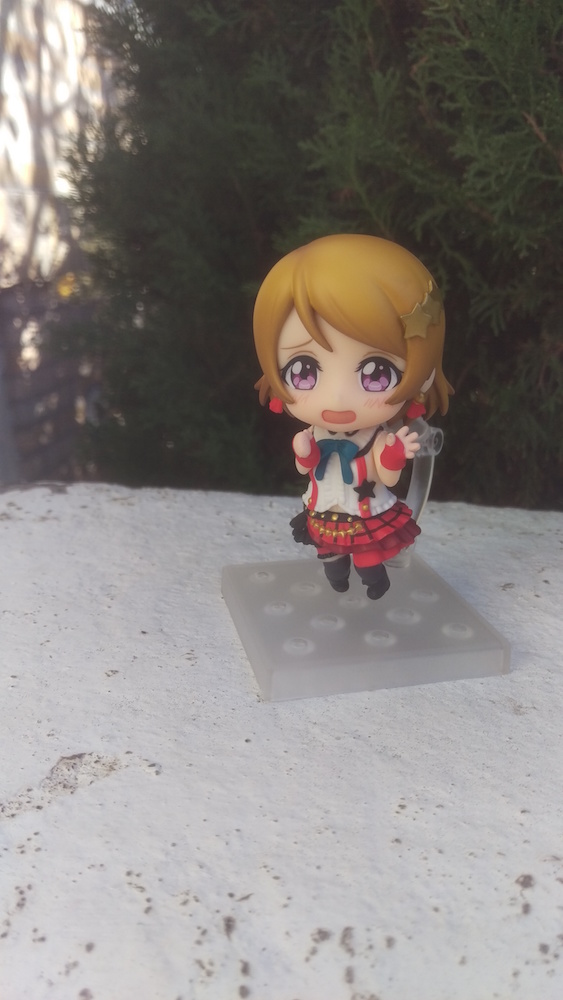
See Hanayo.

See Hanayo with rice.
Hanayo is one of the nine original Love Live! Nendoroids, based on their outfits from the first anime opening. In order to facilitate any fans’ desires to collect them all, they come with fewer accessories as well as a lower price tag to match. I did not buy the other members, but if they’re as good as Hanayo’s Nendoroid then I think they’re a worthy investment, especially if you have a favorite Love Live.
There’s an even better Hanayo Nendoroid that comes with a rice cooker and glasses, but it has yet to be released. I do wish I had it for this occasion, but maybe next year.
—
If you liked this post, consider becoming a sponsor of Ogiue Maniax through Patreon. You can get rewards for higher pledges, including a chance to request topics for the blog.
BEST MALE CHARACTER

Sunakawa Makoto (My Love Story!!)
In the narrative of My Love Story!!, Sunakawa is naturally handsome, intelligent, and charismatic to the point that girls from ages 8 to 80 seem to fall in love with him at first sight. However, what makes him truly stand out aren’t his looks or his smarts, but his genuine bond with his best friend, the seemingly brutish Gouda Takeo. Sunakawa’s opposite in practically every way, but the two share one important thing in common: big hearts. Sunakawa sees not only the goodness in Takeo but the petty shallowness of those who judge people only by their looks, which affects him just as much as Takeo himself.
Takeo is also a worthy pick, but it’s the way Sunakawa looks out for Takeo that makes him the Best of 2015. Whether you want to be Sunakawa or have him watch your back, there’s no better best friend in all of anime (except maybe Tomoyo).
BEST FEMALE CHARACTER

Koizumi Hanayo (Love Live! The School Idol Movie)
Last year, Koizumi Hanayo was in the final running for Best of 2014, but ultimately the immensely powerful personality of Kill la Kill‘s Kiryuuin Satsuki won out. Now, with Love Live! The School Idol Movie being the swansong for the original Love Live! girls, I thought it best to call Hanayo Best Female Character of 2015 because there might never be a chance to do it again.
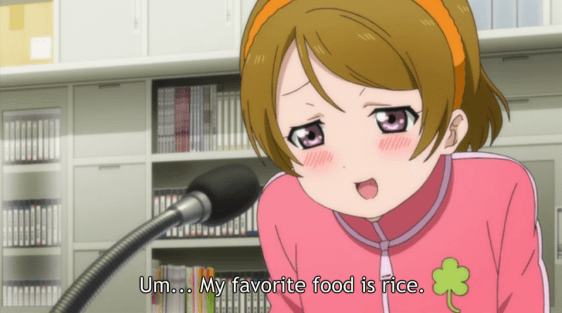
If there’s one word I would use to describe Hanayo, it would be “passion.” It’s her nearly unrivaled love of school idols, along with some support from her friends, that allows Hanayo to take the step from fan to idol in the first place. The fiery look in Hanayo’s eyes and her characteristic “quiet scream” when something big is happening is unmistakable. When Hanayo helps Rin overcome her negative self-image, it’s from a place of genuine care and compassion. And when Hanayo goes on a rant about how rice is the central component of a proper meal and that this is one of America’s most critical flaws, why, it’s only appropriate. Hail to the Rice Goddess.
Final Thoughts
When it comes to determining my favorite characters in anime, I don’t think I’m alone in saying that they often possess either admirable qualities I would like to emulate, or traits that I can directly relate to. Sunakawa’s perceptiveness and compassion are things that my oblivious self would love to have. Hanayo’s devotion to food is a match for my own constant desire to find the latest, greatest things to eat, and her instant switch from shy to fervent fan also reminds me a lot of myself. Of course, these are not their only criteria, and ultimately it is their impact on their friends and loved ones that is in a way much more significant, but there’s something about both Sunakawa and Hanayo that makes them both like quiet fist pumps in anime form.
Yesssss.
—
If you liked this post, consider becoming a sponsor of Ogiue Maniax through Patreon. You can get rewards for higher pledges, including a chance to request topics for the blog.
Following a previous appearance on The Anime Now Podcast to talk about the Love Live! The School Idol Project TV series, I was invited back to discuss the recent movie alongside Bamboo of Anime News Network fame and Host Bradley Meek. Find out which of us is the biggest Love Live! fan, and see our mutual thoughts on some of the more interesting quirks of the film.

Love Live! is huge, no doubt about it, and I would say deservedly so. Between the quality of the anime TV series, the appeal of its characters, the addictive nature of its mobile game, and of course the slew of songs produced, in a way it’s no wonder that Love Live! manages to attract both male and female fans in large numbers. I attended the New York City premiere for Love Live! The School Idol Movie, and as expected was greeted with a long line full of cosplayers, glow stick wielders, capes adorned with the characters’ faces, and just generally fans who love the main idol group so much that they practically treat the showing like a live concert. Watching the movie amidst an audience of differing values and perspectives, what I found most interesting is how the movie juggles all the various aspects that go into the franchise while maintaining both a fun experience and a solid narrative, and which speaks further to how malleable Love Live! is as a fan experience.
Synopsis and General Thoughts

In the world of Love Live! are idol groups that represent specific high schools. Kousaka Honoka, a new attendee at Otonokizaki High School, forms a “school idol” group called μ’s along with eight other girls so that they can save their school from rapidly declining attendance and closure. Eventually, through various trials and setbacks, they not only manage to keep their school, but win the biggest school idol competition, the “Love Live,” defeating the defending champions A-Rise in the process. However, because they cherish the specific circumstances and experiences that brought them together, they decide that they will retire μ’s and its name. As the TV series, ends, however, they receive a note of great importance, leading directly into the film.
The note turns out to be a request to fly to New York City and shoot a live performance to promote a bigger and better Love Live, which results in the film being split into two parts: first, the trip to NYC, and then the build-up to a concert back in Japan. Given the first half, I find that there’s something special about attending the NYC premiere, especially because of how much care and attention they put into replicating New York’s landmarks at overall atmosphere. Jogging through Central Park, visiting the new World Trade Center, what stood out to me in particular were actually the restaurants. Visiting thinly veiled analogues for such NYC institutions as Junior’s (where they experience American cheesecake for the first time) and Japanese restaurant Kenka (where the surrounding St. Mark’s Place atmosphere is captured surprisingly well), it’s clear that the people responsible for the movie did their research, and in terms of capturing the NYC experience they did a good job.
As for the second half of the movie, it’s very much designed to conclude the story of the nine girls of μ’s, which in a way is a major surprise. Not only would it be obvious to have their adventures continue forever given their appeal (and I’m sure they’ll find a million ways to extend the overall life of the group), but the film doesn’t even mention the fact that they’re creating another anime with a new group of girls aspiring to be school idols. One of the criticisms of Avengers 2 is that it feels like a stopgap between two different status quos, and it would have been all too easy to feature the new girls in the movie conspicuously as a way to promote them. In fact, there’s nothing of the sort, at least as far as I can tell. This movie, whether it’s truly the end or not, at least feels like a conclusion to a long and entertaining journey.
As a film that’s supposed to be both the sequel and bookend to the story of μ’s, I find that Love Live! The School Idol movie strikes a good balance of calling back to beloved moments of the TV series, being its own story, and giving enough time and energy to each of the characters without having them overcrowd each other. Some figure more prominently into the main narrative than others, especially in the second half, but there was clearly a lot of effort made to keep the movie tight and not to bog it down with having to showcase each girl like it was a fighting game movie. Notably, entertaining musical numbers group the girls together by year (there are three 1st years, 2nd years, and 3rd years among the group), with one girl in each group being the “center,” and are in a way reminiscent of a Fred Astaire movie.
The Characters of Love Live! in The School Idol Movie and Beyond
A lot of the time, what makes Love Live! work is that the characters’ key traits allow scenes to practically play themselves out, and this comes across very well in the movie. For example, certain characters have their favorite foods. Kotori loves desserts and sweets, so naturally she would view America and New York as a never-ending wonderland. In contrast, Hanayo loves food in general but reveres plain white rice above all else, and suffers in an environment that emphasizes bread and pastries and considers rice merely a “side dish.” In such a circumstance, the normally quiet and reserved Hanayo would act out. It only makes sense for Umi to be a nervous traveler, for Maki to be flustered by a close interaction with A-Rise’s leader Tsubasa, and so on. It’s moments like these which capture the appeal of the characters so well, while tying them into the story.

There are a lot of different values carried in Love Live! fandom, and given people’s differing opinions on favorite characters (Hanayo is the best), level of interest in yuri, amount of fondness for idols in general, and more, it occurs to me that one of the strengths of Love Live! is that it has as much or as little “depth” as you want it to. Take the character of Nico, who’s also by far the most polarizing figure among Love Live! fans. Her appeal (or to some lack thereof) comes from the fact that she’s both the most cynical and optimistic member of μ’s when it comes to being a school idol. She’s sort of like a pro wrestling fan who knows all of the behind-the-scenes information behind wrestlers’ real personalities and controversies, but at the same time gets more excited than anyone else (with the possible exception of Hanayo) by the illusory presentation of the performance.
In wrestling terms, Nico would be a “smark” turned pro wrestler. Having all of this enthusiasm and background knowledge and fully believing in its potency is what prompts her coy, girlish persona and her use of her signature catch phrase, “Nico Nico Nii!”, which has been optimized to be the perfect idol moment. And yet, it’s very easy to say that Nico = “Nico Nico Nii!” Hanayo is rice. Rin is meows. Eli is “khorosho.” Both sides, the simple and the elaborate, are represented well in Love Live! The School Idol Movie, and rather than impacting the quality of the movie and Love Live! in general, I think what it serves to do is widen its appeal. Whether that’s a good thing or not is, of course, up for discussion.

As a final note, I’d like to talk about the present we received at the premiere. Attendees received character signboards as well as codes for the Love Live! School Idol Festival mobile game. It’s the first time I’ve received anything of the sort, and I think it went a long way in making fans of Love Live! feel like they were part of the franchise experience as a whole, even if they couldn’t fly to Japan. As shown above, I received a Nozomi signboard, which I’m happy about, as she is indeed one of my favorite characters. But if anyone has a Hanayo… leave a comment below.
Actually, one last thing: internet fandom in a nutshell.

—
If you liked this post, consider becoming a sponsor of Ogiue Maniax through Patreon. You can get rewards for higher pledges, including a chance to request topics for the blog.

Recently I accomplished one of my goals over the past couple of years: I finally created a team of 9 unique Hanayos in the popular mobile game Love Live: School Idol Festival. Seeing as how tomorrow I’m going to see the Love Live! movie, I think now’s as good a time as any to discuss how I play School Idol Festival as a fan of the franchise, but also as someone who knowingly restricts his exposure to the game, and creates games within games.
There was a time when I didn’t feel as strongly about Love Live! as a whole. All I knew was that I liked the anime quite a bit, and when I discovered the increasingly popular mobile rhythm game, it introduced me to the collector’s mentality that goes into supporting idols, digital or real. What began as a curiosity became an understanding of how involving the rhythm game with its collectible card aspect, character loyalty, and other aspects could be. The game taunts you with the prospect of buying more gems to give you that next gashapon-esque crank of the lever. If you choose to not give the game money, it then becomes the absolute biggest time sink there is. It’s a dangerous combination not uncommon to mobile games, and seeing the potential threat to my free time that the game posed, I knowingly restricted my goals. Thus, the All-Star All-MaddenHanayo Team starring Jerry Rice became my aspiration. I could pick my battles, prioritize certain events over others, and prevent the game from destroying my free (or not free) time.
While I hit my original goal, what’s funny is that somehow I feel that, by aiming for it so intently, it actually got further away from me. What I mean is that in the process of trying to get 9 unique Hanayo cards, I ended up with full teams of Eli and Umi without even trying. I’m sure there are fans of those two characters who would devote their everything to having full squads, but it was merely a stepping stone in my process. Again, it’s a good thing I didn’t approach the game with a completionist mentality, or else I would really be in trouble.
In the end though, I find that the game was merely supplemental to my fondness to the anime, which is why I’m looking forward to the movie far more than my anticipation over getting the final 9th Hanayo on my team. There’s an interesting disparity between the worlds of the game and the anime, and that has to do with the role of men. While players of Love Live! traverse all sexes, genders, and sexual orientations, there’s still the residual effect of idols classically being a point of desire for guys. A lot of the rewards for playing the game are messages from the girls, who will talk about how they want to be alone… with you.
In contrast, men are virtually non-existent in the anime. This is what perhaps makes it yuri fuel for a certain contingent of the fanbase, and certain characters’ actions acknowledge that men exist in a kind of abstract sense (Nico’s behavior, for example), but a lot of the character dynamics and interactions are pointed towards each other rather than the hypothetical viewer/player. The game is where I show my support as an extension of my fondness for the anime, and even if I ever buy a CD (NicoRinPana of course), then that’ll also be supplemental to my fondness for the overall narrative and theme of Love Live!
—
If you liked this post, consider becoming a sponsor of Ogiue Maniax through Patreon. You can get rewards for higher pledges, including a chance to request topics for the blog.
Cutie Panther is one of my favorite Love Live! songs. It’s intense, has a catchy beat and melody, and stands out from most of the other stuff that comes out of that franchise. When you actually listen to the lyrics though, it ends up sounding like something a stalker (or maybe a yandere character?) would be thinking.
Below are some of the choice lines. Translation is taken from this School Idol Festival wiki.
(Who are you with?
No way, you’re not allowed to be with anyone besides me)
I love you! You should be falling in love with me
I love you! That’s the right thing to do
Icy words, a gentle gaze… The prize at stake is you!
The rules of love are so hot
They exist to be broken
I miss you! It’s not wrong if it’s out of love
I miss you! That’s what intense love is like
Again, I don’t think this ruins the song, as it’s still my #2, but it sure does make them sound like stalkers! Also, there’s a history of catchy yet creepy-sounding songs, including a lot of old denpa songs (is that still a thing?) from visual novels. The most famous stalker song is probably “Every Breath You Take” by The Police:
If you’re curious, my ranking for Love Live songs is 1) After School Navigators 2) Cutie Panther 3) Shocking Party
Magical Angel Creamy Mami
I recently learned (thanks to Japanese popular culture scholar Patrick Galbraith’s new book The Moe Manifesto) that Magical Angel Creamy Mami is not only an influential magical girl anime but the very first anime about an idol. In other words, idols and magical girls have been conceptually tied to each for decades now. You can see this not only in the the fact that you’ll get the occasional idol + magical girl still (Cure Lemonade and Cure Sword in the Precure franchise, for example), but the fact that the latest competitors to magical girl anime have been idol-themed shows, such as Aikatsu! and Pretty Rhythm, both of which feature magical girl-like transformation sequences. I think Creamy Mami is especially significant here because the majority of magical girls prior to it were more “witch girls,” characters who already have magical powers without the need for transformation and use them for mischief.
Of course, the common trait of magical girls and idols is that they both feature cute girls, and with idols especially they’ve always occupied a position where they are innocent yet sexual, and I don’t mean that necessarily in an “idols are creep magnets” way. Both men and women respond to idols for a variety of reasons, and a lot of it is tied to the image they present. They can be somewhat literal idols for girls and targets of affection and desire for men, and this can be seen in how idols are used in anime. While Creamy Mami built an unexpected older male audience, for example, Superdimensional Fortress Macross reveled in it by combining the idol with the extremely prominent aspects of science fiction and giant robots. The 1970s brought forth a lot of giant robot anime, and the 1980s saw the time when those who became fans of robots and SF began creating their own works, as seen with Kawamori Shouji and Macross and later Studio Gainax and their Daicon III and IV animations. Many of these creators said, “I like SF, and I like cute girls,” and created a defining combination of anime where mecha and other forms of fantastic technology are mixed with cute girls.
Daicon IV
It can also be argued that the girl in the Daicon animations is herself a magical girl, but the connection between magical girls and science fiction is especially evident in the 1990s and the advent of the fighting magical girl, most notably with Takeuchi Naoko’s Pretty Guardian Sailor Moon. While Sailor Moon does not feature giant robots, it’s undoubtedly influenced by the Super Sentai (i.e. Power Rangers) franchise with its own transformation sequences, color-coded costumes, and monster of the week fights. Super Sentai is not only traditionally marketed at boys (though this too changes as they eventually start trying to appeal to the “moms” market), but it’s also more broadly tied to tokusatsu, the costumed fighters and rubber monsters genre that more or less literally means “special effects.” What I find significant here is that when it comes to categorization of genres in Japanese, you often see “SF/tokusatsu,” tying things back, at least somewhat, to science fiction.
Pretty Guardian Sailor Moon
Moreover, the manga group CLAMP have been fans of titles like JoJo’s Bizarre Adventure, Saint Seiya, and Galaxy Cyclone Braiger, and have produced titles such as Magic Knight Rayearth, which features magical girls in a swords-and-sorcery world who also gain the power to summon giant robots. “Rayearth” itself is the name of a giant robot, thus making the title itself reminiscent of the naming scheme of many mecha anime such as Mobile Suit Gundam or Super Electromagnetic Machine Voltes V. It’s as if these female creators have taken the works that were made “masculine” by Kawamori, Gainax, and others, and in a sense re-feminized them in a process that created something new and exciting.
If we’re talking influences though, Sailor Moon and CLAMP works such as Cardcaptor Sakura are huge in and of themselves, and their shadows can be seen in a number of anime from the 2000s on. Sailor Moon basically transformed magical girls to such an extent that many assume that fighting magical girls have always been the norm, and Precure has come up as a spiritual successor that has lasted even longer than Sailor Moon. The protagonist in Sunday without God practically is Cardcaptor Sakura protagonist Kinomoto Sakura, and Magical Girl Lyrical Nanoha, which has as its primary audience older men, clearly takes a lot from Cardcaptor Sakura as well. In the case of Nanoha, it also incorporates an increasing level of science fiction from one series to the next, as the franchise goes from technology-based magic staffs that shoot lasers in battles reminiscent of Mobile Suit Gundam to spaceships and interdimensional travel. Once again, the magical girl as cute girl is tied to SF. As for idols, they not only haven’t been forgotten, either in real life or in anime (as seen with series such as Love Live! and the aforementioned Aikatsu!), but Kawamori makes his return in the form of AKB0048, a series that not only features idols as magical girls of sorts both piloting and fighting giant robots in a story that spans a galaxy, but is directly based on one of the biggest real-world idol acts in Japan today.
AKB0048
It’s as if magical girls, idols, and SF have been doing a song and dance for years and years, changing partners along the way but always being drawn to each other. They’re seemingly tied together by the fact that just a few tweaks to either appeal to a male or female audience more, while the fact that people will not necessarily stay within the genres or types of entertainment that they’re “supposed” to remain with. Cuteness is a versatile tool that at times reinforces societal and gender norms while other times becoming a tool to defy them, and this continues to influence anime to this day.
—
If you liked this post, consider becoming a sponsor of Ogiue Maniax through Patreon. You can get rewards for higher pledges, including a chance to request topics for the blog.

Love Live! is a cool show not to be underestimated. I recently made a guest appearance on The Anime Now! Podcast to talk about it along with ANN’s Bamboo and host Bradley. More importantly, I explain why Hanayo is the best Love Live.

 OGIUE MANIAX