Believe in the Evangelion 2.22: You Can (Not) Advance that Believes in You

I watched Evangelion 2.22: You Can (Not) Advance over the weekend and I have a whole smattering of thoughts to put down on the subject. It’ll be part-review, part-editorial, and it will contain a ton of spoilers, so watch out.

Evangelion 2.22: You Can (Not) Advance is the second of four movies whose purpose is to retell the story of Studio Gainax’s Neon Genesis Evangelion, one of the most influential works ever in anime history. Fueled by hindsight and merchandise profits, Rebuild brings it all back while taking into account changes that have occurred in the world and in anime since the original series ended back in the 90s.

The basic premise of Evangelion is that a cataclysm in the early 21st century has left most of the world unpopulated. Ikari Shinji, a quiet, passive teenager, is tasked  with defeating otherworldly monsters known as “Angels” through the use of unusually organic-looking robots called “Evangelions.” However, his nature and personality make him perhaps the least qualified person in the world to be engaging in battle, let alone defending the Earth. He is supported by the organization NERV, which houses the Evangelions as well as his fellow pilots, the mysterious, stoic Ayanami Rei and the aggressive and competitive Sohryu Asuka Langley.

The idea seems fairly simple, but Evangelion would eventually become a whirling dervish of emotional trauma and introspection that sucks you into the characters’ thoughts and fears, and that characteristic of the series is by far its main strength, and according to some, also its main weakness.

Shinji especially is a pile of neuroses and doubts, which can make him an aggravating main character but also establishes him as quite a bit of an “anti-protagonist.” In watching the first Rebuild of Evangelion movie I found myself unable to engage Shinji, as they tried to build him up to have just an ounce more confidence and determination, but failed to spend enough time on his inner thoughts. His change of heart at the end of the movie comes so suddenly that it rings false to some extent as a result. Luckily, You Can (Not) Advance solves this problem with grace and artistry, which is to say, I liked this second movie. Now on to why.

While the movie opens with a fight between brand new character Makinami Mari Illustrious and an equally brand new Angel, I feel like the movie truly “begins” with the scene immediately after. Here, Shinji and his father Gendou, who is also the head of NERV, are at the grave of Shinji’s mother. Prior to the first movie, father and son had not seen each other in years, and so their relationship is justifiably awkward. Walls have been erected towards each other. However, here at the grave of Ikari Yui, both show that the walls are not absolute, that they are willing to express their feelings towards each other, if only briefly.

While Evangelion has always been about humans relating to one another, this idea of taking just that one tiny step towards trying to connect with others is what really sets apart the Rebuild of Evangelion from the original TV series. The characters aren’t significantly different from who they were in previous incarnations, but by attempting to reach out to others they encourage others to do the same as well, which keeps everyone from retreating into the comforting shell of personal insecurity. Ayanami Rei is seemingly without personality in the first film, and could have very well remained that way, but Shinji is able to reach out to her. In turn, in this film when Asuka (now sporting the surname “Shikinami”) confronts Rei and accuses her of being a “doll,” Rei is able to reply that she is not, but more importantly tries to help Asuka, who she sees as being much more human than herself and thus able to foster relationships outside of their “work.”

I really became aware of this element when Rei invites Shinji and Gendou to dinner to try and have them grow closer (or perhaps less distant). Amidst all of the talk of Angels and Human Instrumentality, I began to care a little more about this dinner, as I felt it skirted closer to the heart of the movie than anything else. The film follows a minor variation of the motto for success from another Gainax work, Gurren-Lagann, “Believe in me who believes in you.” Everyone is portrayed as a thinking and feeling being, even the Angels, who are not one-trick ponies but instead contain backup plans which are augmented by contingencies, hinting at the idea that they have brains underneath those monstrous facades.

The dinner ends up being canceled, as a disaster leads to Asuka and her new experimental Evangelion being possessed by an Angel. Shinji is sent out to fight the compromised EVA, but cannot act out of fear of hurting Asuka. Despite Shinji’s protests however, Gendou is able to override his controls, causing Shinji’s unit to go on auto-pilot and crush the Angel, with Asuka still inside. Shinji is justifiably upset at the whole ordeal, but what he curses most is that he ended up doing nothing. When Shinji is faced with a similar situation again, this time with Rei being the one at risk, Shinji is determined to not repeat the same mistake. Even if something terrible happens as a result, it’s better than having stayed on the sidelines.

The final scene of the movie mirrors one of the most famous scenes in Evangelion, that of Shinji falling unconscious and the EVA rampaging out of control, ultimately leading to it consuming the Angel in an orgy of violence and “evolving.” In this instance however, Shinji does not fall by the wayside and instead is fully in control. His desire to do something and make a difference where he once could not causes the EVA to transcend into a god-like state, visually captured by the movement and posture of the EVA. Neither hunched like normal, nor craven like when berserk, this divine manifestation stands with shoulders apart and head raised, as if to say that it has transcended into another level of existence. Its movements are steady and deliberate, with a clearly conscious mind behind them. In the end, Shinji is able to succeed because he has grown as a person with the help of those around them, who were themselves made better by knowing Shinji.

Whether or not I like this more than the original TV series is still up in the air, but seeing as there is so much to this film, so much to discuss and address, I am quite surprised that so much of the discussion going on about You Can (Not) Advance tends to be rather lacking. Instead of exploring the characters in-depth or talking about themes and story, the conversation revolves around talking about whether or not Asuka is tsundere, the levels of fanservice in the film, and how much merchandise the whole thing generates, as if to say that the movies do not contain any merit beyond being cash grabs. Why is that? I understand that Evangelion, being the classic it is, has been discussed to high heaven by anime fans the world over, but I don’t think any of us are too cool for school that we cannot bring about that fervor again.

Actually, a better way to put it would be to say that people seemingly do not allow the discussion to move beyond the idea that Rebuild of Evangelion is tapping into that pool of devoted fans. It is doing that of course, but no one ever said that they cannot still put heart and effort into the whole project.

So let’s talk!

(And if you’ve talked already, kudos to you.)

TSUZUKU

I don’t know if it’s just from the media I’ve watched, but over the past four years or so I feel like there’s been this steady increase in a certain kind of nostalgic sequel/remake. These are different from your A-Teams and your Transformers movies and such, where the works are designed to tap into fond childhood memories and bring them screaming into the modern age; they’re more about addressing the previous work more directly, whether as a sequel or as a remake or in some hybrid form.

The first example that pops into my mind is Rocky Balboa, the sixth movie in the classic series about an underdog boxer, while more recently Toy Story 3 gives off a similar vibe. Anime is no exception, either. The Rebuild of Evangelion movies, while acting as a story reboot, also feel like direct responses to what came before them.

In all of these cases, it is as if there was some unfinished business left by the previous work which the original creators felt needed addressing, something simply beyond “the last thing made some mistakes.” For Rocky Balboa, it was a combination of Rocky V being a terrible way to end the saga of the Italian Stallion and Stallone himself realizing how old he was getting. With Toy Story 3, it seems like Pixar realized just how many years it’s been since the original Toy Story came out and wanted to bring it back one more time and use it to address both the people who grew up on those movies and Pixar itself and talk about growth and change and passing things on to a new generation. And the new Evangelion movies take the raw material of the original series, puts it through the lens of a decade and a half of anime post-Evangelion, and uses it to try to more deeply explore  the relationships between the characters, to talk about all of the new concerns that have cropped up in Japanese society since then.

Again, I don’t know if it’s just that I’m at the age to really notice this sort of thing, or if it’s that this generation of adults is especially keen on discussing the topic of change and resolution, but I can’t help but feel that it could be a defining feature of this time period in creative entertainment.

Four Kings Meet in a Room to Discuss the Meaning of a Punch Made out of Rocket

If you were to ask someone informed what the most influential giant robot series of all time were, they’d probably give the following answer: Mazinger Z, Mobile Suit Gundam, Super Dimensional Fortress Macross, Neon Genesis Evangelion. Isn’t it amazing then, when you realize that all four of these series have had recent revivals, as if the Forces of Anime have deemed this period of time to be the celebration of all things humanoid and mechanical?

Mazinger Z has the new Imagawa-directed Shin Mazinger Shougeki! Z-Hen, which takes elements of the entirety of Mazinger lore and its remakes (as well as much of Nagai’s works) and incorporates them into a single cohesive story that explores and brings to light the thematic elements which make Mazinger Z itself such a prominent part of anime’s history. As the first Super Robot to be piloted from within, and the first to declare its attacks with passionate yells, and then in 2009 to make such a show feel fresh and original, I think we’re all the better for knowing it exists.

Gundam received a new series set in our timeline (AD) in the form of Gundam 00, as well as a return to the Universal Century timeline that few expected after all these years in the form of Gundam Unicorn and Ring of Gundam. There’s also the massive celebration of its 30th anniversary in real life, which includes life-size Gundams, weddings on life-size Gundams, and musical concerts. Whichevery way you prefer your Gundam, whether you’re an old-school curmudgeon or someone who came in from Wing or SEED, there’s a message for you, and that message is “Gundam is Amazing!”

Macross Frontier meanwhile celebrated the franchise’s 25th anniversary. Unlike Gundam, Macross doesn’t just get animated series updates every year, so to have a full series emerge and capture much of the energy of the original Macross while still being true to its current era of anime made Frontier a joy to follow. The most interesting departures, so to speak, were the extremely current-era character designs (in contrast with the classic 80’s Mikimoto ones), and the ways in which the concept of  the “pop idol” has morphed over the course of two or three decades.

Evangelion is in the process of having its story entirely re-animated and retold in a series of movies which seek to do more than just cash in on an already perpetually marketable franchise, though that’s not to say that they don’t do so at all, and instead also transform the story in dramatic ways, from adding entirely new characters to subtle changes in the characters’ personalities and actions, everything is moving towards the idea that things will Not Be the Same. It’s also the newest series of the bunch, and thus the “freshest” in the public consciousness.

What’s also interesting about this is that when you step back and look, you’ll see that each of these series has influenced the one after it in very powerful ways, whether indirectly or otherwise. Mazinger Z set the stage for the super robot formula, which led to a young Tomino Yoshiyuki working on super robot series, then getting tired of them, eventually leading to Gundam, the first series to really push the idea of giant robots as tools, and to advance the concept of a war with no real winners that existed in series such as Daimos and Zambot 3. Macross is an evolution of this “real robot” concept thanks to a staff that fell in love with Gundam years ago, and now includes real-world vehicles transforming directly into robots, a much greater emphasis on character relationships, and an optimistic spin with the idea that the power of songs can influence two warring cultures and bring them closer to one another. Evangelion’s director Anno Hideaki worked on Macross, and the influence of both it and Gundam and even Mazinger Z permeate throughout its episodes and general design. The “Monster of the Week” formula made popular by Mazinger Z finds its revival in the form of the mysterious “Angels” in Evangelion, but the story and the monsters are merely part of a philosophical backdrop. Characters are entirely the focus of the series, and these children are so intrinsically flawed that some do not enjoy them as characters.

And now it’s like all of these series are sitting in the same room, feeling the weight of their years of fame, and standing shoulder to shoulder, eager to see what happens next in the world of giant robot anime. And then sitting in the same room is Tetsujin 28, which nods its head in approval.

Are giant robots still capable of capturing imagination and transforming world-views after all this time? I think so, and I think it’s happening as you read this.

Living Light 2.0: The Angels of Rebuild of Evangelion

I have always considered the Angels of Evangelion to be at the pinnacle of monster design in anime and the giant robot genre. More than the Mecha Beasts of Dr. Hell, the Mechasauruses of Emperor Gore, the Dolems of Mu and so many others, the Angels inspire fear and discontent with their unorthodox, downright eerie designs that make you question the facts of their existence. With the Rebuild of Evangelion, it turns out that the Intelligent Designer decided to get another PhD, as we are now treated to highly improved revisions of the Angels we know and love.

Whereas the Angel’s core in the TV Series was akin to a glimmering gem, this vital organ has been re-imagined as a fleshy, amorphous, organic substance that has been tempered and forged into an object that resembles solidified blood. The bodies of the Angels themselves have been given similar treatment. When alive, they resemble sculptures molded by a divine hand, but upon death their natures as living beings are revealed as they collapse into a pile of undefinable viscera.

The relatively static Shamshel, the second Angel that Shinji must face and the namesake of my online alias, is given new life. Shamshel’s relative immobility is contrasted by the undulation of its many ribs, evidence of a Perfect Design where the living and un-living blend together. Its partially translucent torso also reveals an unknown liquid bubbling inside, giving further evidence of it being alive.

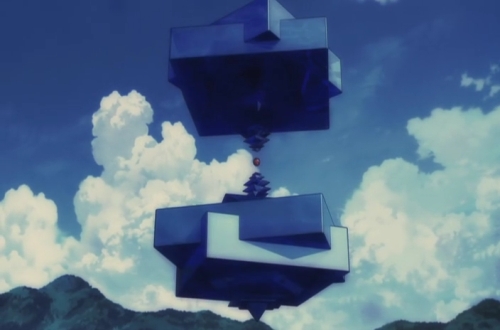
The most drastic change comes from Ramiel. I was a fan of the simple diamond design of its TV incarnation, but Ramiel has been re-imagined into a being who also toes the line between the organic and the artificial but in an entirely different way. Ramiel is not limited by how we perceive space, and as it transforms into various geometric structures it does so with a surprising amount of life and personality.

One unusual thing about the Angels in Rebuild of Evangelion is that their numbering system has been bumped up by one. Whereas Sachiel was once the 3rd Angel, it is now the 4th and so on. The movie also hints at the fact that there will be fewer Angels than in the TV series, so we’ll be seeing a few of the lesser ones getting the cut.

Zeruel and Bardiel are shoe-ins, but sorry Matarael, no one likes you.