Best Anime Characters of 2015

BEST MALE CHARACTER

Sunakawa Makoto (My Love Story!!)

In the narrative of My Love Story!!, Sunakawa is naturally handsome, intelligent, and charismatic to the point that girls from ages 8 to 80 seem to fall in love with him at first sight. However, what makes him truly stand out aren’t his looks or his smarts, but his genuine bond with his best friend, the seemingly brutish Gouda Takeo. Sunakawa’s opposite in practically every way, but the two share one important thing in common: big hearts. Sunakawa sees not only the goodness in Takeo but the petty shallowness of those who judge people only by their looks, which affects him just as much as Takeo himself.

Takeo is also a worthy pick, but it’s the way Sunakawa looks out for Takeo that makes him the Best of 2015. Whether you want to be Sunakawa or have him watch your back, there’s no better best friend in all of anime (except maybe Tomoyo).

BEST FEMALE CHARACTER

Koizumi Hanayo (Love Live! The School Idol Movie)

Last year, Koizumi Hanayo was in the final running for Best of 2014, but ultimately the immensely powerful personality of Kill la Kill‘s Kiryuuin Satsuki won out. Now, with Love Live! The School Idol Movie being the swansong for the original Love Live! girls, I thought it best to call Hanayo Best Female Character of 2015 because there might never be a chance to do it again.

If there’s one word I would use to describe Hanayo, it would be “passion.” It’s her nearly unrivaled love of school idols, along with some support from her friends, that allows Hanayo to take the step from fan to idol in the first place. The fiery look in Hanayo’s eyes and her characteristic “quiet scream” when something big is happening is unmistakable. When Hanayo helps Rin overcome her negative self-image, it’s from a place of genuine care and compassion. And when Hanayo goes on a rant about how rice is the central component of a proper meal and that this is one of America’s most critical flaws, why, it’s only appropriate. Hail to the Rice Goddess.

Final Thoughts

When it comes to determining my favorite characters in anime, I don’t think I’m alone in saying that they often possess either admirable qualities I would like to emulate, or traits that I can directly relate to. Sunakawa’s perceptiveness and compassion are things that my oblivious self would love to have. Hanayo’s devotion to food is a match for my own constant desire to find the latest, greatest things to eat, and her instant switch from shy to fervent fan also reminds me a lot of myself. Of course, these are not their only criteria, and ultimately it is their impact on their friends and loved ones that is in a way much more significant, but there’s something about both Sunakawa and Hanayo that makes them both like quiet fist pumps in anime form.

Yesssss.

If you liked this post, consider becoming a sponsor of Ogiue Maniax through Patreon. You can get rewards for higher pledges, including a chance to request topics for the blog.

On the Fanfiction Origins of the Mary Sue

The term “Mary Sue,” originally meaning a kind of overly perfect self-insert character in fanfiction who would be dropped into a story to solve all of its problems, has been a battlefield of sorts in popular culture. Characters are called Mary Sues if they show even the slightest bit of wish fulfillment, and in response there is a feminist movement to reclaim the term, fueled by the idea that idealized male characters are the norm and similar female characters are unfairly maligned. This is what is fueling discussion concerning the character Rey in Star Wars: The Force Awakens. However, I feel that, as the discussion over which characters are and aren’t Mary Sues due to their perfect (or perfectly dramatic) natures, the fact that the term derives specifically from fanfiction gets lost in the shuffle, and that it is crucial to remember that its origin comes not from big blockbuster movies but from fans of popular culture navigating their chosen works and worlds.

Before I go into greater detail, I want to make a few points clear. First, I do not think wish fulfillment characters are inherently bad, whether they’re male, female, or something else entirely. Second, I believe fanfiction does have merit as a space for active participation, as a source for good and/or interesting stories, and everything else in between. Third, I understand that the meanings of words can change over time. Basically, this isn’t a criticism of fanfiction, or lack of originality, or a stubborn refusal to acknowledge the natural evolution of language.

The earliest known use of the term “Mary Sue” comes from Star Trek fandom, specifically from Paula Smith’s parody of a common trend in Star Trek fanfics at the time. Essentially, many stories would involve a young girl (most Star Trek fanfiction was written by women in the 1970s) who would become the center of attention, would have some unique visual identifier that instantly screamed “unique,” and would have just enough tragedy to emphasize how special they are. While you can think of many characters in fiction who fulfill these categories (Uzumaki Naruto, Bella in Twilight), I think the real key to the “Mary Sue,” and why its fanfic origins are so important to remember, is that by being the center of attention they were viewed as 1) drawing focus away from the world and characters that form the basis for that fandom 2) their idealized natures, rather than feeling universal, felt overly specific to the point of making it difficult to empathize.

To expand on both points, when we look at anime and see the generic shounen hero with a unique and special power, or the generic shoujo heroine who all the boys fall in love with, they can be seen as attempts to have a broader, more general appeal. Even if they end up being cliches, and even if they’re considered by more hardcore fans as being “boring”—though I think this comes from a time when fandoms were more niche and the deepest fans tended to prefer the subversive/evil/morally gray characters—there is a desire for broader appeal. When a character’s quirks or backstory or overall qualities make them wish fulfillment for people at large, that is different from when those same traits make them inaccessible to a reader due to being overly specific. In other words, when a character feels as if they are designed solely to appeal to only the author and no one else, then the term “Mary Sue” comes to light.

Of course, even that criteria is subjective, as different people will connect to different characters, whether they come from fanfiction or not. Also, if the “Mary Sue” was such a problem that Paula Smith had to address it, perhaps it could be argued that there were enough people with that same fantasy that it could be considered a broad enough desire to not be thought of as “overly specific.” It also needs to be pointed out that the Mary Sue derives from an amateur space, where writers do not have editors or marketers or even the need for a coherent narrative. These sorts of stories tend to happen naturally from those who do not consider common “good story rules” such as conflict, character depth, etc., and in a way we all have our Mary Sue stories inside of us where everything just goes right.

However, the idea of the Mary Sue did not originally come from an explicit connection to women, narratives, and society, but rather an implicit one. Because Star Trek fanfiction was the domain of women, it is possible to argue that its values developed in a feminine space, which when expanded to also include men to a large degree made Mary Sues a target for criticism and conflict in ways that trivialized the wish fulfillment of women more than men. Perhaps the biggest issue with the “Mary Sue” is in her name: chosen to be generic, and to reflect a recurring type of character in fanfiction, the doubly feminine nature of the moniker infuses it with gender values. Even though alternatives have been created for males (Gary Stu, Marty Stu), they simply never caught on as much. It’s also interesting to note that criticism of the Mary Sue originally took place between women.

I have one last question to ask: does the term Mary Sue even need to be reclaimed? Have men really seized it as their own, or has it never really left the grasp of women at all?

If you liked this post, consider becoming a sponsor of Ogiue Maniax through Patreon. You can get rewards for higher pledges, including a chance to request topics for the blog.

Future Boy: Genshiken II, Chapter 119

At long last, it’s the final date! Hato gets his turn with Madarame, but while their time together starts off with some comedy, it quickly turns into a very serious conversation that brings Genshiken back to a core theme: 2D characters vs. 3D relationships.

Actually, to be more accurate, the clash between “fantasy” and “reality” emerges from the very beginning. Just calling it a “date event” betrays the entire club’s otaku orientation; among regular people it would just be a “date.” From there, Hato starts to clearly delineate the differences between a biological woman and he himself who only dresses as a woman, namely that a crossdresser tends not to want people to get too close, otherwise they might recognize the truth. Though it ends with a funny moment where Madarame and Hato try out holding hands (did you know that Madarame has cold hands?), only to pull them apart after being spotted by the rest of the group, the tension is already set.

Though the dirty looks from Sue and Keiko (and Kuchiki) are magnificent.

Throughout the chapter you see Madarame use certain words that associate Hato with the the characters in the boy-girl (otoko no ko) games Madarame plays. He uses terms like “spice,” or “forbidden,” which eventually causes Hato to directly confront Madarame about what it would take to be in a homosexual relationship. Hato outright says to Madarame, “I’m a guy!” (pairing an effeminate “watashi” with a masculine “otoko”) and essentially asks if Madarame has really thought about what that means. If he actually starts something with Hato, then in the long term it won’t be a crazy alternative, or a thrilling experiment. Dating a man, even one that dresses convincingly like a woman, won’t be like seeing it in an anime or a visual novel, where no real consequences can occur. If he chooses Angela, Sue, or Keiko, then he won’t have to deal with these hardships.

I don’t know if I’m reading too much into this, but I think that implicit in Hato’s words is the awareness that gays are stereotyped and discriminated against in Japanese society. Picking Hato comes with it a future of tribulations, and the question is if Madarame is really prepared to take this seriously, or if it’s just a fetish at the end of the day that can’t move beyond fantasy.

Madarame’s response in turn, “Sorry,” then signals two things. Hato’s devastated reaction indicates that he’s not so much taken aback by Madarame’s apology, but the very nature of it. That’s because the “sorry” comes across as noncommittal, another case of Madarame vacillating because he still desires for the pieces to fall into place without him having to make any hard choices. Madarame has the potential to start a real relationship with Hato or any of the others, but he’s still afraid to make a decision. It calls back to the Madarame who originally decided to let his crush on Kasukabe slide by unrequited, and was willing to let it eat away at him for the rest of his life.

What I also find fascinating about this entire situation is that it not only subverts that harem aspect of the series, but that it’s a strong reminder that the qualities that have made Madarame somehow charming to these prospective partners are also the very things that can aggravate them. He’s both his own best friend and his own worst enemy, and I believe it keeps the series from truly entering actual “harem” territory.

The question of how Madarame will engage with the reality of having a flesh and blood partner is what I think makes Ogiue’s appearance at the end so interesting. As stated in the chapter itself by Ogiue, Hato’s running away from Madarame mirrors Ogiue trying to reject Sasahara out of fear of both hurting others and being hurt. However, I also feel it’s not really the same situation.

Sasahara hesitated because he was a naive dork who couldn’t read between the lines. Even though he recognized his own feelings for her at that point, when Ogiue told him that she couldn’t date guys, Sasahara took it at face value and almost gave up as a result. Madarame, on the other hand, has to decide whether his feelings are for Hato the person or Hato the image, and whether he’s willing to take a much more difficult road in the process when he clearly has three less troubling options moving forward that he also seems to have feelings for.

Writing all of this out, it makes me realize that Madarame’s hesitation can also be interpreted as wanting to make certain that he makes the right decision. He’s been raised to believe that romance is a special thing, a world of childhood friends and deep bonds that are anything but frivolous (though at the same time sex is raunchy and powerful). It might be another angle worth exploring.

Angela believes that Madarame clearly has eyes for Hato. We’ll see if she’s right.

If you liked this post, consider becoming a sponsor of Ogiue Maniax through Patreon. You can get rewards for higher pledges, including a chance to request topics for the blog.

My Shirona: Nendoroid Cynthia and the Sinnoh Champion’s Amazing Popularity

nendoroidcynthia-official_pose-closeup Merry Christmas from the Sinnoh Champion!

This year, I received from a very good friend of mine an awesome gift I wasn’t expecting at all: Nendoroid Cynthia! Also known as Shirona in Japan, as well as “the best Pokemon champion ever” by most fans of the franchise, her presence continues to be felt over 9 years after her debut in Pokemon Diamond & Pearl.

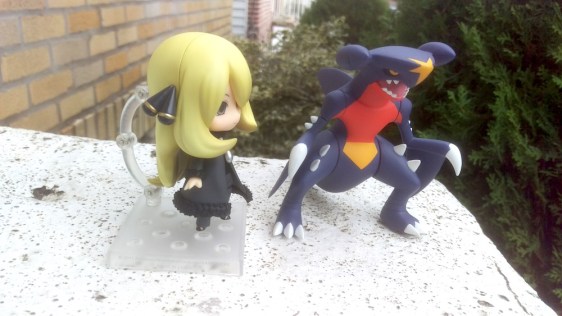
As you can see, Cynthia comes with one slightly bent leg and one bent arm so that you can faithfully recreate Cynthia’s pose from her official artwork. The attention to detail on this figure is so good…it comes with a second figure!

nendoroidcynthia-garchompfocus

I knew beforehand that Cynthia came with a Garchomp, but I didn’t realize how large it actually is relative to the Cynthia Nendoroid. It’s a crazy time we live in where the accessories for figures are at a higher quality than what official merchandise used to look like back in the late 90s for Pokemon.

nendoroidcynthia-sideview

Though I originally wanted to just show off Nendoroid Cynthia, I ended up also thinking about the fact that she got a Nendoroid figure in the first place. Consider this: Cynthia is only one of two Pokemon characters to get a Nendoroid in the first place. The other? That would be Red, the original protagonist of the Pokemon series.

That means, more than Misty, Brock, Lorelei, Lance, Flannery, Roxie, or any number of other characters, Cynthia is a fan favorite and flagship character. To a certain extent, given the excitement of battling her, the personality she shows throughout the games, and even her overall visual design, it’s not surprising that she is so beloved, but she seems to have some other “X Factor” that puts her over the top. In comparison, Diantha, the XY Champion, seems to get hardly any fanfare. Maybe it’s her amazing battle theme:

So do you think Cynthia’s popularity is justified? Is there any Pokemon character you’re dying to see as a Nendoroid? Just the fact that Nendoroid Pokemon characters are even a thing still amazes me.

If you liked this post, consider becoming a sponsor of Ogiue Maniax through Patreon. You can get rewards for higher pledges, including a chance to request topics for the blog.

[Anime Secret Santa 2015] The Possibilities of Adolescence: Simoun

simoun

My first exposure to Simoun came about 10 years ago, when many of my online friends had been discussing the series. As my friends were fans of cute, sexy girls, and girl-girl relationships of both the Ikkitousen and Maria Watches Over Us variety, at the time I had felt it difficult to genuinely gauge the series based on their positive responses. Though my wariness caused me to set aside Simoun as an afterthought, more recently it was chosen for me to review as part of the 2015 Reverse Thieves Anime Secret Santa. Having finished the series  I realize now that I had unfairly judged Simoun for its surface qualities, and that is in fact a very strong, emotionally-oriented science fiction story that fits in and exemplifies a long and evolving tradition of science fiction anime and manga.

In the world of Simoun, everyone is born a girl and choose their genders when they become adults. The main character of Simoun, a teenager named Aer, joins the Sibyllae, priestesses who fly divine vessels known as Simouns. The Simouns and the priestesses, normally meant to fulfill a religious role, are also thrust into conflict because their vehicles can be weaponized, though unlike conventional crafts they fight primarily by inscribing patterns across the sky that trigger magical effects. The key to the Simouns, and why Aer and the others are chosen to be Sibyllae, is that they can only be piloted by those who have yet to become adults. Simoun Sibyllae form close bonds with their co-pilots, signified by a kiss before they take flight.

Sometimes there will be an anime where where you can maybe argue that it’s concerned with gender and sexuality, women’s rights, and other similar topics, but that requires a fairly loose reading. Simoun is not one of those anime. It is a work, and a world, where questions about sex, gender, and sexuality are front and center. For example, while it’s not difficult to see why Simoun is labeled as a yuri series, in many ways it defies that categorization. Though everyone enters the world as a girl, the paths they make towards their ultimate choices are contingent upon the circumstances of their world, who they fall for, and how they go about navigating their lives in general. Children who fall in love as girls might both become women, or men, or any combination.

I have to stress how much this series plays with the ideas of gender and sexuality, because it’s such a major factor in Simoun. Girls, as they become adults, slowly transform into their new bodies, so a girl, even a buxom one, will only start to resemble a man after a few years. While the idea of transitioning between sexes is nor considered the norm in our world, in Simoun this is just the natural way of things, both physically and culturally. One interesting choice Simoun makes to emphasize this fact is that all characters, from children to bearded old men, are voiced by women.

Simoun features a very emotionally and environmentally robust science fiction narrative that interestingly is tied strongly to the emotional weight of its characters. Romance is a part of their world, but it’s not their entire world. Other countries attack Kyuukyoku because the Simouns do not pollute the sky like their own aircraft. The war itself is ever-present, and the Syballae put themselves on the line, but they’re shown to also be somewhat disconnected due to their positions as religious figures. The girl-girl kissing that happens before every battle might be seen as a thrilling yuri moment, but it’s not necessarily the case that the characters need to form romantic relationships to fly their Simouns.

The very power afforded those who have yet to become adults, the power of potential, is integrated into the very core of the narrative and its explorations of this alternative universe. Even the Simouns themselves have a certain bizarre quality in their designs that make it difficult to ascertain how much they’re truly divine aircrafts and how much they’re simply highly advanced technology.

Part of the reason I had my slight misgivings over Simoun back then were that the character designs are very reminiscent of more fanservice-oriented series. While I myself like the designs, and Simoun does not have a great amount of sexual allure on display, it’s enough in its promotional materials and its general aesthetic that one could,  even while watching the show, take only shallow titillation from it. This isn’t inherently bad, but I can imagine there are others like myself who approached the series with an eyebrow raised because that was all it appeared to be. Moreover, there are elements that might have come across as merely fulfilling certain fetishes, such as large age differences, incest, and more. However, they are for the most part developed well, and exist as a few of many possible relationships in the world, and just in general I do not feel like they hold back Simoun to any large degree.

Overall, I would highly recommend Simoun to just about anyone, but especially those who want to see an anime that fosters thought and discussion. It presents a unique and robust world of utopian/dystopian imagination full of limitations, possibilities, and unique characters.

If you liked this post, consider becoming a sponsor of Ogiue Maniax through Patreon. You can get rewards for higher pledges, including a chance to request topics for the blog.

Save

Glitter Force: Old Dubs Are New Again

I made an appearance on the Reverse Thieves’ podcast to talk about the first episode of Glitter Force from Saban Entertainment, the Power Rangers-style adaptation of Smile Precure!

What happens when Cures become Glitters? Apparently a lot of constant never-ending dialogue.

I’m surprised we didn’t make more Saban opening theme jokes, but can’t win ’em all.

Pokemon Omega Ruby and My Fabulous Pageantry Adventure

I’ve been a fan of Pokemon since before I first picked up Pokemon Red all those years ago. Since then, I’ve made an effort to play at least one game from each generation of Pokemon games. While I don’t mind the repetitive aspects of the franchise, and I appreciate the changes they’ve made in terms of storytelling, multiplayer, and more, after 15 years of fighting gym leaders and saving the world I wanted to spice up my Pokemon experience.

Then I remembered this post I made back in 2010. The gist of it is that I always thought that the addition of Pokemon Contests was unfulfilled potential. While it’s presented in the anime as an alternative path for trainers who don’t care about Gym Leaders, in the games it always played second fiddle to the main path to the Elite Four. However, with the release of Omega Ruby and Alpha Sapphire last year, I decided it was the perfect opportunity to change my approach: I would become a Pokemon Coordinator.

Omega_Ruby_Alpha_Sapphire_Contest_May

I would also play in Japanese because the Pokemon games give you the option to choose now. “Why not?” I thought.

What would a “Contest Run” of Pokemon entail? Essentially, rather than my primary motivation being gym badges, I would instead value the earning of contest ribbons. While I would fight the Gym Leaders, foil Team Magma, and more, these would be more means to an end. Instead of caring about my Pokemon’s battle stats, I would mainly focus on their essential Contest qualities: Beauty, Toughness, Coolness, Cleverness, and Cuteness.

When Steven asked me if I was motivated to take on the gyms, I even answered, “No.” He seemed quite surprised!

One outcome of this path is that my Pokemon almost perpetually had impractical movesets, whether for single or multi-player. To give you an idea, here are a couple of my Pokemon towards the end:

277Swellow Albania the Swellow @Red Scarf
Coolness Champion
Aerial Ace
Fly
Brave Bird
Quick Attack

284MasquerainChiba Mamoru the Masquerain @Pink Scarf
Cuteness Champion
Bubble
Water Sport
Sweet Scent
Bug Buzz

Those aren’t just the movesets of someone who has no idea what they’re doing, they’re chosen so that each Pokemon has 3 moves according to their Contest specialty, (Bubble, Water Sport, and Sweet Scent are all “cute” moves in Pokemon Contests), and even their items, the scarves, boost a Contest quality but provide no benefit in battles. It really made me feel like I was grooming my Pokemon to have little to no practical skills, and that they could only survive in the lofty world of pageantry.

Of course, as it was a single player campaign I didn’t put in a Smogon level of research into all of this. I’m sure that any TRUE Contest aficionados could tear me a new one. I mean my management of berries and blocks (the things you feed to your Pokemon to improve their contest stats) was terrible!

Omega_Ruby_Alpha_Sapphire_Lisia

One cool new addition to Omega Ruby and Alpha Sapphire that made the Pokemon Contest path feel more significant was the introduction of a new character: a world-famous Contest Idol named Lisia (Lutia in Japanese). As the premiere Pokemon Coordinator and the one who sets you on your path to competing in Pokemon Contests, she becomes a motivating factor. Lisia was my goal, my aspiration, and the reason why I continued to make my Pokemon as clever and beautiful as possible. By the time I earned all 5 Master Rank contest ribbons and earned the chance to take on Lisia and her daunting Mega Altaria (Dragon Dance is amazing in Pokemon Contests), I had reached my own personal Pokemon League.

In the end, I became an overall Contest Master and even took on the Elite Four and Steven. Though I could also add “Pokemon Champion” to my list of achievements, in my heart it was more of a nice epilogue than the true climax of my journey.

If you liked this post, consider becoming a sponsor of Ogiue Maniax through Patreon. You can get rewards for higher pledges, including a chance to request topics for the blog.


Are Comics Companies Really Learning the Importance of Diversity?

ms-marvel-9-coverIn recent years, diversity in representation of peoples has become a frequent topic of debate among fans of animation and comics. Whether it’s the rise of Steven Universe and its positive portrayals of strong female characters, or the increase in panels on women in comics, minorities in comics, and more at New York Comic Con, there has been a strong move both from fans and creators to make sure that tokenism is never a thing, and that the Rule of Three (see the video below) doesn’t stop any group from finding themselves in cartoons.

In 2014, at a Women in Comics panel at NYCC, one of the panelists mentioned the importance of learning how to communicate with the old, white men who run these companies if people want to make a difference up top. The following year at NYCC, a Diversity in Comics panel had multiple industry members talk about how management across multiple companies are realizing that other groups besides the white, male demographic are customers and are worth appealing to. Ultimately, people are communicating in the language that executives understand most of all: money.

However, while the net result seems to be in favor of a strengthening of cultural diversity, there’s a question that nags at the back of my mind as I see the talk of a changing tide. Are those executives, those old, white men, actually learning why cultural diversity in comics is important, or are they simply seeing it in terms of potential sales? Part of the reason why comics appealed to that white, male demographic for so long, aside from latent racism, was that it was seen as a reliable market, but catering too much to that aging audience has stymied its growth among the population at large. This means more attention is paid to women, LGBT, racial minorities, and more, but does it just all come down to the bottom line?

My fear is that, if diversity is simply seen as the latest ticket to profit, that if comics and animation start to be less successful, will the companies and their heads be just as quick to jettison the desire to bring different groups of people to comics? Are we ultimately beholden to entertainment media as a product of popular culture in a capitalist society?

If you liked this post, consider becoming a sponsor of Ogiue Maniax through Patreon. You can get rewards for higher pledges, including a chance to request topics for the blog.

One Punch Man’s Japanese and American Superhero Lineage

One Punch Man has been a hit, both with the people who have long championed the manga, and with those discovering it through its animated adaptation. The story of Saitama, an invincible superhero who literally finishes most of his fights with “one punch,” the series puts a great deal of emphasis on humanizing its Superman figure. It handily deflects the classic criticism of invulnerable protagonists as “boring” while also drawing from both Japanese and American superhero traditions, and I think it’s worth exploring what it does to make Saitama a sympathetic figure.

To talk about a Superman-type character is to also naturally bring up the Man of Steel himself. Originally conceived with incredible strength and speed and gradually transformed into a being that could move planets and reverse time, much of the past three decades’ stories concerning Superman have been finding ways to make him human. Zack Snyder’s Man of Steel film focused on the psychological and emotional struggle of having to hold back all the time, something shared with select episodes of the Justice League cartoon. Superman has been reduced to the point of being not quite so omnipotent, and also turned into a brooding teenager for Smallville. Numerous “what-if” scenarios have made him Soviet, nearing death, old and out of touch with the youth, and alternative takes on Superman-esque figures have dealt with mental problems, become amoral, and more. Even other superhero-themed series such as Tiger & Bunny and My Hero Academia will build in flaws into their Supermen, though the fact that they’re in the distance means that it’s more about how their image and reality compare.

One Punch Man ties Saitama’s ongoing turmoil to the fact that his astronomical power levels have made him unable to fulfill his heart’s desire, which is to be pushed by a powerful foe and go beyond his upper limits. He wants to feel like Son Goku being brought to the brink by Frieza. He wants to be Ryu from Street Fighter, constantly pursuing the next challenge. He draws from that popular tradition in manga and other Japanese media about the thrill of the journey, and yet while Akagi brushes with death before defying it, even that is denied when it comes to Saitama. Even if we’ll never as powerful as that, I think it’s easy to understand why this would be so painful.

Perhaps the more important element is that Saitama is kind of an idiot. The fact that Saitama doesn’t quite think through his position in the world (or perhaps choose to actively ignore it) brings a certain quality that reminds me of the earliest Superman comics and stories, back when he could only leap tall buildings in a single bound. If you look at the very first Action Comics, Superman spends a lot of it bullying the bullies. There’s a certain satisfaction in the fact that Superman’s personality and character aren’t so elaborate, that there isn’t almost a century of material exploring his psyche. One Punch Man achieves something similar by just having Saitama’s morality have good intentions but generally be kind of vague. He hasn’t thought too much about his role as a superhero other than that it’s “fun” (or at least should be), though at the same time it puts a twist on that basic desire to be so powerful that no one can stand in your way.

If you liked this post, consider becoming a sponsor of Ogiue Maniax through Patreon. You can get rewards for higher pledges, including a chance to request topics for the blog.

Thrall for Super Smash Bros.

smashbros-thrallmoves-small

When thinking about game creator Sakurai Masahiro’s desire to celebrate gaming through his Super Smash Bros. series, one significant missing piece of gaming history thus far has actually been PC gaming. Even with the plethora of third-party characters, most recently Cloud Strife, all of them have been console-based.

If there could be one character who would represent PC gaming in Smash Bros., who would it be? It’s a ridiculous question and kind of unfair to PC gaming, but ultimately I decided on Thrall, the heroic orc raised by humans, from the Warcraft franchise.

The reason why I picked Warcraft as a representative is because not only are its characters and games extremely popular, but it covers two different genres that blossomed on the PC: Real-Time Strategy and MMORPGs. Thrall, in turn, is the most iconic character of Warcraft.

I’ll admit, I never really played any Warcraft or World of Warcraft games, so I needed a good deal of help from a more knowledgeable friend. From him, I got the idea that Thrall would be kind of a mix of Robin and Dedede, a heavy hitter up-close with lots of powerful ranged attacks whose strengths are tempered by relatively poor mobility.

All of Thrall’s attacks come from Warcraft III, where he is a heroic Farseer, though the animations would be more in line with the recent Heroes of the Storm. Chain Lightning, rather than being area of effect, homes in on one opponent after the other, doing less and less damage per trip. Earthquake is similar to Bowser Bomb, except it can also trip nearby opponents. Side B would work like Zelda’s Phantom Strike, except that the recovery would be quicker and it would stun instead of damage the opponent, somewhat like a long-range Mewtwo Disable. Lastly, Windfury lifts Thrall up in the air, and before he lands his aerial attacks come out twice as quickly, replicating the higher attack speeds the move grants in other games. In a way, it functions similarly to Bowser Jr.’s Abandon Ship move, giving greater mobility and more dangerous offensive power.

Though Thrall does not learn Bloodlust in his own games, it is a representative ability of Orcs in Warcraft, so I believe it fitting to be his Final Smash. Instead of him casting it on himself, imagine Orc Shamans casting it on him instead. Bloodlust would provide a boost to movement and all melee-range attacks, with enhanced effects.

Well that’s it until Tuesday’s final Smash Direct! No matter what characters are chosen, I’ll still try to find time to do more of these, simply because I enjoy making them. I do have another PC gaming representative in mind, but we’ll see if people find it interesting. If you could put any PC gaming character into Smash, who would it be?

Previous Characters:

King K. Rool (Donkey Kong Country)

Princess Daisy (Super Mario Land)

Geno (Super Mario RPG)

Great Puma (NES Pro Wrestling)

Pitfall Harry (Pitfall)

Zoma (Dragon Quest III)

NiGHTS (NiGHTS into dreams…)

If you liked this post, consider becoming a sponsor of Ogiue Maniax through Patreon. You can get rewards for higher pledges, including a chance to request topics for the blog.