This month, Kio mostly talks about Elden Ring. But we also get to see a high-quality version of one of the best covers he ever drew (no bias from me, clearly).
Even after 100 hours, Kio is having trouble in Elden Ring. In many places, he feels that he would never have been able to figure things out without strategy guides. (Forgive me for not translating this in greater detail.)
Kio keeps seeing figures and illustrations from Elden Ring but for the most part has no idea who anyone is, seeing as he’s only played 16% of the game.
Reflecting on his time with a much older FromSoftware game, King’s Field II, Kio recalls his experience. Despite the fact that it wasn’t really “open world,” finding out how one area of the game connects to another was very exciting.
There was a remix of AKIRA music playing at the gallery, and Kio wondered where it came from. Turns out that it was new arrangements done for the gallery. Kio wants a CD of it.
High-quality version of the cover to Genshiken Volume 6, as well as just the art of Ogiue. Needless to say, I love this cover and volume to death. Also check the thread to see lots of people posting their copies (and variations).
At this point, Otakon is a given in my life. I have enough faith in the people who run the anime convention every summer that they will create a rewarding experience. But short of anything pertaining to Genshiken, Otakon 2023 ended up with a guest announcement straight out of my otaku wishlist: Iwao Junko, the voice of Daidouji Tomoyo in Cardcaptor Sakura.
And yet, somehow, Iwao was only the tip of the iceberg. Between Asamiya Kia (manga artist of Silent Mobius, Nadesico), Aramaki Shinji (mecha designer on Bubblegum Crisis, Magazine 23), Terada Takanobu (producer on Super Robot Wars), and even the sleeper hit that was Ikezawa Haruna (science fiction writer and the voice of Yoshino in Maria Watches Over Us), I feel like I three conventions’ worth of experiences.
Line Con No More
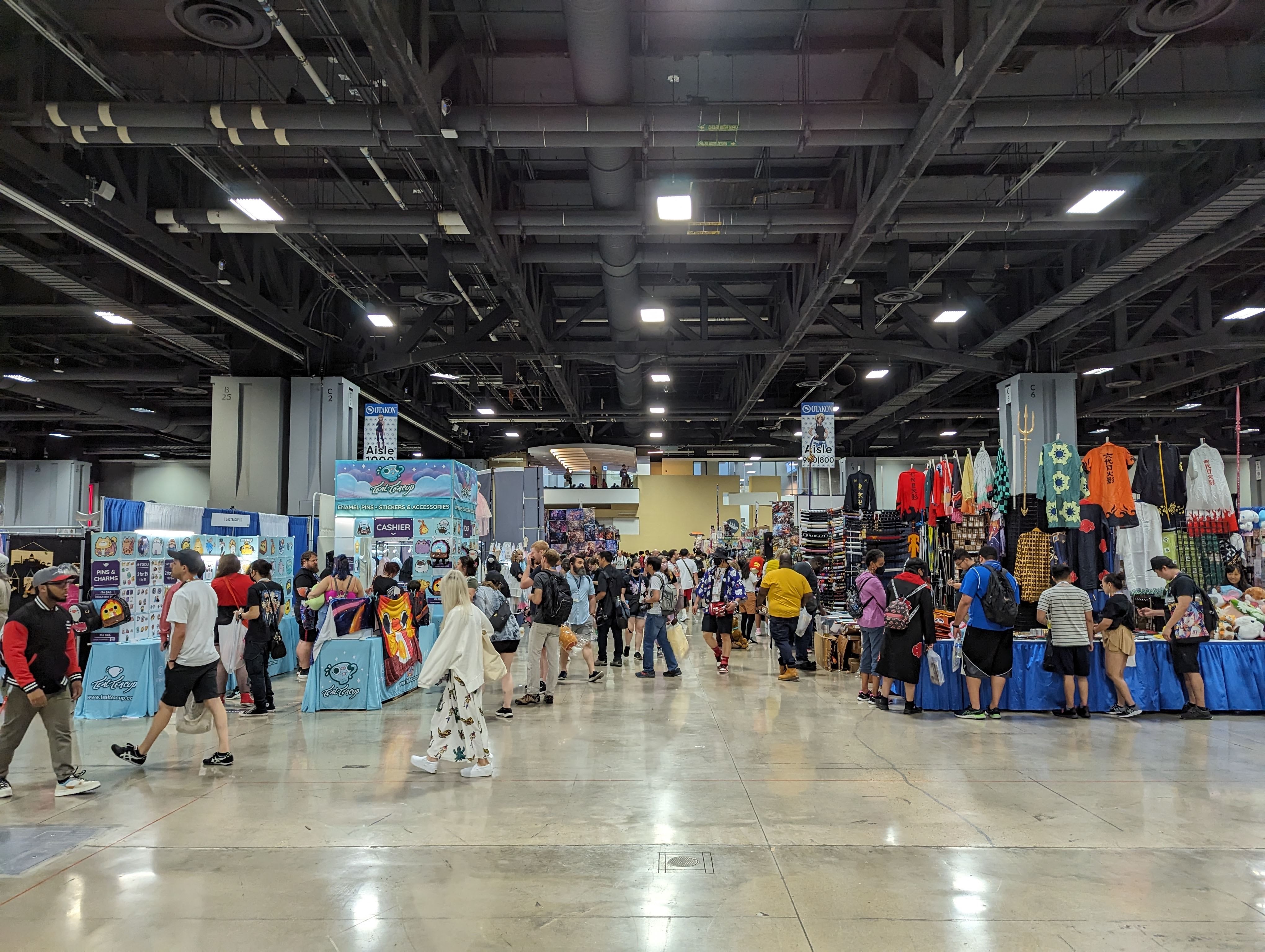
Otakon 2023 took place from July 28 to July 30, once again at the Walter E. Washington Convention Center in Washington, DC. It was coming off a previous year with record-breaking attendance, and two big questions were whether 2022 was a fluke caused in part by the US opening up again after the height of the COVID-19 pandemic, and how Otakon would handle the flow of foot traffic if it wasn’t. Long story short: Otakon actually surpassed its record this year, and the lines got noticeably better. While there were still a few hiccups here and there (like an unusually long wait to get my panelist badge due to a change in how they handled that process), it’s no coincidence that multiple people in the post-con feedback session praised the staff for fixing most of the congestion issues in a single year.
Fixing the lines was of even more paramount importance due to the weather over that weekend. DC was blisteringly hot; including humidity, there were times the temperature was reported as feeling like 112 degrees. Otakon needed to make sure people could get into that convention center quickly and easily, and they succeeded.
Lack of Masking Policy
I know it is incredibly difficult to put the genie back in the bottle, especially because “officially” COVID-19 is no longer a national emergency, but I really do wish Otakon would re-implement a mandatory masking policy. While I didn’t catch it at this convention, I was definitely in circles where the virus was present, and it would just allow more people to attend the con.
Industry
The guest list this year was truly packed, to the extent that I had to make some serious decisions as to what to spend time pursuing. Kawamori Shoji (creator of Macross) would have been near the top of the list any other year, but the fact that I had already gotten the chance to interview him in 2018 meant sacrifices had to be made. There were also a great number of manhwa artists at Otakon 2023, and as a general enjoyer of comics who is less familiar with Korean comics, this could have been a great opportunity to learn more. Alas, time was truly limited.
A good chunk of my time this year was thus spent on obtaining autographs because a lot of the guests are industry veterans, and some are getting up there in age. It may sound a bit morbid, but I’m worried that we’re going to lose more and more great figures in anime and manga, and I want the chance to see them and thank them before it’s too late. At the same time, I do worry that too much of my Otakon experience ends up being in autograph lines, and every year is a bit of a struggle in that for every wonderful thing you do, you know you’ll miss at least two other equally fantastic experiences.
Iwao Junko
One guest panel highlight for me was Iwao Junko’s, where she went over how she got into voice acting, her earliest days in the industry, and how she eventually made it into a full-time job. I have a detailed summary of the panel as its own post, and I also interviewed Iwao alongside her frequent music collaboration partner, Kawamura Ryu.
Mecha Guests
Another panel I was looking forward to featured multiple creators involved with mecha, including all the ones mentioned in the introduction. Just getting to hear them banter back and forth was entertaining, and you could tell that all of them would gladly talk your ear off if given the chance. One funny part of all this is the fact that Kawamori was clearly but somewhat surreptitiously drawing on his tablet in between answering questions—a fact that one panel attendee humorously called him out on (it turns out he was working on a project).
I got to sit down with two of the guests and talk more in depth: mecha designer Aramaki Shinji and Super Robot Wars producer Terada Takanobu.
Ikezawa Haruna
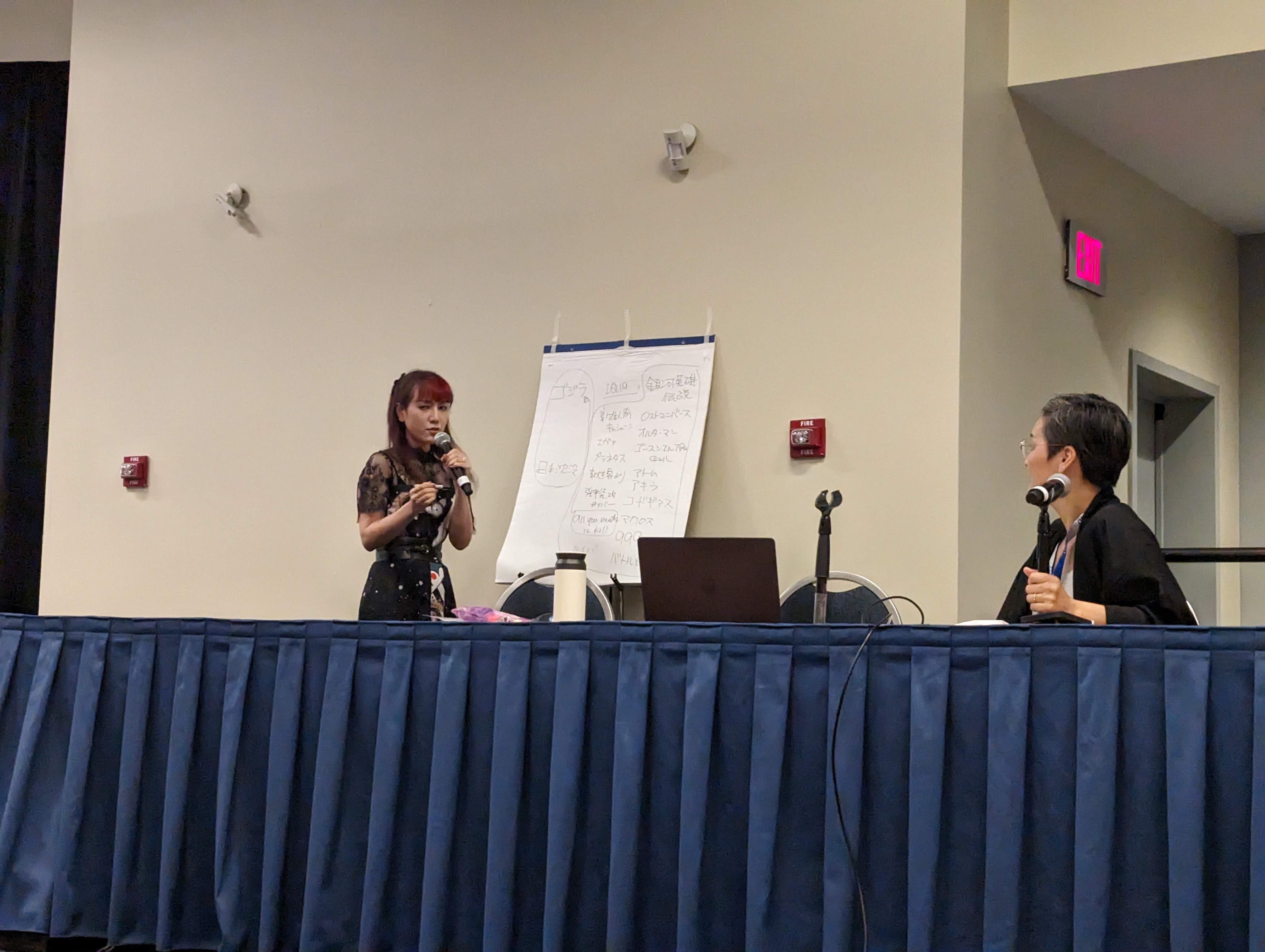
But there was one guest who was possibly the sleeper hit of the entire con: Ikezawa Haruna. While Ikezawa did her requisite panel about what it’s like to be a voice actor, she also did something incredibly rare for Japanese guests: run a panel entirely about one of her own personal interests.
In this case, it was a panel all about Japanese SF as compared to Western SF. Not long after she started, it was crystal clear that her knowledge was encyclopedic, and that her passion for the subject was through the roof. She probably knew more about science fiction in that room than the entire audience combined, and she made some interesting points about the essence of regional science fiction. For example, in the context of Japanese SF, she mentioned how xenophobia has become a big topic because it’s a major subject right now in Japanese society.
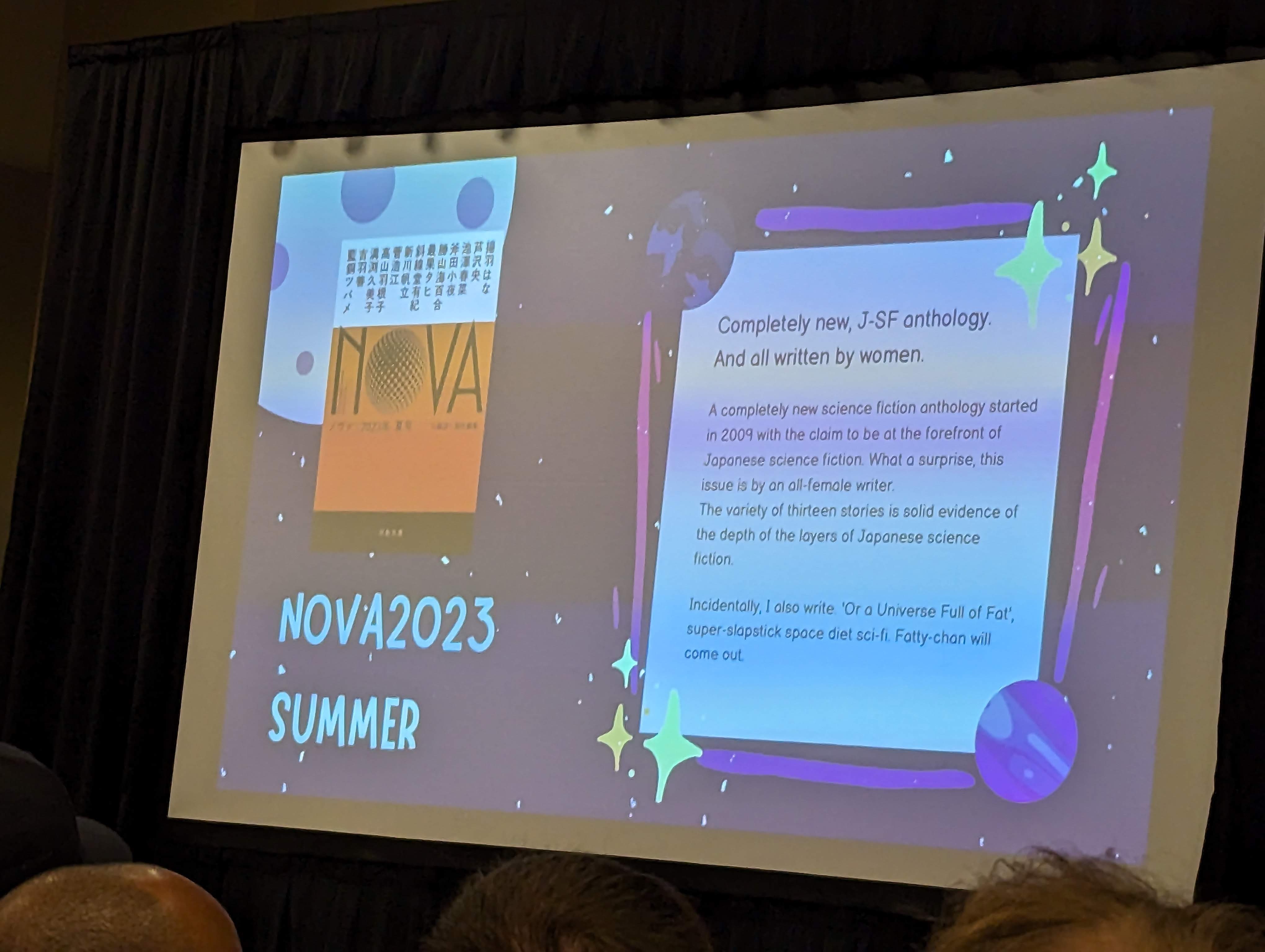
Ikezawa talked about how she actually prefers the term SF to “science fiction” because she thinks Japanese SF encompasses so much more—the abbreviation can stand for sukoshi fushigi (“a little mysterious”), speculative fiction, super fantasy, and so on. She also gave a variety of recommendations, including stories she’s written herself. These are Nova 2023 (an all-woman anthology), SF in 2084 (an anthology themed around stories that take place in 2084), the Naoki Prize–winning Maps and Fists by Ogawa Satoshi, Law Abiding Beast by Harukure Kouichi, and First, Let the Cow Be the Ball by Isukari Yuba. Unfortunately, all of them are in Japanese, but another story by Isukari, Yokohama Station SF is available in English.
Anime Screenings
While I was unable to attend the Discotek panel this year, I do think it’s worth mentioning the fact that they licensed all the Digimon Adventure movies, including both the original Japanese versions as well as the smashed-together film shown in US theaters. Not only is this the first time they’re all available in English, but Discotek did a special screening of them at Otakon. Sadly, I couldn’t attend that either, nor the showing of Macross Frontier: The False Songstress. That’s because I chose to watch the US premiere of The Tunnel to Summer, the Exit of Goodbyes, which I’ve reviewed here.
VTuber Presence
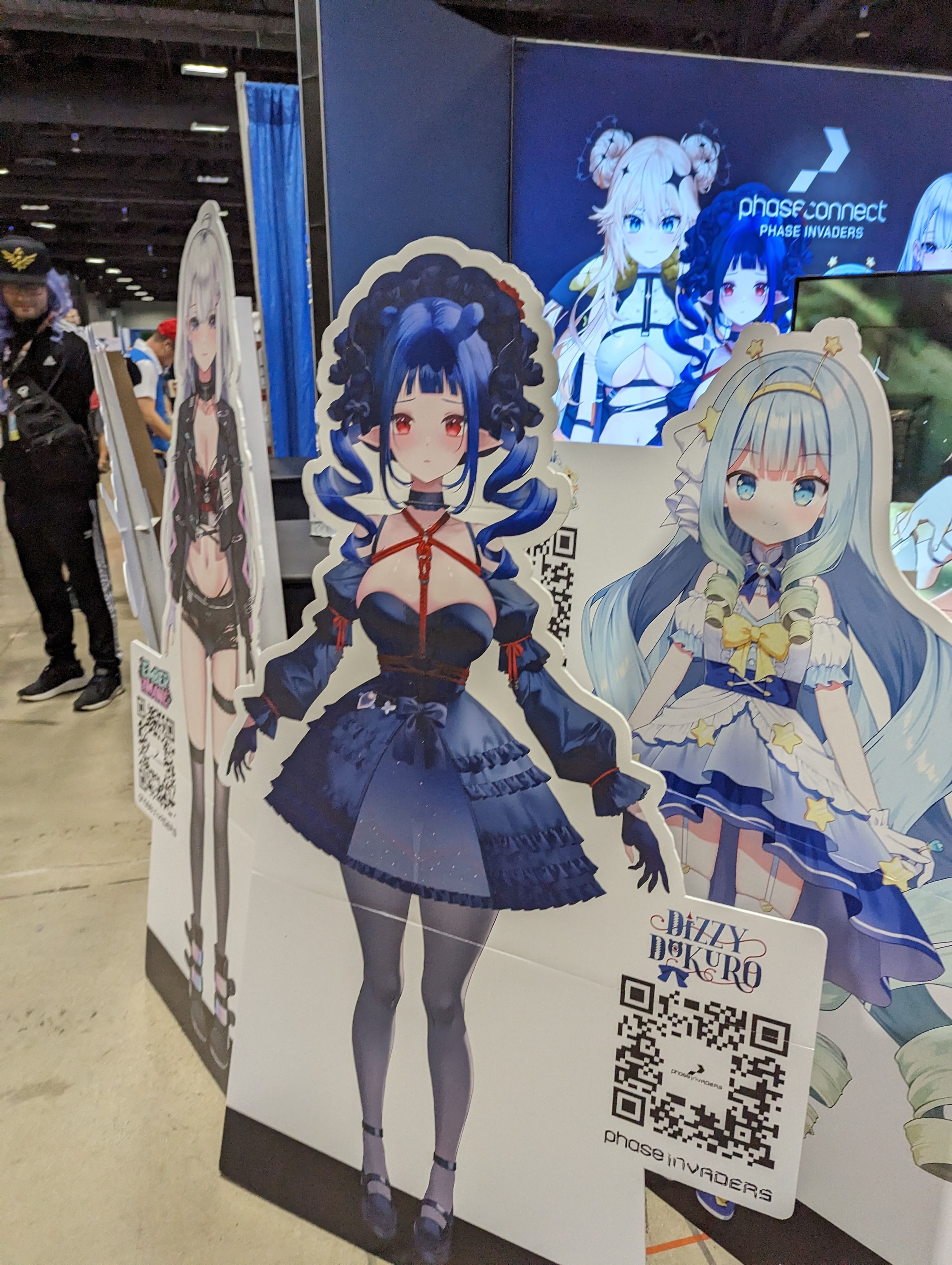
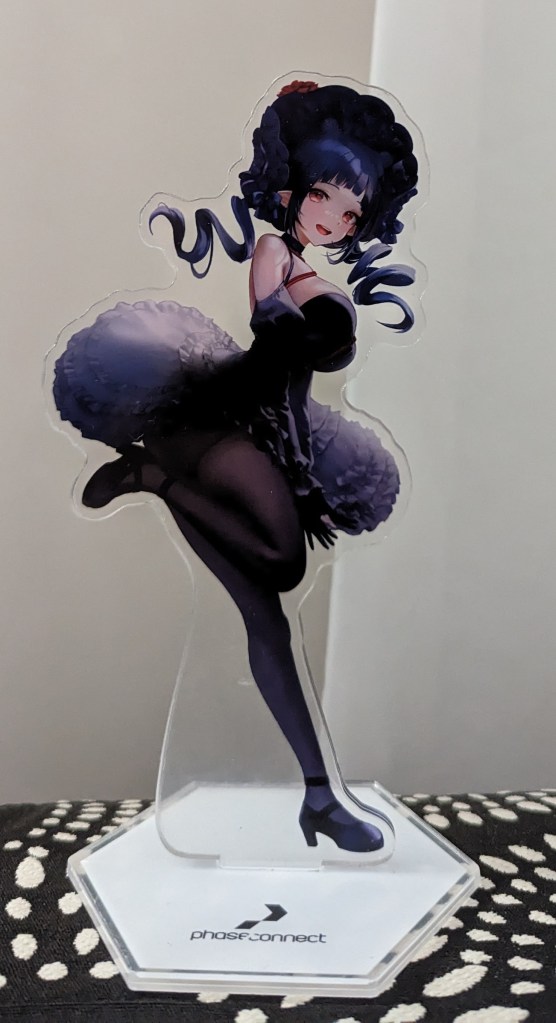
While there were cosplayers and artists who were repping the VTubers, there wasn’t much of an official presence (in contrast to Anime Expo, where it was a major force). That said, the group Phase Connect had a booth. I visited and bought an acrylic stand of Dizzy Dokuro.
Panels
Due to everything else going on, I shamefully ended up not attending very many fan panels this year despite that being one of Otakon’s best features. And for the ones I did, I could only see them in part.
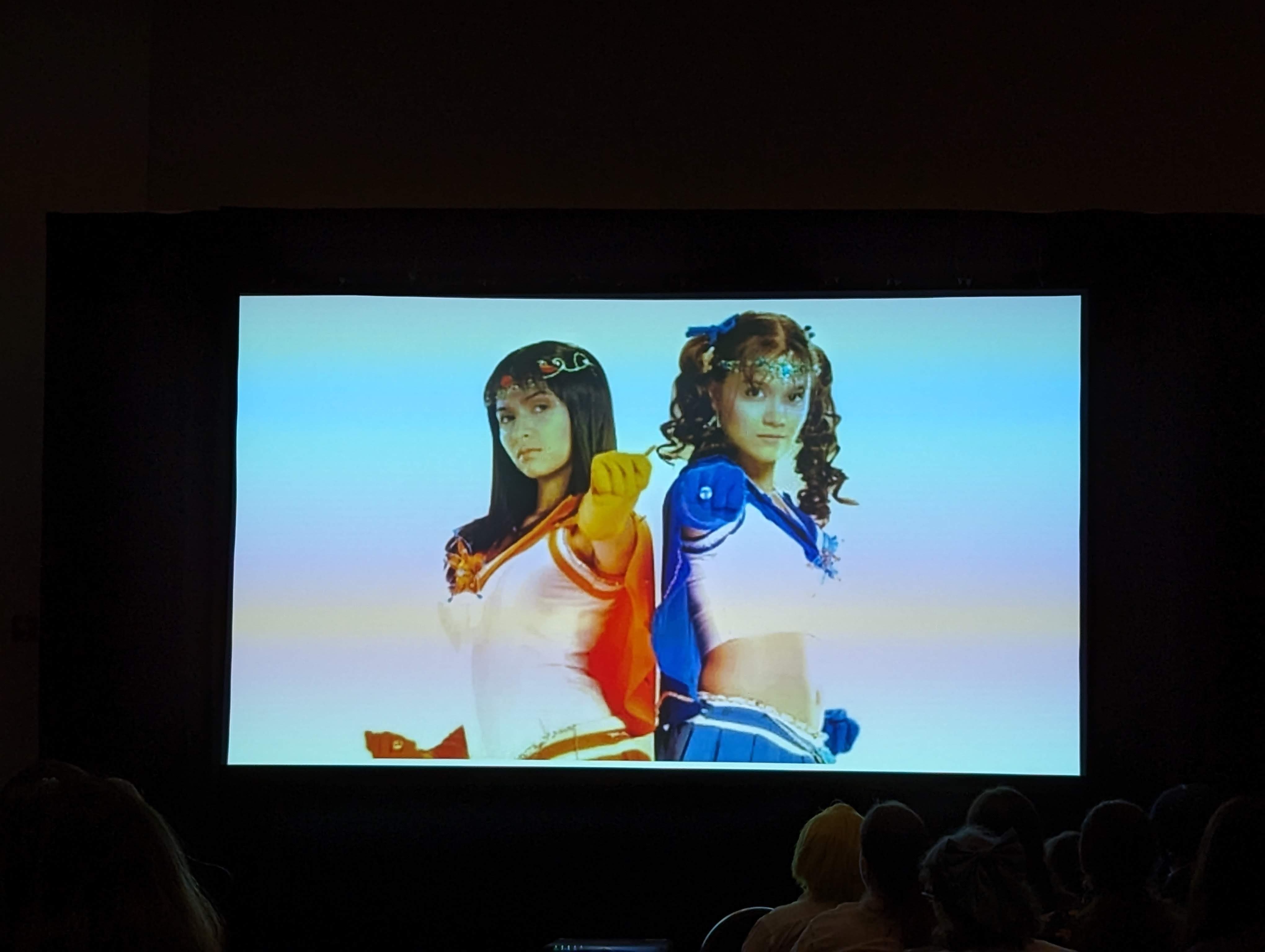
I do want to give a shout-out to Anime in the Philippines, as it definitely taught me new things, and gave a window into a culture and fandom that I was largely unfamiliar with. For example, now I know that Mechander Robo aired there, and I learned about this:
I did present on two panels this year myself, though: “Giant Train Robots of Anime and More” and “Densha Otoko: Train Man, Modern Myth, Internet Legend.” The theme of Otakon 2023 was trains, so I decided to play along.
Giant Train Robots was a joint project between myself and Patz from The Cockpit. We both love mecha, and I also relied on his greater knowledge of the tokusatsu side in bringing this together, and I think the result was a fun and breezy panel whose goal was to entertain, inform, and leave the audience appreciating trains that turn into robots. We got a good-sized attendance despite being at 1030am on Friday, and I hope everyone enjoyed it.
The Densha Otoko panel was all me, and I had actually started thinking about doing it since the end of Otakon 2022 when they had announced the train motif for the following year. Densha Otoko had been such a phenomenon in the mid-2000s, and I was curious to both look back on that era and to see what was its legacy today. I seemed to get mostly people who had already seen or knew about it, but that was just fine with me.
I think Giant Train Robots actually got more attendance than Densha Otoko, and I find that interesting because it used to be that the evening panels were better attended than the morning ones, and that mecha panels weren’t terribly popular, at least back in Baltimore. And this is on top of us actually being at the same time as a different giant robot panel! I wonder if there has been a generational shift or something that would explain this.
Food
After many years, the convention center cafeteria was finally open, giving another option for those who want to get something to eat but don’t want to travel too far. I dropped in there once, and saw that there were three options: Japanese, pizza, and hot dogs/sausages. I went for the last option (which was pretty similar to what’s offered at Ben’s Chili Bowl) mainly because it had the shortest kind, and it was pretty decent. The Japanese food naturally had the longest line at an anime con, though I still remember Otakon staff claiming a long while back that the sushi was actually pretty decent.
But the best food in the Walter E. Washington Convention Center was still the Caribbean food stand, which was located at the far end of the Exhibit Hall. While all con food is inevitably overpriced, this place always feels like the best deal, and the meals feel well balanced in terms of taste and nutrition. I’ve had something from them pretty much every year, and they never disappoint.
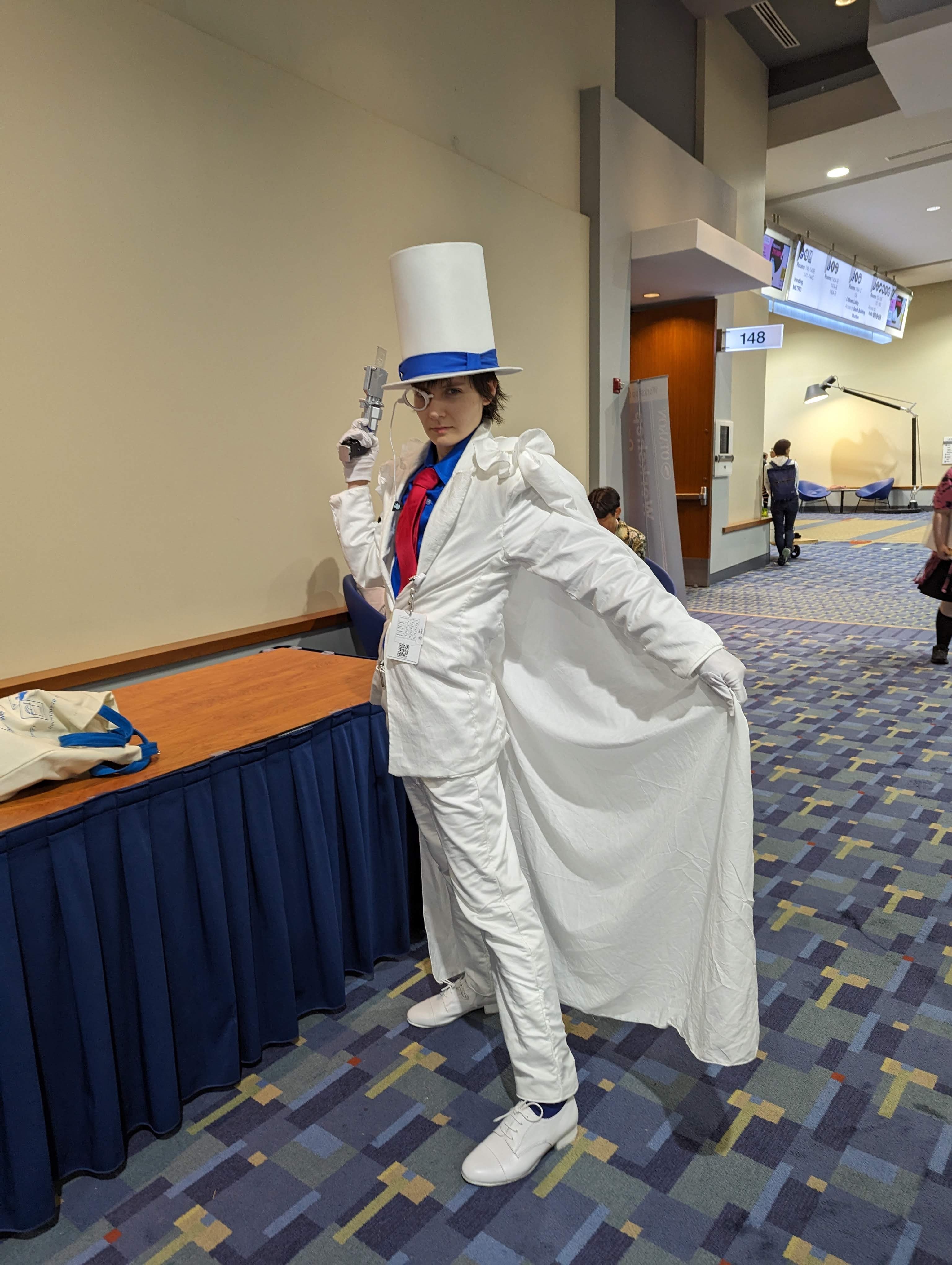
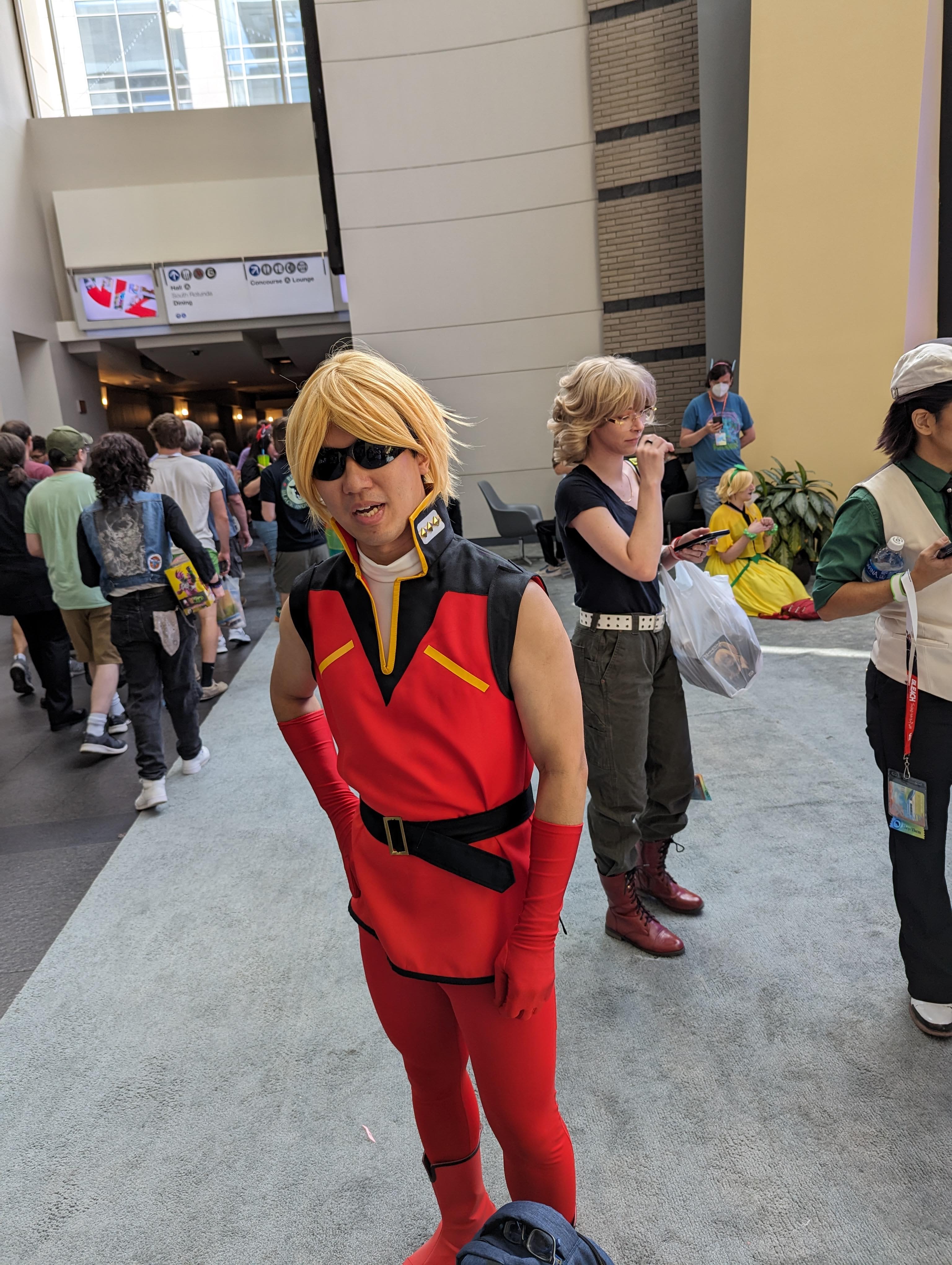
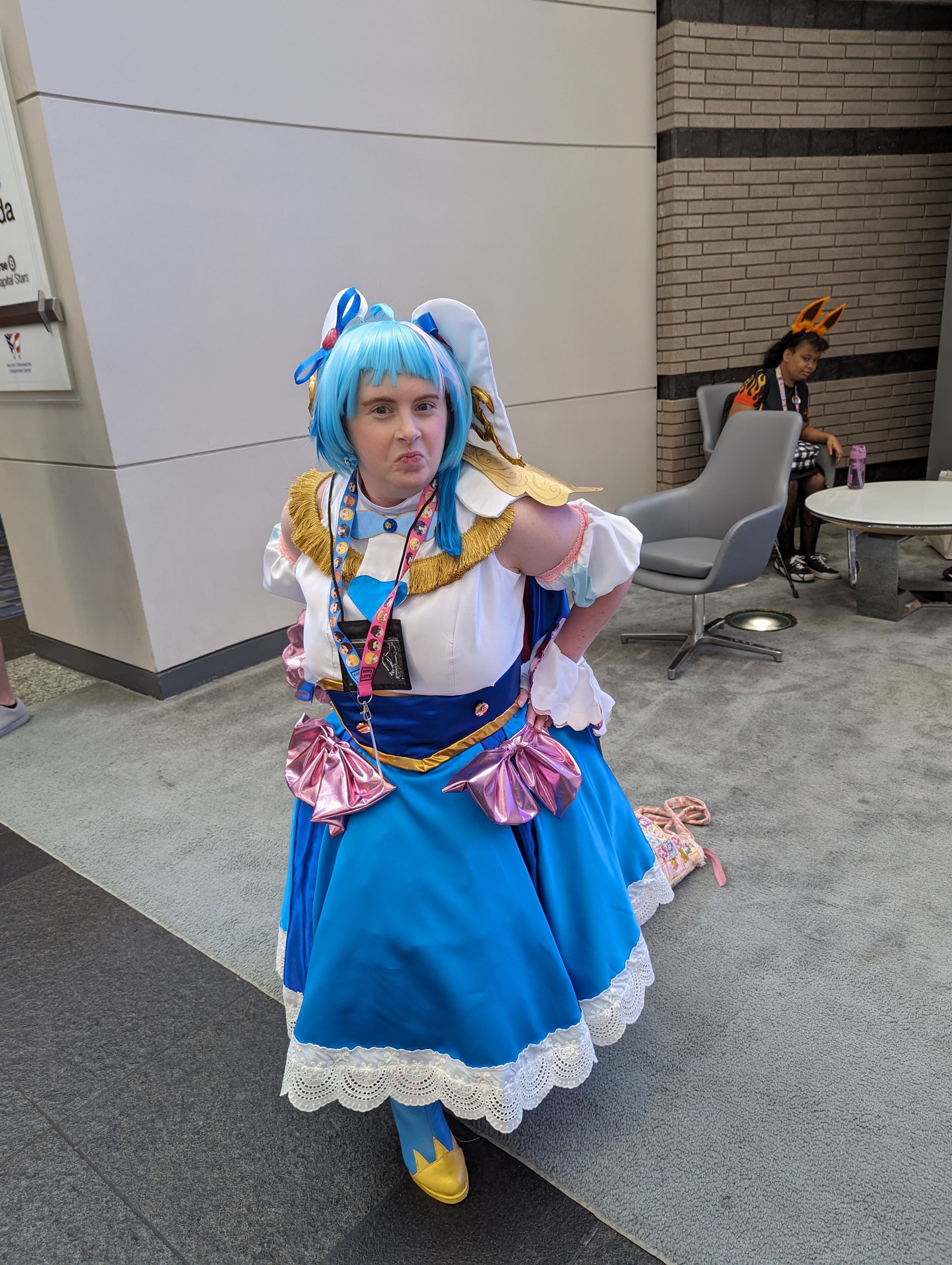
Cosplay
Closing Thoughts
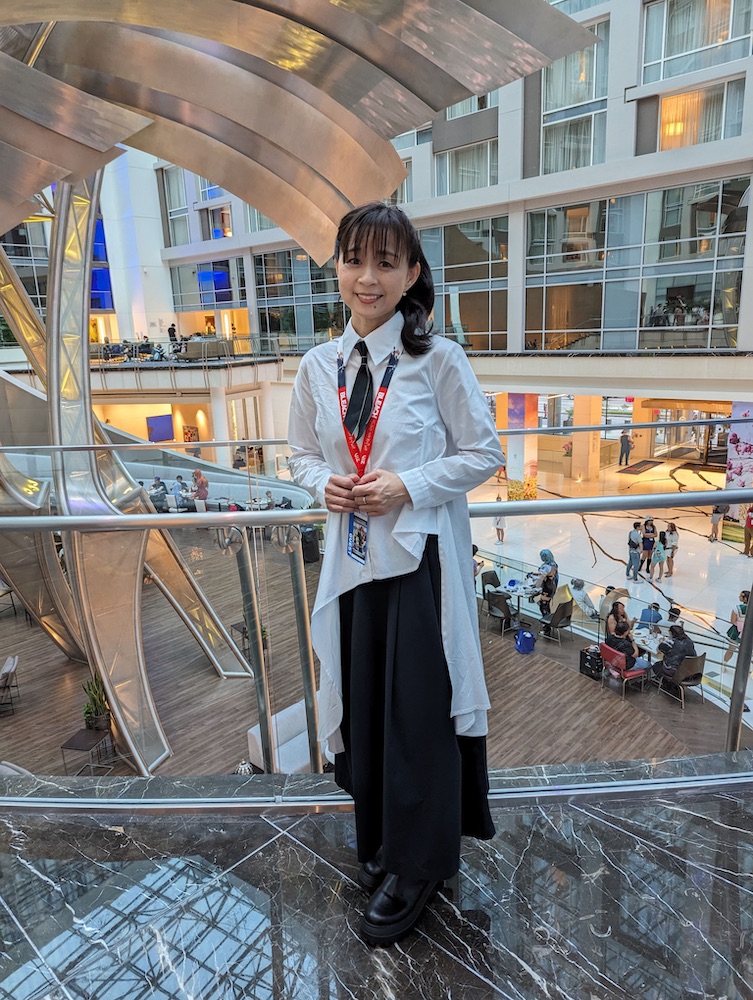
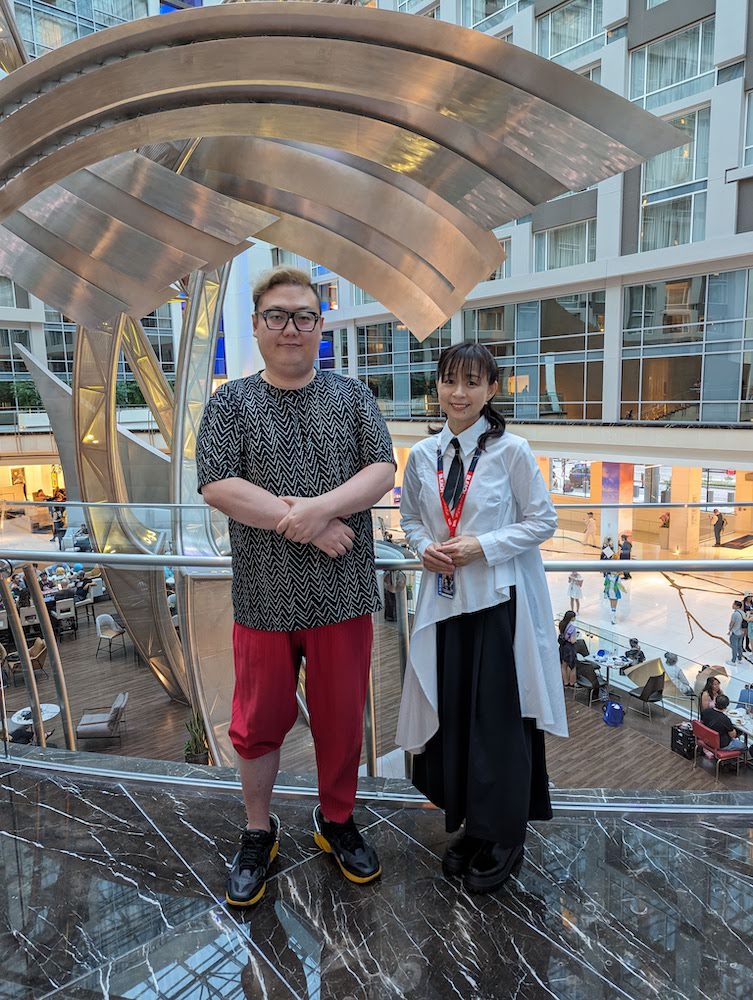
2023 was definitely a strong Otakon in spite of circumstantial issues like the weather. Most importantly, I got to meet Tomoyo.
That said, the amazing thing is that next year promises to be even bigger and more powerful because it’ll be Otakon’s 30th anniversary. I’m already brainstorming ideas for panels, and wildly speculating on potential guests. I feel like it would be the perfect time to get people who were big back in 1994, and I trust the staff running the show to bring in some big guns.
Terada Takanobu is a veteran game producer, and has been involved with the Super Robot Wars franchise since the 1990s. This interview as conducted at Otakon 2023 in Washington, DC.
Hello, it’s great to meet you. I’ve been a long-time fan of the Super Robot Wars series, and I’m very glad that is finally easy for people to play around the world.
My first question: You recently announced that you were becoming a freelancer. How has that change been for you? Have there been any particular advantages or challenges that come with it?
There were lots of interests I wanted to pursue, so I decided to step down from the producer role to become a supervisor, and use that time to do the things I’d like to do.
I want to make toys and plastic models, and original robot animations—ones that are not Super Robot Wars OG.
Do you have any all-time favorite anime or even tokusatsu works?
My favorite super robot is Mazinger Z. As for tokusatsu, Ultraman and also Masked Rider. And more and more.
Original Kamen Rider, or…?
It would have to be the first Masked Rider, fundamentally.
One signature element of SRW is the continued use of very creative 2D attack animations. What are the reasons you have stuck with this style even though so much has changed about video games over time?
In Super Robot Wars DD, we’re doing 2D animations and something between 2D and 3D too, so we’re diversifying.
In SRW DD, the idea behind going for 3D animation is to better capture the original. But more than when I was a producer, I can now better create the content I make compared to before
What has it been like developing mobile games, as well as having multiple games out there? Is it part of a broader strategy?
With regard to the overall strategy of creating mobile games, that lies with the publisher, Bandai Namco, so I can’t really speak to it. However, as for challenges in mobile games specifically, I’d say one that having a deadline every month is a bit challenging. For example, before, if it was for a console, you had three years to get the battle animations and the scenarios and put everything into one package. But now, with the mobile games, you have everything packaged every month.
You started at Banpresto in the 90s. Are there any staff from that era still at [its successor] BBSoft?
There are some.
Do you have any specific series or character units that you thought turned out especially well in terms of their presence in SRW? Or do you think there were any storylines that were executed very well?
It’s a bit difficult, because all of them are a lot of work, and I’m mainly putting effort into making what’s there. It’s a cyclic process of making and releasing and making. More than myself, it’s ultimately the users who decide what’s good.
Are there any titles you are especially proud of being able to obtain for SRW or thought you’d never get for the series?
Space Battle Yamato, aka Star Blazers. As for recently, too many. Hmm…recently, Gridman, Mobile Suit Victory Gundam, and Gun x Sword. In SRW DD, Devilman and Koutetsu Jeeg. What’s it called in English?
Translator: [Steel] Jeeg.
Oh, just that directly.
Ogiue Maniax: There isn’t much of a Jeeg presence in America.
Ah, I see. Oh, and there are two Jeegs now: [Steel] Jeeg and [Steel God] Jeeg.
The impression I have about SRW is that there are the “main” games—Alpha, F, F Final, V, X, T, 30, etc.—and then there are smaller ones that tend to be a little more daring with game mechanics and what series they include. One title I think of is SRW Neo, with Jushin Liger. Is there any truth to the idea that you see the smaller games as more experimental?
Before, yes, there was a difference with the more experimental ones. But now, SRW DD is the only one out, and in there, we try all sorts of things like Jushin Liger and Granzort. SRW DD does embrace the style of SRW, such as the game stages and the scenarios and everything.
I know that you cannot reveal any unannounced information, but has there ever been any consideration to include giant robots from non-Japanese media?
I’m not allowed to say what it was, but there were past attempts. There’s lots I would like to license, but it didn’t work out.
Do you receive feedback from the directors and other staff involved with the titles included in SRW? For example, have you ever had to interact with directors Tomino or Anno?
Yes, there has been some feedback—and actually, there have been some ideas that came from Tomino-san and Anno-san. And actually, I came across some suggestions that Kawamori-san of Macross had earlier. But I had to tell him that’s not something I have control over.
One last question: Over the years, you’ve worked with many voice actors, and unfortunately, some have passed away. Sometimes, they are replaced by new actors, and other times, you re-use existing voice clips. Do you have any say in who gets recast in SRW, or is it outside your control?
If it’s stated by the original source material, I will do as the source material requests. Otherwise, I have the freedom to choose.
It’s not uncommon for people to dwell on what might have been. “If only I could get back what I lost, then everything would be better.” The Tunnel to Summer, the Exit of Goodbyes is an anime film that explores this feeling, told through the lens of a summer romance with a spark of the fantastical.
The Tunnel to Summer explores the lives and relationships of two teenagers, a boy named Touno Kaoru and a girl named Hanashiro Anzu, who end up finding an actual urban legend: the Ryuuguu Tunnel that is said to give you your greatest desire but at the price of losing everything. Touno has to deal with an abusive father who blames him for all their troubles and trauma. Hanashiro has something to prove and an attitude to match—one that says, “I have neither the time or patience to deal with stupid crap.” The pair discover that time passes much more quickly in the tunnel, and even a few seconds in there translates to hours in the real world. But the two have wishes they want to fulfill, and so they work together to figure out its secrets, all the while growing closer.
Time dilation isn’t a new premise in Japanese fiction. Both Aim for the Top! Gunbuster and Voices of a Distant Star explore how human relationships can be affected by the uneven passage of time within science fictional settings. Even beyond anime, the Ryuuguu Tunnel itself is a reference to the fairy tale Urashima Tarou, which is about a guy who visits the underwater Ryuuguu-jou (Dragon Palace) for what he perceives as three days but is actually 300 years. As a trope, I actually enjoy time dilation quite a bit because of how it messes with our minds so simply and easily—and The Tunnel to Summer adds another emotional dimension because it’s not just about how they are passively affected by it but also how their active decisions have consequences. The characters must consider how the past (or future) they long for might very well be distracting them from finding happiness in the present.
Something else that stands out to me is the central relationship between Touno and Hanashiro because of how much the two feel like equals. It sort of brings to mind BL shipping in shounen series, and how often it happens simply because all the boys are involved in the same competition—which often engenders visibly greater passion than whatever interaction the hero has with a female love interest. Here, Touno and Hanashiro feel very much like they’re in it together as they learn and experiment about the Ryuuguu Tunnel. In terms of how this plays out in the overall story, I like how each character is very invested in their mutual endeavor in their own way. The similarities and differences between the two ultimately enriches their relationship and gives the film a nice emotional anchoring.
Because of the subject matter and the seasonal setting, The Tunnel to Summer, the Exit of Goodbyes ends up having a very nostalgic feel while at the same time questioning the value of nostalgia itself. It’s more than just another summer-themed anime movie, carrying a memorable identity all its own.
Aramaki Shinji is a creator known for his mecha design work on Bubblegum Crisis, Genesis Climber Mospeada, Megazone 23, and more. He also designed many of the toys that became Transformers, including Soundwave. Aramaki is also an anime director who has focused on pushing 3DCG animation since the early 2000s.
You have a lot of experience as a mechanical designer, and I understand that different mechanical designers have different processes for designing. For example, Kawamori Shoji has talked about how he uses Legos. What are the key aspects of your approach?
Well, it depends a lot because I get different requests for each project I work on. For example, you mentioned that Kawamori Shoji-san uses Legos, but I think that’s mainly for designing transforming mecha. Should I answer just based on transforming ones? It’ll make it easier if we narrow it down to a certain genre.
Sure, let’s go with transforming.
So we initially choose two or three shapes/forms, and we ask, what are we going to transform and how. But we start out with the two coolest forms.
Would you say you sort of work backwards from the final designs/silhouettes perhaps?
Initially, we don’t really get into the details. We just think, oh this is what a cool bike looks like, and this is what a cool robot looks like. So we just start off with what looks cool and don’t get into the particulars of how it transforms yet.
It gets difficult from there. In the past, I used to study how things might transform using papercraft. Nowadays, though, we can use 3D programs. We start off with simple blocks, but using them, we can join them and see how these volumes move around.
If we use 3DCG, we can study how these forms look from varying perspectives, so it makes the process much easier.
The next work is one that you might not be as known for. I looked up your credits, and it said that you’re responsible for conceptual design on the anime Star Driver. The style of the mecha there are quite different from what I typically think of when it comes to your work. How far removed are the final designs compared to your originals?
Actually, for Star Driver, I didn’t do much mechanical design, and I didn’t really touch any robots. But I actually designed the landscapes and backgrounds—the stage design—for Star Driver. The series is set on an island, and I designed what the island is like, and what the school is like. I did it based on discussions I had with the director, Igarashi, to set the mood for the anime.
You directed works such as Appleseed, which was, at this point, decades ago. I remember seeing them first start to show up, and that was a time when directing in full 3DCG wasn’t nearly as convenient as it is today. What are some of the challenges you faced in the early 2000s?
Back then, we actually had a lot of problems. There was no standardized software for design, so the character design software was different from the landscape design software. That made it really difficult to organize everything and keep it together as one team.
For one scene, when we decided on the camera angle and looked at the scene, the table and the character were sort of shifted because they were designed using different softwares.
These seem to be simple problems, but back then, Japan wasn’t as advanced in the field of CG. So we faced challenges every single day.
My final question: I actually have fond memories of the cartoon M.A.S.K. and its toys, and I was excited to learn that you worked on it. What designs were you responsible for, and what did it feel like to work on a foreign production?
This series involved a lot of transforming vehicles such as trucks and boats, but the original designs came from the toy company, Kenner. Back then, I was working in LA, but I went to Chicago where their company was based, and took a lot of pictures of the prototypes. We did drawings to help with animations.
Most of the mechas were designs provided from the toys, but some were not from the toys, so I got to design them.
I don’t remember all that well where they appeared in the show, but they let me design two transforming vehicles back then, where I got to pick the car types and how they transform. They were called the Manta and the Shark.
Thank you for this interview. It was great to have you at Otakon!
At Otakon 2023, Iwao Junko (Tomoyo in Cardcaptor Sakura) had a panel focused exclusively on her history and career. This is a summary of the panel, as well as notes from the Q&A that occurred. To read the interview I conducted with her and collaborator Kawamura Ryu, go here.
The Beginning
Iwao started off the panel by talking about her childhood, and how she loved listening to records found in storybooks, watching anime, listening to music. At that time, voice acting wasn’t seen as it is today, so when she asked others about a career in that realm, they told her she would have to be an actor or a singer/musician. Even so, she thought about getting into voice acting since she was 6 or 7 years old.
Around 13, she secretly auditioned to become an idol, and while she was ready to get rejected 100 or 200 times, she ended up getting accepted after just on try. Her parents (especially her dad) were very against it, but she promised them that she would quit in ten years if she didn’t make it.
So she went to Tokyo and did lessons, and she eventually debuted as an idol in a four-person group at the age of 16. She was actually replacing another idol in the group who had “graduated” (i.e. quit and moved on), but the group was already planning to split up after one year. Once that was done, she had to do part-time jobs and attend night school.
Iwao’s First Anime Role
From then on, until the age of 23, Iwao just worked and auditioned, ending up with various jobs. She was in musicals, and also played an assistant in a science show for kids. She even worked at a train station. One day, one of the members of the science show saw Iwao and asked if she had given up on show business. At that time, the ten-year deadline she had promised her parents was almost up. This person mentioned that a certain show was looking for someone who could act and sing, and so Iwao went for it because it could be her last chance. After auditioning, she was nervous waiting for results every day.
It was her first anime role, and it was Melissa Thorn, one of the main characters in an Japanese-French co-produced anime called Montana Jones, about explorers on a voyage. Got the part of one of the main characters of Montana Jones. When she told her parents about it, worried that time was technically already up, her parents instead congratulated her, and said they want Iwao to keep trying for another 10 or even 20 years.
From there, Iwao joined a voice acting school and practiced for her debut in Montana Jones. One thing that surprised her about working on the show was that there was no rehearsal time in anime. The first day of recording is when you meet the rest of the cast.
Another surprise was that they recorded based on roughly drawn non-color animatics. She expected to be acting in reference to finished animation, and while there was sometimes color, that was often not the case. Sometimes, ttwo characters would even be represented by just a red line and a blue line.
The other main characters were played by Otsuka Akio (Solid Snake, Black Jack) and Nakao Ryusei (Freeza). Their performances were so good that she worried there were actually prior practice sessions that she didn’t know about and missed. Iwao couldn’t keep up with them at all.
The way the recording studio was set up, 10-plus people had to work with four microphones. And in fact, one of those mics was the “main character mic,” exclusively used by Ohtsuka as Montana Jones. The result: you ad to quietly get up to the mics each time and constantly choosing which of the three you’d use every time. Not only that, but recording was analog back then, and the tape didn’t stop for you. Every take was 15-minute long (about half an episode), and whenever there was a mistake, everyone had to start all over again. Iwao remembers the other voice actors getting frustrated with her and asking, “What is this amateur doing here?” It was Otsuka and Nakao who helped her through the process, until they eventually finished the first episode.
After the debut episode, haired, the show actually got complaints from viewers who wanted her to be replaced with someone more experienced, and she even received a stack of physical hate mail complaining about her. The other actors supported her and let her know that everyone has to deal with this. Gradually, the staff also supported her, and she gained fans little by little. She still got negative feedback, but would also receive letters from fans. Because of that, she wanted to become someone who could someday help a newbie overcome these same troubles. Something curious she noticed was that once she started having a more positive outlook, she started landing a lot more roles.
Going Full-Time
At first, she didn’t have enough voice acting gigs to quit her day job, but eventually had enough roles that she could go full-time. Her first time as protagonist was in Key the Metal Idol, and from there, it was Cardcaptor Sakura and Evangelion and so on. She remembers her manager saying, “You’re gonna get it,” in regards to Eva. It was with Eva that she could make voice acting her sole career. One thing she learned, though, was that despite the job being “voice acting,” a lot of her work seemed to be event-related. Couldn’t get much sleep, which was rough.
Iwao recalled that the Eva audition was 15 minutes long for everyone. There was a long bench where everyone sat as they waited to try out, and she could see so many voice actors there who were interested. Iwao actually auditioned for two roles, and hinted that the second role has become known recently, but did not specify which one.
Q&A
At the 20th anniversary CCS exhibition, she got to go to dinner with all the other actors outside of work.
Shows she wishes people would know more: Harimogu Harley, Betterman, Key the Metal Idol.
Perfect Blue was a case where she actually received a real script and storyboards prior to recording. Iwao’s time as an idol only lasted one year, but she knew from others while working at that time that some of the things Mima goes through in the film actually dho happen. What she didn’t find out until later that director Kon Satoshi didn’t know anything about her idol history or age, and decided it based on one line that everyone was supposed to recite for their audition: “Who…are you?” Kon had decided on voice alone, so when he looked at her résumé, he reacted to Iwao’s extremely strong-sounding family name, which translates roughly to “Boulder Man.” Kon was excited to see what kind of Rock-like Man would show up, and was surprised Iwao was rather small. Because of this, he was watching her with a stern and scary face, but she didn’t know this was the reason, and Iwao was so scared that she couldn’t greet him. When playing Mima and the “other” Mima, she had to have separate recording days for the different personalities, and thought Matsumoto Rica (who played Rumi) gave a powerful performance.
When asked if she ever had the chance to be the mentor she wanted to become during Montana Jones, she mentioned that she thought upon entering her 50s that this would be her mentorship phase (Iwao is 53 this year). The series where she was able to to do this was an anime called Shining Post, where she thought, “Now is my time to shine.” Iwao ended up telling the new voice actors about what she herself had experienced.
I got to ask a question as well, one that I couldn’t fit into the interview! “Are there any roles you played later in your career that would have been difficult for you earlier in your career?” Iwao replied that it would have to be Hisae in Onihei, as it was a role where she felt she could bring the experience she had built up over time. When playing her, Iwao thought, “Finally, I can play adult roles.”
Everyone who worked on the Madoka Magica found out about the twists and turns week by week, so it was a surprised to everyone.
Iwao is from Kyushu, and a major Tomoyo/Iwao fan asked the final question, which was regarding recommendations for anyone traveling to her home prefecture. Iwao’s Her recommendations are Beppu in Oita Prefecture, which is famous for hot springs. She also suggested checking out Nagasaki.
Iwao Junko is a singer and voice actor most famously known for playing Daidouji Tomoyo in the anime Cardcaptor Sakura. Kawamura Ryu is a musician and composer who has frequently collaborated with Iwao on musical projects.This interview was conducted at Otakon 2023 in Washington, DC.
My first question is for Iwao-san: I first came to know you through your role as Tomoyo in Cardcaptor Sakura, and you helped make her one of my favorite characters ever. I’ve noticed that in the first series, our approach to Tomoyo was a little different from how it turned out later on. Was there any catalyst for this change?
Iwao: Daidouji Tomoyo in the Clow Card series is an elementary school girl, and she’s grown up a bit in Clear Card. So as some years have passed, I played her a little more mature.
Iwao-san, your singing as Tomoyo is beautiful but also notably different from how you approach your personal music. How do you manage to stay in character so well while singing as Tomoyo?
Iwao: When I sing as Tomoyo, I sing as an elementary school girl. But when I sing as myself, I use my natural voice.
Is it a challenge to play Tomoyo while singing?
Iwao: It’s not all that difficult, actually.
My next question is for Kawamura-san: What made you decide on the bass as your instrument of choice?
Kawamura: I’d have fewer rivals.
And how did you go from playing music yourself to also arranging for others?
Kawamura: It’s actually something I learned from Tanaka Kohei-san. What he mentioned was that, as a musician/player, you don’t get the same royalty payments as you would if you’re a composer. So what I learned is that you should be well-rounded, and have both “composer” and “player” under your belt.
Are there any other lessons you’ve learned from working with Tanaka-san that have stuck with you?
Kawamura: His policy was “make something other people won’t make.” He’s ingrained that in me.
Speaking of Tanaka Kohei, I also know Iwao-san from a series called Betterman, and your performance really stands out to me when you play Sakura—it’s very haunting. What was it like working on Betterman?
Tomoyo: So on Betterman, which Tanaka Kohei-san did the music for, I auditioned and landed that role. I wanted to play the character of Sakura as a girl who is cute, yet enigmatic and even a little frightening. Expressing that scariness was not so much about changing my tone, but rather taking care to change the tempo within the lines.
Kohei-san was the one who basically welcomed me into the world of anime, so I’m very grateful to him. I had done various jobs as a singer and such, but I always longed to be involved in the world of anime—to be a voice actor. I was missing that step towards that industry, though, and It was Kohei-san who allowed me to get into singing covers of other songs, providing me opportunities for people to see and hear me. So he is a very important figure to me.
Another series Iwao-san worked on that is very influential is Evangelion. Do you have any memories of working on Eva that stand out strongly in your mind?
Iwao: I got the role of class rep Horaki Hikari from auditioning. When playing her, Director Anno-san asked me to express her energeticness and her “class-rep feel” through my voice. However, in Shin Evangelion, Hikari is a mother, and as a mother, she would have a different voice tone as well as a different emotion to her compared to the television version where she was a school girl and a class rep.
On that note, over the past decade or so, you returned to many roles—in Evangelion, in Cardcaptor Sakura: Clear Card, and you even reprised the role of Sakura in Super Robot Wars 30. What is it like to revisit these older characters of yours?
Iwao: Going back to previous roles is very interesting because what I thought I remembered I may not actually remember, and some things might have changed—like the tone of my voice. I would want to focus on meeting the expectations of my fans. For example, for Super Robot Wars 30, the Betterman director, Yonetani-san, was actually there to see over my breaths and my tones so that I was better able to reproduce what I sounded like and what the fans expected me.
The first Virtual YouTuber to really pull me into Hololive was none other than Akai Haato, aka Haachama. She’s currently on an indefinite break for health reasons, so I wanted to support her even when she’s not streaming by writing about why she’s still an all-time favorite of mine.
As Hololive continues to grow, it pulls in more and more ridiculously creative people. Whether it’s through singing and dancing, language skills, gaming ability, comedic chops, charisma, or more, they prove time and again to be a collection of extremely talented individuals.
Haachama is not exceptionally strong in most categories—more a Jack of All Trades. However, there are a couple areas where she outshines just about everyone else: experimentation and adaptation.
To VTuber fans, the roller coaster that is the Haachama experience is well known at this point. Originally joining Hololive to play a tsundere high school girl, she began to take on an increasingly unhinged character personality as she spent four years abroad in Australia, including during the height of COVID. Her experimentation during this time with videos and editing was in part her making the best of a bad situation, i.e. notoriously terrible Australian internet, but it nevertheless laid the foundation for much of Haachama’s fame. The Haachama Cooking videos, where she would confidently and genuinely demonstrate some of the biggest culinary crimes, are just one example of the lengths she’s willing to go.
Fans began to joke that Akai Haato the tsundere and Haachama the unbridled horror were actually two different personalities, with the latter overpowering the former. They even created fanart about it. But then one day, Haachama began to stream as Haato again, using her old catchphrases that she had long since rejected. This culminated in what’s known as the #Coexist Arc, where Haachama seemed to imply that Haato and Haachama were actually sisters who went through some kind of unspeakable tragedy, and that both personalities now inhabit the same body while battling for supremacy. In practical terms, the result is that she now sometimes streams Haato-style (more mellow and relaxed) and sometimes Haachama-style (manic and intense).
In other words, Haachama took a joke from the fans, added her own spin on it to create a kind of semi-interactive lore, and then parlayed it into a way to expand her repertoire and not get boxed into one way of being. Very few Hololive members or even VTubers in general are willing to take such risks with their branding and image, yet Haachama seems to experiment endlessly with what she can be.
It’s important to note, though, that Haachama is also fairly shrewd. She has mentioned that the reason she started changing her character was in order to fill a hole in what Hololive lacked at the time, and her decision was to be a little more “Nijisanji.” The two companies are somewhat defined by their inaugural VTubers—Hololive with Tokino Sora as ideal idol and Nijisanji with the elegantly crass Tsukino Mito—and Haachama as unpredictable idol carries shades of both. This is her adaptability in action.
I previously compared Haachama to the late pro wrestler Brian Pillman because of how his drastic change from white-meat babyface to loose cannon was similar to hers. Since then, it’s clear to me that she’s more of a Matt Hardy—being performers who repeatedly reinvent themselves to either keep up or defy the times. “Haachama the Eldritch entity” is not that far off from the bizarre and imaginative transformation of “Broken” Matt Hardy and the way Matt would play with history and expectations. Neither seem to be satisfied settling into one mode of performance.
I don’t necessarily love everything Haachama does. There are times when she swings big and misses. But even when one stream or project flops, I enjoy seeing Haachama continue to try new things. One prominent example is how she no longer releases Haachama Cooking videos where she eats weird ingredients (like tarantulas) and approaches food with zero practical kitchen skills. Instead, she has moved towards making real progress in actual meal preparation. I miss the absurdity but love her adventurousness.
Haachama pushes boundaries, always seemingly looking for avenues of change. It can be rough for her when things don’t turn out as she intended, but her ability to entertain and renew herself is hard to match. It might make her branding a bit inconsistent, but that plays into her presence all the more. Sometimes, she’s so unpredictable that she does the most predictable thing. I hope that whenever she makes a full recovery, she can come back and still be proud of what she’s accomplished.
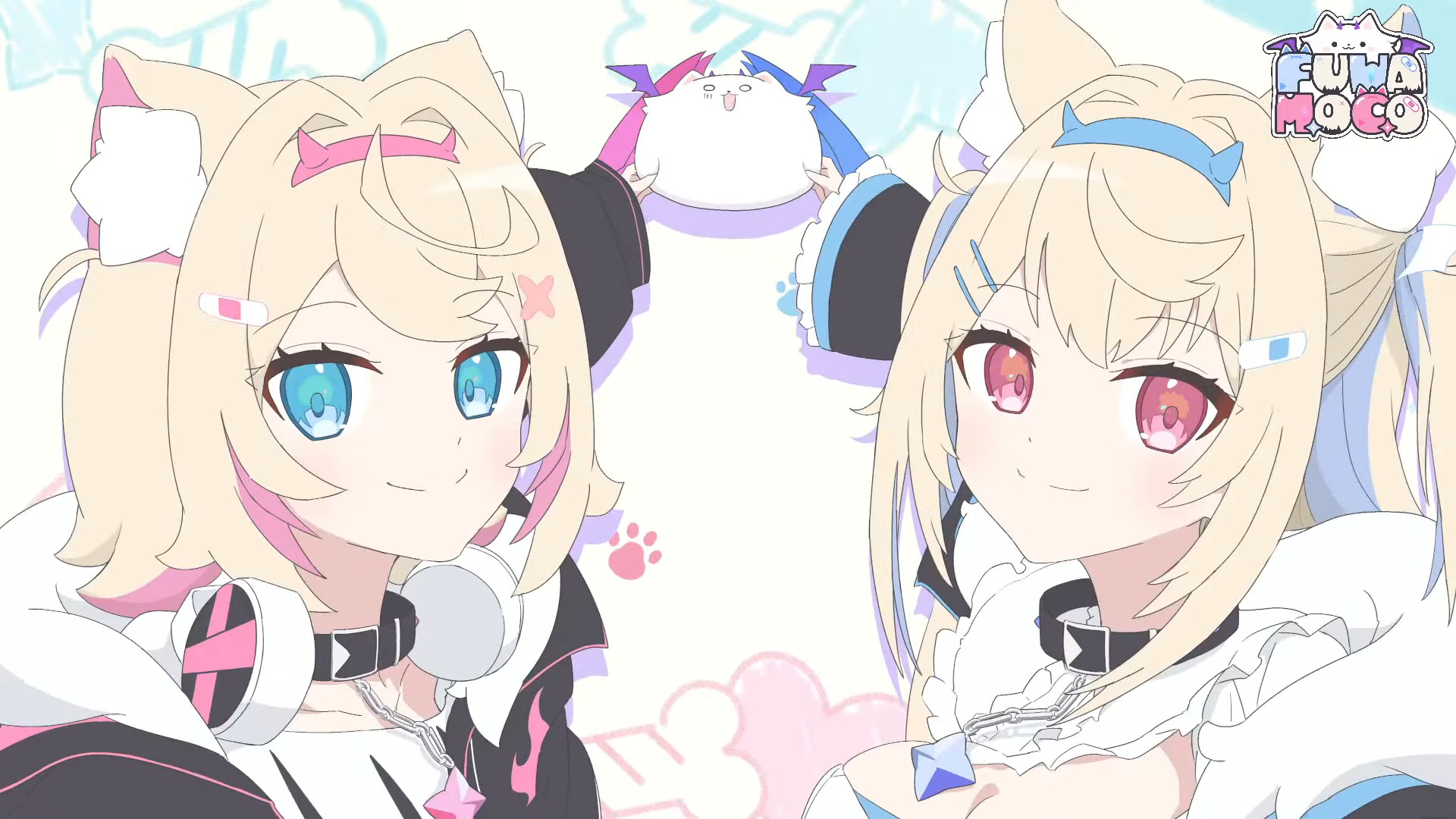
The new Hololive English generation, HoloAdvent, has made their debut after more than two years of waiting. Among the five Virtual Youtubers are actually a pair of twins—the Abyssgard sisters Fuwawa and Mococo, collectively known as FuwaMoco. And while there is a lot to potentially talk about (including the fact that Fuwawa is a Genshiken fan!!!), I want to focus on one thing: The pronunciation of their names.
During their inaugural stream, Fuwawa and Mococo made some requests to viewers about their names. First, their last name isn’t pronounced “a-BYSS-gard” but rather A-byss-gard.” Second, their first names are “FU-wa-wa” and “MO-co-co,” and notfu-WA-wa” and “mo-CO-co.” With those specifics, FuwaMoco has brought overseas Hololive fans back into the realm of “pitch accent,” a prevalent element of the Japanese language.
The Pitch Accent Rabbit Hole
Much has been said about Japanese and pitch accent already. Multiple language-learning Youtubers, such Dougen and Yuta, have dedicated videos to the topic. Use of pitch accent can differentiate meanings of words, but more often, hitting the correct pitches can make your Japanese sound more natural and easier to understand for native speakers.
In the realm of Hololive, it’s one of the things that makes Inugami Korone’s regional accent so distinct. As heard in the above video, her pitch accents are very different from those of the more standard Japanese spoken by Murasaki Shion.
It’s even to the point that native Japanese speakers can have trouble with Korone. However, because pitch accent is hard to teach from a textbook and not as prominent in English, it can be a challenge for those going from English to Japanese to even pick up on the differences. Even in those Korone videos, there are comments from people saying that they can’t really hear the difference.
Nailing FuwaMoco’s Names
Incorrect pitch accent isn’t necessarily a deal breaker when it comes to learning Japanese, and how much you want to devote to it is a matter of personal priority. Is sounding closer to native speech more important than learning a wider vocabulary or memorizing kanji, for example? But if your goal is to pronounce FuwaMoco’s names correctly, then you can start from there.
Let’s first look at their family name, Abyssgard. While technically it’d be “Abisugaado” in Japanese, for our purposes, we can ignore those particulars (and in fact, FuwaMoco do the same.)
When focusing on the “Abyss” part of it, the incorrect pronunciation is “a-BYSS” and the correct one is A-byss.” When wrong, it sounds more like the English word “amiss,” while the right one is closer to how you’d say “pumice.”
“Pumice Guard.”
“Abyssgard.”
You can then carry that distinction to their given names, Fuwawa and Mococo, because those follow a similar pattern: FU-wa-wa and MO-co-co.
Going Forward
Keep in mind that the above guide is not a universal rule or anything. If you continue to study Japanese pronunciation, you’ll definitely find plenty of words that don’t follow those specific pitch accents. Also, regardless of whether you can say their names perfectly without effort or you find it to be a struggle, it doesn’t make you less of a fan.
Street Fighter 6 has succeeded in its goal of bringing in new players through a simplified control scheme labeled “Modern.” The signature special inputs that Street Fighter pioneered are basically replaced by one-button inputs and cardinal directions, with the caveat that damage dealt is reduced by 1/5. The Modern control scheme has also spiced up discussion in the community as competitive players try to figure out if having your most powerful moves be instantaneous is a worthwhile tradeoff for having fewer options overall. But this is not the first time fighting games have included easier inputs, and I think it’s interesting to see how past games have tried to incorporate more accessible control schemes.
In the GameCube Capcom vs. SNKEO and the 3DS Street Fighter IV, the advantages their shortcuts provide is tremendous. The only thing that kept them at bay is that they were not the “main” tournament versions; if they were, high-level play would be fundamentally worse because the characters were simply not balanced with instant specials and such in mind.
Another approach comes from Granblue Fantasy Versus. In that game, players have simultaneous access to both traditional specials and simplified ones (on a cooldown timer), with the expectation that stronger players will use the former and newbies the latter. In actuality, competitive players use both, recognizing that faster inputs are more reliable in certain situations.
Then there’s Super Smash Bros., a game franchise built around more simplified controls. When traditional 2D fighter characters became playable, the big question was how they would be incorporated into the Smash system. The answer, it turns out, was to allow everything—you can use Smash-style special inputs and classic fighting game motions, the latter rewarding the player with greater damage and KO power. However, no Ryu, Ken, or Terry Bogard players worth their salt play a primarily “Modern”-esque style. And unlike Granblue, the simplified versions are only ever used when recovering offstage.
This is because the aforementioned distinction between damage and KO power is an important part of Smash. In SF6, your Shoryuken taking a bit less off might just mean you need to land one additional hit. In Smash Ultimate, it might mean not being able to finish off the opponent at all. The fighting-game characters are balanced around their ability to take stocks relatively early through their “true” specials, as they’re called by the community.
The saving grace of SF6’s Modern controls is probably the fact that they’re part of the game from the very beginning, and they make players feel powerful without going overboard. Unlike some games, you cannot have your cake and eat it too with respect to accessing both modes, and Modern comes with drawbacks that feel neither ineffectual nor overly harsh. Efficacy seems to vary from character to character, and players have to be cognizant of what they give up to obtain instant specials and supers—advantages the opponent can know about and play around. I expect them to be a staple of Street Fighter going forward, and are one big step in helping to chase the elusive specter of accessibility all while maintaining competitive integrity.








 OGIUE MANIAX