Over yonder, beyond the horizon, is the Saki individuals tournament arc. It’s been referred to frequently throughout the series, and though at this point the manga is a long, long way from reaching it, it does give me the joy of speculating who might face whom as they go through the brackets (or round robin system, not sure which they’re using). One I’ve already mentioned before is Amae Koromo vs. Oohoshi Awai because of how their strengths lie at opposite ends of the game, but there are plenty of others.
Minor manga spoilers, by the way. Remember though, these are not actual matches but just ones (in no particular order) that I’d like to see.
1) Kataoka “Tacos” Yuuki vs. Usuzumi “Hell’s Gate” Hatsumi
I think this one is pretty obvious. Imagine Yuuki as dealer in the East round (meaning she’s double East) versus Hatsumi in the North position. To whom do the East tiles go?
Awai’s insane Double Riichi vs. Toyone’s Pursuit Riichi. Who overpowers who?
3) Matano “Fisherman” Seiko vs. Inoue “Strategic Pon” Jun
Both have a tendency to call for tiles but for very different reasons (winning vs. control). Seeing them in the same match would likely make for a very aggressive game.
4) Funakubo “Osaka Data Girl” Hiroko vs. Sawamura “Nagano Data Girl” Tomoki
Two characters who specialize in gathering information on their opponents. Who is the better strategist?
5) Aislinn “New Zealander” Wishart vs. Hao “Chinese-Style” Huiyu
Aislinn is capable of envisioning the perfect scenario in her mind and having it play out to her advantage. Mako ruined her day by disrupting the discard patterns that Aislinn had set out, but then Huiyu tends to prefer closed, quiet hands. At the same time, Huiyu’s Chinese-influenced play style is highly unorthodox and could disrupt Aislinn possibly without any effort on Huiyu’s part.
If you’ve watched all of Samurai Flamenco you’ll know that even though the show has humble beginnings and then progressively gets into increasingly more outlandish territory. It’s the kind of thing that you try to keep your mouth shut about so as not to spoil the uninitiated (by the way, SPOILER WARNING), partially because it’s obvious how intentional the whole thing has been.
The main character Masayoshi goes from tryng to be like a Kamen Rider-type to actually being a Kamen Rider-type, to being the leader of a Super Sentai team (with giant robot) and eventually even an Ultraman-style giant (and that’s not even mentioning the final genre shif at the end). The changes are so abrupt and swing so heavily from one thing to the next that I can only interpret the show as poking fun at the mid-season corporate meddling that can happen to a tokusatsu series and yet genuinely embrace it as a part of tokusatsu history.
I have to wonder, did Samurai Flamenco hint at this from the start? Perhaps Samumenco was always projecting an aura of neverending incongruities. Just think about the name “Samurai Flamenco.” What gimmicks or powers would a guy with a codename like that have? He’d maybe have some rhythm or dancing abilities (like Cure Lovely in Happiness Charge Precure) and probably a costume based more on a Japanese suit of armor. Real tokusatsu series do similar things, like how Ressha SentaiToQger currently features trains, and even the fake in-universe shows of Samurai Flamenco like Red Axe features… a guy with an axe. Samurai Flamenco, however, is neither Samurai nor Flamenco, and when he finally gets a set of effective weapons his gimmick of all things turns out to be “weaponized office supplies.” In that respect suddenly getting a giant robot that’s a mix of Combattler V and Dancougar isn’t so odd.
Perhaps Samurai Flamenco was always about the hodgepodge, the elements that don’t quite fit together so you have to smash them all in and enjoy what comes out. After all, it does start with a guy dressed like a superhero getting beat up by kids, who then forms a friendship with a cop where they sit around and watch children’s television.
In the world of Pokemon, Diantha (Carnet in Japanese) is not only the Pokemon Champion of the Kalos region and the final boss of Pokemon XY but also a movie star with renowned beauty. It shows in her character design, but there’s something I find interesting about Diantha’s attractiveness. As far as I can tell, rather than being the perfect woman for guys, Diantha appears to be closer to women’s general perception of the ideal feminine beauty.
I’m not especially well-read on the differences between how men and women view beauty except to know that there is at least some appreciable difference between the sexes. From my own experience talking to others about this, if you were to look at the female chefs on the Food Network and ask who is the most attractive, men often prefer Giada De Laurentiis while Claire Robinson appeals more to women. A lot of it seems to do with the men and women focusing on different features, though I can’t say for certain which is which. When I look at Diantha’s design she leans closer to Claire than she does Giada in terms of facial structure, and her pose and overall stature exude less of an alluring, sensual quality, and more a powerful, statuesque grace. It also might be the eyebrows.
Of course, tastes between individuals can vary even within the same gender, and there are also cultural differences to account for. In this sense I’d say that Diantha is more of a European ideal than an Asian one, but as with all of this it’s more my own impression than anything else. Obviously I can’t speak about how women perceive beauty firsthand, and if there’s something you think I’m overlooking or just plain wrong about, don’t hesitate to leave a comment.
Though, if we’re talking about ideal Pokemon girl for guys, I imagine it’d be either Cynthia (Shirona) or Flannery (Asuna).
Name: Kondou, Mayuka (近藤繭佳)
Alias: Mr. X (ミスターX)
Relationship Status: Single
Origin: Onii-chan no Koto nanka Zenzen Suki Janain Dakarane!
Information: Kondou Mayuka is a model high school student and class president who in contrast to her pristine reputation secretly goes out at night to buy BL magazines. When she accidentally bumps into her classmate Takanashi Shuusuke one evening while the two are on their respective porn runs, she winds up making Takanashi into her “pet,” an errand boy who has to buy BL for her in exchange for food and pats on the head. While she at first she keeps him around by way of threats, the two eventually develop an actual friendship.
Kondou is adept at cooking and studying. Her most noticeable feature is her black pantyhose, to the extent that she singlehandedly induces a black pantyhose fetish in Takanashi. Mayuka has feelings for Takanashi, though they appear to be tied to her fondness for yaoi and wish to see him in equally dire situations. Her alter ego, Mr. X, is her personal name for when she wishes to disguise herself and her fujoshi side.
Fujoshi Level:
The reason Mayuka turns Shuusuke into her errand boy is that while she desires more extreme yaoi titles she is too embarrassed to buy them on her own, showing that while her imagination is vast she has limits based in reality.
!!!SPOILER WARNING!!! THIS POST ASSUMES YOU’VE SEEN ALL OF KILL LA KILL
Kill la Kill has been a fairly controversial show since its start. Back in the early episodes I remember seeing a great deal of questions suspicious of what I’d call the anime’s “integrity.” Does this story have any legs or is is just a random assortment of wacky and violent things? Is there a solid sense of character development at work, or is it all style and flash? Are the ridiculously skimpy outfits there to titillate or to make a point?
In other words, is the show smart or stupid?
For those who’ve watched through to the end, I think the answer is pretty clear: much like the question of whether Ryuko and Senketsu are human or clothing, Kill la Kill is neither smart nor stupid, yet it’s also smart and stupid.
I’m oversimplifying the point in the hope of expressing my thoughts succinctly, so let me elaborate.
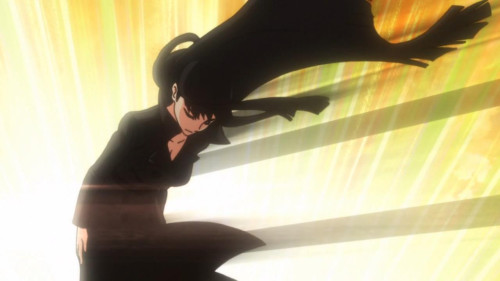
A lot of features of Kill la Kill simultaneously buck and conform to convention. Traditionally, when we think of narrative in anime, we think of it as the visual style serving the plot, but in a lot of cases Kill la Kill shifts between which facet, narrative or style, takes priority, and sometimes they act as equals. In this last regard, I think one of the best moments to showcase this in Kill la Kill is Satsuki’s apology to Ryuko, where her characteristic blinding aura takes on new meaning.
Kill la Kill also encompasses both of anime-as-animation’s dual personas. Is anime a detailed and expressive medium which breathes life into its characters, or is it a series of creative money-saving cheats honed through decades to become a craft all of its own? In Kill la Kill, while it’s easy to tell which moments are which, often the scenes which exemplify the latter quality of anime are so smart and effective that I wouldn’t be surprised if people preferred them to be “static” shortcuts.
When it comes to anime and pop culture references, the series is rife with them. Yet, there’s no need to “get” them to enjoy the show, or to take meaning from it. I’m 90% sure that Ryuko and Senketsu’s decent to Earth is a reference to the ending to Zambot 3, only the show takes the extremely bittersweet conclusion of Zambot 3 and turns it into something more sweet than bitter.
(Pay attention to the last 6 minutes or so. Also, Zambot 3 spoilers of course).
What about the theme of clothing? Did it truly serve the show in the end? When Senketsu burns up in the atmosphere and tells Ryuko that all girls stop wearing their school uniforms eventually, while it doesn’t explain everything in the show, it does highlight one of the consistent themes of the series, which is that it’s about girls growing into women. The moments of embarrassment, the rebelliousness and desire to make up for lost time, there are a lot of different threads at work here (pardon the pun), which may not be entirely consistent, but it doesn’t feel like the ideas presented by the series are any lesser for that. Ryuko’s motto, that she’s all about not making sense, comes to the fore here. While what she says is true in a sense, her ability to embrace nonsense, to swing wildly in terms of her emotions, and to come to conclusions which are less about solving problems and more about coming to terms with things in ways which fit her, all of that has its own logic.
What works, works, and who’s to say anyone has to follow the template laid out for them? Though, even that isn’t wholly consistent because the “purpose” of Senketsu has a clear arc, at least in terms of utility. Of course, the real purpose of Senketsu was to bond with Ryuko in more ways than one.
As for one of the main controversies, that of the show’s depictions of female characters, I find that we’re left with a surprisingly complex situation as well. All of the major female characters in Kill la Kill are strong in significantly different ways, and they each bear their own distinct personalities and personas which celebrate their broad archetypes but also encourage viewers to think about those differences as more than just “uniqueness points.” Ryuko’s strength is her passion, Satsuki’s is her indomitable will, and Mako’s is her relentlessness. This extends to a certain degree to the rest of the cast as well, for both men and women, notably the Elite Four. With respect to the tendency for the series to dress its central characters up in absurdly revealing outfits, it’s a curious thing that often the way that Ryuko and Satsuki carry themselves drives attention away from their curves and towards their intensity. It’s not even entirely a matter of personality over looks, as Senketsu and Junketsu themselves also sometimes help to, in a somewhat contradictory fashion, put the focus on themselves and not on the bodies to which they’re clinging.
While I find that the initial criticism of Kill la Kill came from a place of fear (oh boy, it’s anime at it again!), I think those who were initially wary of Kill la Kill also had every right to be. There was no definitive sign that the differences and the “stupid” elements wouldn’t transform the show into an Ikkitousen or some other show where the girls are action figures placed into awkwardly sexual poses. There was no definitive sign that its setting would be any different from Baka and Test or any number of series where the idea of “high school” is pushed to the “extreme.” What Kill la Kill manages to do, however, is give these inclinations teeth. It shows that these tropes and “vapid elements” have more power in them than simply their ability to distract and excite, that they can be engaged and utilized to express something I would dare call truly artistic.
Episode 1 of Space Dandy made an impact by killing off its main characters. In episode 2 they were back, and I think everyone (including myself) took this as a sign of the show not treating death or continuity very seriously. Supporting this is the fact that many episodes after this had odd, seemingly irreversible turnouts, like the zombie takeover of the universe, or the Redline-esque galactic race leading into time travel.
At the end of every episode there’s a catchy ending theme (by the singer of the Mawaru Penguindrum openings) which talks nonchalantly about the quantum physicist Hugh Everett III and the confusion caused by his theory of… parallel universes.
Sue’s moved in next to Hato and the awkwardness is palpable. The rest of the Genshiken girls pick their horses in the Madarame race: Yoshitake believes in Keiko x Mada, Yajima is for Hato x Mada, Ogiue supports Sue x Mada, and Ohno picks Angela x Mada. Meanwhile, Sue and Hato visit Madarame to take care of him while he’s still recovering from his illness. There, the harem-like scenario prompts Hato to make his intentions clear and obvious.
I find the discussion between the girls about who they think would work best with Madarame fascinating for a couple of reasons. First, you can tell that each girl’s pick has different degrees of idealism and pragmatism. Yajima and Ohno are kind of longshots because of gender and distance respectively, while Ogiue for example thinks Sue and Madarame are a good match and Yoshitake’s preference for Keiko, as she’s explained before, has to do with trying to keep all her friends. Second, I find that it calls back to one of the basic questions of Nidaime, which is what would this club be like if it were mostly girls? Here, we can see how the act of pairing common to female otaku extends beyond simply the realm of BL and into the possibility of heterosexual relationships as well. It’s also interesting seeing them blur that fantasy/reality line, especially with Yajima who digs Hato but is a sucker for the Hato x Mada pairing.
The main topic of the chapter, however, is the rivalry between Hato and Sue. Hato’s begun to make some serious moves, like learning how to cook better so that he doesn’t disappoint Madarame, dropping as many lines as he possibly can to make his feelings all but crystal clear (“I’d like to cook for you again, Madarame, but without Sue around”), and outright mentioning the “harem” atmosphere. Yet, Hato finds that he doesn’t mind being a part of this harem, something which I can only attribute to the very staticness that is at the core of harem manga as a genre. In this state, Hato gets to express his feelings without there being any commitment one way or another, allowing him to participate without the consequences of having “winners and losers.” In other words, Hato probably thinks this is the closest he’ll ever get to really being with Madarame.
If there’s one thing about this chapter that really stands out visually, it’s the intensity of the blushing. Sue, Hato, and Madarame seem to have this reciprocal relationship where when one person’s face turns red, the other’s goes one step further, like they’re having an arms race using their cheeks. The blushing possesses an almost three-dimensional quality, like it fills the very room I’m sitting in, and I can’t tell whether or not I should be blushing as well. I think the key to this is how Kio successfully communicates the escalating sense of embarrassment that the characters, especially Hato, experience in this chapter.
Seeing Sue go wide-eyed over Hato’s soup, for a brief moment, I thought Sue might actually start to fall in love with him instead. Of course, that’s not what happens, and instead you get this sort of grudging respect from Sue for Hato. As stated in the chapter, Sue mainly only eats convenience store bentou (I think the reference she makes in this episode is actually to Ben-To!), and while those things tend to be quite tasty (seriously, they’re really good), it doesn’t match up to the level of a proper home-cooked meal. As Sue becomes increasingly prominent in the manga, I wonder if she’ll begin to express self-doubts similar to Yajima’s to go with her perpetual shyness around Madarame.
Probably the most interesting topic in this chapter for me is the way Madarame feels that he simply cannot rely on harem anime and manga to navigate this situation. His reason is not simply that it’s unrealistic, but that the tendency for harems in shows to keep everyone at arms’ length so that everybody can be happy and the protagonist can have fun without any real repercussions doesn’t work when it comes to real people. Even indecisiveness has its consequences, and as we’ve seen already, it’s a topic where Madarame is surprisingly thoughtful.
Next chapter is the return of Yoshitake’s basketball-playing little sister of questionable tastes, Risa. I’m actually pretty excited, as I’ve been hoping for Kio to do more with her, especially because she had a few plot threads left from last time. There’s no telling if any of them will get resolved, but I’m just curious how she might factor into this whole complex relationship web, given that she also may or may not be interested in Hato.
One last thing: I can’t believe how good Ogiue looks in this chapter. I feel like Kio over the course of Nidaime has been working with somewhat unfamiliar territory when it comes to Ogiue’s character design. It’s substantially different from her old look, and I feel like he’s been gradually getting more comfortable with expressing Ogiue’s character as she currentlyexists in a way which properly captures where she’s been in the past and how she’s overcome all of that. In a way, she almost gives off a Kasukabe vibe, but in a way which is unmistakably Ogiue. The hoodie/dress shirt combination doesn’t hurt, either.
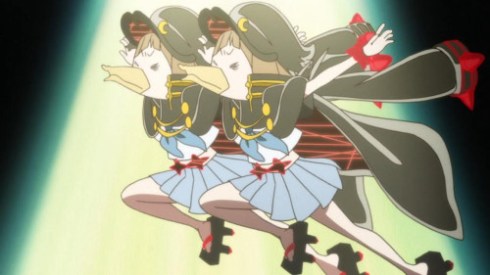
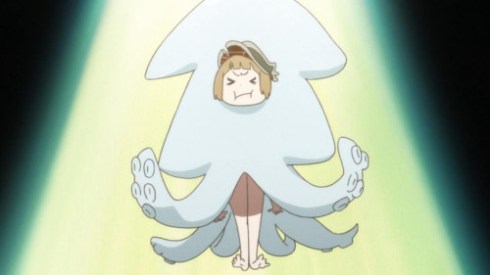
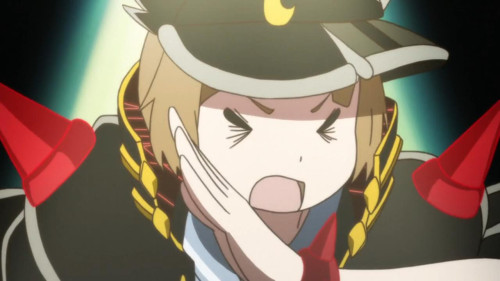
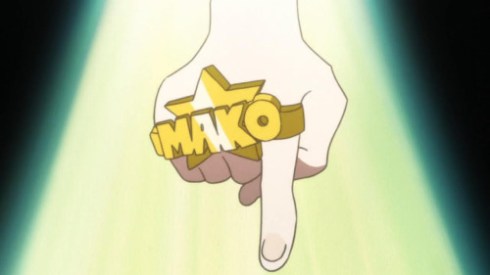
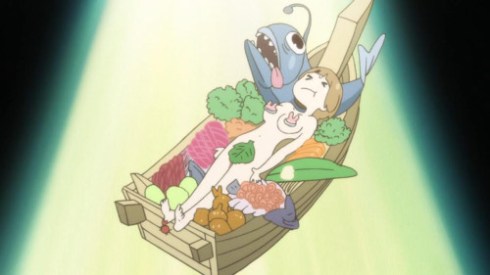
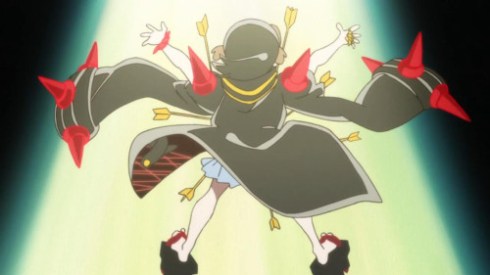
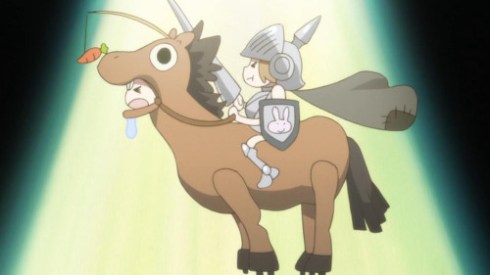
Mako in Episode 23 of Kill la Kill gives a speech where she exclaims, “But I can’t be beaten here! I have to protect this ship!” The visual accompaniment actually consists of a rapid-fire sequence of puns, which I thought I’d break down here.
1) “But I can’t be beaten here!”
Koko de taoreru wake niwa ikanai mon!
Taoreru can mean ‘”to be defeated” but it’s also used when saying someone has fallen ill or worse. Mako is posed as if she were a corpse.
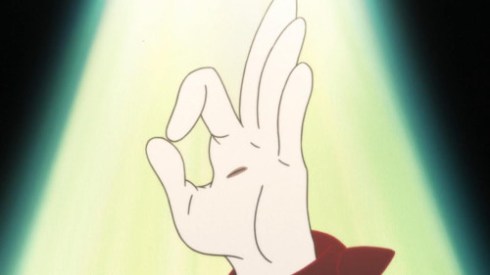
Wake is broken up into its syllables: wa (輪) means ring, hence the loop made with her fingers, ke (毛) means hair.
Niwa is represented by Mako dressed as two birds because niwa (二羽) is how you count two birds.
Ika means squid (烏賊), a familiar pun for all you Squid Girl fans.
Nai is used as a negative conjugation in Japanese verbs, so we get the familiar image of Mako shaking her head. Ikanai means cannot, but more in the sense of “I musn’t.”
Mon is a way to emphasize one’s emotional investment. Mako is posing in the shape of the kanji 門, pronounced mon, which means gate.
2) “I have to protect this ship!”
Kono fune mamorenai to
Kono means “this,” Mako is pointing down at “this.”
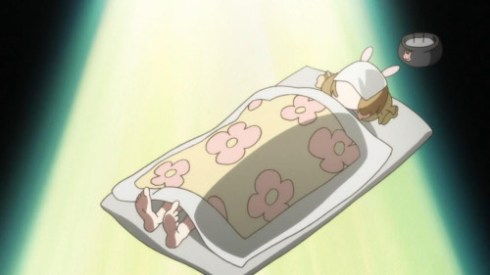
Fune means boat, Mako is in a sushi boat, simple enough.
Mamorenai to means “have to protect,” which is split up into mamore, “protect,” and nai to, which is also how you pronounce “knight” in Japanese.
Name: N/A Alias: Hoshino Rei’s Senpai in Life (星野 れい人生の先輩), Beret Adventure Club (ベレー帽冒険部) Relationship Status: Dating Origin: Tonari no 801-chan: Fujoshi-teki High School Life
Information: The unnamed girl referred to by fujoshi Hoshino Rei as her “Senpai in Life” is an experienced doujinshi artist who regularly attends events while also dispensing advice for Rei. At one event, Rei, along with Rei’s acquaintances, help her to sell her entire stock.
Fujoshi Level: Little is known, other than that Hoshino Rei considers her to be a stronger and wiser fujoshi.
This post is about a week late to the “Kill la Kill episode 22 was awesome” meeting, but Kill la Kill episode 22 was awesome. As far as I’ve seen, this has been the general consensus among fans of the show, and it’s no surprise given the fact that many of the show’s narrative threads reached their turning points in this episode. While 22 was packed with a ton of impressive moments (like the Evangelion reference with Ryuuko hunched over and covered in blood like EVA-01), I’d like to talk about ones that I enjoyed in particular.
1) The Glory of Mako and More
The return of Fight Club Mako will forever be one of the glorious highlights of Kill la Kill, but in that triumphant return there is also a serious Ira x Mako moment. I’ve been a fan of that particular pairing and of course as the show has progressed it’s turned very real and I’ve enjoyed every minute of it. While people will talk about the fact that Gamagoori eats Mako-shaped croquettes in the episode as the Ira x Mako moment of the episode, I actually turn to Fight Club Mako’s appearance instead.
At the end of the episode, the heroes are attacked by a giant COVERS monster when out of a sky drops a dresser. As we know now, Mako in her banchou outfit is in there, but how does she introduce herself? Mako’s over-sized fist comes flying out of the dresser door and socks the giant monster, a feat of comedic spatial distortion the show normally associates with Gamagoori.
You can keep your croquettes.
2) Satsuki’s Radiance
In episode 22, Satsuki finally comes clean with her entire plan, and how she intended to use Ryuko as an x-factor in her rebellion against her mother’s global domination scheme, but realizes that manipulating others to serve her needs was the wrong way to go about it. Satsuki then apologies and takes a deep bow (the lower you go, the more humble and respectful you’re being, see Barack Obama), and then begins to emit a blinding light.
One of the visual icons of Satsuki throughout the series has been her literal radiance. When Satsuki appears, a blinding light shines forth from her, as if to say that she is simply that much more amazing than everyone else around her. It is as much a part of her character as her indomitable will and her giant eyebrows, but when you think about it, it hasn’t been around for quite a few episodes. To have the moment where Satsuki sets aside her pride also be the point at which she is at her most brilliant encapsulates the character so wonderfully that in an episode of great things it’s an absolute high-point.
In other words, to see the visual style of Kill la Kill match up so well with its narrative is just a rewarding experience.