Why the Little Sister is an “Osaka Mama” is a Little Sister

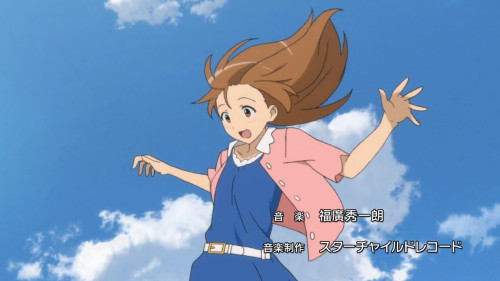
Boku no Imouto wa “Osaka Okan”, or, My Little Sister is an “Osaka Mama” is an odd anime. Ostensibly about a younger sister who grew up in Osaka having to move back to Tokyo, this (sparsely animated) show is actually a way of showing various cultural differences between the two cities. It’s a funny little series, with the ever-changing ending theme based on the events of each episode being a highlight, but what I find especially funny about this anime is its origins.

Boku no Imouto wa Osaka Okan actually comes from a series of books designed to educate people about Osaka customs. The first book, Osaka Rules (as in “to live by,” not as in “Hulkamania”), is itself part of the Rules series for various parts of Japan. It was followed by Osaka Okan, which was designed to help people marrying into Osakan families to understand and deal with their in-laws better. What this means, then, is that the “little sister” component was added specifically for the anime, as if to try and capitalize on current otaku trends. I certainly can’t think of any other reason.

There’s something unbelievably shameless and perhaps even tongue-in-cheek about this that I can’t help but clap in admiration rather than hang my head in shame. Sure, little sister-focused stories are a dime a dozen in light novels, but what if the scope was widened in the way that Boku no Imouto wa “Osaka Okan” has shown us?

My Little Sister is a Forbes 100 CEO

My Little Sister is Doing a PhD on Molecular Biology

I Discovered My Little Sister is an Excellent Game Show Host

I Can’t Believe My Little Sister is the Catalyst for a Proletariat Uprising

The possibilities, as they say, are endless. I’m also aware that this sort of parody joke exists already, but I think the key difference is that the little sister component should appear deliberately grafted on, rather than being the axis upon which an anime revolves.


By the way, this show is from the gdgd Fairies people so you know it’s good.

I Seriously Can’t Believe No One’s Made This: One Punch

onepunchman-guygardner-small

On JManga’s Closure, and the Movement of People and Technology

JManga, the digital manga service backed by a number of Japanese publishers, is shutting down. No more points may be purchased, and all titles will be taken down by May 30, 2013. Any remaining points on users’ accounts will be refunded to them in the form of Amazon Gift Cards.

JManga, unlike so many other official manga sites, was at least partly accessible in regions outside of the US, and it was for this reason that I initially supported it in spite of its initial convoluted pricing scheme. Eventually, they changed the pay format to something a little more enticing and easy to understand, but when a friend told me that he wished he could purchase a title that was already on JManga, it made me realize just how unknown the site was. I tried to do my part and encourage others to use JManga, but for one reason or another it apparently wasn’t enough. It’s a shame, because I think they really made some excellent strides in getting manga to a digital format, even if their reader left something to desire in terms of functionality and ease of use.

The news of JManga’s impending demise brought up conversations about piracy and users’ rights that is affecting industries well beyond manga at this point (the Sim City server problems being currently the most prominent), and one of the arguments being made is that it’s in the end the fault of scanlations. I have a problem with this. While I don’t doubt that scanlations impact sales, especially when it comes to the popular titles, the fact is that none of the manga on JManga were heavy hitters. Their famous titles were things that simply don’t sell too well, like volume 1 of Golgo 13. I believe their most successful manga was Soredemo Machi wa Mawatteiru (some of which I purchased and am kind of miffed that it’s going to vanish in a couple of months), which to put it lightly is not a Naruto or a Sailor Moon.

The lineup at JManga was extremely esoteric, and while this had a great amount of appeal for me personally, I’m also aware that the average manga fan, whether they read free manga online or not, is not going to chomp at the bit to go read about a Heian era fujoshi (another purchased title I will miss). Essentially, the titles on JManga were so out there that for the most part they were not the things people would look to scan and distribute, so the traditional argument of piracy doesn’t really apply here. Also, JManga was apparently shackled by the fact that publishers would not hand over their A-List titles. Tokyopop tried the flood of mediocrity approach as well, and that didn’t go so well in the end. While it is possible to say that fans should have subscribed anyway in order to give JManga the opportunity to go after the big titles, as Narutaki over at Reverse Thieves and the Speakeasy podcast pointed out, you can’t expect people to pay money in the hopes that they might someday get the titles that they want, especially if they’re from wildly different genres and demographics.

I could see it argued that manga scanlations created the environment which made publishers fear handing over their major titles, and by extension was the cause for JManga’s demise, but I think this would be overlooking the fact that media companies tend to be conservative about trying out new platforms until they absolutely must. HBO’s business model, for instance, is based on subscriptions to their premium cable service. This is fine and all, but it turns out that people who only want to watch online (legally, mind you) must also buy cable and HBO anyway. Media companies, if they can help it, will dig their feet into the ground to the point that they pretty much have to be dragged kicking and screaming to evolve alongside their potential customers’ habits. As a classic example, would the music industry have even bothered with digital distribution and the mp3 format if something like Napster hadn’t forced them to do so?

This is not me defending piracy as some kind of noble endeavor, but merely making the point that if scanlations did not exist and were not so ubiquitous, then I highly doubt that Japanese manga publishers would have simply decided to put manga online “just because.” In other words, to say that JManga would have been fine had readers of manga behaved all along is I think a flawed argument because there’s a good chance we wouldn’t even have sites like JManga or J-Comi. Valuing creative talent and creative output is still important, but defining that value according to current conventions and blindly accepting the current distribution methods (or lack thereof) is problematic itself. That’s not to say that one must rebel against the system in order to “save manga” or “stick it to the man,” but it would be beneficial to acknowledge where it is flawed, and to also not put blame squarely on the shoulders of readers, especially when the site was not giving them what they want.

Pavlov’s Anime Blogger

After more than a year of intentionally delaying it so as to not use up my supply of excellent magical girl anime, I’ve begun Mo~tto! Ojamajo Doremi, the third series in the Ojamajo Doremi franchise.

As I was watching one episode, there was the standard stock footage of one of the girls using magic, which starts off by showing a closeup of a music-playing magic wand. Before the show even revealed on-screen which girl was casting the magic, I thought, “Oh, it’s Aiko,” the tomboy character from Osaka. Moments later as Aiko appeared, I wondered to myself, how did I figure that out?

Upon re-watching, I realized that the signal to indicate Aiko was the music playing from her wand, which mimics a harmonica. Each of the characters in Doremi have an instrument associated with them, so in hindsight this is a rather obvious part of the show. As mentioned before, however, I hadn’t watched any Doremi in quite a long time, so it felt more like an unconscious response. I had watched enough of the show to absorb its elements into my psyche, and that “conditioning” showed up in this instance.

By the way, Doremi is a really fantastic show, and I wrote a review of the first series. If you’re wondering why there isn’t a review of the second series, it’s because pretty much everything I say about the first series more or less applies to it as well.

The Fujoshi Files 67: Rinbara Megumi

Name: Rinbara, Megumi (林原恵)
Alias: Buchou/President (部長)
Relationship Status: Complicated
Origin: The Manken Club, Like Whirlwind and Surge Waves!!

Information:
Rinbara Megumi is a second-year student and the president of her school’s manga club, though somewhat irresponsible. She is comfortable with using her body for personal gain.

Fujoshi Level:
Rinbara depleted the Manken Club’s funds by buying nothing but yaoi doujinshi.

Gattai Girls 3: Rinne no Lagrange – Flower Declaration of Your Heart and Kyouno Madoka

Introduction: “Gattai Girls” is a series of posts dedicated to looking at giant robot anime featuring prominent female characters due to their relative rarity within that genre.

Here, “prominent” is primarily defined by two traits. First, the female character has to be either a main character (as opposed to a sidekick or support character), or she has to be in a role which distinguishes her. Second, the female character has to actually pilot a giant robot, preferrably the main giant robot of the series she’s in.

For example, Aim for the Top! would qualify because of Noriko (main character, pilots the most important mecha of her show), while Vision of Escaflowne would not, because Hitomi does not engage in any combat despite being a main character, nor would Full Metal Panic! because the most prominent robot pilot, Melissa Mao, is not prominent enough.

Rinne no Lagrange – Flower Declaration of Your Heart (2012) is one of the most recent titles to qualify for the Gattai Girls series. Comprised of a galaxy-spanning war affected by the portrayal of the everyday lives of a select few characters, the approach that Rinne no Lagrange takes is fairly indicative of contemporary non-franchise giant robot anime and the tendency for plot to revolve primarily around individuals and their emotions.

The main heroine is Kyouno Madoka, an endlessly energetic teenager living in the city of Kamogawa. Always seen helping around the city while clad in a track jersey, Madoka inadvertently becomes the pilot of the ancient robot Vox Aura, spoken of in legends of destruction, she also becomes involved in a war between the two faraway planets Le Garite and De Metrio.  Madoka manages to befriend a girl her age on each side of the conflict, Fin E Ld Si Laffinty (aka Lan), princess of Le Garite, and De Metrio representative Muginami, inspiring change in both alien girls to move towards peace for their peoples.

When I say that the daily lives of the characters affect the overarching story, what I mean is that Rinne no Lagrange literally spends episode after episode primarily focused on the three girls’ deepening bonds to the point that its pacing can come across as slow and uneven when one can argue that there’s development of the universe to be had. The show does make an effort to establish the science fictional aspects of the story and the origin of the conflict between the two planets, and the robots themselves have an interesting aesthetic that approaches to a small degree the same sense as the Motorheads from Five Star Stories, but a more prominent and fundamental theme of the anime is how Madoka the simple local girl can literally change the universe through a never-say-never attitude.

Madoka’s incredibly infectious spirit and a willingness to work hard for herself and others is probably the biggest draw of Rinne no Lagrange. Fueled by energy drinks, her philosophy in life is something along the lines of “If you give a man a fish, he’ll eat for a day, and if you teach to fish, he’ll eat forever, but if you do both then it’s perfect.” Madoka is perpetually strong, the sort of character who is not entirely without flaw, but who is practically designed to be a walking, talking inspiration generator. Madoka’s strength both physically and mentally are not because she’s a girl or in spite of being a girl, but more having to do with her love for her city, a topic removed from debates about the role of women. Also, in the first episode she uses her robot to German suplex the enemy into submission.

In looking at the other girls, Lan and Muginami (who are both pilots of legendary machines themselves), their place in the story is clearly an active and important one, though they’re also designed strongly along popular character stereotypes. Lan is a mostly stoic blue-haired noble girl clad in a skintight suit who’s clumsy and easily embarrassed, while Muginami is clearly the ditzy big-boobed blonde type. The two manage to flip some of these conventions to a certain degree, such as the fact that Muginami’s airhead personality is clearly just an act, but they also show a great deal of loyalty to their “big brothers” while their friendship with Madoka provides a prominent yuri subtext for the series. While the show isn’t absolutely about yuri, it’s also obvious that Rinne no Lagrange encourages the viewer to read into it that way if they should so choose, provided plenty of reasons to do so. This isn’t an indictment of any of the elements discussed, but rather a reminder that this show is indeed about the closeness of its main heroines before it’s about giant robots.

I know it sounds a little strange to be saying this about an anime that came out just last year, but Rinne no Lagrange really feels like a product of its time. The way it de-emphasizes some of the more traditional elements of a giant robot anime of favor of “possibly yuri friendship adventure” is also suggestive of the heavy character-as-icon and moe styles of anime that have been a big trend for the last ten years or so. However, while its female characters cater to the viewers a good deal, the three heroines also establish themselves strongly, with Madoka herself and her boundless attitude creating the strongest impression.

(Last note: the show has a fantastically addictive opening .)

The Function of AKB48 Songs in AKB0048

The anime AKB0048 asks a simple question: “What if the J-pop AKB48 was in the future and its members fought with light sabers?” Essentially another marketing platform for an already extremely popular band, the anime uses a lot of existing AKB48’s songs, most of which are fluff pieces about falling in love or being young girls. The songs are part of their image and have factored into their popular and financial success, but within the context of AKB0048, I find that these same pop songs start to carry a different meaning.

AKB0048 takes place in a future where mankind has colonized space, and during which a movement to ban all entertainment and performance has grown increasingly strong. Successors to the “legendary AKB48,” the girls of AKB0048 fight in order to protect people’s rights to rock out, and in this setting the songs of AKB48 are near-ancient “relics” passed down through the generations. No longer acting as the supposedly genuine expression of young girls’ thought and feelings, the songs are “weaponized” within the context of a guerilla movement to restore entertainment in the universe. The songs act more like representative anthems of a better world, not so much in the actual lyrics, but in the way they promote the right to have lyrics so light and fluffy.

AKB48’s songs in AKB0048 act as symbols of change, revolution, and renewal. This is even more apparent when looking at the songs made for the anime. Compare the lyrics below:

First is “Heavy Rotation,” a popular preexisting AKB48 song used frequently in the anime:

I want you!
I need you!
I love you!
The blaring music
Playing in my head
Is on heavy rotation

The words “I love you” dance
Like popcorn
Popping
Just thinking
Of your face and voice
Makes me go crazy

I’m so lucky
To get to feel like this

(translation taken from Kiwi Musume)

Now compare it with “Dreams Will Be Reborn Again and Again,” the 1st ending theme for AKB0048:

The stars shining in the night sky
are billions of light-years away
Even if the deep despair
turns into endless darkness
The truth will be passed on
Who will be the one to accept
its message of light
that is entrusted to the flow of time?

People will be born
People will die
The flesh is mortal
What resurrects
from its ashes
is passion
that goes to the next generation

(translation taken from Words of Songs)

The lyrics writer for all of the AKB48 songs, as well as “Dreams Will Be Reborn Again and Again” is the famed AKB48 producer Akimoto Yasushi, so it’s not like AKB0048 is divorced from the creative forces which govern the actual band. Suffice it to say, however, the songs from the “future” seem cut from a different cloth than their predecessors, and this changes the meaning of “pop idol group,” at least for the anime.

It is difficult to regard the fictional group AKB0048 as simply girls who desire fan support within a specific section of the music industry. The girls begin to embody values beyond music, youth, and sexuality, such as social and political potential. Granted, this isn’t too surprising, seeing as the man directing AKB0048 is the creator of Macross. Kawamori Shouji has decades of experience in creating anime about pop idols changing the world, though I actually feel that the usage of pop music in AKB0048 surpasses Kawamori’s more established work because of the more thorough incorporation of the very idea of popular music into the anime’s narrative.

With the criticism and controversy surrounding AKB48 as a pop idol tour de force and all that it entails, the existence of AKB0048 is a curious thing. Is it in support of that system, does it go beyond, or does it sit somewhere in the middle? Is the “ideal” of AKB0048 different enough from the constructed space of AKB48 that it can be considered something more?

Jaoh Shingan: Genshiken II, Chapter 85

It’s back to basics in Genshiken II, Chapter 85 as  Sue, Yoshitake, and Yajima revive the old Genshiken tradition of spying on club members who think they’re alone. When it looks like Hato is getting unusually close to Madarame. Right when things seem to be getting to the point of no return, in comes Keiko, who quickly deduces that Madarame’s decision to quit his job comes from a desire to regress back to his old self now that he’s been rejected by Saki. When Keiko suggests that Madarame come to her Cabaret Club to “get dirty,” Sue interferes and inadvertently makes it known that they were being watched. An embarrassed Hato runs home, only to be met by Sue as the chapter ends.

The more I write these reviews, the more I worry that my constant references to the old chapters may be unfair to the new series. Perhaps if I engage the current Genshiken on its own terms, I’ll be able to do it justice. At the same time, I do actually feel that many of the ideas being explored in Genshiken II have their roots in the original manga, and that the new characters allow for a more complex elaboration.

Back when Ogiue’s own main storyline resolved, the message was one of acceptance. So what if others find your tastes weird? You’re who you are. While such a conclusion fit perfectly for Ogiue’ character, the question of whether the border between fantasy and reality is airtight or porous wasn’t answered to any great length. Not that it needed to be, but if we accept acceptance and remove moral and value judgments from the equation, how complex can that interaction be? This, I believe, is what is happening with Hato and his interactions with Madarame. Hato can go where Ogiue never could.

Hato is clearly emotionally confused in the current story, where everything he thought he knew about himself is being thrown into question. I don’t get a sense of a fear of homophobia from his situation, but that he is having trouble establishing the distinct barrier between his male self and female guise and that it means he doesn’t understand himself anymore. The breakdown hints at the power of imagination, of how we see and define ourselves, and invokes the idea that, while sexuality isn’t a learned behavior, that learning provides additional information for reflection.

Once again, if we go back to Ogiue, she once stated that the Sasahara of her yaoi fantasy is clearly different from his real self, but she also clearly enjoys and is even turned on by Sasahara when he role plays his imaginary “Strong Seme” self. For Hato, who not only includes a form of Madarame in his yaoi fantasies but is also becoming increasingly good friends with him, he almost provides a powerful thought experiment whose solution can’t be as simple as “he’s gay,” even if he turns out to be.

Something I find particularly interesting about Madarame’s portrayal in this chapter is the focus on his neck. The current Madarame looks different from when he was in college, and this is shown most overtly in his change in hairstyle, but when viewed up-close from behind, he still looks the same as he always had. Given that in this chapter he basically admits to wanting to regress, and the fact that Sue, Yoshitake, and Yajima did the old spying trick, I can’t see this callback as unintentional.

Keiko continues her role as a kind of substitute Saki in her own unique way. By that, I mean that where Saki has a natural pragmatism about her that Keiko lacks, Keiko seems to make up for it with sheer (mistake-filled) experience. I almost get the impression that her experience working at a cabaret club is actually increasing her perception skills far beyond what they already were, which even back when she was still attending college were still quite sharp (she’s the one who immediately noticed the sexual tension between Sasahara and Ogiue). I really can’t tell if Keiko is actually into Madarame or not, though the reveal that she’s been purposely mispronouncing his name as “Watanabe” the whole time says something. Even if Keiko is curious about Madarame, though, I can only see her interest being short term, even more than Angela’s.

As for the general idea of the “Madarame harem,” I think that it’s only a name. Take Sue, who both this chapter and last chapter was caught blushing in front of Madarame. The most obvious interpretation is a crush, but why did Sue stand back and watch when it looked like Hato was putting the moves on Madarame, but interfere when it looked like Keiko was about to do the same? For that matter, why did Sue interfere with Angela back when she was trying to get into Madarame’s pants? Given her appearance at Hato’s door at the end of the chapter, we’re probably going to find out more, but wish fulfillment fantasy with Madarame at the head this is not.

I am curious as to where Sue (who was super cute this chapter) is going. Is she going to get some real character development? She did start off as a kind of larger-than-life super fujoshi from another country, and to humanize her may either be an amazing decision or a terrible mistake. I have faith, though.

The last thing I want to point out is the significance of the Children’s Literature Society member we see in this chapter. In the past, that club was clearly on good terms with Genshiken given the whole spying thing, but I got the impression they were not exactly into anime and manga. The fact that this particular fujoshi chose to be part of the Children’s Literature Society in spite of the presence of not only Genshiken but also the Anime Society and the Manga Society (which has a large fujoshi contingent) has a connection with the recurring theme of  the generation gap between otaku that primarily manifests in the mainstreaming of the otaku and the rise of the fujoshi. The otaku are not limited to the clubs that are meant for them, which I think says a lot.

As for Ogiue ending the spying thing, it only makes sense given that she was already the victim of it in more ways than one.

Energy Girl

Straight Title Robot Anime, or, MIKUBAIN: LET’S GET SILLY

In a previous post, I had likened the bizarre 3dcg anime gdgd Fairies to an Adult Swim cartoon. I still think it’s an apt comparison, and with the new season currently running this only renews my confidence in that description, but what I hadn’t expected was for there to be another anime like gdgd Fairies, especially not one that’s themed around a giant robot future. This isn’t so surprising once you learn that it’s from the same creator as gdgd Fairies, but what’s impressive is that in some ways this new show’s humor is even more absurd.

Straight Title Robot Anime (yes, that’s the title) takes place in a time when humanity has gone extinct and only giant robots are left to fight an eternal war. Living on this Earth are three human-sized female robots who are trying to stop the war by re-discovering mankind’s great invention: humor. In order to accomplish this, they try to figure out what it means to tell a joke and induce laughter, but the concept is so foreign to them that they’re unable to make any headway.

In other words, this anime is actually all about trying to explain jokes, which is classically regarded as humor’s own kryptonite, but amazingly this just makes the whole premise funnier. It’s also animated entirely in the free program Miku Miku Dance, which was created for just the purpose its name implies (animating Hatsune Miku).

If it wasn’t obvious that this show is from the same mind as gdgd Fairies from, the fact that there’s an “improv” section similar to the fairies’ own “Magical Spring Dubbing Lake” should be more than sufficient evidence. In it, the three robots visit simulations of “ancient human locations,” such as a hardware store, and try to figure out uses for the objects found. I’m not sure how they accomplish these scenes, but I imagine it actually involves them gathering materials from those real-world places and then having the voice actors engage in prop comedy. Here, not only are the voice actors unable to keep up their acted roles and break down into their normal voices, but one character goes from having a very artificial BEEP BOOP I AM A ROBOT voice to having a natural cadence which not even an electronic voice distortion can fully hide.

Most telling of all is the fact that, despite the show being premised around the idea that the robots do not understand what it means to laugh, the robots in this sequence are giggling constantly. The narrator nonchalantly explains this as “interference,” invoking that old Mystery Science Theater 3000 mantra, “It’s just a show; I should really just relax.”

So that’s Straight Title Robot Anime. In my opinion, the humor isn’t quite to the level of gdgd Fairies yet, but its appeal is such that if you liked gdgd Fairies you’ll probably enjoy this too. However, if your only response to the fairies was revulsion then this show won’t help either. These really are both love it or hate it shows, as is evident from the comments both anime received. You can experience Straight Title Robot Animegdgd Fairies 2, and the angry comments these shows tend to get, on Crunchyroll.