Information: Ameya Yuiko is an older woman dating a younger college student named Mutou Taiga. Ameya enjoys teasing him on a regular basis by showing him yaoi and referring to him as “Sebastian” (Sebas) while having him make tea. Preferring uke characters, she sees Mutou as one as well. Ameya works as an Office Lady, a job where she must frequently fend off the advances of her boss.
Ameya has a close circle of fujoshi friends, including Masana and Sachi, as well as Seto Akari. She is particularly fond of the shounen series Sepatte Takuro, about the Malaysian sport of Sepak Takraw.
Fujoshi Level:
Once, when Yuiko was ill, she tried to convince her boyfriend read BL to her as if it were a bedtime story.
Gargantia on the Verdurous Planet is probably my favorite show of the spring season. It has a very strong science fictional feel without constantly, constantly delving into exposition, and it has some interesting narrative themes too, as well as ways of expressing those themes. It also has a strong cast of characters through whom the world is experienced, and the excellent design of the robot Chamber also doesn’t hurt. Episode 11 in particular caught my interest, so I’d like to discussi t.
In episode 11, Ledo’s superior officer Kugel returns. Initially disappearing in episode 1, Kugel turns out to have been on the other side of the planet, where he has basically become the god of a people over there. Using the philosophy of the Galactic Alliance, Kugel moved their way of life away from a familial/religious structure and more towards a stratified meritocracy. This is, of course, quite different from Ledo’s own experiences.
Key to this difference is the reveal that, due to an endemic disease, Kugel cannot leave the sterile environment of his own cockpit. Although this decision is clearly practical in many ways, it also sets up the idea that the cockpit of his Machine Caliber is a bubble, not only physically but also ideologically. Because Kugel is unable/unwilling to leave the safety of his environment, he never had the chance to experience firsthand the way of life of the people who now worship him, nor for their philosophy to “contaminate” him. Even though he’s basically a good person (as can be seen when he saves Ledo in episode 1), Kugel continues to follow the hard line of the Galactic Alliance without flinching.
I think it’s a really nice piece of symbolism, and what I especially like about this development is that it’s sort of the “war comes to Earth” theme which seemed very likely from the start, but in a different sense. With Kugel, Gargantia, and then Ledo in the middle, it’s more of a clash of ideas and perhaps even a postcolonial criticism of the idea of bringing “civilization” to other cultures.
Recently I read two manga with very similar conceptions, I’ll Make You into an Otaku, So Make Me into a Riajuu and 3D Kanojo (also known as “Real Girl.”) Both are based on the concept of an otaku guy and a fashionable girl forming a friendship (or something more), but the messages they convey, at least from what little I’ve read, are significantly different. In particular, the way Otaku Riajuu handles its female lead is pretty embarrassing, and highlights a lot of things wrong with whatever mindset produced the story, and for which 3D Kanojo provides a better alternative.
First things first, there are some differences in the setup of each. Unlike 3D Kanojo, which is about the budding romance between the otaku guy and the fashionable girl, Otaku Riajuu is similar to Toradora! in that the two leads are at least initially trying to help each other to get together with someone else. Other similarities include the fact that the girl is tiny and feisty, much like Taiga. Toradora! is pretty great, so that’s not so bad in and of itself, but there’s more to it.
In Otaku Riajuu, the girl, Momo, has a reputation for sleeping around a lot. The guy, Naoki, upon becoming aware of this, basically wants nothing to do with her. He thinks of her as a “bitch” (in Japanese context, the term veers closer to “slut,” see Panty in Panty & Stocking with Garterbelt for a prime example), and therefore wants nothing to do with her. A pretty messed up opinion to be sure, but then when he find out she’s actually uncomfortable around guys and clearly can’t be the bed crusader the rumors make her out to be, then he gets along with her a lot better.
Think about it: Naoki doesn’t like her when he thinks she’s a slut, but when he finds out otherwise everything’s “okay.” I’m not one to throw out the term “slut-shaming” liberally, and in fact this is the first time in the history of the blog that I’ve even used it, but it is literally the main character looking at a girl with disdain for being sexually active. The fact that we’re supposed to think Naoki the poor closet otaku is a Good Guy for changing his opinion of her after he learns the truth makes it even worse.
3D Kanojo on the other hand establishes that its female lead, Iroha, actually does sleep with a lot of guys, but doesn’t make the concept itself an inherent minus other than the fact that she has to deal with a lot of angry former lovers. Here, although the male character Hikari, being an awkward otaku virgin, is uncomfortable with the way Iroha is, the series seems to be more about their budding romance both in spite of and because of their differences. Hikari is also a nice guy in that he tries to save Iroha from a couple of angry suitors and gets so nervous when she invites him to have sex that he ends up avoiding it, but it’s clear he sees her as a person neither in spite of or because she’s sexually active.
I think a lot of the reason for this difference is just the intended demographic. Otaku Riajuu is based on a light novel, and aims for that male otaku market. Although not always the case (and not something exclusively otaku or Japanese), a valuing of virginity and purity by way of moe aesthetic is very clear and obvious here, and the strange idea the manga has about what it means for a guy to be “nice” likely stems from this. 3D Kanojo however is a shoujo manga, and this can be seen in the male lead who has a smattering of “gentle, ideal boyfriend” in him. He’s awkward around girls, but that’s what makes his attempts at heroics all the more charming. It also goes a long way in explaining why Iroha is written in a more well-rounded manner.
I’ve only read a bit of each, so I can’t say for sure if my opinions of either title would change down the road, but for now I’d have to say that 3D Kanojo is clearly the better title. The differing approaches to the popular girl character used by it and Otaku Riajuu do not form the entirety of my reasoning for recommending one over the other, but I think they give a good indication anyway.
It’s taken a while for Japanese publishers to get anywhere close to the idea of free online manga, but we’re finally getting somewhere. There’s Grand Jump (from Shueisha, the same publisher as Shounen Jump), which releases a few of their titles online every month for a limited time, and the decently popular Onepunch Man comes from another Shueisha site, Tonari no Young Jump. Now, while One Punch man gets all of the attention, I do want to point to a different title on there I enjoy, the 4-koma manga f ningyo, by G3 Ida.
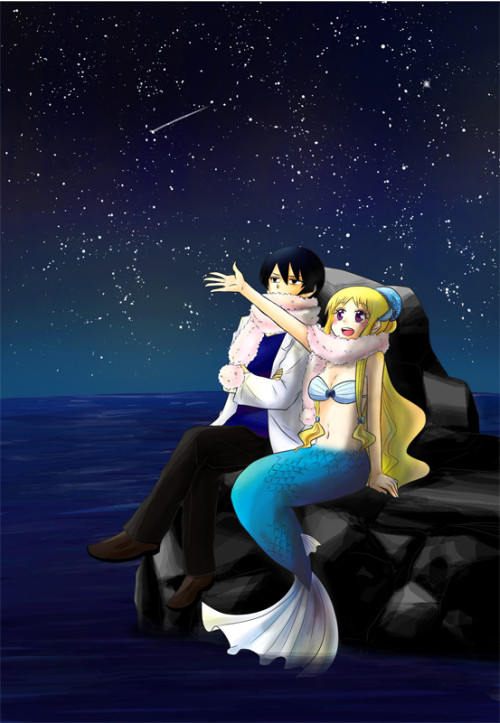
It’s a comedy about a fujoshi mermaid.
More specifically, it’s about a mermaid named Mero whose only conception of the human world comes from yaoi manga, so to her the surface is just teeming with guy on guy action. She’s discovered by a marine biologist named Tsubsa Reiji who’s far more interested in fish than women, and in order to keep this research a secret he tells everyone that she’s his girlfriend (her fins turn to feet when away from water for prolonged periods). The two other recurring characters are the scientist’s student, and his childhood friend, whom the mermaid sees as the scientist’s lover and a fellow fujoshi, respectively. Given the white lies and misconceptions on their parts, the foundation of the series’ humor comes from everybody misunderstanding each others’ words and intentions, sort of like Minami-ke. When she first introduces herself to Reiji, Mero tells him that she’s clearly not human because she has no balls.
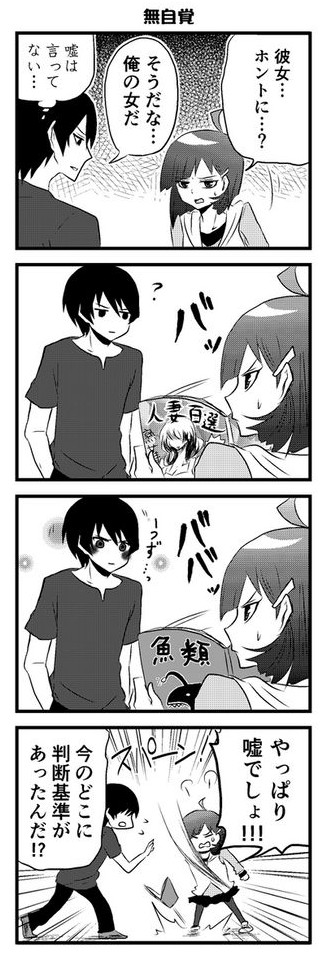
Even though the fujoshi-based humor is funny, two of my favorite jokes from the manga don’t even really have to do with that angle. The first is when Reiji’s friend, who has a crush on him, is extremely suspicious of his claims that the beautiful girl in his office is his girlfriend and decides to test him. She shows him a porn magazine, zero response. Then she follows up with a magazine about aquatic life and he immediately perks up.
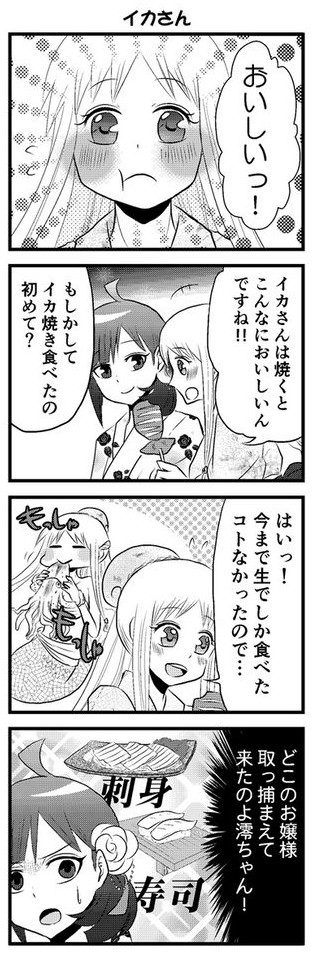
The second is when they’re all out at a festival, and the mermaid gets the chance to eat some fried squid. Being from the sea, she remarks that she’s only ever eaten raw squid before (which she would literally catch and bite into live), but the friend misinterprets her words as those of an incredibly well-to-do woman of luxury, i.e. “I only ever eat squid sashimi.”
Unfortunately, I think this manga has a lot less chance of being released in English like One Punch Man has been. That said, it is the second most popular manga on Tonari no Young Jump, so maybe there’s hope after all.
Nintendo just revealed the new Super Smash Bros.today at E3, and the Villager from Animal Crossing as well as Mega Man have been confirmed as characters.
Next to NiGHTS, Mega Man was my #1 wish for Smash Bros. (and putting in a character more flight-themed than even Pit is a tall order), so I am super, super hyped. Sure, the Sonic reveal from Brawl was cool in that we got to see that console rivalry materialize in a way which was not some game about the Olympics, but Mega Man is a bigger deal to me.
We know nothing about the balance or the depth of the game outside of the fact that it seems to not be wildly different from its predecessors, so obviously this isn’t based on how great the new Smash Bros. is. Rather, it’s because Mega Man as a series is very precious to me, a piece of my childhood.
While NiGHTS into dreams… and Pokemon taught me all about being a part of a fandom, I think it was actually Mega Man which first taught me how to be a fan. By providing an exciting world with a clear template for personal input, the Robot Masters, the series allowed me to exercise my creative imagination as young as the age of 4. I still remember Cockroach Man and Glue Man to this day.
There’s a bit of information about his moveset from the trailer: He has his slide, Charge Shot, and Rush Coil, as well as the ability to access moves from a variety of Robot Masters from his own franchise. Exactly ow many weapons are available is unclear, but it looks to be quite a bit more than, say, his entry into Marvel vs. Capcom 2. Even if we didn’t know that, however, there’s something about Mega Man which makes him easy to imagine in Smash Bros., even more than in his other fighting game appearances. The run speed, the jump height, the various interactions of his attacks, it all makes sense. Perhaps the only disappointing thing is that he can’t absorb other characters’ powers it seems, so no Mega Kirby vs. Kirby Man.
I don’t have a Wii U or a 3DS yet, but this may be my incentive. Well, that and Pokemon X/Y.
Information: A blogger and housewife, Sachi is fortunate to have a husband who is accepting of her hobby. Called Sacchin by her friends Yuiko and Masana, she is a hardcore seiyuu otaku who tries to buy everything voice actor-related that she possibly can. Sachi has the ability to recognize any voice actor in any role, and is particularly fond of the seiyuu Kubokouji Akira.
Fujoshi Level:
Sacchin listens to BL drama CD’s while doing the dishes and the laundry, even when her husband is around.
The pasttwo years, I’ve attended the Dutch anime con, “Anime Con,” but this year I decided to mix it up a bit and go primarily to the Dutch Starcraft League Finals, which was happening as a part of the Anime Con. It was a fun event, and I got to meet such great personalities as Madals,Kaelaris, and even German champion Hasuobs, who was actually there not for the tournament but for the anime con. Also of course congratulations to the winner Harstem, who managed to upset in the finals with strong Dark Templar play.
One weird thing about the event was that the cameras broadcasting the event had a tendency to fixate on cute girls (especially if they were in cosplay), as if to say, “Hey, girls watch this too! Isn’t that amazing?!” The funniest thing to come out of this was the fact that the camera would focus on one female cosplayer so much that it failed to actually notice that the guy she was with was Hasuobs.
As it was a Starcraft tournament at an anime con, I thought it only appropriate that I quickly make some cheerfuls combining both hobbies together.
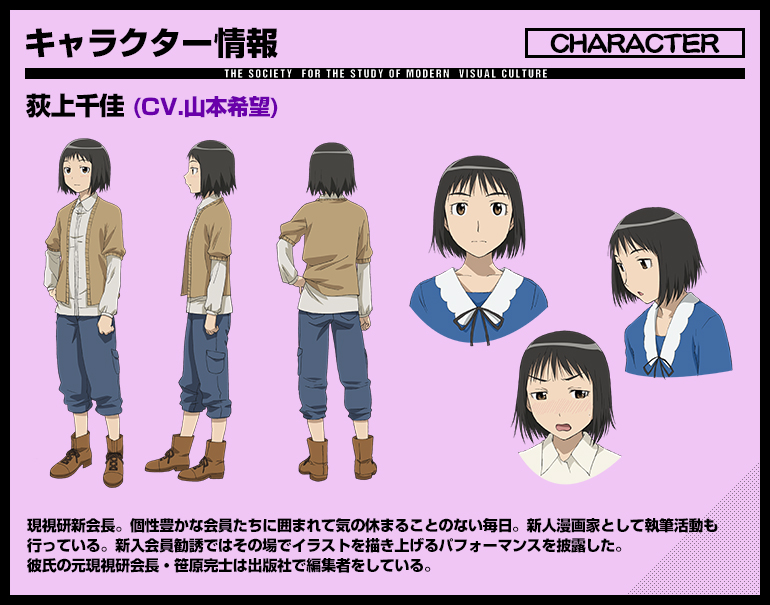
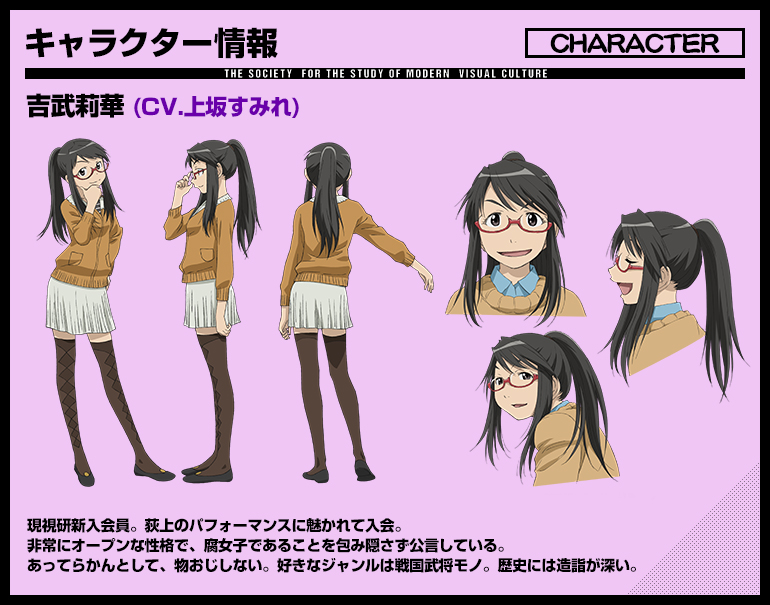
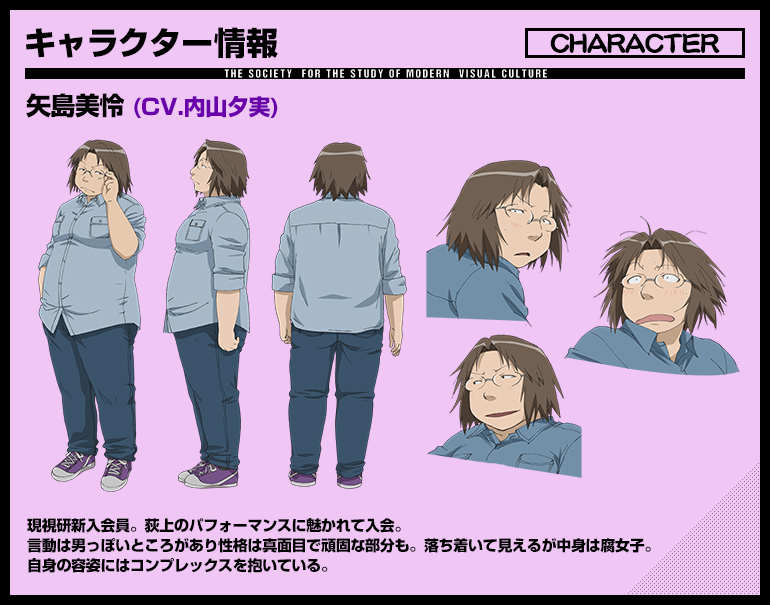
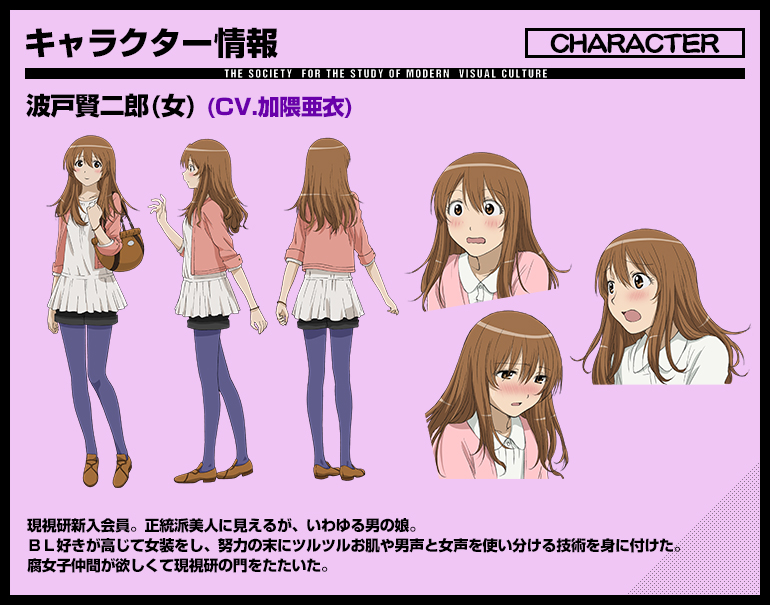
The official Genshiken II anime site has updated with a bunch of information, including a full voice actor list, and character lineart images for all of the coreNidaime cast.
At this point it’s no longer a suprise, but the entire cast list has changed from previous versions. My thoughts can be found below the cast list.
Angela Burton: Kobayashi Misa, formerly Kaida Yuki (Fuji Shuusuke, The Prince of Tennis)
Sasahara Keiko: Hayama Ikumi (Nunotaba Shinobu, A Certain Scientific Railgun S), formerly Shimizu Kaori (Nijou Noriko, Maria-sama ga Miteru!)
Yabusaki Kumiko: Yonezawa Madoka (Hirasawa Ui, K-ON!), Takagi Reiko (Kaolla Su, Love Hina)
Asada Naoko: Tada Konomi (Sakaguchi Karina, Girls und Panzer), formerly Saitou Momoko (Touyoko “Stealth Momo” Momoko, Saki)
Kaminaga: Noto Mamiko (Toudou Shimako, Maria-sama ga Miteru!)
They’ve also update the staff list, but most of the main people working on the show are already Genshiken veterans, such as the director Mizushima Tsutomu, and series composer Yokote Michiko, who even worked on the Drama CDs. The fact that it’s being done by Production I.G. is hopefully a good sign, though I have to wonder why in the world this series is going to have 3DCGI. Maybe for the ComiFes episodes?
As someone else pointed out to me, just by having Kaminaga in the cast you can tell roughly how much of the manga the anime will cover. The fact that it goes that far is pretty exciting (for those who haven’t read the manga, she’s a pretty big deal).
Notably missing from the voice cast though is Yoshitake Rihito. You’d need someone with a pretty masculine voice. Paku Romi perhaps?
What I think is especially interesting about the voice cast is that for a lot of the old characters they seem to have found people who are less experienced but have played somewhat similar roles in the past. For Tanaka and Madarame, you go from two veterans of screaming-and-shouting to two who are still capable. For Kuchiki, you go from one smooth and hammy (in a good way) voice in Athrun Zala to another one in Lelouch. About the strangest one might be Ui from K-ON! as the loud-mouthed Osakan, Yabusaki.
In fact, I think the voice I might miss the most is Kugayama’s, as his favorite actor sounded so much like an awkward overweight dork that it really set the tone for the rest of the anime. Not that he appears much in Nidaime though.
I also found out that Yamamoto Nozomi, the new Ogiue, is from the Tohoku region of Japan, so she should be able to do Ogiue’s inner voice no problem. Ogiue’s new character design is looking quite good. It’s really close to her current design in the manga, and while she doesn’t have that seething anger and frustration she used to have, she still shows all of the passion which has always defined her. I do want to point out that she has the glimmer in her eyes from after she started dating Sasahara. By the way, I hope they at least address that significant piece of character for Ogiue that is the Karuizawa trip somehow.
(No, seriously, it’s such a big part of her character that to skip it would be like to skip Darth Vader betraying Palpatine at the end).
Speaking of the character designs, Yoshitake in particular is fantastic, and I get the feeling that seeing her in motion is going to garner her a lot more fans.
The last thing I want to talk about is Angela Burton, who is an utter challenge for any anime to cast because of the fact that she doesn’t know Japanese and has to be shown using Ohno as an interpreter, i.e. English skills are required. Kaida Yuki (whose performance in the third Drama CD was stronger than in the anime), studied abroad in the U.S. While she hasn’t done much by way of anime, I did find out that Kobayashi Misa lists English conversation as one of her skills on her official profile, You can hear a bit of her English on her profile as well, if you click the last “3” in that small voice sample section, under “その他.” She’s decent. It also turns out she’s also a professional mahjong player, and in fact the only video of her on Youtube I could find is on the channel of a prominent mahjong player, where she’s giving her opinion on a tournament.
So basically what I’m saying is if she came to a convention, I’d probably get her to sign my mahjong set in addition to Genshiken Nidaime DVDs/Blu-Rays.
Over the past few months, Anita Sarkeesian has released the first two videos on her series concerning tropes regarding women in video games. Back when it was first announced, I had my concerns that she would so emphasize what has gone wrong that she wouldn’t leave sufficient space for what has gone right, or even what was meant to be female empowerment but fails for whatever reason. Later, after having done some further reading, I amended my thoughts on the matter when I realized that, even if it wasn’t my intent, the idea that women (as well as people in general) should settle for “good enough” as if that’s the best they could hope for in regards to portrayals of women in media is a problem.
I watched the first two episodes, which concern the “damsel in distress” trope. The third one, which is supposed to address some of the inversions or subversions of the damsel device, is not yet out, so I can’t at this point speak about that element, but I’d still like to state my thoughts on what I’ve seen so far. I find Anita’s strongest overall argument to be the idea that video games have tended to assume violence as a primary course of action so often that as games have tried to become more sophisticated this mechanic limits the potential avenues for solutions beyond “punching them until they die.” As Anita notes, the inertia created by the games of old, both in terms of having damsels and having violence as a means to save them (or not), is perpetuated, though not out of malice but from not thinking about other alternatives.
Multiple times during the videos, Sarkeesian talks about how the hero having to rescue (or even mercy kill) the damsel turns the woman into an object or goal for a male power fantasy, and one of the concerns I have with this is that, even if she might not mean it, it can be interpeted as casting male power fantasies in a negative light. Certainly I understand some of the problems of the male power fantasy and how its ubiquity can create a narrow scope of examples of acceptable behavior for men in lieu of male characters capable of functioning in different capacities , but I don’t think male power fantasies are wholly the product of perceived gender role imbalances where a man must protect the woman, nor are they mainly about the trivialization of women, even if it on some level contributes to the perpetuation of such stereotypes.
Rather, rescuing the girl speaks more to the fantasy that a man can be relied on no matter what, and is capable of accomplishing anything and everything. Thus, when the damsel is fridged (killed or injured for the sake of advancing the male character’s story), it is about playing with these assumptions and desires, an attempted move towards more diversity and creativity in storylines even if the products end up not being very well thought out, containing many of the problems which Anita points out. The power to do something in every possible circumstance can also be found in the idea of the self-made man or the rugged outdoorsman, who can be thrown in the middle of a jungle and come out of it with muscles flexing. I think it’s a valid desire for men to want to be able to be relied on, though once again I understand that wanting to be relied on and being relied on as a requirement for masculinity are two different things.
You might be asking, “But if there are all of these problems with the male power fantasy, why even defend it?” In that case, compare the male power fantasy to another type of “power” fantasy, the rags-to-riches story, where a person uses their wits, hard work, and/or luck to go from a life of poverty to one of profit and wealth. There are many valid criticisms for such stories, such as the idea that it reinforces an unforgiving capitalist mindset where money is the most important thing in life, or that if rags-to-riches stories present the idea that anyone can pull themselves up by the bootstraps then it implies that people who haven’t done so simply haven’t tried hard enough. In other words, there’s a clear downside to this type of narrative. However, there are people who enjoy these stories and fantasize about doing the same thing, even if they are conforming to a flawed concept that is a product of assumed societal values it still speaks to their desires. This ability to respond to people’s desires is one of the things I think art and creative media can and should have, as is the ability to criticize that very same thing.
To restate, it’s not entirely clear if Sarkeesian is saying that male power fantasies are tainted from the roots, but I could see this being an issue that skeptical viewers might jump on to show that she is “man-hating” even though she isn’t. At the very least, Sarkeesian points to the ability for male characters to get captured and then break out of captivity through their own strength and wits as a way in which male characters are not truly in distress, and this scenario has a clear power fantasy component which can function without the victimization of women as a plot device.
Of course, this leaves the question of where the “female power fantasies” are, and in this regard Sarkeesian is right that the repeated use of women as damsels in video games feeds into the perpetuation of these scenarios. However, my opinion is that this does not make the male power fantasy in video game form itself the main problem and that the character in need of rescue needs to be removed from media, but the lack of alternatives for characters of all genders and sexualities to do more and be more. That said, I think Anita’s goal in making these videos is on some level to create awareness so that people will think to produce these alternatives, and in that regard she is getting people to talk.
Genshiken II, Chapter 88 is Winter ComiFes! As always, the Comic Festival chapters are among the best or most interesting in Genshiken.
It’s Day 1 of ComiFes and Angela Burton the Athletic Bostonian has come back to Japan. Though she’s decided to tone it down she still ends up stirring the pot, especially by noticing that something funny’s going on with Madarame and Sue. During the event, as the others move about, Ogiue and Yabusaki sell the doujinshi they’ve been working on. They even manage to completely exhaust their 1000-book supply, which is a first for them. Hato, who is abstaining from BL, tries to act like a normal otaku and even perv out like a normal otaku, but it just doesn’t work for him, and he ends up not enjoying what is normally a highlight of his life. The chapter ends at the start of Day 2. Yajima plans to buy a yaoi doujinshi for Hato, which may be hinting at some more romantic feelings.
This chapter of Genshiken had the same energy as the old ComiFes chapters, and especially compared to the last one doesn’t have quite so much overt drama. Not that it doesn’t have any drama, of course, but it’s a little more low-key, and you can really feel the hustle and bustle of a event as huge and as crazy as not-Comiket (because it’s a fictional world, remember). At least, that’s how it is for Day 1. Who knows what Days 2 and 3 will bring?
I couldn’t recognize either cosplay this time around, but thankfully there’s at least one blogger who knows his stuff: The first cosplay (pictured above) is from a new series called Shuushokunan Zombie Tori Girl (“Employment Scarcity Zombie-Catching Girl”), and the other is from Hi Score Girl, which if I recall, won some kind of award recently? In any case, I want to check out both manga now. The image of a blue collar worker using a combination fishing pole and net is quite striking.
Just in general, I thought the fashion in this chapter was really nice. Clothing-wise, the two characters who stand out to me the most this chapter are Yoshitake and Angela, for different reasons. For Yoshitake, it’s because of the way she’s able to at times look like the coolest girl around and at other times like the biggest dork in history (or “history dork in history”), when probably both are true. For Angela, I feel like Kio expresses her character through her clothing especially well. Even when trying to hold herself back (another “be yourself, or not” moment?), she still exudes a confidence in herself, her body, and her actions that’s hard to find in even someone like Saki. I’d like to point out that she’s wearing shorts in the middle of winter, when Comic Market is known for sometimes for being blisteringly cold.
I actually like Angela more and more every time she shows up, possibly because of the way that she shakes up the current situation of the club no matter what it might be. Her attitude towards just about everything is a far cry from everyone else, best exemplified when she suspects there being a thing between Madarame and Sue. Angela has some romantic and physical interest in Madarame, and to see her react not with jealousy or anger but with the same excitement she displays when talking about her favorite character types really cuts through the more conventional sense of relationships you see elsewhere.
Ogiue gets a good amount of focus this time around because of the fact that she’s selling her collaborative doujinshi with Yabusaki. If you’re not sure why the two of them are freaking out from the get-go, it’s because they’ve been put in a spot that’s usually reserved for the most popular and highest-selling doujinshi circles. Their table is against the wall, and at a doujin event, the groups whose products will create the most traffic are put against the wall in order to reduce traffic congestion. Ogiue says it’s mainly because the title they chose to parody this time is extremely popular, and that it wasn’t all under their own power, but I think selling out of 1000 copies is amazing no matter the circumstances.
While I of coursed loved seeing Ogiue back when she was struggling with herself, it also brings me joy to see Ogiue this happy. Though she’s hardly what you’d call totally uninhibited now, it’s clear how much more relaxed and comfortable she is now, especially when her nervousness this time around has more to do with feeling like a little fish in a big pond, and not anger at herself. The pinnacle of this can be seen in the very last panel of the chapter, where she’s in the classic doujinshi-buying frenzy. The panel even references the line that something is opening up at the top of her head, the thing that happened to Sasahara at his first ComiFes. The last time we saw Ogiue do this, she was disguised and frustrated about having to disguise herself, but now Ogiue isn’t holding herself back, or trying to disguise herself, or anything. It’s Ogiue, who has allowed herself to be herself. I don’t think I’ve ever seen Ogiue with such a look of confidence and authority before.
Even her interactions with Yabusaki show this, and it’s possible to see how far their friendship has come from what was once a decidedly antagonistic relationship. Speaking of Yabusaki, or rather Asada, it’s interesting to see how a once-extremely minor character has been developed to the point that you can really get a sense of her friendship with Yabusaki, and how the two get along with each other. What once appeared to be Yabusaki as boisterous leader and Asada as quiet tag-along is actually more complex.
By the way, I think it’s telling that Nakajima did not show up, despite Ogiue being so much easier to find this time around.
“Being yourself,” as cliche as it sounds, seems to be the theme of this chapter, especially when taking into account Hato’s own situation. On this first day of ComiFes, the day with generally the most female-oriented and yaoi content, Hato decides that he will not buy any BL. The line towards the end of the chapter says it all, though. On Day 2, Hato has a revelation: “Everyone seems to be enjoying ComiFes, but I haven’t been enjoying it at all.”
In forcing himself to do the “right thing,” Hato suffers. ComiFes is supposed to be the space where otaku can let their otakudom loose, but he’s restrainined himself. Hato’s attempt to be a “normal” otaku brings up an important question: if you’re not having fun as an otaku, why are you trying to be one in the first place? Whether we’re using the older definition of otaku as a pathetic person lost in the delusion of his hobbies, or the more charitable one that emerged later on to just refer to someone passionate about his fandom, “otaku” is not something that’s supposed to cause you anguish because you can’t fulfill the proper behavior in being one. If anything, it’s traditionally the opposite such as with Ogiue.
Anyway, with everything happening, I am certainly looking forward to next month. Last time, I asked about the possibility of Sue x Hato. What about Hato x Yajima? I’m not one to pair couples typically, but there’s something about having the guy better looking than the girl which can create interesting stories and dynamics, particularly in terms of the issue of confidence.