Created Equals

Warning: Spoilers for Aquarion EVOL in this post

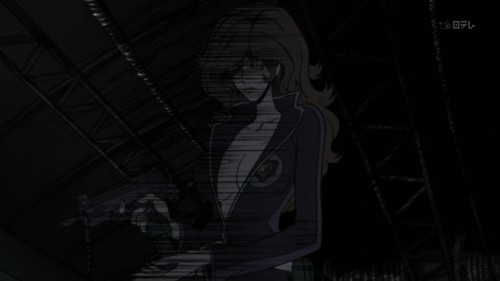
Amidst fears that a television series starring the matron saint of anime femme fatales would be mired in an inescapable well of sexism, Lupin III: The Woman Named Mine Fujiko manages to assuage those worries through extremely sharp characterization. Say what you will about nudity or Fujiko as an object of sexual desire, but the show makes it clear that they all have the skills and the smarts to succeed in their mutual world of thievery. Even if trust is at a premium (as is often said), there is no shortage of respect between Fujiko, Lupin, and the rest, and with mutual respect comes a sense of equality.

I’m not about to decry anime and manga as being polluted with unequal male-female relationships, as I can think of many examples to counter that idea, enough so that they don’t collectively turn into “the exception that proves the rule,” but this very idea of representing gender-egalitarianism has me thinking about what goes into portraying such relationships. For example, if a boyfriend and girlfriend each alternate being “dominant,” then is that “equal” or is it merely just multiple instances of inequality? Does breaking things down for comparison defeat the idea of equality between a guy and a girl by putting too much emphasis on haves and have-nots, or is ignoring it a bigger mistake?

As far as recent anime goes, the other show besides Lupin: Fujiko which has me really considering the concept of equality among opposite sexes is Aquarion EVOL, particularly that of Yunoha and Jin, the (literally?) star-crossed lovers who seem to have taken Pixiv by storm. Yunoha is an extremely quiet girl whose very shyness translates into her power (invisibility), and when she meets Jin (an enemy spy whose power is to keep others away), the two form a bond which gradually grows stronger.

Between Yunoha’s diminutive size in multiple respects (in a series full of toned and busty girls, her proportions are significantly more subdued) and her personality, Yunoha can seem to carry a potential problem that is similar, yet in a certain sense opposite to that of Fujiko in the sense that she can come across as the girliest girl, harmless and pleasant and easy to dote upon. Yet, despite the awkwardness of some of her interactions with Jin which can come across as her being dominated (notably the part where he tries to kidnap her out of love so that she can be the mother of his children and save his woman-less population from dying out), I don’t get that sense from their relationship.

While Yunoha can seem weak, and even her willpower and inner strength aren’t particularly impressive, Jin in many ways seems even weaker despite the basic idea that he’s an extremely skilled pilot and a deadly fighter. There’s something to his personality, perhaps a combination of naivete and extremely subtle yet numerous emotional scars, which make even his “domination” seem weak. In that sense, I find their relationship to be a very equal one, but in the sense that the two seem to grow to understand each other, a resonance between similar, yet complementary individuals.

One of the big ideas I keep running into when it comes to portraying a character well with respect to their gender is “the right to be a weak character.” By that, I mean how weakness (mental, physical, emotional, etc.) is generally thought of as a trait which makes one character “lower” than another, and which implies that their appeal is in their “lower” status, but at the same time that weakness can resonate on a more “equal” level with those who perhaps find themselves similarly weak. I think this is probably part of what makes arguments over moe so volatile, but let’s leave that for another time.

(Please don’t argue over moe.)

Mysterious Girlfriend X is Somewhat Different in Anime Form

I’m actually a pretty big fan of the manga Mysterious Girlfriend X, so I naturally had to check the anime out. While it followed the manga very closely, I still came away with a somewhat different experience (though not necessarily a bad one), and it has something to do with some of the choices they made in adaptation, as well as the very act of adaptation itself.

Mysterious Girlfriend X is definitely a weird concept that just isn’t for everybody. The story centers around a high school couple, Tsubaki Akira and his girlfriend Urabe Mikoto, and their connection through saliva, specifically the fact that Urabe’s drool seems to have paranormal properties related to empathy. As boyfriend and girlfriend, rather than kissing, they exchange saliva by finger. I’ve seen it argued that the series is solely for people who have a saliva fetish, but I think this is really shortchanging the series and its viewers, because the reasons for following it aren’t as overly specific and narrow as “liking drool.” The appeal is more basic than that, as you have this thrilling and bizarre romance between an established couple who share a bond that seems to go deeper than anyone else’s.

That said, I found the experience of watching the whole saliva exchange to be different between the anime and manga in a way I’m not entirely for. In the manga, the drool is kind of a visual motif, drawn very simply, something that while ever-present is almost just like a rendered symbol. In the anime, however, they go out of their way to make the drool glisten and glow, to give it depth and dimension. The real killer is the sound, because in addition to all the effort they put into it visually, they also tried to make it sound as loud and slimy as possible. Again, drool is definitely a part of the series, but I think a little too much attention is given there.

Another thing that makes the anime quite different is the lack of manga-style paneling. This is kind of unavoidable, as anime is a different medium that works along different rules (unless it went out of its way to mimic the panel-based structure of manga), but Mysterious Girlfriend X has really fantastic page composition and paneling, especially in its smart usage of the contrast between black and white. I even used it in my article about decompression in comics. Take a look at the page above, and you’ll see that even if you took every one of those panels and animated them together, it would simply lack the overall structure of the “columns” created by the characters. When you then add color to the film-like style of the anime, it just makes for a different impression.

There are also a couple of more minor things to note. The first is that the elaborate dream backgrounds, which are fully drawn in the manga, are rendered in CG in the anime. A practical change of course, but one which kind of takes away that impressive bit where you realize someone drew all of that. The second is that the voice actor for Urabe doesn’t sound like I imagined she would, though that’s more on my end than anything else. Her voice actor also seems to be quite new at this, showing something of a similar effect to Omigawa Chiaki in her days as Maka from Soul Eater.

I’m still going to keep watching Mysterious Girlfriend X, of course, and I’m probably going to enjoy it. I just wanted to say something about the subtle changes that are present, and perhaps how this speaks to the things that can occur in adaptation from one medium to another.

My Experience with “Fudanshism”

As part of the ongoing project that is the Fujoshi Files, I’ve been reading Fudanshism and its sequel Fudanshifull! By Morishige (of Hanaukyo Maid Tai fame/infamy), the story is about a boy named Amata who can only get close to the fujoshi he loves by crossdressing.

Though at first I didn’t particularly enjoy this series, at some point I found myself growing attached to certain characters in particular, to the point that I looked forward to reading about them more. A natural progression, perhaps, but it’s important to note that this change of heart didn’t happen until about volume 4 (out of 7) of the first series. If you’re wondering why I kept reading despite being pretty unimpressed, when it comes to the Fujoshi Files, I try to read as much as is available. But because I “forced” myself to read through, I have to ask myself, how much of it is me genuinely starting to enjoy the series, and how much of it is the effects of otaku Stockholm Syndrome, where you’ve been with a work for so long despite signs that you should have abandoned ship long ago, and even the below-mediocre starts to be impressive?

One of my favorite characters is Toumine Michika, a ditzy (and ritzy) non-otaku girl who talks about moe like Homer Simpson talks about the internet, as if she’d say, “Oh, moe is in anime now, huh?”

When paired with another character, an always-exasperated male otaku named Matsumoto Senri, it makes for enjoyable comedy. It doesn’t hurt either that Toumine isn’t malicious or selfish; she simply likes to have fun, and she acts as a foil for Matsumoto. Though actually, Matsumoto seems to exist for the purpose of having foils, or maybe it’s better to say that he’s the perpetual tsukkomi character. I mention this because my other favorite character in the series is Matsumoto’s younger twin sister, Setsuna.

Unlike Toumine, Setsuna is very much a fujoshi, which alone wouldn’t make her stand out in a series where there are more fujoshi than male characters, but I really dig the fact that Setsuna always has this strangely diabolical look on her face. Her brother knows she’s a fujoshi, and knows the true nature of the gears constantly turning in her head, and it results in this interesting back-and-forth where he calls her “kimouto” (kimoi (disgusting) + imouto (little sister)), and she mockingly refers to him as “onii-chama.”

Then there’s Rittoku Kanae, resident gothic lolita/crossplayer with some particularly complex and interesting body issues when it comes to her large chest. When she first meets “Amane” (the main character in drag), she’s immediately able to tell that he’s really a guy because she knows from personal experience what hiding a developed female figure should look like. However, because Amane epitomizes her ideal image of how a woman should look, Kanae takes a liking to him. An additional twist is that she also has a crush on Amata but doesn’t realize the two are one in the same.

In any case, I find them a lot more interesting than the main characters, who are kind of bland overall. I get the feeling Morishige eventually thought this too, because there’s much more emphasis on them in Fudanshiful!

Thinking it over, I feel like I have very legitimate reasons for enjoying those characters, and that they make the series itself more enjoyable to read to the extent that, while I wouldn’t call myself a fan, I can say that I liked it overall. The odd part is that I wouldn’t really expect anyone to stick with the series as long as I had to get to the point where I changed my mind about it. At the same time, I can’t deny that it did get better, and not just for the characters but also artistically, as Morishige’s ability to convey information visually improves as the manga goes on. My dilemma isn’t so much if I would recommend the series, but more, what does the very act of sticking through with a series do to one as a consumer of entertainment?

The School in Aquarion Evol is a Pokemon

The Fujoshi Files 40: Yoshitake Rika

Name: Yoshitake, Rika (吉武莉華)
Alias: N/A
Relationship Status: Single
Origin: Genshiken: The Society for the Study of Modern Visual Culture II

Information:
Yoshitake Rika is a student at Shiiou University who, despite her youthful looks and demeanor, actually entered college at the age of 20. She initially joined the Society for the Study of Modern Visual Culture (Genshiken) after seeing a particularly appealing drawing of Sengoku Basara characters by Genshiken president Ogiue Chika at the club fair. As a member, she quickly befriended everyone in Genshiken, especially her fellow freshmen, Yajima Mirei and “fudanshi” Hato Kenjirou. Yoshitake has a younger (but taller) sister named Risa who is also an otaku, and has bought doujinshi for Risa, who is typically unable to attend events due to her obligations to her basketball team.

Her sense of fashion, forward personality, and willingness to break a few rules in the name of fun (like convincing her slightly underage friends to drink) belie a person who is more comfortable in social settings that the average fujoshi might not be. At the same time however, Yoshitake has a capacity for expounding endlessly on BL-related topics, which allows her to strike up conversation with her fellow fangirls just as easily as she would non-otaku. Yoshitake’s taste in media is also very diverse, going from classic literature to anime and manga to live-action films.

Fujoshi Level:
Yoshitake is able to combine both the wide breadth and depth of her interests with her fujoshi mindset, and consider the pairing and yaoi potential of a range of works far greater than the average fujoshi. Notably, she believes that the judo novel Sugata Imatarou is excellent in part for the emphasis on sweaty men forging close bonds with one another.

SRWZ2 Saisei-hen Out Already?! And It Has Tetsujin 28?!

Recent events have made me aware of how out of the loop I am with the mecha fandom. Whereas I would’ve once known and posted about it within days of the first announcement, this time I wasn’t even aware of it until someone linked me to a video the day it came out.

(Thanks, Jorge.)

Probably the most surprising thing about the new game is that, finally, after something like 20 years’ worth of games in the franchise, the grandfather of the heroic giant robot, Tetsujin 28, has made its SRW debut. Now, all of the questions about how Shoutarou factors in will be put to rest (he doesn’t even appear next to the robot, meaning he won’t accidentally get smashed by falling debris).

Granted, it’s not the original 1960s Tetsujin 28 here, but rather the 1980 remake, Emissary of the Sun Tetsujin 28 (not to be confused with Emissaries of Light Cure Black and Cure White, or Brave of the Sun Fighbird). I have to wonder why they decided to go with this iteration, as opposed to the ultra-90s remake, or the more recent Imagawa adaptation, but I figure it probably has to be for one of two reasons (or maybe a combination of the two). First, its style meshes the best with all of the other robots in the series, and so it has the least chance of sticking out. Original Tetsujin, which also appears in the 2004 version, is too clunky and rough, and the 90s version is too beefy and doesn’t share enough of the iconic look of the original. Second, as per the reason Space Emperor God Sigma got into SRWZ (the director said, “I liked it as a kid so now it’s in the games), maybe someone just wanted it in there.

One thing I find interesting, however, is the fact that they managed to get Tetsujin 28 in any form into the game at all. I remember hearing that back when Super Robot Wars Alpha 3 came out that they were originally going to have Giant Robo: The Animation in, just as they had it in the first Alpha game, but that the license had become too expensive after the creator of Giant Robo and Tetsujin 28, Yokoyama Mitsuteru, passed away. But now years later we have what might be his most lasting legacy ever in an SRW game. What gives? Was that rumor merely just that? Is the cost perhaps the reason why there are so few new series in Saisei-hen? Does being an adaptation factor in, much like Godmars?

In any case, check out the game’s animation. It is fantastic.

Maybe I Don’t Read Enough Manga

Given the fact that I dedicate an entire blog to anime and manga, it might be strange for me to think that one of my problems is that I don’t read enough manga. Many burned-out bloggers cite the activity of blogging itself ends up taking a chunk out of their actual enjoyment time with the stuff they love, but that’s not really what I’m feeling here. My posting rate is consistent but light enough for me that, while I do sometimes feel the pressure of thinking of something to say, I don’t treat it as a chore.

Part of it may have to do with the fact that, although I can read Japanese, I do have my limitations and one of them is speed. I just can’t read fast enough. That’s only a part of it, though. Instead, I have this strange sense that I don’t quite have a proper pulse on manga as it currently is, and by extension manga as it has been. When I’m reading a bunch of manga in the same genre or for the same demographic, I get this strange sensation that I’m continuously boxing myself in too much, that I need to keep expanding my horizons. And so I do, I keep reading more, I keep trying new things out, but it’s like I can’t try them fast enough. I want to feel everything manga has to offer, to understand it as well as I possibly can, but somehow it’s just not enough, like I’m losing my connection to it.

What I’m experiencing may be somewhat the opposite of burn-out, though not in the way that you feel when you initially dive head first into a new obsession, where you have to consume every little bit that you can possibly find, good or bad. Rather, it’s this unusual melancholy where instead of feeling like way too much, it feels like not enough.

Ishiguro

Last week saw the passing of one of the greatest anime directors of all time, Ishiguro Noboru. I’m not an expert on Ishiguro, so I don’t think it’s appropriate to talk as if I am keenly aware of his entire history. Instead, I would like to just talk about his impact on a more personal level.

Ishiguro’s list of influential works is almost second to none, and I know from personal experience that his finest works stand the test of time in a way that few can. Back in 2004, I was a college student who finally managed to get all of the original Super Dimensional Fortress Macross. The show was so utterly engrossing that I managed to finish all 36 episodes in two nights. During that time, I felt myself moving from cheering for Minmay to cheering for Misa; the way the show had developed and grown its characters amidst the backdrop of pop-songs-as-simple-ideals and war made it feel like I might  never experience that kind of thrill burning through a show again. Then came late Autumn 2008, and Legend of the Galactic Heroes.

At a daunting 110 episodes, it wasn’t a show that was really possible to marathon in a short period, but I still found myself often unable to stop. This wouldn’t have been any sort of a problem except at the time I was also studying for my Level 2 Japanese Language Proficiency Test. Was it worth it to cut into my study time so much? Well, the fact that I managed to pass probably colors my reflection, but again I was treated to one of the most well-crafted, intelligent, and hopeful pieces of fiction I’ve ever had the privilege to enjoy. I know Macross and LOGH aren’t Ishiguro’s only works, and there are even people who hold them far more dear than I do, but together they shape much of my views of the man.

I first had the opportunity to talk to Ishiguro as part of a press conference at Otakon 2009, and asked him a question about Nagahama Tadao, director of Combattler V, Voltes V, and Daimos. The way I framed my question was that since Nagahama had passed away decades prior, the only way to really know about him was to ask those who had worked with him, which included Ishiguro. Reflecting on this question, I realize that I had mentally placed the idea of Ishiguro dying far away from Nagahama’s own passing.

Then at Otakon 2011, I attended a panel which had both Ishiguro and Shinkai Makoto (5cm per Second, Place Promised in Our Early Days), and seeing the significant age gap between the old veteran and the newer talent and how that difference also meant the difference between cel and digital animation, I asked if Shinkai had any advice for Ishiguro. I caused a fair amount of light-hearted controversy for suggesting that the younger Shinkai could advise Ishiguro on the craft in which he made his name, but Ishiguro was more than open to it. For a man who was still looking for his next anime to work on, the hierarchy of age didn’t matter to him.

One question about the past and the old, one question about the future and the young, both assuming the man would live for many more years to come. Funny how things work.

I hope Angel Scandies makes it somehow.

Ogiue, Club Ace: Genshiken II, Chapter 74

The latest Genshiken is big, but in a rather narrow way that requires some clarification. Nothing climactic really happens, and what it sets up for the following chapter(s) is quite significant, but more than that, Chapter 74 is the most Ogiue-heavy chapter we’ve had since the manga’s revival.

This month sees Ogiue personally working to help Hato overcome his wardrobe-based artistic barrier. After a suggestion from Sue (who interrupts some rather personal fun between Ogiue and Sasahara), Ogiue decides that the best thing to do is to literally sit next to Hato and watch him draw to see what exactly goes awry in the process. Though Yoshitake wishes to watch as well, Ogiue decides that this has to be a one-on-one affair, especially because Yoshitake wears her corrupted intentions on her sleeves.

After much deliberation, which includes narrowly avoiding bringing up Hato’s shocking (?) high school love story and Ogiue admitting how impressed/jealous she is of Hato’s skills, Ogiue determines that as a man, Hato confines himself mentally so that when he does draw as a woman, his desires all come out at once and lead to yaoi. Acting as both wise upperclassman and as club leader, Ogiue instills confidence in Hato’s drawing abilities—which he believed to be fake as a result of what seems to be copying the style of a fujoshi he once knew (again, “high school love story”)—by basically saying, if you can draw like this, then you can draw manga as well.

Hato passes the test, drawing a character in a panel without having it descend into outright homoeroticism, but when his old “friend” from the student government comes barging in with another council member, the (imagined) fiery passion between the two compels Hato to draw some BL of them on the spot, essentially undoing much of the progress he and Ogiue had just made.

The chapter closes out by revealing the fact that pretty much everyone from the old guard will be around to attend the school festival this year, and that this includes both Madarame and Kasukabe (with Kohsaka). It’s a recipe for danger, or just a whole lot of mumbling and awkward glances as a result of unrequited love.

Normally I try to come up with a post title which references both the chapter itself and something nerdy, which is also how the actual Genshiken chapter titles work, but even though I don’t expect to win, this time around I can acknowledge a complete loss. Chapter 74 is “Itten Toppa Ogin-Lagann.” I can’t top that. But let’s put that aside.

Even though I said that this chapter is chock full of Ogiue content, my summary can make it seem like it was really a Hato chapter. It wasn’t. Sure, he had his own development, but here, we really get to see Ogiue as a central focus in a manner similar to the second half of the original series. In addition to the Ogiue we’re familiar with, it even ends up showing a couple of sides to her that hadn’t been revealed previously, or to put it more accurately, have developed since.

The chapter actually begins with Sasahara and Ogiue in her room, where Sasahara is shown actually praising Ogiue’s manga draft for the school festival, something we almost never have the privilege of seeing because these “editor review sessions” seem to typically lead to a lot of tension. The room and especially the couch, however, hold significant meanings for the two, and we get to see Ogiue actually tease Sasahara in that restrained “you’ll have to meet me half-way because it’s kind of embarrassing and it’s kind of fun” fashion. Specifically, Ogiue asks Sasahara if it’s okay that she might be in a room alone with another guy (Hato), to which Sasahara replies that it’s fine. Ogiue, on the other hand, was trying to bring out the “strong seme” side of Sasahara which she has a thing for, and which Sasahara picks up on almost immediately after. It’s similar to when Sasahara and Ogiue were alone in the clubroom in the last chapter of the original Genshiken and Ogiue hinted that it would be a good time for a kiss, but here their increasingly red faces combined with their comparatively comfortable (though not entirely awkward) body language show that they both know what’s really going on, and that is a very comfortable familiarity. They want each other, and even though Sue ends up interrupting before anything actually goes down, it’s still a sweet and beautiful sight to behold.

On top of Spotted Flower, this whole sequence tells me that Kio Shimoku has gotten better at portraying romantic relationships. Keep in mind that I already thought he was quite talented at it, perhaps as a result of being so good at character interaction in the first place, but there’s the keen sense of how intimate moments in a relationship really happen, in those quiet lulls where both parties can sense mutual desire.

The meat of the chapter though is the drawing session with Hato, and Ogiue’s thoughts and character fill that scene as well. When Hato shows the inadvertent BL that he made out of Ogiue’s characters, she has an epiphany: “Is this what it would be like if my manga had doujinshi made from it?” Though I may be reading into it too much, I feel like, in that moment, Ogiue has just begun to cross that threshold between the amateur creator and the professional, that realization that perhaps somewhere out there is a fan who’s creating work inspired by her own. Of course, as an artistic fujoshi herself, Hato’s “fanart” creates some complex feelings as well, where she’s turned on by yaoi of characters she created herself, even if they weren’t made expressly for that purpose.

That look of satisfaction on Ogiue when her advice ends up working out has a lot behind it as well. It’s really powerful, not just because it’s coming from Ogiue the older, more experienced otaku and yaoi fan which we’ve seen already in previous chapters, but the way the advice clearly comes from Ogiue’s own experiences in overcoming her own psychological blocks pertaining to drawing and being a fujoshi. Ogiue had to wrestle extensively with her personal demons in order to begin moving past them, and the words of encouragement she offers Hato are ones from the heart, and from knowing that it’s not only important to accept oneself, but that it’s more than possible to do so. I think this is one of the reasons the chapter starts off with Sasahara in the first place. It acts as a reminder of what happened with Ogiue and how far she has come with his help, and how even though the trauma doesn’t seem as dire, that process continues.

With that, I’ll end by mentioning that we even get to learn the name of Ogiue’s manga: Getsu Gankyou. It means something like “Lunar Glasses” or alternately “Lunar Insight.” Chuuni-byou indeed.

Eh, let’s throw in one more Ogiue image for good measure.

The Fujoshi Files 39: Ageha

Name: Ageha (アゲハ)
Alias: N/A
Relationship Status: Single
Origin: Fujoshi no Honkai

Information:
Ageha is a highly fashionable 15-year-old girl who actively hides the fact that she is a fujoshi. Fearing that her secret would ruin her relationship with her friends, she goes out of her way to hide in plain sight, creating decoy cellphone wallpapers and even disguising her BL books as fashion magazines. Ageha was originally antagonistic towards her classmates and fellow fujoshi, Takako and Shu Mei, but eventually became good friends with the two of them.

Ageha is a fan of the Nanairo no Shacho series along with Takako and Shu Mei. She is also particularly fond of Fujiko Fujoo A’s Ai Yue series, having been moved to tears upon meeting her, but is not aware of the fact that the author is actually a teacher at her school. Ageha strongly values having one solid BL pairing in a series over having many different ones.

Fujoshi Level:
So seriously does she take her fujoshi life that Ageha once broke up with a boyfriend in order to celebrate her favorite character’s birthday.