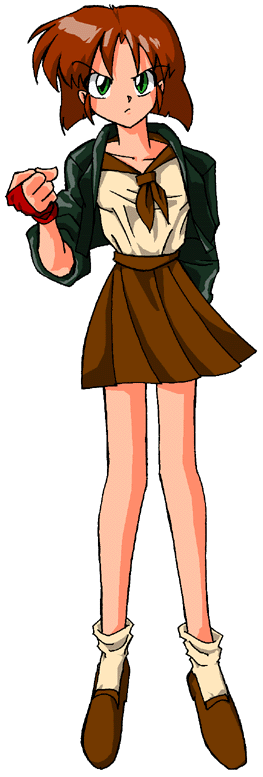
Behold, the Greener Grass Saga!

While I love anime and manga, I also like cartoons and comics the world over. I grew up with superhero comics, so even though I don’t keep up with them terribly much these days, I still like to know what’s going in them. In reading American comics blogs, it makes me aware that certain topics which garner extensive discussion and debate are hardly blips on the radar for anime and manga discussion. One topic in particular is character interpretation.

Spandex-and-cape comics, particularly the big mainstream ones from Marvel and DC, have a long history of changing writers, and so too with them comes different ideas of how the same characters should act. In time, you have notions of things like “definitive runs,” or the story or series of stories where the portrayal of a particular character ends up carrying through well after that writer has left. Examples include Alan Moore’s Swamp Thing, where a B-level character whose power was basically vegetation-based was revealed to have been an “Earth Elemental” all along, or Frank Miller’s Daredevil, which gave the blind superhero’s stories more gritty realism as he fought the mobster dregs of New York City. As time goes on, a character’s chances of getting more definitive portrayals increases. With a longstanding character like the Joker, the wild variation from comic slapstick villain to utterly mad mass murder can seem almost schizophrenic. Appropriate in a way for someone like the Joker, but perhaps less so for others.

Fans can discuss which is the best, most true face for the character. Others can argue that all of the portrayals are authentic, and that the character is an iconic concept to be interpreted by the creators. It’s just the kind of talk that doesn’t have very much opportunity to occur in manga given the difference in history between it and superhero comics. The closest thing anime and manga have to discussions of continuity and portrayal is probably Mobile Suit Gundam. Granted, it’s pretty close, especially with something like Turn A Gundam, a series which takes the idea of all portrayals of Gundam being “true” Gundams and turns it into a cohesive story. But sometimes I look over and think, “I wonder what manga discussion would be like with more of that.”

Then I look at all the downsides of continuity and retcons and the arguments that come with it, and I’m pretty okay with where anime and manga are. It’s a fair trade-off, I think, and I’d rather have the comics of the world be more different than the same.

What Does “Accessibility” Really Mean?

It’s the final day in my matchup at the Aniblog Tourney, and compared to when the voting began, both featured matches have had a surprising turn of events, leading to extremely close vote counts. It’s been a lot more thrilling than anyone anticipated, and this unpredictability has me asking a simple question: What do fans want in a blog?

Writing Ogiue Maniax, I’ve gained a reputation for having an intelligent, yet accessible writing style that has given me a unique voice online. I am constantly working on improving all aspects of that voice, and I work towards having my posts be fairly easy to digest while also encouraging further thinking. But the Aniblog Tourney has made me well-aware that there’s always room for improvement and change, particularly in the area of accessibility.

Looking at anime blogs, the most popular ones tend to be “episodic blogs,” or ones that review shows episode by episode, laying down summaries and opinions on a (mostly) weekly basis. Most commonly, the latest shows are the ones that get episode blogged the most, though there’s nothing stopping people from doing the same with older shows. Not only do the more well-known episode blogs get more hits, but they also garner more comments, and as the tournament has showed us, have their fair share of staunch defenders and loyal supporters. In these, the most prominent of episodic blogs, their voices and content have reached a great number of people.

So I wonder, is the fact that I write in what’s often categorized as an “editorial” style holding me back from improving my accessibility?

I know that this sounds suspiciously similar to “Why isn’t my blog more popular?” but that isn’t really what I’m saying. Instead, it’s that anime fans appear to feel more comfortable with the episodic mode of anime blogging that has me thinking hard about the way I write. How can I reach more fans without scaring them off with meta-posts such as this? Would I be able to encourage more people to examine anime and their own fandom by adopting an episode blogging format?

Don’t get me wrong though, I like the way I write, and the basic format of Ogiue Maniax isn’t going to change any time soon. I’m not even sure if I would be able to even pull off Ogiue Maniax-style episode blogging all that well. It’s just something I wanted to contemplate. Though, if any of you are up for the challenge, be my guest. Out of what’s currently there, I think Unmei Kaihen‘s style is roughly where I’d be aiming for, as I always feel like I learn something from reading his Giant Killing posts.

Cosplay Parallelism in Genshiken and the world of 2.5D

I like Genshiken, and I like when other people talk about Genshiken, especially when they’re able to see just how strong and fleshed out the characters are. Best of all, it gets me to think more about the title, and reminds me that as much as I have looked at the series, there’s always more to consider. So when I read Pontifus’s look at the second half of Genshiken, it not only reminded me of a post from years back, but it also made me aware that the series presents many more comparisons between 2-D and 3-D than I originally thought.

In his post, Pontifus wonders about why Madarame never felt anything for Ogiue, first pointing out that:

“Ogiue is precisely the kind of manga character he likes (literally!). When she’s finally talked into cosplay, she even dresses as Madarame’s favorite Kujibiki Unbalance character, who, in terms of broad traits, isn’t all that unlike her.”

He then goes on to describe how based on his own personal experience, the things that get you going in a fictional character don’t exactly apply to actual women, and that this seems to be the case with Madarame as well. Madarame does show a moment of piqued interest towards Ogiue’s brief debut as Kamishakujii Renge, but it seems to be more about the character than the person behind it.

However, Madarame isn’t the only one in the story whose attraction to a real woman runs opposite to his manga character fetishes; Sasahara also falls into this category. While Sasahara’s taste in pornography isn’t dwelled on as much in the latter half of the series, we are told fairly early on that his favorite female character is Ritsuko Kubel Kettengrad, the chairman in Kujibiki Unbalance, whom Kasukabe famously cosplays to save the club from doom.

So we have Kasukabe, whom Madarame likes, as the character that turns Sasahara on, with Ogiue, whom Sasahara likes, in the guise of a character that turns Madarame on. Again, given the guys’ doujinshi-buying habits and overall anime character fetishism, you might think that their taste in women has been flopped, but the series makes it clear that they have good reason for liking the girls they do, and it all has to do with how they are as people.

In addition to reminding the reader of the distinction between 2-D and 3-D, the parallels between Sasahara and Madarame (or perhaps Ogiue and Kasukabe?) affirm the overall theme of growth and maturity in Genshiken. Otaku can enter the real world and still be otaku, it just might take some help to adjust. But putting aside notions of “2-D complexes” and such aside, people’s tastes in women (and men!) change over time. You can have in your mind your concept of your “ideal partner,” or a mental checklist of all the things you like in an anime character, but you never know if something is totally going to surprise you. It’s not necessarily that they’re fickle, but more that there could always be more qualities that you love, either in a person or a character, which even you don’t realize.

K-On! Manga Too Extreme for TV

K-On!! episode 8 kind of disappointed me.

Before anyone knew that there would be  second season, I was reading K-On! manga. In one chapter, Yui is having trouble deciding her possible career path, and everyone else gives some idea of where they’re headed after high school. This includes Mugi, whose response clearly contains an underlying meaning.

If it wasn’t obvious before (and it was pretty obvious), Kotobuki Tsumugi plays for the other team. Not only that, but the sharper girls picked up on it long ago. She’s a lesbian, and others know she’s a lesbian. I laughed pretty hard when I first saw this, and it’s still one of my favorite moments from the manga.

So of course I was looking forward to this very scene in full color and animation once K-On!! was announced. And right when I realized episode 8 would be the episode, I sat there, waiting for the gag to hit.  I waited, and waited, and then… they removed it entirely?!

The only reference to it is that Mugi mentions going to an all-women university, but then it completely bypasses the setup and goes into some thing about the difficulty of the school she’s applying to.

Adapting a 4-koma manga into a full half-hour TV show requires adding extra material, but what gives? Did the K-On! manga cross some line that was unacceptable for Kyoto Animation? Are they worried that it damages Mugi’s image in some way? They animated a scene hinting at Mugi’s preferences in season 1, but in a situation where it’s made almost explicit, they shrink back in fear? Could it be that they think having her so clearly in the other camp might alienate some of her more devoted fans? Or perhaps their vision of Mugi doesn’t line up with the original author’s. It’s almost as is Kyoto Animation saw this and went, “Whoa! Too far! Are you trying to break the illusion?”

Maybe it’s the fact that it pretty much reveals Mugi as a lesbian lesbian, who likes girls, as opposed to just the one girl as you so often see in yuri material (especially yuri material written for guys). There, like in yaoi, the love seems to go “beyond” gender, but with Mugi that’s just how she is. So then I have to wonder if the problem is that it’s just too much to just outright state her sexual orientation in that manner.

Hopefully I’m wrong and they’re just saving the gag for another time. In that case I apologize for ruining the joke for people.

Oh and if you’re wondering, no, Mugi is not my favorite member of the band. I’m on Team Ritsu. But actually my favorite character is probably Nodoka.

Aim for the Ogi 2! Fudebuster

Once again I am up in the Aniblog Tourney, an idea devised by Scamp to expose more types of anime blogs to people through the guise of (mostly) friendly competition. My opponent this time around is Chaostangent, and opposite our duel is the match between Tenka Seiha and 2-D Teleidoscope. Best of luck to all.

For those of you new to Ogiue Maniax, I want to direct you to my previous introduction for the tournament, as I believe it does a good job of summarizing what this blog is all about. In short, my approach to anime and manga is less about seeing what I like and more about seeing what anime and manga are. Of course, I still enjoy myself, I still cheer for the shows I love, laughing and crying along the way.

This tournament has been a good fun so far, but amidst accusations of elitism and the like, as well as visiting some communities I hadn’t in a while, it reminded me how easy it is to get inadvertently boxed in by the fans you interact with more often, and that for nearly every instance of “No one could ever possibly think this!” someone inevitably will.

Of course, I don’t think you have to spend time with every type of community. I for example tend to avoid livejournal groups as they tend to be a little overwhelming. It’s just good to keep in mind that there all sorts of anime and manga fans out there. But that is perhaps a topic for another day.

Now, for those of you who have come to know Ogiue Maniax through the Aniblog Tourney but are wondering just how much more there is to see beyond the list of posts I’d given previously, I’ve provided an additional set for your browsing pleasure. Take a lot of time, or a little, in either case I hope you get to know this blog well.

Ogiue/Genshiken

Fujoshi-related

Analysis

Translation

Reviews

Bad Humor

Artwork

Let Me Tell You About “Anime” Okay

In the mid 90s when I was still a fledgling anime fan, I thought about how I would summarize anime to other people. In the end, I came up with something along the lines of “Anime looks really awesome but the story tends to be the weak point. They’re confusing and make no sense.”

When you think about it, you could almost argue that anime is the opposite of what the pre-teen me said. Anime tends to use a large amount of animation shortcuts to save money on already sparse budgets, but make up for it through storytelling and visuals which support that storytelling. It all makes sense though when you consider that my main exposure to anime at the time came in the form of Chinatown bootleg VHS tapes, whatever my brother could bring home, and Blockbuster rentals, the era of MD Geist and friends. If you told me that I would receive a million dollars if I could recall to you the plot of Armitage III, I would be walking away none the richer.


It’s about uh… a girl and stuff…

But there I was, summarizing the entirety of anime as if I knew so much when in fact I had such limited experience with the subject. It’s so easy to think that what you see is everything there is to know, to believe that your little island encompasses the entire world.

Any 5-Year-Old Can Tell You Why Summer Wars is Great

As of late, it seems like podcast after podcast is discussing Summer Wars. Speakeasy podcasters Hisui and Narutaki use the movie as an impetus to talk about how getting taken out of a movie causes you to more readily notice its faults. Andrew on the Veef Show talks about how the hype for Summer Wars is met by backlash, while also stating that he finds the movie to be good but not great. Anime World Order’s Daryl and Gerald also disagree on the merits of the movie. Overall, the two big questions seem to be 1) Why do the people who love Summer Wars love it and 2) Why do the people who hate it do so?

Now I am on the side of thinking the movie was fantastic, so the best I can tell you about why critics deride it is hearsay and conjecture, but I can tell you about why I think Summer Wars is a very strong movie on par with Hosoda’s previous work, The Girl Who Leapt Through Time.

Summer Wars‘ greatest strength comes from its overarching theme, centering around the idea of closing gaps, be they generational, technological, or even familial. A super advanced online world is contrasted with old-fashioned ways, the celebration of family is contrasted with the desire to move beyond the home, and young is contrasted with old. But in every case, Summer Wars doesn’t say that one is better than the other, instead giving a message that each is equally useful and that everyone can work together for the common good. It’s a very optimistic view of where we’re going as a society and as a planet, and I think that optimism is what keeps people cheering and praising the movie.

A lot of reviewers seem to neglect mentioning these themes, and I find that to be quite odd. It’s pretty much the heart of Summer Wars and for all of the praise and the criticism, how is it not mentioned more often? And it’s not like the themes are particularly subtle to the point of invisibility either. When I went to the New York Children’s International Film Festival showing of Summer Wars, there was a Q&A session with director Hosoda. In every case, it was the kids who nailed the most important theme of the movie, as well as a lot of the lesser themes. Now, these kids had to be fairly smart, being able to keep up with the subtitles on-screen, but they were still about eight years old on average. Surely the great minds of the anime internet can’t be outdone by a bunch of elementary school kids, right?

Re-reading my glowing review of the film, I am forced to realize that I too forgot to mention the overarching theme of Summer Wars and so am just as guilty of obfuscating the discussion as anyone else. Looking at my own words, I get the feeling that I was so caught up in trying to describe the enormous amounts of effort clearly put into the film and its potential for wide appeal through juggling many different elements that I simply forgot to actually say why I think the film is great. Perhaps everyone else experienced the same problem, like a collective mind fart from thinking too much about anime without actually thinking about it.

And so in the end, we were bested by third graders.

A Visual Comparison of Marvel-Style Capcom and Tatsunoko-Style Capcom

When the preliminary screenshots for Marvel vs Capcom 3 were revealed, the way the Capcom characters were portrayed really caught my eye.

Now it wasn’t too long ago that the similarly themed Tatsunoko vs Capcom saw the light of day. Both it and MvC3 portray Capcom characters using 3-D models, but you might see a notable difference between the two games.

Ryu here, despite being in two very similar games, turns out looking quite different. Against the anime characters of Tatsunoko he too looks closer to an anime character, but against the American-friendly grittiness of Wolverine and other Marvel characters, he too becomes almost equally gritty. His design is being adapted differently in order to better match with the types of opponents he’s facing.

In any crossover but especially in video games, visual consistency is important. If the characters do not look like they belong together, then it becomes extremely jarring. The Capcom vs SNK series suffered from this, as the old Alpha sprites of the Capcom characters clashed with the newly designed sprites for the SNK characters. As an opposite example however, Sakurai Masahiro purposely added realistic touches to all of the characters the later Super Smash Bros. games in order to minimize the visual discrepancies between them, so that someone like the relatively realistic Samus Aran matches up with the more cartoonish Mario. If you look at Mario actually, he has much more detailed textures on his overalls than in any other game he’s in.

One last thing that I find interesting is that the old VS games (most notably Marvel vs Capcom 2) actually leaned in the opposite direction of MvC3 by having the Marvel characters designed to better match the anime-style Street Fighter characters used at that time. Either way though, the message seems to remain the same: MUGEN is really ugly.

Fanseverance

The topic of fanservice can be a touchy one among anime fans. Providing some blatant eye candy is nothing new for anime, as Space Battleship Yamato regularly featured skirt flips and a brief glimpse of pure white cloth, but it seems to be especially controversial these days as the nature of fanservice itself changes and anime is increasingly seen as catering to a fanbase which actively sexualizes characters.

But there are many different approaches to fanservice, and I wonder, what do anime fans consider to be the “best” (or in a sense “worst”) form of fanservice?

Let’s say there’s a fairly serious show, and the show contains fanservice. Which of the following do you consider the lesser of two evils/the better of two worlds?

1) Fanservice that occurs during a dramatic and emotional scene that is possibly the climax of a show.

2) A fanservice moment or possibly even episode which occurs between important and emotional plot points.

Essentially, when is fanservice more welcome or considered more egregious, when it exists within a “dramatic” moment or when it happens as a “break” of sorts?

I can see arguments for either side. Someone who says example 1 is worse would probably argue that fanservice can trivialize or harm what could have been a truly great moment. However, it reminds me of Tezuka’s work, where he would stick comedic moments right in the middle of serious ones, only here we’re replacing comedy with sex appeal (and also possibly comedy).

Example 2 meanwhile can be seen as the greater menace because it can detract from characterization. But then it can be seen as a form of relief, a break in between emotionally involving moments in a series.

So, which is the path you’d choose?

A Form of Evolution, Perhaps

A couple days ago I talked about how I like the idea of broad interpretations of  video games for film and TV adapations, citing examples such as Tekken, Super Mario Bros, and Pole Position. But soon after making that post, I realized that I forgot probably the best example of taking necessary liberties with a video game property in order to adapt it into some kind of narrative media. That game is Pokemon.

Although the series stays true to the basic premise of Pokemon, a young kid goes out to capture and battle with monsters of which there are at least 150, it also plays around with and introduces a lot of ideas. As it would be difficult to write a long show without giving our hero Ash (Satoshi) some traveling companions, the writers took the first two bosses of the game, the “Gym Leaders” Misty (Kasumi) and Brock (Takeshi), and made them into supporting characters. They even went as far as to revise their outfits to be more suitable for travel. In case you forgot or just never knew, Misty originally wore a two-piece swimsuit and Brock was shirtless.

The Team Rocket in the show consisting of Jessie (Musashi), James (Kojirou), and Nyarth (Meowth) are entirely the product of the anime. Instead of having recurring antagonists in the form of faceless foot soldiers, the show saw it fit to give their primary representation of Team Rocket distinct looks and personalities. And just like Harley Quinn from Batman: The Animated Series, they were popular enough to be introduced into the original source material after the fact.

Then there’s the Pokemon themselves. In the video games, they made digitized sounds meant to be perceived as cries and roars, but that sort of thing can’t really fly in a TV show, so they introduced the concept of Pokemon talking by saying their names over and over again. And now it’s the way we think Pokemon talk. The show, especially early on, also modified the idea of the “Pokemon Battle,” converting the turn-based battles of the game into something more dynamic. They often played fast and loose with the rules, with ideas like a Bellsprout that knows kung fu, Whirlwind as an offensive technique, even outright ignoring the game’s type weakness chart by having it be possible to “super charge” Pikachu to the point where it could overcome the Ground type’s immunity to electric attacks.

Speaking of Pikachu, it might very well be the greatest liberty taken of all by being Ash’s starter Pokemon. The starting Pokemon in the original games were Bulbasaur, Charmander, and Squirtle, but in order to keep kids from thinking that their own personal pick for their first Pokemon was somehow “wrong,” they picked a neutral Pokemon. Actually, at first they planned to use Clefairy, but found Pikachu to be more popular.

So think about how much of Pokemon comes from outside of the games, and once again consider the possibilities of adaptation.