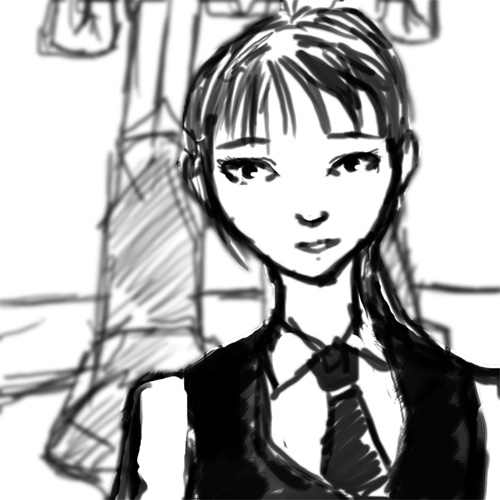
Mine Characters, Aye

While bored on the train, I decided to do a quick (not-to-scale) sketch of a lot of the characters whom I considered to be “main” or “important” characters in the stories and worlds I made up growing up all the way up until now. If you see any recurring themes in certain characters, well, that’s because I like certain things. I will not say that all of these were good ideas. Some concepts are better than others.

1. I don’t remember her name. She had the ability to “defy” laws of conservation of matter by tapping into the energy of an alternate dimension. Key point is her headband. Came up with her around the age of 16.

2. A pillow man based on the pillow I slept with when I was very little. He had a gun and his own video game where he fought enemies like a piranha man with tank treads for legs and a guy with satellites for arms. Probably my earliest character from when I was about 4 or 5.

3. The Victim. Co-created with a friend based on a calendar we got for class, the Victim is a dim-witted, optimistic fellow prone to getting himself in life-threatening, violent situations. Around age 10 or 11.

4. Peanutty. A peanut person. Liked to use anvils. Also created around 10 or 11, but before the Victim.

5. Tentsuki Akiko. You can tell by the psuedo-Japanese name that this was during a time when I started getting into anime. She’s a school girl and giant robot pilot, with her robot resembling somewhat the Aestivalis from Nadesico. Created probably age 15 or 16.

6. King HIV. Final boss of a video game about the immune system. Wears  crown. Created in 3rd grade. Seriously, not even kidding about this.

7. Alex Bellberry. Male bounty hunter who is very bitter about his effeminate looks. Around age 17 I believe.

8. Name undecided. The latest main character for an upcoming comic. She’s interested in the truth. Created just this year.

9. A magician girl whose name I forgot. Carries a staff. Created around age 15 or 16.

10. Super Six. He’s a muscular half-butterfly, half-man with 6 arms each of which have a weapon on them, ranging from a stinger to a can of insecticide. Created when I was about 5 or 6.

11. Sylvia North. A cheerful, intelligent girl who flies around in a modified garbage can and delivers garbage to those in need. Created at age 20-21.

12. Blink, co-created with the friend who drew Victim comics with me. Blink and his twin sister are the main characters of a puzzle platformer where they have to defeat an evil mosquito named Mr. P. Created around age 10.

13. Elyuna. A sickly girl whose disease happens to give her the perfect physiology to make an alien giant robot think she is a member of the alien race it came from. Created around age 18 or 19.

Let’s Play a Game Using GONZO’s Woes

The animation studio GONZO, unable to make up for much of its losses over the past few yaers, recently cut most of its staff and is planning on reducing their output by 50%, down to four shows a year instead of eight. As GONZO marches forward, trying to do what it can to survive (which includes big steps into streaming video online), I feel it might be fun to figure out who these remaining creative staff members are.

I haven’t done any work on it at this point, but I figure there’s only 30 of them left, down from 130. By cross-checking the names that appear at the end of all of their shows, a comprehensive list could be formed.

That said, I wonder if any cut staff members are perhaps planning on forming their own companies.

Sprkng! Early Observation of Dragon Ball Kai

I don’t plan on making it a habit of blogging about Dragon Ball Kai, but seeing as I reviewed a very “special” remake yesterday, I felt I should talk a little about how the other, inarguably better remake is doing.

For those of you who don’t know, Dragon Ball Kai is an HD re-mastering of the original Dragon Ball Z with new audio recorded (both music and voices) and, most importantly, all fat trimmed to make the show more streamlined and in-pace with the original Toriyama manga. Three episodes are out so far, and it should give a good indicator as to how the show will fare later on.

Dragon Ball Kai accomplishes in three episodes what took the original anime five, and early Dragon Ball Z wasn’t even that filler-laden! At the pace they’re going, the show may end up feeling it’s never dragging. That is, unless perhaps the manga dragged in certain areas as well. It’s an interesting conflict, being “true to the manga,” because should you be true to it, bad parts and all? Probably the main difference in pacing that will be seen is that in the manga powering up hardly takes any time. It’s the classic cliche of Dragon Ball Z that entire episodes are spent “powering up,” and it’ll be funny to see that stereotype smashed. It’ll be even funnier when the Namek saga takes significantly less time, and the inevitable jokes will occur which go, “Are they still on Nam- oh…I guess not. Carry on!”

Unlike that other thing, there’s really no point to discussing whether or not Dragon Ball Kai is true to the spirit of Dragon Ball. While this is clearly going to make them massive piles of money to roll around (and to sleep on top of with lots and lots of beautiful women), it’s still, I feel, a labor of love to a certain extent, even if it’s simply a repackaging of old material to seem new and fresh. I’m cool with that.

I just have to wonder if this mean that for all the young kids who are watching Kai before Z, will they be unable to ever watch the Z anime when a superior alternative exists?

The Best Argument for Creationism: Dragonball Evolution

Dragonball Evolution, what can be said about it? Well,  I can certainly call it a “movie.” It is a series of scenes placed one after the other on a film strip and shown in a sequential order. Dragonball Evolution: People involved in a production to put a form of entertainment in theaters.

Upon first hearing that a live-action Dragon Ball movie was being made, I had an image in my head full of cheesy lines and attempts to bring stories full circle, revisions to existing aspects of Dragon Ball designed to make it seem “cooler” and less “cartoony,” unfaithfulness to the source material’s characters and their personality, and awkward special effects. When the first trailer was released, and then the second, this prediction still appeared to hold true. Now, after having seen the whole thing, I can say that the movie was exactly what I expected it to be.

Where to start with this, “Evolution” of Dragon Ball as it wishes to be known? Well, how about the way in which it relates to Charles Darwin’s theory, or rather the attack on it by certain religious groups?

Proponents of Intelligent Design commonly state that there is evidence in the bedrock that shows that the Earth’s history is not a continuous chain of events, and that there are mass extinctions and sudden increases of certain types of animals, as if the history of the Earth and its wildlife are a series of islands connected by a higher power. This is in fact how Dragonball Evolution feels. You know it’s a story mainly because you’ve been told that it’s one, but while the events of the movie follow a chronological order, there is almost nothing which smoothly connects one scene to the next. Master Roshi will claim that going to the tournament is vital to their quest to defeat Piccolo. Then no one will participate in the tournament and then we never find out what going to the tournament actually accomplished. Yamcha and Bulma hate each other in one scene and in the very next they’re already falling in love. There isn’t even at the least a generic scene where Yamcha catches Bulma while she’s falling or something. Goku is in high school for some reason, and he gets picked on by jocks. He meets Chi Chi there. Then high school is never ever mentioned again. Master Roshi, the narrator, and Piccolo will all mention that Piccolo was responsible for nearly destroying the Earth until he was sealed 2000 years ago, but now he’s free and looking to enact revenge on humanity. How exactly did he break free from his confinement? Apparently NOBODY KNOWS OR CARES, at least not enough to tell the audience.

That’s not to say EVERYTHING is bad about this movie. Characters are occasionally true to their manga portrayals in certain ways. Goku is always naive, gets one or two nice lines to show how dumb he is. Master Roshi’s introduction feels very much like Master Roshi except in every scene after that he turns into generic old master. Also, sometimes the action scenes make it feel like a generic action movie, which is to say not super awful. Also my friends and I burst out laughing practically every minute at one bad line after another until we lost count.

An interview with the people who made Dragonball Evolution has members of the cast and crew defending the production, saying that the director succeeded in keeping the spirit of Dragon Ball alive and adapting it just enough to appeal to a wider audience. The problem is that they’re totally wrong and Dragonball Evolution is not faithful to the spirit of Dragon Ball at all. I can go into the many reasons why this is the case, but I’ll just give one: the core of Dragon Ball is represented by its main character Son Goku and his personality: goofy, often very dumb, loves to fight, and has a strong sense of justice when it comes down to it. There’s a certain kind of whimsy and humor that never leaves the series even when planets are being destroyed and limbs are being chopped off. That is to say, Dragon Ball is all about having serious fights never be too serious because it’s always been about the comedy as well. Dragonball Evolution throws all of this out and decides to be an action movie and coming-of-age story like so many others out there. Even if it succeeded in being a well-constructed story with brilliant direction, it would still not be Dragon Ball.

Glass Mask on Crunchy Roll

You might recall that I called the latest anime adaptation of Glass Mask to be one of the best shows of 2005. You might also recall my lament that no one has ever finished fansubbing the series, and so even if you started watching you wouldn’t be able to enjoy it fully.

Those days are numbered however, as Crunchy Roll recently acquired the show for free streaming with subtitles. The chances of them completing the show are very high, and all it took was for the actual company in charge of Glass Mask to give a new streaming site which recently went “legit” episodes they subtitled persoanlly. That’s all!

Anyway, check out my above review and see if that doesn’t get you watching.

Oh, it seems a lot of people are comparing Glass Mask to Skip Beat! and saying Glass Mask is better. I’ve never seen Skip Beat! so take that how you will.

Time Warner Warned, Sane People Win

In a previous post, I talked about how Time Warner was experimenting with tiered pricing plans, and the impact this could have on anime fans if it was approved for all Time Warner services across the United States.

Thankfully however, the plan has had such a negative reaction with consumers in test markets that it’s back to the drawing board for the folks at Time Warner. Full-out rejection. The movement to stop the tiered price plan scheme was headed by the website Stop the Cap, which even got New York’s Senator Chuck “The Deadliest Barbarian” Schumer to give Time Warner a stern talking to.

So for anime fans, the fear of having our ability to watch anime the way we want to has subsided, at least for now. This will not be the last time Time Warner tries something, but I can only hope the next time will be more sensible.  If not, this’ll probably happen again.

Examples of Anime’s Cel to Digital Conversion

Though much less frequent these days as the anime industry has all but completely converted to using digital means to animate shows (Sazae-san I believe is an exception which still uses cels), it wasn’t so long ago that debates about the merits of cel animation vs digital animation were a common sight among certain groups of otaku. Those on the side of cels would accuse digital animation of lacking life and energy, those on the side of digital would ask the cel supporters why they liked having dust on their animation frames so much. These days, I think it’s fair to say that much like 2d vs 3d animation, or drawing with paper vs drawing with a tablet, each has its own merits.

It can be difficult to compare digital to cel in the sense that usually entire shows have been done one way or the other, but there are a few which were made during that transitional period between cel and digital, and so they too are transitional. A brief list follows, if you want to take a closer look.

1) The Big O

Season 1 was done with cel animation, the Cartoon Network-sponsored Season 2 was done entirely digitally. Some will say that the second season lacked something the first had in terms of visuals, possibly that everything feels too “clean.” Judge for yourself.

2) Galaxy Angel

Again, Season 1 was all cel while for Season 2 Broccoli decided to go digital. They also decided to cover up Forte Stollen’s cleavage but that’s a discussion for another time.

3) JoJo’s Bizarre Adventure (Stardust Crusaders)

In an odd twist, the later parts of the manga were animated in the 90s while the earlier parts were animated in the 2000s. Watching this show in chronological order can be very unusual.

4) Gaogaigar Final

Now this was really meant to be a big budget OVA and it shows. Gaogaigar Final began production in 1999 (with the first episode out in 2000), and ended in 2003. Being an OVA, there was a long period between each episode, so the jump to digital is rather sudden when watched side to side. This is probably the one that best exemplifies the power of both cel and digital animation.

The Exciting World of Ron Sharks: Akagi

When you first look at an anime like Akagi, there might not be much to grab you especially if you’re an anime fan. The art style is very unusual, some would even say “awful.” You’re not even entirely sure what the show is about, and all you’ve seen of it are screenshots of a guy with a chin so pointy he could use it to assassinate people. But that’s when you look at the full title and realize that’s all you need: It’s not just Akagi, no it’s Mahjong Legend Akagi: The Genius Who Descended Into the Darkness.

Akagi is based on a manga about mahjong by Fukumoto Nobuyuki. This might be an unusual topic for you. “Who would make a comic about mahjong?!” However, unlike most cases where this might be shocking (“Who would make a comic about breadmaking?!”), what you have to know here is that mahjong manga are actually quite common in Japan. There are entire magazines devoted to the subject, like if you took Shounen Jump or Shounen Magazine and instead devoted all of the content to how-to-play mahjong guides and mahjong comics. This is the world Akagi comes from.

The titular character is Akagi Shigeru, who when we first see him is a boy in his early teens, who the narrator (voiced by Furuya Tohru i.e. AMURO RAY) tells us will “some day” be a legend in the underworld. Akagi is a lad with a penchant for deadly games which push his body and will to their limits. At this point, Akagi has never played mahjong in his life, but his intelligence, fearlessness, and incredible capacity for gambling with all of his soul without succumbing to pressure make him a perfect match for a game like mahjong, a game where your entire psyche is mapped out in the actions you take. Needless to say, the entire show revolves around Akagi playing Mahjong with a) Yakuza b) people known by the Yakuza c) Yakuza-esque people, and every moment at the mahjong table is filled with the kind of intensity you can only get when your life can be decided by a single, seemingly insignificant action.

You might think that with all this talk of mahjong, you would need to know how to play the game in order to properly understand Akagi. This is not the case at all, and I will attest that I watched the whole show before ever learning anything about mahjong. There’s a lot of strategy involved, but it has little to do with the actual rules of the game and everything to do with human psychology. The way the show is presented makes every moment as tense as possible, as the characters’ minds are assaulted by doubts and fears that come from trying to read another player’s moves.

The art style for Akagi is pretty unusual, but my only complaint about it is that the anime doesn’t quite match up to the art style of the manga. Neither one is very conventional, but when you look at the manga, you’ll see that it has a vibrancy and “ugliness of the world” that is lessened due to the consistency of the animation in the anime adaptation.

The Akagi manga practically looks like a gag manga, but it only makes the comic better, especially when combined with the game of mahjong. One advantage of the anime though is that they were able to create a CG set of mahjong tiles to use throughout the show, and are able to do some pretty creative things with it.

It does seem like the animators got a little bored with the show after a while and began to do more creative things. In the early episodes, Amuro Ray would describe a metaphor for how a character was feeling at the time and that was it. Towards the end however, it ends up being a situation where the narrator will describe a metaphor, and then the anime will shift to a visual scene to accompany the metaphor. So if the narrator says, “AKAGI’S SITUATION IS SIMILAR TO BEING A COBRA IN A DESERT WITH ONLY A CAN OF PICKLES AT ITS SIDE,” you will be sure to see a scene with a cobra, in the desert, with a can of pickles. Some might call it stalling for time, I think it’s the animators wanting to do something special. This would continue into the next anime adaptation of a Fukumoto work, Kaiji.

Ultimately, Akagi might be about mahjong but what they’re playing matters less than how they’re playing it. Again, if you’re worried about not understanding it, do not let that stop you. This is Initial D with mahjong tiles instead of cars. This is Yu-Gi-Oh! for 40 year olds (especially the early chapters of Yu-Gi-Oh!). If either of those descriptions make you hesitant, don’t let them stop you either. Watch this show.

Mager

The Mean Among Ends

Looking back at the anime that concluded in Winter of 2009, I have to say that I was quite satisfied with how all of the shows I watched had finished. I did not watch every anime that came out, but out of those I did, I felt there was a general trend of decent to great endings.

A funny thing about anime is that it has the reputation of giving the viewer incredibly good endings and incredibly bad ones, and often times fans can’t even agree on which endings are which. I could come up with a variety of hypotheses as to why people so vehemently disagree on the quality of certain conclusions (or lack thereof), but it really all comes down to personal experience, personal experience that says, for example, whether wrapping everything up by the end is a Good Thing, or if it would be better to leave some things open or to the imagination.

I think the mixed reputation for Anime Endings has very much to do with anime shows actually ending in the first place. I’m not saying this is a good or bad thing, but one of the oft-touted qualities of anime that got fans choosing it over cartoons and TV shows in their own countries was that anime tended to have endings which built upon events which occurred in previous episodes. Of course, as the general level of writing in TV shows has improved over the years there’s less of a discrepancy, but anime seems to rarely get canned outright with no warning to the writers and staff the way American TV shows do. The trend instead seems to be that if a show is getting canceled, the anime staff is told in advance so that they may try to cobble together something to finish the series off with, be it a cliffhanger ending or even the Ideon TV series’ Narrator Exposition Ending (it has to be seen to truly be experienced).

What makes a good ending? Something that says your viewing experience was worthwhile.