Don’t forget to replace your Eureka Seven Volume 11 DVD!

So a factory defect has resulted in a large number of defective DVDs from Bandai Entertainment, chief among them being Eureka Seven Volume 11, with the saucy cover with both Anemone and Eureka.  For those of you who have bought a defective DVD, the instructions for how to replace it are here.

And for those of you who haven’t bought Eureka Seven Volume 11, well what the hell are you waiting for?  Eureka Seven is a series I recommend to anyone and everyone.  I guess I should write a review of it, but let’s just say that I discovered E7 at the same time I discovered Ogiue, and both have been very good to me.

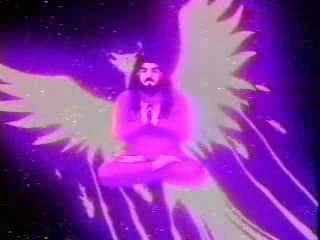
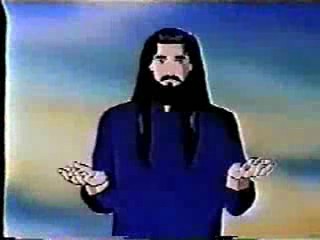
Aum Shinrikyo the Animation

DUN DUN DUUUNNNN DADADADUNDUNDUNNNN…

In the future, man discovers the Shinrikyou Drive, bringing limitless prosperity.

CRUSH THEM, GIANT SHOKO!

Yes, this is a review of an Aum Shinrikyou anime. The Aum Shinrikyou, currently known as Aleph, was the religious cult/organization responsible for the nerve gas attacks in the Tokyo Subway in 1995. During their heyday in the 80s and 90s, Aum, well aware of fiction’s power over men and women, produced their own anime and manga to try and persuade people to join. Fred Schodt’s book, Dreamland Japan, has a section concerning the manga side of things. So here we have this delightful 15 minute piece, entitled Chouetsu Sekai, or Transcendental World.


This is just the name and title of Aum founder, Asahara Shoukou, but I don’t really want to translate it so I can maintain the illusion that it’s an attack in Hokuto no Ken. Pretend it says “Hokuto Ujou Haganken.”

This anime starts off like so many anime with an opening theme. Except it’s clearly sung by someone with no real singing ability or even ability to modify his voice in post-production so he can pretend to sound good. The song is about how all great and wonderful Aum and Asahara are, and I would give details but I didn’t want to expend too much effort watching it.

The main focus of this anime is, of course, Asahara Shoukou, and his benevolent nature and awesome power. Asahara’s primary abilities appear to be levitation, astral projection, levitating while doing astral projection, and having soft anime eyes so he can seem like an upstanding guy. Naturally, his voice actor mumbles a whole lot and you can’t really tell what he’s saying.

Two other important characters are two Aum members who are dating each other. By far the defining moment of this 15 minute extravaganza is when Asahara astral projects himself into an Aum class and notices that the two of them are sitting together with two others and making sure no one knows about their relationship. Later, the girl receives a phone call directly from Asahara and gasps as soon as he says, “You’re seeing that guy aren’t you.” But he says it’s fine and people are made up of their experiences.

Then he goes astral projecting through office buildings.

I can’t quite describe how uniquely terrible this all is. Or maybe I can. Imagine a man with no limbs trying to convince you of the greatness of arm wrestling matches where the prize is getting kicked in the balls by Kenyan marathon runners.

So yes, wonderful. Exactly.

The Fujoshi Files 3: Houshakuji Renge

Name: Houshakuji, Renge (宝積寺れんげ)
Alias:
Renge-sama (れんげ様)
Relationship Status:
Single
Origin: Ouran High School Host Club

Information:
Houshakuji Renge is the manager for the Host Club of Ouran High School. She is obsessed with visual novels and moe, and often blurs the line between fantasy and reality. The most notable example occurs during her first appearance at Ouran High School, where she assumes Host Club member Ootori Kyouya to be her fiancee due to a physical resemblance to her favorite visual novel character. She also begins to fancy newest member Fujioka Haruhi, until Haruhi is revealed to actually be a girl in drag and not just an effeminate boy.

Renge loves to cosplay and can often be seen in various stylish outfits, chief among them being a cosplay of Kisaragi Quon in bikini from the anime RahXephon. Outside of school, Renge can be seen hosting a live Sentai performance at a local mall for kids, partially to entertain, partially as an excuse to wear another cute outfit.

Renge is often heard before being seen. When the situation is right, a shrill laughter can be heard over the grinding gears of a high-powered motor, signaling her arrival.

Fujoshi Level:
The biggest indicator of Renge’s fujocity is the fact that, in a school where the Host Club exists, where almost every girl has a burning desire for guy on guy action, Renge is their queen and leader, and the one whom all the girls look up to in order to gain deeper insight into what it means to be a lover of boys’ love. In that respect, Renge is unassailable.

It’s over 400: Pokemon Diamond & Pearl: Dialga vs Palkia vs Darkrai

So the 10th Pokemon movie is about

VS

VS

This is the first Pokemon movie for the Diamond and Pearl series, which brings the total number of known Pokemon to almost 500.

Dialga is called the “Time-ruling Pokemon” and Palkia the “Space-ruling Pokemon.”  Normally they’re never supposed to meet, so when they encounter each other in a dimensional rift, they naturally end up fighting one other.  Their powers are so tremendous that it affects our dimension as well, though in such a way that is unfathomable to humans.  Darkrai is another powerful Pokemon who lives in the city Satoshi and friends travel to, and its defining trait is that it induces nightmares in any being it meets.  The people blame Darkrai for their problems, but it turns out Darkrai is actually trying to save the city, and thanks to everyone, the city is saved from being forever disintegrated by space and time destroying one another.  In the end, the most important lesson is understanding one another.

It’s everything you’d expect out of a Pokemon movie.  I’ve seen every single one prior to it, and I’d rank it somewhere in the same placing as the 9th movie, Pokemon Ranger and the Prince of the Sea Manaphy.  I still consider the first movie to be the best one, though I know I can’t exactly fairly judge this movie because I’m not quite into Pokemon the way I was back when I first saw Mewtwo Strikes Back.  Still, I feel like Dialga vs Palkia vs Darkria did not have quite as much substance as Mewtwo Strikes Back, or even something like Lord of the “Unknown” Tower.  Still, I have no doubts any kid who is a Pokemon fan would enjoy this movie, and more often than not, it is quite well-animated.

It also features Lickilicky (Japanese name Beroberuto), one of my favorite Pokemon of the new generation, so it wins points for that.

Vote for Raoh

Seriously, do it.  Viral is decent but he’s no Raoh.  Raoh, who is the End of Century Conqueror.  Raoh, who decides that in order to bring peace to the land he must rule over it and its endless hordes of mohawked goons so that he can control them.  Raoh, the demon who eats demons.  And Raoh, the character so manly, he launches his life force into the heavens by himself, rather than needing a proper funeral to do so.

Please make it happen

I propose that whenever anyone speaks about Gundam 00, particularly in real life, they should call it “Gundam Ooooooh.”

Gundam 00, Season 1, Episodes 1-13

I have finally gotten around to watching Gundam 00, and now at the end of part 1 of season 1 (episodes 1-13), I find myself with a series which manages to be culturally relevant and captures the spirit of Gundam without actually trying.

I am aware of the fact that the director of Gundam 00, Mizushima Seiji, has said that he’s never seen a Gundam series before, and that this was an intentional decision by the staff to get some fresh ideas into Gundam. I know there are some disagreements among fans about this, but you know who else never saw any Gundam before directing his first Gundam series? Tomino Yoshiyuki, that’s who.

A technicality yes, but the point is that Tomino, like Mizushima, did not approach his directorial role from the position of a mecha fan or a fan of the conventions of giant robot series. The result is a pleasing series which tries its best to show that even in this fictional world of hot girls and suave (mentally damaged) men, that world peace is not so easy to achieve.

When viewing Gundam 00, I feel as if I’m looking at a very elaborate jigsaw puzzle. There are many parts to it, and eventually it will form a greater whole, but I can’t see where exactly everything will fit into place. It’s pretty interesting slowly watching the plot and world unfold. Everything and every character is given prominence in the series, and to continue my jigsaw puzzle analogy, the main gundam pilots, the Gundam Meisters, are like the corner pieces. They are only more important in their role of being a helpful start, but the true main characters are everyone else, from the politicians to the other pilots to the civilians. Gundam 00 is a series which asks the viewer to see a bigger picture.

Now, Celestial Being’s goal of eliminating warfare is something we’ve seen before in Gundam series, especially when this goal is being carried out by a series of bishounen. One main difference from its predecessors though is that their idealism is not the reality of the show. Celestial Being acknowledges the sheer logistical difficulty of trying to prevent war via giant mobile death platforms, and sees that an ideal is just an ideal no matter how hard they fight towards it. Sacrifices must be taken, concessions must be made, it isn’t all rainbows and flowers and they know it. Even the “Relena” of this series, Marina Ismail, acknowledges this from the very start.

As I said in my Votoms part 1 review, I am at the point where the plot will truly begin. Congratulations Gundam 00, I am proud to call you a Gundam series.

PS: I laughed my ass off when I saw the sudden arrival of Future Kato.

The Generation Gaps in Taste in Anime Fandom

While anime fandom in the United States is old enough that a literal generation gap is possible, though that is not quite what I mean by the term. When I say generation gap, I mean the difference between waves of fans that have appeared since anime first gained popularity back in the 70s. The biggest indicators of these gaps, I believe, are the statements that will give away how they feel about themselves relative to anime fandom, such as “all these new shows are terrible compared to older ones” and “I won’t watch any show if it looks too old.” But why is it that the fandom resorts to such statements about their interests and how they compare to different times in the life of this hobby?

Speak to an anime fan of any age, and ask them why and how they got into anime. Most likely, you will get an explanation of how the anime they first watched differed from whatever else was on tv. I will give you my own example. While I watched Voltron and other such shows as a kid, I first discovered anime as coming from Japan in the form of bootleg Dragon Ball Z tapes a few years prior to it airing on American television. What stood out to me about DBZ relative to other cartoons I had been watching at the time was first the fighting, second the serial nature of the show, and third the idea actions had consequences. Characters could DIE (and then run around and have dead adventures and come back to life later, but they were still officially dead). In a time of only “cartoon” violence, I got something I wouldn’t call realistic, but rather much more weighty. The universe hung in the balance, after all.

Now, the reason I’m giving this example is to begin to show that I believe that this generation gap in anime fandom has not only to do with physical age, but also that anime hits us hardest during periods when we are most emotionally and mentally receptive to it. It is during these times that I believe people have a hunger for entertainment which satisfies them, and this is the basis of peoples’ nostalgia for certain times. Anime fandom in the 70s grew out of science fiction and fantasy fan scenes, out of Star Trek and Star Wars, and the first big shows were things like Battle of the Planets and Star Blazers. These fans were receptive to it because it was similar to the types of shows they enjoyed beforehand, but it also flipped their worlds upside down with stories and themes that went beyond other forms of fiction they had been exposed to at that point. When Dragon Ball Z rose in popularity in the 90s, I strongly believe that kids had a reaction to it similar to my own. It affected their world, introduced them to new ideas. Same thing goes for people discovering Sailor Moon around the same time. And Pokemon. And even Love Hina.

The conflict occurs because the values which affect people have changed, and why anime fans of one generation can have difficulty with fans in another. While the values may have changed, the strong feelings towards the anime which they fell in love with means that each generation feels strongly about the shows which got them into it, and where feelings are concerned, misunderstandings arise, because when you attack someone’s favorite anime you are essentially attacking what they believe in, what makes them feel good about life. It’s easy to joke about not taking anime so seriously, that chill out it’s just a cartoon, but it is also easy to see why and how people can be affected by not just anime but any form of fiction or storytelling. And because these feelings are so strong, it makes other periods of anime pale by comparison because they are not easy to relate to on an emotional level. To give an example which is not necessarily generational, take a look at the Robotech and Macross fandoms. Robotech’s appeal is that it presents three series as a single cohesive universe with a unified theme. Macross’s appeal is that very different stories take place within the same universe, giving a variety of themes and subjects. Different values, different fanbases (though of course there’s plenty of crossover).

Older anime isn’t good precisely because it looks old, and seemingly exists in a time far gone and surely these shows could not possibly be better than the ones that have influenced a fan’s thoughts. New anime can’t possibly be good because it fails to tackle the themes which a fan finds most important. Those are the essential feelings.

Now, one thing I should point out is that it’s certainly possible to have multiple periods of increased receptiveness towards anime. By my count I’ve had at least 3 or 4 (the most recent being the era of Genshiken and Eureka Seven). Perhaps the people who say every show they watch is the best show ever do so because they are in a current renewed state of fandom, instead of simply being standard internet-style exaggeration.

Seeing why people become anime fans, I think, will result in a lot less misunderstanding.

The Fujoshi Files 2: Tamura Hiyori

Hiyori

Name: Tamura, Hiyori (田村ひより)
Alias:
Hiyorin (ひよりん)
Relationship Status:
Single
Origin: Lucky Star

Information:
Tamura Hiyori is a student at Ryouou High School in Saitama Prefecture. A friendly and sociable girl, Hiyori has no problems making friends. Despite her age, Hiyori is a doujinshi artist and member of a popular circle which has even sold at Comic Market. A very enthusiastic artist, Hiyori frequently comes up with ideas for new comics but often forgets them just as easily, which is a continuing source of frustration for her. While not obviously a fujoshi at first sight, Hiyori has a tendency to (almost) accidentally blurt out phrases which betray her true status.

Fujoshi Level:
Hiyori frequently uses examples from real life to inform her work. Most notably, her two female friends and classmates, Kobayakawa Yutaka and Iwasaki Minami, who have a very close friendship with each other, have become a recurring subject and inspiration for many doujinshi. Unlike many fujoshi, Hiyori’s draws more than just boys’ love pairings, as shown in the example of Yutaka and Minami. However, she rarely ventures outside the theme of sexually charged pairings, which perhaps says more about her status as a fujoshi than anything else.

Why hasn’t there been another Evangelion?

Evangelion is an anime which resonated with the Japanese population because it accurately captured what they were feeling at the time of its broadcast. Probably for similar reasons, this is also why it resonated with fans around the world. It materialized feelings.

Now, I think the reasons why there has not been another Evangelion, in the sense of a title which transcends the normal/otaku divide and causes a lasting emotional influence on the public at large are many. I feel that the otaku community may have gotten more insular. I feel that the animators respond to this by trying to cash in easily on things like moe. When the shows DO try to resonate with their audience, there is resistance and backlash. Perhaps a show has the power to reach fans far and wide and affirm their feelings has been shown, but it was put in a bad time slot. I do not fault anyone for doing any of these things, and it may be a sign that there is simply too big a diversity of opinion among people now for a show to hit on the level Evangelion did. Blame everyone and blame no one.

So what’s the answer to my question? Perhaps that for an anime to affect people on such a large scale again, there has to be large scale events affecting Japan in the real world that the normal person and the reclusive otaku can feel in their daily lives.