Deep in the Tiger’s Den is a Het Pairing: Sasuke × Sakura’s Doujinshi Popularity

When I traveled to Japan this past May, one of my activities was to visit various doujin shops such as Toranoana. I like to see what’s popular, to get a general image of trends among hardcore fans. Which titles are popular? Which characters? Which pairings? And unlike doujin events, where many artists release their own works more for passion than profit, Toranoana is about what sells.

In Akihabara, this means going to multiple Toranoana stores, each of which specialize in a certain demographic. One in particular is devoted to girls (though nothing prevents guys from entering and shopping there), and as expected it’s primarily filled with BL.

However, one major exception was actually Naruto. In a relatively small yet dedicated section, surrounded by guy-guy pairings in most every other title, heterosexual romance took to the majority of the Naruto shelf. Of those couples, Sakura × Sasuke was by far the most popular.

I’m not against Sasuke × Sakura by any means, but I have to wonder why does it hold such a special place among hardcore female anime and manga fans. Why is it to the point that other het pairings are outshone, and the normally dominant BL pairings fade into the distance in this one ninja-themed microcosm?

One thing I discovered while searching for reasons is that Sasuke × Sakura is perhaps the most popular straight romantic pairing in English-speaking Naruto fandom, and visibly popular among Japanese fans. Given that context, it might just be the case that its sheer prominence is able to overcome even the fujoshi hegemony of the girls’ doujin scene.

Perhaps one factor is that Sakura is an easy target for female readers to project themselves onto. She’s also closer to the two most important characters in the manga than anyone else. However, given that fujoshi popularity is usually based on the strength of the pairing itself than the individual characters, it makes me skeptical about Sasuke × Sakura being an exception, even if it is a heterosexual ship.

From what I’ve read, a common reason fans support Sakura is her sense of loyalty towards Sasuke. She’s willing to support him through thick and thin, and even oppose him when she feels he needs it. The scene where Sakura tries to stop Sasuke from leaving to join Orochimaru appears to have been a flashpoint for supporters and haters of Sasuke × Sakura, because the former saw Sasuke’s “thank you” and knocking Saa away as him reluctantly pushing away those he cares about, while the latter saw it as an example of Sasuke showing flat, platonic fondness at best. Given the actual outcome of the series—Sakura and Sasuke married and had a child—the fans clearly won out, with Sasuke’s behavior best described as “reliably angsty.” Even as husband and wife, Sasuke’s #1 gesture to show affection is to tap Sakura on the forehead, and then disappear for months or years on end, undergoing secret missions to protect his family Andy his village.

Sasuke × Sakura reigns strong as a premiere het pairing, and I’m not bothered one bit. If any fans would like to help me understand the SasuSaku mind further, feel free to comment!

Darling in the Franxx: Thoughts on a Divisive Anime

WARNING: Spoilers for Darling in the Franxx, Gurren-Lagann, Evangelion, and Daitarn 3 (yes, you read that right)

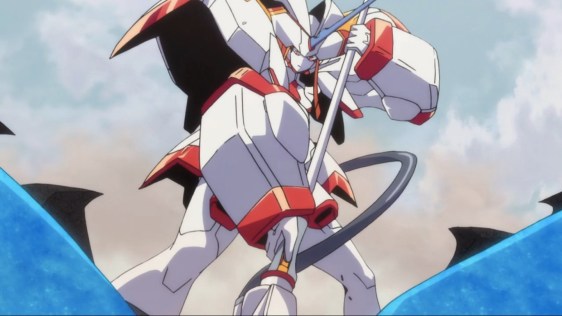
When I first wrote about Darling in the Franxx and its sexual dystopia, the series had just presented some major revelations, among them how Hiro and Zero Two first met, and the true identity of the Klaxosaurs. Seven concluding episodes later, it turns out those “bombshells” were only the tip of the iceberg.

But this show has been full of surprises, and fan reactions to all of these twists and turns has been just as fascinating to follow as the show itself. Darling in the Franxx is, in a word, divisive—perhaps more than any other anime I’ve seen in a long time. I believe the reason for this boils down to one thing: the show attracted a wider range of fan types than most anything else, and the conflicting takes are a product of these differences. My own take is tha the series only got better as it went along, but I’m well aware that many do not share my view to the extent that it seems as if we were all watching different anime. When I give my opinion and analysis of Darling in the Franxx, it’s with this caveat in mind.

Eye of the Beholder

Let’s get into some of the major reveals in the last quarter of the series.

  • Magma energy is revealed to be the energy source that has allowed humanity to achieve immortality.
  • The Klaxosaurs don’t consider humans their true enemy, because the actual problem is a non-corporeal alien race of conquerors called the VIRM, who all but destroyed Klaxosaur civilization both directly and indirectly thousands of years ago.
  • “Papa” is actually one of the VIRM. They infiltrated the human race and purposely pointed them towards magma energy as a way to weaken the Klaxosaurs. This is because the planet’s magma is actually made up of Klaxosaurs who purposely sacrificed themselves to become an energy source for the monster-form Klaxosaurs to fight off the VIRM.
  • The VIRM basically takes the minds of all of the adults because their goal is to integrate all species in the universe within themselves. This leaves only the non-adults (namely the Franxx pilots!) left to fight. The remaining humans join forces with the Klaxosaurs and go into space to fight the VIRM.
  • Ultimately, through the power of love and friendship, Hiro and Zero Two manage to truly become one (more on that later) and defeat the VIRM. Humanity has to rebuild without the use of magma energy, fully aware of the price they paid for draining the planet of such an important resource, and out of respect for the Klaxosaurs.

That’s quite a lot for a series where the initial main debate was “which girl is better, Zero Two or Ichigo?”, and for every fan who fell in love with the show from episode 1 only to be disappointed by where it went by episode 24, there seems to be another fan who thinks the opposite. Moreover, unlike series such as Dragon Ball Z, where the things that fans love about it are the very same things the haters scoff at, no one can actually seem to agree what Darling in the Franxx is about or what it’s saying, let alone which parts are good or bad.

The anime appears to have drawn in a larger variety of anime fans to it than is typical, combining a multitude of genre signals (mecha, science fiction, romance, love triangle) with provocative, often sexual imagery. As a result, the disparate values (both in terms of personal values and ideas as to what makes a show good) of the viewers meant that people came to the show with wildly different expectations from one another. In this environment, I’m not certain I can change anyone’s minds, but I can at least put my thoughts out there.

Defying and Affirming Conventional Humanity Through Romance

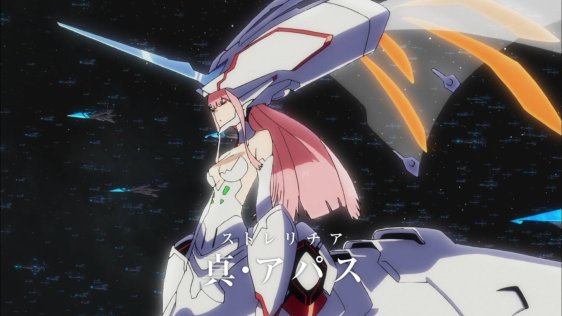
Take the subject of my previous post: whether or not the anime reinforced heteronormative values, extending to the rule of man and woman as father and mother. While Darling in the Franxx indeed ends with multiple characters having children in heterosexual relationships, it’s still notable that the main couple of the story cannot have children together. The ultimate expression of their union and happiness instead involves Zero Two becoming a literal giant robot version of herself, in a cross between a wedding dress and Mechagodzilla, while Hiro pilots her from within, carrying connotations of both penis and womb but also referencing the series’s own world. Hiro, in a way, acts like the magma energy that powers the Klaxosaurs, moving away from “conventional humanity” in order to be with the one he loves.

On a less dramatic scale, Ikuno (the only lesbian in the series) ultimately does not have children, but instead devotes her life to science and medicine. Without having any offspring of her own, she makes for herself a position that can help ensure humanity’s future. Hiro, Zero Two, and Ikuno all found ways to help humanity without having to be directly involved in pregnancy. And while not entirely clear, it might just be the case that Ikuno found someone who reciprocated her feelings as well. So I can’t see Darling in the Franxx as being all gung-ho about baby-making at the expense of other people’s life choices, though those more sensitive to the topic might see the degree to which the core cast decides to have children to be the stronger message.

Through the Lens of a Long-Time Mecha Fan

Another criticism of this series is that it’s shallow, schlock entertainment more interested in M. Night Shyamalan-esque swerves than any actual substance. What exactly this has meant in the context of Darling in the Franxx has changed over the course of the series, but one of the big sticking points is the VIRM reveal. Online discussion revolved around whether this was an unnecessary twist that betrayed the feel and purpose of the series, or if the show had cleverly set it up all along, and that it made perfect sense for Darling in the Franxx. I personally lean towards the latter, but I think this comes partly from being a long-time fan of the mecha.

Long before Gurren-Lagann took “go big or go home” to the most lovingly ridiculous degrees, sudden shifts to space or to larger-scale stakes were part and parcel of an anime genre founded in kids’ entertainment. The series Daitarn 3 (1978) literally goes immediately from Earth to space for the first time (barring flashbacks) in the final episode. In time, more creative and ambitious shows tried to incorporate that dramatic build-up more effectively, and I see the heavy emphasis on personal relationships and sexual tension of early Darling in the Franxx as an effective low-key cornerstone that sets up the eventual ramp-up in the long-term. Even the rapid pace of the last few episodes bothered me little for similar reasons, but fans who did not come into anime on shows that preferred such abrupt shifts could very well see it as clunky, headless-chicken writing. I understand, yet I still feel the progression to be appropriate and maybe even nostalgic.

Final Thoughts on the VIRM, and the Ending

It’s not uncommon to see Darling in the Franxx compared to either Evangelion or Gurren-Lagann for aesthetic and thematic reasons, but there’s another factor all three shows share: the idea that they in some way or form betrayed their audiences. Evangelion is probably the most famous example of an unexpected ending, with its compete stylistic departure and its abstract, introspection-heavy final episodes. Famously, the staff of Evangelion actually received death threats for it. Gurren-Lagann pulled the brakes on its do-anything, push-the-envelope mentality for its conclusion, which stung fans who watched it precisely to revel in that feeling of “doing the impossible.” Darling in the Franxx is capable of “betraying” large swathes of its diverse viewership, but I do not think the series actually crumbles when looked at with greater scrutiny.

While the opinion that the VIRM twist comes “out of nowhere” isn’t shared by all—some even accurately predicted the show’s move into space—I think an essential difference between detractors and supporters of the final episodes is that the finale comes with a tonal shift from being an anime that was focused heavily, at least on the surface, on the personal, intimate, and erotic. If that’s what you came to the show for, then it might feel like the two pieces don’t connect.

As mentioned previously, however, I don’t mind this change one bit. The reason? Because Darling in the Franxx has emphasized that something is terribly wrong with its world all along, and not just in terms of the Klaxosaur attacks. Whether it’s meeting other Franxx pilots and realizing how emotionally stunted they are, to the adult/child divide, to the sheer sterility of their cities, something has felt amiss from the start. Perhaps the VIRM being “the real enemy” can feel contrived, but taking a wide view of the series means seeing the depiction of a false Utopia that humankind bought into and that the children had to eventually make up for. Not enough people questioned the gradual consolidation of power around Papa and his organization, APE, or the exact nature of magma energy. Theirs was a society of ignorance, and it led to children like Hiro being punished for trying to fight that ignorance.

Even though Hiro and Zero Two manage to deal a crippling blow to the VIRM, the real challenge is trying to survive as a species without any magic bullets like magma energy. The libidinous energy that was once literally redirected into warfare goes to expressing love, whether that’s through making children, helping children, or just creating happiness. While personal perspective plays a significant role in how one interprets the series’s message, is it strange to see the main cast, poised to change the world since the first episode, end up doing so?

The Important Lesson Nadesico Teaches Us About Entertainment

Current discussion of entertainment media is filled with questions as to what messages, intentional or otherwise, are conveyed to audiences. Does a work promote racism or sexism through its characters actions? Does a series portray as heroic characters whose values are misanthropic? In this time, one work to look back on is the science fiction anime Martian Successor Nadesico, which highlights the idea that creative works are ultimately subject to personal interpretation, but that those subjective outlooks can have real consequences.

In Nadesico, many of the characters are fans of an old giant robot anime called Gekigangar 3. Cut from the same mold as 70s-era anime such as Getter Robo and Voltes V, it’s a simple story about heroes of Earth defending against alien invaders through the power of friendship and passion. At first, this series within a series acts mainly as a fun retro contrast to the setting and aesthetics of Nadesico itself. This all changes, however, when it’s revealed that the enemy forces are also fans of Gekigangar 3. In fact, they’re not just fans—they’ve based their entire civilization on Gekigangar.

Jovian men dress like the male heroes of Gekigangar 3. The women pattern themselves after the sole female character, Nanako. Even the robots they use to fight the Earth forces are made to look like the titular Gekiganger III. This mutual love of the same series between the space battleship Nadesico’s crew and the Jovians opens up the opportunity for peace. After all, Gekigangar 3 is all about friendship and passion, right?

One character, Jovian Vice-Admiral Kusakabe Haruki, does not see it that way, and he acts as the main antagonist at the finale of the TV series. When asked how he could defy the principles of Gekigangar, Kusakabe argues that his actions are completely in accordance with the show that forms the basis of Jovian society because Gekigangar 3 is about victory for the righteous against evil.

The same action scenes that the main crew of the Nadesico viewed as the bridge to peace also acts as the pretense for war and violence. While it’s possible to argue that Kusakabe’s interpretation was misguided and a too-narrow reading of Gekigangar 3, the reality is that it fuels his actions, and that even if the work had the best of intentions, the work does not exist in a vacuum and is subject to both social and personal perspectives.

The final joke about Gekigangar 3 is that the ending is pretty bad and hokey. Negating the noble sacrifice of one of the characters, Joe (whose design and narrative purpose is a mix of Hayato and Musashi from Getter Robo) conveniently comes back from the dead for a last-second save reminiscent of the finale of Mazinger Z when Great Mazinger shows up. The main hero of Nadesico, Tenkawa Akito, talks about how he held off on watching the last episode of Gekigangar 3 for a long time, only to find out that it’s nothing special. In a way, everyone who worshipped Gekigangar 3 put it on a pedestal that far exceeded its actual content, but at the same time the way it inspired people to strive for their best and to live with passion in their hearts is seen as a net-positive. “Remember this anime at its best” is the takeaway for the crew, but it requires an already-held belief of wanting to take a positive and humanity-affirming spin on any media consumed, which won’t always be the case for everyone.

Even works with the best of intentions, like Fight Club, are infamous for being misread. Entertainment meant to portray something in a negative light might accidentally be seen in pop culture as supporting those ideas. So for those shows and films like Gekigangar 3 that aren’t necessarily meant to be deep or extremely thoughtful, the opportunity for both loving and hateful interpretations is even greater. Ultimately, it’s the responsibility of those watching to give their takes on a work, even if it’s not 100% intended by the original creators, so that a work’s interactions with the cultural and social symbols that live and grow among us can be discussed and debated upon.

Hopefully Celebrating Independence: Ogiue Maniax Status Update for July 2018

The United States is another year older, and it’s starting to feel its age. I normally don’t try to talk politics too much in these monthly updates, but the times compel me to.

Before I jump into the nitty-gritty messiness, however, I want to thank my sponsors on Patreon and Ko-fi. You help make writing and blogging even more worthwhile than it already is.

Thank you to…

General:

Johnny Trovato

Ko Ransom

Alex

Diogo Prado

Sue Hopkins fans:

Serxeid

Hato Kenjirou fans:

Elizabeth

Yajima Mirei fans:

Machi-Kurada

When it comes to the state of the US in 2018, I feel a great deal of anxiety. Politics are tricky, but I constantly feel as if those in charge, especially on the right, are playing with napalm and are willfully ignoring the danger they pose to the people and the very foundations of American democracy. I’ve been watching Legend of the Galactic Heroes: Die Neue These, and every instance of the democratic Free Planets Alliance trying to use jingoistic loyalty or play with human lives to gain favor for an election season his way too close to home at the moment.

If I had to describe my political beliefs, I’d say I’m broadly left/liberal. It’s not as if I walk lock-step with everything the left says, but if I have to choose between a side that can get a little over-enthusiastic about their desire to create a world free of racism, sexism, and discrimination of all kinds, and one that holds onto power by any oppressive means necessary, then I’m willing to take some disagreements from the former. Seeing the endless mental hoops that defenders of our current political climate try to jump through, all in order to keep power in the hands of those who willingly exploit the marginalized, saddens me.

I know that some others on the left don’t share my interpretation of Darling in the Franxx. And in the past, I’ve actually argued that Anita Sarkeesian was unfair in her early analyses of women in video games. But it’s better for a Sarkeesian or anyone else to try and call out issues of representation where she sees them than to pretend they don’t exist at all—or worse yet, drum up controversy for the thinly veiled sake of minimizing input from other groups.

On a lighter note, here are my favorite posts from June.

How Super Smash Bros. Ultimate’s Gameplay Decisions Support Both Casual and Competitive Players

The new Smash Bros. was revealed, and I am beyond excited. One thing I did notice is that a lot of the new changes try to embrace both casual and competitive players, and I’m optimistic about it.

“Mogusa-san Fights Against Appetite” Concludes on a Body-Positive Note

The sequel to Mogusa-san, the story of a charmingly gluttonous girl, comes to an end.

Thoughts on Shinkalion, the Robot Anime Designed to Promote Bullet Trains

Subliminal, liminal, and superliminal approaches to selling the Shinkansen.

Return to Genshiken

It’s the final post on my series 1 re-read! See my closing thoughts on my favorite manga ever.

Hashikko Ensemble

Chapter 5 of Kio’s new manga is the best one yet.

Patreon-Sponsored

The Relevance of Older Anime to Newer Anime Fans

It’ll always benefit a newer fan to look back, at least a little.

Closing

Here’s to hoping for a better world.

Precure: The Crossroads of Voice Acting

Fifteen years is a long time for an anime to continue running strong, and Precure still stands at the apex of the magical girl genre in terms of prominence and notoriety. In that decade and a half, numerous voice actors have lent their performances to Precure, and it’s made this franchise into one in which seiyuu of all stripes, from anime veterans to relative newbies, intersect. To be involved with Precure can become a defining role, or an affirmation of an illustrious career.

In the original Futari wa Pretty Cure, Cure Black was played by Honna Youko, who at the time had more experience playing small roles in live-action series. While the few voice performances under her belt at the time were big deals—starring roles in Studio Ghibli films Omohide Poroporo and Whisper of the Heart—she wasn’t an anime industry juggernaut. Opposite Honna in the role of Cure White was Yukana, who was coming into her own as a fan-favorite due to roles such as Li Meiling in Cardcaptor Sakura and Teletha Testarossa in Full Metal Panic! Since then, Honna has earned some major roles in anime, notably Sumeragi Li Noriega in Gundam 00, but the bulk of her career is in voice-overs and narrations for television. Yukana, meanwhile, has become an anime industry veteran.

Mizusawa Fumie, voice of Cure Marine

Another voice actress who had a career-defining performance in Precure is Mizusawa Fumie, voice of Cure Marine. Prior to Precure, she was relatively unknown, playing roles mostly in small and relatively obscure anime. Now, she’s beloved by both children and adults for her energetic performance in Precure, and is considered a highlight of every crossover movie she appears in. In contrast, Mizusawa’s counterparts—Nana Mizuki (Cure Blossom), Kuwashima Houko (Cure Sunshine), and Hisakawa Aya (Cure Moonlight—were in 2009 already known for numerous characters in extremely popular series. These include Naruto (Nana as Hyuuga Hinata), Azumanga Daioh (Kuwashima as Kagura), and Sailor Moon (Hisakawa as Sailor Mercury).

The list of veterans goes on. Sawashiro Miyuki (Mine Fujiko in the more recent Lupin III works) became Cure Scarlet. Kugimiya Rie, the tsundere queen, came to Precure as Cure Ace. Tamura Yukari (the Magical Girl Lyrical Nanoha to Nana Mizuki’s Fate Testarossa) is Cure Amour. Koshimizu Ami, who originally began her career as Nadja Applefield from the 2003 Toei anime Ashita no Nadja, became Cure Melody. In each case, there’s a sense that they’ve “arrived in Precure” at long last.

One unique case is Miyamoto Kanako, who began her Precure career as a theme song vocalist across multiple series. In time, she landed the role of Cure Sword before going back to performing more themes. Other Precure singers have made cameo appearances, but only Miyamoto has made it as a Cure.

Various levels of acting experience existing in a production is hardly unusual, anime or otherwise. However, what Precure has is sheer longevity and the constant reboots to bring in new blood. It’s been around for so long that girls who grew up with Precure are now old enough to audition for it. To that point, according to the original producer of the franchise, Washio Takashi, 2017’s Kira Kira Precure a la Mode was the first time that girls who grew up watching the series became the voices behind the Precures themselves. Precure is in a unique position to push younger talent while also celebrating the efforts of voice acting’s Titans, and it should continue to do so for as long as it’s around.

Splaket 11 + Popket Rebroadcast Double Doujin Event Report

On my recent trip to Japan, I had the opportunity to visit not one but two doujin events at the same venue: the Splatoon-themed Splaket 11 and the Pop Team Epic-themed Popket Rebroadcast. Both were held at Ota City Industrial Plaza PiO, which is the same venue as the Love Live! event I attended two years prior.

Splaket

Splaket wasn’t overwhelmingly large by any means, but it did get plenty of foot traffic. I actually saw a few parents bringing their young, Splatoon-loving kids there. I like to imagine they were otaku parents introducing their kids, but Splatoon is big enough a series that I’m not sure that’s guaranteed.

What stood out to me most, however, were the ways artists and creators of these doujin works transformed the Splatoon concept to fit their needs. It’s like the world established by the games is just detailed enough to girl the imagination and just open enough to let that same imagination fill in the blanks. I saw detailed weapons catalogs, fashion guides, BL, yuri, straight romance, Callie and Marie, Marina and Pearl, and everything in between. It made me feel what an astounding success Splatoon is in terms of visual aesthetic and design.

Popket

The first thing I saw upon reaching Popket was the event catalog—a standard of doujim events. However, when I tried to pay for it, it turned out that the ¥333 price tag meant exactly that amount. It’s based on a Pop Team Epic joke about how animators make only ¥3,330,000 (approximately $33,000 USD) in spite of the grueling labor required. if you wanted them to keep the change, they wouldn’t let you! It was free to enter, but if you wanted that extra item, you had to come prepared.

Given that Pop Team Epic actually had a fair amount of mainstream penetration in Japan, I was expecting a fairly large event, but it was actually significantly smaller than Splaket. I’m not sure why this was the case, but I wonder if it was a combination of factors, like scheduling and Pop Team Epic being a difficult series to parody for the purposes of doujinshi.

The goals of fan works are many, but two are taking the original property to new and curious places, and trying to faithfully extend it such that the characters remain familiar as they’re adventures continue. But Pop Team Epic defies nearly all expectations. How do you parody a work that practically parodies itself? How do you tell jokes on its level? It’s not easy.

What I saw from Popket was less parodying Pop Team Epic and more using it to parody other series. Rather than trying to put Popuko and Pipimu in new situations, the doujin creators mimicked the drawing style of the original artist, bkub, to spoof other works. It reminds me of that artist who keeps drawing parody doujinshi of various series in which all the characters look and act like they came from Fist of the North Star.

Overall

It was an afternoon well spent, and a good chance to connect with Japanese fans. As always, I wish there was more of a doujin culture in the US and elsewhere.

The Relevance of Older anime to Newer Anime Fans

This month, I was asked to write about “the relevance of older anime to newer anime fans.” The short answer is that older anime is always relevant, even if newer fans don’t think it is. I’ll leave the criteria for “older” up for interpretation, but no matter whether it’s one year or 30 years, looking back on the anime that came before is a way to gain perspective on this form of art and entertainment that enthralls us so.

When a fan only watches what is newer, there’s a risk of developing a very skewed sense of what anime was, is, and can be. It’s easy to assume certain ideas are entirely new and have never been explored before, when in fact there’s a whole back catalog of shows that take on those topics. For example, the surface reputation of Gundam as vaguely “giant robots do fighty army things” can often color people’s views of what the franchise is actually like, and actually taking the time to look into those older series can broaden one’s perception.

In other cases, it’s easy to think that it’s “always been this way,” when certain stylistic or narrative tendencies are in fact the product of continued development reflecting the changing times. I recall being a young anime fan in the 90s, when most of what we got were short OVAs meant to be proof-of-concept adaptations for manga that doubled as advertisements. Often, they didn’t make any sort of effort to acclimate new viewers, so many fans were under the assumption that most anime were visually beautiful but unfollowable nonsense story-wise. We often failed to understand that it was simply what we received.

The above examples aren’t necessarily about looking backwards, but the point isn’t to position “older anime” as “better.” Not only is that highly subjective, but there are strengths and faults to anime made in any era, as well as cultural assumptions that might be controversial in hindsight. Rather, the important thing is to look beyond one’s current purview.

I understand that it’s easier said than done to get into older anime and not have it feel like a “chore.” It shouldn’t be “watch this show from 20 years ago because it’ll make you appreciate newer things—to hell with your own enjoyment!” Moreover, there are so many forces at work that directly and indirectly discourage newer anime fans from looking backwards. The newer shows take up all of the mental space through advertisements and social media discussion and who knows what else. If watching anime is a social experience for someone, it can become difficult to convince friends to abandon the opportunity to keep up with current trends. And while good aesthetics are in the eye of the beholder, older shows can at first look dated and thus lack relevance to a young, modern person. But for those who can overcome those hurdles, the reward is a more expansive library to potentially love and learn from.

This is actually why I’ve begun to think that remakes aren’t such a bad thing. Notably, Devilman Crybaby has re-introduced a classic manga to the wider world, and people have embraced it. The visuals might not be standard anime by any definition, but they’re fresher and more contemporary than what came beforehand, and they help fans to understand that the stories told in the past can still be relevant and powerful even if they look like they’re from a bygone era. If done well, it can encourage fans to break out of their shells and see.

See more, see wider, see further.

This post was sponsored by Ogiue Maniax patron Johnny Trovato. If you’d like to request topics for the blog, or support Ogiue Maniax in general, check out the Patreon.

The Fujoshi Files 178: Zombina

Name: Zombina (ゾンビーナ)
Alias: N/A
Relationship Status: Single
Origin: Monster Musume: Everyday Life with Monster Girls

Information:
Zombina is a member of M.O.N., a monster girl task force that deals with monsters who break the law in regards to the Interspecies Protection Act that allows monsters to live in the human world. As a zombie, she does not feel pain, and is able to lose body parts without it seriously affecting her negatively. Zombina is clever, utterly without inhibition, and a lover of firearms. However, accuracy is less important to her than being able to cover a wide swathe with bullets. She also enjoys zombie movies.

Fujoshi Level:
Zombina is a “rotten girl” both in the sense of being a decaying corpse and a lover of BL. She especially loves Levi x Eren and Bertolt x Eren from Attack on Titan (itself a zombie-esque manga), and hopes to go to a yaoi doujin event someday.

Ponkotsu Kyonyuu: The “Busty Failure” Character

Over the past few years, a new-ish character archetype seems to be emerging in manga. As far as I know, there’s no widely accepted term in Japanese or English, but the two common words used to describe them are kyonyuu, or “giant-breasts,” and ponkotsu, or “piece of junk.” The former word is pretty self-explanatory, but the latter likely requires some explanation.

A ponkotsu character is described by the Pixiv Dictionary as a type of moe female character who seems cool and capable on the surface, but is a comedic wreck on the inside. Two examples of ponkotsu characters in recent memory are Kawashima Momo from Girls und Panzer, the student council vice president who tends to panic in high-pressure situations, and Aqua, the “useless goddess” from KonoSuba! In fact, one might argue that all of the characters in KonoSuba! count.

The small trend, then, seems to be pairing the ponkotsu type with a large chest. I’ve found who qualify for that criteria are Shidare Hotaru from Dagashi Kashi (above), the titular character from Magical Sempai, and Takizawa from Bijin Onna Joushi Takizawa-san (both below).

As heroines, “busty failure” characters appear to share many of the same physical characteristics and mannerisms, even when ignoring chest size. In particular, their facial expressions seem to exist on a spectrum ranging from “incredibly smug” to “profuse blushing,” with these characters most commonly falling somewhere in the middle. Also, they’re frequently incredibly intense individuals.

Given their beauty and their curvaceous figures, there’s an obvious sex appeal component to the archetype. What’s unclear is why this exact combination has taken traction, in contrast to the standard moeblob, e.g. Asahina Mikuru from the Haruhi. For example, clumsy dojikko types are a dime a dozen, but there’s plenty of characters of all chest sizes who fall under that umbrella. Perhaps there’s something fascinating about having these girls be, in a sense, “mentally clumsy.” Maybe it’s that having these girls be “perfect” physically provides a powerfully arousing contrast with how easily flustered they are.

Thoughts on Shinkalion, the Robot Anime Designed to Promote Bullet Trains

Shinkansen Henkei Robo Shinkalion is the most blatant advertisement in cartoon form that I’ve seen in a long time. It’s so upfront with its true purpose—promoting Japan Railways’ shinkansen (aka bullet train) system—that it’s right in the title. But I actually don’t mind the extreme shilling of Shinkalion all that much, and it’s for one simple reason: the Japanese train system, including its shinkansen, is astoundingly good.

The hero of Shinkalion is a young boy named Hayasugi Hayato, a total train otaku. Hayato discovers that his dad, ostensible a Japan Railways (JR) employee, works for a secret division dedicated to fending off monsters attacking Earth. In an emergency, Hayato becomes the pilot of a Shinkalion, a super-advanced train that can transform into a giant robo, and helps his dad in their fight against the forces of evil. Naturally, all Shinkalions are based on actual, real-world shinkansen trains. Incidentally, one recurring gag among Japanese Shinkalion viewers is referring to the series as a reverse-Evangelion because it’s about a young pilot who can’t wait to support his dad on his mission to fight off monstrous invaders.

It’s not just the Shinkalions themselves that are selling Japanese trains to the audience, as nearly everything about the anime talks up the country’s rail service. Hayato’s family name, Hayasugi, is a homophone for “way too fast” in Japanese—a reference to the high speeds of the shinkansen. His catchphrase, “I’m Hayasugi Hayato, the guy who always makes it on time!”, is based on the fact that the Japan rail system is famously on-schedule. Whereas other train systems around the world might see a 10-minute delay as “reasonable,” a five-minute difference is considered “extreme” in Japan. This is part of why train otaku exist, as it’s not just the mechanical aspects of the trains themselves that hold appeal. The precision and complexity allows enthusiasts to imagine riding from one part of Japan to another while planning the most perfectly efficient route possible.

While Shinkalion is indeed mainly about high-speed trains, it also advertises for a few other things. There’s tourism, the natural extension for a show about trains, with the ending theme showing various famous landmarks across Japan. While I haven’t researched it, I’m confident that all locales presented are reachable by shinkansen. Then there’s the Google product placement. Not only is one of the characters a popular Youtuber, they even use the term Youtube and show it off. The strangest promotion is the fact that the Vocaloid, Hatsune Miku (or a convenient alternate version of her), is a pilot in the show—and she’s actually voiced by the Hatsune Miku software! In this instance, it might be JR that’s benefiting from the association instead of the other way around. The result is that Shinkalion is a kind of marketing black matter. The characters would have to be plastered with logos like NASCAR racers for it to go any further.

I’ve taken bullet trains, and they’re an amazingly comfortable experience. I’ve taken regular trains, and they’re so reliable it makes coming back to New York City’s subway system almost feel like culture shock. If this fairly generic giant robot cartoon wants to sell me on shinkansen, it can do that all day long. That said, I would be wary of Shinkalion becoming propaganda for JR as this perfect entity, because there’s evidence that it isn’t. Glancing at reviews on Glassdoor, there are multiple negative comments about the companies being extremely conservative businesses and thus stifling its own growth. Perhaps the efficiency of the system comes at a (human) price.

Still, I can enjoy Shinkalion for what it is. This 500-yen Shinkalion model kit I bought is a testament to that.