The Ambiguously Vague Gestures: Genshiken II, Chapter 81

After the intensity and emotion of the last chapter, this month’s winds down with a post-confession Madarame. In order to try and cheer him up, the old Genshiken girls (+ Hato and Kohsaka) cosplay for him, and for a brief moment the old impassioned expository Madarame makes a triumphant return. As Tanaka and Kugayama leave with Madarame for some male bonding, Saki encourages Madarame to not let go entirely of his past with Genshiken. There also seems to be some bad blood between Keiko and Hato, though the reasons are unclear.

As is the case with recent previous chapters, this one also referenced an old anime, in this case the title of Akuma-kun‘s final episode. Appropriate, because whether you want to call it the denouement of dramatic structure or the ketsu of kishoutenketsu, Chapter 81 feels like a wrap-up of the crazy developments that have happened over the past few months with Madarame, at least when it comes to his feelings for Kasukabe. As such, this chapter feels a lot less overt with its significance and its presentation of information compared to last time, but there are still plenty of moments which radiate with potential. As always, this isn’t an end (well obviously because the manga isn’t finished but you know what I mean), but a continuation.

There’s one scene in particular this chapter that I’ve read over and over because I’m not sure how to interpret it. As the girls (and guys) cosplay for Madarame from the gender-bender game that Kohsaka worked on, Kasukabe herself joins in as well. Before we see Saki in un-drag though, we see her having a conversation with Kohsaka about her character, who’s supposed to be “boyish,” to which Saki retorts that it’s actually a boy. Then, we see two characters off-panel speaking to each other (their words are visible but they aren’t), who I’m pretty sure are Kohsaka and Kasukabe. One of them asks if they accidentally “let it slip” and the other says that it’s not about that. I believe we’re supposed to read it as Kohsaka having hid the details of his game from Saki and her response being that the content of his game is besides the point. However, because of the way she says “it’s a boy,” and the follow-up conversation about a secret being out, and the fact that we see Saki go from what others have charitably referred to as “maternity clothes” to an outfit with a corset such that we can never get a clear idea of her figure, and the fact that even with the corset she looks bigger than she used to (notably in the chest area), I feel as if this chapter is lending credence to the theory that Saki is indeed pregnant.

I might just very well be overanalyzing, and things like Saki’s slightly larger figure and larger breasts might just be either a stylistic change by Kio or a sign that she’s growing older, but it just has me wondering. If my speculation turns out to be unfounded, I’m of course fine with that.

This chapter we get to see the “old” Madarame make a return as he muses on the very concept of “trap” characters and how there are different things to consider when translating them to 3D, a rant which Saki quickly reminds everyone is reminiscent of the Madarame she first met and despised. Is this scene a sign of Madarame getting his otaku groove back? Is it the case that the last few years have been a continuous trial and now that it’s over with he can go back to being himself, or is it that Madarame is trying to force it? Is it a regression to a past identity, or is it a progression, a nerd phoenix rising from the ashes of rejection and anxiety? I’d like to believe that the old Madarame is a new Madarame, and I’m definitely looking forward to where his character will go from here.

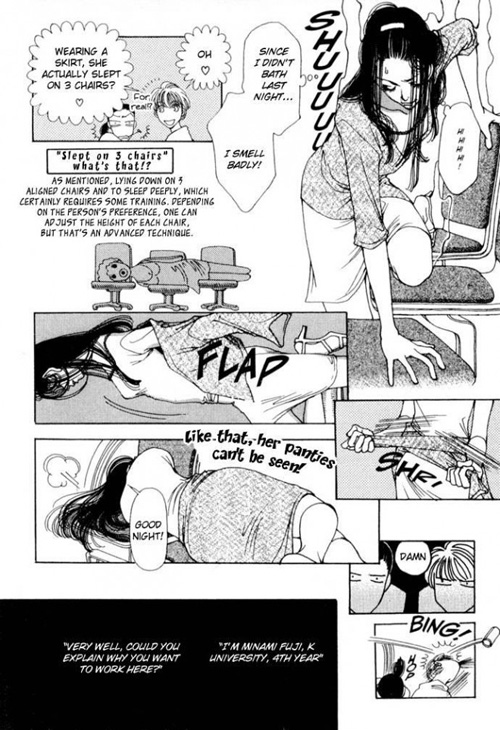
As a side note, if you’ve ever wondered what I meant by density of information looking unusual in manga, just look at the page above where Madarame is ranting. If you’re used to manga at all, just the whole page seems to stray from how Genshiken usually flows, though that’s what also gives this page its impact.

An interesting thing I’ve noticed about Madarame’s character is that Madarame seems to get paired with more characters than anyone else both inside Genshiken itself and among fans both English-speaking and Japanese. There’s of course the whole ordeal with Kasukabe, but there’s also Ogiue’s Sasa x Mada fantasies, Angela putting the moves on him hard, the ambiguity of Hato’s friendship, Kohsaka feigning (?) interest this very chapter, and then on top of that I’ve seen fanart and such going all the way back to 2005 that put him with Keiko and Sue, well before they interacted with him like they do now. It might just be that, as Hirano Kouta of Hellsing fame puts it, that “Madarame is the most moe character in Genshiken,” but I just find it interesting that so many, fictional or otherwise, seem to want Madarame to be happy (or at least less pathetic). It’s probably a testament to his enduring character and the fact that he is above all others the quintessential nerd/otaku.

In any case, it makes Saki’s comment that Madarame could very well make his own harem feel both tongue-in-cheek, yet somehow serious, though in the end I interpret it more as Saki telling Madarame that he is actually attractive in his own way. That said, I have to wonder how awkward it would be to have a girl who just rejected you also tell you that it’s okay for you to keep the sexy(ish coplay) photos you have of her. That’s the kind of scenario that so many nerds ae desperate to avoid (“What if she knows that I find her sexually attractive?”), but it’s a new world I guess. I wouldn’t be surprised if Madarame ends up throwing them out anyway, though I also wouldn’t be surprised if he keeps them.

I’ve used this comparison to describe multiple characters over the series, but Keiko is something of a Saki-type for Genshiken II. Yajima is a Saki in the sense that she’s a fish out of water and has the dry wit, but Keiko serves the role of being the character with the most “real world” experience, though as Sasahara remarks it’s more the result of making numerous mistakes. Still, it gives Keiko a type of perceptiveness that’s lacking in the current members of Genshiken, and it makes the moment where she just shows Madarame how his secret never really was one quite hilarious. Given how she didn’t even appear in the second TV series (though as far as I know that was just an unfortunate scheduling conflict, and she does make an appearance in one of the drama CDs), it almost feels like the series is making up for that by giving her more presence in the current manga.

As for the dirty look Keiko gives Hato, it’s yet another ambiguous moment in this chapter whose path will lead us who knows where. If we go by the harem view mentioned before, then this could be interpreted as Keiko exhibiting jealousy, but I think it’s something else. If I had to guess, I’d say that Keiko’s impatience towards Madarame dancing around and avoiding his own feelings for fear of confrontation is also showing itself with Hato and where he might stand with Madarame.

Even though she’s clearly not the focus, I do want to talk a bit about Ogiue’s part in this chapter. When Kohsaka grabs Madarame’s arms and tells him that they could’ve had a polygamous relationship with each other and Saki, I like how you can tell who is thinking what in that moment. For most of the guys, it’s just an awkward moment, but clearly Ogiue and Hato think more of it. Ohno seems much less affected, though it might make sense given her preference for significantly older, hairier, and balder guys. Keiko’s blushing on the following page is probably the most surprising, and another moment in this chapter open for interpretation. Could Keiko be a candidate for the Fujoshi Files after all?

The chapter ends with the reappearance of Katou, who we don’t know much about other than that she has Ohno-esque preferences, and that she’s been job-hunting as of late, but I wouldn’t mind seeing more of her at all. At this point Asada has more development than her, and she doesn’t even have a real face! I don’t have confidence we’ll see much of her, but one can always hope.

My First Exposure to 70s Robots

I can still remember my first exposure to pre-Gundam giant robot anime. I had a VHS fansub which at the very end had a number of retro openings on it, a preview of what was to come from that fansub group. That’s where I was first introduced to Zambot 3, which I thought looked pretty cool, and where I first got a glimpse of the 80s’ Aura Battler Dunbine, whose catchy theme song sticks with me even today. At the same time, though, I remember distinctly thinking that Koutetsu Jeeg looked like the dumbest thing ever.  I still think Jeeg is an ugly robot with its pickle legs, but it was more the overall style, fashion, choice of song, everything, that made it seem so foreign to me as an anime fan. I loved robots then as I do now, but obviously I needed some education, and I’m glad that I now know better.

I think what really sticks out in my mind in that video was the second Mazinger Z opening, mainly because of the way that Mazinger Z itself was shaded. It didn’t have the standard shine+shade of later giant robot anime, and instead had these large areas of pencil (or something like it) blocked in. When you watch the opening, you can literally see the grit of the drawing materials right there on the limbs and stomach. I hated it then, thought it made the show look old and tacky, but looking back, the way it stuck in my mind is part of why I started being able to look well past the aesthetics of 90s anime I had become so accustomed to, and to eventually realize how much the time that we’re in influences the look of everything around us, including the entertainment we watch.

Sakuga and “Action”

When it comes to the animation itself in anime, I believe myself to be a person who can appreciate not only the well-executed but also the bold and daring, but compared to all of the sakuga fans out there who can name names and pride themselves on spotting particular animators I am but a rank amateur. Especially because ending credits of anime are in Japanese (and Japanese names can be a pain to read), it’s traditionally been difficult to find out these things, but thanks to YouTube videos, presentations, and websites such as Anipages, it’s become easier and easier to find this information out.

So now we have an accessible history of Japanese animators, with names ranging from the ultra-famous (Tezuka, Miyazaki) to ones well-regarded but not so much in the public eye (Kanada, Itano). When it comes to the way that “great animators” and “great animation” are discussed, however, there appears to be a bias—perhaps an unintentional one—towards action scenes. By action, I don’t mean just “movement,” but  displays of violence, explosions, mecha, and so on. Itano is known for his “Itano Circus,” that detailed missile barrage most associated with the Macross franchise, but if Gundam Sousei is any indication, Itano’s talents also extended to something as simple as the way a key falls. And yet, much of what I hear and read about sakuga emphasizes “action.”

The appeal of a good fight scene, be it between two humans or two robots or even two planes, is fairly obvious, I would think. It catches the eye immediately, and there’s a lot of movement to work with. What I’m wondering, though, is to what extent this focus on action has shaped the discourse of “great animation in anime,” and whether or not that may have changed over the past decade or so.

Anime looks different now than it did two or three decades ago, and in that time the amount of mecha in anime has also risen and fallen, while the detailed animation of cute girls has increased. Though I say this without any real evidence to back me up (so please prove me wrong if you can), I get the feeling that the fans who grew up to be animators in the anime industry took to heart that which they saw on TV, so a generation of animators who fell in love with Yamato and Gundam wound up in the anime of the 80s and 90s, pushing “mecha” and “action” forward. But at some point, the new generation became the old, and the one that has started to take its place has its interests elsewhere, be that cute girls or something else entirely.

I can only assume that there have always been animators in love with the girls they animate (so to speak), so this isn’t strictly a new vs. old, but perhaps that the ratio has changed to the extent that values about animating have changed as well. That, and maybe changes to the toy industry connected to all of this may play a role as well.

This is not my condemnation of animators who work for the sake of giving motion to cute girls (or boys), as when you think about it that’s no better or worse than animating for the sake of mecha violence, and as I stated, this is not my expertise. If this is merely a mistaken hunch, then I’ll be glad to learn more.

The Text in the Word Bubble

I’ve been thinking about word bubbles lately, specifically the conventions behind how words are organized in them across Japanese and English.

Basically, if you ever look at a word bubble from an English comic, be that a translated manga or something originally created in English, the words tend to follow the shape of bubble to an extent, such that the top and/or bottom lines of text are shortest and the middle bulges out. In contrast, if you look at manga in Japanese, the text is usually in the shape of a square block, though it might be more accurate to say that the text is “top-justified,” where the top of each line is flat (remember that Japanese text in bubbles is generally written from top to bottom and from right to left), and the length of the final line can vary from being the shortest to being the longest. They don’t necessarily have to be this way, as is evidenced when an English-language bubble in a Japanese manga ends up having the text un-centered, but these seem to be the “rules.” When we defy them, something looks “off.”

What I’m wondering is, how much of this is the result of the written languages themselves, and how much of it has to do with the conventions laid before us by decades of comics? Could it be that a stable top is more important in either case, but that the top line in an English text is always flat due to the horizontal nature of English writing, whereas Japanese has to make an effort at it? Is it simply efficiency, or the result of past limitations which have seeped into the very nature of how we perceive word bubbles? What about other languages, notably Hebrew or Arabic which are horizontal and written right to left? How do their translations/comics fare?

81 Diver is Amazing

Sometimes I can’t believe how much I enjoy the ugly, ugly, ugly art of 81 Diver. Just look at this page for a moment.

I don’t know about you, but when I first saw that kick I simply couldn’t hold my composure. This scene, among many others, actually gets me to burst out laughing.

81 Diver is the work of Shibata Yokusaru, the same man who created Airmaster. It is a manga about Sugata Kentarou, a gambling shougi player, and the woman he loves, “Ukeshi,” an excessively well-endowed maid who is also known as a legendary shougi player renowned for her defensive and reactionary play. I have never played a game of shougi in my life, so much of the terminology goes straight over my head, but the terseness of the dialogue and the sparseness of text in the word bubbles combined with the frenetic line work makes each match extremely tense and exciting, especially given how absurd the characters are.

Let me tell you about what I believe is one of the defining moments in 81 Diver. Sugata is playing a hobo/shougi hermit. Money is on the line. Sugata’s stipulation is that if he wins, he gets the shougi hermit’s money (he’s a hobo but he isn’t poor). The hermit agrees, but in exchange, he demands that his prize be to get a handful of Ukeshi’s breasts. The hero, hearing this stipulation, demands that this be a serious match, but rather than forcing the hobo to change his prize, he takes the reward of touching Ukeshi’s chest as his own incentive, even foregoing the money to do so. As the two of them play an incredibly intense game of shougi full of blood, sweat, and tears, both of them have one thought on their mind: “I’M GONNA GRAB EM!” Spoilers, I guess, but in the end neither gets to grab them. That’s the kind of manga 81 Diver is.

I know there’s a J-drama based on 81 Diver, but I’ve yet to take a look. I do worry that the basic veneer of attractiveness that all live action Japanese manga and anime adaptations undergo with its actors would take away from the appeal of the manga. Related to that point, I honestly think that if the art were prettier or sexier or even had a more solid grasp of anatomy, then it would fundamentally change 81 Diver for the worse. The premise, a shougi-playing maid with gigantic breasts, could easily become another Ikkitousen or Queen’s Blade where the content of the manga practically bends and warps to the will of the women’s curves. And certainly there are plenty of cleavage shots of Ukeshi and the like, but the artist’s style instead manages to shift emphasis away from her attractiveness despite how much time is spent on describing her as a voluptuous woman. It’s ugly and outrageous, and the result is that when I think of Ukeshi I think of her unbelievable shougi skills first. It also doesn’t hurt that she’s shown to be in most ways Sugata’s superior in their chosen game, which makes their absurd romance all the more fun to read.

Almelo Anime 2012 Sketches

As promised in my con report, here are the doodles I did while in the drawing room at Anime 2012. My favorite one is the creepy cult leader hitting on the lady.

Anime and Idealized Figures

When it comes to figure drawing in the western art tradition, the standard human is marked at about 7-7.5 heads tall. Increasing those proportions will result in a more idealized figure, to the point where if you want to make a figure look heroic you make him 9 heads tall. However, based on information I’ve learned from the manga drawing workshop at Anime Expo 2012 (and backed up by the Wikipedia entry on body proportions), it turns out that manga and anime much prefer a 6.5-head-tall character as its baseline, and in some cases as an ideal.

The Wiki entry gives moe as an example of where those proportions change, but even putting aside moe girls and going straight into masculine tough guy territory, what I find particularly interesting is that even some of the majestic figures in anime and manga are about 6.5 heads tall.

Reinhard von Lohengramm (right) is a genius tactician and a brilliant leader beloved by all who serve under him, someone who’s not just heroic but legendarilygalactic heroic, and yet he himself is only 6.5 heads tall, maybe 7 heads at best.

Kinnikuman is a super powered wrestler with muscles rivaling even the greatest of American comics superheroes, and yet he too ranks in at about 6.5 heads tall. The same even applies to that most recognizable of anime superheroes, Goku.

Obviously not all anime and manga characters are 6.5 heads tall, and there are plenty of tall, svelte characters who go into fashion model territory, but I have to wonder how this might affect people’s perceptions of characters both male and female. For example, are anime characters viewed as more child-like or less powerful when viewed by someone unaccustomed to manga for these reasons?

Explaining Compression in Comics

Last year I wrote a post titled “Explaining Decompression in Comics” in response to what I felt to be persistent misconceptions concerning decompression in comics storytelling. “Decompression” is characterized in these instances as using multiple panels to do what can be done in just one panel, and the gist of my argument was that decompression is less about total page count or delaying the rate at which a story is told and more about how information unfolds. It was quite a popular post, and it seems to have helped people get a better understanding of some of the particulars of decompression, especially in terms of manga paneling. However, even before I wrote that post, I was well aware that the opposite problem exists, where some readers of comics, particularly manga readers, can have trouble with the way “compression” works, especially in superhero comics of the Jack Kirby tradition. That is why I am writing this followup, to point out different ways as to how content can be conveyed.

Before I begin, I want to make something of a correction to my previous post that also applies to this one. In using titles like “Explaining Decompression” and “Explaining Compression,” I may give the impression that decompression and compression are simply things which comics “do.” This is not exactly true. Rather, decompression and compression are best thought of as descriptions of a variety of elements and how they interact within a comic, words which help to summarize an overall effect achieved by the relationships of many constituent parts such as panel layout, density of information, and the arrangement of elements within a panel. Also, I’m associating “decompression” with manga and “compression” with American comics due to their respective histories, but I’m well aware that the line has never been rigidly defined.


Suppli

In a recent article comparing the manga Suppli and 2011’s Batman #7, Forrest Helvie criticized Suppli for being overly compressed while praising  Batman for avoiding this problem, an odd opinion given manga’s notoriousness for being “too decompressed.” While this usage is somewhat erroneous, the nature of that mistake brings up some important points about the meaning of “compression.” Essentially, he associates visual conciseness with decompression and visual complexity with compression, when such distinctions are non-existent. A comic can be concise and compressed, just as one can be elaborate and decompressed, and in fact those two ideas better summarize the visuals of Batman #7 and Suppli respectively.

Even the seemingly easy-to-understand compression turns out to not be so simple, so it should come as no surprise that American comics and their tradition of compression can be a tough read for those unfamiliar with it, notably readers of manga. While the stereotype is that manga fans’ dissatisfaction has to do with the content itself, characterized by caped musclemen and good vs. evil dichotomies, I would say that it also has a lot to do with how those comics work visually.  More specifically, the problem is that a highly compressed comic can make a reader more accustomed to the decompressed nature of manga feel as if the story is dragging along, creating a sense of impatience.

This can seem rather peculiar, given that decompression is stereotyped as taking forever to get to anything significant, but the word impatience takes on a different meaning depending on whether we’re talking about decompression or compression. For decompression, a sense of impatience has to do with the feeling that a comic is taking forever to get to where it needs to be. Impatience towards compression, on the other hand, derives from a sense that the story being told is not moving as quickly as your eyes want to, and this can be a significant hurdle which the inexperienced must overcome if they are to derive greater enjoyment from such comics.

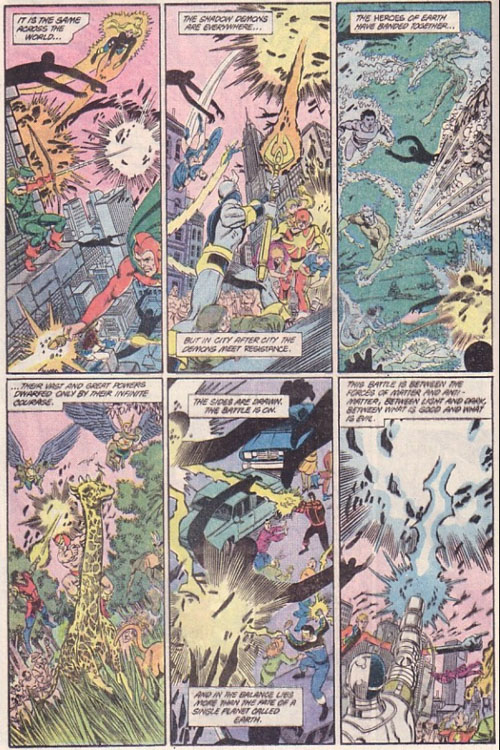
The above page, taken from a scene in Crisis on Infinite Earths, DC Comics’ first mega-crossover, called the “Battle Around the World,” is a classic example of complex compression, a big fight scene with simply a lot of figures acting and participating, with the text boxes very thoroughly explaining the context in which the battle is occurring. Though there is a cohesiveness to the page as a whole, this comic places incredible importance on each individual panel, where even the smaller elements within each panel encapsulate some distinct meaning. Each panel tells its own dense, rich story, a glimpse at events in every corner of the planet, and each character is posed to show them performing an action which defines their character to some degree. In the first panel for instance, the Green Arrow shoots from his bow and Starman is firing a blast from his signature weapon, the Star Rod. The image composition of each individual panel is vivid, each of them related to each other through similarities in both form and content.

For someone more used to manga, the way in which this information is organized together can be overwhelming. Whereas a character may be placed and posed to influence the reading direction of the page in manga, here the characters and panels are more self-contained. As a result, the manga reader may start to feel as if the story comes in fits and starts, almost as if someone were slamming the breaks every time there was something interesting to see. Manga and other comics which are more decompressed present panels as fragments of a whole, but here, panels are whole ideas unto themselves.


Batman #7

If we look at Batman #7, we can see that the word bubbles are fairly precise. There is no deluge of visual information requiring the reader’s attention. However, each panel is still being presented as a whole nugget of information, communicating a clear and specific point in every instance. That is not to deny the overall relationship the panels have with each other or the page on which they sit, but if you then look at Suppli, while it has some panels which present information as dense exposition, each panel (as well as each visual element within the panel), appears to cascade into the next, with the reader collecting bits of information along the way. Keep in mind, however, that compression and decompression, though essentially operating on opposite philosophies, can co-exist in a story, and the dividing line between them is not absolute, though one is often more present than the other.

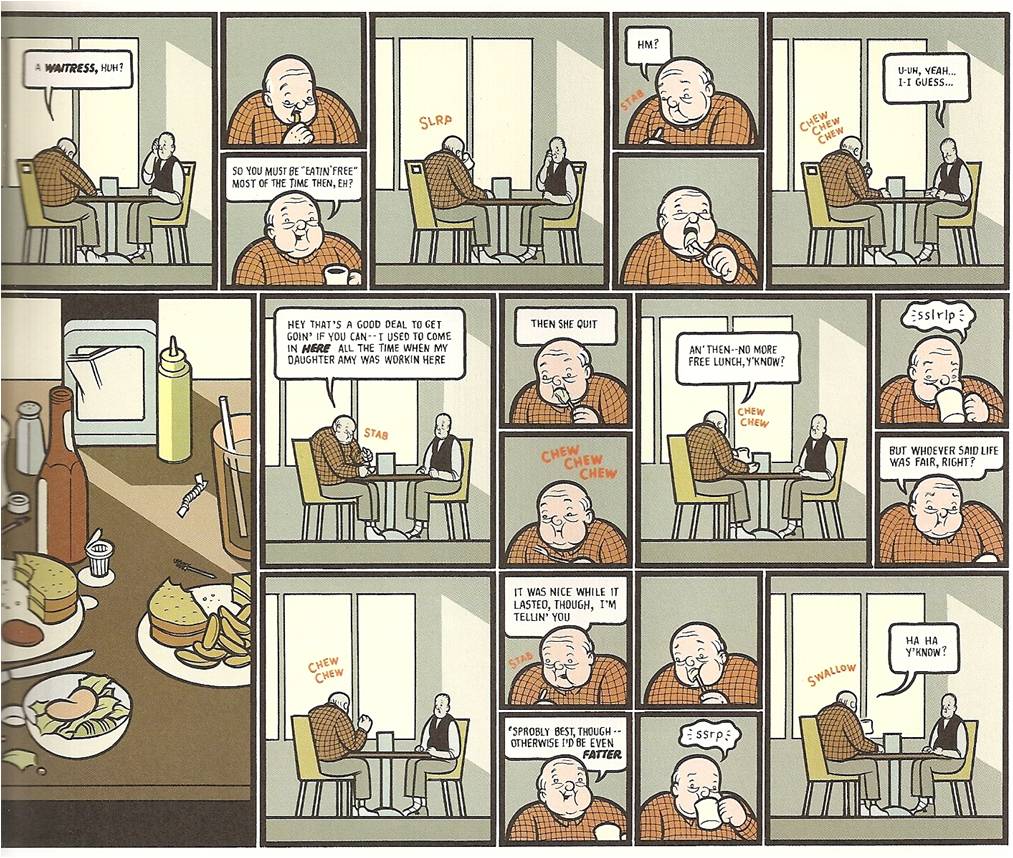
Decompression is increasingly a part of American comics, but the long-standing history of compression in American comics can be seen even in the ways a lot of more current comics have incorporated decompression. Marvel writer Brian Michael Bendis, for instance, is known for his snappy, natural-sounding dialogues which occur over multiple panels and pages, and which lend his comics a sense of decompression, but different artists have use different ways to portray those extended conversations, some of which are more compressed than others. Similarly, Chris Ware’s work (something decidedly non-superhero) can be both sparse and minimalist or extremely detailed and elaborate, but the paneling used in his comics also shows signs of an American comics tradition, albeit transformed heavily. The panels are somewhere between existing for complete information while also trying to hold back and let themselves strongly present their relationships to the panels around them.

So in the end, what can be done to help the reader for whom compression is a problem? In my opinion, the key is mainly awareness of how the panels operate. If you find yourself being weighed down by the comic, then just try to approach it one panel at a time. Think of the panel in a compressed comic as a lake or a pond. You dive in to examine its breadth and explore its depths, and then surface before moving on to the next one. Over time, your experiences will accumulate, but it’s important to let them build up.

Mysterious Girlfriend X is Somewhat Different in Anime Form

I’m actually a pretty big fan of the manga Mysterious Girlfriend X, so I naturally had to check the anime out. While it followed the manga very closely, I still came away with a somewhat different experience (though not necessarily a bad one), and it has something to do with some of the choices they made in adaptation, as well as the very act of adaptation itself.

Mysterious Girlfriend X is definitely a weird concept that just isn’t for everybody. The story centers around a high school couple, Tsubaki Akira and his girlfriend Urabe Mikoto, and their connection through saliva, specifically the fact that Urabe’s drool seems to have paranormal properties related to empathy. As boyfriend and girlfriend, rather than kissing, they exchange saliva by finger. I’ve seen it argued that the series is solely for people who have a saliva fetish, but I think this is really shortchanging the series and its viewers, because the reasons for following it aren’t as overly specific and narrow as “liking drool.” The appeal is more basic than that, as you have this thrilling and bizarre romance between an established couple who share a bond that seems to go deeper than anyone else’s.

That said, I found the experience of watching the whole saliva exchange to be different between the anime and manga in a way I’m not entirely for. In the manga, the drool is kind of a visual motif, drawn very simply, something that while ever-present is almost just like a rendered symbol. In the anime, however, they go out of their way to make the drool glisten and glow, to give it depth and dimension. The real killer is the sound, because in addition to all the effort they put into it visually, they also tried to make it sound as loud and slimy as possible. Again, drool is definitely a part of the series, but I think a little too much attention is given there.

Another thing that makes the anime quite different is the lack of manga-style paneling. This is kind of unavoidable, as anime is a different medium that works along different rules (unless it went out of its way to mimic the panel-based structure of manga), but Mysterious Girlfriend X has really fantastic page composition and paneling, especially in its smart usage of the contrast between black and white. I even used it in my article about decompression in comics. Take a look at the page above, and you’ll see that even if you took every one of those panels and animated them together, it would simply lack the overall structure of the “columns” created by the characters. When you then add color to the film-like style of the anime, it just makes for a different impression.

There are also a couple of more minor things to note. The first is that the elaborate dream backgrounds, which are fully drawn in the manga, are rendered in CG in the anime. A practical change of course, but one which kind of takes away that impressive bit where you realize someone drew all of that. The second is that the voice actor for Urabe doesn’t sound like I imagined she would, though that’s more on my end than anything else. Her voice actor also seems to be quite new at this, showing something of a similar effect to Omigawa Chiaki in her days as Maka from Soul Eater.

I’m still going to keep watching Mysterious Girlfriend X, of course, and I’m probably going to enjoy it. I just wanted to say something about the subtle changes that are present, and perhaps how this speaks to the things that can occur in adaptation from one medium to another.

Dead or Alive 5 and the Portrayal of Women

When Tecmo’s Dead or Alive 5 was first announced, the developers express the desire to portray their female characters better than they had in the past, with Team Ninja’s head developer Hayashi Yosuke even mentioning in an interview that “we’re trying to focus on the real women that surround us; the voice of a female, the mannerisms. We are being realistic about it.”

The DOA franchise has always been known for its sex appeal, from the first game’s available option to set level of breast jiggling to the Xtreme Beach Volleyball series where the girls trade their fighting uniforms for bikinis, so the promise of increased realism and improved depictions of women led to a some questions. Just what did they mean by real women, and could this fall flat on its face? Thus, although the guest appearance of Virtua Fighter protagonist Akira Yuki was the main headline, the new promotional trailer for Dead or Alive 5 is significant in that it gives us our first glimpse at just what the developers were aiming for.

Kasumi, main heroine, in DOA4 (left) and DOA5 (right)

Given the comparison image above and the statements from Hayashi, I think it’s clear that the changes to Kasumi’s look are not caused solely by improvements in graphics technology in the 7-year time span between the games. While Kasumi is still meant to be obviously attractive, there has been a bit of a reduction in her breast size and her face is substantially different, coming across as indeed “more realistic.” In fact, given the track record of the series, where greater realism could have meant shapelier breasts, Team Ninja has done a better job than probably anyone expected.


Ayane, Kasumi’s sister and rival, in DOA4 (left) and DOA5 (right)

Another feature that’s not really obvious without another character for comparison purposes is that DOA5 looks to be making more of an effort to give each character a more distinguishing face. When you look at any of the girls in previous titles, there isn’t much difference in their facial structure, andhen you look at the DOA4 versions of Kasumi and Ayane especially, they’re not that different from one another. With DOA5 however, their faces have substantial differences. They’re still designed to be attractive, and they still have similarly idealized bodies, but there seems to be an effort to vary the characters by more than their costumes and three sizes.

One element of Kasumi and Ayane’s newfound realism is that she seems to come across as “more Asian” than their previous iterations. Even though I haven’t actually seen this point discussed, I feel like this could potentially lead back to an argument concerning the appearance of anime characters where Japanese characters supposedly look “white” or distinctively “non-Japanese,” and that there may be some underlying psychological and historical reasons for making Japanese not look Japanese. The counter-argument to this has been that to assume the wide eyes of anime characters somehow equals “whiteness” is a cultural assumption in and of itself, but in the face of these revised looks, how does this hold up?

When I look at DOA4 Kasumi, even though her face comes across as “less Asian,” I still find that it comes across as more Asian than anything else, especially when compared to the non-Asian characters. And actually, Asianness and Whiteness as a binary is probably the most important mistake to avoid. Instead, the key difference is in another type of realism. In previous versions the characters come across across as more plastic and doll-like, especially in the eyes, with Kasumi’s own doe-like gaze, for example, acting more like an element of innocent seductiveness than anything else. In somewhat of a contrast, Kasumi in DOA5‘s eyes aren’t more realistic just because they’re closer to an Asian’s eyes in the real world, but because there is a sign of personality behind them.

I think the change in not just the way the characters’ eyes are, but the way in which they stare speaks towards what Hayashi meant when he referred to “the real women around us.” To some extent, this is aided by the improvement in technology, but it still requires the desire to move in that direction. Even as Kasumi continues to act as the sexy poster girl for the franchise, and while it can also be argued that her (and everyone else’s) bodies are ridiculous, I think that from what we’ve seen, Team Ninja actually seems quite serious about making the changes to the franchise that they promised.