Not the X-Games: Anime Expo 2012

Anime Expo 2012 was my first Anime Expo and my first west coast convention. While I’m not one of those really thorough con veterans, I still found some interesting differences between it and the conventions I’ve been to before, both when compared to the bigger cons as well as the smaller ones. Located in Los Angeles, it uses its position to its fullest.

Industry

In a change of pace of sorts, I  somewhat foolishly attended fewer industry panels than I normally would at a convention. I say somewhat only because of the fact that, for so many of them, they largely amount to announcements (which appear within a minute on Twitter) and they have Q&A sessions which lack teeth. Sometimes you can get a good one, and I try hard to ask good questions when I can, but the more “official” it is, the less chance you’ll get a decent answer. The foolish part is the fact that I was accustomed to Otakon, where one must generally choose between autographs and panels, an only later found out that AX works on a system of giving people “skip the line” tickets for attending guest panels. Lesson learned for (hopefully) next time.

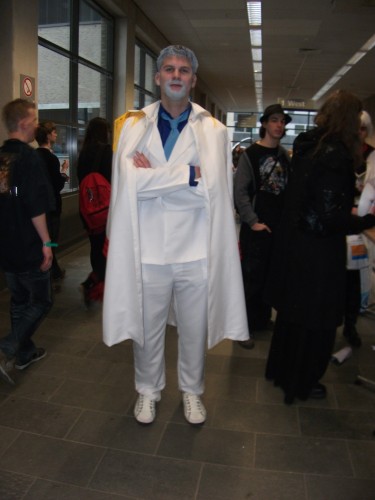
Despite those limitations, AX2012 was by far my most autograph-heavy convention experience I’ve ever had, which is a reflection of one of Anime Expo’s greatest strengths: the sheer amount of guests, particularly Japanese ones. I managed to get stuff signed by the staff from Madhouse, Animetal USA, Kajiura Yuki + FictionJunction, a limited autographed image from manga artist Toume Kei (who wasn’t attending but offered the images as part of a gallery), and probably the biggest one for me: an OVA of Legend of the Galactic Heroes signed by Horikawa Ryo, voice of Reinhard von Lohengramm. I happened to take a fantastic picture of him.

I did manage to go to a few panels as well. I went to the Animetal USA Q&A just to see that bit of spectacle (it was calmer than I had expected), and attended the panel for GoFA, or Gallery of Fantastic Art. GoFA can be described as an organization dedicated to taking anime and manga and giving it a sense of realism by creating products and opening galleries based on those works. The panelists showed off actual products such as glasses and watches based on the designs of anime and manga creators, and mentioned that artists such as Hoshino Lily (Mawaru Penguindrum character designer) and Fukumoto Nobuyuki (Kaiji, Akagi manga creator) have or will have gallery exhibitions in Japan. Apparently they’ve been a part of AX for a long time now, but this was their first time running a panel, a privilege they received because they’re actually producing a stop motion animation based on the artwork of Toume Kei (Sing Yesterday for Me). We got to see a very short preview, about which not much can be said because it lasted less than two minutes.

Another panel of interest was a manga workshop run by an actual manga artist whose name I sadly did not catch (though Peepo Choo’s Felipe Smith was helping to translate). I was unable to stay for the entire thing, but what I saw focused a good deal on anatomy, working from the idea that a solid foundation in realism is needed in order to deviate from it. While I don’t entirely agree with that assessment, I think it is nevertheless an excellent skill to foster and definitely a legitimate way to begin to create art and comics. I do wish that manga workshop panels and the like could move more towards paneling and page layout, but I get the feeling that character design is much more immediate has much more impact for the vast majority of people.

Concerts

I went to all three of the concerts—Animetal USA, FictionJunction, and LiSA—in some capacity, though could only stay for a small portion of the FictionJunction concert due to some scheduling conflicts (more on that later). Animetal USA had by far the smallest crowd, but an enthusiastic one nonetheless, and it was great to hear their take on classic anime songs from shows like Gatchaman, Mazinger Z, and Saint Seiya. I’ll admit, I’m not a fan of heavy metal (though that’s not to say I don’t enjoy it), but I’m glad I went. Later at their signing, the most impressive thing was that there was a real Animetal USA cosplayer, a girl dressed as guitarist “Speed-King” (aka Chris Impellitteri). What little I heard of FictionJunction was definitely excellent. I definitely wish I could’ve seen it all.

The LiSA concert is one of the highlights of AX2012 for me, because I went in only knowing her as the singer of the Fate/Zero opening but not particularly interested, and came out of it as a fan. Not only were all of her songs really good, but her practically-headbanging enthusiasm just filled the concert venue. Impressively, she managed to do the emceeing for her own concert almost entirely in English. I’m not sure how much of it was from actual fluency and how much was practiced and scripted, but she pulled it off regardless. She gave us the benefit of singing the opening to a new summer anime (that wasn’t even out yet), Sword Art Online, and the concert actually made me want to check it out despite only having a passing interest in it prior.

Non-Industry Panels

If AX’s main strength is its industry presence, its main weakness is a lack of interesting fan panels. While fan panels can always vary in quality, they tend to follow along the same basic goals of bringing fans together in order to share in a topic or to convey new ways of seeing the things we love, hat’s not to say that the fan panels at AX weren’t or couldn’t be interesting, but that the sheer amount of “official” panels somewhat limited the overall presence of fan panels. On top of that, many were workshops or something similar, but personally speaking I generally don’t go to conventions for workshops.

I attended the Bloggers and Podcasters Town Hall, not knowing quite what to expect, especially given the use of the term “Town Hall,” but it ended up actually being fairly accurate. Moderated by the Benjamin “Benu” Lopez of the long-running Anime Genesis podcast, the audience (including myself) discussed various topics, including the move to include blogging into a podcast and vice versa, as well as ways to break up the factionalism and cliques which often appear around groups of bloggers/podcasters. It was a fruitful discussion, and I got to meet a number of people I’d only read/heard previously, though I do kind of wish that we didn’t just talk about reaching out but also ways to refine and improve our existing work. As I said at the panel, I do believe that content is king.

Given that I’ve been a part of academia for a while now, I went with the purpose of attending as many of the academic panels as I could. At times, this caused conflict as I had to sacrifice seeing a certain guest in order to see what other researchers were working on, but I think it was well worth it. Even though other events clearly overshadowed the attendance of the academic track, there was something distinctly different about having it as part of a general convention instead of simply being a stand-alone academic conference. Mainly, I felt like presenters had prepared for a mix of academic and non-academic audiences, and it made the presentations a little more fun than what would normally happen.

The highlights of the academic track were the keynote address, where Professor Jeffrey Dym of UC Sacramento discussed his “History of Manga” class, and the “We Make Manga” panel run by Northrop Davis of the University of South Carolina. In both cases, the speakers really knew what they were talking about, and described the challenges they faced in creating their classes, how they designed their curricula, and what sources they used as the foundations for their classes. For Dym’s panel, the things that stood out to me the most were his lament that Ishinomori Shoutarou did not have more work out in English despite his legendary status and the fact that he hesitated on including sports manga in his class because of how little of the really groundbreaking series (Star of the Giants for instance) exist in English. For Davis’s panel, it was definitely the fact that he mentioned his class as being designed to somewhat mimic the editor system used by manga publishers in Japan, especially given the degree to which endeavors such as Tokyopop’s old OEL material lacked in that very area.

I think the attendance could have been stronger if the academic panels hadn’t been added so late. The large color guide didn’t even have those panels, and it was clear that despite the giant screens showing the updated schedules that many attendees ignored it. When I presented at my own panel (which ended up overlapping with the FictionJunction concert due to a 40 minute delay, thus eliminating my chance of doing both), it was to a rather sparsely populated room, which I honestly think could have been made more lively if only people knew about it (and if the concert didn’t start and end when it did). Overall, I think I did an all right job (I did a visual analysis of the manga 7 Billion Needles), I just wish more of you could’ve attended it!

Cosplay

I think I’ll say it: AX2012 was possibly the best convention I’ve ever attended in terms of cosplay. Not only were many of the costumes excellent, but I don’t think I’ve ever seen so much variety. Popular cosplay topics such as Homestuck and Hetalia!, while still very present, didn’t even come close to dominating the visual landscape of the con, and cosplays I had resigned myself to possibly never seeing appeared in numbers. Whereas previously I had seen zero Dragon Kid cosplays from Tiger & Bunny, this time I saw five.

I remember being the only person to clap for Dragon Kid at Otakon 2011’s Sunrise panel, so this was a pleasant change.

In addition, I thought I’d never see a Precure cosplay at an American con, but I was gladly proven wrong. Have you watched Heartcatch yet? It’s really good.

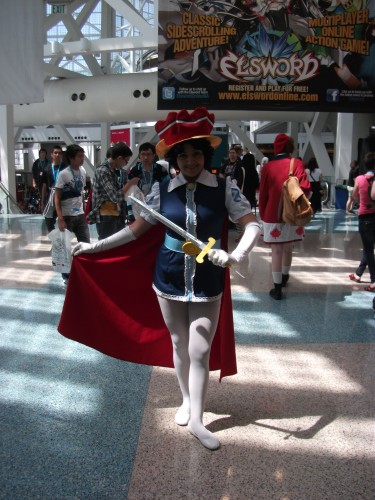
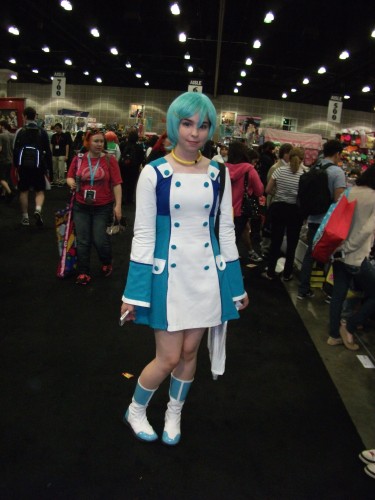
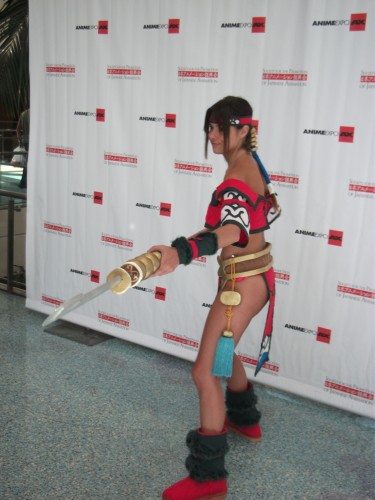
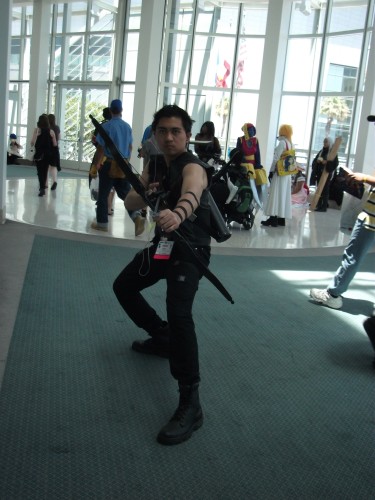
Anyway, I’ll let the rest of the cosplay speak for itself, though keep in mind that this certainly isn’t an accurate representation of all of the cosplay at AX2012, merely what I photographed.

Final Thoughts

So there went my first Anime Expo. If I had to do it over again, I probably would’ve found a better medium between panels and autographs, and I would’ve definitely tried to see more faces. Also, the Kinokuniya in LA is definitely better than the one in NYC.

Ogiue Maniax’s First Trip to Anime Expo!

Though not my first time in Los Angeles, it’ll be my first time hitting up Anime Expo, that monster convention whose size and majesty dwarfs all around it. In fact, it’s also my very first west coast convention, so while I know what to expect from a big convention, I don’t know if there’s anything particular this con in particular that I should be aware of.

In any case, I’ll be attending most if not all of the academic panels, and trying to go to the concerts if I can. I’ll also have my own presentation to give while I’m there on Saturday, as part of the Building Bridges Through Individual Texts panel. My presentation is titled going to be focused on the science fiction manga 7 Billion Needles.

My (tentative) schedule is as follows:

Friday

The Cutting Edge of Anime and Manga Studies (11am-12:15pm)

Why Do We Try So Hard? Anime and Manga Studies Roundtable Discussion (12:15pm-1:15pm)

The Origin of Anime Fandom (2pm-3pm)

Aniplex of America Industry Panel (3pm-3:45pm)

Animetal USA (WHO IS IT WHO IS IT WHO IS IT) (4:30pm-6:15pm)

Adventures in Teaching: “The History of Manga” (7:15pm-8:15pm)

Bushiroad Industry Panel (8:15pm-9:15pm)

Saturday

E-Manga: The New Style of Manga with Ryo Horikawa (11am-12pm)

Animetal USA panel (12:15pm-1:30pm)

Madoka Magica panel hosted by Aniplex (3pm-4pm)

Anime Bloggers/Podcasters Town Hall (4pm-5pm)

Yuki Kajiura/FictionJunction (6pm-8pm)

Building Bridges Through Individual Texts (8:30pm-10pm) (That’s me!)

Sunday

My Little Pony: Friendship is Magic Fan Panel (9am-10am)

Hamada, Morio, Tsunoki (Madhouse) (10am-11am)

LiSA Concert (12:15pm-2:45pm)

Right Stuf/Nozomi Entertainment Premieres (3:15pm-4:45pm)

What do Anime Fans do, Why and How? (5:15pm-6:45pm)

Supporting and Expanding Anime and Manga Studies (7pm-8pm)

Monday

Who knows!

So there you have it. For all you cool dudes I know, I hope to see you, and if I don’t know you, then I hope to at least meet you.

Blaaaazin’: Anime 2012

This past weekend was my second time attending the unambiguously named “Anime Con” over in Almelo, the Netherlands, only unlike last year I managed to go for more than one day. Truth be told, I had originally planned on skipping out this year for various reasons, but when I saw the guest list it seemed like a must. Not only was anime and manga scholar with a particular fondness for Tezuka Helen McCarthy attending, but there was Initial D opening/ending band m.o.v.e. as well. Another prominent guest was Dutch comics artist Martin Lodewijk, but I was not able to see him because he was only able to attend on Friday (which I skipped out on).

Located near the German border, the train ride to Almelo for me altogether took about two and a half hours, something I felt I should have remembered from the last time I did it, but somehow seemed strangely new. I was unable to procure a hotel at or near the venue, but taking the train back and forth ended up costing less money (and even less than a similar trip by Amtrak back in the US), and it gave me a lot of time back and forth to read manga and even to draw, which I hadn’t done in a long time. So, even aside from the actual convention itself, fun was had. Also quite fortunate was that the weather in Almelo was excellent, and if I hadn’t had to pass through wind and rain to get there I would’ve thought it to have been a waste to wear a jacket.

Before I get into the con itself, I do want to note that there are some interesting parts of the event which didn’t change too much from last year like the game room and the maid cafe, so I’ll refer you again to last year’s report.

Panels

Now I am the type of con-goer who loves to attend panels, and it was very clear to me that Anime Con this year had made a concerted effort to insert more panels into its programming. There were humorous panels, quiz shows, and a number of informative ones, including a Vocaloid panel. Not being terribly interested in Vocaloid myself normally, I walked in on it half an hour after it had begun in order to be around for the next panel, only to realize that in my ignorance I had missed out on what may have been the best Vocaloid panel ever.

Normally, Vocaloid panels seem to be more celebrations of Hatsune Miku and friends, but this panel was actually run by motsu, the rapper from m.o.v.e. Known for such sage wisdom as “I got no impression/ This town made by the imitation/ Wanting your sensation/ In this silly simulation/ I wanna rage my dream,” from the little I caught of it, the whole hour was a little bit of history about Vocaloid and a lot about how it works as a music-making program and its limitations, like how Vocaloids are bad at that double-consonant often found in Japanese, the “kk” in Tekkaman for instance. The band has somewhat close ties to the program, as not only was his fellow bandmate yuri was made into the celebrity Vocaloid “Lily,” but the guy as an active musician uses the program himself, even posting on Nico Nico Douga under the name “Nicormy.”

We learned that motsu likes to use the Gackt-based Vocaloid “Gackpoid,” and that there was originally some trouble with Vocaloid Lily because of yuri’s relatively deeper voice and how the program is better-suited for high-pitched tones a la Hatsune Miku. He also gave some tips for working around the program’s limits, like using the hi-hat (the cymbal?) from a drum machine in order to simulate a “ssst” sound, another weakpoint for Vocaloids, or using a “bend down” to improve the sound of Vocaloid rapping. Even though I don’t know music and had to look up some of these terms after, I really regret not being in there earlier.

Right after the Vocaloid panel was Helen McCarthy’s talk on “kawaii” and its origins, tracing it back more generally to a biological human tendency to want to protect doe-eyed creatures be they babies or kittens, as well as more directly how the styles we associate with Japanese cuteness were the result of an intermingling between Japanese and Western cultures. For instance, Helen pointed towards Betty Boop as an influence on kawaii, a mix of cute and sexy and facial proportions which resemble a traditional idea of attractveness in Japan, and talked about the French artist Peynet, whose romantic drawings of Parisian life still persist today.

Of particular note for me was her brief discussion of the artist Macoto Takahashi, whose “Makoto Eyes” (see above) would clearly become an influence on 60s and 70s shoujo manga. In fact, I had to ask Helen about the clear lineage into shoujo, and what might have caused a decline in those types of sparkling eyes, to which she replied that it likely has to do with how the painstaking detail of Makoto Eyes, which can take hours to draw precisely, conflicts with the hectic work schedule of a manga artist.

The last panel I attended was “The Future of Comics is Manga.” Held on the last day of the convention, it drew what I felt was a surprisingly large crowd based on my experience with American conventions, and I have to wonder if there are actually proportionately more anime con attendees interested in industry and creator discussions compared in Dutch conventions. On the panel were Helen McCarthy, Japanese manga and video game pixel artist curently living in the Netherlands Aoki Noriko, writer for the Dutch anime magazine Aniway Rik Spanjers, and Dutch comics writer Sytse Algera. The discussion went to various places, from how it’s faulty to say that comics never appealed to adults around the world and that it’s more an issue of the comics industry not being able to hold onto those readers to the comparatively low salary that most manga artists make, which has to be tempered by an actual passion and enthusiasm for creating comics.

Somewhat unfortunately, the Q&A session turned into primarily a discussion of piracy and copyright, from downloads to doujinshi to everything in between. While I felt that it was in certain ways a fruitful discussion, and everyone agreed that creators cooperating with fans had definite benefits, it also pushed aside all other potential questions. Moreover, a lot of the discussion had to do with artists feeling that they’re being slighted by downloads, and I feel that when you have a panel comprised of mostly artists and creators it skews the discussion in a certain direction, just as a panel of mostly editors might, or a panel of mostly fanfiction writers. All in all, though, it was quite informative.

The Concert

While I’m aware of the fact that m.o.v.e. has performed at at least one anime convention in the US, given my current living situation and the sheer size of the United States it was actually easier for me to go to Anime 2012 to see them than if I were still back in the US and they had visited another state.

Last year I had attended a portion of the Aural Vampire concert, but had to leave early. This year I decided to stay for the full thing, which almost didn’t happen because the concert started 45 minutes late. In spite of not getting home until 1am as a result, it was still really great, with m.o.v.e. playing up the crowd and throwing in their Initial D songs alongside some of their non-anime-related work.

I am no regular concert attendee, so I can’t say if this is anything truly special or not, but I was pretty amazed that the singer yuri actually sounds better live than she does in official recordings. I don’t have the proper musical vocabulary to describe what I mean, but she actually comes off as more powerful on-stage than in music videos. motsu meanwhile rapped up a storm, and in some ways it’s even more special to hear live than yuri’s strong vocals.

There were also some technical difficulties with the microphones during the concert, but m.o.v.e. handled it very well with the help of a supportive crowd. When mics would stop working, the two would share one, and at one point the DJ Remo-con (who also deserves respect) passed over his personal headset to motsu so he could continue.

As might be expected, motsu actually has excellent English (he was even occasionally switching to English in the vocaloid panel prior), and was definitely not working from a script when talking to the audience. My favorite moment was probably when motsu asked if we wanted “A CAT FIGHT” or “ANOTHER KIND OF FIGHT.” Remo-con responded with a cat paw gesture. At another point, motsu also asked what kind of beat we want, giving “flamin'” as one option. Naturally, there was only one choice.

Artist’s Alley

Unlike many of the Dutch cons I’ve attended the artist’s alley this time around was somewhat separate from the dealer’s room. I’ve spoken about this many times before, but I’m still interested in the fact that most of the artists in the alley seem to prioritize making full books, either by themselves or in collaboration with others, as opposed to buttons and other trinkets (though those were still around). I have to wonder if it has anything to do with the Netherlands’ own strong tradition when it comes to publishing (it was known for having very good freedom of publishing centuries back), though that connection may be too tenuous.

An interesting element of this convention’s artist’s alley was that there was this peculiar collectible card game available, where you actually buy cards based on the amount of things you buy in the artist’s alley, which you could use to create an actual deck. I didn’t buy too much from the alley, so I couldn’t experience the game firsthand, but it was apparently the idea of the people running the Manga Kissa (manga cafe) at this convention and many others, and who actually currently have a permanent location in Utrecht.

I also got a chance to talk Aoki Noriko, the Dutch-resident Japanese artist, who is also apparently a huge fan of Saint Seiya given her personal portfolio. As we talked, she mentioned some of the difficulty going from traditional media to digital, which is a topic I’m always interested in. In the end, I bought the comic above and left with a thank you, though looking back I regret not asking her more about her work in video games, as she did sprite graphics in the 8-bit and 16-bit era.

Speaking of art, ever since Nishicon 2011 I’ve been really enjoying the idea of a drawing room at conventions, a place which provides free paper and drawing tools so that people can go nuts. Like at Nishicon, the room was run by “Mangaschool,” the group which also ran various drawing tutorials and workshops throughout the convention. I feel like sometimes the best thing to do to get away from the hustle of a con while still being a part of it is to just sit down and draw, to let the mind wander through the hand. Also robots are cool.

I don’t have a proper scanner on me at the moment so while I’d like to share the drawings I made at the convention, I’m going to save it for a separate post in about a month. Look forward to it!

Storyboards

Also on display at the convention were various anime design work and storyboard pages from a wide variety of shows. I’ve included some below for your enjoyment:


Sakura contemplates revenge

Cosplay


Sadly she was not singing the Panty & Stocking opening

Overall

While I may not be the best judge of the long-term progress of “Anime Con,” I noticed many improvements compared to last year, especially in terms of varying the kinds of things that are available to do. Theaterhotel Almelo may only be able to hold 3000 people, but I certainly felt their energy as fans.

Preparing for Anime Con NL 2012

I’m going to be heading to the Dutch con known simply as  “Anime Con” next weekend (May 18-20). Located in the city of Almelo near the German border, I attended for the first time last year, though this time I’ll be attending for more than one day.

Of particular interest at this convention is their musical guest, m.o.v.e., known for their Initial D themes, manga scholar Helen McCarthy, and the famous (actually I believe most famous) Dutch comics artist, Martin Lodewijk.

If you’re in the area but haven’t decided to attend yet, do note that the hotel rooms are all booked, but that you can still get a discount if you register by the 17th.

The Adventures of Tsunacon 2012 ~New Wings~

This year was my second time at the Dutch anime convention known as Tsunacon. As a one-day event I won’t have a ton of things to say about it, but there were some significant differences this year, not least of which is the move from the town of Sliedrecht over to the more well-known city of Rotterdam to make room for the ever-growing con attendance numbers.

Naturally, the first difference was transportation. Whereas last year required me to transfer to a rather small and adorable train, Rotterdam is one of the largest cities in the country and so took only one train to get there (getting back was a different story, but more on that later). This also means that for other people living around the country, there is a far likelier chance that the trains will be relatively more convenient for them as well. But unlike in Sliedrecht where it took only a short walk from the station to the convention, going to the new location required an additional bus or tram. Well, you could still walk but it would probably take you over an hour, and if you’re like me and European cities and streets confuse you, then it would take you about twice that amount. The trams and buses are both very close to the train station though, so it isn’t really a hassle.

The actual site of the convention this year was the Social Sciences building of Erasmus University, and it was, as promised, significantly larger than the old place. With three floors available as opposed to just one, and a significant amount of space per floor, it seemed just the right size for the convention, providing enough room for people to move around, but not being so spacious as to dwarf the crowd and make the place seem barren. Cosplayers were naturally everywhere, and as is common here, the dealer’s room is combined with the artists’ alley, with dealers and artists all mixed together. Overall, the university was lacking some of the charm of the old location in terms of its coziness and warmth, but I think it was a fair (and of course necessary) trade.

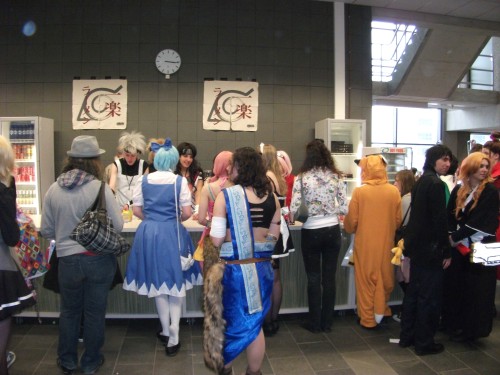
One major difference with the new location was the way in which food was handled. The spot in Sliedrecht was something of a fitness and recreation center, so it had both a small bar in the main area, as well as a bar with seats where karaoke had taken place. One of the most vivid memories for me at my first Dutch con was seeing a fairly large crowd chowing down on cup noodles like they were the best thing ever made (a claim that is supported to some extent by the fact that it has its own museum). This year however, cup noodles were practically a thing of the past, as Tsunacon saw it fit to serve actual bentou and bowls of ramen straight out of Naruto (with signs saying “Ichikaru Ramen” hanging above the serving area). Though the lack of a bar limited the food options (no bitterballen or Japanese beer as far as I could tell), this did not seem to bother the patrons at all, because the line was gigantic.

Even though I passed by the line repeatedly over the course of many hours, not once did the line ever die down, as if the people’s desire for ramen was insatiable. Honestly, I can relate, because unless you live in Den Haag, Rotterdam, or Amstelveen, it can be quite difficult to get a half-decent bowl of Asian noodle soup in the Netherlands, whether it’s ramen, wonton noodles, or pho. I know it’s a hunger that never fully dies down, and maybe on a different day I would have joined them.

There’s some obvious advice for you: serve Japanese food at an anime convention and you’re sure to be a smash hit. Think Pocky is the talk of the town? Why not hit them with some udon?

The larger space also allowed for something new this year: panels. Whereas last year the closest thing you could get to a panel was a cosplay/AMV competiton or an arts and crafts workshop or two, Tsunacon dedicated a room to the endeavor. Seeing as the panels were in Dutch, I couldn’t exactly get the most of them, but I did attend the one panel I could actually follow along with: Name that Anime. Divided into categories such as “openings,” “action scenes,” and “traps” (yes, that kind of trap), the panelists showed footage from a large variety of anime. As far as I could tell, most of the anime were from the last decade or so, with a sprinkling of Ghibli as the primary representation of anime 20 years and older. As I wasn’t sure of the exact nature of the panel going into it, I didn’t participate for fear that my inability to speak or comprehend Dutch would hold me back, but I might try next year. Overall, the panel was 90 minutes, which might either be too much or not enough for this kind of “game show,” but it seemed like it was on a good track to improvement for next year.

The last thing I did at the con was go to the karaoke room, as anyone who knows me is aware of the fact that I enjoy singing anime songs even though I can’t sing. It’s also fun to see people really get into the songs they love, which ranged from Vocaloid tracks to the popular shounen titles to the English Pokemon theme, which seems to be universally popular among singing anime fans. I spoke about this last year, but the people responsible for karaoke at Dutch cons have an entire fancy system set up to mimic a proper set. With a monitor displaying words in-sync with the song, just about anyone can follow along if they know the basics of the song, something that not even Otakon has. As for myself, I recognized a lack of burning passion in people’s selections, so I went with the go-to song for both me and one Astro Toy columnist: Kanjite Knight. Though quite off-key, the crowd was still nice enough to applaud my endeavor.

When I look at the attendees at these conventions in the Netherlands, I get the feeling that, while tastes are largely similar between the US and Dutch fans, there seem to be some major differences as well. Most notably, One Piece seems to be more well-loved among the Dutch anime fans. Does anyone else get this impression? People sang One Piece songs at karaoke, One Piece merchandise seemed to be popular in the dealer’s room, and I even saw a Garp cosplayer, which is something I have never seen at an American con (though I may have just not been paying attention). How popular is Monkey D. Luffy and his merry band of pirates among Dutch otaku, anyway?

In any case, cosplay:


(To the cosplayers above who asked me to send you this photo, my apologies as I seem to have lost your card!)


The famous combo of Chii & Stocking

I would have stuck around longer, but by 4pm noticed that it had began to snow. As I have learned during my time here, snow + Dutch trains = not fun, and what was once a 30-minute trip turned into 2 hours. Obviously, that’s no fault of the convention itself, and in hindsight I can only imagine how much worse the delays would have been going to and from Sliedrecht. In spite of those troubles, it was overall a fun convention where people just enjoyed being anime fans.

To Tsunacon This Weekend

This Sunday, February 12, I will be attending the Dutch anime convention Tsunacon in its new location in the city of Rotterdam, which so happens to be where I was a couple of weeks ago watching the premiere of the Ace Attorney movie.

Seeing as I’m generally bad at finding my way to places, I expect to get lost at least a couple of times on my way to the convention center, but hopefully things will turn out all right.

I’ll likely have a badge to identify me in case anyone wants to say hi, though as for some kind of unique clothing, it all depends on the weather (for those of you not currently in Europe, it is so unbelievably cold here!).

If you want, you can also read my coverage of last year’s Tsunacon in its old location in Sliedrecht.

(I’ll miss that tiny train.)

Appreciating Fandom at Nishicon 2011

This past month I had the opportunity to attend an entirely brand-new anime convention in the Netherlands, Nishicon.

Taking place in the city of Haarlem, Nishicon was held in a kind of sports gymnasium, which meant a few things. First, the primary form of seating was bleachers, which given the small con population (though by no means a disappointing turn-out) actually made for very convenient seating. Practically everything took place on that central floor, with workshops and video games being the only exceptions, so it was easy to move from one thing to another. If you were on the main floor, it was essentially impossible to avoid hearing the cosplay and AMV competitions, which seemed more of a close gathering of enthusiasts than the massive arena-filling extravaganzas of a large or even medium-sized American anime convention. When the AMV contest was taking place, every so often I could peer over to the other corner of the room and catch a glimpse of it.

Another feature of Nishicon was the bar and maid cafe, which like “Anime Con” in  Netherlands (and unlike New York Anime Festival) allowed the maids to serve its customers. This maid cafe is run by a different group than the one from Anime Con, and in speaking to one of the head maids I found out that they were looking to differentiate themselves from other maid cafes at Dutch anime cons by providing a more interactive experience. In addition to custom snacks (alongside the standard Dutch bar fare, beer, frikandel, kroket, etc.), they also provided a chance to play card games and board games, as well as provide a shoulder massage which only cost 2 euros.

Speaking of cost, I’ve noticed that Dutch cons seem to provide much more affordable food options than their American counterparts. While a tad pricier than just going to an automat, a broodje kroket (croquet on a roll) cost me a mere €2.50 or so. While I don’t know the exact reason for this, I have to imagine that it’s because every convention I’ve been to so far has had some sort of fully stocked bar attached to it, and they simply charge the prices they normally would. That said, if you’re coming from the United States watch out for the dollar to euro conversion rate.

I bought one piece of merchandise at this convention: a card game called “Manga Manga” (no relation). As you can see from the box, it has Action Power.

Outside of the AMVs and the cosplay, there were no big “events” or panel programming. For me, this is quite unusual, as I primarily spend my normal convention experience darting from panel to panel, with breaks for food and checking out the dealers’ room. As a result, this meant that if I were to enjoy myself at Nishicon, it would have to be at a relaxed, non-goal-oriented pace. In that regard, I think Nishicon was quite successful for me. I was able to play Go for the first time (and lose, naturally). I spoke to people at tables, asking them what they thought of the convention, one of whom mentioned that it’s fortunate for a convention to be located more towards the western side of the country). I found myself at a drawing area (run by the fine folks at mangaschool.nl) next to people I didn’t know, putting to paper whatever came to mind. It was actually the first time in a long while that I’ve drawn that much, and that made me feel good (or bad, depending on how you look at it).

What it all came down to for me was that the “lack” of major events made me participate in the convention the way I think most con-goers in general do. The point isn’t to listen to fans and creators talk about some aspect of anime and manga, nor is it to expect some “thing” out of it. That vital aspect I think people are looking for is the simple pleasure of being surrounded by others with the same passion for anime, and that is something that can be experienced by just sitting around other anime fans. Don’t get me wrong, I love attending Otakon, but I would not have ever sat down there next to other artists (aspiring and otherwise) in order to just relax with pen and paper.

Before I leave off with a barrage of photos, I want to mention something that might make some people feel a tad salty: did you know that Michiko & Hatchin was released in the Netherlands but not the United States?

Ogiue Maniax Headed to Nishicon 2011

To partially sate my persistent curiosity about the anime fandom in the Netherlands, I’ll be attending Nishicon tomorrow, November 13, in Haarlem. As far as I know this is the very first Nishicon, and I’m interested in seeing how it debuts. The only other fledgling conventions I’d been to otherwise were New York Anime Festival and New York Comic Con, and those are quite different in scale for a variety reasons, one of which is that the NY cons are professionally run exhibitions.

In any case, I’ll be there for probably most of the day. You can find me by speaking Dutch and observing my blank stare.

Ice Ice, Cold Cold: Otakon 2011

Otakon 2011, occurring over a blistering 100-degree weather weekend, was a unique anime convention for me because it was the first US anime convention that I have been able to attend since my departure to the Netherlands. In the context of my vacation back in the US, it was an odd little break within a break that felt all the more special as a result.

There was also just a lot to do at Otakon, even more than previous years.

Premieres

Otakon this year was packed with premieres, anime that had never officially aired outside of Japan. In an age where convention viewing rooms have lost their importance compared to when they were the main reason to go to a convention, the willingness for Japanese companies to debut their works at cons brings back a bit of old school flavor.

I attended the showing of episodes 1 through 3 of Puella Magi Madoka Magica, the dark, subversive magical girl anime which this past year took the Japanese internet by storm. Though normally I would not watch at a con something I’d seen already, especially a series which doesn’t rank among my top favorites, I attended the premiere in order to gauge the audience reaction to the show. Who exactly was attending this premiere? Despite its popularity among fans on the internet, how many people had actually seen Madoka Magica?

Though there were a number of people who had obviously seen the show already, it was clear that for much of the audience, this was all-new. The crowd cheered and clapped not at the moments where you expect someone with full knowledge of the show would, but at points in the episodes where new and exciting things happen, such as when a magical girl transformation happens for the first time. Also, in re-watching these early episodes, I noticed some particular details, such as how Mami’s transformation sequence is different every time. Overall, I think the show made quite a good impression on the viewers, and I expect the series to reach some degree of success.

Another of the big showings was for the film Trigun: Badlands Rumble, a follow-up to the enormously popular Trigun series. Trigun is probably one of the most beloved anime titles among American fans. I’ve known a lot of people both personally and through observation who had been itching for more Trigun anime for years, and Badland Rumbles scratches that itch pretty well. Centering around Vash the Stampede’s confrontation with a robbery-obsessed villain named Gasback, who only ever takes money so he can use it to fund his next heist. The film features all of the main Trigun cast, and acts as a good reunion for fans, though I’m not sure how well it would do for someone who’s never seen any Trigun before. If I had to make a guess, I think it could still do a decent job because of how action-packed and fun it still is.

The last premiere I attended was for Shinkai Makoto’s new film, Hoshi o Ou Kodomo: Children who Chase Lost Voices from Deep Below. Known for deeply introspective works such as 5cm per Second and The Place Promised in Our Early Days, Hoshi o Ou Kodomo is a first for Shinkai, a more mainstream-feeling title that, although possesses a good deal of introspection, has a greater emphasis on adventure and exploration. Focusing on a young girl named Asuna who gets drawn into a mysterious world, the film has a number of flaws, feeling like it tried to introduce too much all at once and so occasionally lost focus. It manages to mostly overcome these problems, though they’re still a sticking point. This may be a sign of Shinkai’s inexperience with this type of film.

Regardless of the film’s strengths and weaknesses however, the showing of Hoshi o Ou Kodomo was made all the more special by the fact that Mr. Shinkai himself was a guest at Otakon 2011, his first ever American anime convention.

Guests, Directors, Producers

We were given a number of opportunities to interact with Shinkai, with a Q&A directly after his film on Saturday, an additional Q&A later in the day, a press conference on Sunday, and then a final Q&A with a bunch of directors and producers. Due to certain conflicts, I was only able to attend the first and last Q&A but both were extremely informative. Shinkai is not just simply polite but actually very humble, giving detailed answers to every question asked. At the first Q&A, Shinkai elaborated on his desire to create a more mainstream film that is visually accessible not only to a Japanese general audience but an international one as well. I was able to ask Shinkai a question myself:

Q: In the film, Agartha is in decline and the people there think it’s best to accept it, but others struggle not just against death itself, but struggle to live their lives. What are your own thoughts on to what extent a person should struggle against that fate or accept it?

To which he responded:

In the film, there are those who have accepted that they are not long for this world. But Shin, a resident of Agartha, hasn’t accepted it. If asked this question 15 years ago, I would have definitely sided with Shin, but now that I’m older I can’t help but say I understand the view of the other people. In this film, I didn’t want to side with either side. I didn’t want to deny either side.

I had originally wanted to ask Shinkai about digital animation, but after seeing the film and the concept of accepting the decline of one’s own civilization, it had me thinking about the way in which all of the various characters struggle in different ways and to varying degrees against their circumstances, and it spurred me to ask this question instead. Fortunately, I would have another opportunity to ask Shinkai about the animation process itself at the Directors Q&A Panel.

The Directors Q&A was nothing short of amazing, as it brought together directors Ishiguro Noboru (Macross, Legend of the Galactic Heroes), Murata Kazuya (To Heart, Full Metal Alchemist: Sacred Star of Milos), and Shinkai, and every answer showcased just how different these three were in terms of age and experience. The best example might be when someone asked what series would be considered the directors’ top must-watch anime. Whereas Murata picked a good, yet fairly expected response in Future Boy Conan, Ishiguro mentioned old Czech puppet shows, Canadian animator Norm McLaren, and a Chinese sumi-e-style animation from decades prior called Muteki and Shinkai actually selected Ishiguro’s own Legend of the Galactic Heroes. This generational difference was also evident in their responses to how the recent earthquake and tsunami might affect the industry and its people, with Ishiguro mentioning that the lack of escalators and power outages were something that he remembers and is familiar with from decades ago, while Shinkai talking about how he thinks that there is definitely potential to use this event to fuel the creative process but doesn’t quite know yet how to do so.

Keeping in mind this living history of directors available, and also remembering a comment from Ishiguro earlier in the panel about how he has had trouble adjusting to digital animation, I crafted my question accordingly: I asked if Shinkai and Murata, who both worked in digital animation, had any advice for Ishiguro in terms of working with digital animators. If you think about it, Ishiguro worked primarily in an age of analog animation, Murata worked in the transitional period between the two, and Shinkai is purely digital, this meant that each of their responses would embody different experiences and values. Knowing that Ishiguro is a living legend and that neither Shinkai nor Murata would want to show any disrespect towards him, I tried to phrase the question to give them as much leeway for politeness as possible, but it was still clear that this was going to be a tricky situation when the translator actually said, “I’m not going to touch this one.” Fortunately, Ishiguro, upon learning what I asked, actually encouraged the younger directors to give answers, sincerely willing to set aside seniority for some help.

Murata spoke of his own initial thoughts towards digital animation. Having worked with cel animation and remembering the hardship of lining up cels and taking photos of the compiled images one by one, Murata saw the move to digital as an opportunity to do more with more freedom. Shinkai, however, actually said that today’s digital animators should be learning from the older cel animators because, at the end of the day, as long as the initial images are still drawn with pencil on paper, those experiences and talents are still very important. Another interesting conversation arose when Shinkai mentioned working with older animators and how they worked in “millimeters” while digital animators think of space in terms of “pixels,” to which Ishiguro responded that he had to deal with the opposite problem, seeing the term “pixels” for the first time and wondering how many millimeters that was supposed to be. My question was the last one and it felt good to end the panel that way.

I was also able to get Evan Minto from Ani-Gamers to ask Shinkai a question at the press conference, about what it’s like to work with computers in animation. Interpreting the question as to mean 3DCG, Shinkai remarked that he actually prefers 2D animation despite his background in games, and would only go back to 3D if 2D faded away. Given the number of great anime creators who only started working in anime because they couldn’t find more “legitimate” work, I have to wonder if this could be another case for allowing 3D anime to fully mature.

There were Q&A sessions with both Ishiguro and Murata, as well as Madhouse founder and perpetual Otakon guest, Maruyama Masao, but unfortunately they conflicted with just about everything else. Notably, Maruyama’s and Ishiguro’s panels ran during the showing of Shinkai’s film. Still, I am glad I got the opportunity to see Ishiguro on the Directors/Producers panel, and I managed to get autographs from both Ishiguro and Maruyama. Speaking of Maruyama, the man has worked on so many things it’s actually kind of hard to be completely unable to find merchandise related to his work. In my case, I had him sign my Cardcaptor Sakura movie DVDs.

Industry Panels

This year’s Otakon included a Sunrise industry panel, which might not seem all that special compared to other companies’ panels until you realize that Sunrise never holds industry panels. Usually, there stuff goes to Bandai Entertainment, but this time it was Studio Sunrise, creators of Gundam, coming straight out of Japan to talk to the fans at Otakon about their shows. The panel began with an introduction from Sunrise producer, Ozaki Masuyuki, and then continued with a video showing called “The World of Gundam,” giving a brief history of the franchise and how it has affected Japanese animation. The video delivered on two points, first of which is that it fulfilled my wish for it to have a hilarious English-language narrator, and second of which is that it managed to result in a few surprises. Ozaki was clearly expecting the cheers for the original Gundam and titles like Gundam W, but when the crowd went into a roar over G Gundam, I could literally see that Ozaki didn’t expect it, with his body actually being taken aback by it.

From there, they showed a recap of the first season of Tiger & Bunny (which contained spoilers!), and it was also evident that the show was extremely popular. I also had a bit of a realization during that section, as Ozaki asked one by one if each hero was the crowd’s favorite character. Naturally, characters like Wild Tiger, Barnaby, and Blue Rose got good reactions, but when he asked about Dragon Kid, I found myself to be the only one clapping and hollering.

(Dragon Kid is the best, forget y’all.)

The panel also had a bunch of new show previews, the most interesting of which is probably (Gundam AGE aside) a series titled Phi Brain Puzzle of God. Apparently, it features a kid who is good at solving puzzles. The title alone makes me want to check it out.

Speaking of Gundam, the Tamashii Nations booth in the Dealer’s Room featured this:

Being that this was the first and possibly only time we’d ever see an official Sunrise panel, a lot of questions were asked about a lot of series. Patz from Insert Disc for example asked about the possibility of streaming older shows, especially the Yuusha robot series, and the answer there was that they were looking into streaming as much as they can but that there were no definite plans. I asked about the possibility of reviving significantly older giant robot franchises such as Zambot 3 and Daitarn 3, to which the response was that Sunrise prefers to create new concepts rather than going back to older ones, unless there is significant fan demand or a director/producer has interest in doing so. Gundam, I assume, falls under both the former and latter. There was also a lot of praise for Tiger & Bunny and hope from the fans that there would be more. Probably the question that sticks out to me most was the lone girl who politely asked them for more My-HiME/My-Otome in a thick southern accent, if only because that franchise didn’t seem to be on anyone’s radar. Interestingly, Ozaki said that the My series is designed to have sequels. These are certainly not concrete answers, but more than I typically expect from a company official.

If you want real answers at an industry panel though, look no further than Vertical Inc., publishers of Twin Spica, Chi’s Sweet Home, and a plethora of classic Tezuka titles. While going through all of their upcoming titles, marketing guy Ed Chavez (who you may remember from the old Vertical Vednesdays) would talk about his own feelings towards them, giving a genuine sense that he had a personal investment in all of their licenses, which include a manga adaptation by Furuya Usamaru of No Longer Human, Princess Knight, and The Drops of God. In answering a question of whether or not the manga would be flipped or unflipped, Ed remarked for instance that The Drops of God would remain unflipped despite its potential for success outside of manga readers because of how the intricate labels on wine bottles would be excessively difficult to correct afterwards.

The Bandai After Dark panel tried to be a somewhat free-flowing, “casual” panel as well but didn’t quite come across that way. That said, there were a number of highlights. The Gosick and Nichijou anime have been licensed for DVD release, as has the Nichijou manga, which according to one person I know is far superior to its adaptation in terms of comedic timing and such. The composer for The Disappearance of Suzumiya Haruhi was also present, and he played a violin solo of that movie’s main theme, Yasashii Boukyaku. I really love that song, and I think that was one of my favorite moments from Otakon.

In terms of industry panels, last but not least must be the Angel ScandyS Q&A, which centered a show that isn’t even actually in production yet. Ishiguro, the aforementioned director of Macross, has thrown his hat into the ring that is the moe idol genre. Planned to be a story about angels, devils, and human idols competing over a young man’s soul (or something), what’s fascinating about this project is that they bothered to show it at Otakon at such an early stage, something I’m certain has never been done before. The voice actors, who were selected first and had characters based on them rather than the other way around, had prepared a skit as well, both in valiant Engrish and in Japanese, to give the audience an idea of what the show might be like. When asked about the music, we were told that Ishiguro himself wrote the lyrics for the music. Ishiguro meanwhile, had been sneaking around the panel itself, preferring to film the panel from an audience perspective. I asked them about the character designs, which seem oddly familiar despite being so generic, but was told that 1) it was done by an unnamed Artland (Ishiguro’s studio) employee and 2) that the character designs aren’t even final. I don’t know, seeing a project so early in its life piques my interest.

Fan Panels

Due to the sheer amount of premieres and unique industry panels this year, on top of the scheduling conflicts that caused similarly themed panels to run at the same time (Gundam Unicorn showing vs. Sunrise panel vs. Gundam panel vs. Underrated Mecha panel), I unfortunately was unable to attend very many fan panels. Still, of what I saw I certainly enjoyed.

The Reverse Thieves ran two panels this year, “The Best Manga You Never Read: Tokyopop Edition” and “Investigating Detective Anime.” The former pointed out titles that the two considered to be underrated titles, many of which did so poorly in the US as to be canceled even prior to Tokyopop’s demise. One good reason to go that panel is actually the Q&A section, not because they give out free stuff, but because they’re actually really good at answering questions and taking suggestions. The Detective Anime panel showed the sheer range of genre fiction available in Japanese animation, and focused less on finding the most obscure titles possible. Again, their Q&A session was excellent.

I also made a quick stop at the “Moe Moe What?” panel, curious about how exactly they were going to approach the subject. Though I cannot say how the panel turned out by the end because I had to leave early, I found the panel to be informative enough, though obviously geared towards fans of moe who are looking for an intelligent way to defend the idea.

I attended both of Daryl Surat of Anime World Order‘s panels, “Remembering Satoshi Kon” and “Anime’s Craziest Deaths.” As someone who knows Kon but doesn’t really know Kon, it was a highly informative panel which showed his influences and his connections to other great names in manga and anime. In particular, Kon began his career as a manga assistant for Otomo Katsuhiro (Akira), and even worked with Oshii Mamoru (Ghost in the Shell) on a number of occasions. As for Anime’s Craziest Deaths, I had talked to Daryl when he was originally planning it a couple (?) of years ago, and even contributed some examples, but was just unable to see the final result for a long time. Now that I’ve experienced it, I can say that it’s really worth its own title, though I realized that my suggestion of Zambot 3  felt a little weak compared to the blood-and-guts violence of the likes of Baoh and Violence Jack. Perhaps something from later on in the series would do it more justice, though I think it more has to do with the fact that the “craziness” of the deaths in Zambot 3 are more contextual than visceral.

The last fan panel I attended was the Otakon Game Show, which had four contestants on-stage showing off their anime trivia skills, one of whom was an aforementioned Reverse Thief. The format of the game had it so that the audience could participate as well, and keen panel attendees might have noticed that I reached second place in Round 1 of the Game Show, just about 30 points shy of the #1 spot.

I realized my own frightening power during that panel. One of the categories in the second round was “Shower Scenes,” and for one question, even before the clip started playing and all the only thing visible was a shower head, I said “Chun-Li” to my friends and was eventually proven to be correct. Sadly, none of the contestants actually got it, though any arguments I make about that shower scene being really distinct and iconic does not help me in any way. Still, for one moment I shined in the most brilliant yet dark way imaginable.

Though that was the last panel I participated in as an audience member, I was also a panelist on “Anime and Manga Studies,” which had us answering questions from both the moderator, Mikhail Koulikov as well as the audience. It was a Sunday 9am panel, which meant that attendance would inevitably be somewhat sparse, but I was still glad to see quite a few people show up. I hope we provided a good panel for you all!

Cosplay

I’ll let this section more or less speak for itself, but I do want to say that the three of the biggest cosplay this year were probably Madoka Magica, Panty & Stocking, and especially Tiger & Bunny. Sadly I did not get any photos of Tiger & Bunny, and the only Dragon Kid cosplayer I managed to find was when I was waiting for the bus on the way home.

Miscellaneous Noteworthy Things

The artist’s alley this year had some really interesting features, an “Art of Akira” exhibit that features the animation cel collection from a diehard Akira fan and did a really good job of showcasing the visual excellence of that film.

A couple of artists also caught my eye, especially one Ashwara, who I commissioned to draw a piece of Ogiue fanart for me. Amidst a number of artists who draw well but pretty much look the same in style, his work really stood out and I was glad to have seen it.

There was also a wall at the Aniplex booth where people could ask Kyubey for a wish. Seeing it, there was one wish I knew I had to make.

Is it a cat?

This year also gave attendees the opportunity to donate to Japan in light of the recent disaster, to which they gave merchandise. I received this Madoka poster for my efforts.

In terms of cheap and simple food, a Jimmy John’s had opened up since the previous year, which had me jumping for joy (you can ask others about it). Back in college, I frequently visited the local Jimmy John’s, and had not been able to partake of it in over five years. Now that I know that there’s one to greet me every Otakon, I know where I’ll be eating at least once. It’s nothing fancy, but it’s really quick and I think it tastes better than Subway.

In terms of more expensive food though, the place to go this year was Abbey Burger Bistro, which features a number of exotic meats in burger form. My burger ended up being a medium-well Kangaroo burger with mushrooms, onion rings, chili mayo, herb yogurt, swiss, and pepper jack. The only thing that made it better was being in the company of good friends, including Daryl and Gerald from Anime World Order, the Reverse Thieves, Patz, the crew over at Ani-Gamers, and many more. Same goes for everyone I met over the weekend. You know who you guys are.

A Special Message

In the sweltering heat of Baltimore in July, when humidity and temperature worked together as an unpleasant duet, only one man was truly able to save us from the sun. He sold cool, freezing temperature water for a mere dollar, and he had a powerful advertising jingle to go with it. Apparently around last year, the addition of the megaphone made his presence fully known. Even for those who did not buy his goods, he was quite possibly the most refreshing part of Otakon 2011, his pitch quickly becoming a popular tune to sing along with for the attendees. I found myself in that group as well.

Ice Cold Water cosplay is inevitable.

Study Up for Otakon 2011

This weekend from July 29th to the 31st is Otakon weekend and I will be in attendance. Otakon this year is packed with guests and premieres, and I’ll most likely be attending as many of those as I can, as well as a bunch of other panels in between.

I’ll be wearing this:

I’ll also be participating in one panel, which is “Anime and Manga Studies” on Sunday at 9am. If you’ve ever thought about using anime or manga in a school paper, or if you’re interested in becoming a research of anime and manga, this is the panel for you. Don’t worry about not being “academic” enough, either. I’m a fan who became an academic, and as anyone who knows me is aware, my fandom is stronger than ever.

I also recommend attending the Masao Maruyama Q&A (even though I probably won’t be so I can see Shinkai’s new film). He comes every year but those things are always incredibly, incredibly informative. Ask him about the new Kaiji Season 2 that’s currently airing!

This is only a tentative schedule, and my plans might change on a whim or because I’ll be hungry, but here are just some of the things I am considering attending. I’ll also be trying to get a bunch of autographs.

Friday

  • 9:00am: Best Manga You’ve Never Read (Panel 4)
  • 10:30am: Moe Moe What? (Panel 4)
  • 11:00am: Remembering Satoshi Kon (Panel 1)
  • 12:00pm: Becoming a True Pokemon Master (Panel 4)
  • 1:00pm: Opening Ceremonies (Panel 3)
  • 3:00pm: Aniplex of America Panel (Panel 1)
  • 5:00pm: Madoka Magica + Q&A (Video Room 5 HD)
  • 8:00pm: Chemistry Concert (Hall D)
  • 9:30pm: Fukushima Dai-ichi (Panel 1)
  • 11:00pm: Bad Anime, Bad!! (Panel 5)

Saturday

  • 9:00am: Unusual Manga Genres (Panel 2)
  • 10:00am: Hoshi o Ou Kodomo +Q&A (Video Room 5 HD)
  • 1:00pm: Special Surprise Premiere (Video Room 5 HD)
  • 2:30pm: Trigun: Badlands Rumble (Video Room 5 HD)
  • 4:00pm: Vertical Industry Panel (Panel 5)
  • 5:30pm: Full Metal Alchemist: Sacred Star of Milos (Video Room 1)
  • 7:30pm: Sunrise Industry Panel (Panel 3)
  • 10:00pm: Dubs that Time Forgot (Panel 1)
  • 12:30am: Anime’s Craziest Deaths (Panel 6)

Sunday

  • 9:00am: Anime and Manga Studies (Panel 2) <– I will be on the panel
  • 12:00pm: Kylee Concert (Hall D)

See you at Otakon!