When it comes to comics, the Netherlands is an interesting country. Situated close to Belgium and France, the Dutch have had close ties with that bande dessinée (Franco-Belgian comics) culture, particularly when it comes to the Flemish comics, but they’ve also developed a comics culture all their own. While I’d learned about this a fair deal before, when I went to the Dutch comics festival “Stripfestival Breda” this past month, I was able to see it much more clearly.
Taking place in the city of Breda and spread across different locations near the center of town, Stripfestival Breda is a two-day event to celebrate comics. There, you could buy comics from a variety of venders, get your picture taken with your favorite characters (whether that means cosplay by fans or actual people hired to dress up), and even meet the artists responsible for all of these comics. Each location specialized in a certain area, such as one for events and awards, though I didn’t attend all of them due to time constraints and other inconveniences such as my lack of Dutch fluency. Instead, I primarily looked at the industry area, located in a theater, and the self-published area, located in the city’s Great Church (every Dutch city seems to have one).
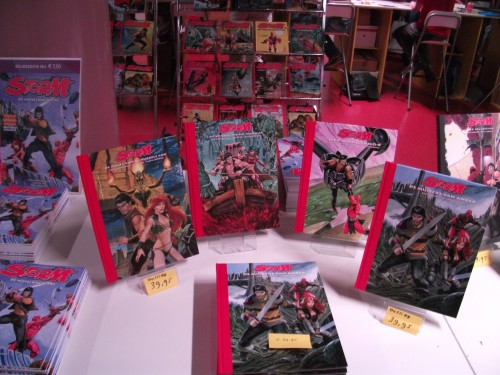
The industry locale was the epicenter of the festival, and companies from both inside and outside of the Netherlands were there. They had plenty of books to sell, but what I found to be most impressive is that in a lot of cases, not only were the artists themselves there, but they were offering free sketches. The biggest booth was the Eppo booth, home of a variety of Dutch comics both classic and new (and in some cases the comics have run long enough to be both), which housed about 8-10 artists each with their own lines. With big names in Dutch comics such as Martin Lodewijk of Agent 327, as well as Jorg de Vos and Roman Molenaar, the artists behind Storm (which is available in English), it was a collection of heavy hitters, but amazingly the lines were short enough that I could get multiple sketches in well under an hour.
Martin Lodewijk
In fact, by my estimation, the combined lines between all of the Eppo artists was about as long as a line for Fred Gallagher (Megatokyo) at Otakon. This isn’t to say knock either Fred or the Dutch artists, but just to say that I was amazed by how accessible these artists were.
Interestingly, the most popular comic among young Dutch kids is an Italian series called Geronimo Stilton. I don’t know much about it other than the fact that it features an anthropomorphic journalist mouse who goes on adventures, or whether it’s doing well in the US, but its success was clear as kids line up to take photos with a real Geronimo Stilton, Disneyland-style.
There was definitely a French/Belgian presence as well, though I didn’t spend much time with them, and there were vendors selling a huge variety of comics, including (what I assumed to be) old, hard-to-find items. Many of the vendors sold comics with some erotic content, but there didn’t seem to be any particular separation or shame in it. In some cases they were shrink-wrapped, in some cases they weren’t.
There was some presence for manga and American comics, especially the life-sized Iron Man statue, the anime fan artists who I’ve seen at the Dutch anime cons, and the requisite maid cafe, though they definitely weren’t the main focus. Asking one vendor of superhero comics about the status of American comics in the Netherlands, he told me that The Walking Dead is quite popular.
The independent/alternative comics area was quite a different experience from the hustle and bustle of the industry location, though I think that may have had to do with the fact that it was held in an old-fashioned gothic-style church and featured many art pieces which I might call not very church-like at all. Featured here were many comics which strayed from convention, featuring really erratic character designs and strange subject matter, the artists were not just comics makers but sometimes contemporary art scene artists as well. Items were generally more expensive for the alternative comics than they were for the industry items, but often times not by much.
I spoke to one artist, who told me that his favorite comic was the one that had the sold the least because it wasn’t really to Dutch tastes. Intrigued, I asked him what he meant by Dutch tastes, because I don’t have anywhere near as keen a sense for European comics as I do for American and Japanese, he mentioned that it had to do with round, cartoonish characters with big feet and so on. It’s something I’ll have to do more research on.
In the end, what probably stood out to me most was the fact that gender and age distributions seemed very even. I saw people from five-years-old to fifty-year-sold both male and female lined up at booths, whether it was to buy comics or to meet the artists or their favorite characters, often times for the same series. It made me realize how much comics is a thing for all ages in the Netherlands.
Otakon is an event I look forward to every year, and to give you an idea of just how much, I actually plan my time in the US to coincide with it. I went in with the intent of getting some autographs (but not too many as I felt a bit autographed-out from my Anime Expo experience), but ironically I pretty much got everyone but the three I was looking to get the most: Hirano Aya, Nanri Yuuka, and Kakihara Tetsuya. Though a bit disappointed as a result, I realized that this is Otakon and it’s always impossible to accomplish everything you want to do. The scheduling is so jam-packed with events that time is always against you, but then you look back and see all of the fun you had.
This year, as seems to be the case over the past few Otakons, Baltimore was hot. Given that most of it is spent inside an air-conditioned space this isn’t so bad, but there always came a time where people had to brave the heat. Taking Megabus to Baltimore, for example, requires one to walk quite a distance to catch the local city bus. It’s a trek I’m accustomed to at this point, but still one I have to brace for. As for the people in elaborate cosplay, you have my pity to an extent, but seriously you guys must have been dying, especially the full-on fur suit wearers.
Industry Panels
Urobuchi Gen
When it comes to industry guests, my main priority is generally the Q&A sessions followed by autographs, and the reason is that I love to see people pick their brains, especially the creators. I always try to think of a good, solid question or two to ask them, and over time I think I’ve become pretty good at it, because the responses I receive are generally great, though actual credit for the answers of course goes to the guests themselves.
The first industry panel I attended was that of Urobuchi Gen, writer of Fate/Zero and Puella Magi Madoka Magica, two shows which are the new hotness, and by extension make the man himself the new hotness as well. Surprisingly, there was only one question nitpicking continuity, and the rest were about his work, and even some “what if” questions. From it, we learned that Urobuchi is inherently suspicious and so would never sign a magical girl contract, considers Itano Ichirou (of Itano Circus fame) to be his mentor, that he would never pick Gilgamesh as his servant, that the main reason Kajiura Yuki did the music was because of SHAFT Producer Iwakami’s magic, and that working with both UFO Table and Shaft is like being aboard the USS Enterprise and meeting different alien species. In addition, it turns out that Madoka Magica wasn’t influenced by any magical girl series in particular, and the closest lineage it has is with Magical Girl Lyrical Nanoha (atypical magical girl show with striking and violent imagery) and Le Portrait de Petit Cossette (a gothic-style show by Shinbo). Given my recent post about this topic, I have a few words in response to that, but I’ll save it for another post.
As for my question, I asked Urobuchi how he felt about influencing such an enormous industry veteran in Koike Kazuo (who is in the middle of creating his own magical girl series), to which he answered that he considers it something he’s most proud of. Though the two have not talked since that interview, he still follows Koike on Twitter. Later, I would get a Madoka poster signed by him.
Satelight
I also attended the Satelight (Aquarion, Macross Frontier) panel, attended by Tenjin Hidetaka (who technically isn’t a Satelight employee), which was just a fun introduction to their studio. They explored their history, from making the first full-CG television anime (Bit the Cupid), the creation of some of their less-regarded shows (KissDum, Basquash!), and into the modern age. Given the small attendance it actually felt a bit personal, and in this time we had some pretty interesting facts dropped on us. A studio which prefers to do original animation instead of adapations, we learned that they sometimes just like to animate things because they can. Case in point, they showed us Basquash! footage they animated just because they liked the characters and world so much, with no additional TV series planned for it. About director and mecha designer Kawamori Shouji, we learned that he likes to work on 3-5 projects simultaneously despite his somewhat old age (52), that Kawamori is devoted to making anime look good, sometimes at the expense of his budget.
They also showed us some CG-animated clips of concerts by Ranka Lee and Sheryl Nome from Macross Frontier, which were really nice and elaborate. Originally they were meant to be used in commercials for a Macross Frontier pachinko machine, but the 3/11 earthquake prevented the commercial from going on air. Another Satelight anime they showed was the anime AKB0048, which actually looks amazing, and from all reports by even the most cynical of reviewers, actually is. Kawamori even graced us with his recorded presence, giving an interview where he briefly discussed topics such as attending Otakon years ago and making the second season of AKB0048.
Given the flow of conversation, when it came to the Q&A portion there was one question I just had to ask: Why did Kawamori end up directing a show like Anyamaru Detectives Kiruminzoo, a show about girls who turn into animal mascot characters and solve mysteries, an anime seemingly far-removed from his usual mecha and idol work? The Satelight representative’s response was, Kawamori is known for working on anime with transforming robots, and when you think about it, transforming animals are not that different from transforming robots. Hearing this, I actually had to hold back my laughter.
One last thing to mention about the Satelight panel was that the laptop they were using was on battery power, and when it started to run out of steam, rather than finding an AC adapter to plug into a wall, they actually just gave the industry speaker another laptop entirely, also on battery power. An amusing hiccup in an otherwise great panel.
Maruyama Masao
Maruyama Masao is a frequent guest of Otakon. One of the founders of Studio Madhouse, he’s been to Baltimore for many, many Otakons, and it had gotten to the point where I began to feel that I could skip his panels to see other guests. This year was different, though. First, with the unfortunate death of Ishiguro Noboru, the director of Macross and Legend of the Galactic Heroes who had died just this past year, it made me realize that the 70+ Maruyama won’t be around forever. Second, this year Maruyama actually left Madhouse to form a new studio, MAPPA, an unthinkable move for someone in as good a position as he was. The studio was created in order to obtain funding for Kon Satoshi’s final project, The Dream Machine, but in the mean-time it also released its first television anime, Kids on the Slope. Even if Hirano Aya’s autograph session was originally scheduled for that time (it got moved), I felt I had to attend Maruyama’s Q&A. In fact, if you are ever at Otakon, I highly suggest anyone, even people who think they might not be interested in the creative side of anime, to attend one of his panels. His answers are always so rich with detail and history given his 40-year experience that you’re bound to learn something and then thirst for more knowledge.
Some of the highlights include the fact that he’d very much like to make an anime based on Urasawa Naoki’s Pluto but thinks the right format, eight hour-long episodes, would be difficult to fund (the manga itself is eight volumes), that half of the animation budget of Kids on the Slope went to animating the music performances, and that he is looking to try and get funding for Kon’s film in the next five years. I find it personally amazing that he would think of the format best-suited for Pluto first, instead of thinking how the series would fit the typical half-hour TV format. In addition, Maruyama pointed out that a lot of work was done in Kids on the Slope to blend and hide the CG, and I think it shows.
In any case, while I would normally be content to just give a summary of the panel, I’m going to link to a transcript just so that you can read the entire thing. The question I asked is as follows:
How did director Watanabe Shinichirou (director of Cowboy Bebop and Samurai Champloo) become involved with Kids on the Slope?
“I was working with Watanabe from back in the MADHOUSE days. Unfortunately there were about three years where nobody got to see his work — his projects always got stopped at the planning stages. So when I got Kids on the Slope, I handed him the manga and said, ‘here. You’re doing this.’ At MADHOUSE we had developed a feature — it was already scripted and ready to go, but then I left the company and the project fell through, so I gave him this as something to do. I really think he’s one of the top directors in Japan, one of the top 5. That’s why I wanted to create a theatrical animation with him. Up until this project, he’d only worked on original projects, so this was his first adaptation from a manga, and as a result, he didn’t really know how faithful he had to be, or if he had room to adapt, so he put up a lot of resistance at first.
“Mr. Watanabe loves music, and has a lot of deep thoughts on the music. So I told him that it was a jazz anime, and that he was likely the only director that could pull it off. That convinced him. Then Yoko Kanno said, ‘if Watanabe is working on this, I’d like to work on it too,’ and so that’s how that show came to be.”
Also note that in the photo above, Maruyama is wearing a shirt drawn by CLAMP to celebrate his 70th birthday, showing him to be a wise hermit.
Hirano Aya Concert
Partly because of scheduling conflicts, I attended the Hirano Aya concert knowing that it would be my only experience getting to see her. As expected, it was quite a good concert, and I had to get up despite my con fatigue for “God Knows,” but there wasn’t quite this process where I felt won over like I had with LiSA at Anime Expo. Thinking about it, it’s probably because I’m already familiar with Hirano Aya’s work.
I did wonder if her cute outfit was designed to kind of draw some of the controversy away from her, the large bow tie on her head possibly trying to restore her image in the eyes of certain fans. At the same time, given her songs and given her vocal range, I had to wonder if she would benefit from being presented as less of an “idol” and more of a “singer.”
Getting to the concert 15 minutes late on account of 1) the Baltimore Convention Center not being entirely clear as to what can lead to where, and 2) my own forgetfulness from not having done this for a year, I sadly missed the announcement that she would be signing autographs at the end, and ducked out after the encore was over. Alas, I’ll have to wait a while before I get the chance to have my volume of Zettai Karen Children signed.
Other
Apparently Opening ceremonies was ushered in by the Ice Cold Water Guy. Unfortunately I wasn’t there, but I heard it got quite a reaction.
I also attended (the last half of) the Vertical Inc. panel, whose big, big license is Gundam: The Origin. Honestly, I’d never expected to actually see it released in the US, seeing as Gundam is practically seen as poisonous in the States, and I doubly didn’t expect it from Vertical. In addition, though I didn’t attend, some friends went to the Kodansha Comics panel and got me a Genshiken poster! Would you believe that I’ve never owned a Genshiken poster? This one even has Ogiue on it! Granted, I can’t put it up just yet, but it’s basically a copy of the English cover to Volume 10.
Also, while I didn’t attend some of the guest Q&As, I did conduct personal interviews with some of them.
A panel run by the Reverse Thieves, I was happy to see that the room was so packed that people were starting to get turned away at the door. The goal of the panel is exactly in the name: the two panelists pointed out anime that have come out within the past five years that they felt older anime watchers, even the kind who have children of their own, could enjoy. By far the most popular show was The Daily Lives of High School Boys, which just got endless laughs. What I found to be really interesting though is that I could tell the panel was working because I heard more than one baby crying throughout the whole thing. Assuming that the babies did not magically crawl in on there own, I could only assume one or more parent was there with them, also learning about New Anime. I even had a couple of old college friends attending Otakon tell me how much they wanted to watch some of these shows.
Genshiken: The Next Generation
If anyone thought this was my panel, my apologies! It was actually run by my old Ogiue co-panelist, Viga, and offered an introduction for existing fans of Genshiken to its sequel, Genshiken Nidaime aka Genshiken: Second Season. Overall, I thought it was a fine panel, though at points I felt like Viga couldn’t quite decide who the panel should be for, explaining some things while omitting other details entirely. Should it assume that people had read the current chapters or not? If the panel could have a tighter focus with a clearer idea of where it wants to go, I think it would be much better.
Fandom & Criticism
This panel was dedicated to introducing and exploring the concept of “active viewing” to a convention audience, which is to say the idea of distancing oneself from one’s own emotions while watching something in order to more accurately gauge what the work is saying. Hosted by Clarissa from Anime World Order, as well as Evan and Andrew from Ani-Gamers, I took interest in the panel partly because I know the panelists, but also because as an academic myself the concept comes into play with my own studies. The discussion was quite fruitful I think, though one thing I do want to say is that I feel the concept of distancing and dividing between the rational mind and how one’s emotions operate while consuming media can make it difficult to see how other people might view a certain show, and that it is important, I feel, to consider emotions and “passive feelings” while watching a show, as they can shape one’s experience in a way that “active viewing” may tend to break down like a puzzle.
Anime’s Craziest Deaths
It was my second time seeing Daryl Surat’s violence smorgasboard of a panel, and probably what impressed me the most wasn’t any single clip, but the fact that the footage was (as far as I remember) 100% new compared to last year’s Otakon, and that a lot of it came from newer shows. The panel is a treat to watch, and that the craziness of a death doesn’t necessarily have to do with its violence level, but it certainly helps. The panel was a full two hours, so the middle felt like it started to drag, but I think it has to do with the basic idea that people’s attentions will slowly fade over time, so it’s somewhat necessary to up the ante as it goes along. I’ll finish this part by letting Daryl himself offer some sage advice.
The Art of Fanservice
The last fan panel I attended was hosted by the third host of Anime World Order, Gerald, and it was a brief look through the history of fanservice, as well as some of the general differences between fanservice for men and fanservice for women. Defining the art of fanservice as titillation which is not just outright pornography, Gerald’s theory, which seemed confirmed by the audience’s reaction, was that fanservice for guys is typically very visual, very isolated, while women usually require some kind of context. A pair of bare breasts, no matter what situation the woman is in, can be enough for a guy, but a girl usually wants some backstory. Possibly for this reason, the clips of women’s fanservice tended to be a little longer. Also of interest was the Cutie Honey Flash opening, which was a Cutie Honey show targeted towards girls, and though Honey is still leggy and busty, I noted that the way the shots are framed is a far cry from its most immediate predecessor, New Cutie Honey.
I think the idea of “context” does definitely ring true to an extent, but I have to wonder about the degree to which people, especially otaku, defy those gendered conventions. For example, there is definitely “context-less” fanservice in Saki, but there are also moments which are meant to thrill based on the exact circumstances of the characters’ relationships, like when Yumi tries to recruit Stealth Momo for the mahjong club and shouts, “I need you!
Speaking of Saki, why I had a panel to present this year as well.
Mahjong
It was likely thanks to Saki: Episode of Side A that Dave and I got the chance to once again present”Riichi! Mahjong, Anime, and You.” The format was essentially the same as our panel from 2010, where we try to help the attendees learn not so much how to play mahjong (an endeavor which requires hours and hours of workshop time), but how to watch mahjong anime. New to 2012 though were the fact that we had two years of additional playing experience, which meant we knew what we were talking about a bit more, as well as a number of new video clips to thrill the audience, including one that Dave was so excited about he was almost willing to skip the order of presentation just to reveal it).
It was held in a larger room than last time, and though there were still some empty seats, the fact that we were able to mostly fill a room at 10 in the morning on Friday pleased me so.
After the panel, I was waiting on line for the Urobuchi panel, when the people in front of me not only recognized me from the panel, but also let me join in a game of card-based mahjong, where instead of tiles playing cards with the images of tiles are used. From this I learned that mahjong cards don’t work terribly well because it becomes extremely difficult to see your entire hand, but I have to thank those folks anyway for giving me the chance to play, and though the cards are less than ideal, they’re still handy in a pinch, especially because carrying tiles takes so much more effort.
Thanks to Dave’s effort, however, we actually brought tiles with us to play, and on Friday and Saturday, Dave and I managed to find time to sit down and play for a few hours against not only opponents we already knew but also people we’d never seen before. The tables at the conference weren’t particularly suited for this, and we had to find a table edge and play the game with the mahjong mat angled diagonally. I ended up doing pretty well overall, including an amazing game where I never won or lost a hand and maintained a default score of 25,000, but what really stood out to me is the realization that we had all improved since we started playing mahjong. I know I said it before in discussing the panel part, but playing live against other people made it so that even my mistakes were the mistakes of a more experienced person who could learn from them.
Apparently we weren’t the only ones doing this, as we saw a second mahjong group as well. I couldn’t stay long enough to assess their ability, but as long as they were having fun it’s all good.
Other Photos (mostly cosplay)
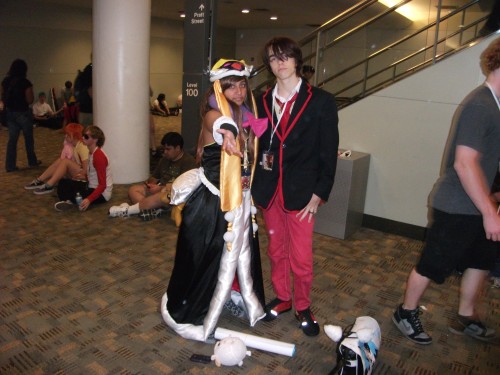
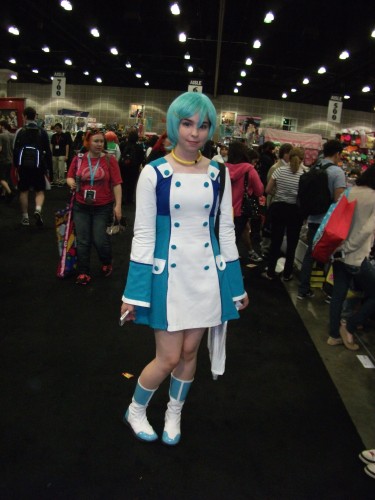
Despite a number of good costumes out there, I actually didn’t take too many photos this year. I blame the amount of times I had to hurry to get to the next thing on the schedule. Also, I saw absolutely no Eureka Seven AO cosplay. Promise me for next year!
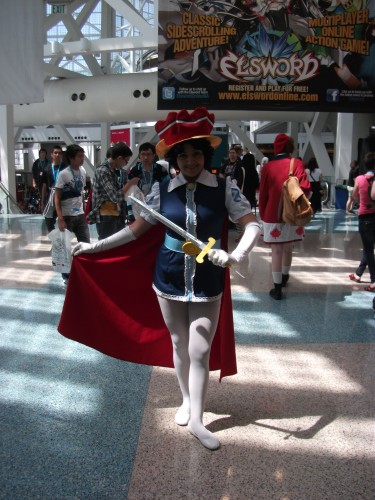
This was actually the first Fuura Kafuka cosplayer I had ever seen, and I’m amazed (and grateful) that someone would remember her. A funny story came out of this, as the cosplayer had not been aware that Nonaka Ai (Kafuka’s voice actor) was at the event. I told her about the autograph-signing on Sunday, and I hoped she was able to make it. Now, onto the next.
Overall
While at the convention I would notice little things here and there that I thought could use some improvement, the sheer amount of content at Otakon means that with even a few days of post-con recovery the bad mostly recedes away and all that I’m left with is fond memories. One complaint I do have, however, is that because the convention is set up to have some entrances and pathways usable and some off-limits, it is extremely difficult to tell just based on the map given in the con guide how to get from location to location. As an Otakon veteran at this point, I mostly have no issue with it, but even I ran into problems while trying to find the Hirano Aya concert. A combination of better signage to point people to the right locations alongside a clearer map would do wonders.
Even though Otakon had a “cooking” theme this year, I didn’t really feel it, pretty much because I didn’t attend any of those related events. At this point, every Otakon is starting to feel similar, but I can never hold that against it. After all, with a convention this big and with this much to do, I feel that we as fans of anime and manga make of the convention what we want. This isn’t to say that the way the convention is run doesn’t matter, of course, but that it is run smoothly enough that it becomes almost unnoticeable.
Truth be told, I used to take the sheer variety of panel programming and activities at Otakon for granted, but when I attended AX for the first time this year, I realized how limited that event is by comparison. Not only are there a good amount of industry panels with all of the guests they’ve flown over from Japan (or elsewhere), but the fan panels are a nice combination of workshops, introductions, and even philosophical explorations of topics concerning fans. Seeing Otakon once more in person, I knew this was indeed the con I waited for all year.
I’ve been thinking about word bubbles lately, specifically the conventions behind how words are organized in them across Japanese and English.
Basically, if you ever look at a word bubble from an English comic, be that a translated manga or something originally created in English, the words tend to follow the shape of bubble to an extent, such that the top and/or bottom lines of text are shortest and the middle bulges out. In contrast, if you look at manga in Japanese, the text is usually in the shape of a square block, though it might be more accurate to say that the text is “top-justified,” where the top of each line is flat (remember that Japanese text in bubbles is generally written from top to bottom and from right to left), and the length of the final line can vary from being the shortest to being the longest. They don’t necessarily have to be this way, as is evidenced when an English-language bubble in a Japanese manga ends up having the text un-centered, but these seem to be the “rules.” When we defy them, something looks “off.”
What I’m wondering is, how much of this is the result of the written languages themselves, and how much of it has to do with the conventions laid before us by decades of comics? Could it be that a stable top is more important in either case, but that the top line in an English text is always flat due to the horizontal nature of English writing, whereas Japanese has to make an effort at it? Is it simply efficiency, or the result of past limitations which have seeped into the very nature of how we perceive word bubbles? What about other languages, notably Hebrew or Arabic which are horizontal and written right to left? How do their translations/comics fare?
Introduction: I attended Otakon this year and got the chance to interview mechanical illustrator and designer Tenjin Hidetaka. Responsible for box art from various series including Gundam and Macross, his latest work can be found in Aquarion Evol. His official website can be found at http://www.studio-tenjin.com and his Twitter is @TENJIN_hidetaka.
For the sake of consistency with the rest of this blog, Japanese names are last name first.
OM: How did you get started working in the anime and toy industries?
Tenjin: My very first anime work was Macross Zero from Satelight. I can’t remember what year it was, either 2002 or 2003, but my first anime was Macross Zero.
OM: How is it like working with Kawamori Shouji? How did you meet?
Tenjin: I met Mr. Kawamori Shouji because I had been illustrating for a Macross fansite. I was drinking with a few friends of mine I had met through the fansite and Mr. Kawamori Shouji also attended the event.
But even before I met Mr. Kawamori Shouji I had been working as a professional illustrator, so when I had a chance to meet him I showed him my portfolio, and he gave me the chance to start working with him.
OM: Does the fansite still exist?
Tenjin: The fansite no longer exists. I deleted it right away. But I think some archive of it still exists. Some very hardcore fans from the past still hold onto their precious archives of the past.
OM: I can understand that. So you work both in fantastic designs such as robots as well as more realistic designs such as planes and other vehicles. As an illustrator, do you use the same philosophies and concepts in drawing the realistic vehicles and the more fantastic ones, or are there more significant differences you have to keep in mind while drawing them?
Tenjin: I think about the practical purpose of the vehicle, how it’s used. For instance, with a Gundam it’s a weapon, an instrument of war. So I picture what a tank would be like, and I take the heavy texture of paint and use it for the Gundam. But on the other hand, for something like a Valkyrie, it’s basically a plane so I try to use lighter textures and try to focus on thinner silhouettes.
OM: I actually have a question related to that as well. When it comes to robots, we mainly hear about mechanical designers such as Katoki, Okawara, and Kawamori, who are all about designing the robot from various angles, but we rarely get to hear from someone who’s a mechanical illustrator. What are some of the unique advantages and some of the things you have to consider while drawing mecha without necessarily having “design” in mind?
Tenjin: The difference is, when there’s already a design, I need to think about what the designer had in mind. Even with something as simple as a single line, I have to think about what its purpose is. I need to focus not just on the design in front of me, but other designs that the designer has created because what I am trying to portray through my illustrations is not just the mechanical design or that one item, but the worldview of the designer, the fantastic world that the designer is trying to communicate.
For example, for classic model art for the package or box art, something I focus on is the background. By putting a lot of details in the background, I try to express the storyline of the world behind the design.
OM: You worked on Aquarion as well as its sequel Aquarion Evol. It’s been a few years between those projects. What do you feel you’ve learned between Aquarion and Evol in returning to the franchise?
Tenjin: Something I improved in is weathering texture, introducing weathering to express just how old a vehicle is within the world of Aquarion and Aquarion Evol. But with Aquarion, there are two time periods, the present and 12,000 years ago. I don’t think I was successful in depicting how things would change in 12,000 years.
OM: Related to Aquarion, it seems like 3D modeling is increasingly used to animate mechanical designs, and figures such as Mamoru Oshii have talked about how there are fewer and fewer people who know how to work with 2D designs without going to 3D models. As an illustrator, what do you see as the potential for 3D modeling for mechanical designs in anime?
Tenjin: When I first entered this industry, 3D animation was just at its start. You were seeing the very first examples of 3D animation and, to be honest, the quality was very low. But these days 3D is used very frequently in Japanese animation and very naturally and so the techniques have improved enough that you don’t really notice the differences between 2D and 3D animation. So, I don’t think there’s anything to worry about in that respect.
OM: I just have one more question. I noticed that there quite a few works in that slide show [Tenjin had in front of him an iPad displaying various examples of his box art] from VOTOMS. Do you have a particular fondness for VOTOMS?
Tenjin: [in English, without the need for a translator to explain my words] Of course!
I was thinking a little about the concept of “Cool Japan,” and why the idea has lost traction among various levels of fans and critics. One argument I hear occasionally is how, at the end of the day, people cosplaying and running around at conventions doesn’t give an image of “cool” or “cutting edge” but an image of regression or perhaps even immaturity. Essentially, people overestimated how “cool” Japan actually is. I don’t know how much this is really the case.
Another side is the way that Cool Japan was essentially government-backed. The idea of it was to use the media/fashion/image of Japan as “soft power” to influence the world. The problem, as far as I see it (and I think I’ve read similar arguments elsewhere), is that one of manga’s oft-touted strengths is its variety in terms of genres, ideas, philosophies, demographics, and even art styles. However, when it is being used by the Japanese government as one of its public faces, the manga and anime pushed out by the government becomes tacitly “government-approved.” If something is government-approved to be an image of the nation, then there is little chance that any government would willingly let their country’s image be tarnished by specific titles.
Essentially, what I’m thinking is that Cool Japan as a government-backed endeavor to some extent has to necessarily work against manga and anime as mediums of variety. I think the difference is between having something “government-approved” and “government-allowed.”
But I’m sure this topic has been talked to death. Probably at Neojaponisme.
Anime Expo 2012 was my first Anime Expo and my first west coast convention. While I’m not one of those really thorough con veterans, I still found some interesting differences between it and the conventions I’ve been to before, both when compared to the bigger cons as well as the smaller ones. Located in Los Angeles, it uses its position to its fullest.
Industry
In a change of pace of sorts, I somewhat foolishly attended fewer industry panels than I normally would at a convention. I say somewhat only because of the fact that, for so many of them, they largely amount to announcements (which appear within a minute on Twitter) and they have Q&A sessions which lack teeth. Sometimes you can get a good one, and I try hard to ask good questions when I can, but the more “official” it is, the less chance you’ll get a decent answer. The foolish part is the fact that I was accustomed to Otakon, where one must generally choose between autographs and panels, an only later found out that AX works on a system of giving people “skip the line” tickets for attending guest panels. Lesson learned for (hopefully) next time.
Despite those limitations, AX2012 was by far my most autograph-heavy convention experience I’ve ever had, which is a reflection of one of Anime Expo’s greatest strengths: the sheer amount of guests, particularly Japanese ones. I managed to get stuff signed by the staff from Madhouse, Animetal USA, Kajiura Yuki + FictionJunction, a limited autographed image from manga artist Toume Kei (who wasn’t attending but offered the images as part of a gallery), and probably the biggest one for me: an OVA of Legend of the Galactic Heroes signed by Horikawa Ryo, voice of Reinhard von Lohengramm. I happened to take a fantastic picture of him.
I did manage to go to a few panels as well. I went to the Animetal USA Q&A just to see that bit of spectacle (it was calmer than I had expected), and attended the panel for GoFA, or Gallery of Fantastic Art. GoFA can be described as an organization dedicated to taking anime and manga and giving it a sense of realism by creating products and opening galleries based on those works. The panelists showed off actual products such as glasses and watches based on the designs of anime and manga creators, and mentioned that artists such as Hoshino Lily (Mawaru Penguindrum character designer) and Fukumoto Nobuyuki (Kaiji, Akagi manga creator) have or will have gallery exhibitions in Japan. Apparently they’ve been a part of AX for a long time now, but this was their first time running a panel, a privilege they received because they’re actually producing a stop motion animation based on the artwork of Toume Kei (Sing Yesterday for Me). We got to see a very short preview, about which not much can be said because it lasted less than two minutes.
Another panel of interest was a manga workshop run by an actual manga artist whose name I sadly did not catch (though Peepo Choo’s Felipe Smith was helping to translate). I was unable to stay for the entire thing, but what I saw focused a good deal on anatomy, working from the idea that a solid foundation in realism is needed in order to deviate from it. While I don’t entirely agree with that assessment, I think it is nevertheless an excellent skill to foster and definitely a legitimate way to begin to create art and comics. I do wish that manga workshop panels and the like could move more towards paneling and page layout, but I get the feeling that character design is much more immediate has much more impact for the vast majority of people.
Concerts
I went to all three of the concerts—Animetal USA, FictionJunction, and LiSA—in some capacity, though could only stay for a small portion of the FictionJunction concert due to some scheduling conflicts (more on that later). Animetal USA had by far the smallest crowd, but an enthusiastic one nonetheless, and it was great to hear their take on classic anime songs from shows like Gatchaman, Mazinger Z, and Saint Seiya. I’ll admit, I’m not a fan of heavy metal (though that’s not to say I don’t enjoy it), but I’m glad I went. Later at their signing, the most impressive thing was that there was a real Animetal USA cosplayer, a girl dressed as guitarist “Speed-King” (aka Chris Impellitteri). What little I heard of FictionJunction was definitely excellent. I definitely wish I could’ve seen it all.
The LiSA concert is one of the highlights of AX2012 for me, because I went in only knowing her as the singer of the Fate/Zero opening but not particularly interested, and came out of it as a fan. Not only were all of her songs really good, but her practically-headbanging enthusiasm just filled the concert venue. Impressively, she managed to do the emceeing for her own concert almost entirely in English. I’m not sure how much of it was from actual fluency and how much was practiced and scripted, but she pulled it off regardless. She gave us the benefit of singing the opening to a new summer anime (that wasn’t even out yet), Sword Art Online, and the concert actually made me want to check it out despite only having a passing interest in it prior.
Non-Industry Panels
If AX’s main strength is its industry presence, its main weakness is a lack of interesting fan panels. While fan panels can always vary in quality, they tend to follow along the same basic goals of bringing fans together in order to share in a topic or to convey new ways of seeing the things we love, hat’s not to say that the fan panels at AX weren’t or couldn’t be interesting, but that the sheer amount of “official” panels somewhat limited the overall presence of fan panels. On top of that, many were workshops or something similar, but personally speaking I generally don’t go to conventions for workshops.
I attended the Bloggers and Podcasters Town Hall, not knowing quite what to expect, especially given the use of the term “Town Hall,” but it ended up actually being fairly accurate. Moderated by the Benjamin “Benu” Lopez of the long-running Anime Genesis podcast, the audience (including myself) discussed various topics, including the move to include blogging into a podcast and vice versa, as well as ways to break up the factionalism and cliques which often appear around groups of bloggers/podcasters. It was a fruitful discussion, and I got to meet a number of people I’d only read/heard previously, though I do kind of wish that we didn’t just talk about reaching out but also ways to refine and improve our existing work. As I said at the panel, I do believe that content is king.
Given that I’ve been a part of academia for a while now, I went with the purpose of attending as many of the academic panels as I could. At times, this caused conflict as I had to sacrifice seeing a certain guest in order to see what other researchers were working on, but I think it was well worth it. Even though other events clearly overshadowed the attendance of the academic track, there was something distinctly different about having it as part of a general convention instead of simply being a stand-alone academic conference. Mainly, I felt like presenters had prepared for a mix of academic and non-academic audiences, and it made the presentations a little more fun than what would normally happen.
The highlights of the academic track were the keynote address, where Professor Jeffrey Dym of UC Sacramento discussed his “History of Manga” class, and the “We Make Manga” panel run by Northrop Davis of the University of South Carolina. In both cases, the speakers really knew what they were talking about, and described the challenges they faced in creating their classes, how they designed their curricula, and what sources they used as the foundations for their classes. For Dym’s panel, the things that stood out to me the most were his lament that Ishinomori Shoutarou did not have more work out in English despite his legendary status and the fact that he hesitated on including sports manga in his class because of how little of the really groundbreaking series (Star of the Giants for instance) exist in English. For Davis’s panel, it was definitely the fact that he mentioned his class as being designed to somewhat mimic the editor system used by manga publishers in Japan, especially given the degree to which endeavors such as Tokyopop’s old OEL material lacked in that very area.
I think the attendance could have been stronger if the academic panels hadn’t been added so late. The large color guide didn’t even have those panels, and it was clear that despite the giant screens showing the updated schedules that many attendees ignored it. When I presented at my own panel (which ended up overlapping with the FictionJunction concert due to a 40 minute delay, thus eliminating my chance of doing both), it was to a rather sparsely populated room, which I honestly think could have been made more lively if only people knew about it (and if the concert didn’t start and end when it did). Overall, I think I did an all right job (I did a visual analysis of the manga 7 Billion Needles), I just wish more of you could’ve attended it!
Cosplay
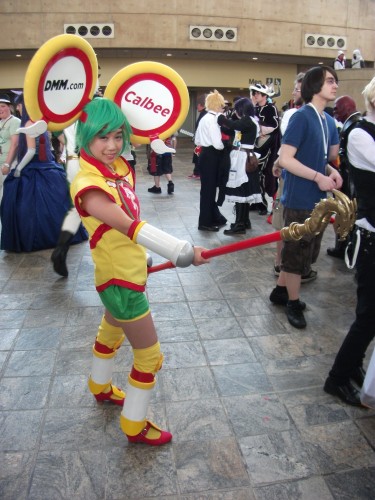
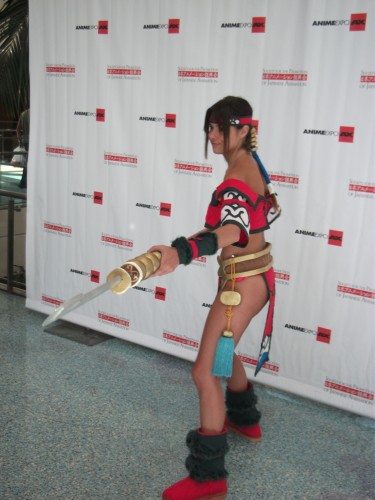
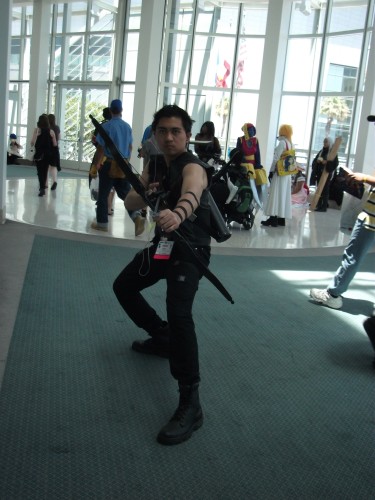
I think I’ll say it: AX2012 was possibly the best convention I’ve ever attended in terms of cosplay. Not only were many of the costumes excellent, but I don’t think I’ve ever seen so much variety. Popular cosplay topics such as Homestuck and Hetalia!, while still very present, didn’t even come close to dominating the visual landscape of the con, and cosplays I had resigned myself to possibly never seeing appeared in numbers. Whereas previously I had seen zero Dragon Kid cosplays from Tiger & Bunny, this time I saw five.
I remember being the only person to clap for Dragon Kid at Otakon 2011’s Sunrise panel, so this was a pleasant change.
In addition, I thought I’d never see a Precure cosplay at an American con, but I was gladly proven wrong. Have you watched Heartcatch yet? It’s really good.
Anyway, I’ll let the rest of the cosplay speak for itself, though keep in mind that this certainly isn’t an accurate representation of all of the cosplay at AX2012, merely what I photographed.
Final Thoughts
So there went my first Anime Expo. If I had to do it over again, I probably would’ve found a better medium between panels and autographs, and I would’ve definitely tried to see more faces. Also, the Kinokuniya in LA is definitely better than the one in NYC.
Though not my first time in Los Angeles, it’ll be my first time hitting up Anime Expo, that monster convention whose size and majesty dwarfs all around it. In fact, it’s also my very first west coast convention, so while I know what to expect from a big convention, I don’t know if there’s anything particular this con in particular that I should be aware of.
In any case, I’ll be attending most if not all of the academic panels, and trying to go to the concerts if I can. I’ll also have my own presentation to give while I’m there on Saturday, as part of the Building Bridges Through Individual Texts panel. My presentation is titled going to be focused on the science fiction manga 7 Billion Needles.
My (tentative) schedule is as follows:
Friday
The Cutting Edge of Anime and Manga Studies (11am-12:15pm)
Why Do We Try So Hard? Anime and Manga Studies Roundtable Discussion (12:15pm-1:15pm)
The Origin of Anime Fandom (2pm-3pm)
Aniplex of America Industry Panel (3pm-3:45pm)
Animetal USA (WHO IS IT WHO IS IT WHO IS IT) (4:30pm-6:15pm)
Adventures in Teaching: “The History of Manga” (7:15pm-8:15pm)
Bushiroad Industry Panel (8:15pm-9:15pm)
Saturday
E-Manga: The New Style of Manga with Ryo Horikawa (11am-12pm)
Animetal USA panel (12:15pm-1:30pm)
Madoka Magica panel hosted by Aniplex (3pm-4pm)
Anime Bloggers/Podcasters Town Hall (4pm-5pm)
Yuki Kajiura/FictionJunction (6pm-8pm)
Building Bridges Through Individual Texts (8:30pm-10pm) (That’s me!)
Sunday
My Little Pony: Friendship is Magic Fan Panel (9am-10am)
Hamada, Morio, Tsunoki (Madhouse) (10am-11am)
LiSA Concert (12:15pm-2:45pm)
Right Stuf/Nozomi Entertainment Premieres (3:15pm-4:45pm)
What do Anime Fans do, Why and How? (5:15pm-6:45pm)
Supporting and Expanding Anime and Manga Studies (7pm-8pm)
Monday
Who knows!
So there you have it. For all you cool dudes I know, I hope to see you, and if I don’t know you, then I hope to at least meet you.
JManga, a 100% legal digital manga distribution site, is an interesting phenomenon. Good intentions mixed with a hodgepodge of titles and a bizarre pricing structure, which I can basically describe as paying the site to give you an allowance, have made it questionable as to whether or not anyone should try it out. Ultimately I decided to subscribe myself (the $10/month deal), and there are two major reasons for my decision.
The first reason is that it is now available in Europe. Up to only a few months ago, JManga as a service was restricted to the US and Canada, and so I wouldn’t have been able to use it anyway. With their roll-out into Europe, however, I wanted to at the very least support that decision. Even if I don’t get terribly many manga on there, I wanted to encourage the idea that regional restrictions for books in digital form is nonsense. Though I know that I’m only one subscriber, I also want other similar services in the future to follow suit.
The second reason is that JManga actually has a feature that I have not seen on any other manga site, legitimate or otherwise. Sure, tons of scanlation sites exist and they provide easy access to thousands of titles, but JManga actually gives you the option to switch back and forth between Japanese and English. One click of a button and the page you’re on changes into the other language. For someone like me who wants to read more manga in Japanese but might have trouble with particularly difficult phrasings or unknown vocabulary, it’s a far simpler solution than constantly running to consult good ol’ Jim Breen. It’s even more convenient than owning the physical books in two languages in certain ways, though the load time between versions can be a bit long, and the interface itself still needs some work.
I’m well aware that this utility really only helps readers with strong (but not perfect) Japanese literacy skills, people who can read a manga in Japanese for the most part, people with a good grasp of kanji, who have a firm enough understanding of the grammatical structure of the language to know what specific part of the sentence in a potentially quite liberal translation corresponds to the original, and who can spot when a joke has been localized for the English version. For beginners, it may be too much of a chore to consult the Japanese versions, and for someone who’s fully fluent or even a native speaker, there’s simply no need to switch to English at all, unless perhaps that person wants to learn English. I happen to fall in that “sweet spot” though, and in that respect I’ve found it quite useful. If you do too, then maybe it’s something worth considering.
By the way, it seems like the most popular manga on JManga are yaoi titles, yuri titles, and Soredemo Machi wa Mawatteiru. Makes sense to me.
This past weekend was yet another Free Comic Book Day for the United States, but as it turns out, it was also the first ever Free Comic Book Day for Netherlands and its neighboring country of Belgium (don’t know about Luxembourg). FCBD has been a tradition for my friends and I back in the US for many years now, but sadly I was unable to join in on the fun in 2011 on account of living overseas, so I was glad to see the concept reach all the way over here.
Unlike the complicated Manhattan crawl I’m accustomed to where we’d hit every comic store around, the city I’m living in only has two comic shops so it was a far simpler affair. What I found particularly interesting, though, was the selection of free comics. I typically think of the FCBD giveaways as being a mix of superheroes, some humorous Archie-esque comics, a couple of more experimental works, and then a smattering of manga offerings, and this year appeared to be no exception. In contrast, the comparatively small selection of comics for the Dutch/Belgian FCBD primarily involved European comics, with The Walking Dead being the only American comic as far as I can tell. Of particular note is the Dutch Storm, and the variety of lively artwork in Het beste van Oogachtend FCBD (a compilation of various artists’ work) probably makes it my favorite overall.
Sadly I can’t really read Dutch so I can’t actually tell you how these comics are, but they’re quite pleasant as souvenirs regardless. For those of you familiar with Dutch comics, I currently have as my distant, distant goal for Dutch literacy volumes of Agent 327 and Suske & Wiske, as well as a Dutch-translated issue of Yoko Tsuno. Some day…
I’ve been enjoying Gundam AGE quite a bit since it began airing, and I think it’s a solid show (thought not without its flaws) which successfully utilizes its main premise of a battle being fought over multiple generations. The second generation hero Asemu is a far cry from his dad Flit when they were similar ages, and through hindsight it ends up highlighting what made Flit unique in the first place. As it turns out, though, Gundam AGE isn’t doing so well in the ratings, and it apparently has failed to reach the kids demographic it was trying for in the first place. At this point, it’s pretty easy to just say that the mistake was marketing to kids, that they shouldn’t have repulsed the older fanbase through the kiddier designs and the like, and that the solution is more UC (or things similar to the Universal Century stories), but I think this would be a huge mistake.
Putting aside the fact that this is not the first time that a good Gundam series has disappointed in the ratings (see Gundam X and even the original Mobile Suit Gundam) and just assuming that nothing the show does now will turn it around, the kind of risk that Sunrise took in gearing Gundam AGE towards a younger demographic is, in my opinion, the healthiest kind of failure there is. Well, if you consider it in terms of profits lost I’m sure there would be some disagreements, but what I mean by healthy failure is that they didn’t have to do this, but saw that there is a potential market from a new generation far removed from the original 1979 anime, and made a concerted effort to appeal to it. It reminds me of Sunrise’s recent hit, Tiger & Bunny, because that show was a surprise hit to even Sunrise themselves, and I have to wonder if it encouraged them to take more risks. Obviously I don’t know if AGE was in planning before or after T&B, but there seems to be this general spirit of experimentation which I’d rather not see stifled because of this setback.
When Sunrise did research into why kids weren’t getting into AGE, they arrived at the conclusion that kids these days don’t understand or know about wars and space colonies. It seems like an odd result, but assuming that this is the problem (or perhaps more accurately that modern kids don’t care about space war by default), the thing I want to point out is that there are ways to work from this information without just abandoning it entirely. If the children of Japan today are ignorant of wars and space colonies, then perhaps one of the goals of a Gundam which targets them should be to introduce those concepts as if they were entirely new. In other words, if it’s unfamiliar, make it familiar.
Perhaps an easier solution would be to just find out what the kids like and transform the premise to fit the current trends, but I don’t think the solution has to be an all-or-nothing endeavor, even if Gundam AGE may have toed the line too much. Heck, I think looking back at the previous alternate universe of G Gundam could provide some nice possibilities, not so much because of the martial arts aspect, but the premise of having Gundams from various nations each with their own special abilities, which isn’t that far off from the cast of a collectible card game/monster battle show.



 Martin Lodewijk














 OGIUE MANIAX