There’s a general trend I’ve been seeing with male anime protagonists from light novels, or more specifically anime adaptations of light novels. In many of these titles, the main characters tend towards having passivity as a defining trait, sometimes to the point of “aggressive passivity.” Not to be confused with someone who’s passive-aggressive, or even someone who’s mostly passive and occasionally active (like Shinji in the Evangelion TV series), the aggressively passive protagonist is someone whose passivity is almost a badge of honor, either in the form of a passive special ability, a self-image in which passivity practically defines them, or a reputation for passivity.
Let’s look at a brief list.
My Teen Romantic Comedy SNAFU: Hikigaya Hachiman persistently mentiones how the real world is harsh and unforgiving and how it’s best to kind of just coast through it with little ambition.
Mayo Chiki: Sakamichi Kintarou has the nickname of “Chicken Tarou,” indicating what a pushover he is, which he tries to fight.
A Certain Magical Index: Kamijou Touma, though not truly passive, operates on an extremely loose philosophy of “do the right thing, I guess.” In addition, his ability is a defensive one which neutralizes other superpowers.
Monogatari Series: Araragi Koyomi helps others out, but his abilities as a vampire mainly manifest in his ability to endure pain and injury, and even his method of active help comes across as essentially philosophically passive.
Ookami-san: Morino Ryoushi, Ookami’s partner, is someone who can only help fight from the shadows, as he fears direct confrontation.
Suzumiya Haruhi: Kyon, though he eventually enjoys it, starts off talking about how much he’d rather not be having strange and crazy adventures.
If you look, you’ll also find such characters in non-light novel anime. This is somewhat different from the classic milquetoast harem lead, whose averageness is taken as a way to make him the everyman and the avatar of the reader, because often-times with these aggressively passive characters a lot of time is spent talking about just how average they are and how being average/passive is the way to be.
I’m not sure why this is the case, but I suspect it may have something to do with the “herbivore men” concept that has taken hold in Japan. Herbivore men are defined as guys who shun the life of wealth, success, sex, and family, the classic symbols of masculinity, and embrace a more passive lifestyle which shirks society’s expectations. This trend gets tied to a number of things by those curious as to why it’s occurring, such as the poor Japanese economy driving down ambition towards employment, and it’s possible that the protagonists described above are a product of this environment, that the people reading (and perhaps even writing) these light novels and watching their anime adaptations also see the traditional path of Japanese men to be fraught with lies and deception.
Of course, in many of these cases, it’s not like the characters sit back and do nothing, but that passivity on some level becomes a part of their characters, either as something to be celebrated or something to be worked on. If anything, even the sampling of titles above speak towards a broad range of viewpoints as to what passivity is and whether or not it’s something to be embraced or to be worked on.
This trend is actually why I think Kirito in Sword Art Online has become such a popular hero for anime fans both male and female. It’s not that the aggressively passive hero is inherently bad, but that in this environment an aggressive protagonist stands out that much more. In SAO, Kirito is an extremely skilled fighter who helps the downtrodden, attracts women left and right, and has a powerful reputation among those inhabiting the world, while also being gentle, considerate, and devoted to those he loves. He becomes the exemplary light novel hero for those who’d rather not have a passive protagonist.
When the Robotech/Voltron crossover comic was announced a few months ago, my immediate response was, “Why?” Of course the answer is “nostalgia grab,” but there’s something strange about both of these works and their continued presence in the geek public eye (and perhaps even beyond that). Unlike Transformers which not only has a huge variety of toys both old and new, as well as a long history of cartoons both from America and Japan (not to mention the live action films), both Robotech and Voltron do not really renew themselves, aside from the occasional thing like the The Shadow Chronicles or The Third Dimension.
Though this speaks more about the people I associate with, I can’t say I’ve ever talked to anyone, online or offline, who is hardcore into either Robotech or Voltron. I know that there’s a Robotech community of course (they even have an official site for it), though I have little interest in it. With Voltron, I know people who have fond memories of it, myself included, but the foundation that Voltron has in geek culture seems not only deeper than Robotech‘s but to the extent that, when you say cool giant robot with a signature finisher, Lion Voltronis just the default, or it shares that spot with the Megazord from Power Rangers. It’s like Voltron as a source of nostalgia goes so far beyond itself that the vague perception of it exceeds the influence of the actual anime.
What’s funny about a show like Voltron and its emblematic presence in US geek culture as de facto super robot is that the process of dubbing and adaptation that turned the anime King of Beasts Golion and Armored Fleet Dairugger into Voltron: Defender of the Universe happened with different anime in different countries to similar effect. In the Philippines, Voltes V exploded with popularity. In France and Italy, UFO Robo Grendizer captured attention as Goldorak and Goldrake respectively (with success in the Middle East to boot). In Brazil, Gloizer X became O Pirata do Espaço, the country’s first real exposure to giant robots. While it’s possible say that this was all a matter of timing and that they’re all interchangeable in that respect, I do think that the specific properties of each show had a major impact on how each country perceived giant robots from that point forward (I’m less sure about Gloizer X so if any Brazilians want to help, feel free to leave a comment).
One thing that I do believe plays a role in how these series become more specific in their nostalgic output is the level of support the original works have in Japan. I visited France recently, and when I went into the comic stores I would regularly see displays of Grendizer merchandise. Whether it was the Super Robot Chogokin or the Soul of Chogokin or a chibi version, it was all straight from Japan, sitting prominently in the store. Grendizer has enough cultural presence in Japan that it can continue to get these toys and even a fairly stable presence in Super Robot Wars, whereas Golion has had to content itself with just one Nintendo DS appearance. In lieu of support from Japan, Voltron‘s had to carve its own place, and often times it’s not even from the company World Events which holds the Voltron license but from fans conjuring it up in their own minds. And while Robotech is an utter legal mess due to the way it stifles the presence of Macross in the US, if you put that aside part of Robotech‘s prolonged presence comes from the fact that its fans want new Robotech to constantly feel like old Robotech, whereas Macross changes according to the whims of its dark lord Kawamori Shouji.
Actually I wouldn’t mind at all if Voltron got a revival with a solid piece of fiction to support it which doesn’t rely too much on nostalgia. I know we got Voltron Force, but the less said about that the better.
Though I doubt he needs introduction, Seki Tomokazu is a well-known and highly celebrated Japanese voice actor, who has performed roles such as Domon Kasshu in G Gundam, Tanaka Souichirou in Genshiken,and Takahashi Keisuke in Initial D, among many, many others.
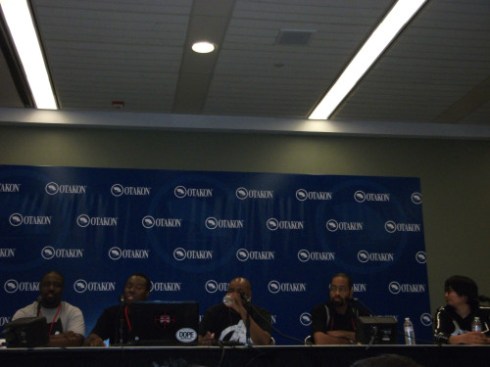
Hello, welcome to Otakon! Actually, a few years ago when you were a guest at Otakon I actually asked you a question about Hiyama Nobuyuki, but now I’d like to ask you about your recent work.
So the first question I’d like to ask is your role in Gyrozetter as “Mic Man Seki,” because I’m wondering, as you share the same name, if you were the inspiration for the character, or is it merely coincidence?
So originally the character was called a different name, and his profile was different, but the staff said, “It’s Seki doing it, so we should probably change this around.” So they decided to change the name, change the profile, and now the character is me.
I’d like to ask you about another recent role you had, your voice work in Gokaiger. How is voice acting for a live-action show different from anime, and how do you feel about your voice coming out of children’s toys?
So when I was small, I was also playing with tokusatsu toys, and to think that children nowadays play with those toys and that my voice comes out of it, I feel very honored and very happy that children are playing with those toys.
Regarding acting, I don’t really differentiate anime acting from live-action. It would be the same, but then the only thing I would really care about is to say it very heroically and courageously, as the word “goukai” in Gokaiger implies.
My next question is actually about Genshiken, of which I’m a fan, because you play Tanaka, a character very different from your other roles. What was it like playing Tanaka, and because of the recent cast change, although I know this may be a difficult question, if you know the reasons for the change?
So regarding the character Tanaka, he really likes figures and plamos and such, and I personally really like models, and although this character is very different from the ones I’ve been doing, his inside, as a person who likes models, is something I could relate to very much. I feel that the casting and such were matched up for that purpose.
As for the cast change in Genshiken, it does sort of happen at times when the sequel of a series goes on with a different company or production, and I thought I would love to do it again, but since I took on other roles after other people in similar ways, I would just need to term it as an “adult world.” I don’t have much to say.
I would also like to ask you about working with Mizuhashi Kaori, especially in Genshiken.
Mizuhashi Kaori is small but very energetic. She’s a very nice girl, but I don’t get to see her much these days. She’s about this big. *Seki puts his hands about a forearm’s length apart, to which I do the same*
*Laughs* You don’t believe me.
You’re known for voicing a lot of powerful characters, but your strangest role may be Mepple in Pretty Cure. How did you get that role, and how was it playing the character? Was it a challenge?
About Mepple, this offer came in to me, and they told me to do it as I like it, so I thought I should just do it in my regular voice. That day, on my very first recording on Mepple, I was feeling really good, and I decided to do it with a sort of high voice. They told me, if you can do that for an entire year, please do it. So, the only really good day I had was just that one day, and afterwards I was having a really hard time doing that one voice. Now that I think about it, it was a year of really hard work.
My final question has to do with voice acting. A few years ago, Mitsuya Yuji was a guest at Otakon, and he talked about how in the old days voice acting was a side job for theatre and drama actors. Nozawa Masako has also mentioned outside experience is also valuable, as opposed to acting exclusively in anime or voice acting. What do you think of this advice, and do you think it’s possible to be a strong voice actor without that outside background?
I think both opinions are correct. Whether you have influence or not, it’s all about how hard you work yourself. But, I am in the generation where Ms. Masako was my teacher, my sensei, and I learned from her that to be a good voice actor you have to be very powerful without just the voice actor part, that you need to be very good at using your body to act and such. From how she raised me, I think that’s very true, and outside experience helps very much, but the recent generation don’t really follow that example, so it really is up to the person.
This is an interview with Tachikawa Yuzuru and Suwa Michihiko, both of whom are involved with the Anime Mirai project, an annual Japanese government-funded program to help teach young animators the skills they need to improve Japan’s animation industry. Tachikawa is the director of one such Anime Mirai-funded work, Death Billiards. Suwa is better known as the producer for works including Detective Conan, Magic Knight Rayearth, and City Hunter, and is part of the Anime Mirai selection committee.
So the first thing I want to ask you pertaining to Anime Mirai is, because the project developed from wanting to help young animators, what is your opinion of the current state of anime for young animators in Japan? Would you like to see a future perhaps where the AnimeMirai project is no longer necessary because there are so many opportunities for young animators?
Tachikawa: So the reality is that when it comes to the number of animators versus the number of projects, the projects are greatly outnumbering the animators. The upper staff (senpai) is supposed to teach the younger (kouhai), but that’s not really happening these days. To speak bluntly, the studio doesn’t have much time or money, so it’s sort of centered around making the project. So since Anime Mirai is being funded by the country, I hope that it will be a starter for raising new hopes for the anime industry.
In the end, what would be best is if the upper staff at the studio would be able to teach the younger staff and that way Anime Mirai would no longer be needed. That would be the best future we could see.
You said the Anime Mirai project is funded by the Japanese government. What unique advantage does this provide, the fact that it is state funded?
Suwa: So the country funds Anime Mirai with I think 38 million yen, check back with me for the numbers. Sfter Anime Mirai makes a project, throughout the year the project will be shown as a movie. But after that, the movie/show will be in the hands of the companies, and it will then be a new project for the companies to get a profit out of Anime Mirai, so I think it will be a new way of doing things.
This question is about Death Billiards because it uses a lot of 3DCG in its animation of billiards. I know 3DCG has been seen in a variety of ways, such as a shortcut, a new form of animation unto itself, and as a cost-saving measure. What is your opinion of using 3D computer graphics in anime?
Tachikawa: Personally I don’t like anime becoming all 3DCG, it has to be a balance of both. The importance would be using 3DCG in the right place at the right time. The balls in Death Billiards are 3DCG, but the project had plans to teach the younger ones how to draw the more human parts, so we left the billiard balls and such to 3DCG.
This year’s Otakon was its 20th anniversary, and as expected of the staff they brought out the big guns, with names such as Watanabe Shinichirou, Kanno Yohko, and Seki Tomokazu. As with every year, one of the biggest strengths and weaknesses of Otakon is that there’s too much to do, and it leaves me feeling both satisfied and a bit disappointed.
For one thing, I didn’t get to see the Space Dandy trailer.
Industry
Watanabe Shinichirou (Cowboy Bebop)
Possibly the biggest news to come out of Otakon was the announcement of Watanabe’s new anime, the aforementioned Space Dandy. Described by Watanabe as “80% comedy, 20% serious” in contrast to Cowboy Bebop‘s “80% serious, 20% comedy,” the series sounds just plain interesting when you hear how much they’re putting into it. In terms of music, for example, Watanabe stated that they would have over 20 artists contributing to the soundtrack, and in terms of production every episode would have different episode directors and different designs for the aliens inhabiting their planets.
I managed to ask Watanabe about having Thomas Romain (Basquash!, Oban Star Racers) on staff for ship design, and Watanabe mentioned that he had been impressed with Romain’s work for a while. Also, while Romain is Satelight staff and normally wouldn’t be able to work at Bones for Watanabe, Romain turned out to be a huge fan of Cowboy Bebop which gave Watanabe the leverage to get him on board for this one project.
I do wonder how it’ll be received among American fans, because there was some disappointment from the fanbase over Watanabe’s previous work, Kids on the Slope. While Space Dandy is closer to his action-ey works, the “80% comedy” part might be unwelcome by those fans looking for drama and grit. That said, I’m certainly looking forward to it.
One of the more unique guests this time around was Kurosaku Kaoru, a novelist in her own right, but also more relevant to the otaku audience as the wife of Watsuki Nobuhiro, author of Rurouni Kenshin. Originally Watsuki himself was supposed to come as well, but he was unable to due to working on Embalming. Kaoru also held a panel all about Watsuki, but because of the way she went about it the crowd also learned a lot about some of the most famous Shounen Jump manga artists, as well as the workings of Jump in general.
There was also a gallery of Watsuki’s works, the first of its kind, but sadly even though we could take photos we are not allowed to share them online. (I’m sure somebody has though.)
Watsuki we learned is a big fan of American media, as one of his biggest regrets about not being able to attend Otakon was not being able to visit a Toys “R” Us and look at the Pacific Rim merchandise. He’s also a big fan of American comics, and his favorite superheroes are the X-Men. We also got to see his daily work schedule, which is mind-bogglingly arduous but also par for the course. According to the breakdown, Watsuki works from 10am to 6pm, from 7pm to late, and midnight to 4am. Sleep is 4am-9am, and the other gaps are for meals. That’s 5 hours of sleep versus about 15 hours for work. If he keeps on schedule, he gets four days of rest at the end of each month.
Kurosaki also provided a monthly breakdown of his schedule, and while inking comprised the majority of it, it was especially fascinating to see that the “name,” an extremely rough preliminary version of the manga which is mainly about panel and page layout and narrative flow, takes four days to comple. Kurosaki mentioned that the “name” is so simple as to use stick figures, but the attention paid to this part of the manga-creating process does emphasize how important panel flow is in manga.
Kaoru also took us through the process by which Watsuki makes color images, which involves drawing a thumbnail and then going over it with a Japanese calligraphy brush and copic markers for color. Watsuki apparently thinks that It’s good for one shot illustrations but not the manga itself, as it requires more concentration but the lines become more dynamic, and it acts as a time-saving measure for color images. The traditional feel that the brush art gives off also matches the theme and feel of Kenshin. Related to that, when someone asked about the setting of Rurouni Kenshin, the answer was that Watsuki wanted to draw a period piece with sword fights but didn’t want to draw topknots (they were strange-looking to a modern Japanese audience as well as an international one), so the Meiji period was the only point in history where you could have the former without the latter.
I wish I could’ve asked more about copics, as I find it interesting that they’re such an industry standard.
In terms of former assistants, Watsuki’s lineup is near-Olympian, counting among them Oda Eiichirou (One Piece), Murata Yuusuke (Eyeshield 21), Shimabukuro Mitsutotshi (Toriko), Mikio Itoo (Normandy Secret Club), and Takei Hiroyuki (Shaman King), all of whom consider Watsuki a friend. From Kaoru we learned that there are three breaks a year for Jump artists, and that during those breaks everyone either gathers at Watsuki’s or Oda’s house. Shimabukuro is a current neighbor of theirs, while Takei is a former neighbor. Murata, now known for his exquisite artwork on One Punch Man, used to be an assistant on Gun Blaze West, though at the time Watsuki thought his drawings were “no good.”
Mikio Itoo is known as the “cameo king,” appearing multiple times in One Piece, Shaman King, and even Kenshin in background posters and crowds and such.
Another major name who worked with Watsuki on Kenshin was former editor-in-chief of Shounen Jump, Sasaki Hisashi, whoworked with Watsuki from his first submission all the way to the end of Kenshin. The basis for a certain character in Bakuman (he even uses the fictionalized version of himself as a Twitter avatar), Sasaki is often asked about the accuracy of Bakuman, to which the official reply is, “Things depicted in Bakuman are neither true nor false.” We also learned that Jump employees are not supposed to give comments outside the office using their real faces.
Not limited to people who have worked directly with, over, or under Watsuki, we also saw comments from Kishimoto Masashi (Naruto), Inugaki Riichirou (also Eyeshield 21), Matsui Katsunori (La Sommelière), and Suzuki Shinya (Mr. Fullswing). Did you know the last chapter of Kenshin ran in the same magazine as the first chapter of Naruto? Kishimoto saw this as a kind of passing of the baton, and credits Kishimoto for making Japanese culture popular in manga again (but also believes that now it’s become too much). For this reason, Kishimoto calls Watsuki the leader of a generation.
Inugaki’s comment was that Watsuki taught him techniques to speed up the manga-creating process, namely giving rhythm to the use of detail and not trying to draw every little thing. We then learned from Kurosaki that both she and Watsuki playGerman board games often with Inugaki and his wife, and are especially fans of Dominion. As someone who hasn’t played it but has played games like it and has heard much about it, the intrigue continues to build for me.
Suzuki’s message talked about Watsuki’s fandom, as he once found an entire box full of fan letters for Watsuki. Matsui, whom Kurosaki commented that he’s especially good at drawing cute girls (I would agree), actually did not send any comments, except to promote him in the US. As much as I’d like to see that, I know Drops of God didn’t knock the manga community off its socks, so I don’t know how well the less adventurous La Sommelière would do.
What was maybe the most interesting bit of trivia of all, however, was that a lot of the Jump artists use the instant messaging service LINE to talk to each other and joke around. Watsuki doesn’t use it because he’s bad with computers, so his wife has to tell him what’s going on.
Sentai Filmworks
The only American industry panel I attended was Sentai Filmworks’, where they were very excited over their recent Girls und Panzer announcement. I also ran into an unfortunate bit of luck, discovering that they had license rescued Betterman, a show which I had just recently scoured Amazon for in other to get the complete release of the original Bandai DVDs. It’s a shame, because it definitely would have been a show I would’ve bought and supported, mainly because it’s such an unusual piece of work.
I asked Sentai Filmworks about the translation issues in their release of Mawaru Penguindrum but the answer given was ignorance, claiming that they had not been aware of the criticisms brought out against their translation choices. Oh well.
Maruyama Masao
While many of the industry guests and panels are excellent, every year the most stand-out guest is Maruyama Masao, founder and former producer at MADHouse, currently founder and producer of MAPPA (Kids on the Slope). Even though he’s been at one Otakon after the other, his Q&A panels are consistently informative and interesting. To give you an idea of how great his answers are, when asked about production delays for Redline (which took 7 years to complete), Maruyama answered that Redline was not late, it took as long as it should have, which was a lot of time due to the amount of work required for it. Maruyama then said that he left MADHouse to take responsibility for the debt that Redline put them into but then said in English, “IT’S A JOKE.”
In one of my favorite moments of Otakon, I asked Maruyama to share some stories about the recently departed Dezaki Osamu (director of works such as The Rose of Versailles, Aim for the Ace, Black Jack OVAs, and even Dear Brother), to which he replied with what was about a 10-minute long answer. Maruyama stated two significant events responsible for his long career in anime: working with two Osamus. First, he worked for Tezuka Osamu at Mushi Pro, and then formed MADHouse with Dezaki. Their first non-Tezuka work was Ashita no Joe. Eventually when the Ashita no Joe 2 film was in planning, they had creative differences where Maruyama believed it was unnecessary and Dezaki wanted to work on it, so he left and formed a studio called Anapple. They would not work with each other for many years, though they were still friends and still played mahjong with each other.
During the time they were apart, Maruyama produced directors such as Hosoda, Kon, Kawajiri, and had no time to work with Dezaki. Eventually, as they both reached old age, they decided to work together once more, and their final project together was, of all things, Ultraviolet. Dezaki wasn’t sure if it was the right work, but it was the only one in the pipeline at the time and the only chance they had to work together. Maruyama said they were happy to make it, though said nothing of the quality of the show. Maruyama then mentioned that Dezaki’s final work, Genji, had Dezaki tryingg to put in everything he couldn’t put into Ultraviolet. Then Maruyama said that with the time he has left on Earth, he would try to bring Dezaki and Kon’s remaining works to the world.
The panel also included a special showing of a short titled Hana wa Saku (Flowers Bloom), directed by Katabuchi Sunao (Mai Mai Miracle) with music by Kanno Yohko, whose purpose was to encourage the people affected by the earthquake. I hear in his other panel he also showed a video directed by Rintaro which was a funeral tribute to Kon Satoshi.
Interviews
I managed to get interviews with both acclaimed voice actor Seki Tomokazu, as well as Tachikawa Yuzuru and Suwa Michihiko, who are involved with the Anime Mirai project. Keep checking Ogiue Maniax for those.
Fan Panels
In terms of fan-run panels, this year was a mix of new and interesting subjects as well as a few “greatest hits” to celebrate the 20th anniversary. Mike Toole’s panel on “Outsider Anime,” his take on the Henry Darger-esque idea of “Outsider Art” looked at a number of creative and off-the-wall artists who, while for the most part not totally “outsiders” still push the boundaries. Names such as Shinkai and Yuasa are somewhat familiary to anime fans at this point, but I hadn’t heard of Tomioka Satoshi and his bizarre toilet humor rabbit animation Usavich for instance, and only recently learned about Mizue Mirai and his abstract animations. I was especially glad though to see him mention Iseda Katsuyuki, a man infamous for creating anime pretty much on his own with… unique results.
I attended the “45 Years of Shounen Jump” panel (while also singing along with the anime openings). Run by landofobscusion, it was a short “greatest hits” breakdown of the magazine. I learned quite a few things. For example, I did not know Sexy Commando was a top 3 title at one point, nor did I know that the end of Dragonball lost the magazine 500,000 readers while Slam Dunk’s finish lost them 2 million. What was even more interesting was hearing the crowd react to all of the titles mentioned. Yu Yu Hakusho for instance got a gigantic pop that I wasn’t quite expecting, as I knew people liked the show but didn’t know it was nestled that fondly in the hearts of fans who watched it on Cartoon Network.
Because of this panel the second City Hunter opening is stuck in my head now.
Speaking of surprising fan reactions, I am pleased to see the mecha fandom’s opinion of Gundam SEED turn around tremendously. Traditionally, when you go to a giant robot or Gundam-themed panel, there is a valuing of the Universal Century timeline over the alternate universe counterparts not named G Gundam. (The Seki Tomokazu panel I attended taught me just how many people love G Gundam, to the extent that more than one attendee exclaimed Domon Kasshu as a role model for how to live as a man.)
In the past Gundam SEED was seen as a black spot on giant robot anime, “the beginning of the end,” and all it took was a panelist to go “Gundam SEED! BOOOO!” to get the crowd to follow along. This time, though, when I attended the Mechapocalypse panel, Gundam SEED received largely applause rather than jeers, and it just warms my heart to see a mecha fandom which accepts what SEED brings to the table. We all agree though that SEED Destiny is still terrible.
Actually, the Mechapocalypse panel in general was a good deal of fun. Generally mecha panels are all about going through the history of giant robots and having everyone cheer for their favorites, and while this one retained some of that, it also mixed it up heavily with roundtable discussions of specific themes and characteristics of robot anime, all while keeping it light-hearted. While I’m already familiar with the Japanese Spider-Man, it’s inevitably a crowd pleaser whether you’ve seen it or not.
The other mecha panel (of sorts) I attended was Al’s presentation of the directorial works of Tomino Yoshiyuki, creator of Gundam. Neither full of blind praise for the man nor unfairly critical of his body of work, the panel laid out the various aspects of Tomino’s reputation, particularly his tendency for works to be either fairy light-hearted or particularly violent and morbid, and how both make up Tomino’s overall ouevre into something special. While I know a decent amount about Tomino anime, I also learned a good deal from the panel. I also realized based on audience reaction that Gundam has this strange memetic power which actually exceeds the content of the actual shows. This might be commonplace for anime fans nowadays as a lot of current anime operates actively under such influence, but I recall seeing the shouts of “Char is a lolicon!” back in the late 90s, and I think it’s what fuels some of the odder aspects of most Gundam panels, whether the panelist plans it or not.
The last panel I want to mention is “Anime Mystery Science Theatre 3000.” Although it was my first time seeing it, I learned from others that it was an extremely popular and well-regarded Otakon panel back in the day. Coming out of retirement for Otakon’s 20th anniversary , the Anime MST3K crew took down the GONZO film Origins: Spirits of the Past (aka Gin-iro no Kami no Agito), pointing out the hamfisted environmentalism message alongside the sudden and strange character/romance development points which result in the deformed child of Appleseed and Nausicaa. In addition to being hilarious, I noted that they had indeed kept up with anime over the years, spotting multiple Girls und Panzer references.
Concerts
This year, Otakon decided to hold two double concerts for its four guests, which resulted in Home Made Kazoku starting for TM Revolution and Ishikawa Chiaki preceded Kanno Yohko. I saw Home Made Kazoku back in 2010 at Otakon and TM Revolution back in 2008 at the first New York Comic Con. In both cases they’re among my favorite concerts I’ve attended, and to see them together was quite a treat. One notable thing about the Kazoku/Revolution concert was that it was held in the Mariner Arena, which made lining up in advance almost entirely pointless as you could get a decent seat even at the last minute. It was a pleasant change-up compared to previous years, and unlike the time with JAM Project I was glad to see the arena fill up a decent amount. I heard that at the end the two groups had a superhero teamup and did a song together, but I sadly had to leave before that.
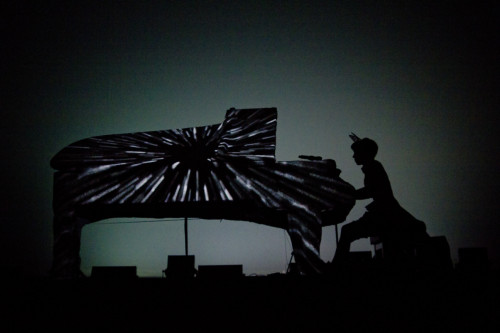
The Ishikawa/Kanno concert was an anomaly before it even began. Unlike every other concert at Otakon, this concert required tickets due to “unforeseen demand,” and tickets could only be picked up at specific times of the day. While I know Kanno is probably the most popular anime composer out there, it seemed to be an intentional choice to up the value of each seat, marketing at its finest. In order to keep up with demand, Otakon actually created an overflow room so that people could watch the live feed from elsewhere within the Baltimore Convention Center. The concert itself was also quite fantastic, as Ishikawa’s haunting melodies (“Uninstall” is a perennial favorite) led well into Kanno’s part, which was unlike any convention concert I’ve attended. Kanno was alone on stage with a piano, playing a number of her best hits, including of course “Tank!” and “The Real Folk Blues” from Cowboy Bebop. As the concert went on the white covering laid over the piano became a kind of projection screen which displayed graphic animations to accompany her music. It was a full-on aural/visual combination, as much an artistic performance as it was a musical concert. It was definitely another highlight of Otakon 2013.
The title of this con report comes from Kanno’s introduction by her producer, which I found quite memorable.
Baltimore and Friends
The most surprising news to come out of Otakon had to do with the convention itself, as the staff announced that Otakon would be moving out of Baltimore into Washington, DC in 2017. Citing capacity issues, I experienced firsthand the fact that the Baltimore Convention Center is increasingly unable to handle the growing attendance rate of Otakon. Friday afternoon saw for whatever reason extreme, extreme congestion on the third floor that made it so it literally took me 15 minutes to walk what should be a 3-5 minute trip, tops. I do feel pretty bad for Baltimore, as I know that Otakon provides them a good deal of money every year. On a personal level, my friends found a great hotel and great places to eat, and to leave them with the possibility of never returning does fill me with a bit of sadness. That said, I still have three years to chow down and go wild.
By the way, if you ever are in Baltimore and decide to go to Abbey Burger Bistro, I’ll tell you about my custom burger I ordered this year because it was fantastic. Duck meat burger (it’s a meat of the month so it might not be available) cooked medium rare, with brie, grilled onions, mushrooms, pineapple, and red pepper paste on thick toast. Do it.
I didn’t hang with or meet people as much as I had in previous years, but I still enjoyed seeing everyone. In terms of group activities, the highlight of the convention was watching Salty Bet in the hotel room. We happened upon a great night which pitted all of the famous overpowered characters against each other, and the unstoppable force vs. immoveable object that was Berserk vs. Rare Akuma made for an unforgettable evening.
Cosplay
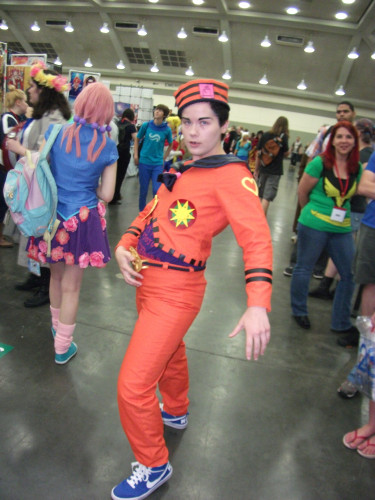
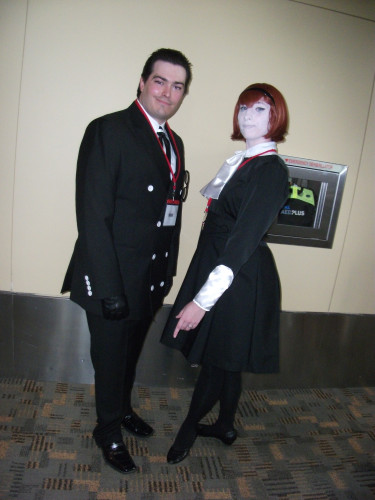
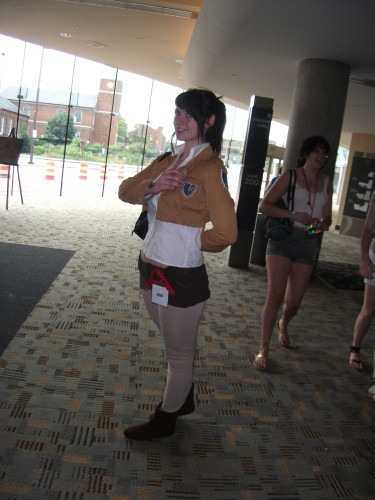
I’ll end off with the semi-standard cosplay photo bonanza. I was not quite as trigger happy with the camera this year, but I did find some definite gems. Special shout out to the Sasha cosplayer who actually handed me a potato afterward.
NIS America announced last month that they have the rights to the Genshiken Second Season anime, and knowing their history of putting out deluxe box sets that are a little pricier but come with all sorts of doodads (an art book being the main one), anyone who’s a Genshiken fan would be satisfied with their Bluray release (though we don’t know what’s there yet).
The question is, would you be satisfied enough?
For the Japanese release of Genshiken Second Season, there is a special deal: If you preorder all 4 Bluray volumes before September 1st from one of three specific stores, you will get a 12-page illustration booklet AND a color print by Kio Shimoku. Order from Animate for Double Hato, Gamers for Yoshitake and Yajima, and finally Toranoana for Ogiue and Sue.
This is in addition to existing extras, which at least for Volume 1 include a 16-page illustration booklet and an animated extra entitled “The First Meeting to Discuss How a Girl This Cute Can’t Possibly Be a Girl,” as well as a “Post-Clubroom Rambling Discussion.” Whether that’s another animated feature or voice-only, I don’t know.
The only thing is, if you opt into one of these deals, you’re looking at roughly 30,000 yen for 13 episodes. Also keep in mind that a lot of these stores don’t ship internationally so you’ll have to find a way around that, which can cost you even more. You can get them cheaper through Amazon JP but then of course you wouldn’t get the extra extras.
I’ve pre-ordered the Blurays because I am an idiot. As you may have guessed, I went for the Toranoana version. I did not decide to get all three sets of Blurays because even I’m not that insane.
Honestly, unless you’re me, you’re probably better off sticking with the NIS America release as I’m pretty confident it’ll look good. The Japanese Blurays are a realm beyond, for those looking to collect every bit of Ogiue merchandise they can (there’s not a lot, you know).
Actually I’m going to buy the NIS America release as well.
UPDATE: FUNDING FOR CREAMY MAMI EPISODES 1-13 WAS SUCCESSFUL! I DON’T KNOW IF I PLAYED ANY SIGNIFICANT PART BUT THANK FOR READING.
A company called Anime Sols has been trying to crowdfund a number of old anime, some classics, some rather obscure. Despite streaming all of their shows at least in part, none of the anime they’ve picked so far seem to be anywhere near their intended goals, and I think it’s a bit of a shame. Of their shows, the one that seems to have the best shot is Magical Angel Creamy Mami. At over $8000 currently of its $19,000 goal, it’s been much more “successful” than its fellow Anime Sols shows, and I’ve even pledged myself. With only four days left there isn’t a lot of time, but that also means it’s still possible to contribute.
A popular 80s magical girl show which is still well-loved, Creamy Mami is less Sailor Moon-style “magical girls as fighting force” and more Full Moon o Sagashite’s “magical girls using magic to turn into adults.” It’s from a different era and conception of magical girls, and thematically also very representative of what was around at the time, and the ability to have these shows brought over and sold to English speakers would be great for fans of anime, especially those interested in the mahou shoujo genre.
Now those who’ve read Ogiue Maniax may be aware that I’ve not exactly given Creamy Mami the bestreviews. I don’t exactly find it to be a riveting show, so it may seem like I’m talking out of both sides of my mouth, but my support of Creamy Mami has less to do with the quality of the individual show and more about the potential opportunity it brings to have more classic magical girl anime available. I’m a fan of mahou shoujo for aesthetic, narrative, and emotional reasons, and so even if Creamy Mami isn’t fantastic, it may be the bridge to shows of a similar cloth which are. Keep in mind that I’m not asking people to support a magical girl show so that they can get more violent action shows or harem works, nor am I suggesting that failure to support this would mean the death of all anime crowdfunding. However, if mahou shoujo is your thing, then it might just be worthwhile.
And once again, I have to say that the second ending theme for Creamy Mami is really good.
May 4, 2013 marked the second anniverary of Free Comic Book Day in the Netherlands. An American institution which I’ve participated in for over a decade now, I was amazed last year to see it brought over to other countries as well.
This year the full selection of free comics was raised from 7 to 10, far less variety than what was offered in the US, but at the same time had many of the charms and stylistic tendencies associated with European comics (even if they may not have been made in Europe!). The comic book store owners I did talk to all seemed to make it a point to tell me that they lose money participating in Free Comic Book Day, and urged me to buy something alongside. In my opinion, this kind of goes against the spirit of Free Comic Book Day in the sense that it isn’t supposed to be a guilt trip, but it might just be a difference in population/costs/other factors which make it not as sustainable as the American FCBD.
Sadly I am mostly illiterate in Dutch so I can’t really talk about the quality of narrative, but I can at least talk about some of the comics which caught my eye, or which most likely would catch yours.
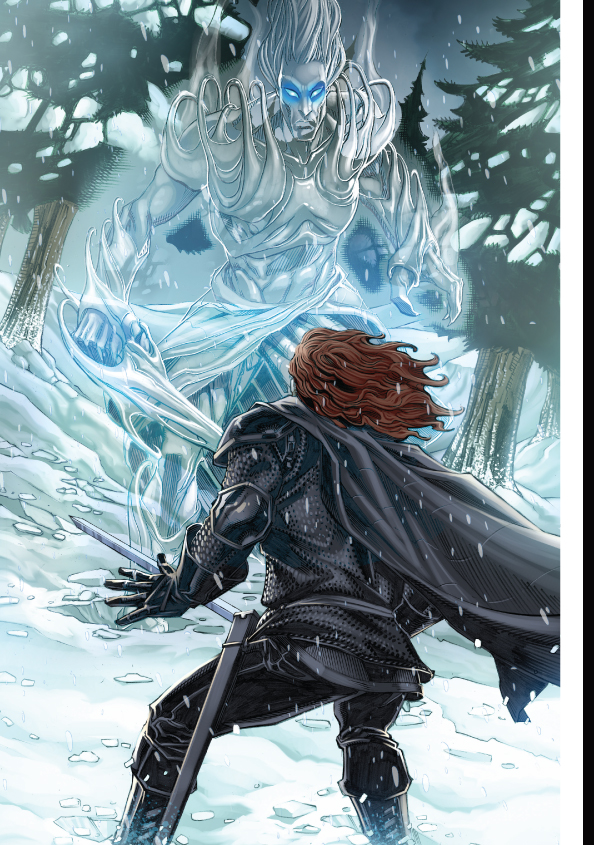
Probably of greatest interest to people would be the Game of Thrones comic, adapted by Tommy Patterson, and actually available in English. I have not read A Song of Ice and Fire, nor have I seen the HBO Game of Thrones, so in terms of accuracy or spirit I can’t really say anything. At the very least the art is vibrant, and I like it way more than Patterson’s previous work on series like Grimm’s Fairy Tales.
Next is Sienna, by Desberg, Filmore, and Chetville, about a female government agent. “Sexy women of action” as far as I’ve seen is quite a popular genre here, at least in terms of comics made, and this one takes a more mature and dramatic angle. The art is quite nice, and there’s plenty of violence and (I assume) conspiracy. You can see a small preview here.
De Verborgen Geschiedenis (“The Hidden History”) by Pécau, Kordey, and Chuckry stands out immediately just because of the camel on the cover. As far as I can tell (and please correct me if I’m wrong), the comic appears to mainly be about what its title implies: some mix of conspiracy and secrecy spanning decades. Like both Sienna and even Game of Thrones, it goes for a more serious art style. There’s also a prominent English (?) female military officer in this issue whose name I can’t find. With a prominent scar on her face, she toes the line between sexy and legitimately frightening (more the latter), as her expressions go from cold to menacing throughout the comic. Overall, she comes across as like a female Golgo 13, especially because one scene has her casually waking up surrounded by a pile of naked bodies both male and female.
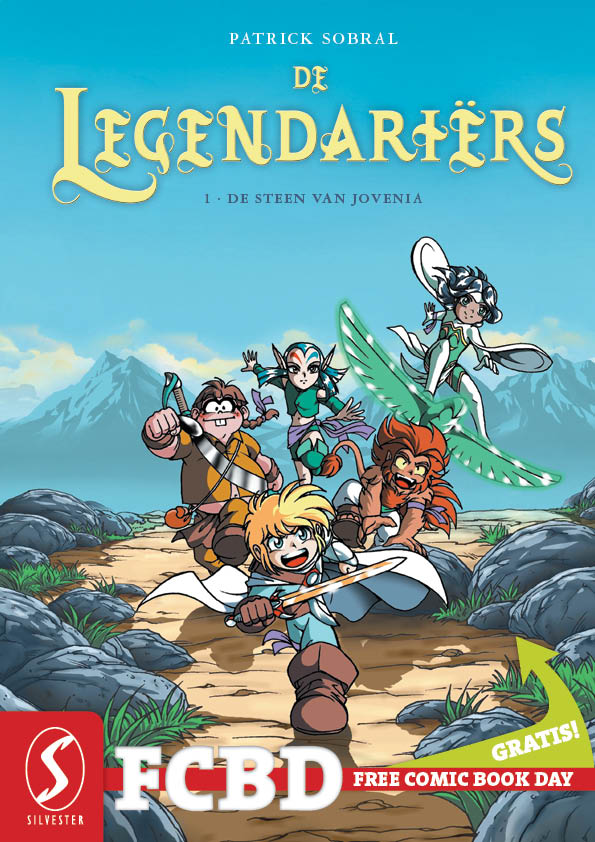
The last one I want to point is De Legendariërs by Patrick Sobral, due to its overt stylistic influence from anime and manga. Unlike the other three, this one has much more light-hearted feel. Its super-deformed characters and fantasy setting give me the impression of a pre-Playstation Japanese RPG. In fact, the characters look more like a late-80s/90s anime characters instead of current ones anyway, which really harkens back to that era. Anyway, the villain is named “Darkhell.”
So that’s a (very) cursory view of Free Comic Book Day 2013 in the Netherlands. Take my opinions with a grain of salt here, as I can’t give you a true impression of any of them.
And I must ask, for those of you who can read French or Dutch and picked some of these up, which ones impressed you the most?
Ever since the announcement of the new Genshiken anime, I’ve speculated about the voice cast. Courtesy of one Anonymous Spore and the official anime website, the new cast for the Genshiken Nidaime (or Genshiken II as I prefer to call it) has been revealed, and the big, big shocker is that Mizuhashi Kaori will no longer be playing Ogiue, that most grand of angry, once-traumatized hair-brushed fujoshi.
My initial reaction has been genuine surprise and confusion, as I thought she fit the role tremendously well, and seemed to be well-established as Ogiue. Her Ogiue felt genuinely conflicted about everything, and it’s my favorite role of hers (biased perhaps). She even participated in the Genchoken radio shows with Madarame’s voice actor Hiyama Nobuyuki, and drew a comic about how she landed the role as Ogiue. Even putting aside my own Ogiue fandom I’ve thought for a long time that Mizuhashi ranks among the best voice actors out there.
That said, I think it would be a bit unfair to judge Yamamoto Nozomi before I even get to hear her voice the part of my favorite character. She’s pretty new, but she’s also already played roles such as Yukimura in Boku wa Tomodachi ga Sukunai, and Tetora in Joshiraku. When I think about Tetora’s voice in particular, it may actually be a bit closer to how I imagined Ogiue’s voice in my mind when I first read the manga. Actually, Gankyou’s voice would have been even closer, but that’s maybe getting too off-topic.
As for the rest of the cast, you have Uesaka Sumire (Dekomori in Chuunibyou demo Koi ga Shitai!) as Yoshitake Rika in addition to performing the opening theme, Uchiyama Yumi as Yajima Mirei (Davi in Dokidoki! Precure, Arata in Saki: Episode of Side A), and a combination of Kakuma Ai and Yamamoto Kazutomi handling the female and male voices of Hato Kenjirou, respectively. If you look at their list of works, all of them are pretty new voice actors, so perhaps there was something on the production side that required the use of newer voices. I read that they may be changing the old characters as well? Or maybe there was just a good old-fashioned scheduling conflict, which even happened with the Genshiken 2 anime and Keiko’s voice actor. In the end, it’s all just speculation, unless someone more familiar with the seiyuu scene could inform me otherwise.
Based on the previous roles of the actors for Yoshitake and Yajima, I can imagine them fitting their roles well, especially if they go for more naturalistic and awkward voices. I think Yajima especially will be a challenge.
In addition, voices aside, the art and character designs look probably the nicest they’ve ever been for Genshiken anime. I guess it all remains to be seen (and heard).
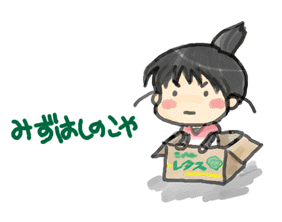
UPDATE: I decided to look at Mizuhashi Kaori’s official site, which isn’t really updated anymore, and what’s really curious is the fact that where once the front page image was of Ogiue in an empty cardboard box, now Ogiue has been replaced by a different character. I’m unsure if it’s meant to be Mizuhashi specifically or if it’s meant to be another one of the characters she played, but just the fact that she used to use an Ogiue image on her front page as early as September 2012 may indicate that she was rather close to the character of Ogiue.
JManga, the digital manga service backed by a number of Japanese publishers, is shutting down. No more points may be purchased, and all titles will be taken down by May 30, 2013. Any remaining points on users’ accounts will be refunded to them in the form of Amazon Gift Cards.
JManga, unlike so many other official manga sites, was at least partly accessible in regions outside of the US, and it was for this reason that I initially supported it in spite of its initial convoluted pricing scheme. Eventually, they changed the pay format to something a little more enticing and easy to understand, but when a friend told me that he wished he could purchase a title that was already on JManga, it made me realize just how unknown the site was. I tried to do my part and encourage others to use JManga, but for one reason or another it apparently wasn’t enough. It’s a shame, because I think they really made some excellent strides in getting manga to a digital format, even if their reader left something to desire in terms of functionality and ease of use.
The news of JManga’s impending demise brought up conversations about piracy and users’ rights that is affecting industries well beyond manga at this point (the Sim City server problems being currently the most prominent), and one of the arguments being made is that it’s in the end the fault of scanlations. I have a problem with this. While I don’t doubt that scanlations impact sales, especially when it comes to the popular titles, the fact is that none of the manga on JManga were heavy hitters. Their famous titles were things that simply don’t sell too well, like volume 1 of Golgo 13. I believe their most successful manga was Soredemo Machi wa Mawatteiru (some of which I purchased and am kind of miffed that it’s going to vanish in a couple of months), which to put it lightly is not a Naruto or a Sailor Moon.
The lineup at JManga was extremely esoteric, and while this had a great amount of appeal for me personally, I’m also aware that the average manga fan, whether they read free manga online or not, is not going to chomp at the bit to go read about a Heian era fujoshi (another purchased title I will miss). Essentially, the titles on JManga were so out there that for the most part they were not the things people would look to scan and distribute, so the traditional argument of piracy doesn’t really apply here. Also, JManga was apparently shackled by the fact that publishers would not hand over their A-List titles. Tokyopop tried the flood of mediocrity approach as well, and that didn’t go so well in the end. While it is possible to say that fans should have subscribed anyway in order to give JManga the opportunity to go after the big titles, as Narutaki over at Reverse Thieves and the Speakeasy podcast pointed out, you can’t expect people to pay money in the hopes that they might someday get the titles that they want, especially if they’re from wildly different genres and demographics.
I could see it argued that manga scanlations created the environment which made publishers fear handing over their major titles, and by extension was the cause for JManga’s demise, but I think this would be overlooking the fact that media companies tend to be conservative about trying out new platforms until they absolutely must. HBO’s business model, for instance, is based on subscriptions to their premium cable service. This is fine and all, but it turns out that people who only want to watch online (legally, mind you) must also buy cable and HBO anyway. Media companies, if they can help it, will dig their feet into the ground to the point that they pretty much have to be dragged kicking and screaming to evolve alongside their potential customers’ habits. As a classic example, would the music industry have even bothered with digital distribution and the mp3 format if something like Napster hadn’t forced them to do so?
This is not me defending piracy as some kind of noble endeavor, but merely making the point that if scanlations did not exist and were not so ubiquitous, then I highly doubt that Japanese manga publishers would have simply decided to put manga online “just because.” In other words, to say that JManga would have been fine had readers of manga behaved all along is I think a flawed argument because there’s a good chance we wouldn’t even have sites like JManga or J-Comi. Valuing creative talent and creative output is still important, but defining that value according to current conventions and blindly accepting the current distribution methods (or lack thereof) is problematic itself. That’s not to say that one must rebel against the system in order to “save manga” or “stick it to the man,” but it would be beneficial to acknowledge where it is flawed, and to also not put blame squarely on the shoulders of readers, especially when the site was not giving them what they want.