Precure has been the juggernaut of girls’ anime for the past 20+ years, and the most common way for others to compete has been by making shows focused on music idols. So when You and Idol Precure was announced as the first entry to also incorporate this popular motif, I wondered how it might try to differentiate itself from the rest of the pack.
You and Idol Precure is a return to the beams-and-brawls style that had long defined the franchise but was minimized in the most recent predecessor, Wonderful Precure! In this way, You and Idol Precure is also a series that speaks to the legacy of both “magical girl as idol” (Creamy Mami, Looking for the Full Moon) and “magical girl as fighter” (Cutie Honey, Sailor Moon). I had high hopes that this season could combine the two sides in an interesting fashion, and while I think it overall turned out decently, I can’t help but feel that there was some wasted potential.
The building blocks are excellent: The premise of bringing joy and defeating doubt as idol magical girls is fun. The heroines are vivid and memorable in terms of personality and presentation. The animation, while at times inconsistent, can really shine, such as during big battles and transformation sequences. Side characters, be they allies or enemies, have a nice balance between seriousness and silliness. And the show tries to basically say that people have both light and darkness in them, and celebrating the former shouldn’t mean denying the presence of the latter.
But the series falters for me in two ways. The first is that its approach to the idol side feels both a little too conventional, and like it doesn’t lean into that side enough. The second is that the show doesn’t give its more interesting stories and themes enough room to really breathe and develop.
In regard to point #1, part of me hoped that the series would be them going around and having to live their careers as idols while taking down the bad guys. While this is not far off from what actually happens, I really think it could be more exciting. Similarly, every heroine in the series does a special song and dance as their finishing move highlighting their unique qualities: Cure Idol loves to sing, Cure Wink has a classic western music background, and Cure Kyunkyun is a dancer. Naturally, they eventually get group performances as combination attacks, but it ends up being the same ones on repeat, and the emphasis on what makes each Precure special falls to the wayside. If they had changed up the center based on who is the focus in an episode, they could have maintained this aspect.
As for point #2, there are a number of characters introduced that help give some depth and dimension to the world. There are narratives that involve dealing with sacrificing your greatest desires to help save the ones you love, ones about getting consumed by negative emotions, and even ones about guilt over succeeding where your friends and peers have failed. All of these have the potential to guide plotlines in ways that reward viewers over a longer period, but they are almost all resolved in one or two episodes. One story—involving a famous male idol who befriends the main heroine Uta and his desire to reconcile with an old friend—is probably the best executed of them, but I would have liked to see even more in that vein.
I know I’m not the target audience in most ways. I’m not a little girl or even much of an idol fan (despite my ever-growing interest in VTubers). In fact, seeing as I’ve now been watching Precure for over two decades, the gulf only gets wider with time. I’m aware of all this, and understand that what I want out of an anime is not necessarily what a 9-year-old wants.
But I’ve seen when Precure can make something for its core audience and still present something with greater substance. I don’t think this is a case of Precure failing to respect the intelligence of its young audience, as I really believe it’s trying to help them understand and process complex and conflicting emotions while providing great role models to admire and emulate. Rather, I believe You and Idol Precure could have been a more cohesive work that more deftly sews together all its best qualities to create something truly fantastic.
Maho Girls Precure!! ~Mirai Days~ (also known as Witchy Precure!! ~Mirai Days~) is the second case of the Precure franchise creating a direct sequel anime that features its heroines many years after their original stories. While it might be a bit unfair to compare this series and Precure Full Bloom, their diverging approaches to portraying their respective characters as adults is noteworthy for how they connect to the concept of “youth” and all it entails.
Ever since the end of their original story, heroines Asahina Mirai and Izayoi Liko have each been living in the non-magical and magical worlds respectively. Mirai is a college student now, but she also continues to secretly use her witch powers to help people as the mysterious “Maho Girl.” Liko has become a teacher at her old school, training a new generation of magic users. When a new enemy threatens both worlds, the two reunite to become Cure Miracle and Cure Magical once more.
To me, the biggest difference between Full Bloom and Mirai Days can be summed up in the transformations. While the Yes! Pretty Cure 5 and Pretty Cure Splash Star girls revert back to their middle school selves when transforming, Miracle and Magical remain adults. In the former, the power of Precure is locked to the youth of the past, but in the latter, that power continues forward.
One aspect that might have influenced these diverging approaches is the fact that they are targeting different age demographics. Yes! 5 and Splash Star are around 10 years older than Maho Girls, and that means one sequel is targeting women around 30, as opposed to those closer to 20. Thematically, the first group are adults worn down by society and the clash between the dreamy ideals of your youth and the harshness of the “adult world.” In contrast, Mirai and Liko have to fight those who want to remain in an ideal past where they felt happiest.
Even then, I liked the way Maho Girls did it even more. I want to see how adults might look in magical outfits, and how they would carry their life experiences in their actions. Why can’t we see women in their mid to late 20s (and beyond) undergoing full, proper magical transformations that acknowledge their maturity?
A couple of episodes of the magical girl anime You and Idol Precure has an enemy henchman named Cutty forcibly transformed into a giant robot called Cuttinda. As a fan of both giant robots and magical girls, I felt the need to write about Cuttinda, particularly its appearance and the way it draws from three different works from the mecha genre.
The first robot referenced is Mazinger Z, based on the red plate on its chest. Normally, those shades are part of the Monster of the Week’s face, but here, they’ve specifically been placed in a way similar to the Mazinger line.
The second is Gaiking. The limbs, particularly the design of the wrists and the red sections of the legs, are really reminiscent of the monster-chested robot.
The third is Giant Robo. Cuttinda’s head, like Giant Robo’s, resembles that of a pharaoh or the Sphinx.
I think Cuttinda being the way it is comes from the fact that Precure is a Toei franchise, as all three of these mecha are also by Toei. Mazinger Z and Dino Mech Gaiking are both anime, while Giant Robo is a tokusatsu series.
WIll we ever see Cuttinda merch? Probably not, but I wouldn’t mind getting a silly robot.
I’m not a big fan of obsessing over tropes. The way people might try to fit everything into a TVTropes category bothers me, and even when asked questions about what kinds of character pairings I prefer, it always greatly depends on context and execution. Despite this, I do enjoy occasionally watching Overly Sarcastic Productions’ Trope Talk, and after watching their recent episode about the “Dreaded,” I found myself wondering what might be my favorite example.
The answer, as with so many things, is Heartcatch Precure!, the 2010 entry in the Precure magical girl franchise.
According to TVTropes, the Dreaded is “a character or a single, unified group whose primary characteristic is the fear the other side has of them.” Examples include Darth Vader, All-for-One from My Hero Academia, and perhaps even Uncle Iroh from Avatar: The Last Airbender. In terms of narrative the way the character’s reputation precedes them adds to the sense of anticipation for when they do show their full strength, and as the Trope Talk video points out, a character can also lose their “Dreaded” aura if they are overused or mishandled.
The reason I love Heartcatch Precure!’s version of this is that there are two “Dreaded” characters, and the way the series handles them both is just magnificent.
WARNING: SPOILERS
The series begins not with girls who would become the main characters, but a clash where a warrior named Cure Moonlight is defeated by a formidable foe named Dark Precure, who seems to mirror her abilities. Before all hope is lost, Moonlight’s companion mascot, Cologne, sacrifices himself and creates an opening that will allow a new generation to take over the fight. In the first two minutes, Dark Precure is established as this overwhelming entity who crushed Cure Moonlight, but then Heartcatch! does something important: Dark Precure doesn’t show up, at least for a long time.
And so the new heroes, Cure Blossom and Cure Marine, discover their new abilities and find their footing as they repel the enemy’s minions and monsters time and again. Then, Episode 10 hits, and Dark Precure appears, beats them down, and makes all their efforts and progress look hopeless. The first episode established her as a dangerous foe, but this just shows superior she is compared to Blossom and Marine. It does a great job adding to Dark’s aura of dread.
But when nearly all hope is lost, a high school girl they met earlier shows up and does the seemingly impossible, blocking Dark Precure’s finishing blow. This girl, Tsukikage Yuri, is actually the former Cure Moonlight, and she’s using the broken remnant of her transformation stone as a shield. This is when Heartcatch does something that pushes the Dreaded trope to the next level: Upon realizing who it is standing before her, Dark Precure reacts with a caution so different from her previously stoic attitude that it immediately makes clear what a force Yuri is. With just a fraction of her strength, she makes a seemingly unstoppable villain hesitate.
Heartcatch Precure! thus establishes its Dreaded characters: one on the side of evil, and the other on the side of good. What’s more, both their stories play important roles long term in various ways. Relative to each other, they establish a deep sense that they are each others’ true arch enemies. To the main heroines, Dark Precure acts as a litmus test: As the series continues, the girls go from being outclassed to being able to at least hold her off—not enough to diminish Dark’s status as a Dreaded. Yuri, for her part, is part of a vital part of the story: It’s through the efforts of the others that she slowly regains her conviction to fight and to stop blaming herself for the death of Cologne. When Yuri finally transforms into Cure Moonlight again, all the anticipation that comes from her reputation pays off in spades.
The presence of a trope does not make anything inherently good or bad, and 90% of its effectiveness comes from execution. They’re descriptive rather than prescriptive, and Heartcatch Precure! uses both its Dreaded characters to both entice and reward its audience over time. It’s just one of the million reasons I still love this magical girl series so much.
Wonderful Precure! is the 21st anime series to carry the Precure name, and it continues a trend of breaking unspoken rules of the now decades-old magical girl franchise. But whereas the previous series broke age and gender barriers, Wonderful Precure! defies one of the most core aspects of its predecessors: how it approaches violence.
The story of Wonderful Precure! centers around Komugi, a Papillon Dog and resident of Animal Town who wishes she could communicate with her owner, Inukai Iroha. When the town’s mystical Mirror Stone grants Komugi the ability to speak human language and even transform into a person, her friendship with Iroha grows closer than ever. She also gains the ability to transform into the magical girl Cure Wonderful and face off against monsters called Garugaru—once-peaceful animals who have been twisted and corrupted into dark creatures. Later, she’s joined by Iroha (as Cure Friendy), as well as Cure Nyammy and Cure Lilian.
Komugi is not the first combination of magical girl and mascot in Precure, with characters like Milky Rose and Cure Parfait coming before her. However, she’s the first to be the main heroine. This in itself is a notably different angle taken by Wonderful Precure!, but even bigger is the fact that Wonderful Precure! is the first Precure to all but eschew combat as a fundamental part of the Precure experience.
When Futari no Pretty Cure hit Japanese airwaves back in 2004 and kicked off the Precure franchise, something caught the eyes of viewers about the way its heroines fought. Action-focused magical girls had been a thing since Cutie Honey in the 1970s, and Sailor Moon was home to heroines who could shoot lightning and cause earthquakes, but Cure Black and Cure White threw hands. They’d punch, kick, back fist, throw, and when the time came, shoot a massive energy beam to finish monsters off. (The original director also famously worked on Dragon Ball Z). Though never portrayed in a bloody manner, violence became a key element of Precure. Later entries would follow this to varying degrees, some preferring to concentrate more on elemental blasts and mystical energies, while others continuing the fisticuffs with gusto.
In contrast, outside of a few episodes where it’s a point of character conflict, the heroines of Wonderful Precure! don’t ever try to hurt the Garugaru. Rather, they try to corner them like, well, animals so that they can heal and restore the poor transformed critters. The approach is understandable: The creators probably wanted to discourage kids from punching animals. I also can’t tell if removing violence from Precure is a brave move or a conservative one, but it does make for a much less action-packed anime as a result, for better or worse.
Precure has always primarily targeted young girls (with things for older fans to appreciate), but Wonderful Precure! has a more childish feel than all previous titles. That said, this series isn’t entirely toothless. The animal theme emphasizes cuddles and fun, but the series also brings up the harm humans have inflicted on animals and the environment. The reality of people being responsible for the extinction of entire species becomes a vital part of the narrative, especially towards the end. It’s just that Wonderful Precure! approaches its pacing more like episodic anime from decades past, saving all the heavy stuff for the final stretch. It also has what I think is the best execution of an actual heterosexual romance Precure has ever seen, as well as possibly the best main villain ever.
One other thing that I believe is particularly cool about the series is that it tries hard to counter gender stereotypes. Iroha’s dad (who as far as we know is straight) is a mountain of muscle who dresses in frilly pink and shows tender kindness to all the animals he takes care of. Iroha’s longtime friend, a boy named Toyama Satoru, is a gentle soul who uses his dedicated study of animals to support the girls. And funnily enough, Satoru has a pet rabbit named Daifuku, who you might expect to be an adorable cinnamon roll. But when Komugi translates Daifuki’s speech, it turns out the fluff ball has the most badass manly speech mannerisms in the entire series. Trust me that the last aspect pays off.
While Wonderful Precure prefers it heroines to not kick ass and take names, that isn’t the case with the next series, You and Idol Precure! This may very well be the first and last time Precure decides to take a more peaceful approach, but it makes for a series that stands out all the more as a result. Wonderful Precure! can be profound in its own ways if you give it the chance to tell its story.
The Stories of Girls Who Couldn’t Be Magicians is an anime that should have been longer.
Adapted from a web novel, the story of Mahonare (as it’s known for short in Japanese) follows Kurumi Mirai, a girl who has always dreamed of being a magician, but failed to get into the magic program of the prestigious Rettoran Academy. Attending the school’s non-magical track, a crestfallen Kurumi and the rest of her class soon meet their homeroom teacher, the unusually petite and eccentric Minami Suzuki, who promises that she will teach them magic, despite common sense saying that it should be impossible.
There is one series above all others that Mahonare reminds me of: the wonderful Ojamajo Doremi. While the magic aspect is something they clearly have in common, the similarities also include the style of presentation. From the pastel-like filters to the opening narration each episode to the theme songs themselves, Mahonare greatly resembles the morning girls’ anime of the late 90s and early 2000s that include Doremi but also things like Ashita no Nadja and Fushigiboshi no Futagohime.
But the more important way that the Mahonare draws upon the tradition of Doremi is the way it builds up a strong cast of characters, both major and minor, that contributes to world building and story. Though we get only a few glimpses of some characters, each gives the impression that they’d have their own interesting stories to tell if given the chance. One girl in Kurumi’s class is supposed to be part of the magic elite, only to have come short. Others are more happy to just be attending even if they can’t cast spells, eager to pursue their passions whether it’s cooking, music, or fashion.
Moreover, while the teens have teen troubles, the adults have adult troubles, and the intersection between them creates conflicts about everything from pursuing your dreams to moral quandaries that cut to the heart of their society. One of the most interesting plot points involves the positives and negatives of the magic notebooks that have become ubiquitous. Their widespread adoption encourages magic to be converted to easy-to-use apps that don’t require necessarily understanding fundamentals, mirroring concerns over the way smartphones and tablets have transformed how children grow up with electronics.
But that resemblance to Doremi is exactly why I think Mahonare should’ve had more episodes. It feels like a 52-episode work that was condensed down to 12, and the show suffers for it. Little crumbs of plot development that could have been sprinkled in here and there instead come one after the other. Character bonding moments happen very rapidly as well, as opposed to building up gradually and therefore with more weight. While I understand that the reality of current anime production means very few anime get that privilege, I can still lament the loss of that possibility for Mahonare nevertheless.
This certainly isn’t the first time that a series has received a truncated adaptation, and some even go on to have a more thorough version be made later. I can only hope that The Stories of Girls Who Couldn’t Become Magicians falls into this select category.
20 years of Precure is an astounding milestone, so it‘s only appropriate for this magical girl franchise to celebrate hard. To wit, we’ve seen a sequel where characters are all grown up, gallery exhibitions, a concert, and of course, the latest main entry: Soaring Sky! Precure.
Known in Japan as Hirogaru Sky! Precure—hirogaru meaning “expand or spread,” and also being a pun on “hero girl”—the series stars Sora Harewataru, an aspiring hero and a resident of a magical world called Skyland. When the king and queen’s baby, Ellee, is kidnapped by an agent of the Undergu Empire, Sora uses her superhuman athleticism to chase down the culprit, but a mishap causes them to all end up in the human world. Sora needs the power to protect Ellee, and she soon discovers it: Ellee has the latent ability to help create fighting magical girls called Precure.
In many ways, this isn’t unusual for Precure, but there is one immediate difference that is crucial: Sora Harewataru is blue.
To those unfamiliar with Precure as a whole, that might not seem like a big deal. However, throughout its long history, pink has been the dominant motif of all but one protagonist: the original from 2004, Cure Black, and even she has pink highlights. Chalk it up to marketing or heteronormativity or whatever, but that’s the standard Sora Harewataru, aka Cure Sky, defies just through character color alone.
Along with her athletic tomboy personality and her desire to become a hero who fights to protect others, Sora feels like both a return to the roots of Precure but also a pivot into uncharted territory. Her presence is a signal that Soaring Sky! breaks all the rules of what Precure is supposed to be like, and as more Precures join the team, other “expected standards” start to fall like dominos. Why does the pink-haired girl have to be the lead? Why can’t a boy become a Precure? Why can’t an adult? This habit of asking itself and the audience “Why?” becomes a central thread of the series.
Soaring Sky! is conceptually one of the strongest series in the franchise, and it largely succeeds in its execution. The characters all feel very distinct and memorable, and not just because they depart from established norms. Whether it’s the gorgeous and personality-filled transformation sequences or the interactions, they feel realized as unique individuals. One of my favorite early moments comes from when Sora is attending school in Japan for the first time and shouts with gusto, “YES! I AM VERY SHY!” despite being a very straightforward person who also happened to break every school athletic record (and can shatter boulders with her fists untransformed).
The villains also end up having a lot more depth to them than many past entries, with some of the most interesting arcs for them across Precure. Even the final boss is given more development than usual. And one of the potential biggest drawbacks, the constant presence of a baby, turns out to be one of the show’s strengths.
That said, it can sometimes feel like certain characters just aren’t getting enough attention. The way the show portrays the aforementioned adult-age Precure, Cure Butterfly, often comes across like the creators weren’t entirely sure how they wanted to convey her relative maturity to a young audience. In her better moments, she’s shown providing a perspective her younger teammates lack, but she often seems kind of distant. Compared to The Power of Hope: Precure Full Bloom, Butterfly ends up feeling a little flat, though I wonder if that’s the difference between trying to write sa mature character for children vs. writing one for adults.
The highs of Soarin’ Sky Precure are (appropriately) very high, but the show can get a little overly meandering, and it doesn’t live up to its potential in every instance. However, the show is trying to do a lot, and it still works by refusing to confine the possibilities of what Precure can be. As the series moves from start to finish, the series asks why “the way things are” can’t change for the better, and why can’t we be the ones to accept the possibility of a brighter future.
With only a few exceptions, Precure has always been resistant to portraying its heroines when they’re older. If they’re middle schoolers, that’s all you’ll ever see them as; if they’re high schoolers, same deal. That’s why one of the 20th anniversary projects, which portrays some of them as adults, came as such a surprise.
Power of Hope: Precure Full Bloom is a series that brings back the cast of 2007’s Yes! Pretty Cure 5and 2006’s Futari wa Pretty Cure Splash Star in their 20s, clearly aimed at the original audience of young girls who have themselves grown up. Known as Kibou no Chikara: Adult Precure ’23 in Japan, the story centers on the eight former Precures as working adults. When mysterious shadow monsters start appearing all across town, they discover that they can age backwards to their old middle school selves and transform once again into combat-ready magical girls.
Thematically, one of the biggest things about Power of Hope is the way it portrays a messier and more complicated world than the actual main series of the franchise. In contrast to the generally rose-colored optimism of their youth, the girls are all running into challenges that can’t be solved by sunny dispositions alone. Even those who have basically achieved their childhood dreams see that joy crashing into reality. What’s worse, they are well aware of how little other adults care about their fellow human beings. Rather than concerning itself with girls who are trying to find themselves and what they want to do in life, the anime is more about confronting the cynicism of the “real world,” both locally in Japanese society and on a global scale. Among the topics brought up are overly conservative and sexist workplace bosses, climate change, fear that you peaked too early and that your life is all downhill now, unethical mining in Africa, rampant capitalism, and so on.
It’s funny to me that this series would come out in the same season as Bullbuster, an anime also about working adults connected to a domain usually seen as kiddy (magical girls, mecha). Like Bullbuster, Power of Hope refuses to say that things will work out in the end—it just hopes we can reach that better outcome.
The creators of the show clearly put a lot of thought and effort into aging up the girls. Where many series might just make them taller, change their hair a bit, and call it a day, Power of Hope really gives each of them a mature quality that is uniquely their own. In fact, I consider these adult designs to be some of the best I’ve ever seen. The only shame is that they decided not to give them grown-up versions of their magical girl forms. I suspect it was as much a time saver as anything else—it allows the anime to reuse stock footage from the original series they came from. Splash Star kind of gets shafted here just because it’s a digital-paint anime from before the transition to HD broadcasts in Japan, so it really shows its age.
A number of characters make cameo appearances, and fans of those earliest Precure series are likely to get a kick out of their presence. Of particular interest are the hosts of the online video channel “Dark Night Light,” in which two familiar voices make for surprisingly hilarious comedians. My only real gripe about the guest characters is the fact that Masuko Mika—the old intrepid school journalist—is nowhere to be found.
While the mainline Precure titles touch on some serious topics, they also are not in the business of crushing children’s aspirations. The presence of adversity usually carries a message to not give up because things will look brighter on the other side. But now that those same kids are older, it wants to speak to them as adults. In Power of Hope, it’s more like “some people just suck, but you still gotta work for a better future for yourself and the world.”
What does it mean for a work of fiction to feel “realistic?” It’s a question I return to over and over because of how subjective the answer can be. The more I’ve thought about different possible takes, however, the more I’ve found that I resonate strongly with something I call “emotional continuity,” and it informs which series I view most positively.
Broadly speaking, there are many types of continuity in storytelling. There’s the simple that the events of the past should inform the events of the future. A character who loses an arm in episode 1 of a show shouldn’t get it back with no explanation in episode 10. Then there’s capital “C” continuity, like what American superhero comics often deal in, where all the individual parts ideally look together to form a consistent universe and timeline across multiple different series. “Emotional continuity” isn’t nearly so complex. Instead, I define it as simply when events that should affect a given character emotionally result in an appropriate response, and that this character remembers this feeling on some level. Those reactions and memories don’t have to be “sensible,” and they don’t have to result in a “character arc,” though both are possibilities. They simply have to feel consistent with the character and their way of being, and then leave a mark on that character.
One work I’ve debated with others about realism (and by extension show quality, though the two are not necessarily related) is the anime Mobile Suit Gundam: Iron-Blooded Orphans. Whereas others saw the character actions as making little sense and thus stunting the overall story, I felt the opposite. I came to strongly understand each character’s motivations, especially in the core cast, and to see how early events both happy and tragic would inform the general trajectory of their approaches to life.
Another anime that I’ve argued about is Kill la Kill, specifically in regards to the idea that the heroine, Ryuko, is a strong main character even though she didn’t receive much “character development.” The big sticking point for detractors is that she doesn’t really change significantly throughout the series or learn any personal lessons. However, I find that even if she doesn’t transform dramatically, she conveys a strong sense of “emotional continuity” based in her anger, her stubbornness, and her desire to right wrongs. Even if she’s still the same rage-filled Ryuko by the end, it’s impossible to say that the events of the series don’t affect her emotionally or inform her friendships, battles, and decisions.
I realized that “emotional continuity” also greatly informs my utter fondness for the series Heartcatch Precure! and might even explain why the series is often seen as the best of the Precure franchise or somewhat overrated. Years ago, a blogger named Scamp tried to watch through as much Precure as he could, but ended up dropping every show, including Heartcatch. His reason was that nothing ever seemed to happen for the most part, and that dramatic, story-changing moments came too abruptly. This surprised me, because I felt the total opposite—that the show built up to every significant plot point like a skilled architect oversaw the construction. I even wrote a response. In hindsight, while I used the phrase “emotional logic,” i.e. reasoning through feelings, to describe what I saw, what I was actually highlighting was emotional continuity.
Moonlight…in suffering loss…felt wracked with guilt, giving up her role as protector. The task to defend the world had been passed onto a new generation…and as they collected the Heart Seeds, they laid the groundwork for Moonlight to redeem herself, to learn from her mistakes while also forgiving herself…. Although Cure Moonlight’s return is telegraphed to a degree, for me it built anticipation … I felt satisfied that the show had reached a strong emotional point with a solid expression of how the feelings of each character, especially Moonlight, defined their actions.
Rarely in fiction is anything utterly devoid of emotional continuity, but the best series make you feel as if they care about what’s happened to their characters. Something that has had issues with maintaining this continuity in recent years was World Wrestling Entertainment, and that seems to be finally turned around in the past couple years. While there are general structural issues with how WWE presents itself that go beyond emotional continuity, it’s telling that fans had very little faith in their favorites wrestlers being recognizable beyond a basic template. Continuity is played fast and loose in general, and the highly physical nature of their format means injuries and other unpredictable elements can gum up the best laid plans, but there’s a persistent sense that what a given wrestler does or says one week should actually matter the next.
Do you find emotional continuity to be important? If so, how much is it a priority for you? I’m curious to see how others feel.
At this point, Otakon is a given in my life. I have enough faith in the people who run the anime convention every summer that they will create a rewarding experience. But short of anything pertaining to Genshiken, Otakon 2023 ended up with a guest announcement straight out of my otaku wishlist: Iwao Junko, the voice of Daidouji Tomoyo in Cardcaptor Sakura.
And yet, somehow, Iwao was only the tip of the iceberg. Between Asamiya Kia (manga artist of Silent Mobius, Nadesico), Aramaki Shinji (mecha designer on Bubblegum Crisis, Magazine 23), Terada Takanobu (producer on Super Robot Wars), and even the sleeper hit that was Ikezawa Haruna (science fiction writer and the voice of Yoshino in Maria Watches Over Us), I feel like I three conventions’ worth of experiences.
Line Con No More
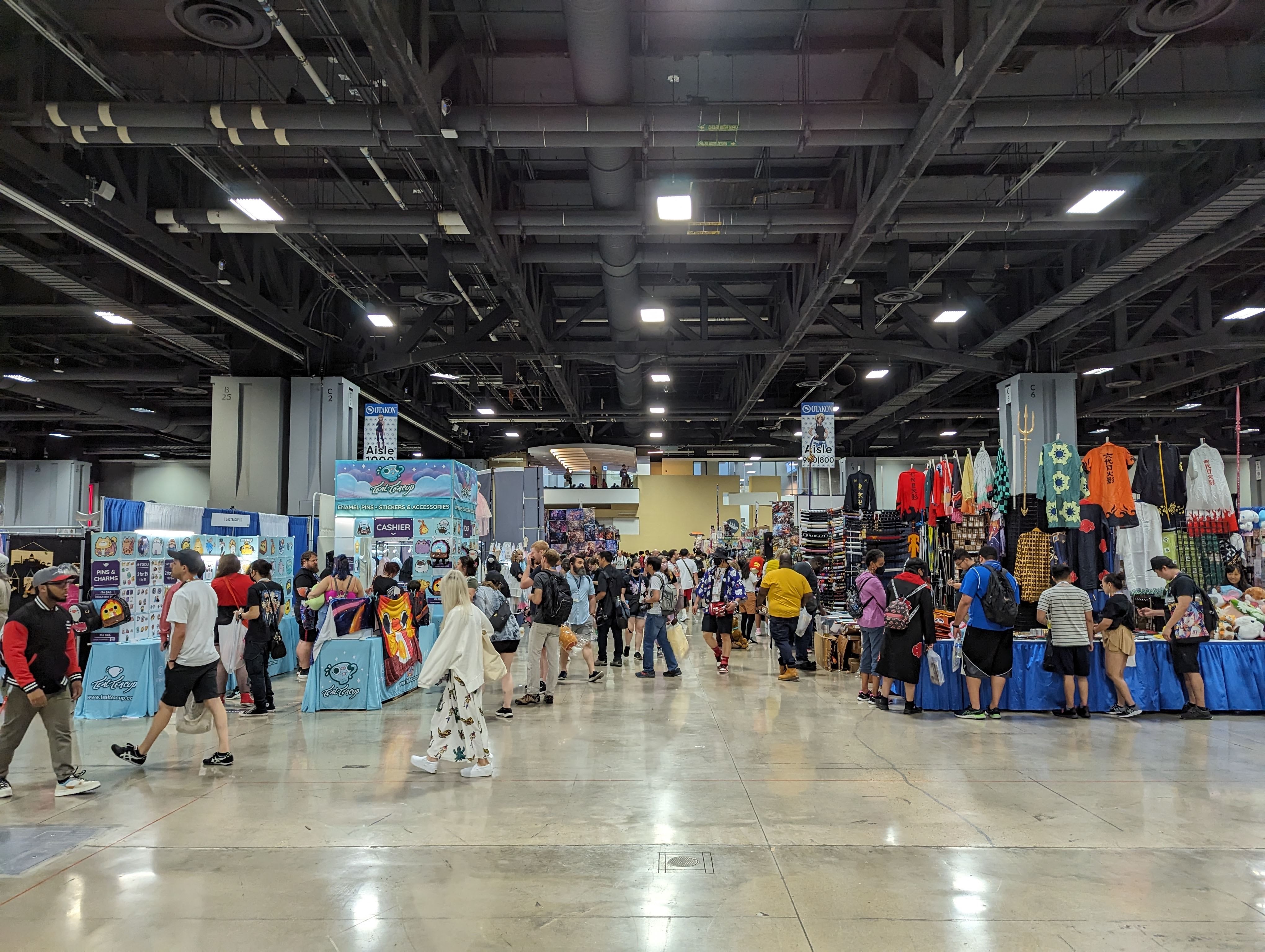
Otakon 2023 took place from July 28 to July 30, once again at the Walter E. Washington Convention Center in Washington, DC. It was coming off a previous year with record-breaking attendance, and two big questions were whether 2022 was a fluke caused in part by the US opening up again after the height of the COVID-19 pandemic, and how Otakon would handle the flow of foot traffic if it wasn’t. Long story short: Otakon actually surpassed its record this year, and the lines got noticeably better. While there were still a few hiccups here and there (like an unusually long wait to get my panelist badge due to a change in how they handled that process), it’s no coincidence that multiple people in the post-con feedback session praised the staff for fixing most of the congestion issues in a single year.
Fixing the lines was of even more paramount importance due to the weather over that weekend. DC was blisteringly hot; including humidity, there were times the temperature was reported as feeling like 112 degrees. Otakon needed to make sure people could get into that convention center quickly and easily, and they succeeded.
Lack of Masking Policy
I know it is incredibly difficult to put the genie back in the bottle, especially because “officially” COVID-19 is no longer a national emergency, but I really do wish Otakon would re-implement a mandatory masking policy. While I didn’t catch it at this convention, I was definitely in circles where the virus was present, and it would just allow more people to attend the con.
Industry
The guest list this year was truly packed, to the extent that I had to make some serious decisions as to what to spend time pursuing. Kawamori Shoji (creator of Macross) would have been near the top of the list any other year, but the fact that I had already gotten the chance to interview him in 2018 meant sacrifices had to be made. There were also a great number of manhwa artists at Otakon 2023, and as a general enjoyer of comics who is less familiar with Korean comics, this could have been a great opportunity to learn more. Alas, time was truly limited.
A good chunk of my time this year was thus spent on obtaining autographs because a lot of the guests are industry veterans, and some are getting up there in age. It may sound a bit morbid, but I’m worried that we’re going to lose more and more great figures in anime and manga, and I want the chance to see them and thank them before it’s too late. At the same time, I do worry that too much of my Otakon experience ends up being in autograph lines, and every year is a bit of a struggle in that for every wonderful thing you do, you know you’ll miss at least two other equally fantastic experiences.
Iwao Junko
One guest panel highlight for me was Iwao Junko’s, where she went over how she got into voice acting, her earliest days in the industry, and how she eventually made it into a full-time job. I have a detailed summary of the panel as its own post, and I also interviewed Iwao alongside her frequent music collaboration partner, Kawamura Ryu.
Mecha Guests
Another panel I was looking forward to featured multiple creators involved with mecha, including all the ones mentioned in the introduction. Just getting to hear them banter back and forth was entertaining, and you could tell that all of them would gladly talk your ear off if given the chance. One funny part of all this is the fact that Kawamori was clearly but somewhat surreptitiously drawing on his tablet in between answering questions—a fact that one panel attendee humorously called him out on (it turns out he was working on a project).
I got to sit down with two of the guests and talk more in depth: mecha designer Aramaki Shinji and Super Robot Wars producer Terada Takanobu.
Ikezawa Haruna
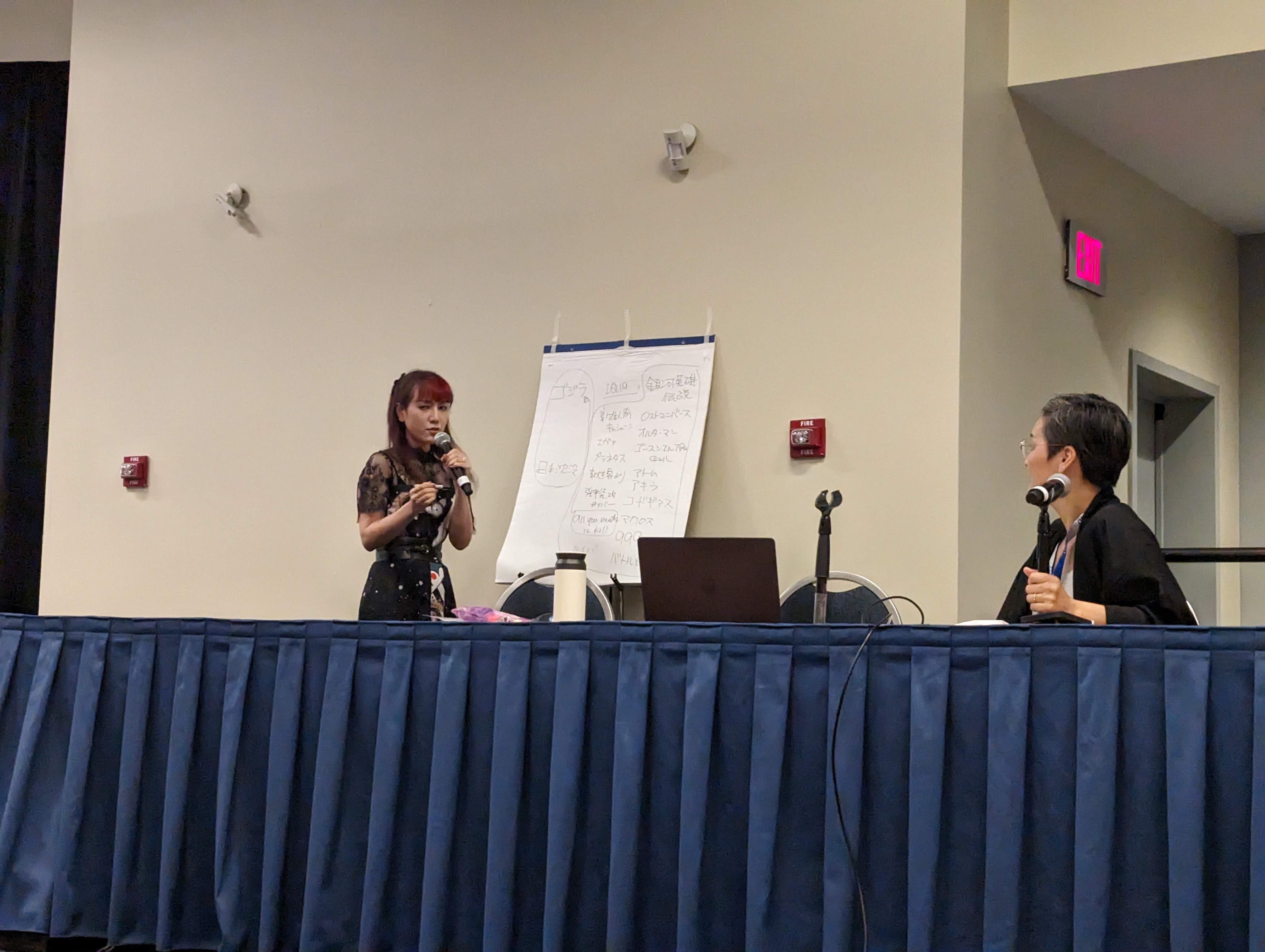
But there was one guest who was possibly the sleeper hit of the entire con: Ikezawa Haruna. While Ikezawa did her requisite panel about what it’s like to be a voice actor, she also did something incredibly rare for Japanese guests: run a panel entirely about one of her own personal interests.
In this case, it was a panel all about Japanese SF as compared to Western SF. Not long after she started, it was crystal clear that her knowledge was encyclopedic, and that her passion for the subject was through the roof. She probably knew more about science fiction in that room than the entire audience combined, and she made some interesting points about the essence of regional science fiction. For example, in the context of Japanese SF, she mentioned how xenophobia has become a big topic because it’s a major subject right now in Japanese society.
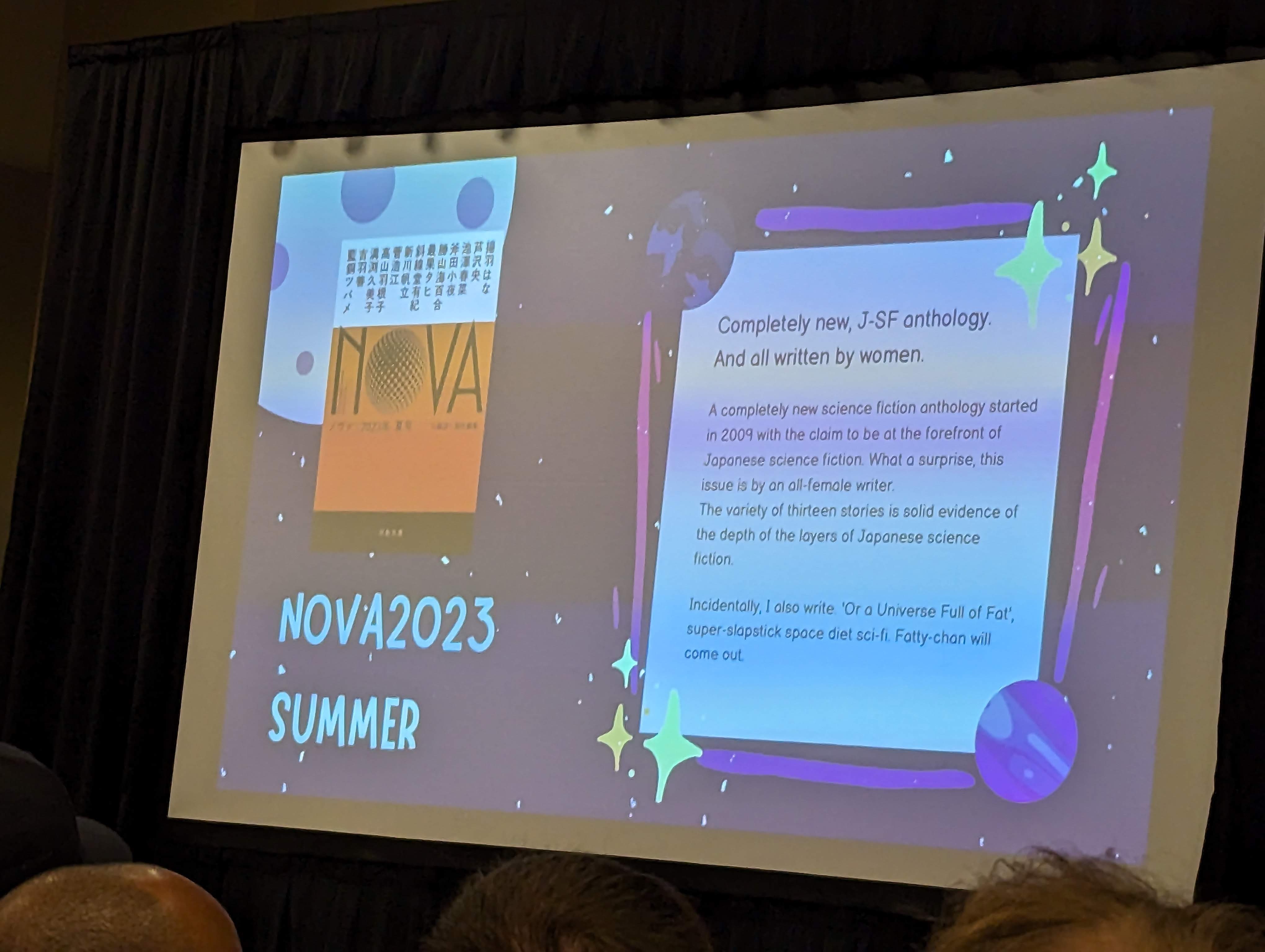
Ikezawa talked about how she actually prefers the term SF to “science fiction” because she thinks Japanese SF encompasses so much more—the abbreviation can stand for sukoshi fushigi (“a little mysterious”), speculative fiction, super fantasy, and so on. She also gave a variety of recommendations, including stories she’s written herself. These are Nova 2023 (an all-woman anthology), SF in 2084 (an anthology themed around stories that take place in 2084), the Naoki Prize–winning Maps and Fists by Ogawa Satoshi, Law Abiding Beast by Harukure Kouichi, and First, Let the Cow Be the Ball by Isukari Yuba. Unfortunately, all of them are in Japanese, but another story by Isukari, Yokohama Station SF is available in English.
Anime Screenings
While I was unable to attend the Discotek panel this year, I do think it’s worth mentioning the fact that they licensed all the Digimon Adventure movies, including both the original Japanese versions as well as the smashed-together film shown in US theaters. Not only is this the first time they’re all available in English, but Discotek did a special screening of them at Otakon. Sadly, I couldn’t attend that either, nor the showing of Macross Frontier: The False Songstress. That’s because I chose to watch the US premiere of The Tunnel to Summer, the Exit of Goodbyes, which I’ve reviewed here.
VTuber Presence
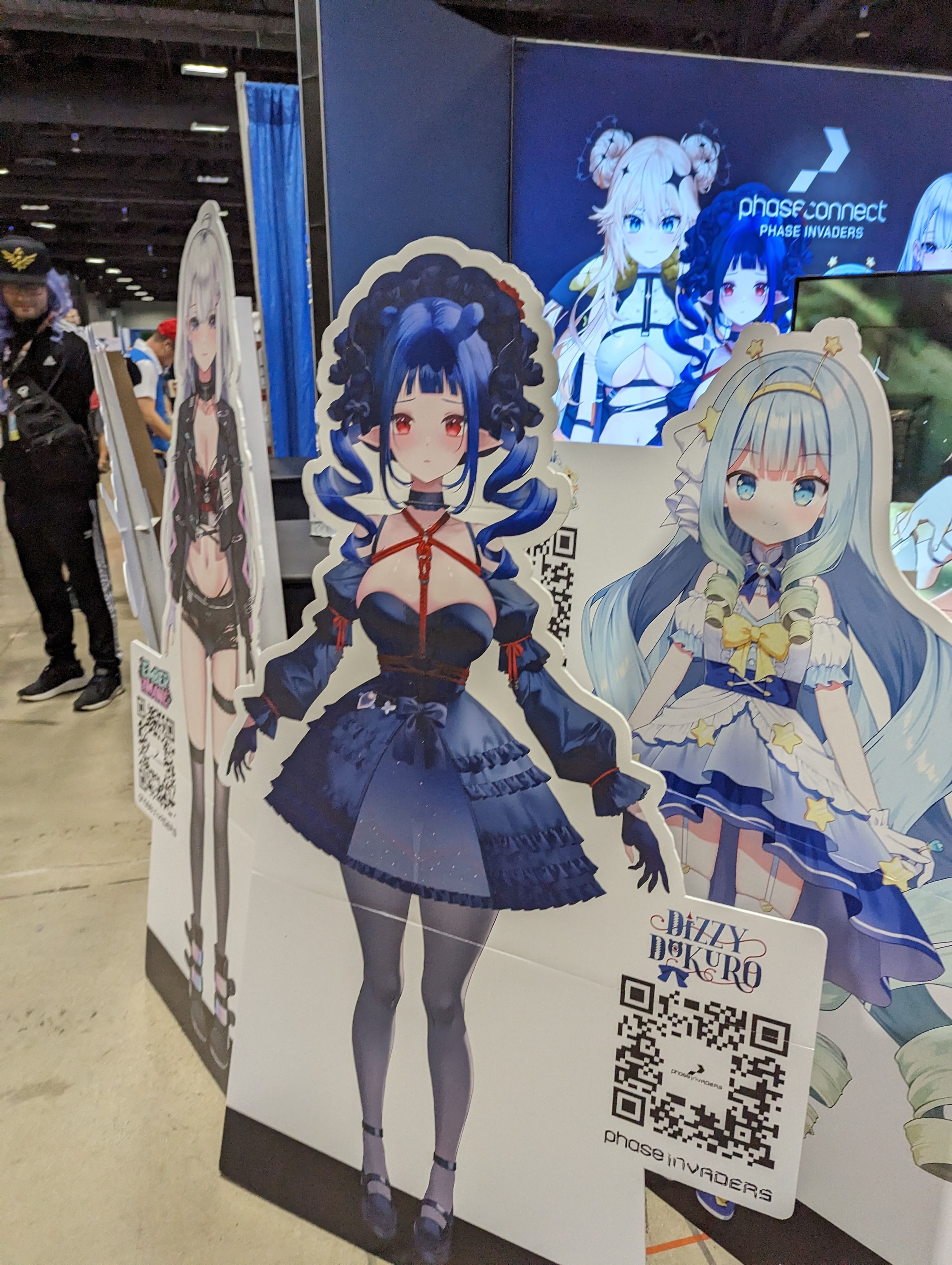
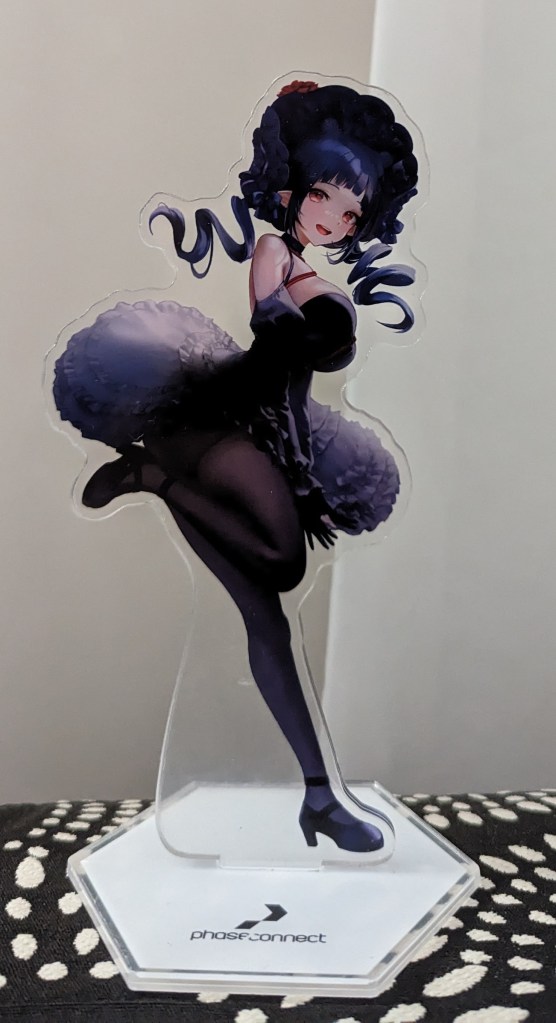
While there were cosplayers and artists who were repping the VTubers, there wasn’t much of an official presence (in contrast to Anime Expo, where it was a major force). That said, the group Phase Connect had a booth. I visited and bought an acrylic stand of Dizzy Dokuro.
Panels
Due to everything else going on, I shamefully ended up not attending very many fan panels this year despite that being one of Otakon’s best features. And for the ones I did, I could only see them in part.
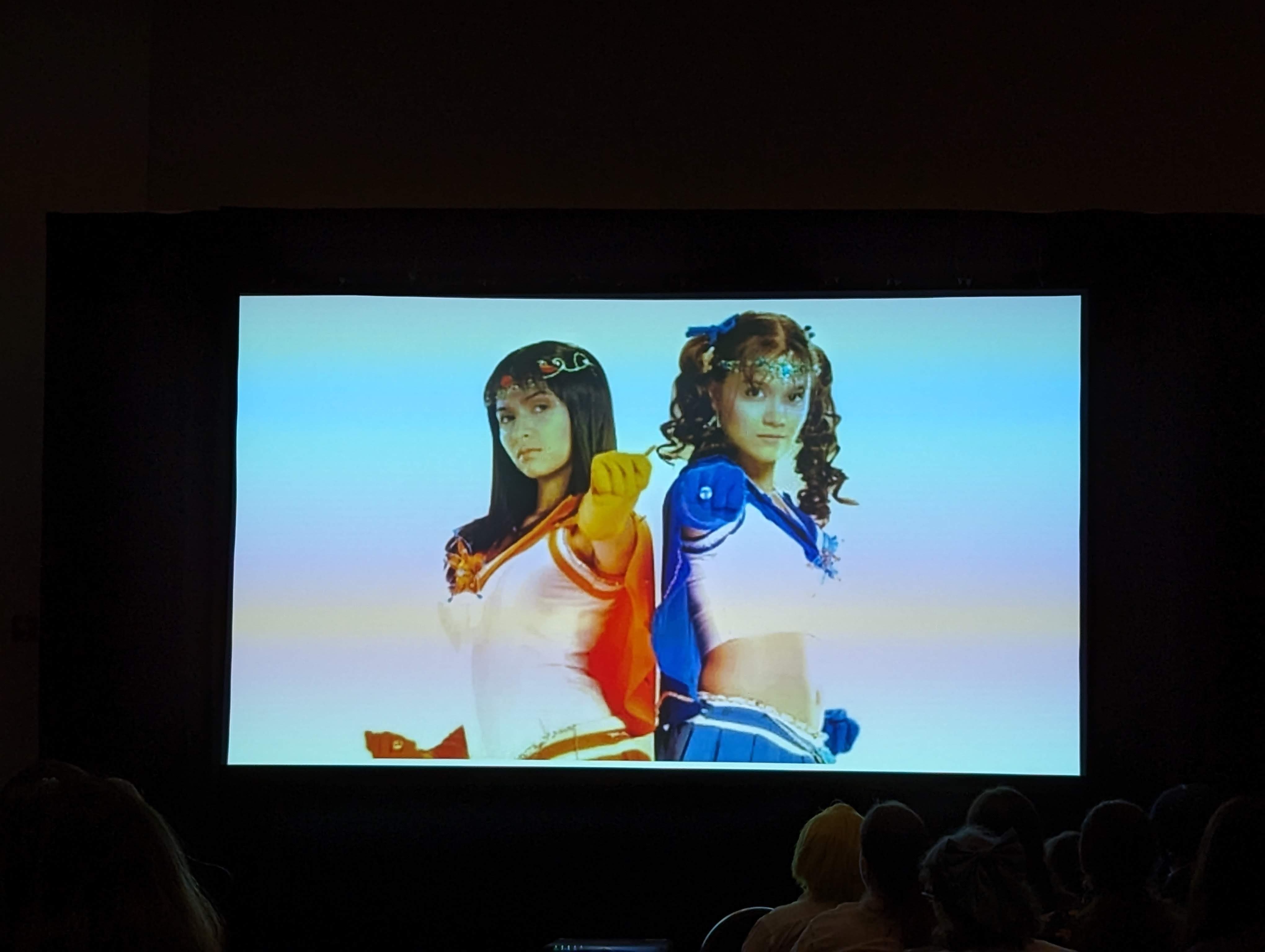
I do want to give a shout-out to Anime in the Philippines, as it definitely taught me new things, and gave a window into a culture and fandom that I was largely unfamiliar with. For example, now I know that Mechander Robo aired there, and I learned about this:
I did present on two panels this year myself, though: “Giant Train Robots of Anime and More” and “Densha Otoko: Train Man, Modern Myth, Internet Legend.” The theme of Otakon 2023 was trains, so I decided to play along.
Giant Train Robots was a joint project between myself and Patz from The Cockpit. We both love mecha, and I also relied on his greater knowledge of the tokusatsu side in bringing this together, and I think the result was a fun and breezy panel whose goal was to entertain, inform, and leave the audience appreciating trains that turn into robots. We got a good-sized attendance despite being at 1030am on Friday, and I hope everyone enjoyed it.
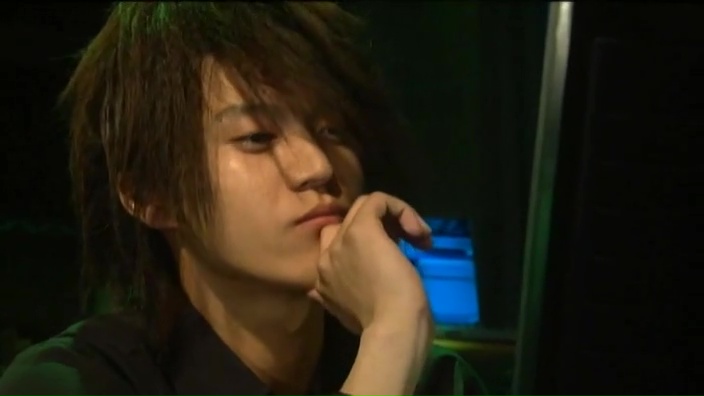
The Densha Otoko panel was all me, and I had actually started thinking about doing it since the end of Otakon 2022 when they had announced the train motif for the following year. Densha Otoko had been such a phenomenon in the mid-2000s, and I was curious to both look back on that era and to see what was its legacy today. I seemed to get mostly people who had already seen or knew about it, but that was just fine with me.
I think Giant Train Robots actually got more attendance than Densha Otoko, and I find that interesting because it used to be that the evening panels were better attended than the morning ones, and that mecha panels weren’t terribly popular, at least back in Baltimore. And this is on top of us actually being at the same time as a different giant robot panel! I wonder if there has been a generational shift or something that would explain this.
Food
After many years, the convention center cafeteria was finally open, giving another option for those who want to get something to eat but don’t want to travel too far. I dropped in there once, and saw that there were three options: Japanese, pizza, and hot dogs/sausages. I went for the last option (which was pretty similar to what’s offered at Ben’s Chili Bowl) mainly because it had the shortest kind, and it was pretty decent. The Japanese food naturally had the longest line at an anime con, though I still remember Otakon staff claiming a long while back that the sushi was actually pretty decent.
But the best food in the Walter E. Washington Convention Center was still the Caribbean food stand, which was located at the far end of the Exhibit Hall. While all con food is inevitably overpriced, this place always feels like the best deal, and the meals feel well balanced in terms of taste and nutrition. I’ve had something from them pretty much every year, and they never disappoint.
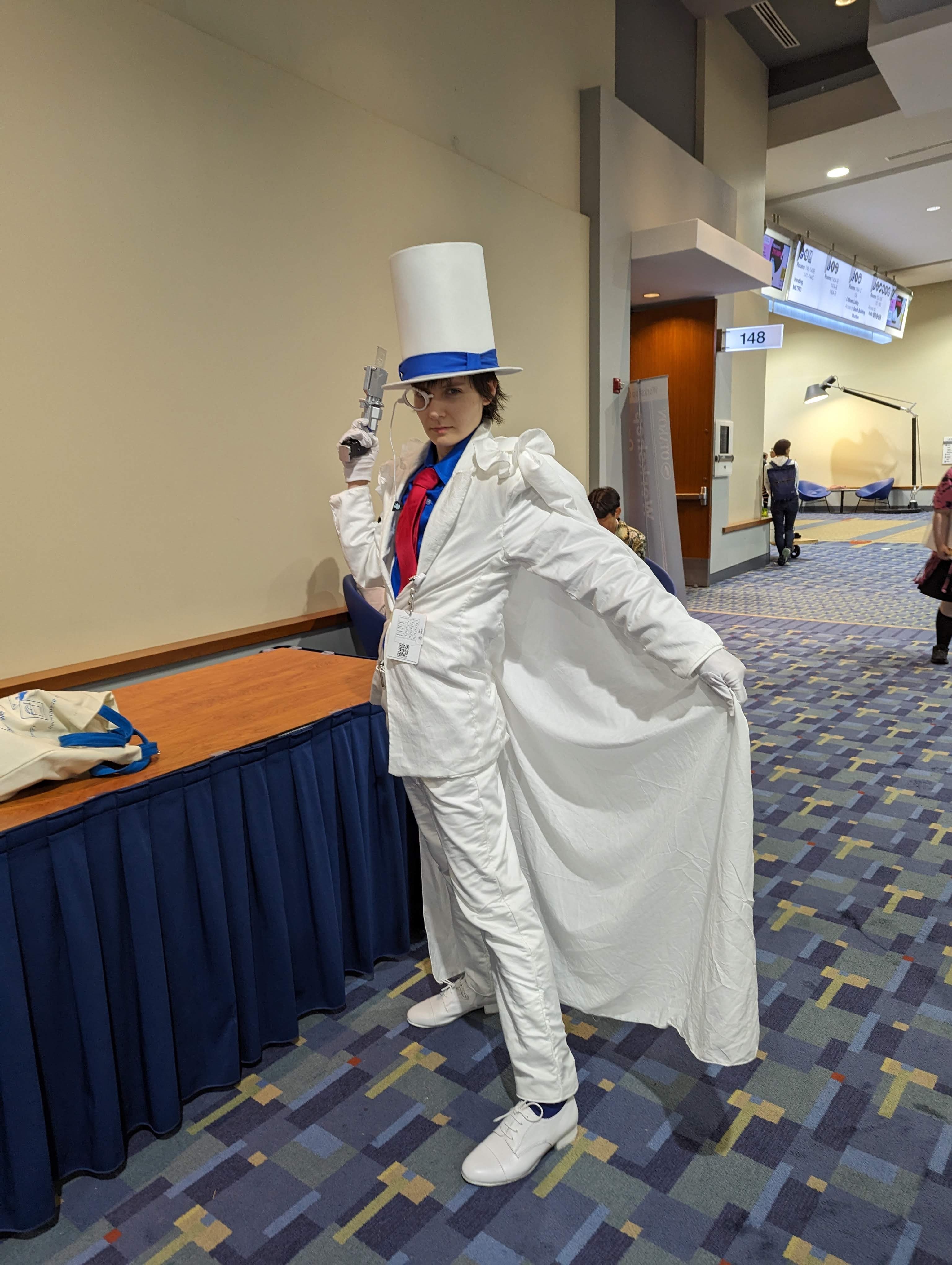
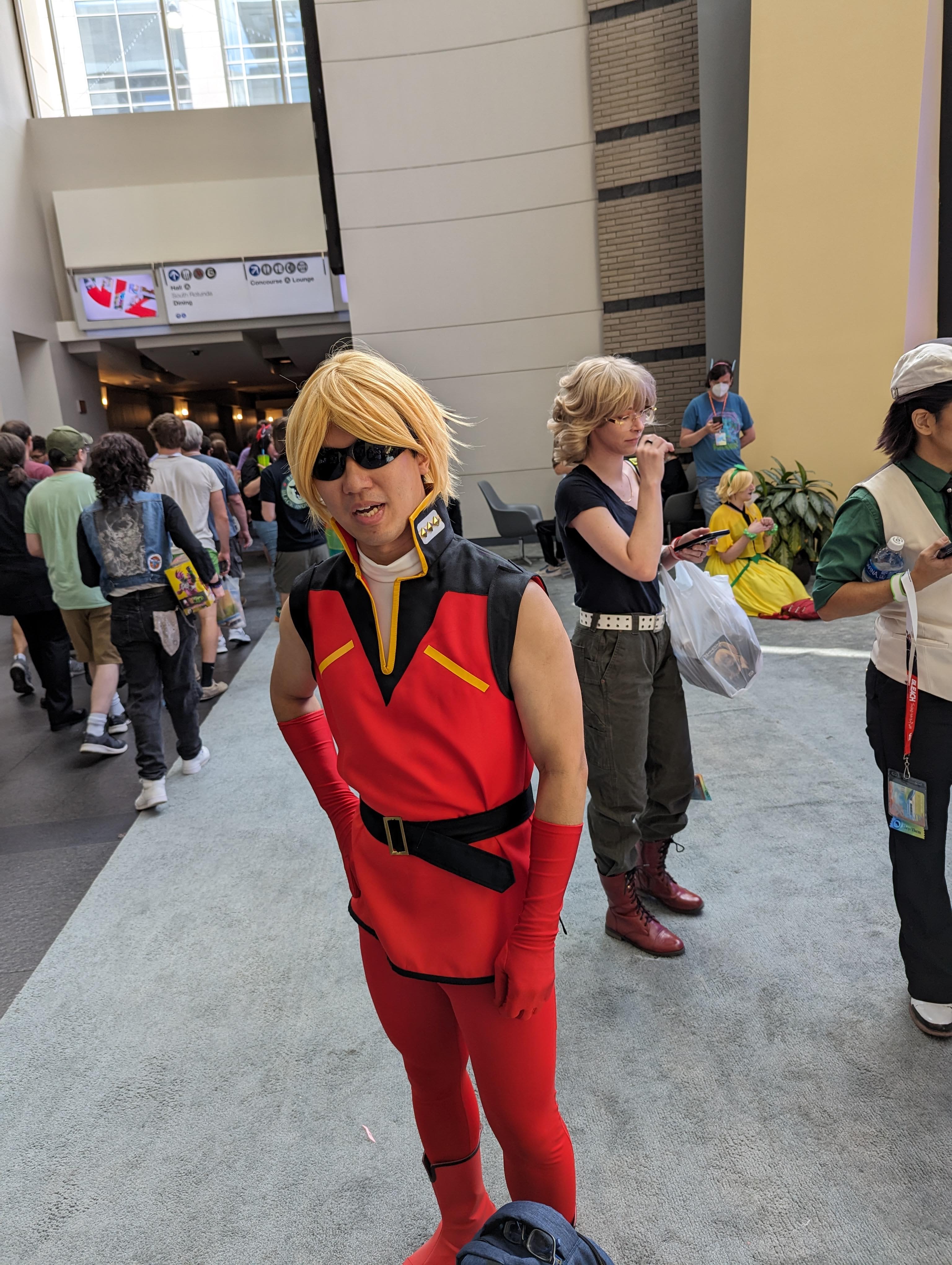
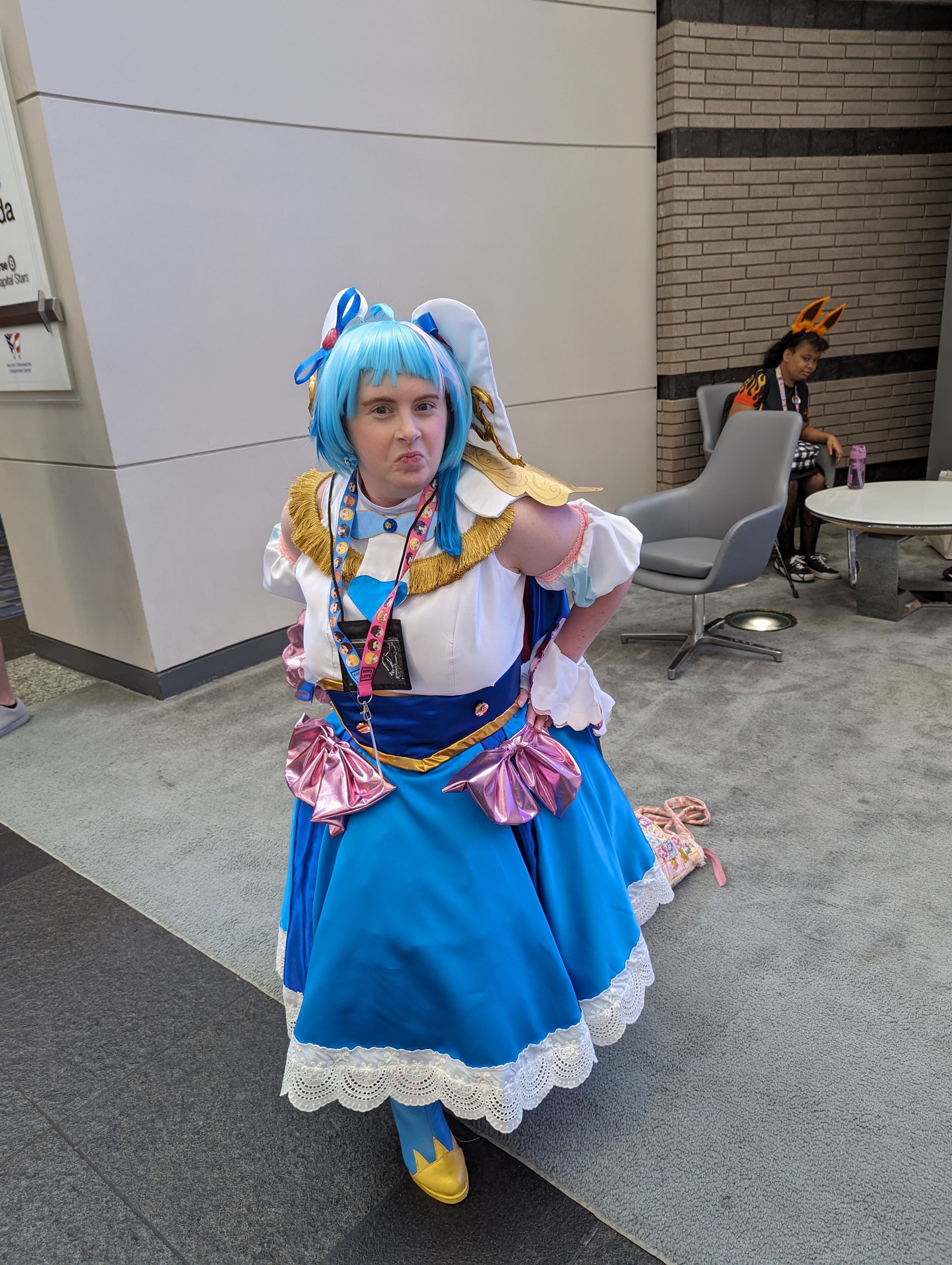
Cosplay
Closing Thoughts
2023 was definitely a strong Otakon in spite of circumstantial issues like the weather. Most importantly, I got to meet Tomoyo.
That said, the amazing thing is that next year promises to be even bigger and more powerful because it’ll be Otakon’s 30th anniversary. I’m already brainstorming ideas for panels, and wildly speculating on potential guests. I feel like it would be the perfect time to get people who were big back in 1994, and I trust the staff running the show to bring in some big guns.








 OGIUE MANIAX