Alpha vs. Omega, Awai vs. Koromo

As a manga about cute girls with mahjong superpowers playing in tournaments, Saki constantly adds new characters as opponents for its heroines. We’re getting to the point where the cast is not just large but enormous, which has me wanting to see characters who are not normally associated with each other paired together. I don’t mean that in the yuri sense, but in the mahjong throwdown sense.

The two characters I really want to see square off against each other, possibly in the national individuals tournament, are the lunar-powered Amae Koromo, Miyanaga Saki’s final opponent in the Nagano prefectural team tournament, and the double-riiching Oohoshi Awai from Shiraitodai, who is a teammate of Saki’s sister Teru. The reason why I want to see a mahjong match between them is because their respective abilities appear to function almost opposite to the other’s.

Koromo has two main abilities. The first is that she can consistently win by drawing the last tile in a game, also known as Haitei Raoyue, or “scooping the moon from the bottom of the sea.” When combined with her second ability, which is that she can bog down her opponents’ hands, making them unable to reach tenpai no matter how hard they try, it means a slow, painful death to her adversaries.

Awai also has two abilities. Rather than winning on the very last tile Awai is firstly able to reach tenpai on her opening hands and call a double riichi, and then combo off of it for big points. Along with her second ability, which is to induce awful starting hands in her opponents, it means she’s able to reach victory more quickly while everyone else is scrambling to assemble even a semi-decent hand.

So you have a character who wins by giving herself a large advantage at the start, and who aims to win early, versus a character who stifles opponents’ progress throughout the game and wins by dragging them down. If you look at those power sets, it would appear that Awai has the advantage as she can get to tenpai at the very start, and win well before Koromo gets to the last tile. However, this also means that Awai’s negative influence on her opponents’ starting hands affects Koromo less because she generally aims for Haitei anyway (though neither of them have to use their powers). The impression I get from them is the unstoppable force vs. the immovable object, and it all hinges on whether or not Koromo’s ability to prevent hands from forming affects someone already in tenpai. Other factors that might contribute to how this plays out are that Awai doesn’t win off of her kans but simply uses them to bolster her hand in big ways, as well as what appears to be a limitation of Awai in that she can’t use her powers simultaneously while Koromo can. I suspect that the degree to which one character’s abilities outrank the other’s will have to do with Koromo’s tendency to be influenced by phases of the moon.

I’m aware how ridiculous this all sounds, and at the end of the day Saki abilities don’t actually make sense. However, I do think this confrontation is likely to happen as Saki continues, so I remain hopeful towards seeing it happen in the actual story.

Additional New Voice Actors for Genshiken Nidaime Anime

As people suspected, it looks like the entire cast is being replaced for the new Genshiken anime. In addition to the previous announcement, now we know the following:

Ohno: Yukana (Cure White, Teletha Testarossa), was Kawasumi Ayako (Lafiel, Mahoro)

Madarame: Okitsu Kazuyuki (Jonathan Joestar), was Nobuyuki Hiyama (Guy from Gaogaigar)

Kasukabe: Satou Rina (Misaka “Railgun” Mikoto), was Yukino Satsuki (Kagome from Inuyasha)

Sue: Oozora Naomi, was Gotou Yuuko (Asahina Mikuru)

Angela: Kobayashi Misa, was Kaida Yuki (China from Hetalia)

The two voice actors for the Americans are really new, which has me concerned as both of them require varying amounts of English. This is especially the case for Angela, who often speaks for minutes in English, and her previous voice actress had actually studied abroad in the United States, so she at least had a strong amount of English fluency. Even Sue uses some English in Genshiken Nidaime/Genshiken II, so it’s going to be tricky business if their English isn’t up to snuff.

Although Yukana’s voice is noticeably different from Kawasumi Ayako’s, it similarly has a soft and gentle feel to it which you can hear in her roles such as Cure White, and Satou Rina as Kasukabe fits her forward and no-nonsense personality. In regards to the DESTINY OF BLOOD as Madarame, while Okitsu is nowhere near the screaming veterancy of Nobuyuki Hiyama, I think his role as JoJo #1, especially in the early episodes, shows that he can play a dork of sorts. In these three cases, it’s easy to just imagine the Genshiken characters with the voices of their previous roles, and I’d have to say all of the replacement voices seem like they’ll fit their characters, though they may take some getting used to. Of course, a part of me would still like the old voice actors back, but if this is what they’re going with, then at least for the older characters it works out.

By the way, this is the second time Yukana is a replacement voice actress. The last time was with the Z Gundam movies where she became the new Four Murasame. Genshiken is no Gundam though, so I doubt there’ll be as much backlash.

The Fujoshi Files 72: Shigeta Mina

Name: Shigeta, Mina (重田三奈)
Alias: N/A
Relationship Status: N/A
Origin: Genshiken: The Society for the Study of Modern Visual Culture

Information:
Shigeta Mina is a former classmate of Ogiue Chika’s from their middle school days in Yamagata Prefecture in Tohoku. She was a member of the same Literature Club as Ogiue and Nakajima Yuuko, where they collaborated to create BL stories, though her friendship with Ogiue apparently soured after the incident with Ogiue’s then-boyfriend discovering the extremely graphic yaoi doujinshi they made of him.

Shigeta is still close friends with Nakajima, eveident from the fact that the two regularly attend Comic Festival together. Shigeta appears more quiet and relaxed than the more talkative Nakajima, which also appears to have been in the case in their younger days.

Fujoshi Level:
Other than the fact that Shigeta used to collaborate in the Literature Club’s BL works and that she has remained a yaoi fan, nothing else is known about the extent of her fujoshi fandom.

Proof-of-Concept Singapore Mahjong Manga

Note: the page is is read left to right.

Further reading:

For my thoughts (and a summary) of Singapore-style mahjong, go here, as well as here.

The American-style mahjong conceptual narration and comic page (the two are somewhat unrelated).

My initial idea of having manga about all styles of mahjong.

Genshiken Nidaime Voice Cast…and a NEW OGIUE?!

UPDATE: Small point made below.

genshikennidaime-image

Ever since the announcement of the new Genshiken anime, I’ve speculated about the voice cast. Courtesy of one Anonymous Spore and the official anime website, the new cast for the Genshiken Nidaime (or Genshiken II as I prefer to call it) has been revealed, and the big, big shocker is that Mizuhashi Kaori will no longer be playing Ogiue, that most grand of angry, once-traumatized hair-brushed fujoshi.

My initial reaction has been genuine surprise and confusion, as I thought she fit the role tremendously well, and seemed to be well-established as Ogiue. Her Ogiue felt genuinely conflicted about everything, and it’s my favorite role of hers (biased perhaps). She even participated in the Genchoken radio shows with Madarame’s voice actor Hiyama Nobuyuki, and drew a comic about how she landed the role as Ogiue. Even putting aside my own Ogiue fandom I’ve thought for a long time that Mizuhashi ranks among the best voice actors out there.

ogiue-newvoice

That said, I think it would be a bit unfair to judge Yamamoto Nozomi before I even get to hear her voice the part of my favorite character. She’s pretty new, but she’s also already played roles such as Yukimura in Boku wa Tomodachi ga Sukunai, and Tetora in Joshiraku. When I think about Tetora’s voice in particular, it may actually be a bit closer to how I imagined Ogiue’s voice in my mind when I first read the manga. Actually, Gankyou’s voice would have been even closer, but that’s maybe getting too off-topic.

As for the rest of the cast, you have Uesaka Sumire  (Dekomori in Chuunibyou demo Koi ga Shitai!) as Yoshitake Rika in addition to performing the opening theme, Uchiyama Yumi as Yajima Mirei (Davi in Dokidoki! Precure, Arata in Saki: Episode of Side A), and a combination of Kakuma Ai and Yamamoto Kazutomi handling the female and male voices of Hato Kenjirou, respectively. If you look at their list of works, all of them are pretty new voice actors, so perhaps there was something on the production side that required the use of newer voices. I read that they may be changing the old characters as well? Or maybe there was just a good old-fashioned scheduling conflict, which even happened with the Genshiken 2 anime and Keiko’s voice actor. In the end, it’s all just speculation, unless someone more familiar with the seiyuu scene could inform me otherwise.

Based on the previous roles of the actors for Yoshitake and Yajima, I can imagine them fitting their roles well, especially if they go for more naturalistic and awkward voices. I think Yajima especially will be a challenge.

In addition, voices aside, the art and character designs look probably the nicest they’ve ever been for Genshiken anime. I guess it all remains to be seen (and heard).

miz84-1 miz84-2

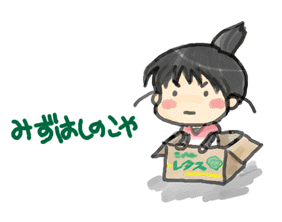
UPDATE: I decided to look at Mizuhashi Kaori’s official site, which isn’t really updated anymore, and what’s really curious is the fact that where once the front page image was of Ogiue in an empty cardboard box, now Ogiue has been replaced by a different character. I’m unsure if it’s meant to be Mizuhashi specifically or if it’s meant to be another one of the characters she played, but just the fact that she used to use an Ogiue image on her front page as early as September 2012 may indicate that she was rather close to the character of Ogiue.

The Fujoshi Files 71: Nakajima Yuuko

Name: Nakajima, Yuuko (中島裕子)
Alias: N/A
Relationship Status: N/A
Origin: Genshiken: The Society for the Study of Modern Visual Culture II

Information:
Nakajima Yuuko is a fujoshi from Yamagata Prefecture in the Tohoku region of Japan. An old classmate of Ogiue Chika’s from their middle school days, the two would collaborate on their own amateur BL manga along with the rest of their school’s “Literature Club” with Nakajima as one of the writers. However, the two had a falling out when their last collaboration, an extremely graphic depiction of Ogiue’s secret boyfriend Makita with his own best friend, became known to Makita, which caused Makita to transfer schools. Though there is no direct evidence, it is likely that Nakajima and her friends are the ones who showed it to Makita in the first place, being aware of what was actually going on between Ogiue and him.

In the present, Nakajima still lives in Tohoku, and remains friends with at least one of the girls from her middle school days, Shigeta Mina. Though Nakajima is very stylish and fashionable, her regular trips to Comic Festival indicate that she is still very much into yaoi. In addition, her current feelings about Ogiue are not entirely clear, as she exhibits signs of jealousy and resentment towards her, and seemingly revels in reminding Ogiue (and Ogiue’s friends) of her past, but at the same time also appears to show a certain degree of concern for her.

Fujoshi Level:
There are no clear details about Nakajima’s fujocity other than that she has some experience writing BL stories, and that she is at least to some extent still a fan of yaoi.

Wacomplex: Genshiken II, Chapter 87

First thing first, Genshiken anime info dump! it’s been confirmed that the Genshiken II (or Nidaime) anime will be starting this summer, with a different studio but with a lot of old staff. I do find it kind of funny that Genshiken can’t seem to get a consistent animation studio or anime character designer, and given the sheer variation of work that the character designer Taniguchi Junichirou has worked on, it’s hard to predict how they’ll look exactly. Also, Uesaka Sumire will be singing the opening. Next month is the voice cast reveal, so let the speculation begin!

Anyway.

In Chapter 87, Hato continues to try to be one of the boys, but the fact that he is unable to draw properly for the sake of Ogiue’s ComiFes doujinshi when not in drag causes him to go back to it, at least in private. At the same time, Ogiue has decided to charge into the 21st century by buying a pen tablet monitor in order to save time and manpower, but the transition isn’t as simple as she hoped for. As ComiFes is drawing near, familiar faces appear as Angela makes her return to Japan and Keiko is looking to take another stab at the event.

I literally laughed out loud when I saw the pen tablet monitor. It was clearly introduced by Kio Shimoku as a metaphor for not only Hato’s current situation, but also the Genshiken club itself and even the manga as a whole. In this regard, I think it does an excellent job of representing the dimensions of a generational divide.

By showing Ogiue struggling with her tablet despite purchasing it to alleviate her work schedule, Genshiken touches upon the idea that transition can be a difficult thing because of how much we must acknowledge and rework our assumptions. The strengths and limitations of the zoom function, referenced during Ogiue’s little rant, is the perfect example. On the one hand, it lets you get up close and put detail into even the smallest part of a drawing, but on the other hand it can be stifling if one is obsessed with detail.  Ogiue’s plight somewhat mirrors the difficulty by which the manga itself has transitioned into its new cast and their very different values, not only in terms of the content of the manga, but also for a good portion of the manga’s readerbase which seems to see the new Genshiken as “not Genshiken.”

However, I think it would be a mistake to say that the ideas implied by the tablet transition are narrowly limited to Genshiken as a topic, as I really think it goes beyond this one manga. What really adds to the tablet metaphor is the conversation between Hato, Yajima, and Yoshitake where they mention the simple fact that, for some artists, digital drawing is all they’ve ever known.

Drafting, cleaning, paneling, for them, everything is done on the monitor, and it highlights this idea that, rather than this newer generation of artists being untrained in the old ways, that their “environment” is simply different and they have adapted to it in kind. Instead of the tablet being a facsimile of “real” drawing by mimicking pen on paper, for them the tablet is real drawing. That difference in mindset is so central to the changes between generations, whether it be music and art, dance, technology, or any other topic, and it shows how neither the old or new generation are “bad,” but that people are the product of their experiences.

I get the sense that, as the manga continues, Ogiue will continue to use the tablet, but that it will require her to adjust her current work habits to better fit it, or to make it more of a supplementary tool. In either case, if she does incorporate it, it means that her work may never be the same again. The impossibility of returning to the “old way” is also shown in the beginning of this chapter, when we see Madarame, Hato, and Kuchiki discussing anime much in the same way the club used to, with mentions of sakuga, seasons (cour), and the economic side. While definitely similar to the old Genshiken, something’s not quite right, especially in terms of how Yoshitake and Yajima appear a bit alienated by it because it’s not the atmosphere they’ve participated in and even helped to create. It feels a bit artifical and out of step with time, which also has implications in regards to Hato, who is trying to act like a “proper” male otaku.

If we look at the notion of the “proper” otaku (and perhaps even the whole debate over fake geeks), it’s kind of funny that people prescribe a certain set of behavior as “proper” for a group that has been traditionally stereotyped as behaving improperly by virtue of being otaku. I think Hato’s vain attempt to quit crossdressing and yaoi may be a sign of how ridiculous this can be, as if the manga is saying that it’s not as simple as getting rid of the girly stuff to bring back the “true” Genshiken, and that there has been a change in environment that the manga has been trying to address.

I may have gone a little too crazy with that analysis, but I honestly think that I haven’t completely or properly explained the intricacies of the tablet metaphor, though I’ll leave it as is for now. It’s been a while since we’ve had this much Ogiue in a chapter, so I’m pleased in that regard, and I’d been wondering when Angela would show up again a she’s a significant factor in the whole Madarame-Hato story. The fact that Keiko is planning to go to ComiFes out of her own free will may actually say everything about how much the world in and around Genshiken has changed.

(A bit of Ogiue Tohoku-ben inner dialogue teaching us that Ogiue is still not used to Kanto winters.)

Attack on Titan is the Mobile Suit Gundam of Shounen Fighting Manga and Anime

Attack on Titan, the manga and now anime about a world where humans live in walled cities for fear of being eaten by nigh-invulnerable giants, is an interesting and unique title in that it goes against the grain of shounen action series and their conventions, especially when it comes to heroics. In particular, I find that Attack on Titan emphasizes people as a group over individuals in a way which doesn’t really happen in other popular titles.

When it comes to shounen fighting series, especially over the past ten years or so, gigantic ensemble casts are the norm. In something like Inuyasha or even Hajime no Ippo, you have the main characters, their friends and family, rivals, enemies, enemies turned allies, and so on until they require multiple volumes of guide books to keep track of them all. It’s even more the case that titles in the shounen fighting genre will emphasize group-oriented concepts, such as friends (One Piece) or fighting for a greater cause (Saint Seiya), but ultimately it boils down to unique characters cooperating. Where Attack on Titan differs, at least initially, is that it gives you a sense of a world where individual heroics are much more ineffectual, and it is only through the massing of people that they can have any hope of surviving in their world, and a slim one at that.

The reason why I make the comparison to Mobile Suit Gundam (though I understand that the comparison is not perfect) is that Gundam is known for bucking the trend of giant robots as metal superheroes, instead positioning it as an individual war machine as part of a greater force. The Gundam is still glorified to an extent, but compared to the shows which came before it, this is much less the case.

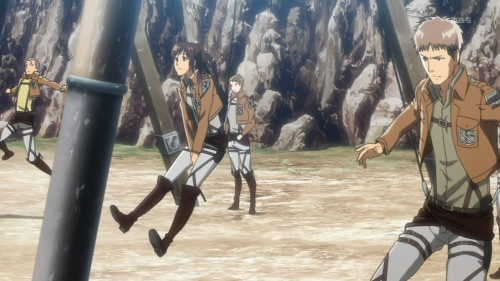
I think my point can be seen by just looking at the opening to Attack on Titan and comparing it to intros from other shounen fighting anime. Popular and long-running shounen fighting anime go through a process where their first openings emphasize a core group of characters, but as the cast expands they find it important to at least show a bit of each remotely significant characters. Whether it’s those slower-paced initial openings or the later frantic ones, though, there is still that focus on a multitude of individuals. In Attack on Titan‘s opening on the other hand, you barely get glimpses of the core cast, who are shown running and jumping from one structure to the next, almost as if the camera can’t stay on them for too long. Even Eren receives only a few brief moments centered on him, and in some of those cases he’s still seen as part of a group of fighters. The fact that the soldiers are all similarly dressed, male or female, instead of wearing unique outfits, and the fact that they all use standardized weaponry, creates a sense of them as a unified army.

That’s not to say that Attack on Titan lacks individualized or unique characters. There’s a clear protagonist in Eren, and there is a core cast of characters who are given personalities and particular skills such as sound judgment and lack of mercy. I’ve also read enough of the manga to know that there are developments which change things up significantly. However, the sense of group which Attack on Titan portrays goes beyond the typical shounen concept of such, and it lends an atmosphere which almost (but not quite) puts more attention on the military force than the people who comprise it. They swarm the titans like ants, which is about as un-shounen heroic as it gets.

The Fujoshi Files 70: Shiguma Rika

Name: Shiguma, Rika (志熊理科)
Alias:
N/A
Relationship Status:
Single
Origin:
Boku wa Tomodachi ga Sukunai!

Information:
Ostensibly a high school student at St. Chronica Academy, Shiguma Rika is a technological genius who performs her own independent research as her “curriculum” away from other classmates. Possessing poor social skills and an eccentric personality, Rika is a member of the “Neighbors Club,” a club secretly devoted to helping people become better at making friends.

Rika possesses a dirty mind, and is eager to turn almost anything anyone says into a sexual innuendo, specially when it comes to her fellow club member, Hasegawa Kodaka. In spite of a massive yaoi collection, Shiguma has never actually been to a Comic Market, owing to a sense of fear and discomfort towards large crowds. Rika once spoke of never having “kissed a mammal” before, and owns a video collection of invertebrate mating.

Fujoshi Level:
Rather than being a simple fujoshi, Shiguma Rika is more of an overall pervert. Her favorite titles are not simply yaoi-themed, but ones where giant robots engage in intercourse, described through creative visual metaphors.

On the Use of Fending Off Sexual Assault as a Way of Defining Strength in Female Characters

In the past I’ve written in an attempt to pinpoint what I find so troubling about some portrayals of “strong” female characters, especially in American superhero and fantasy comics, but despite having expressed various reasons for these impressions as such I still have never felt that the answers I’ve given were entirely adequate. It’s been an on-going process of self-questioning and observation, and the reason I’m making this post is that I’ve come to realize another issue when it comes to the representation of female strength.

It came to me while I was reading the comic Flipside, which features as its main character a sexy and strong female jester named Maytag. Throughout the first volume, Maytag is repeatedly  confronted with a similar sequence of events. Some bad men confront her, threaten her with rape or call her a bitch, and then Maytag turns their expectations upside down and defeats them (for the most part), while still emphasizing her sexuality or making some sexual innuendos.

Keep in mind that Flipside isn’t a particularly egregious example, as it suffers more (at least early on, I haven’t read further) from a lack of experience and characters overly designed as wish fulfillment, nor are anime and manga completely innocent of this. Also, the act of knocking out your would-be rapists can be empowering imagery. Instead, what I realized by seeing this two-step process over and over in such a short span of pages is that the the seeming need for sexual threats to happen in order to establish a female character as strong diminishes a story because strength winds up being defined as the ability to not get sexually assaulted. In these scenarios, the girl can’t be strong in a world which accepts the possibility of strength in a woman as a believable occurrence, only in a world which has to constantly remind her what a girl she is and how as a girl she’s liable to be attacked.

Another problem is what I would label the “straw misogynist,” or characters who are purposely set up to be extremely sexist so that they can be put in their place when the girl fights back. The way straw misogynists are used in situations like the ones I’ve been describing is that by threatening rape or sexual abuse they immediately bring attention to the sexuality of the girl target, creating this mixed message where the thrill is both in that danger but also in the sexual way the girl fights back. As a result, it ends up conveying something along the lines of, “You might not be able to overpower me sexually, but if you could oh boy would you be having fun!” And even a sexual fantasy such as that is not a problem because it’s just fantasy, but if it’s being touted as an example of how female characters can be strong, then there should be no surprise if some readers reject that notion.

This is not to deny the use of dangerous situations for women in stories, nor do I think that stories need to “ignore” gender. Instead, what I want to emphasize is how showing someone is strong is a different experience from showing someone is strong with constant and persistent caveats to that notion.