The Boku wa Tomodachi ga Sukunai Anime Could Be Better

Earlier this year, I started to read the Boku wa Tomodachi ga Sukunai manga.

I became an instant fan.

I really enjoyed the manga because of how it showed the difficulties of making friends when inexperience and considerably flawed personalities are thrown into the mix. It’s a decidedly otaku-oriented series that hits kind of close to home in a pleasant way. So when I heard that it was getting an anime adaptation I was pretty thrilled about it. I had my fingers crossed that it would be the anime of Fall 2011. Now, a few episodes into the TV series, I find it safe to say that I am fairly disappointed with the anime adaptation of Boku wa Tomodachi ga Sukunai.

On a basic level, the anime and manga are not that different from each other. They have the same premise, a group of people who are very bad at making friends trying to help each other to humorous effect. They have the same characters with the same personalities. They both have fanservice and their fair share of otaku references. But where I find the manga to pass with high marks using this mix of ingredients, the anime by comparison falls short of the manga’s success.

I think the best place for me to begin is the art, because the character designs for the manga and anime are drawn in markedly different styles. Whereas the anime has more of what I’d call a typical light novel/visual novel-esque style to it, the manga’s artwork seems more loose and fun. The manga doesn’t feel the need to stick to its template too closely, and perhaps because it doesn’t have to devote frames of animation to consistency, it makes the comic feel comparatively more energetic. Putting aside more abstract aspects of manga such as page and panel layout, decompression, etc. (things which I think the manga does quite well and do contribute to the quality of the series), even the smiles from the characters in the manga show a lot more emotion behind them. I feel like I can understand the inner workings of the characters and I’m pleased by that. The anime on the other hand, while its designs aren’t abysmal or anything, don’t seem capable of as much expressiveness, and in general the show feels a little stiff and wooden by comparison. I understand that the anime’s designs are closer to the original light novel’s but I still like them less. On that note, I have not read the light novels, so I cannot say if either is a faithful enough adaptation to the original, but the problem isn’t faithfulness so much as it is the particulars of execution.

Another major factor is the fanservice. By that, I don’t mean that the manga is devoid of fanservice which makes it somehow automatically better. In both cases, the girls are still cute, Sena’s chest is equally impressive, and they all have a tendency to wear attractive outfits. There’s nothing particularly objectionable about this. However, the anime has significantly more fanservice, to the point that I find myself saying, “The girls are already cute enough! You don’t have to do anything more with them!” The fujoshi character Rika has scenes showing her fantasizing in both versions, but the anime’s depictions tend more towards a climax in an eroge while the manga emphasizes the extent to which it leaves her flustered. The show also has a tendency to repeatedly linger on the female characters below the belt to a degree which exceeds the yuri mahjong anime Saki. The opening video itself seems particularly dedicated to showing off the girls’ bodies and ignoring the friend-making aspect of the show, and I find myself wishing it had been done differently, perhaps something akin to the Toradora! OP. To put it simply, there’s a difference between the girls wearing a sexy bikini that shows off her figure and a shot that draws specific attention to the underboob.

Now, I understand that the series has something of a harem vibe to it. It’s an unavoidable aspect of it, for better or worse, and it’s not like I have anything against a harem series which is designed to show off its girls. I once compared Infinite Stratos to Kore wa Zombie Desuka? and while I found the latter series better and more engaging overall I thought the girls of Infinite Stratos were more attractive with better designs. That approach is fine, if a little limited in its appeal. With that said, I find the key difference to be that, based on how the two adaptations approach the categories mentioned above, the expressiveness of the characters/aesthetics in general and the approach to showing off the attractiveness of the girls, the manga does a much better job of making me think of the female characters as people first and cute girls second. While I certainly don’t mind that the girls are nice to look at, what made me love the series in the first place was that it encourages a deeper understanding of the characters, particularly their awareness of their own personal flaws. With the manga, I feel that it gives a much stronger sense that these characters really do wish they could make friends in a way that outshines the fanservice, which I think gives it far greater ability to reach otaku and other readers with that bit of warmth. With the anime however, although that aspect is still there, I think it makes it more difficult to see past that simple harem exterior and into the meat of it (no pun intended for Sena fans).

I’m not going to accuse people who really like the show of having poor taste or think they’re simply unenlightened fools. I much prefer the manga and its style, but people may choose the anime’s designs over them for whatever reason. The girls are cute and it’s okay to think that they’re cute, to be attracted to them or even obsessed with them. Perhaps most importantly, while I find the level of fanservice in the manga to be more or less acceptable, I know there are people out there who would find that the cheesecake ruins the character portrayals in the manga. Even so, I just can’t shake the feeling that the anime’s approach to Boku wa Tomodachi ga Sukunai obscures its greatest strengths too much.

The Difference in Variety in the New Genshiken

In the past, I’ve written a number of posts in response to some of the backlash that the new Genshiken receives, particularly in regards to the new cast of characters. Whether it’s pointing out how Genshiken changes throughout its run (for the better), or that the general perception of otaku has changed just enough that some are happily willing to be labeled as such, my goal has been to show that the series has never stopped being “real,” and that it most certainly still reflects otaku life. There’s nothing wrong with or invalid about liking Genshiken while disliking Genshiken II (the comic does feel somewhat different, after all), but I just find the criticism that the characters are somehow less developed to be one I can’t agree with.

So when I see the criticism that the new characters in Genshiken lack variety, I was surprised. Upon seeing the reasons, I was confused.

The argument is that the new characters are all into BL, whereas once you had a guy who was into model kits and cosplay (Tanaka), a guy who was ostensibly into drawing (Kugayama), a guy who fought hard for Otaku Life (Madarame). This supposed lack of variety potentially even labels all female otaku as BL-hungry fujoshi, a mistake that many make both in and out of the world of fiction. At first, I considered arguing from the fact that the Genshiken old guard all had fairly similar tastes in erotica and doujinshi, some more extreme than others. I realized, however, that taking such a stance wasn’t really answering the question of variety, and that it’s true that the older characters seemed to have a wider array of otaku hobbies. Among the current members, most of them are indeed into yaoi, many of them like to draw, and their conversations often lead to discussions of pairings and such. That said, there is an important difference between the old and new Genshiken in that the approach to diversity has changed.

It is true that Sasahara and the rest all have different interests as otaku, and together they show a variety of colorful personalities in part due to those interests, but at the same time they’re all different types of Awkward Nerd, Kohsaka with his good looks and upbeat personality being the only real exception. Kasukabe and Sasahara’s sister Keiko of course aren’t even otaku at all, and instead provide a very clear point of comparison, the normals as opposed to the nerds. With the current iteration of the club however, while just about all of them are into similar things like BL, they actually have widely varying degrees of awkwardness. While Hato’s crossdressing can create awkwardness, he himself does not necessarily exude it, and Yoshitake is almost impossible to label as such. Whereas once Kohsaka was the major exception, his approach to being an otaku, while not quite yet the rule, resembling this current generation more than the one before it. Moreover, between Hato’s judo training and the younger Yoshitake sister’s years of basketball you even have now, of all things, athletic individuals devoid of the physical awkwardness that is prevalent in so many portrayals of otaku.

As is explored in Chapter 58 (the drunken party chapter), part of Yajima’s character is that she feels caught in the middle of this transition. In her mind, otaku are supposed to be weird, inept people who look and possibly smell less than ideal (I’m paraphrasing), but all of the girls (and at least one guy) around her in Genshiken seem to be smart, beautiful, talented, and confident. In this regard, she is somewhat alone, her type and level of awkwardness greater than the rest, but with her ability to comfortably interact with all of them even she is a sign of the ever-changing times and identity of “otaku.”

While the new Genshiken may indeed be populated by yaoi fans (and we’re not even sure if Risa’s thing for shota is necessarily also a BL thing), it has a level of variety in characters and personalities that was previously only achieved on a much more extreme scale, one that had to even include non-otaku. Their hobbies may not be as varied, but they themselves are comprise a diverse cast of fully formed otaku-as-characters in a world where awkwardness, social or physical, is not a prerequisite.

Smooth Criminal: Genshiken II, Chapter 69

Last time we met what can be best described as the Luigi to Yoshitake’s Mario, Yoshitake Risa. No, seriously, think about it. She’s younger, taller, and jumps higher.

Anyway, unlike the previous little sister in Genshiken who didn’t really get a dedicated spotlight until many volumes later, we get to learn a lot more about Risa just one chapter after her introduction. She’s quite an intriguing character, so I’m all for it.

(Did you know Yoshitake has the power to snore in English?)

As the freshman drinking party concludes at Yoshitake’s place with everyone crashing for the night, we get to learn quite a bit about young Risa. She awakened to her nature as a shotacon because of a particular child star, though she prefers the timelessness of 2-D over the aging process which inevitably affects the inhabitants of the real world. Also, though she loves playing basketball (enough to attend games instead of going to doujin events), she is tired of everyone assuming that she’s going to pick a college based on her hoops prowess. Yoshitake Rika, always the loving older sister, not only buys all of Risa’s doujinshi for her, but brought her to Shiiou University to help her think things through.

When all’s said and done, Risa has one last request. Knowing that Hato began crossdressing so that he could make friends with fujoshi, Risa is curious as to just how “challenging” that process is, how far Hato has gone for the sake of meeting like-minded people. Yoshitake, who can also be a “helpful” older sister, manages to twist the situation such that it ends with a visit to Hato’s place.

There, Yoshitake wants to use the time Hato spends showering to find out all of his secrets, but Yajima stands in her way. Despite assistance from the younger sibling , Yajima manages to stop Yoshitake, though in the process they inadvertently open the door to the bathroom and both Yajima and Risa get to see that Hato is indeed a man, albeit an incredibly smooth one. Risa, with Hato’s image possibly burned into her brain, now finds a reason to take the exam for Shiiou University, much like the other Genshiken little sister.

Before I get into my thoughts on the chapter itself, I want everyone to look at this image of Risa’s body.

Risa’s figure can be described as that of a tall, slender but athletic woman with small curves. It makes sense, given the amount of time she puts into sports. It is also an incredibly uncommon body type for a female character in a manga with men as its primary audience. Sure, there are girls with small chests in shounen/seinen, and there are also plenty of athletes, but rarely are they like Risa’s. Even in most comics targeted towards girls of all ages, a body type like this is not drawn with as much focus on anatomy.

Ohno, Kasukabe, and Ogiue’s bodies were already quite different, and Yajima is of course overweight, but Yoshitake Risa’s realistically athletic figure, which doesn’t really try to adhere to typical notions of feminine appeal nor masculine portrayals of heavy musculature, makes me fully aware of just how varied the body types of the female characters are in Genshiken. It’s actually quite impressive, and I think shows that Kio Shimoku, more than ever, is trying to draw female characters for men in a way that fosters understanding of women as people.

The way this chapter is, it actually feels like a hang-out between girls (plus Hato). It’s kind of like that scene at the retreat back in Volume 7, only without the painful recollection of traumatic events from the past. Instead, they were able to create new traumatic events (again, Hato). Again, it’s not out of the blue, and when I look back on Genshiken it’s clear that it’s always been different in portraying female characters, but Chapter 69 somehow feels like a particularly strong example of this approach.

I continue to enjoy the sibling relationship between Rika and Risa for reasons touched upon in the chapter summary above. Yoshitake comes across as a person who genuinely loves and looks out for her younger sister, and it’s clear that her happy-going personality has had a positive effect on Risa’s development through the years. That Risa is comfortable with calling her older sister for advice is in itself a strong sign of their bond, as is the fact that Risa feels compelled to go along with her sister’s hair-brained schemes (crossdressing, bearhugging Yajima). Again, I have to contrast it with the Sasaharas, who eventually reached something along those lines, but only through a long and arduous process.

As for Yajima, I find that she is in this strange position where Hato’s crossdressing has taken on the opposite effect of what it used to be for Yajima. Initially, Hato’s female guise made Yajima rather uncomfortable, as it challenged certain deep-rooted feelings and beliefs in her. As they have become friendlier however, the crossdressing almost acts like a barrier preventing Yajima from thinking of him as a man, which Yajima consistently views as a kind of “other,” like so many nerds out there. This is why you see Yajima try to prevent Risa from convincing Hato to change into his male version. Poor Yajima.

Speaking of Hato, the chapter also provided some insight into his life. For one thing, we learn that the reason Hato lives so far away is that he had to find an apartment with a walk-in closet to store both his dresses and his massive amount of doujinshi. Now that’s the kind of dedication that Risa can understand.

Next chapter is the school festival, and while not quite as exciting as a ComiFest chapter, it’s still something I look forward to from Genshiken. We’ll also get to see Ogiue again. And if that’s not enough, Volume 11 is on its way in February December with a special edition and an exclusive Hato figure. I’ll probably end up owning one myself, if only because I try to get every single special edition of Genshiken that I can.

I do not intend to ever break that streak.

The Fujoshi Files 28: BL-chan

Name: BL-chan (BLちゃん)
Alias: N/A
Relationship Status: Dating
Origin: Tonari no 801-chan

Information:
BL-chan is a good friend of 801-chan’s. Along with Odango-chan they often join together for “fujoshi meetups.” Though she originally declared that she can find true love because her true love is 2D, BL has been dating a younger man.

BL-chan shares similar tastes with 801-chan, such as a fondness for the Prince of Tennis musical, but will also disagree on certain aesthetic matters, such as how hairy the men should be below the belt (BL-chan prefers guys to be smooth). She is also more receptive to content that is a little more hardcore compared to her friends. Like 801-chan, BL-chan manifests her fujoshi side through the appearance of a small creature, though hers has what might be either bat wings or ears.

Fujoshi Level:
Upon being asked about her boyfriend, BL-chan responded by describing him as “a vulnerable uke (bottom) who thinks he’s a seme (top).”

Thoughts on Singapore Mahjong

Ever since I wrote about the idea for a mahjong manga where the protagonist travels the world and plays various forms of the game, I’ve been eager to try out other types. Unfortunately, the best I could do was read about them and engage solely in theoryjong, which while potentially useful and certainly fun in its own way could not match the act of actually playing a game. Fortunately, I was able to find a website with not only rules for a Singapore-style of mahjong, but also an online game implemented for the enjoyment of visitors. Apparently it’s been around for a while, and I just wasn’t looking hard enough.

Before I go into my impressions of Singapore mahjong, there are two caveats I have to make. First, the online game provided by the above site is 1-player only. None of my words reflect someone who has played other human beings, and so I cannot talk much about the mental aspect of it beyond a certain solitaire-esque mindset. That said, I think a lot can be discerned just from playing the computer. Second, as I am mainly familiar with the Japanese-style riichi mahjong, I will be using that form of the game to relate my experiences. Also vital to note for those who are stumbling on this post from perhaps other mahjong sites is that I’m not even that good at Japanese mahjong, so the particulars of my “tactics” are mediocre at best.

Like all of the other forms of mahjong, the Singapore style is about creating a complete hand consisting of a number of 3-tile combinations and a pair to finish it off. 3-tile combinations consist of either three-of-a-kinds or straights. Players draw and discard tiles looking for a winning hand, with the last vital tile coming only after the rest of the hand is in a position to actually win. Like Japanese mahjong, you need at least 1 yaku/fan in order to win. However, there are three main differences (and a bunch of minor ones, but I won’t go into those too much).

1) Animal Tiles

While many forms of mahjong have “flowers,” tiles which are collected and set aside during the round that can potentially give bonuses to the player who collected them, the first and most glaring difference between Singapore Mahjong and all other forms is the additional presence of “animal tiles.” Four exist in a set: Chicken, Centipede, Cat, and Mouse, and they behave similarly to flower tiles, except that getting both the “predator” and its “prey” will net you additional points. The chicken eats the centipede, the cat eats the mouse, and should either of these happen you don’t even need to win in order to reap those benefits; you gain the points immediately. This also applies to appropriate flower tile combinations, and it means that even if you end up losing, you still kind of won.

2) Little Variation in Winning Hands

The path to winning of course lies in “fan,” or “yaku,” the predetermined combinations that are considered part of a winning hand. However, unlike Japanese mahjong, the number of fan that exist in Singapore mahjong are remarkably few in number. Whereas in riichi you get credit for hands like san shoku (either straights or triplets), chanta, junchan, chii toitsu, tanyao, ii pei kou, and san an kou, none of those I just mentioned are considered noteworthy hands in Singapore mahjong. Even Yakuman such as suu an kou, ryuu ii sou, and chuuren pooto do not get honored in this mahjong variation. Essentially, the only realistic paths are getting triplets of honor tiles, hands consisting entirely of straights (the “chicken hand” in Chinese forms of mahjong), toi toi, and either chinitsu or honitsu. If you didn’t understand any of what I just said, let me summarize by saying that Singapore mahjong has significantly fewer ways to win a game compared to Japanese mahjong, and that has a clear effect on how it plays out.

3) Everybody Pays

Another major difference with riichi mahjong is the point exchange that occurs when someone wins. In riichi, if someone draws the winning tile themselves, they get a few points from everyone else. If someone discards the winning tile, the victor takes their earnings entirely from the player who threw that tile away, with the other two players remaining untouched. Not so in Singapore mahjong, where everyone pays if a win happens on discard, and everyone pays even more when a win is achieved by self-draw. Combined with an utter lack of furiten, that lynchpin rule of Japanese mahjong that prevents a player’s discards from outright lying to the other players, it means that playing defensively as one normally would with the Japanese style does not hold anywhere near the same benefits in Singapore mahjong.

Overall

Taken all together, Singapore mahjong’s profile is that of a game where aggression is valued and tough decisions have to be made from the very start. The absence of even tanyao as a viable hand means that if your hand is half triplets and half straights, you have to make the decision to go one or the other, or to hope for some honors, flowers, or animals to give your hand the necessary minimum fan to even try to win.

The sheer lack of options can feel stifling for someone like me who is used to having many more options. Hands do not grow into one another easily; a potential san shoku cannot slowly arise from a pinfu attempt, because the gaps between hands are too stark, outside of possibly a honitsu turning into a chinitsu or vice versa. While one could argue that Japanese mahjong has too many options that make the game seem ridiculously arbitrary and tough to learn, the dearth of yaku in Singapore mahjong makes it feel less like a “flow” of tiles and more like a “hail.” That simplicity is not without its merits, but it’s something I’d have to get used to, especially coming from the defense-heavy style of riichi mahjong.

Funnily enough, a pinfu hand actually nets a whopping 4 fan (with 5 fan being the absolute limit allowed typically), but on one condition: no bonus tiles (animals, flowers) can be collected. With 12 of those suckers in a given set, it becomes a matter of avoiding “good luck” just long enough for one’s own “bad luck” to implode on itself and transform into something even more powerful.

Given that my interest in it has something to do with imagining how it would work in a comic, I have to then ask, what interesting story elements could be derived from playing Singapore mahjong? I think that for at least part of a Singapore arc, animal tiles would have to play a significant role. They’re one of the more distinct parts of this particular flavor of mahjong, and if it were something like a Fukumoto manga, the whole predator-prey thing could make for some amazing metaphors, and the immediate point exchanges upon getting a proper combination could subtly shift games.

It would also work as somewhat of a setup for a Malaysia arc, as I’ve read that 3-Player Malaysian mahjong is quite similar. I’ve yet to try that, though if someone can figure out a way for me to do so, I would very much like to hear it.

The Fujoshi Files 27: Naganohara Mio

Name: Naganohara Mio (長野原みお)
Alias: N/A
Relationship Status: Single
Origin: Nichijou

Information:
Naganohara Mio is a high school student and an easily excitable girl who frequently has to deal with the absurdity of others, whether it’s from her best friends Aioi Yuuko and Minakami Mai, or from her older sister Yoshino. Fairly athletic, the main thing that keeps Mio from excelling in sports is a seeming inability to channel her physical abilities in an organized fashion. Regardless, she is a fast runner, has some training in kendo (thanks to her sister being a prodigy in the sport), and is adept at pro wrestling techniques, notably the Dragon Screw. Mio is also notable for her usage of two wooden cubes as hair ties.

Mio is a skilled amateur artist who frequently ends up drawing BL content or something related to it. Though she often tries to refrain from showing that side to others, it ends up coming out whether she wants it to or not. The most frequent reference for her racier drawings is an older student named Sasahara Koujirou, a sophisticated son of a farmer on whom Mio has a crush.

Fujoshi Level:
Mio is able to use her physical skills in defense of her fujoshi lifestyle. When pushed to the limit, she is capable of defeating multiple adversaries, man or beast, in order to protect her artwork.

On NTR

I’ve been thinking recently about “netorare” or “NTR,” a porn subgenre which involves a woman being taken from her significant other by another man and forgetting about her husband/boyfriend entirely, and its rising popularity in ero anime and manga. Generally, the woman does not want to have the affair at first (and the first encounter usually involves coercion, blackmail, or rape), but is swayed by the other man’s superior sexual prowess. About the closest equivalent is a cuckolding fetish. Based on the reactions people have towards it, which is generally something like a mix of anger, frustration, and sorrow (to the extent that you have fans championing “vanilla” material as the heroic counterpart to NTR), I just have to wonder what has made it catch on.

Violence and even rape are not new to pornographic anime or manga. Go back to the 1950s and you will see those as themes in the cheaply produced porn manga that existed at the time. Same thing goes for women cheating on their men. The difference, I think, is that in those older examples, the male viewer was supposed to identify with the seducer/attacker, but in NTR that is no longer the case. The male viewer is now the hapless boyfriend or husband who means well and loves his girl, but can’t do anything about the fact that she’s tasted “better fruit.” The viewer has gone from being the holder of power to being a victim, and the fact that such a scenario has been popular makes me believe that there is a similar feeling of helplessness in those watching.

To me, it doesn’t feel like an extension of the whole “nice guy” phenomenon where girls supposedly prefer jerks, nor is it about affirming the idea that “women are sluts.” I especially don’t believe it’s what the viewers of NTR actually want in reality, and I don’t even think humiliation is the main factor for its relative popularity. Instead, I find it to be more related to perceptions of inherent or fundamental power, in this case represented by the fact that the viewer will be told that the other man has a larger, more satisfying penis that can erase even love itself. In other words, no matter what you have, you may be lacking in the one area where it matters most.

Whether they are in a relationship or not, I think guys into this sort of thing may find a strange kind of comfort in the belief that they are basically powerless or that love is balanced precariously on the fact that the girl has never experienced something better, which may even possibly relate to the appeal of the “virgin” (but we’ll put that aside for this post). To some extent, it may be similar to having a conspiracy theory confirmed or the tension from a horror movie where the main characters are inevitably doomed.

Another possible interpretation might be found in a Japanese critical line of thought concerning lolicon as it was defined back in 80s, girls drawn in a cute, round style reminiscent of Tezuka, as opposed to using a more realistic Gekiga-esque style for portraying females. Here, it is said that the men who enjoy lolicon are actually projecting themselves not onto the man having sex with the girl, but onto the girl herself. The helplessness of the girl is not a preference for weaker girls, but a source of (sexual) comfort for those who feel as weak as those girls.

If that is the case, then NTR may be a sign of men feeling weaker than before, or fearing the danger of the world around them. In this new, harsher time and place, even the comfort of identifying with the woman is taken away now that she is another thing for a man to have and lose. He is made to feel even more powerless. NTR may then be a reflection of some kind of growing discontent or discomfort.

I don’t know if either of the ideas I presented above are actually valid, let alone comprehensive, and the popularity of NTR might just stem from it having more than one type of appeal. In other words, it may have the ability to hit different people in different places, but I do think fear is a significant factor in many of them.

Emergency Salami

For those who don’t get it: Reference #1, Reference #2.

Cross Counter: Genshiken II, Chapter 68

Last month, we were promised a chapter with Yoshitake in the spotlight and Chapter 68 delivers in spades. We learn a lot about Yoshitake’s personality, her family, and even her deepest, darkest secret!!! Suffice it to say, a lot happens, so there’s more to talk about than usual, so you’ll have to forgive me if the following synopsis is wordier than usual.

When a couple of guys enter the Genshiken club room in an effort to hit on Hato, and the only senior member available is a spineless coward (Kuchiki), all seems lost until a tall and striking figure appears and shoos them away. The man turns out to be Yoshitake (Rika)’s brother, Rihito, and we learn the following about him: he is one year older than Yoshitake, attends a different university, and is an otaku (also apparently a shotacon). Yajima is completely smitten by this knight in shining armor, which Yoshitake picks up on immediately and uses to tease poor Yajima in subtle ways.

It turns out though that the guy who’d been hitting on Hato (and who had been asking about “the girl with the long brown hair” back in Chapter 60) is a member of the student government named Harima. Harima’s boss, a serious-looking man in glasses named Mikami, is concerned with the fact that this brown-haired girl no one knows has been seen around Genshiken since the start of the semester. There are strict rules against non-students attending, and Hato, though he is of course a student at Shiiou University, is fearful of having his secret revealed. Harima interjects and convinces Mikami to let him handle it.

Harima tries to clear up the misunderstanding about himself with Hato, except that it wasn’t really a misunderstanding and he actually was trying to hit on Hato after all. The awkward situation is only exacerbated when Kuchiki runs in for the “rescue” and is immediately choked out (again) by Hato. Harima is scared off, and Kuchiki falls unconscious with a smile on his face, though in the process inadvertently places his hand on Rihito’s chest. This in turn generates a decidedly feminine response in Rihito, who reflexively recoils away with a yelp, revealing an elaborate charade.

Yoshitake Rihito turns out to be Yoshitake Risa, Yoshitake’s younger sister who attends an all-girls’ high school and is a member of the school’s basketball club (but still actually a shotacon). Risa is a senior and was checking out Shiiou University as a prospective college, when Yoshitake decided to use the fact that Risa is often mistaken for a boy anyway to pull a prank on the others in Genshiken. However, Risa inadvertently reveals that her older sister is older than she seems. Yoshitake, though a freshman in college, is in reality 20 years old due to a combination of having failed the entrance exams the first time around and having an April birthday (the Japanese school year starts in April), and is the reason she was able to buy all of that alcohol back in Chapter 58 without any hiccups (20 is the legal drinking age in Japan). The chapter ends with the first years + Risa drinking over a discussion of the pairing between Mikami and Harima.

With all of the new character introductions and particular displays of characterization contained within Chapter 68, there is a lot to think about, more than even I’m going to talk about, but let’s begin anyway.

As has been pointed out by Japanese blogger Tamagomago, Yoshitake is very socially savvy, and nowhere has it been more obvious than in this chapter. Probably the best example of this is the fact that she is able to immediately pick up on Yajima’s attraction towards “Rihito” because of how Yajima keeps looking away from the older younger Yoshitake sibling. One might say that it’s as classically obvious a signal as possible, but stuff like this can be surprisingly difficult for nerds to pick up on. While Yoshitake isn’t quite on the level of Kasukabe or possibly even Keiko in terms of perceptiveness, she is still far greater than the average otaku. Sasahara may be considered the “normal” otaku to an extent, but I can’t help wondering if Yoshitake deserves that title more, though its meaning changes when applied to her. On the topic of siblings, this is the first familial relationship we’ve seen since Sasahara and Keiko, and in looking at the interaction between Yoshitake and Risa with a bit of hindsight, Yoshitake really does act like the older sister. This is shown in the way she hits Risa, and how Risa appears to be completely used to it.

When I first saw “Rihito” I thought to myself, “So this must be where Yoshitake gets it from.” It seemed that Yoshitake simply had a good role model who made it look perfectly all right to be an otaku and that it didn’t have to affect your attitude or wardrobe. However, the truth turns out to be far more interesting, as the more likely scenario, given what we know now, would have Rika being the model responsible for Risa’s success in balancing a life of exciting high school basketball competition with one of rampant otakudom. Yoshitake makes being otaku look cool and normal, and it has an admirable effect on her younger sister and her generation of fandom.

Speaking of basketball, Risa makes me think of that fateful scene from Volume 5 where Ogiue tries to explain away her attendance at a Scram Dunk BL event by claiming that she has a younger brother who’s into basketball. I wonder how Ogiue would react to seeing “Rihito?” How quickly would her mind race in order to conjure up dangerous situations for Risa? Actually, Ogiue doesn’t even make an appearance this chapter, so I have to wonder if Yoshitake is going to try to pull a fast one on her (and the other absent members) in the near future.

Risa’s character design is quite interesting in that generally when you have a crossdressing female character in anime and manga, they tend to still look very feminine regardless of the clothing (Mayo Chiki), and even someone like Fujioka Haruhi from Ouran High School Host Club, who can pass for a guy fairly well, is still smaller than the men around her. Risa, on the other hand, even when her secret is revealed and she stops acting “manly” (an act which I think was clearly modeled on bishounen characters in the manga she reads) doesn’t just suddenly look like a girl. Her mannerisms do change to an extent (her body language differs and she begins to use her older sister’s signature -ssu in her speech), but she’s still quite different from what you’d typically expect out of a crossdressing female character. Her height helps with this of course, being one of the tallest characters in Genshiken and dwarfing her older sister. The fact that she’s so tall also puts a bit of a spin on the fact that she’s a shotacon, though I’m not exactly sure how.

I’d also like to point out how Risa and Harima in this chapter mirror each other somewhat. Both are assumed to be one way at first (Rihito is a cool dude, Harima is a sleazebag). Then the truth comes out (Rihito is Risa, Harima is a member of the student government), but it turns out that there was a grain of truth in the lie (Risa is into shota after all, Harima was actually trying to get with Hato). One of the trademarks of Kio Shimoku is having his chapter titles (“Your Name is?” being 68’s) mean more than one thing, and this parallel showcases that aspect of his work.

As for Yoshitake’s dark secret (being 20 years old), I think many of her fans are probably breathing a sigh of relief that it didn’t turn out to be anything more serious. As it stands, Yoshitake is not cheerful to compensate for something else, she just is that way. That she was embarrassed of the fact that her behavior isn’t stereotypically befitting of a 20 year old shows that she indeed aware of how things are “supposed to be” but willfully flouts them anyway, and at the same time also shows that she’s not invincible in the way perhaps Kohsaka is. She’s concerned with what others might think about her, but not too much. It adds a nice dimension to her character that we knew was probably there, but weren’t quite sure what form it would take.

The last thing I want to talk about in the chapter is Yajima’s reaction towards “Rihito” because I think it perfectly captures the feeling of the nerd crush, complete with the fact that Yajima clearly felt that he was out of her league. In that respect, it feels different from the other attractions we’ve seen in the manga in that Ogiue’s, Sasahara’s, and Madarame’s had the awkwardness that comes with familiarity, and Kasukabe thought herself on the same level as Kohsaka. Yajima also has to contend with her own personality in that instance, so the embarrassing nature of that moment for her comes not just from body image problems but also that she has set herself up to be kind of a “cool” character. It reminds me of Yajima’s introduction to Genshiken where she tried to pass off her interest in the club as something kind of casual, and the emotional confusion this whole situation has caused for Yajima is surely going to be a fun thing to explore.

So there we have it for Yoshitake’s first-ever chapter with internal monologue. Next chapter continues the drinking party, and I hope we get to learn more about everyone, as much as we’ve learned already. The next chapter quote is taken from Mawaru Penguindrum, which is to say, watch Penguindrum for more sibling hijinks (also penguins).

The Dynamo of Nidaime, Yoshitake is Really a Charming Girl

Translator’s Introduction: This is another post by Japanese blogger Tamagomago about the new Genshiken series that is currently running in Japan. This time, the focus is on the new character Yoshitake Rika.

The original post was actually written back in June, which means that the contents of the post do not take into account any events that have occurred past Chapter 65. Just the same however, the most recent chapter, 68, focuses heavily on Yoshitake, so before you read the latest chapter I hope you take the time to read Tamagomago’s article first.

Like the last translation, I have used translated images in place of the originals because the text contained in them is mostly relevant to the points being made, and the images are larger because of the difficulty in reading shrunken-down English text.

———

The Dynamo of Nidaime, Yoshitake is Really a Charming Girl

My article “The Appearing and Disappearing Wave of Generational Change in the Meaning of ‘Fun’ in Genshiken II Volume 1/Genshiken Volume 10” has been translated into English.

Thank you! I am very fortunate to have this.

Now then, my initial feelings while reading Genshiken Volume 10 (Genshiken Nidaime Volume 1) were about the sense of distance Madarame and Yajimacchi have towards “how otaku have fun,” as can be seen in the article above.

Is it all right for me to like this stuff? How much is it okay for me to open up? As I get older, will the nature of my passion change? And so on. If the first part of Genshiken starts with “coming into contact with otaku culture,” then the current Genshiken is about the extremely wide age gap between the employed otaku, like Madarame, and the freshmen, Yajima, Yoshitake, and Hato.

Don’t make light of that, five years makes for quite a difference these days.

With that said, this time I’m interested in Yoshitake.

This is from Volume 10.

The three newcomers are characters who are extraordinarily bold and rich, but Yoshitake is something else. By the time she’s reached Genshiken, she openly refers to herself as fujoshi, will say “oink”[1] without batting an eye, and wholeheartedly pursues the things she enjoys. She’s a hyper, out-of-control, super express girl.

As you can see, her way of not hiding anything and showing her true otaku disposition to others is really a lot of fun to watch.

So, I talked to a friend of mine who really loves Yoshitake and we had a discussion regarding the topic of, “Just what kind of role is she going to play?” Then I jotted down the resulting notes.

The Glue that Holds Everyone Together, Yoshitake

Last month’s cover is magnificent.

Look at this!

This image makes it clear that the one who connects the individualistic wills of Hato and Yajima is actually Yoshitake. This confirms it.

No matter how you look at it, with the all-too-conspicuous foreigner otaku Sue and the girl-boy Hato, Genshiken right now has an unusually thick, bold flavor. Yoshitake is also worthy of being considered a bold character, but is something like the average between the others.

While Yajima is more plain, her complexes and irritations are expressed to such a painstaking degree that she instead stands out as a character with whom it’s easy to empathize. That she doesn’t put any effort into fashion also makes her stand out.

Yoshitake is fashionable.

You can’t really say she’s “extremely fashionable,” but I think you can at least say she’s “fairly fashionable.” Even dressing casually, she wears clothing that matches her own figure and style to a certain extent, and she has a new outfit on every time she appears.

Red and bottom-rimmed, even her glasses are fashionable. There’s a big difference between hers and Yajima/Madarame’s; the two of them would just say “All that matters is that they work.”

But while she is fashionable, she isn’t really on what you’d call the cutting edge of fashion, and her attire reflects this quite splendidly. Her subtle, child-like clothing choices are also rather charming. You could say that she’s like a Mori Girl[2], but that doesn’t quite feel right. How can I put it? It’s like she’s still comes off as otaku… but she’s also fashionable… Argh! Whatever, I’ll leave this to someone who actually knows about fashion.

(PS: After consulting a friend, we determined that her style is probably Daily Casual. You can see it at Konshuu no Osusume|tiptop blog.)

Most of all, while I don’t know how to distinguish her style of dress (let’s name it “Yoshitake-style!”), she seems to recognize herself as a so-called “loli-faced character.”

When it comes to the extreme difference between those in Genshiken who care a lot about their attire (e.g. Ohno and Hato, people for whom their clothing is a part of their personalities) and those who couldn’t care less (like Ogiue, who doesn’t care about a lot of things), the middle point between them holds some value.

So then, is Yoshitake’s personality also average among Japanese people? Actually, it’s more like she stands out, but only just a bit.

First of all, her seeming inability to “read the mood” is beyond top class.

But then, I suppose she’s a character who actually just fakes her inability to read the mood, and that she’s instead using her top-notch social sense to liven things up.

It’s complicated, isn’t it? She’s especially similar to characters like Mugi-chan from K-On! and Erika from Heartcatch Precure.

Using all of her power to maintain “fun” and to connect everyone together, I think that’s what Yoshitake is all about.

Yoshitake’s Recent Appearances Have Been All Fun and Games

This month’s cover image connects with last month’s cover. It’s quite nice, wouldn’t you say?

This month’s Afternoon features a Doujinshi Event, and the comic drawn is essentially “All of the Genshiken members cosplaying.”

Homu Homu Ohno, Mami-san Angela (not-Genshiken), Sayaka Yajimacchi, and then Kyouko Yoshitake and Kyubey Sue.

Hato was probably supposed to be Madoka. Ogiue got sick last month and had to bow out. Kucchii is a salesboy.

For everyone in the club to cosplay together like this is in itself rare, but if Ohno doesn’t exercise her influence at an event, then it can’t possibly happen in the first place.

So then, what I want you to see is this.

From beginning to end, Yoshitake makes only a brief appearance (because the main focus is on Ohno and Angela), but you can see that she’s smiling the entire time that she’s cosplaying.

The sweat is probably because it’s hot.

Indeed, this girl really enjoys herself.

Yajima has a body image complex and so must have not wanted to cosplay.
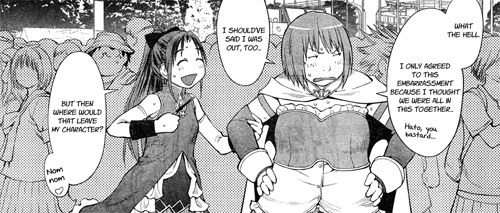
And yet, there she is. It’s a bit surprising.

I mean, if she really were against it she would have rejected it, right?  But then she says, “I only agreed to this embarrassment because I thought we were all in this together.” Actually, this “Madoka Cosplay” became a topic of conversation on the internet. Not only that, Yajima winds up cosplaying the most scantily-clad character, Sayaka.

…This is one of the things that makes Yajima cute.

Let’s put that aside.

The reason Ogiue and Saki-chan have already cosplayed is that Ohno pushed and pushed and got turned down, and finally got them to dress up, but with Yajima, she does so surprisingly without making any fuss.

Huh?

The first thing I felt was that perhaps the bar is lower for this generation when it comes to “cosplay.”

It’s not anything special, but by comparison is instead recognized as just one way among many to play around.

But even so, Yajima should dislike cosplaying.

That’s where Yoshitake comes in.

“But then where would that leave my character? Nom Nom.”

Yoshitake is always, always with Yajima. Here, her good qualities come to the surface.

It’s likely that not just Ohno but Yoshitake also encouraged Yajima to cosplay.

I don’t have a particular reason for using thinking in the following way, but if you can say that the two of them are good friends, and that they’re always together, then it’s quite simple.

Moreover, they must be aware of the pairing of Kyou-Saya.

Let’s take another look.

Hato, worrying (?) about Madarame, splits off this time to be a salesboy. Yajima of course feels something along the lines of, “Why that jerk, running away from this,” which brings about her complex, but Yoshitake pacifies Yajima when she’s in that state.

First, she says that as a pairing cosplay, she would be in trouble without Sayaka.

Next, she suggests that Yajima should find this good for Hato-chan, when one considers how Hato is acting.

That’s right. Let’s look things over.

  • Yoshitake, from the bottom of her heart, has fun cosplaying with everyone else. That she also prepared Pocky for it is really nice. Could it be that the title image for Chapter 59 was foreshadowing?!
  • Yoshitake understands Yajima’s objections, and knowing them is thus able to follow and respond. She doesn’t just ignore it.
  • Yoshitake really understands Hato’s complicated feelings, and cheers him on. She of course does the same for Madarame.

Yoshitake is amazing.

That girl, she’s capable of going along with everyone, and she has a lot of fun while doing so.

Whereas the others up until now have dressed poorly, possessed complexes, experienced trauma, and tried to escape from the world, she’s a little different.

I can feel strongly her desire to have as much fun as she can while considering everyone’s feelings.

At this point, the notions I want to entertain in regards to Yoshitake are, “Just what are her shortcomings,” and “Does she have any problems at all?”

However, to think that her cheerful behavior comes from some kind of inner suffering is perhaps an outdated way of thinking about it? At least, that’s how I’m feeling.

When I asked a friend who likes Yoshitake, “What do you like about her?” he said, “I like Yoshitake because she enjoys the things she likes.”

Ah, I get it. I really do. It has almost nothing to do with her “being an otaku.”

If Yoshitake’s hobby was film, then she’d be a film maniac. If she liked soccer, then she’d be playing soccer.

It just so happens that she likes anime, manga, and BL. That’s why she has fun as an otaku.

Whichever she chooses, she’ll definitely be showing a smile on her face.

She’s not just having fun without any care in the world.

…No wait, that might be an incorrect way to phrase it. She’s definitely carefree, but it’s not like she doesn’t think about anything while she’s having fun.

After thinking about how she should have fun, whether it’s all right to be enjoying herself, and whether she’s being a bother to other people, she consciously tries to have the most fun that she possibly can.

This is the scene in Volume 10 where she enters the club. Right from the beginning, she accurately confirms whether or not liking BL is OK there.

It’s very interesting that she states so plainly, “If it’s NG [no good] then I’ll stop [coming].” In other words, in confirming whether or not the things she likes are okay in there, it shows that she came there looking for a place where she could pursue enjoyment.

She wasn’t relying on escaping or anything, she was being active.

Another friend was saying to me that what she really meant was “If it’s NG then I’ll stop [talking about BL].” If that’s the case, then that’s also amazing.[3]

I might even say that if “BL being NG” means that she would find another way, then that would be the ultimate form of being able to pursue fun.

Therefore.

She’s able to make close friends, and my friend thinks that she has like the greatest smile. That’s why he loves her.

“Yoshitake, has fun doing the things she likes.” Indeed, that’s also why I like her so much.

To have fun doing the things she likes with such firmness, and to even be able to say that she likes it, is truly what makes her so charming.

Yoshitake and Yajima

In the work itself, things are often drawn from Yajima’s point of view, while Yoshitake’s feelings aren’t drawn all that much.

That’s why Yajima can be seen as incredibly cute, but still I’d like to see Yoshitake a bit more.

Yajima’s spirit is filled to the brim with mud.

However, it’s completely different from what’s inside Madarame, Kugapii, Ohno-san, and especially Ogiue, who is an extreme case. She doesn’t have an inferiority complex over being an otaku. She professes her interest in BL, too.

She’s unable to outright talk about her figure. It’s an incredibly vague complex to have, as a human, as a woman, and perhaps more.

That said, it’s clear that it hasn’t turned into hatred.

Currently, she’s enjoying Genshiken. No, it’s more like, she’s able to enjoy herself there.

Here is where I think Yoshitake has an enormous presence.

It’s possible that even if Yoshitake weren’t around, Yajima would have still gone into Genshiken. She possibly would have helped out with Ogiue’s manga as well. She would have probably had fun doing so.

However, that Yajima is able to be in the prime of her youth (it IS the prime of her youth, right?!) is partially because she’s being guided by the raging engine of Yoshitake.

Well, Yoshitake is more like a runaway train going off the tracks, but they’re still really good friends.

They come together through their hobbies, and it really seems like they have fun doing so.

Looking at this makes me happy.

With that in mind, there’s another scene of them with a hint of sorts. This panel is where I picked up on the closeness of their friendship.

Yoshitake is a girl who engages in physical intimacy in the truest sense of the term. She doesn’t go quite as far as Sue, but she clings to Yajima especially.

Yoshitake really cares for Yajima as a friend. This is another instance of “the fun of Yoshitake.”

Yajima also likes Yoshitake. She pretty much reflects on the idea that “Oh well, it seems like I made some fujoshi friends.” Here, “friend” undoubtedly means Yoshitake. It also includes Hato to some extent, but in the end she’s still consciously aware of his status as a “boy.”

“Fun” with respect to Yoshitake appears under a large variety of conditions, but in this case I think one big point is that it’s obtained through being with Yajima.
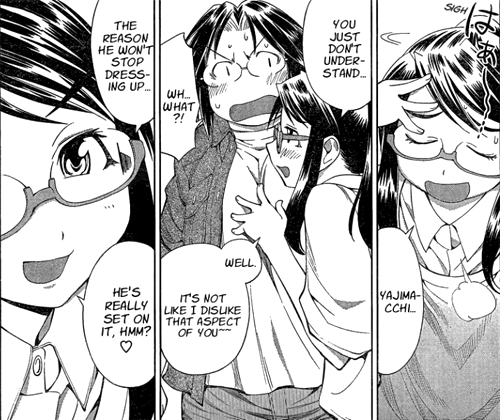
Hato-kun is of course a friend, but it’s Yajima who receives Yoshitake’s physical intimacy the most. The upperclassmen are another group entirely.

I think the balance she achieves between her “ability to read the mood” and her “desire to pursue fun” shows how wonderful she is.

She never feels like she’s thinking, “I have to look out for Yajima’s sake!” Rather, she truly thinks Yajima is fun.

She also doesn’t act conceitedly, as if to say “I make this place better.” However, if she thinks “this place makes me happier because I have more fun here,” then she will indeed make that place better.

Ahh.

Once again, I’m fully aware of how amazing it is that Yoshitake “has fun doing the things she likes.”

She’s never gloomy. Though, there’s a chance she will be at some point, but currently it has never happened.

A friend of mine said, “Isn’t she a symbolic example of a ‘positive otaku?'” To that I said, “Ah, you’re right.”

It’s not that “something happened so I became an otaku” or that “something happened so I became her friend.”

It’s that “being an otaku is fun so I have fun being an otaku” and “I just like my friends, simple as that.”

So, it’s really fun seeing Yoshitake be that way.

In my eyes, Yoshitake’s excitement is also one of her good points. Isn’t it super cute?

But I think what it might really be is that I’d like to become Yoshitake.

If I were as positive, as capable of finding fun in the things I enjoy, and as able to express my fondness for the things I like, how happy would I be?

Presently, Yoshitake is in a total supporting role. She hasn’t had a chapter featuring her, and her inner thoughts haven’t been revealed.

I think that could be because she says everything she thinks anyway.

I think she’s probably a girl who’s pure in the best sense of the word.

The only problem is probably “What’s to come.”

Yoshitake, perfectly fine with drinking alcohol despite being underage.

I won’t deny the possibility that something problematic could occur given her too-pure immaturity.

I won’t deny it, but… currently no one’s been hurt, and on the contrary Yoshitake’s the catalyst for cheering others up.

I think it could be nice to have her remain in a supporting role, to have her be something like the one who raises the spirits of the other club members.

At any rate, this month Madarame is in the heroine position. That’s dangerous.

Just how cute can he possibly be…!

Madarame-tan, you’re not a loser underdog, you’re a winner overdog![4]

———

Translator’s Notes:

[1] Like the last article, “oink” refers to “buhireru” (ブヒれる), an onomatopoeic verb to describe oinking like a pig, implying that one is a disgusting anime fan

[2] A Mori Girl, or “Forest Girl” is a style of Japanese fashion where the goal is to look like a girl who lives in the forest, generally tending towards light, natural colors and simple-looking clothing. More information can be found here.

[3] The confusion over the whether Yoshitake meant that she’d stop coming to Genshiken (i.e. quit) or stop talking about BL (i.e. stop) comes from the fact that the words for “quit” and “stop” in Japanese are the same, yameru (やめる). Normally the easiest way to differentiate them is through their kanji (辞める=quit; 止める=stop), but the original Japanese text leaves it ambiguous. As it is my translation of that image that you see above, I interpreted it as the latter.

[4] The phrase here is “make inu” (負け犬), a phrase which literally means “loser dog” but is generally translated as just “loser.” Tamagomago contrasts it with “kachi inu” (勝ち犬), or “winner dog,” which is to say that he’s not a loser, but he’s not just a winner either. As translating kachi inu to just “winner” would have removed this subtlety, I went with the interpretation of “winner overdog” if only because overdog vs. underdog is about as ridiculous as kachi inu vs. make inu.