There are many unforgettable moments in Initial D. Whether it’s seeing the AE86 drift for the first time, the battle against Ryousuke, the Trueno vs. Levin battles, or many other examples, the races are often showcases of protagonist Takumi’s unbelievable feats. But there’s one battle that often sticks out in my mind—the 86 vs. the Suzuki Cappuccino—because it features an important lesson about not limiting your self-perception.
Throughout Initial D, Takumi is very familiar with being the underdog due to his car being much older and weaker compared to his opponents’. The result is that he has to use various tricks (as well as an intuitive understanding of his own vehicle) to topple one Goliath after another. But the Cappuccino presents a different challenge: It’s actually smaller and lighter than the 86, and can pretty much outdo Takumi’s car at what it does best. Ultimately, though, Takumi prevails by doing what has not come naturally to him: He overpowers the weaker vehicle, even using the relatively larger frame of the 86 to block the Cappuccino.
Often, we think about our strengths in absolutes: “I’m good/bad/mediocre at this.” However, this is all relative. Maybe you’d normally be considered undersized, and have patterned your life to compensate for that, but there could be times where you are the bigger individual and have to use that to your advantage. If you get too stuck on who you’re “supposed” to be and how your actions should reflect your identity, you might lose out on opportunities.
Avoiding tunnel vision about your own attributes is the key—all too fitting for a series about racing.
How much should we do what we’re good at vs. to what extent should we try to work on our weaker areas? And to what end? I’ve been contemplating these questions because of the Virtual Youtuber Calliope Mori.
There used to be an ad campaign in the 2000s for the beer Dos Equis featuring a charismatic older gentleman described as “The Most Interesting Man in the World.” The commercials would boast about his accomplishments, and even occasionally have him wittily comment on various topics. In one case, his advice on careers was “Find out what it is in life that you don’t do well, and don’t do that thing.” It‘s a statement that can be taken as “know your strengths and play to them,” but this and similar sentiments have me contemplating the ways in which we as people navigate the notion of self-improvement.
That’s where Calliope Mori comes in. One of the most popular VTubers in the world, the central theme of her persona is that she is a “rapping reaper”—a death god who has bars for days while also presenting a very anime aesthetic. A lot of her early success was built on her rap skills, and it’s given her both fame and fortune, including a major deal with Universal Music Japan. Yet, rather than stick to the image of the “hip-hop anime girl,” Calli has more recently delved into two areas she feels less experienced in: cuteness and singing.
Among VTubers, being adorable and singing well are certainly not uncommon traits. Her genmate Gawr Gura (featured in the above collaboration, “Q”) is a prime example, and Calli going this route means being compared to the Guras of the world. But while Calli’s qualities (especially her rap skills) are much rarer and help her to stand out among the crowd, she’s also mentioned a desire to work on both cuteness and singing ability. For example, she originally asked if she could have a character model that was short and flat-chested, closer to her ideal image of cuteness. Calli has also been doing covers of cute songs like “Kawaikute Gomen” and “Idol,” the opening for Oshi no Ko. It’s a move that has gotten both positive and negative feedback, some of which has been on the extreme side.
The worst comments seem to stem from the idea that one shouldn’t be putting content like this out unless they match a very high and often gatekeeping standard, and I find it sad and awfully pathetic to attack someone who is trying to do what they want while aware that they’re not the best at it, rather than just be mature and ignore what you don’t like.
Certainly, Calli could only try to operate outside her wheelhouse because she’s had financial success through Hololive and the support of a fanbase that wants to see her do well. It’s a far cry from telling someone barely scraping by to just “do what you feel like, even if you’re not necessarily going to be great at it.” But while Calli has a fairly privileged position, the fact that she’s willing to learn and experiment in the public eye, all while doing things that don’t come as easily to her, is admirable. It would be a terrible thing if people are discouraged from trying unusual things because of the backlash Calli receives. My hope is that everyone, Calli included, does not lose heart.
I have a somewhat rose-colored view of an internet from long ago, and based on my observations on social media, I’m not alone. Increasingly, I see among those who surfed the superhighway a desire to return to a still-connected but far less prominently “public” presence. There’s no doubt a heavy element of nostalgia, but I also think there’s another major factor: a longing for a time when you could feel comfortable baring your insides, both the beautiful and ugly parts, without risking attack en masse.
The internet has thrived as a way to help people feel less alone without great risk to themselves. Whether it’s a political belief, favorite book, or even a sexual fetish, thinking you’re the only person in the world who’s into something can be an incredibly isolating experience. Are you “normal?” If not, are there at least others who can relate to you?
Now, especially as an entire generation has grown up being encouraged (or even forced) to make their online presence and extension of their offline identity, it’s not surprising that people would become afraid to share themselves. In a recent interview, game creator Sakurai Masahiro (of Smash Bros. and Kirby fame) said something related to this, which was summarized by a translator as follows:
“Sakurai talks about how he feels like today’s culture is too combative & people are quick to tear down things they don’t like in bad faith, and that the people putting things out into the world are vulnerable whereas the critics aren’t; he has little faith that things will change.”
I think it captures the environment well, along with the fear it creates.
Trying to find out if there were others like you carried a risk in the past too, of course. I’m under no illusions that those days weren’t filled with trolls or mean-spirited assholes eager to tear people down, but compared to today, the potential damage to the self feels less severe. Or at least, it would be localized.
There’s an anime called Jormungand about a mercenary team led by an arms dealer. In the final episode [Spoiler Warning], the main characters essentially cripple the ability to wage war from the other side of the world, though more regional conflicts are still very possible. In other words, while they can never truly stop war, they at least wanted to slow its spread. I think the desire to return to an era of web rings, bulletin boards, and extremely unpolished personal sites comes from a similar sentiment. Call it harm reduction, perhaps.
Even the most uncreative, awful stories are better than a world where AI scripts are the default.
The Writers Guild of America officially declared a strike recently—their first in 15 years. The Writer’s Strike of 2007 incidentally also began the very same month as Ogiue Maniax, so while this blog isn’t directly related to their cause, I feel a kind of connection to them. This is a form of writing, after all, even if it isn’t the kind that gets made into TV shows or movies on Netflix.
I’m in full support of this strike, but one thing I want to focus on is their preemptive motive to restrict the use and crediting of AI software like ChatGPT, and to emphasize that all writers need to be human. The worry, as far as I can tell, is that studios and media companies will try to use AI to churn out basic scripts and then have the writers clean them up for less pay than they’d normally get. In the highly capitalist United States of America, we’re accustomed to seeing cost-cutting measures that punish the workers and reward the executives, so this would hardly be a surprising development.
My stance on this particular issue is that the writers are justified in their concern and are totally in the right. I’m not inherently against AI providing some form of entertainment. I spent many years enjoying the hell out of VGCW, which basically pit AI wrestlers against one another in a video game and then wrote a story around it. However, that pretty much amounts to using AI as an improvisational prompt not unlike Who’s Line Is It, Anyway?, and the majority of the creative output comes from actual people.
The human connection to writing is paramount, and I think this is something that should concern all writers and fans of media regardless of skill, ethics, or political beliefs. Someone could make the most derivative and poorly written story, and that would still be preferable to an AI script precisely because it is someone’s work that they put out through their own effort, even if it’s “bad.” I occasionally see arguments that using AI can stick it to the liberal Hollywood media or whatever. However, it’s a mistake to think this would only affect people on one side of the political spectrum. This will bite people in the ass regardless of their beliefs—no one wants to have their work trivialized.
The thing I find most insidious about the push for using AI for writing and other areas is that the assumption of cost-cutting implies the notion that writers, artists, etc. are somehow paid too much. Creative fields are notoriously unstable, and acting as if they’re the biggest cost sink is either disingenuous or horrendously shortsighted. I hope the strikers win this one, and that we have a media landscape where writers can feel like they are both fairly compensated and not treated like nannies for AI chat programs.
Sometimes, the perfect analogy to explain something can come from an unexpected place. For me, I recently found a way to organize some thoughts I’ve been having about martial arts, and it’s all thanks to VTuber mega star Ironmouse.
As I peer more into the world of kung fu and the like, I’m frequently encountering the idea that many martial arts are not built around merely being a catalog of techniques one can add to their arsenal. Rather, they’re often systems of efficient power generation for particular circumstances, which then form the foundation for executing techniques.
Something like western boxing has been proven effective for fighting, and it’s a system where specific implementation of techniques can be made functional by anyone if initially taught correctly. From what I understand, a less experienced person can learn to throw a 100% proper and effective punch even if it might not be as good as a veteran boxer’s. In contrast, many techniques across various kung fu disciplines will be largely ineffective without having trained extensively in how a style is meant to generate power and having passed a certain point in which your body has adapted to this counterintuitive movement.
It’s a difference that can be hard for people to grasp, myself included. I’m not a fighter or a martial artist, so it’s not something I can intuitively understand. But this is where Ironmouse comes in.
One of the many impressive things that Ironmouse is known for is that she actually has training in operatic singing. However, her opera voice is not her “normal” singing voice. During her 2023 birthday concert (see below), she sang well but without going into opera mode, and the difference is noticeable. In other words, a person can’t just improve their singing until it reaches “opera level”—it requires dedicated training in a particular way of producing sound.
While not the only VTuber to have studied opera (Tokino Sora from Hololive and Banzoin Hakka from Holostars EN), Ironmouse is probably the most powerful example of how specific the training can be. This is because singing opera style can literally cause her physical pain due to chronic health issues, so she doesn’t often perform that way. When she does, though, Ironmouse sounds incredible.
The similarities to different types of martial arts also extends to the topic of subjectivity. Opera may require a certain type of training to make a certain type of sound, but is it inherently better than other forms of singing? Not necessarily. It’s all down to personal wants, needs, and preferences, as well as what you aim to do with it. Is it the right move to train for years in a specific way of generating power found in certain martial arts, or to work from what one’s body can already do?
So thanks, Ironmouse. I don’t know if it makes sense to everyone, but your singing has helped me in a most unexpected way.
In the past few years, I’ve developed a terrible interest in reading and viewing arguments about martial arts, from kung fu to MMA and beyond. There’s a combination of established knowledge, lost knowledge, myths and legends, fraudsters, hero worship, dick-waving, differing philosophies, and genuine curiosity that makes it a weirdly compelling shit soup. During these trawls, I occasionally see an argument that goes something like “If their kung fu is so great, why don’t they prove it in the ring, and also make a ton of money?”
But what I was surprised to find is a response of sorts to that question in the pages of the manga Mashle—a series that asks, “What if Harry Potter was a non-magical himbo who overcame all obstacles through comically absurd physical prowess like Saitama from One Punch Man?” Not only does Mashle do a surprisingly good job of addressing the inequality inherent in its world, but it also cuts through expectations in other ways too, including how and why people learn to fight.
It’s important to note that con artists are a dime a dozen in the world of martial arts. It’s the realm of claims of supposed no-touch knockouts, poison fists, and chi energy. Even when you put such ridiculous “feats” aside, there are plenty of generic schools that are justifiably derided as “McDojos” or “belt factories,” essentially teaching nothing of substance. Because of this, many have reasonably become skeptical towards anyone who purports to fight with superhuman abilities. Asking for real proof makes sense, but there’s this peculiar jump in logic I see sometimes, where “prove it in the ring“ becomes “doesn’t everyone want to prove themselves?”
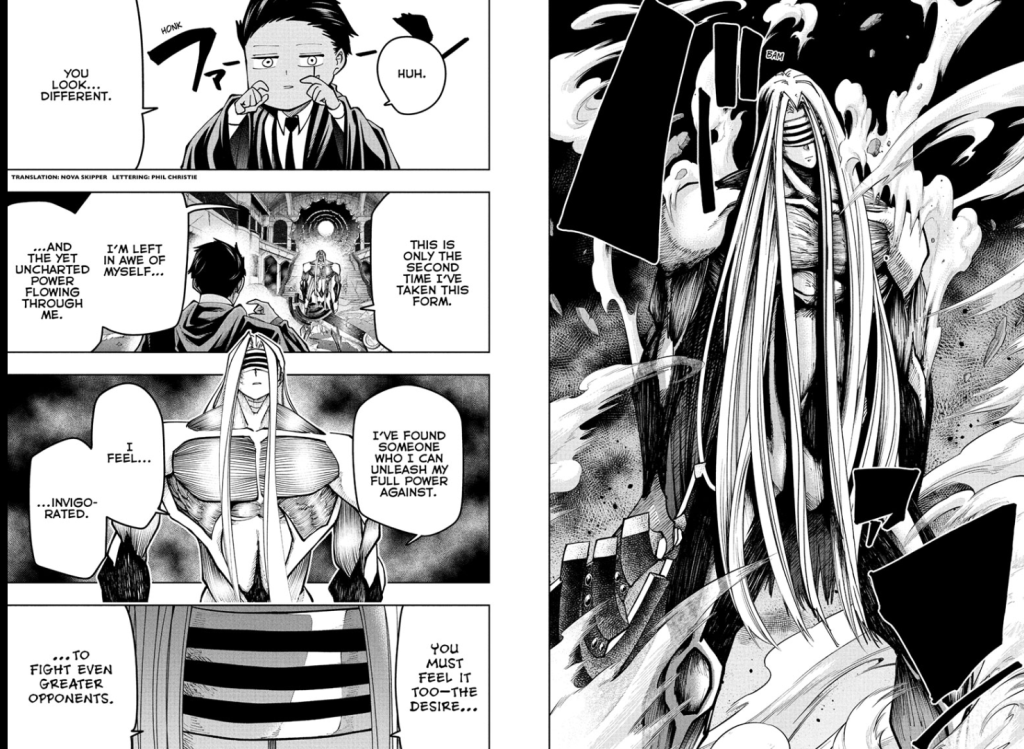
That’s where Mashle and its hero, Mash Burnedead, come in. During one of Mash’s most fearsome battles to date, his opponent says, “I’ve found someone who I can unleash my full powers against. I feel…invigorated. You must feel it too—the desire to fight even greater opponents.”
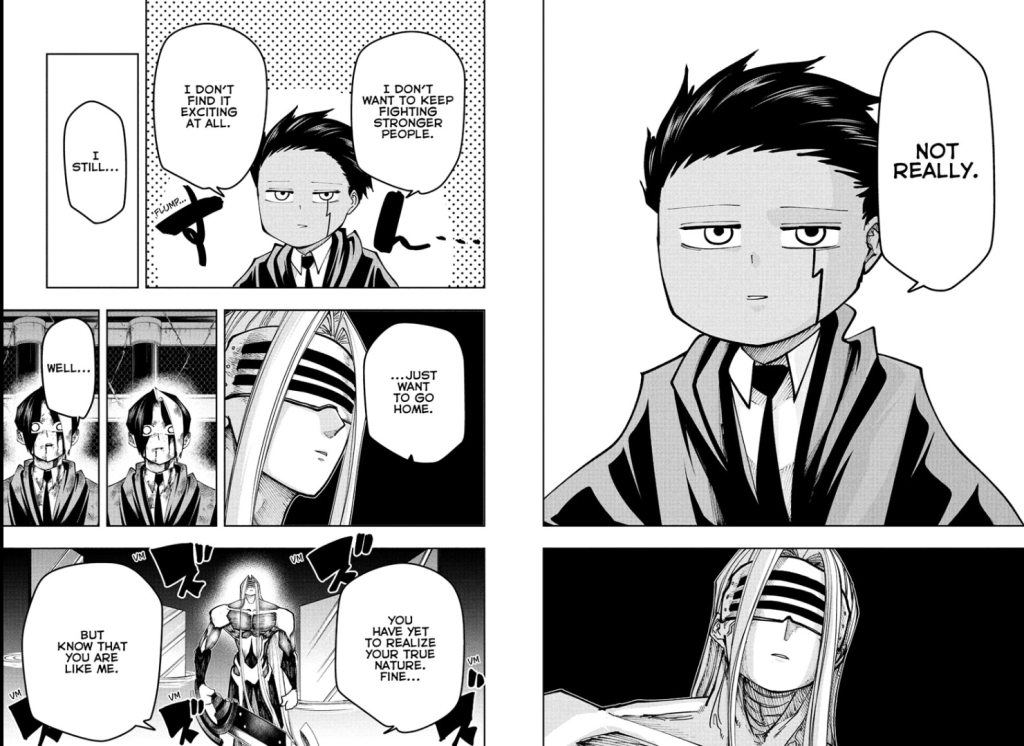
To which Mash responds, “Not really. I don’t want to fight stronger people. I don’t find it exciting at all. I still…just want to go home.”
This whole scene is a brief gag in a larger action scene, but Mash’s answer is a succinct counterpoint to the notion that everyone who truly learns how to fight has this killer instinct they need to unleash upon the world, whether for profit, fame, or to prove something. It actually takes a particular kind of person to want to willingly get in harm‘s way in order to show the world what they’re capable of.
One of the martial arts videos I‘ve watched (see above) is from an instructor on Youtube named Adam Chan, about the Hakka fist. As Adam explains, the Hakka are an ethnic group in China who were historically very poor and had to migrate a lot, and the various martial arts they developed came from civilians needing to survive against prejudice and xenophobia rather than as part of an army or in order to engage in duels. This is where Mash is: he didn‘t learn how to fight because of ego, bravado, a thirst for more, or because of a chip on his shoulder. He did it to protect himself and those dear to him.
Within online discussions of martial arts and fighting, conversations end up getting geared towards “Whose kung fu is strongest?” in the literal sense. But Mash Burnedead represents the reminder that sometimes it’s the wrong question to ask. The desire to hurt others and risk getting yourself hurt in the process is not the only way to view things, even if there is a certain glamor to the idea of honing oneself into a human weapon.
I still remember writing this blog’s tenth anniversary post, and how it felt like such a milestone. Now we’re actually half a decade past that?! It makes me realize that Ogiue Maniax is theoretically supposed to be leaving its chuunibyou phase, but will that ever actually happen? I mean, it’s still a primarily text-based anime blog in the year 2022.
While I don’t want to focus on the short-term too much for a celebration of 15 years, I have to acknowledge that this comes at a time when Twitter is on fire due to the unfathomable competence of one jackass of a billionaire. The reason this resonates with me is that I actually spent the last anniversary post waxing nostalgic on the Something Awful Forums after the death of its founder! And here we are again with another major platform exploding. To go from Lowtax dying to the unfunniest man on Twitter setting $44 billion on fire feels like every year from this point will end up with some piece of the older internet being met with tragedy. What’s next, 4chan’s servers getting eaten by raccoons?
15 years also just makes me feel my age. There are anime fans establishing their tastes and their influences who are as old as Ogiue Maniax (though I get the feeling none of them are reading this blog). I’ve proven the site to possess the magical recipe of longevity known as stubbornness, as even the Patreon is less about making a profit and more about providing a way for the blog to pay for itself. If there’s a way to make big cash-money off it, I don’t have the energy or time to figure that out anymore.
I do worry that as my responsibilities grow elsewhere, I might not be able to keep writing as freely as I do. At the very least, though, there’s a good chance I can outlast the bird app. In the meantime, I’m still loving anime and manga, and I hope my passion for it never fades.
I am tired of media and entertainment companies trying to monopolize my attention.
Fourteen years ago, when the Marvel Cinematic Universe had begun bringing to the silver screen the crossovers that defined superhero comics, I was on board. I love a good superhero team-up, and the MCU films came without decades of baggage. When the first Avengers movie hit theaters, it felt like just the right amount of reward for time spent.
Fast forward to now, and I just cannot keep up, nor do I want to. The problem isn’t just that Marvel is putting out so many more movies and TV shows. I really don’t mind sprawling mega franchises that fans devote their hours to. Nor is it that I’ve just gotten older. Rather, what I’m bothered by is that Marvel seems to be trying to push out all other competition from people’s brains until they’re all that’s left.
Compare this with something like Pokémon. You could easily spend every waking hour (and potentially even your sleeping ones) to these Pocket Monsters. But Pokémon doesn’t act like every game, manga, and anime is interwoven, nor does it imply that missing even one of them means failing to have the whole story. In fact, almost every game starts from the assumption that it’s introducing new players to the world of Pokémon, and they don’t draw specific attention to prequels. Marvel, however, wants you to watch show after show, film after film.
Another example of mind-monopolizing media is just gacha games in general. Between the stamina bars that either encourage players to spend money or keep a close eye on when they refill, the constant limited-time bonuses, the never-ending new stories, and the gambling-esque characterrolls themselves, I constantly find myself wishing I could enjoy these games. That’s not to say that I avoid them entirely, but I have to actively minimize their presence in my life. The worst of them take from the old Farmville school of essentially holding your game hostage.
I’m not inherently against Marvel, mobile games, or similar, but I can’t stand how they discourage exploration by trying to monopolize attention. I love to explore different stories, different forms of art, and different creators. I’m not going to be nerd-guilted out of that passion.
As I scroll down Twitter these days, I’ll occasionally happen upon what seems to be an insightful article or piece. I know it’s probably worth reading, and that I’d get something out of it, but something prevents me from clicking and actually looking. I’m not exactly sure why that’s the case, but the fact that the people who wrote these pieces (or decided to link to them) often feel like they have something to prove about themselves exhausts me. At the same time, I’m well aware that a younger me from 10 years ago would likely have thought differently, and would be more eager to engage.
I think this is what it feels like to mature/grow older. Not enough for an actual IRL mid-life crisis, mind you—more like the fandom version. I think it’s clear from my posting history on this blog that I still engage with my passions pretty regularly, but something else that probably comes across is that I sort of exist in my own world. Sure, I read and view what catches my attention, I think about where the industries and fandoms are going, and I keep writing as an exercise in contemplation. And I talk to other fans every so often. However, what I don’t really do is actively engage with the fandom at large or try to explore the absolute depths of a given topic. More and more, I feel in my body that time is finite, and I’m not sure I have what it takes to go full-steam ahead on any fandom, general or specific. Heck, I don’t even listen to podcasts as much as I used to, and that was an easy way to check out the opinions of others.
Doing my own thing isn’t actually all that terrible. Perhaps one of the reasons I interact less is because the discourse is poisoned by how social media currently works. Still, it comes with a drawback of me feeling disconnected from other fans, especially younger ones who grew up from grade school with manga in their local libraries and such. I’m happy we’ve gotten to that point of easy access, but it fundamentally changes the presence of manga in one’s life. Similarly, the fact that The Simpsons has become the mark of a Millennial/Gen Z divide based on whether people engage with the original jokes or the memes that sprung out of them is fascinating, yet revealing of the passage of time.
I also know that to many older individuals, I still probably come across as a young and spritely sort, and that there are plenty of people with decades on me who still have passion and energy. Taking that into account, maybe the sensation I’m experiencing is that I’m aiming to walk a few blocks to get to my destination, and I’m seeing others sprint or run marathons. My journey is worthwhile, but it’s short and more leisurely, and even though it’s not a competition (and I don’t view it as such), I nevertheless can’t help but notice the people who pass me by.* It’s less about comparing accomplishments and more about being on different wavelengths, and I’m getting used to shifting between them.
*For the record, I used to be part of a casual running group, and I was anything but swift, so I also know this feeling from actual experience.
One of the biggest transformations that occurred from the internet of my younger days to that we have now is the integration of the web into our flesh-and-blood lives. Whereas once you could reasonably maintain some kind of distinction between “online” and “IRL,” the latter term isn’t even really used anymore because it’s kind of pointless. Every major platform wants you to integrate because it helps them make money.
I’m under no false assumptions that Virtual Youtubers are some defiant rebellion against the greed that makes companies share information, but what they do represent is a purposeful separation of selves between who you are among close friends and who you are to an audience—while also making it obvious that there is a distinction in the first place. Of course, there are plenty of famous cases of performers being very different in public and private (see Freddie Mercury for one famous example), but the use of stylized moving avatars reduces the chances of the two sides being conflated.
The way VTubers have reintroduced and even kind of re-normalized an element of pseudonymous presentation makes me wish that they arrived sooner. Perhaps the internet would look different if VTubers were more quickly embraced before Facebook, et al could make everyone think that putting photos of yourself everywhere for all to see should be the default.
Very broadly speaking, that’s what online icons and avatars were for. And when it comes to hiding your face but wanting to communicate, things like chat rooms and voice chat have and still fulfill that function. But where VTubing is able to go a step further is in its ability to convey facial expressions that add an additional layer of interpersonal connection while also keeping that active and outright facade in place. How much more comfortable might people be talking “face to face” if the faces are virtual?
In the video above, Apex Legends player discusses his favorite Virtual Youtubers, but also brings up all the points I’ve made above. Namely, he likes the fact that it gives viewers something to look at while still maintaining some semblance of privacy for the streamer, even if it’s for someone who shows their face normally.
I understand the programs used by VTubers can be expensive and time-intensive, especially if you want something professional-looking like your favorites. Still, I imagine a world where this sort of thing becomes accessible to a great many more people, and they can maybe engage with their online communities more comfortably.