Straight Title Robot Anime, or, MIKUBAIN: LET’S GET SILLY

In a previous post, I had likened the bizarre 3dcg anime gdgd Fairies to an Adult Swim cartoon. I still think it’s an apt comparison, and with the new season currently running this only renews my confidence in that description, but what I hadn’t expected was for there to be another anime like gdgd Fairies, especially not one that’s themed around a giant robot future. This isn’t so surprising once you learn that it’s from the same creator as gdgd Fairies, but what’s impressive is that in some ways this new show’s humor is even more absurd.

Straight Title Robot Anime (yes, that’s the title) takes place in a time when humanity has gone extinct and only giant robots are left to fight an eternal war. Living on this Earth are three human-sized female robots who are trying to stop the war by re-discovering mankind’s great invention: humor. In order to accomplish this, they try to figure out what it means to tell a joke and induce laughter, but the concept is so foreign to them that they’re unable to make any headway.

In other words, this anime is actually all about trying to explain jokes, which is classically regarded as humor’s own kryptonite, but amazingly this just makes the whole premise funnier. It’s also animated entirely in the free program Miku Miku Dance, which was created for just the purpose its name implies (animating Hatsune Miku).

If it wasn’t obvious that this show is from the same mind as gdgd Fairies from, the fact that there’s an “improv” section similar to the fairies’ own “Magical Spring Dubbing Lake” should be more than sufficient evidence. In it, the three robots visit simulations of “ancient human locations,” such as a hardware store, and try to figure out uses for the objects found. I’m not sure how they accomplish these scenes, but I imagine it actually involves them gathering materials from those real-world places and then having the voice actors engage in prop comedy. Here, not only are the voice actors unable to keep up their acted roles and break down into their normal voices, but one character goes from having a very artificial BEEP BOOP I AM A ROBOT voice to having a natural cadence which not even an electronic voice distortion can fully hide.

Most telling of all is the fact that, despite the show being premised around the idea that the robots do not understand what it means to laugh, the robots in this sequence are giggling constantly. The narrator nonchalantly explains this as “interference,” invoking that old Mystery Science Theater 3000 mantra, “It’s just a show; I should really just relax.”

So that’s Straight Title Robot Anime. In my opinion, the humor isn’t quite to the level of gdgd Fairies yet, but its appeal is such that if you liked gdgd Fairies you’ll probably enjoy this too. However, if your only response to the fairies was revulsion then this show won’t help either. These really are both love it or hate it shows, as is evident from the comments both anime received. You can experience Straight Title Robot Animegdgd Fairies 2, and the angry comments these shows tend to get, on Crunchyroll.

One Piece’s Nico Robin Reviews Vividred Operation

Tamako Market is Kyoto Animation’s Next Step

In one of my earliest posts I ever wrote for Ogiue Maniax, I talked about my desire for Kyoto Animation to go beyond its own limits, to go from just adapting work to making their own original material. Though my opinion of Kyoto Animation isn’t quite as rosy as it was back in 2007, with their new original anime Tamako Market I actually feel like they’ve finally fulfilled those expectations to a fair degree.

Kyoani is known primarily for two things: really solid animation and cute girls. Together, the resulting product is a soft, delicate quality that is unmistakably Kyoto Animation (and which shows like Kokoro Connect and Sora no Woto have tried to mimic), and it affects different adaptations in different ways. For Haruhi and their Key game adaptations it lent weight and significance to characters’ movements, while in K-On! and Nichijou, two manga with sharp and abrupt humor, it caused the anime versions to slow down in terms of comic timing. In the end, it seems to all come down to the cute girls.

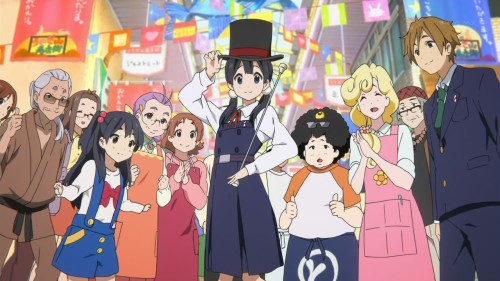
Tamako Market is the first Kyoto Animation show I’ve seen to really let the animators spread their wings. Tamako Market has allowed Kyoani to show personality through movement in a greater variety of character types of all shapes and sizes, from small children to geriatrics, to even a person of ambiguous gender and a silly talking bird. The show then places them in a deliberately slow-paced setting in the form of a small-town shopping area, which makes that Kyoani “slice of life” style feel appropriate. What’s more, even though there are indeed still cute girls in Tamako Market, all of the other characters are portrayed differently from them, giving the viewer not only Kyoani’s bread-and-butter but also something even more substantial.

Given the sheer amount of character variety in Tamako Market, I have to now wonder if it wasn’t just that their old shows didn’t allow them to “push their envelope,” but that having to adapt works limited them due to the contact of the original sources. Most of what Kyoto Animation has adapted has come from dating sims, light novels, which often times are all about cute girls, or manga which center around cute girls. While I think Kyoani isn’t ideal for making certain types of works, it’s clear to me from Tamako Market that their strengths, namely their ability to have characters move with almost a sense of tangible liveliness, go beyond what’s expected of them.

My Article on the Anime of 1977 at “The Golden Ani-Versary of Anime”

The “Golden Ani-Versary of Anime” is a collaborative effort among bloggers, fans, and experts of anime to celebrate the 30th anniversary of anime on television. Coordinated by one Geoff Tebbetts, the plan is to have one article per year from 1963 and the debut of Tetsuwan Atom all the way up to 2012. I’ve included below an excerpt from my entry on the year 1977.

angie-predance

The year 1977 is something of a contradictory time in anime. Although the industry at this point was at the beginning of an animation boom and had been firmly established for over a decade, it can be difficult to pinpoint the exact level of experimentation vs. continuation of formulaic trends, simply because in many cases the individual works of 1977 featured both.

The ’70s were the golden age of giant robot anime, and with six super robot-themed anime debuting (as well as five holdovers from the previous year) 1977 was no exception to that trend. Somewhat unfortunately for the robot anime of that year, the legendary arrival of Mobile Suit Gundam in 1979 tends to overshadow them as a whole, but while nothing in 1977 broke the mold as Gundam would, there were a few series which pushed that mold to its very limits. These shows managed to convey new and interesting ideas while working well within established convention, an impressive feat in its own right.

Continue reading “1977: Conventions and Innovations”

1977-petiteangie3a

The Comedic Stylings of Five Legendary Warriors: Yes! Pretty Cure 5

I was originally going to make my next Precure review about the recently-concluded Smile Precure!, but because of its many similarities to Yes! Pretty Cure 5 I thought it would be better to talk about that one first so that when I do get around to Smile you’ll know where I’m coming from. Do keep in mind that I haven’t seen the sequel, Yes! Pretty Cure 5 Go Go, all the way through yet, so this review is “incomplete” in that sense.

Yes! Pretty Cure 5 comes from the time when the official English still demanded that you refer to it as “Pretty Cure” in spite of the Japanese pronunciation, and it’s the first series in the franchise to step away from a pair oriented cast of main characters and do a full-on Sentai/Sailor Moon-style five-man team. As the story goes, one day an energetic girl named Yumehara Nozomi encounters a small mascot creature named Coco, a prince who asks her to become a legendary warrior and help restore his kingdom, which had been destroyed by an evil organization called “Nightmare.” Nozomi agrees and becomes Cure Dream, and is later joined by the athletic Natsuki Rin (Cure Rouge), the idol Kasugano Urara (Cure Lemonade), the gentle Akimoto Komachi (Cure Mint), and the intelligent Minazuki Karen (Cure Aqua), as well as Coco’s best friend and fellow prince, Nuts.

Out of all the Precure shows, Yes! Pretty Cure 5 ranks as one of the least visually impressive. Its animation is frequently awkward and off-model, and the transformed costume designs are awkward and unmemorable, but Yes! 5 is able to make up for those issues through really, really genuinely fun character interactions and antics. The five Cures all have dynamic characterizations, and seeing their personalities bounce off of each other is simply a joy. This even extends to the side characters, especially the school newspaper’s reporter, Masuko Mika (above), and her infectious Lois Lane/April O’Neil-like desire to get the scoop on the Cures.

Because of how entertaining the lunch-time and after-school banter can be, I sometimes refer to Yes! Pretty Cure 5 as the “Real K-ons, ” a comparison all the more appropriate because they girls are shown eating all the time. Four out of the five Cures have huge appetites and/or are obsessed with sweets, and the only one left out, Komachi, is the daughter of traditional Japanese candy maker. It makes for a show where just seeing the five girls hanging out at school is in many cases far more engaging than the action scenes, something which is often the opposite case when it comes to Precure.

That said, when the two halves of talky comedy and action come together, the result can be some incredibly solid episodes. My favorite example is when you find out that Rin (“the red flame of passion”) and Karen (“the blue spring spring of wisdom”) don’t get along quite as well as the others, but when a villain tries to use their lack of cooperation against them, it actually backfires: their rivalry ends up egging each of them on to perform even better, ironically improving their overall teamwork. Smile Precure! has a similar episode but the conclusion isn’t nearly as hilarious. Also, Cure Aqua takes a lot of her attacks from pro wrestling.

Speaking of the villains, Nightmare may be my favorite antagonist group in all of Precure because it actually runs itself like a corporation, albeit one inhabited by otherworldly monsters. You have the CEO, who can only be contacted through an intermediary. You have board meetings where the bad guys discuss their latest plans, end-of-year staff performance reviews, and of course promotions and demotions. For the most part the individual antagonists aren’t much to speak of, but there are a couple of notable exceptions, the aforementioned intermediary, Kawarino (think of him as the equivalent of Smile‘s Joker), and Bloody, a wizened veteran who attacks the Pretty Cures less through brute force and more through psychological manipulation.

Also of note is the fact that the mascots in the show, Coco (right) and Nuts, are the first in the franchise to be able to take human form, and in this case the two turn into handsome fellows. There’s a not-so-subtle undertone of Coco and Nozomi having feelings for each other, as well as Komachi and Nuts, but it remains just ambiguous enough that it needs to be inferred. Somewhat predictably, Pretty Cure 5 is the Precure most popular with fujoshi; if you ever wondered where Sayonara Zetsubou Sensei character Fujiyoshi Harumi’s favored pairing of “Pine x Napple” comes from, it’s a parody of Coco x Nuts.

Yes! Pretty Cure 5 is most certainly a show with its fair share of flaws, but also really noticeable strengths which make the show great to watch one episode at a time or in semi-large batches. The show’s antagonists make for a decent enough threat to motivate the story along, but the real fun is in seeing the antics of the five Cures, as the series does an excellent job of showing the main cast as friends who trust and love each other. Even more fortunate is that the direct sequel, Yes! Pretty Cure 5 Go Go seems to make up for a lot of the problems of its predecessor.

PS: Cure Rouge is one of my favorite Cures. Yes, more than Sunny. No, not nearly as much as Marine.

Drifting Clubroom: Genshiken II, Chapter 84

Before we jump into the chapter, I have to make sure you’ve heard the news.

ATTENTION:

NEW GENSHIKEN ANIME!!

YOUR EYES DO NOT DECEIVE YOU

You’d think after the Madarame/Saki climax from a few chapters ago that Genshiken would let up for a while, but Chapter 84 is an intense one.  In the previous chapter, Madarame revealed that he was going to quit his job near the school (implying he would be unable to visit the college as often as he used to), despite Saki’s advice not to do so. As Madarame appears to feel increasingly alienated from the current club’s atmosphere (and Yoshitake tries to convert him to the church of BL), Hato is having trouble of his own as his emotions become a mystery to even himself. As Ogiue asks him to contribute to a “Tiger & Bonny” doujinshi, Hato begins to wonder about his relationship with Madarame, and the seeds of doubt Kaminaga placed in him about his heterosexuality begin to sprout.

Meanwhile, Sue of all people seems to have feelings for Madarame as well, though her character might mean it’s stranger (or simpler) than that.

I do not think that the change in demographic in Genshiken is the root cause per se for Madarame’s decision. Rather, my suspicion, based on my own experience, is that Madarame’s connection to the actual Genshiken as an on-campus club is starting to weaken. I had a similar group of nerd friends back in high school, and for the first three years after I graduated I would visit the school often to maintain that experience. Eventually, however, everyone who I even had a loose connection to graduated, and I lost any compelling reasons to continue. I’m still friends with a lot of the people I knew from that time, but our friendship has in a certain sense transcended the physical location, and I could see Madarame feeling like the clubroom itself is no longer that important.

That said, I’ve noticed, based on some of the response to the new Genshiken anime, that there are fair amount of readers both Japanese and non-Japanese who feel a bit alienated or even betrayed by Genshiken II, and I think Madarame is meant to embody that feeling to some extent, being the character who most embodies that classic otaku personality. Perhaps the deal with Madarame’s character is that he’s caught in a state of limbo, where he’s not yet fully integrated into adult living but at the same time his old haven away from reality, Genshiken, is starting to fade away.

The more that Genshiken focuses on Hato, the more I realize that he is probably the most psychologically complicated character in the entire manga (though I get the feeling that there’s something up with Nakajima that might be even more complex). Ogiue is one thing, as her story cuts to the bone, but Hato’s situation is such that you can’t even explain it as simply “he’s realizing he’s gay.” There’s a good chance that’s what’s happening, but based on the specifics of the chapter and of his history, doubting his own sexual orientation doesn’t seem to be the only thing going on.

In the chapter, Hato tries to shoo away the suggestions of his imaginary counterpart, only to have the female Hato replaced by Kaminaga, who echoes the real Kaminaga’s statement that the crossdressing likely facilitates the potential homosexuality of Hato. In that scene are a lot of things to take into consideration, starting with the fact that the Stand (i.e. Hato’s inner thoughts?) transforms specifically into Kaminaga. Based on previous chapters, it’s still not clear what his feelings towards her are. Does he want her? Does he want to be her? Does he perhaps desire both? Even the fact that the transition from Stand Hato to Kaminaga is a little hard to spot at first if you just skim through the chapter is indicative of the fact that Stand Hato continues to resemble Kaminaga, despite the fact that Hato has undergone an image change by semi-permanently switching to the shorter wig, as if to show that she specifically continues to influence him. It’s a weighty past and a convoluted present for Hato.

As for Sue, the easiest connection to make in regards to her blushing is the kiss she placed on Madarame’s cheek at the school festival as a sort of prank. Putting aside the notion of “Madarame: mack daddy of American fujoshi,” I’m starting to realize that Sue pretty much functions in Genshiken the same way the penguins do in Mawaru Penguindrum, bringing into the very foreground some of the “hidden” elements of the characters’ relationships at the time. I also think it’s quite appropriate for her to quote Dio Brando, and to have it be not one from the more popular Part 3 Stardust Crusaders story but from the original Phantom Blood.

There’s not much Ogiue this chapter, but there’s probably going to be another chapter at least partly focused around her soon, given the impending Comic Festival, though I imagine it won’t be until at least another three or four chapters.

Didn’t Quite Go the Distance: Eureka Seven AO

It’s fairly common knowledge that sequels aren’t the easiest thing to successfully pull off in entertainment. Even if the sequel ends up being okay, it may not live up to its predecessor because of how iconic moments and innovations can start to become formula (having to fit “Yippee-ki-yay, motherfucker” into every Die Hard for example), or plot points from the first in the series have to be modified in order to cater to the new version. Whenever I watch a sequel, I’m aware of how daunting this mountain can be, and try to take into account those problems even if they ultimate are my criticisms. This is the approach I took when I heard that Eureka Seven, one of my favorite anime ever, was getting a sequel, but even with an open mind I felt that Eureka Seven AO not only paled in comparison to the original but was in certain ways a regression of what Eureka Seven had done.

Eureka Seven AO is billed as a direct sequel, as opposed to an alternate universe/retelling like the movie or the manga. The story centers around a young boy named Fukai Ao, who lives in the independent nation of Okinawa, and for whom life is difficult because of the way the community tries to ostracize him. In this world, the skub (or scab however they want to spell it this time), are considered a problematic natural disaster, especially because they bring with them mysterious monsters known as “Secrets,” which Ao ends up having to fight. For anyone who’s seen the original, the fact that the world of AO consists of real-world countries and continents is meant to imply that something is very strange or different about its setting, and trying to figure out just what in the world happened becomes part of the initial intrigue of the series.

When I say “regression,” I’m not referring to retcons or weird developments in AO‘s plot which cast a different light on the original’s events, but a regression of what mecha anime is capable of. Eureka Seven took an approach which let viewers explore its world through a cast of engaging, fleshed-out characters and a central love story developed gradually over the course of many episodes, and which anchored the narrative in such a way that the emotional excitement of the series builds up continuously throughout. It’s not altogether unique to Eureka Seven, and you can probably trace this style of show all the way back to Macross.  Eureka Seven AO, on the other hand, feels more like a mediocre 80s mecha anime, more keen to develop its story as a set of vague mysteries and tensions but never entirely delivering on any of them. It’s not just that the plot is worse, but that it ends up resembling the way a staunch non-fan might look at and describe their idea of a Gundam anime.

What Eureka Seven AO does have, at least initially, is a strong cast of characters with plenty of potential as to how they’ll develop, but much of it never comes to fruition (though the brief glimpses at Ivica’s character and past were things I enjoyed in particular), or if there is a development the lack of impact from the rest of the series lessens the overall effect. In particular, AO never manages to have its story properly focused by something like Eureka and Renton’s romance,  and though it didn’t have to necessarily be “another romance” (which might have well turned it into just a rehash of the original), there was nothing that could properly fill that void. It seems like the closest thing was just the mystery of what happened to Eureka and Renton, the intrigue of which the show feeds into fairly well, but the explanation we’re left with at the end is less than satisfying. And there is the potential for romance at the beginning, as the dynamic between Ao and his friend Haru is cute and gives a good sense of their relationship, but it ends up getting pushed aside. In the end, probably the most interesting point brought up in the show has to do with how the Secrets are treated by humanity, and how it reflects in some ways the way the Skub were regarded in the original Eureka Seven.

If the movie Eureka Seven: Good night, sleep tight, young lovers suffered from having a weak and confusing beginning but then a fairly strong finish as all of its disparate ideas came together, then Eureka Seven AO is the opposite: It starts off strong and with many of the pieces in place to tell something both grand and personal, but its plot and character development are so discombobulated that when the ending finally comes it hits like a drizzle instead of the torrent of emotions that the original provided.

The Stylistic Stew of Dragon Who

Manhwa, or Korean comics, are something I am relatively unfamiliar with. I can spot the similarities and obvious influences from manga in modern manhwa, and I’ve looked at a few titles here and there, but I have neither the knowledge of history nor the personal experience to say I have a firm sense of how manhwa “is.” Given that my expertise (if you can call it that) is primarily in manga, however, I found it quite interesting when a manhwa title I’ve read recently, Dragon Who, takes elements clearly inspired by manga but cross-pollinates them in a way which normally never happens among Japanese comics.

A title from 2009, Dragon Who is about a dragon boy named Roa Coatl who travels to South Korea to find the descendant of Quetzacoatl to make her his bride so that they can prevent an impending global disaster. In other words, it’s a shounen-esque school comedy/romance/action title that probably wouldn’t feel too alien to manga readers aside from the decidedly Korean names for most of the characters. Given that comfortable familiarity I think one would expect certain stylistic approaches, and indeed Dragon Who looks the part of a shounen manga to a good degree, but take a look at this image:

(By the way, for those unfamiliar, manhwa reads left to right.)

The character designs look quite shounen, perhaps even closer to late 90s shounen titles, but the use of blooming flowers in the foreground to introduce a character (and this is the main heroine Go So-Ahn’s first appearance) is an element straight out of shoujo. When combined with the fact that So-Ahn herself is designed to be fairly normal as opposed to strikingly beautiful, looking closer to a best friend character than a main character herself, it makes for an almost defiant combination of visual elements: a shounen title with a shoujo-esque heroine with shounen heroine looks.

Not only that, but Dragon Who has its own fair share of attractive guys, and while the title is neither harem nor reverse harem, the following image can give a certain impression as to how the title skews.

At this point, I think it would be easy to chalk it up to the popularity of shounen titles among female reader inside and outside of Japan (and I would have to assume Korea as well), and the titles which are designed to appeal to girls in Japanese comics to varying degrees such as Black Butler and Kuroko’s Basketball, but I’m not so sure that explains it. For one thing, Dragon Who is still keen to include elements like beefy muscular guys who aren’t all lithe bishounen, as well as fanservice for male readers.

Just to be clear, this is not a matter of manhwa looking “enough” like manga or not, but rather seeing how the manhwa inspired by manga doesn’t have to play by the rules (or at least plays with chunks of rules from four different places). To me, it feels more like Dragon Who is the product of authors taking aspects and visual language from manga regardless of genre or intended audience and putting them all in one place, or like if a shoujo writer were paired with a shounen artist. It’s a crossing of assumed boundaries which can show how thin and permeable those walls can be if only we’d allow them to be.

Ebiten’s Unique Look at the Harem Genre

Ebiten is an anime so chock full of references that it relies on them too much. Though not a show I would recommend, there is one point in its favor I’d like to talk about that I imagine a lot of people didn’t take note of because of the overall lack of interest in the show.

From the very first episode we are introduced to a character named Noya Itsuki, a cute girl who turns out be a crossdressing boy. For most of the series, he factors in only somewhat into each episode’s story, but when the final “arc” comes around (if you can say that for a 10-episode anime), Itsuki gains a more prominent role. In reality, Itsuki is not the effeminate side character first presented, but a man with so much raw chemistry that he can literally control any women who come in range of his pheromones (and who’s also a lolicon on top of that). Up until that point, we learn, some of the girls had been suppressing his dangerous abilities by feminizing him through not only making him crossdress but through drugs specifically designed to counter his natural machismo.

In other words, the “real” Noya Itsuki is actually a harem lead, the guy who mysteriously attracts all of the ladies, and the female characters in the show had been actively trying to prevent the anime from becoming another Love Hina. Much like School Days and its own unique take on the harem (i.e. the amount of emotional manipulation needed to actually sleep with the entire cast of girls), I can’t say the show is worth watching just for this fact, but it’s quite a meta-level plot twist for a show that’s basically yet another “girls having fun in their own club,” even if it only exists as a brief blip in its own series. It also brings to the forefront an idea I’ve seen thrown around here and there, which is that the all-girls moe/comedy titles that exist grew out from harem-type shows once enough male viewers no longer needed a Y-chromosome character to “relate with” or to act as a stand-in.

She is Loco, I Said: Genshiken II, Chapter 83

Ohno is worried about her job prospects, when Tanaka mentions that he’s willing to do whatever it takes to provide for Ohno. Misinterpreting his words as a criticism of her for not being able to support herself, however, Ohno decides that a career selling cosplay photo CDs might be in her future. During the photoshoot, Tanaka manages to clear up the confusion, and in the process even implicitly proposes to Ohno when he says that he wants to create costumes for her for the rest of his life. Ohno, who had downed a whole bottle of liquid courage in preparation for the photoshoot, decides to maybe stay another year in school (unfortunately).

Meanwhile, Madarame’s quit his job.

Chapter 83 feels very significant to me, a culmination of multiple threads but in a way different to the climax of the Saki-Madarame storyline. There’s the big plot development with Tanaka’s tacit proposal to Ohno, of course, but Ohno’s plight of employment (whether she brings it upon herself or not) has been around since before Genshiken II even began (and after Genshiken finished, technically, because it was first brought up in the Kujibiki Unbalance manga extras). Here, it finally takes center stage and we also get to see where Ohno and Tanaka have gone since they began dating so many years ago.

This chapter is definitely full of fanservice, particularly in how we get to see Ohno completely topless in private with Tanaka, but rather than just pointless titillation, I find that whole scene and its portrayal of (albeit obscured) nudity to speak of both the increasing maturity of not only the relationship portrayed but also of the Genshiken manga itself. The scene is portrayed with a strong sense of comfort and familiarity between Ohno and Tanaka, the kind where two people are just close enough with each other to bare it all without having it be an event. And while the nudity isn’t quite to the level of Spotted Flower, it still gives a sense that this is an adult’s world, at least emotionally and physically. Though not “canon,” for those who’ve seen the Genshiken 2 anime this chapter is a stark contrast from that episode portraying how Ohno and Tanaka got together in the first place, where Tanaka felt overwhelmed by his own inadequacies and awkwardness.

Even Tanaka’s “proposal” shows the level their relationship is at, as he naturally talks about a future with her moments before realizing what he had said (but still sticking to it). I also actually really love the change Tanaka made to his own words. As he realizes just how much Ohno has impacted his life, as he realizes that he was able to pursue his dream of working in fashion because Ohno was the perfect model and companion for him, he goes from having an attitude of sacrifice to holding onto his dreams no matter what. When he says he’ll find whatever means he can to keep making costumes for her, he includes Ohno in those dreams as a vital component, and I find the whole thing rather beautiful.

Seeing this sharp focus on the employment situation of so many characters, focused on Ohno and Tanaka but also giving us glimpses of Ogiue, Madarame, and even Kuchiki’s lives beyond the university, I feel that Genshiken more than ever has this real sense of life moving forward, even if people aren’t ready for it. Certainly it’s not an old or unfamiliar idea in the manga, with Sasahara especially getting some serious page time as he struggled to find a path for himself, but with Chapter 83 and Genshiken II in general I find that there are not only significant differences in the challenge each character faces in terms of work, but that with the new characters in Genshiken II you can really see a spread of values from people just entering college to people looking at marriage and the future, and how the former can turn into the latter but still seem just as strange. Genshiken has always been a seinen manga, but here I think it really starts to reach at an older seinen audience, beyond just the folks for whom college is a fairly fresh memory.