The Comedic Stylings of Five Legendary Warriors: Yes! Pretty Cure 5

I was originally going to make my next Precure review about the recently-concluded Smile Precure!, but because of its many similarities to Yes! Pretty Cure 5 I thought it would be better to talk about that one first so that when I do get around to Smile you’ll know where I’m coming from. Do keep in mind that I haven’t seen the sequel, Yes! Pretty Cure 5 Go Go, all the way through yet, so this review is “incomplete” in that sense.

Yes! Pretty Cure 5 comes from the time when the official English still demanded that you refer to it as “Pretty Cure” in spite of the Japanese pronunciation, and it’s the first series in the franchise to step away from a pair oriented cast of main characters and do a full-on Sentai/Sailor Moon-style five-man team. As the story goes, one day an energetic girl named Yumehara Nozomi encounters a small mascot creature named Coco, a prince who asks her to become a legendary warrior and help restore his kingdom, which had been destroyed by an evil organization called “Nightmare.” Nozomi agrees and becomes Cure Dream, and is later joined by the athletic Natsuki Rin (Cure Rouge), the idol Kasugano Urara (Cure Lemonade), the gentle Akimoto Komachi (Cure Mint), and the intelligent Minazuki Karen (Cure Aqua), as well as Coco’s best friend and fellow prince, Nuts.

Out of all the Precure shows, Yes! Pretty Cure 5 ranks as one of the least visually impressive. Its animation is frequently awkward and off-model, and the transformed costume designs are awkward and unmemorable, but Yes! 5 is able to make up for those issues through really, really genuinely fun character interactions and antics. The five Cures all have dynamic characterizations, and seeing their personalities bounce off of each other is simply a joy. This even extends to the side characters, especially the school newspaper’s reporter, Masuko Mika (above), and her infectious Lois Lane/April O’Neil-like desire to get the scoop on the Cures.

Because of how entertaining the lunch-time and after-school banter can be, I sometimes refer to Yes! Pretty Cure 5 as the “Real K-ons, ” a comparison all the more appropriate because they girls are shown eating all the time. Four out of the five Cures have huge appetites and/or are obsessed with sweets, and the only one left out, Komachi, is the daughter of traditional Japanese candy maker. It makes for a show where just seeing the five girls hanging out at school is in many cases far more engaging than the action scenes, something which is often the opposite case when it comes to Precure.

That said, when the two halves of talky comedy and action come together, the result can be some incredibly solid episodes. My favorite example is when you find out that Rin (“the red flame of passion”) and Karen (“the blue spring spring of wisdom”) don’t get along quite as well as the others, but when a villain tries to use their lack of cooperation against them, it actually backfires: their rivalry ends up egging each of them on to perform even better, ironically improving their overall teamwork. Smile Precure! has a similar episode but the conclusion isn’t nearly as hilarious. Also, Cure Aqua takes a lot of her attacks from pro wrestling.

Speaking of the villains, Nightmare may be my favorite antagonist group in all of Precure because it actually runs itself like a corporation, albeit one inhabited by otherworldly monsters. You have the CEO, who can only be contacted through an intermediary. You have board meetings where the bad guys discuss their latest plans, end-of-year staff performance reviews, and of course promotions and demotions. For the most part the individual antagonists aren’t much to speak of, but there are a couple of notable exceptions, the aforementioned intermediary, Kawarino (think of him as the equivalent of Smile‘s Joker), and Bloody, a wizened veteran who attacks the Pretty Cures less through brute force and more through psychological manipulation.

Also of note is the fact that the mascots in the show, Coco (right) and Nuts, are the first in the franchise to be able to take human form, and in this case the two turn into handsome fellows. There’s a not-so-subtle undertone of Coco and Nozomi having feelings for each other, as well as Komachi and Nuts, but it remains just ambiguous enough that it needs to be inferred. Somewhat predictably, Pretty Cure 5 is the Precure most popular with fujoshi; if you ever wondered where Sayonara Zetsubou Sensei character Fujiyoshi Harumi’s favored pairing of “Pine x Napple” comes from, it’s a parody of Coco x Nuts.

Yes! Pretty Cure 5 is most certainly a show with its fair share of flaws, but also really noticeable strengths which make the show great to watch one episode at a time or in semi-large batches. The show’s antagonists make for a decent enough threat to motivate the story along, but the real fun is in seeing the antics of the five Cures, as the series does an excellent job of showing the main cast as friends who trust and love each other. Even more fortunate is that the direct sequel, Yes! Pretty Cure 5 Go Go seems to make up for a lot of the problems of its predecessor.

PS: Cure Rouge is one of my favorite Cures. Yes, more than Sunny. No, not nearly as much as Marine.

Drifting Clubroom: Genshiken II, Chapter 84

Before we jump into the chapter, I have to make sure you’ve heard the news.

ATTENTION:

NEW GENSHIKEN ANIME!!

YOUR EYES DO NOT DECEIVE YOU

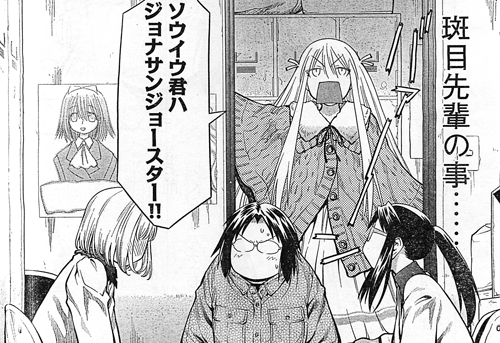
You’d think after the Madarame/Saki climax from a few chapters ago that Genshiken would let up for a while, but Chapter 84 is an intense one.  In the previous chapter, Madarame revealed that he was going to quit his job near the school (implying he would be unable to visit the college as often as he used to), despite Saki’s advice not to do so. As Madarame appears to feel increasingly alienated from the current club’s atmosphere (and Yoshitake tries to convert him to the church of BL), Hato is having trouble of his own as his emotions become a mystery to even himself. As Ogiue asks him to contribute to a “Tiger & Bonny” doujinshi, Hato begins to wonder about his relationship with Madarame, and the seeds of doubt Kaminaga placed in him about his heterosexuality begin to sprout.

Meanwhile, Sue of all people seems to have feelings for Madarame as well, though her character might mean it’s stranger (or simpler) than that.

I do not think that the change in demographic in Genshiken is the root cause per se for Madarame’s decision. Rather, my suspicion, based on my own experience, is that Madarame’s connection to the actual Genshiken as an on-campus club is starting to weaken. I had a similar group of nerd friends back in high school, and for the first three years after I graduated I would visit the school often to maintain that experience. Eventually, however, everyone who I even had a loose connection to graduated, and I lost any compelling reasons to continue. I’m still friends with a lot of the people I knew from that time, but our friendship has in a certain sense transcended the physical location, and I could see Madarame feeling like the clubroom itself is no longer that important.

That said, I’ve noticed, based on some of the response to the new Genshiken anime, that there are fair amount of readers both Japanese and non-Japanese who feel a bit alienated or even betrayed by Genshiken II, and I think Madarame is meant to embody that feeling to some extent, being the character who most embodies that classic otaku personality. Perhaps the deal with Madarame’s character is that he’s caught in a state of limbo, where he’s not yet fully integrated into adult living but at the same time his old haven away from reality, Genshiken, is starting to fade away.

The more that Genshiken focuses on Hato, the more I realize that he is probably the most psychologically complicated character in the entire manga (though I get the feeling that there’s something up with Nakajima that might be even more complex). Ogiue is one thing, as her story cuts to the bone, but Hato’s situation is such that you can’t even explain it as simply “he’s realizing he’s gay.” There’s a good chance that’s what’s happening, but based on the specifics of the chapter and of his history, doubting his own sexual orientation doesn’t seem to be the only thing going on.

In the chapter, Hato tries to shoo away the suggestions of his imaginary counterpart, only to have the female Hato replaced by Kaminaga, who echoes the real Kaminaga’s statement that the crossdressing likely facilitates the potential homosexuality of Hato. In that scene are a lot of things to take into consideration, starting with the fact that the Stand (i.e. Hato’s inner thoughts?) transforms specifically into Kaminaga. Based on previous chapters, it’s still not clear what his feelings towards her are. Does he want her? Does he want to be her? Does he perhaps desire both? Even the fact that the transition from Stand Hato to Kaminaga is a little hard to spot at first if you just skim through the chapter is indicative of the fact that Stand Hato continues to resemble Kaminaga, despite the fact that Hato has undergone an image change by semi-permanently switching to the shorter wig, as if to show that she specifically continues to influence him. It’s a weighty past and a convoluted present for Hato.

As for Sue, the easiest connection to make in regards to her blushing is the kiss she placed on Madarame’s cheek at the school festival as a sort of prank. Putting aside the notion of “Madarame: mack daddy of American fujoshi,” I’m starting to realize that Sue pretty much functions in Genshiken the same way the penguins do in Mawaru Penguindrum, bringing into the very foreground some of the “hidden” elements of the characters’ relationships at the time. I also think it’s quite appropriate for her to quote Dio Brando, and to have it be not one from the more popular Part 3 Stardust Crusaders story but from the original Phantom Blood.

There’s not much Ogiue this chapter, but there’s probably going to be another chapter at least partly focused around her soon, given the impending Comic Festival, though I imagine it won’t be until at least another three or four chapters.

Didn’t Quite Go the Distance: Eureka Seven AO

It’s fairly common knowledge that sequels aren’t the easiest thing to successfully pull off in entertainment. Even if the sequel ends up being okay, it may not live up to its predecessor because of how iconic moments and innovations can start to become formula (having to fit “Yippee-ki-yay, motherfucker” into every Die Hard for example), or plot points from the first in the series have to be modified in order to cater to the new version. Whenever I watch a sequel, I’m aware of how daunting this mountain can be, and try to take into account those problems even if they ultimate are my criticisms. This is the approach I took when I heard that Eureka Seven, one of my favorite anime ever, was getting a sequel, but even with an open mind I felt that Eureka Seven AO not only paled in comparison to the original but was in certain ways a regression of what Eureka Seven had done.

Eureka Seven AO is billed as a direct sequel, as opposed to an alternate universe/retelling like the movie or the manga. The story centers around a young boy named Fukai Ao, who lives in the independent nation of Okinawa, and for whom life is difficult because of the way the community tries to ostracize him. In this world, the skub (or scab however they want to spell it this time), are considered a problematic natural disaster, especially because they bring with them mysterious monsters known as “Secrets,” which Ao ends up having to fight. For anyone who’s seen the original, the fact that the world of AO consists of real-world countries and continents is meant to imply that something is very strange or different about its setting, and trying to figure out just what in the world happened becomes part of the initial intrigue of the series.

When I say “regression,” I’m not referring to retcons or weird developments in AO‘s plot which cast a different light on the original’s events, but a regression of what mecha anime is capable of. Eureka Seven took an approach which let viewers explore its world through a cast of engaging, fleshed-out characters and a central love story developed gradually over the course of many episodes, and which anchored the narrative in such a way that the emotional excitement of the series builds up continuously throughout. It’s not altogether unique to Eureka Seven, and you can probably trace this style of show all the way back to Macross.  Eureka Seven AO, on the other hand, feels more like a mediocre 80s mecha anime, more keen to develop its story as a set of vague mysteries and tensions but never entirely delivering on any of them. It’s not just that the plot is worse, but that it ends up resembling the way a staunch non-fan might look at and describe their idea of a Gundam anime.

What Eureka Seven AO does have, at least initially, is a strong cast of characters with plenty of potential as to how they’ll develop, but much of it never comes to fruition (though the brief glimpses at Ivica’s character and past were things I enjoyed in particular), or if there is a development the lack of impact from the rest of the series lessens the overall effect. In particular, AO never manages to have its story properly focused by something like Eureka and Renton’s romance,  and though it didn’t have to necessarily be “another romance” (which might have well turned it into just a rehash of the original), there was nothing that could properly fill that void. It seems like the closest thing was just the mystery of what happened to Eureka and Renton, the intrigue of which the show feeds into fairly well, but the explanation we’re left with at the end is less than satisfying. And there is the potential for romance at the beginning, as the dynamic between Ao and his friend Haru is cute and gives a good sense of their relationship, but it ends up getting pushed aside. In the end, probably the most interesting point brought up in the show has to do with how the Secrets are treated by humanity, and how it reflects in some ways the way the Skub were regarded in the original Eureka Seven.

If the movie Eureka Seven: Good night, sleep tight, young lovers suffered from having a weak and confusing beginning but then a fairly strong finish as all of its disparate ideas came together, then Eureka Seven AO is the opposite: It starts off strong and with many of the pieces in place to tell something both grand and personal, but its plot and character development are so discombobulated that when the ending finally comes it hits like a drizzle instead of the torrent of emotions that the original provided.

The Stylistic Stew of Dragon Who

Manhwa, or Korean comics, are something I am relatively unfamiliar with. I can spot the similarities and obvious influences from manga in modern manhwa, and I’ve looked at a few titles here and there, but I have neither the knowledge of history nor the personal experience to say I have a firm sense of how manhwa “is.” Given that my expertise (if you can call it that) is primarily in manga, however, I found it quite interesting when a manhwa title I’ve read recently, Dragon Who, takes elements clearly inspired by manga but cross-pollinates them in a way which normally never happens among Japanese comics.

A title from 2009, Dragon Who is about a dragon boy named Roa Coatl who travels to South Korea to find the descendant of Quetzacoatl to make her his bride so that they can prevent an impending global disaster. In other words, it’s a shounen-esque school comedy/romance/action title that probably wouldn’t feel too alien to manga readers aside from the decidedly Korean names for most of the characters. Given that comfortable familiarity I think one would expect certain stylistic approaches, and indeed Dragon Who looks the part of a shounen manga to a good degree, but take a look at this image:

(By the way, for those unfamiliar, manhwa reads left to right.)

The character designs look quite shounen, perhaps even closer to late 90s shounen titles, but the use of blooming flowers in the foreground to introduce a character (and this is the main heroine Go So-Ahn’s first appearance) is an element straight out of shoujo. When combined with the fact that So-Ahn herself is designed to be fairly normal as opposed to strikingly beautiful, looking closer to a best friend character than a main character herself, it makes for an almost defiant combination of visual elements: a shounen title with a shoujo-esque heroine with shounen heroine looks.

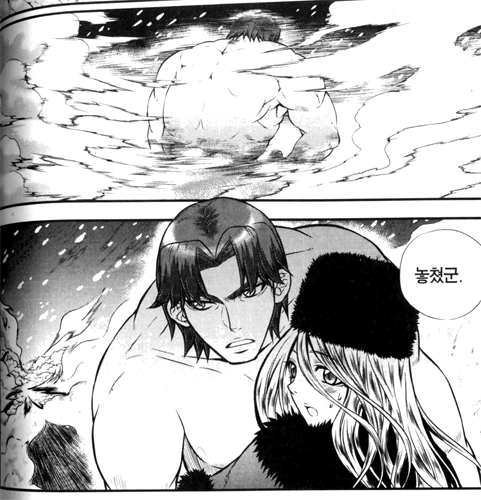
Not only that, but Dragon Who has its own fair share of attractive guys, and while the title is neither harem nor reverse harem, the following image can give a certain impression as to how the title skews.

At this point, I think it would be easy to chalk it up to the popularity of shounen titles among female reader inside and outside of Japan (and I would have to assume Korea as well), and the titles which are designed to appeal to girls in Japanese comics to varying degrees such as Black Butler and Kuroko’s Basketball, but I’m not so sure that explains it. For one thing, Dragon Who is still keen to include elements like beefy muscular guys who aren’t all lithe bishounen, as well as fanservice for male readers.

Just to be clear, this is not a matter of manhwa looking “enough” like manga or not, but rather seeing how the manhwa inspired by manga doesn’t have to play by the rules (or at least plays with chunks of rules from four different places). To me, it feels more like Dragon Who is the product of authors taking aspects and visual language from manga regardless of genre or intended audience and putting them all in one place, or like if a shoujo writer were paired with a shounen artist. It’s a crossing of assumed boundaries which can show how thin and permeable those walls can be if only we’d allow them to be.

Ebiten’s Unique Look at the Harem Genre

Ebiten is an anime so chock full of references that it relies on them too much. Though not a show I would recommend, there is one point in its favor I’d like to talk about that I imagine a lot of people didn’t take note of because of the overall lack of interest in the show.

From the very first episode we are introduced to a character named Noya Itsuki, a cute girl who turns out be a crossdressing boy. For most of the series, he factors in only somewhat into each episode’s story, but when the final “arc” comes around (if you can say that for a 10-episode anime), Itsuki gains a more prominent role. In reality, Itsuki is not the effeminate side character first presented, but a man with so much raw chemistry that he can literally control any women who come in range of his pheromones (and who’s also a lolicon on top of that). Up until that point, we learn, some of the girls had been suppressing his dangerous abilities by feminizing him through not only making him crossdress but through drugs specifically designed to counter his natural machismo.

In other words, the “real” Noya Itsuki is actually a harem lead, the guy who mysteriously attracts all of the ladies, and the female characters in the show had been actively trying to prevent the anime from becoming another Love Hina. Much like School Days and its own unique take on the harem (i.e. the amount of emotional manipulation needed to actually sleep with the entire cast of girls), I can’t say the show is worth watching just for this fact, but it’s quite a meta-level plot twist for a show that’s basically yet another “girls having fun in their own club,” even if it only exists as a brief blip in its own series. It also brings to the forefront an idea I’ve seen thrown around here and there, which is that the all-girls moe/comedy titles that exist grew out from harem-type shows once enough male viewers no longer needed a Y-chromosome character to “relate with” or to act as a stand-in.

She is Loco, I Said: Genshiken II, Chapter 83

Ohno is worried about her job prospects, when Tanaka mentions that he’s willing to do whatever it takes to provide for Ohno. Misinterpreting his words as a criticism of her for not being able to support herself, however, Ohno decides that a career selling cosplay photo CDs might be in her future. During the photoshoot, Tanaka manages to clear up the confusion, and in the process even implicitly proposes to Ohno when he says that he wants to create costumes for her for the rest of his life. Ohno, who had downed a whole bottle of liquid courage in preparation for the photoshoot, decides to maybe stay another year in school (unfortunately).

Meanwhile, Madarame’s quit his job.

Chapter 83 feels very significant to me, a culmination of multiple threads but in a way different to the climax of the Saki-Madarame storyline. There’s the big plot development with Tanaka’s tacit proposal to Ohno, of course, but Ohno’s plight of employment (whether she brings it upon herself or not) has been around since before Genshiken II even began (and after Genshiken finished, technically, because it was first brought up in the Kujibiki Unbalance manga extras). Here, it finally takes center stage and we also get to see where Ohno and Tanaka have gone since they began dating so many years ago.

This chapter is definitely full of fanservice, particularly in how we get to see Ohno completely topless in private with Tanaka, but rather than just pointless titillation, I find that whole scene and its portrayal of (albeit obscured) nudity to speak of both the increasing maturity of not only the relationship portrayed but also of the Genshiken manga itself. The scene is portrayed with a strong sense of comfort and familiarity between Ohno and Tanaka, the kind where two people are just close enough with each other to bare it all without having it be an event. And while the nudity isn’t quite to the level of Spotted Flower, it still gives a sense that this is an adult’s world, at least emotionally and physically. Though not “canon,” for those who’ve seen the Genshiken 2 anime this chapter is a stark contrast from that episode portraying how Ohno and Tanaka got together in the first place, where Tanaka felt overwhelmed by his own inadequacies and awkwardness.

Even Tanaka’s “proposal” shows the level their relationship is at, as he naturally talks about a future with her moments before realizing what he had said (but still sticking to it). I also actually really love the change Tanaka made to his own words. As he realizes just how much Ohno has impacted his life, as he realizes that he was able to pursue his dream of working in fashion because Ohno was the perfect model and companion for him, he goes from having an attitude of sacrifice to holding onto his dreams no matter what. When he says he’ll find whatever means he can to keep making costumes for her, he includes Ohno in those dreams as a vital component, and I find the whole thing rather beautiful.

Seeing this sharp focus on the employment situation of so many characters, focused on Ohno and Tanaka but also giving us glimpses of Ogiue, Madarame, and even Kuchiki’s lives beyond the university, I feel that Genshiken more than ever has this real sense of life moving forward, even if people aren’t ready for it. Certainly it’s not an old or unfamiliar idea in the manga, with Sasahara especially getting some serious page time as he struggled to find a path for himself, but with Chapter 83 and Genshiken II in general I find that there are not only significant differences in the challenge each character faces in terms of work, but that with the new characters in Genshiken II you can really see a spread of values from people just entering college to people looking at marriage and the future, and how the former can turn into the latter but still seem just as strange. Genshiken has always been a seinen manga, but here I think it really starts to reach at an older seinen audience, beyond just the folks for whom college is a fairly fresh memory.

Secret Santa: Overman King Gainer is Such a Thing

This post is my latest participation in the Reverse Thieves Secret Santa Project, wherein fellow bloggers anonymously recommend each other some anime and everyone writes a review of one of their “presents.” Given the Christmas theme of the endeavor, it is perhaps all the more appropriate that I review an anime which takes place in a land of endless winter, but really the reason why I ended up picking Overman King Gainer out of the choices I was given is that I had always wanted to watch it but had never gotten around to doing so.

Overman King Gainer is a 2002 anime from the mind of Tomino Yoshiyuki, the famous creator of Gundam. He’s a man with a long history and resume in the industry, and when people talk about Tomino anime, they usually divide them into two categories: Depressed Tomino Anime and Happy Tomino Anime, with the amount of bloodshed and trauma varying accordingly. Featured above is a gif of Tomino during the production of Overman King Gainer; I’ll let you decide which kind of show this is.

At first glance, Overman King Gainer is a strange show, not only because of its extremely catchy opening courtesy of Fire Bomber and JAM Project’s Fukuyama Yoshiki, Gaogaigar composer Tanaka Kouhei, and both characters and giant robots alike doing the Monkey (possibly the show’s most enduring legacy in anime), but because it presents new information about its world constantly and without any prior warning, making the whole thing quite difficult to summarize.

In the future of Overman King Gainer, humanity attempts to survive a harsh and close to uninhabitable planet by living in massive shelters known as “domepoli,” but among the people there are movements to participate in “Exoduses,” mass pilgrimages to lands with potentially more opportunity and resources, accomplished through the use of massive moving cities. The main character is a boy named Gainer Sanga, a video game champion who becomes the pilot of a mysterious organic robot he dubs the “King Gainer,” and who ends up becoming a part of the Exodus despite his objections to it. There is a complex world underpinning the main narrative, but we the viewers only ever get to see a few slivers of the whole, and even into the final episode the show still keeps a lot of its secrets. In that respect it reminds me of Xam’d: Lost Memories, which shares that similar pacing of world-building = plot progression, but much like Xam’d that’s also where a good deal of its charm lies.

Watching this show, I couldn’t help but feel that, more than Ikari Shinji from Evangelion or Kira Yamato from Gundam SEED, Gainer Sanga is the true updated version of classic Gundam hero Amuro Ray. Gainer has this strange introversion to him, as well as an aversion to the situation he finds himself in, but he adds this additional modern otaku element from the way he engages in his gaming. As an aside, the fact that he engages in games instead of tinkering with machinery reminds me that the original Gundam came out in a very different era of video games.

The character designs in this show are excellent, with both male and female characters clearly showing that a lot of care was put into their creation. The designs are full of vibrancy and personality, and though not the sole character designer on the show, the influence of Yoshida Ken’ichi (who would go on to do character designs for Eureka Seven and Xam’d) is both quite obvious and welcome.  I have to wonder what material would have been made for Overman King Gainer had it appeared in a post-Megami Magazine, maybe even post-Pixiv fandom environment. The show has a large number of female characters who seem to have a fair deal of enduring popularity, and I suspect that characters such as the strong-willed Sara Kodama, the spunky child princess Ana Medaiyu, the spy-turned-humanities teacher Adette Kistler, and the eccentric Cynthia Lane would’ve won the hearts of many current fans had the show been made in the last few years.

Tomino is often known for having rather stiff dialogue, and it’s easy to put Overman King Gainer in the same category, but I feel like that doesn’t quite tell the whole story, because it doesn’t take into account for its usage as a comedic element. The awkwardness of the phrasing and the responses they engender from other characters feels like this constant revolving tsukkomi, and when you take that sort of interaction and apply it to a diverse range of characters, including crazy Koyasu Takehito (see current anime JoJo’s Bizarre Adventure for reference), it makes for a fun if confusing anime which exudes a strange sort of energy that’s hard to find in other anime.

Another element of the anime that really stands out from other shows is its mechanical design, which both Yoshida and Yasuda “Akiman” Akira of Capcom fame worked on. The robots in Overman King Gainer come in two categories, the more basic and grunt-like “Sillhouette Machines,” and the “Overmen,” strangely powerful robots with a variety of abilities from invisibility to lightning bordering on the super (natural). Between their organic appearances and elements (artificial muscle tissue in the limbs for instance), as well as their striking appearances, probably the part of the show which most clearly describes the aesthetics of the anime, and that’s putting aside the whole Monkey-dancing thing.

I know I’m talking more about the components of Overman King Gainer than I am the overall feel of the series, and it’s something I normally prefer to avoid when I write reviews, but again I have to point out that the show kind of messes with expectations. Overman King Gainer is an unusual hodgepodge of elements which perhaps shouldn’t work together but do, and it defies categorization in the sense that it’s hard to say whether the anime is extremely straightforward or extremely obtuse, but which ends up being fun and clever.

In-Flight Mahjong, the Riichi-style Airplane Mahjong

Over the past few years I’ve had the opportunity to fly to other countries, and with flying comes checking out the in-flight entertainment. More often than not these days, in-flight entertainment includes a number of games from Chess to Tetris to even Doom, and sometimes the list even includes mahjong. While much of the time this refers to the tile-matching game, what I’ve found is that on Asian airlines it can actually refer to the real game we know and love. That’s how I found In-Flight Mahjong on Korean Air.

Actually, based on the full description provided, which used the phrase “match the tiles,” I ignored it for a while thinking it was going to be Shanghai, but curiosity got the better of me, for which I’m grateful. Programmed by the guys who make all of the other in-flight games (DHC or something?), the game purposely tries to aim for the anime fan audience by not only following the rules of Japanese-style riichi mahjong, but also boasting what it refers to as “anime-style” characters, which you can see in the videos below (trust me they’re worth it, if only for a healthy laugh).

I’m actually a little sad that I wasn’t able to record the audio (headphones-only after all). Whenever you see a character pop up in those videos with a “PON!” or a “KAN!” as in the first image above, just pretend they’re being exclaimed by people with heavily American-accented Japanese. The voice “acting” is anything but, though I don’t exactly hold my free game programmed to distract me for a few hours in between meals (which included bibimbap by the way) to the standards of Mahjong Fight Club or even Tenhou.

The game offers two modes: “quick game,” and “career,” which is meant to be like a single-player adventure mode (and in fact there is no multiplayer) with a few paragraphs to tell you whether you’re playing in a local parlor or at the end against some significant bigwigs. All of your favorite hands are there, though it refers to some in interesting ways (Chanta and Junchan are “Hon Chanta” and “Chanta” for some reason) The game offers three levels of difficulty, from easy to difficult, and of course I chose difficult out of some bizarre and fragile sense of pride. The computer opponents aren’t tough, but what I did notice is that on the difficult setting they tend to be extremely safe and conservative, and more often than not the rounds would end in a draw.

While this is not too surprising or annoying normally, it unfortunately comes with a peculiar rule in In-Flight Mahjong that rounds, at least in the South half of the game, will repeat if no one wins, even if East wasn’t in Tenpai. What this means is that the same round might last for 10 games in a row, and the only way to break out is to go for a win or hope a non-dealer computer pulls something off. Games that should have taken maybe half an hour total ended up taking about twice that.

Still, it is mahjong and definitely plays like mahjong, so if you happen to be flying to Korea (or wherever, as I assume this specific version appears elsewhere), and you have a desperate mahjong itch, you’ll know how to handle it.

Sexualization Without Objectification in Spotted Flower

When it comes to debates regarding how women are portrayed in media and entertainment, one recurring trend is the way that sexualization gets conflated with objectification. Whether it’s comics or not, Japanese or not, often times the two are presented as one, so it’s no surprise that there are readers who see them as one and the same and argue from a stance that reducing or removing certain depictions of women means a puritan-like removal of sexuality itself from media. While I don’t have the same problems with objectification that others might, it’s still an issue because this misunderstanding begets many other misunderstandings. It’s for this reason that I’m impressed by how the manga Spotted Flower handles the female body, and I think it gives a very clear case of how it is possible to draw sexual characters who aren’t necessarily sex objects.

A manga by Genshiken author Kio Shimoku, Spotted Flower is about an otaku husband and his pregnant non-otaku wife, and the small challenges they face as their lives enter a new stage. With a title referencing Madarame and Saki from Genshiken (Madara refers to spots—take note Naruto fans—and Saki means “bloom”) but clearly pointing out that the characters are not them, much of the manga revolves around how being an otaku can influence the relationship in certain ways. The other prominent theme, and the one I’m more concerned with for this post, is that of the pregnant wife’s sexual frustration. The problem the wife faces is that even through pregnancy she still wants sex and wants it badly, but it’s difficult for the husband to overcome the misconception that pregnant women are entirely different from sexual women (despite the act that it takes to get them that way). This makes sense, as depictions of pregnancy tend to focus on their motherly qualities and ignore the woman’s sexuality.

Spotted Flower does not draw that line in the sand. Much like his work on Jigopuri (about raising an infant), Kio doesn’t play it safe. He draws nudity. He draws bare breasts. He doesn’t shy away from showing sex and the desire for sex as very physical, mental, and emotional, but at the same time also doesn’t reduce pregnancy into a simplistic fetish or kink that you would find in some adult manga. He expresses the wife’s frustration in such a way that, even if she does not have the ideal body or the easy appeal of the “virgin” or the “nympho,” there is a kind of sexual attractiveness to her, an undeniable sensuality radiating from her which has little to do with the woman as object of desire and more as a person who desires.

As is obvious at this point, Spotted Flower is rather unusual in a number of ways, but it is also a series of possibilities and potentials. It pushes boundaries which probably shouldn’t be boundaries in the first place, and does so with a strong sense of characterization fans of Kio Shimoku have come to appreciate.

Blink-801: Genshiken II, Chapter 82

“Just once in my life I’d like to grow a penis!”

-Yoshitake Rika

Yes, it’s that kind of Genshiken chapter.

Yajima’s birthday has just passed, and noticing that Yajima has never engaged in a truly candid discussion with fellow girls, Yoshitake tries to get the straight-laced Yajima to open up moe. When the two discover a strange object in the club room, Yoshitake immediately assumes it to be an enema plug, and as the two let their imaginations run wild, the two narrow down the most likely owner of the plug to be Hato. As Hato and Yoshitake give their belated presents to Yajima, it becomes increasingly difficult to ask him about the enema. However, it turns out that Hato knows nothing about it, that it’s actually Ohno’s, and that it’s simply a small accessory from one of her cosplay outfits.

That Yoshitake and Yajima believed the owner of the “enema” had to be a guy is very telling of the ways in which yaoi has influenced their imaginations. Rather than simply limiting it to fujoshi psychology, though, I feel like the characters this chapter are showing more delusions run rampant, as if BL was more a key to a forbidden kingdom of the mind. It’s interesting how this contrasts with the predominantly male Genshiken of old in that awkward expression of sexuality has been a part of Genshiken since the very first chapter, and was something of a constant throughout the series, but it usually took the form of professing doujinshi or character preferences. It was certainly never to the level that the guys would wonder aloud about genitalia, and in hindsight it lent a good deal of realism to the series, both in the fact that they all had their own quirks and kinks, and that they were embarrassed about it and kept things understated.

When I think about it, the female characters have always been the ones to discuss sex and relationships more directly. Whether that’s Kasukabe describing her “friend’s” doggy-style with her boyfriend, Kasukabe asking Ohno if she and Tanaka had done it in cosplay, or even Ohno and Ogiue’s tough heart-to-heart discussions, the girls have done a lot less tiptoeing around the subject of sex. It’s even clear from this chapter that Yajima is pretty open with Mimasaka as well, relatively speaking, even telling her all about seeing Hato naked.

Yoshitake, however, takes that prospect to an all-new extreme, and I don’t know if that’s because she’s a social fujoshi of a younger generation, or if it’s just because she’s weird. Either way, the manga portrays Yoshitake as a character who at least wants to be unafraid of taboos, and the fact that she almost manages to ask Hato directly about the “enema plug” shows her as a person who can overwhelm whatever fear of awkwardness might still linger within her. Also, as this chapter and previous ones have shown, get a little alcohol in her and all bets are off. The quote at the beginning of this review is followed by Yoshitake declaring that anyone interested in BL has to wonder about having a penis, a line which certainly blows Ohno’s famous “There’s no such thing as a girl who hates homos!” straight out of the water.

One thing I like about Genshiken is the way in which details are not forgotten and can come up again in later parts of the story. One example is Yoshitake’s hair, which had more of a wavy look in the earlier chapters and then became much straighter down the line, which was explained previously as Yoshitake perming her hair to look good at the start of the school year but being unable to keep up with it. In this chapter, the detail which caught my eye was Hato’s present to Yajima, a basket of skincare products. Back when the first years originally all hung out in Yajima’s apartment, the manga showed how Yajima had a complex about her poor skin condition when compared to Hato’s meticulously kept complexion. It’s unclear whether Hato’s realization of this came from some implied off-panel moment or if she picked up on it way back, but the gesture is clear that she wants to help Yajima look better and feel better. Speaking of, in the image above of Mimasaka you can really see how she is perhaps held back by her own lack of fashion sense, similar to Ogiue in the old days.

The previous chapters with their heavy focus on Madarame and Kasukabe casted a fairly large shadow on the newer characters, but I think this chapter shows how well the new characters can hold up on their own side of things. They’re different from the old crew in many ways but there’s still a sense of relatability to them, and they’re interesting characters in their own right. Next chapter though looks to be focused on Ohno, who actually has never gotten a whole ton of coverage in the manga. I wonder if it’ll have anything to do with her tendency to put off getting a job and entering the “real world.”