Anime 2011: Armored Hotel Almelo

This past Saturday I found myself on the train heading towards the eastern part of the Netherlands, stopping just a few miles away from the German border. It was my actually my first time that far out east, but I wasn’t there to sight-see, I was there to attend an anime con. And not just any anime con, but Anime!

Living in a new and unfamiliar country, I had decided months ago that I would use my current situation as an opportunity to get an idea of anime fandom outside of the United States and Japan. I had previously attended Tsunacon, a relatively small one-day event held in Sliedrecht (but moving to Rotterdam starting next year), but Anime 2011 was my first time at a full-out 3-day Dutch anime convention. Though I was only able to attend Saturday, I still felt a strong sense of love for anime, manga, and video games.

Arriving in Almelo after a nearly three-hour trip, it was a short and pleasant walk through an open-air market to Theaterhotel Almelo, called so because it actually features a theater room capable of seating hundreds, something which makes Theaterhotel Almelo a good fit for an anime convention. Benefitting tremendously from gorgeous, 80-degree weather (that’s about 27 degrees Celsius), the spacious front area of the hotel acted as a nice spot for attendees to relax, pose for photos, and take a smoke break.

At three stories tall, and a restricted maximum attendance of 2500, Anime 2011 at Theaterhotel Almelo was not quite as large as the American conventions I’m used to, with Otakon boasting over 30,000 attendees last year, the fact that it was held in a hotel made it comfortably familiar to me, as it reminded me of my early convention experiences. Though, the fact that Anime con is actually only one of three anime conventions total in the Netherlands, and considered large for a Dutch con, should give readers an of the sheer difference in scale. In fact, in the Dealers’ Room, I had struck up a brief conversation with a Dutch attendee about precisely this topic. In a way, it made Otakon and Anime Expo sound downright legendary.

Speaking of the Dealer’s Room, I heard a familiar sound there, that of the loud exclamation of “Yaoi” and how it is probably fresh and hot and available here. Was that something which this con shared with the American ones? Was it actually universal?

Not quite, it was actually doujinshi seller Hendane’s Netherlands debut. He had heard about Anime 2011 from his time in a Dealer’s Room in Denmark. Asking him what sold well here, he said it’s pretty much the same everywhere, though what varies is the amount of disposable income that the young fans have. In Denmark, they’re apparently loaded. In the Netherlands, that is significantly less the case. The guy was doing his best to push Touhou, though I get the feeling that it hasn’t quite made its mark on the fandom here, even if I did photograph a Cirno cosplayer at Tsunacon.

Going around the rest of the dealer’s room, I also asked a few of the vendor what sold best for them. The most consistent answer was Lucky Star, which I find interesting for a number of reasons, most of them having to do with the age of that show. While certainly not old, in terms of anime fan memory it’s quite a few years in, and to see it maintain some kind of longevity was a pleasant surprise. One vendor also said that One Piece sold very well for them, which was also somewhat unexpected. Was there something about Oda’s title that gave it relatively more otaku clout here than in the US?

Just like Tsunacon, the Artist’s Alley and Dealer’s Room were one and the same, and so before I left I decided to pick up a fan-made magazine. And as I said last time, the artists at the con seem to showcase their output primarily in comics form, as opposed to individual illustrations (though those were still available). In a way, it reminded me of Japanese doujin events, and it’s actually something I kind of prefer over the US Artist’s Alleys.

Having missed out on the AMV competition last time, I made an effort to go check it out here, though by the time I got to the aforementioned large theater where it was being held, it was already full and I could not stay long. The AMV competition was sponsored by Archonia, the largest distributor of anime goods in Europe, which makes them a very familiar name to those living in Europe but probably unknown outside of it. They were actually in the Dealer’s Room. Before I left, I got a glimpse of an AMV featuring Naga the White Serpent from Slayers to the tune of Lady Gaga’s “Poker Face.” Makes sense to me.

Around this time, I was feeling the need to take a break, and noticed that Anime 2011 had its very own maid cafe. Normally, I’m not big on maid cafes, but I saw one thing and I had to go: the maids were actually taking orders or serving food. Now that might not sound like a big deal, but let’s put it into perspective a little. New York Anime Festival has touted their own “maid cafe” for a few years now, except that the Jacob Javits Center in which the NYAF takes place has its own unique rules, namely that non-union workers cannot handle food. In other words, the only thing the “maids” are good for at NYAF is posing for photos, which is not to detract from their efforts in entertaining con-goers, but it’s just not quite the same. Seeing that these girls at Anime 2011 had no odd rules to deal with, and also seeing that their menu consisted of a combination of Japanese snacks and Dutch treats, I decided to sit down to some waffle and bitter lemon soft drink. As I looked around, I noticed that the customers were pretty even in terms of gender diversity.

Given the size limitations of the hotel, the convention could not have very many panels and workshops, though there were still a decent number. Of the activities at Anime 2011 though, only one of them resembled the kind of fan panel you would typically see at an American convention. Titled simply “Your Anime Sucks,” it was a guy at the front of the room doing his best to lightheartedly rag on any title you gave him. To keep it easy on everyone, primarily mainstream titles were preferred (and silly me, I thought Akagi was a mainstream title. Whoops!). Interestingly, the guy made an explicit point of using English instead of Dutch, because of the fact that he found Dutch as a language ill-equipped for the task at hand, whether it meant a lack of sufficient wordplay or just not enough derogatory phrases in the language. The guy put in a good effort, and if I had any suggestion to make to him, it is that he doesn’t dive deeply enough into the fabric of the shows to tear them apart. That, and his criticism of the Fate/Stay Night anime didn’t involve mentioning the CG dragon inside Saber’s vagina at all.

Possibly the most impressive part of this convention was its Game Room. Filled with Japanese-style sit-down arcade machines, obscure items like Evangelion pachinko and a Vectrex, all of the newest titles and consoles, and of course Dance Dance Revolution, Anime 2011’s Game Room was good enough for a con ten times its size. Wandering around, I heard an oddly familiar song, which turned out to be the Futari wa Precure opening coming out of a Taiko no Tatsujin game, and it took me back to when I was in Japan, playing that very same song on a machine in Akihabara. It made me reflect a little on how lucky I’ve been to live in so many different places in the world.

Another good feature of this game room was the fact that it was right next to the outdoors, which meant that fresh air was coming into it the whole time. If there is a cure for Game Room funk at conventions, it is actual air circulation.

I tried my hand at a little Super Smash Bros. Brawl where I was clearly rusty, moving on to an unusual Sega wrestling game, and then a couple of fighting games, where I got frustrated by the fact that I was unable to defeat the CPU Sol Badguy in Guilty Gear X. It also reminded me that I simply never got used to arcade sticks.

The last event of the evening was the concert with the convention’s guests of honor, the electronic band Aural Vampire. Sadly, I had a train to catch so I couldn’t stay for the whole concert but I actually enjoyed their music more than I thought I would. Comprised of gothic vocalist Exo-Chika and masked DJ Raveman (who I hear from good sources plays the blazin’ beat), their performance was fun and engaging, and I’d like to see them again, either here in the Netherlands or perhaps even in the United States. Photography was not allowed though, so you’ll have to settle for this picture of Clara the cow, one of two convention mascots. Its owner, not pictured here (but pictured on the official site), is a magical farm-girl named Marieke.

Overall, Anime 2011 was a different experience from both Tsunacon and the American conventions I’m used to, but still familiar enough that I could really feel that anime con atmosphere. If I have any regrets from the convention, they have to do with some necessary concessions on my part. As mentioned in the beginning, it’s a hotel con but I could only stay for one day, and I know from experience that having a convention involve commuting gives it a different impression. In that sense, I probably did not experience the true Anime 2011, especially because I could not be around for one of their signature events, the “Ecchimated Music Video” competition, i.e. an 18+ AMVs contest, which is something totally non-existent in the US as far as I know. I also could not convince anyone I knew to go to the convention with me, so it ended up being a solitary affair. Again, while still fun, conventions are made better by friends. Maybe next time I’ll go, I’ll be able to trick someone into attending as well.
Hanasaku Iroha and Its “Conflict of Interest”

Hanasaku Iroha, one of the new shows of the current season, is unusually divisive in an equally unusual way. Whereas most shows will divide people according to whether they love or hate it as a whole, Hanasaku Iroha has its fans disagreeing as to which specific episodes are the good ones and which are the wastes of time. I think the reason that this is happening is not just because different fans have different tastes and preferences, but because Hanasaku Iroha is a generically (as in genre) transitional show with a contradictory feel to its purpose and the purpose given to it by fans.

The basic premise of the show is that a teenage girl, Ohana, has to move in with her grandmother, who runs an inn. Ohana, leaving behind a boy and the rest of her old hometown, has to adjust to working at the inn and figuring out how to get along with all the personalities at the inn. It’s a big change in her life, but she enjoys it day by day. In other words, Hanasaku Iroha has both elements of a coming-of-age story and slice of life, and this is where the conflict lies, as the two are mutually incompatible in certain ways (though I think they can work well together, and Hanasaku Iroha is one such example).

Coming-of-age stories are primarily about the transition from childhood to adulthood. They are about growth. Gurren-Lagann is absolutely full of this. Slice of life stories on the other hand are about the every-day. Even if time moves forwards, the characters do not have to. The girls of Hidamari Sketch don’t ever have to change. Those are very different values, and Hanasaku Iroha has some of both, so I think it’s easy to see why someone can look at episode 1, which has a good deal of the coming-of-age element, and find it to be one of the weaker episodes of the series, and then look at episode 3, which was more every-day hijinks, and regard that as one of the better. On the flip side, it’s just as easy to see why someone would argue the opposite, and say that episode 1 is particularly strong. Overall, it results in a very character-based show where the story moves ahead primarily through subdued character development, and it is something that might not be terribly apparent because of how Hanasaku Iroha sits at the cross-section of two disparate genres.

I believe Hanasaku Iroha to be part of a larger transitional trend in anime, even if other shows aren’t quite doing the same thing as Hanasaku Iroha. Many anime since, let’s say, Evangelion for a convenient starting point, have been about expressing a certain sense of melancholic loneliness which manifests itself into several forms, from oft-mentioned topics such as hikikomori, to simply depression. If not, they have been about soothing those feelings, being a remedy for unease and internal strife, and I think the interaction between these two routes can even roughly approximate the development of moe over the past decade and a half. Both have been very good for anime and its viewers I think, but now we’re starting to see shows not just address those negative feelings but try to encourage people to find solutions for them, or at least try to show people moving forward and growing. Ano Hana, which is also running this season, shows a group of kids trying to mend their friendship and personal problems after drifting apart. Madoka Magica, for all of its gloom, leaves hope on the table. Fractale takes a look at a society of isolation. Even K-On!, which follows the “time passing with no real change” formula almost to a tee has the younger character Azusa feeling the impact of the four main girls upon her life, particularly their corrupting (but unconsciously welcome) influence upon her work ethic.

For Hanasaku Iroha, the divisiveness that springs forth from the contradiction between coming-of-age and slice-of-life is how this period of change manifests itself.

The Time of Retribution, Battle 2: Genshiken II, Chapter 63

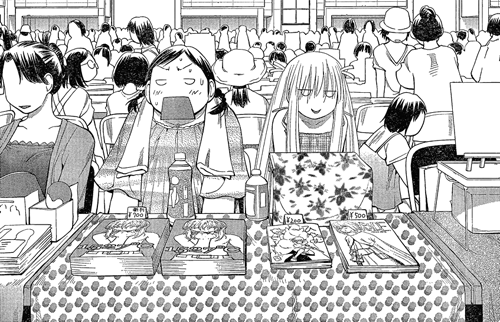
Chapter 63 of Genshiken II is day 1 of Comic Festival, and some of the very best Genshiken chapters have been in that venue. This time around is no exception, and in fact it’s one of the most densely packed chapters ever in the manga. There’s a lot to go through, so let’s do a quick run-down first.

After finishing the second half of her debut professional work, Ogiue pulls an all-nighter to crank out an additional cheaper-quality doujinshi to complement her collaborative effort with Yabusaki. Unable to make it to Comic Festival before the afternoon, she sends Sue in her place, who naturally torments Yabusaki and gets along well with Asada the cat-faced girl, whose first name we discover is “Naoko” (We also get verification on pronunciation of at least the first half of Ogiue’s pen name: Ogino). As Comic Festival begins, a line begins to form at their table due to the popularity of Ogiue’s published manga, which leaves Yabusaki flustered.

I’m not sure if this is Yabusaki’s ComiFest debut or not, but it is Hato’s first time attending. This being Day 1 (the girl-oriented day), he crossplays as Yamada from Kujibiki Unbalance in order to make it less awkward for him to purchase his desired yaoi doujinshi, and in doing so continues the club tradition of Kujian cosplay. Managing to fool men and women alike, Hato ends up facing a dilemma when he’s confronted with having to hold up a large sign for the men’s bathroom, a situation he tries to avoid but is naturally inevitable. While Sue attacks from a fortified position through her signature obscure references (Kyuukyoku Choujin R), Angela brings the gaijin assault head on; when she’s not teaming up for a startlingly apt Panty & Stocking cosplay with Ohno, she’s grabbing Hato’s chest to verify his gender.

Ogiue meanwhile finally leaves her apartment, but at the same time over at Tokyo Big Sight, Nakajima, Ogiue’s old “friend” from her traumatic junior high days, visits Yabusaki’s table expecting Ogiue to be there, wherein the chapter ends on this cliffhanger.

Phew! And again, there’s still two more days of ComiFest left.

The last time Nakajima visited, it conjured up bad memories for Ogiue, who was already dealing with the inner turmoil of shame over her attraction to Sasahara and her fear of hurting him as she did her old boyfriend Makita back in junior high. Since then, Ogiue has learned to accept herself, start dating again, and has even turned her passion for drawing into a career, but when you think about it, she has still never directly confronted Nakajima. Prior to Genshiken II, we could only speculate as to whether or not this would ever happen. Now, short of meeting Makita again, this might very well be the true bookend to Ogiue’s growth over the course of the series, a way to decide her destiny, if you will. All of this has me giddy with anticipation, because while Genshiken II has been delivering so far, all of the fun and games make it easy to forget that this series also handles the dramatic incredibly well.

That’s not to say that the comedy of Genshiken needs to take a hike, as the chapter was hilarious and informative all-around. Hato’s plight is not one I can say I’ve experienced, but I can really feel for the poor guy. It’s interesting to remember that Hato drew a distinction in his mind between cosplay and crossdressing, and also to kind of compare it with Ohno’s own views on cosplaying, particularly that it’s wholly different from dressing sexily. There’s quite a bit of commonality between the two in this respect. And speaking of cosplay, I can’t help but to compare Ohno’s taste in older men to Stocking’s overall poor taste in men, as some would argue that the former is a case of the latter. I’ve also always seen Angela as being more sexually active than the other characters in Genshiken, though obviously not to the extent that Panty does. And if that weren’t enough, Ohno once remarked that her chest is bigger than Angela’s, a situation mirrored somewhat with the Anarchy sisters they’re cosplaying.

The chapter also reveals quite a bit about Sue’s development, specifically in regards to her growing language skills. When Sue first appears, she speaks purely in anime and manga quotes. When she makes her second visit to Japan, she shows that her listening comprehension has grown dramatically. By the time she began studying abroad at Shiiou University, her vocabulary had expanded to the point that she could communicate without the use of otaku references. Now, Sue takes the next step.

It’s not evident in English versions of the Genshiken manga (or at all in any of the anime), but one of the features of Sue’s Japanese is that it’s written primarily in katakana to represent her foreign accent. In this chapter though, some of that katakana has begun turning into hiragana, the script used primarily for non-loan words, indicating that her Japanese is reaching an even greater point of fluency. Personally speaking, I made my greatest strides in my Japanese language skills while studying in Japan, and to see the same happening with Sue brings a smile to my face.

And you wouldn’t believe how glad I am that Kio’s finally told us how to pronounce at least some of Ogiue’s pen name. I’ve even made the appropriate correction to her Fujoshi File.

In any case, I’m probably more stoked for the next chapter of Genshiken II than I’ve ever been. Comic Festival, it always delivers.

Madoka Magica and…Sacrifice?

Puella Magi Madoka Magica has come and gone, and it’s going to be a subject of much discussion. Part of it may simply be that the delay caused by the earthquake in tsunami Japan magnified the anticipation for the finale even more than the already huge expectations for the show, but I think this anime is going to stick in people’s minds for at least the near future. Though the show has its flaws, overly expository dialogue and some contrived twists to name a couple, I found it to be an overall strong show and indeed an interesting twist on the magical girl genre that understands what magical girls are about.

I’m going to be discussing the show and its ending in depth, so take this as the Spoiler Warning.

Continue reading

A Tale of Two Harems: Kore Wa Zombie Desuka? vs. Infinite Stratos

WARNING: Spoilers.

When the Winter 2011 season of anime began I saw two harem anime on the schedule. One was Kore wa Zombie Desuka?, which apparently being zombie-themed I wrote off as something to skip. The other was Infinite Stratos, which, while likely not to set my world on fire, had mecha and SF elements that I wanted to check out.  But thanks to a tip from Sub, I decided to check out Zombie after all, and now that I’ve finished these dual harem series, I find that my relative opinion has flipped. Kore wa Zombie Desuka? is a pleasant surprise, while Infinite Stratos‘s faults far outweigh its strengths.

First, let’s actually list the highlights of Infinite Stratos.

  • Good character designs, better than Zombie
  • Charlotte Dunois
  • The fact that it did not turn into a tournament fighting series

In contrast, I feel that the strengths of Kore wa Zombie Desuka? are substantial enough that they shouldn’t be listed in bullet form, but to sum them up, Zombie does a good job of playing with the conventions of the harem genre and bolstering many of the areas where harem shows tend to be weak. The main character in a harem series tends to take a lot of physical damage, so the series incorporates that into the basics of the setup. The hero Aikawa Ayumu is made undead, so that he can take abuse far beyond what is normal and regenerate. Whereas most harem protagonists tend to waffle and lack motivation, we see that from the very start of the series he has an initial goal to spur him on: to find the person who killed him. He’s still your Average Japanese Guy with Extraordinary Circumstances, but just by having drive and personality, you can see why more than one girl might take an interest in him.

Harem anime are really all about the girls. It is something I gladly accept when watching harem shows, but I prefer to see that the girls have fallen in love with the main character for something resembling a good reason. It helps that Ayumu has something called a personality, as well as traits that are actually admirable instead of vague “nice guy” characteristics, but Kore wa Zombie Desuka? also shows the girls actually developing feelings for him. Seeing the female necromancer Eucliwood’s first meeting with Ayumu, we can see how he charms her with a goofy and well-meaning attitude. Haruna, a chainsaw-wielding magical girl, is witness to Ayumu’s continuous noble actions and sense of self-worth. We can even see where feelings don’t develop with Mael Strom, who does not have feelings for Ayumu but actually works to go from indifference to affection-after-the-fact in some kind of twisted parody of an arranged marriage.

The girls of Zombie are not particularly well-developed in terms of personality, but they have a manic edge to them where their simple traits are pushed to the extreme without having them become tiresomely one-dimensional. This is probably most evident with Seraphim, a deadly vampire ninja not unlike a couple of Axe Cop characters, whose hobby, talent, and favorite word are all the same thing: Tsubamegaeshi, a sword technique, and whose catch phrase, calling Ayumu a “piece of shit,” feels delivered with sincere malice instead of being there to compensate for any sort of weak, fragile interior.

Infinite Stratos fails to convince me that most of the girls have legitimate reasons to be interested in the main character, Orimura Ichika. Looking at four out of the five girls in IS, two of them are childhood friends and two of them fall in love with him after a single fight. With neither situation are these explanations given time to develop. They just are, as if their purpose is to get Ichika in the harem situation as quickly and efficiently as possible. Instead of further flattening the characters as Zombie did, IS sees fit to give them contrived flashbacks where a girl will literally narrate to the viewer as to why her life is tragic. Ichika does this as well, and it doesn’t happen until half-way through, so when we first see him, he’s just a bland fellow who draws all the ladies for Some Reason.

This is actually why I emphasized Charlotte Dunois as one of the highlights of Infinite Stratos, because she is the only girl among the five whose eventual attraction towards Ichika was given room to develop. Charlotte Dunois starts off disguised as a boy, and as the only other guy in the school, Ichika finds a comrade in “Charles.” Their friendship grows through this “male” bonding, and with Ichika talking to her closely and comfortably, it makes sense that she would develop intimate feelings. If more of the girls in Infinite Stratos had this sort of portrayal, instead of having their affections develop out of un-reasons, then my opinion might have very well been more even between the two shows.

The essential strength and flaw respectively of each show is that Kore wa Zombie Desuka? creatively manipulates the harem genre conventions while Infinite Stratos feels beholden to them. This is evident even in each show’s approach to the dramatic. While neither series excels in this regard, in Kore wa Zombie Desuka? the dramatic elements are continuously built upon and reach a fairly satisfying conclusion, while with Infinite Stratos, much like the flimsy bases for affection, the drama just seems to appear instantly and recede just as quickly.

Overall, while I would say that the girls in Infinite Stratos are more attractive, it does not feel as complete a product as Kore wa Zombie Desuka?, which is able to show that a lot can be done with the harem genre without completely subverting it School Days-style. In doing so, Zombie winds up being the better anime.

In Celebration of a Life, Short-lived: Sym-Bionic Titan

This past weekend was the final episode of Sym-Bionic Titan. I wish I didn’t have to say that.

When I first started watching anime, one of the most enticing aspects of it over many of the American cartoons I watched at the time was that, not only did they have on-going stories, but that those stories actually finished. They had conclusions. They weren’t always good conclusions (or good shows), and many times they were so open-ended you weren’t sure what exactly had happened, but you knew that if you started something, chances are you’d get something final out of it by the end.

American cartoons had managed to get some decisive finishes through, such as in Gargoyles or Conan the Adventurer, and I’ll even count the end of the Saturday morning version of Sonic the Hedgehog as a decisive finish despite it setting the stage for another season that never came to be. But for every one of those, you got a Pirates of Darkwater, where the show was set up from the start to reach a certain conclusion, but the show just stops in the middle and all you’re left with is your own imaginative speculation and/or fanfiction. I thought we were past this era, but I was wrong.

Sym-Bionic Titan was the brainchild of Genndy Tartakovsky, the man behind Dexter’s Laboratory and Samurai Jack, and it was his most ambitious and best-looking work to date. Following a trio of aliens (Lance the soldier, Ilana the Princess, Octus the robot) who escaped to Earth as the last hope to save their world of Galaluna from a traitorous general, the show took cues from Japanese super robot cartoons, American action cartoons, teen films, and various other areas and channeled them through some of the most deft usage of flash animation I’d ever seen. Much like Panty & Stocking with Garterbelt (and I have drawn comparisons between them before), it poked fun at genre conventions from multiple genres, and did so with style and grace-disguised-as-clumsiness.  It was a sign that Genndy had learned a lot since working on Samurai Jack, where the animation was often nice but felt very flat, and he married it with excellent characters and an intriguing plot. There were many mysteries in the show. What was Modula’s true motive? What really happened to Lance’s dad? Who was the mysterious person behind the Galactic Guardian Group? While the show could have easily gone on forever, it was not in its best interest to do so, as there was a real sense of urgency throughout the show, especially when you learned more and more about the characters and where they came from and why, on a personal level, they fight.

But Sym-Bionic Titan ran its initial 20 episodes, and was not renewed for more. Genndy Tartakovsky has moved on from Cartoon Network, possibly frustrated that they never let him finish his works. Samurai Jack never fought his decisive battle with Aku, and it’s unlikely that Lance, Ilana, and Octus will ever be able to return to Galaluna for a showdown with Modula. Was the show not doing well? Was it just not getting the money behind it to continue on?

It turns out that the reason given is that the show was actually doing quite well, but it did not have enough toys connected to it. I can see this being a problem, but I have to point out the fact that the show is ABOUT PEOPLE WHO TRANSFORM INTO ROBOT SUITS WHO COMBINE INTO A GIANT ROBOT THAT FIGHTS GIANT MONSTERS. That they couldn’t figure out how to convert this concept into toys is nothing short of ridiculous, and so the reasoning behind the show’s cancellation feels flimsy at best, an act of malice at worst.

Now there’s a possibility that Genndy pulled a Bill Watterson and specifically forbade merchandise from being made, but I highly doubt that. For one thing, he had hoped for a continuation of the series. This much is obvious based merely on the way the show is set up and how its final episode leaves room for so much more, let alone him actually saying as such. For another, the show’s explicit homage to Japanese giant robot cartoons makes it very likely that Genndy was not ignorant of the genre’s toy-centric origins or the fact that giant robot anime practically grew that merchandise industry in Japan to enormous proportions.

So even with the lack of an ending, is Sym-Bionic Titan worth watching? Yes, very much so. Do it.

Cross Fight, Cross Fight: Genshiken II, Chapter 62

What was once fated to shine brightly for a few moments in the grand scheme of the universe now has been given new life, as Genshiken II has shed its limited-time status and has revived itself as a fully serialized title. That’s right, Genshiken is back in full force and I can only be pleased by the news. Almost as if to symbolize this new beginning for Genshiken, Chapter 62 feels almost like another introduction to the series and the madness contained therein. Let’s take a look.

As Angela returns for her third trip to Japan and Yabusaki puts the finishing touches on her Fullmetal Alchemist doujinshi, Ogiue is working frantically to complete the second half of her debut as a legit manga artist. Luckily she has the help of the current Genshiken freshman as well as Sue, but the whole situation begins to derail when Hato becomes self-conscious of the fact that his facial hair is growing in. Yajima suggests that Hato wouldn’t have this problem if he dressed like a guy, given that guys aren’t embarrassed by facial hair, but Hato has no men’s clothing with him. Fortunately(?), Ohno left everyone some cosplay outfits, but things get quickly out of hand and everyone ends up working on Ogiue’s manga while cosplaying.  Even Ogiue decides to join the “party” in an effort to take responsibility. The chapter ends with Yabusaki coming in to help Ogiue, only to lecture them for goofing off. Naturally, Ohno deeply regrets not being around for this rare occasion of cosplay goodwill.

So, this heavy chapter obviously has a ton of references, and it’s not exactly big on character development, so I think it’s a good idea to find out just who they all are. Some of them I got, some of them I needed to do some internet detective work. Here’s a list of the costumes worn by each Genshiken member.

Yajima: Yagyuu Juubee Mitsuyoshi, the rather large and voluptuous heroine of Sekiganjuu Mitsuyoshi.

Hato: Ashikaga Yuuki, the cross-dressing main character of the School Days sequel, Cross Days.

Yoshitake: Kurashita Tsukimi, the Jellyfish-obsessed protagonist of Kuragehime.

Sue: The titular character of Comic Master J, a super manga assistant.

Ogiue: Nakano Azusa, underclassman guitarist from K-ON!

The entirety of Ohno’s selection for Hato consists of crossdressing characters. Though I can’t recognize all of them, at least one of them is Maria from Mariaholic. Yajima’s outfit is arguably the most embarrassing, coming from a manga series by the character designer of badonkadonk resource Real Drive, but given Yajima’s personality that must have been the most conservative outfit of the bunch. It’s interesting that Ohno would see “overweight girl” and interpret that as “cosplay as thick ladies,” though it makes sense in retrospect. Yajima’s outfit this chapter shows that she’s actually quite busty, and much like when Ogiue first cosplayed way back when though, it kind of makes you aware of the fact that Yajima’s baggy clothes are partially the result of shame. How appropriate it is then that Yoshitake is dressed as a character with a similar dilemma.

Ogiue as Azusa of course makes it own kind of sense, especially when you factor in the fact that the girls of the light music club pushed Azusa towards the Azunyan cat motif somewhat resembles Ohno’s own constant persuasion of Ogiue into cosplay. In fact, Ohno can draw a number of parallels to K-ON!‘s Yamanaka Sawako.

Interestingly, everyone except Ogiue is dressed as a main character, despite the fact that Ogiue was pretty much the central focus of the second half of the original Genshiken. If I were to be somewhat liberal with my interpretation, I’d say that this is symbolic of the direction of Genshiken II, where the new girls are starting to establish themselves as the main stars of the new series. As I’ve said before though, I’m quite okay with this, despite my fondness for Ogiue, as it feeds into one of the themes of Genshiken, that of the continuous renewal of the club.

Looking forward, with Angela around, the chances of a Sue-centric chapter rise greatly. And in the spirit of Sue, we’ll end with a fourth-wall-breaking image.

Distance to Travel: The Borrower Arrietty

Thanks to a twitter tip by the fine folks at Tsunacon, I found out that there was a showing last week of the latest Ghibli movie, The Borrower Arrietty, at the Melkweg theater in Amsterdam. Luck would also have it that I’d come down with a cold during the same period, but I managed to power through and experience my first theatrical anime in the Netherlands, and second time in a Dutch theater overall.

The first time, I had gone to see Harry Potter and the Deathly Hallows, Part 1, and it carried the unique challenge of having the audio in a language I understand (English) with subtitles in a language I don’t know but is fairly close (Dutch). Perhaps due to my experience as an anime fan, I found my eyes gravitating towards the Dutch subtitles, and because written Dutch is so closely related to English it would occasionally interfere with my ability to understand what characters were saying, almost as if the subtitles were in English but accidentally taken from the script of Harry Potter and the Half-Blood Prince. For The Borrower Arrietty, the movie was presented with Japanese audio and Dutch subtitles, and I found it a lot easier this time to ignore the Dutch. I think it had to do with both the fact that Japanese and Dutch are quite far apart as languages, and that I had gained the experience of Deathly Hallows. Which is to say, I was able to avoid one potential distraction, and even my cold seemed to play nice. Either that, or the movie drew me in enough that I could comfortably ignore it.

The Borrower Arrietty follows a small family of Borrowers, a race of small people no taller than a ballpoint pen. Living underneath a house inhabited by normal humans, they “borrow” the tiniest amount of materials from the human world in order to fulfill their own needs. The humans meanwhile are oblivious to their existence, and the Borrowers in turn avoid all contact with humans. Arrietty is the family’s only child, a 14-year-old girl who is set to go on her very first “borrowing” with her father, but who is already quite adventurous and often wanders outside to explore. Living above them is a new resident named Sho, a young boy with a heart condition.

The world of the Borrowers is a patch-work world of human products appropriated for use by tiny people, and it is in the portrayal of this world that the movie really shines. Whereas a lesser film would constantly make obvious references to scale, Arrietty does this through a mixture of subtle visual effects and through the characters’ natural interaction with their environment, and it is the first thing that really pulled me into the movie. A hand cloth becomes a blanket, a clothespin becomes a hair clip, staples become the rungs of a ladder. When the family of Borrowers is gathering at the dinner table, they have tea which they pour out of a tiny teapot, but while the teapot is scaled down for their usage, the tea comes out not as a steady flow but as droplets which swell at the tip of the spout due to the small opening and the natural cohesiveness of water. Backpacks are held together by velcro; when viewed from the perspective of a Borrower, the fastening and unfastening feels quite alien. The world is a whimsical and dangerous frontier.

Without giving away too much, The Borrower Arrietty is about physical, social, and conceptual divides. There is the sheer size difference between human and Borrower, the purposeful separation of the two species, and even the way a length of distance for a person can seem mercilessly long to a creature 1/20 our size, or for that matter, for a boy with a weak heart. The film is also about working to bridge those divides, and the degree to which it succeeds actually depends on your own outlook on life. Arietty is as optimistic as you make it out to be.

The Borrower Arrietty is not directed by Takahata or Miyazaki or even Miyazaki’s son Goro, but by Yonebayashi Hiromasa, who has worked on Ghibli films before but is in the director’s chair for the first time. When the movie began, I wondered as to what extent Miyazaki would influence future Ghibli films of which he is no longer apart. Granted, Miyazaki still has a big hand in Arrietty, being responsible for planning and screenplay, but I still had to ask myself how much “Miyazaki-style” and “Ghibli-style” would go hand in hand as time passes. Fortunately (or not), The Borrower Arrietty made me quickly forget my own inquiry with its engrossing visuals and storytelling, and by the time it was finished I felt myself not worrying about it so much.

Vistas: Final Fantasy Advent Children & Character Camera

I’ve written a post concerning Final Fantasy: Advent Children as part of our “multi-vistas” category at the Vistas blog, where everyone on the blog takes a look at the same work and writes a response. Mine is about the character-centric visuals of Advent Children as well as some personal elements, while my colleagues have written about Advent Children as Fantasy vs. Science Fiction and the lack of discrete visibility in its action scenes and its possibilities.

Creamy Mami, All Alone

I’m a little less than halfway through 80s magical girl anime Mahou no Tenshi Creamy Mami, and though it’s fairly entertaining I haven’t really been feeling it. I’ll watch a couple episodes and then have no motivation to keep watching, unlike when I watch, say, Ojamajo Doremi where I almost have to stop myself from watching more. It’s not particularly boring or offensive or anything like that, so for a while I just wasn’t sure why Creamy Mami wasn’t quite gelling for me, but I’ve finally figured it out.

Morisawa Yuu, the girl who transforms into Creamy Mami, has no female friends around her own age.

Instead, you mostly see her interact with adults (some of whom she primarily talks to as Creamy Mami), a couple of male friends, and only rarely do you get a one-off female character the same age as Yuu. This isn’t a problem in and of itself, especially given that it is very possible for a girl to be friends with guys her own age, but in the show Yuu likes one of them, the other one likes her, and that one is the comic-relief fat kid. We never get to see Yuu interact with someone who can truly be considered her peer and equal, and I think it can be a problem, even if the show was intentionally designed that way. (Cardcaptor) Sakura has Tomoyo, Nagisa (Cure Black) has Honoka (Cure White) and her lacrosse team, and even Mitsuki (Full Moon o Sagashite), who also transforms into an older girl, can be seen interacting with her female classmates. All of them are better characters for it.

Without a female friend of the same age, Yuu kind of feels that she’s only there to transform into Creamy Mami, which she very well might be, but I think that she would have been fleshed out much better in a way that doesn’t run contrary to the overall feel of the anime if she had such a friend. I could possibly say that the show works as a somewhat minimalist anime, where only the bare essentials are needed to drive it forward, but even that could have benefited from a female friend for Yuu.