The Haachama Experiment

The first Virtual YouTuber to really pull me into Hololive was none other than Akai Haato, aka Haachama. She’s currently on an indefinite break for health reasons, so I wanted to support her even when she’s not streaming by writing about why she’s still an all-time favorite of mine.

As Hololive continues to grow, it pulls in more and more ridiculously creative people. Whether it’s through singing and dancing, language skills, gaming ability, comedic chops, charisma, or more, they prove time and again to be a collection of extremely talented individuals. 

Haachama is not exceptionally strong in most categories—more a Jack of All Trades. However, there are a couple areas where she outshines just about everyone else: experimentation and adaptation.

To VTuber fans, the roller coaster that is the Haachama experience is well known at this point. Originally joining Hololive to play a tsundere high school girl, she began to take on an increasingly unhinged character personality as she spent four years abroad in Australia, including during the height of COVID. Her experimentation during this time with videos and editing was in part her making the best of a bad situation, i.e. notoriously terrible Australian internet, but it nevertheless laid the foundation for much of Haachama’s fame. The Haachama Cooking videos, where she would confidently and genuinely demonstrate some of the biggest culinary crimes, are just one example of the lengths she’s willing to go. 

Fans began to joke that Akai Haato the tsundere  and Haachama the unbridled horror were actually two different personalities, with the latter overpowering the former. They even created fanart about it. But then one day, Haachama began to stream as Haato again, using her old catchphrases that she had long since rejected. This culminated in what’s known as the #Coexist Arc, where Haachama seemed to imply that Haato and Haachama were actually sisters who went through some kind of unspeakable tragedy, and that both personalities now inhabit the same body while battling for supremacy. In practical terms, the result is that she now sometimes streams Haato-style (more mellow and relaxed) and sometimes Haachama-style (manic and intense).

In other words, Haachama took a joke from the fans, added her own spin on it to create a kind of semi-interactive lore, and then parlayed it into a way to expand her repertoire and not get boxed into one way of being. Very few Hololive members or even VTubers in general are willing to take such risks with their branding and image, yet Haachama seems to experiment endlessly with what she can be. 

It’s important to note, though, that Haachama is also fairly shrewd. She has mentioned that the reason she started changing her character was in  order to fill a hole in what Hololive lacked at the time, and her decision was to be a little more “Nijisanji.” The two companies are somewhat defined by their inaugural VTubers—Hololive with Tokino Sora as ideal idol and Nijisanji with the elegantly crass Tsukino Mito—and Haachama as unpredictable idol carries shades of both. This is her adaptability in action.

I previously compared Haachama to the late pro wrestler Brian Pillman because of how his drastic change from white-meat babyface to loose cannon was similar to hers. Since then, it’s clear to me that she’s more of a Matt Hardy—being performers who repeatedly reinvent themselves to either keep up or defy the times. “Haachama the Eldritch entity” is not that far off from the bizarre and imaginative transformation of “Broken” Matt Hardy and the way Matt would play with history and expectations. Neither seem to be satisfied settling into one mode of performance.

I don’t necessarily love everything Haachama does. There are times when she swings big and misses. But even when one stream or project flops, I enjoy seeing Haachama continue to try new things. One prominent example is how she no longer releases Haachama Cooking videos where she eats weird ingredients (like tarantulas) and approaches food with zero practical kitchen skills. Instead, she has moved towards making real progress in actual meal preparation. I miss the absurdity but love her adventurousness.

Haachama pushes boundaries, always seemingly looking for avenues of change. It can be rough for her when things don’t turn out as she intended, but her ability to entertain and renew herself is hard to match. It might make her branding a bit inconsistent, but that plays into her presence all the more. Sometimes, she’s so unpredictable that she does the most predictable thing. I hope that whenever she makes a full recovery, she can come back and still be proud of what she’s accomplished.

Happy birthday, Haachama.

The Advent of Pitch Accent: Pronouncing FuwaMoco’s Names Correctly

The new Hololive English generation, HoloAdvent, has made their debut after more than two years of waiting. Among the five Virtual Youtubers are actually a pair of twins—the Abyssgard sisters Fuwawa and Mococo, collectively known as FuwaMoco. And while there is a lot to potentially talk about (including the fact that Fuwawa is a Genshiken fan!!!), I want to focus on one thing: The pronunciation of their names.

During their inaugural stream, Fuwawa and Mococo made some requests to viewers about their names. First, their last name isn’t pronounced “a-BYSS-gard” but rather A-byss-gard.” Second, their first names are “FU-wa-wa” and “MO-co-co,” and not fu-WA-wa” and “mo-CO-co.” With those specifics, FuwaMoco has brought overseas Hololive fans back into the realm of “pitch accent,” a prevalent element of the Japanese language.

The Pitch Accent Rabbit Hole

Much has been said about Japanese and pitch accent already. Multiple language-learning Youtubers, such Dougen and Yuta, have dedicated videos to the topic. Use of pitch accent can differentiate meanings of words, but more often, hitting the correct pitches can make your Japanese sound more natural and easier to understand for native speakers. 

In the realm of Hololive, it’s one of the things that makes Inugami Korone’s regional accent so distinct. As heard in the above video, her pitch accents are very different from those of the more standard Japanese spoken by Murasaki Shion.

It’s even to the point that native Japanese speakers can have trouble with Korone. However, because pitch accent is hard to teach from a textbook and not as prominent in English, it can be a challenge for those going from English to Japanese to even pick up on the differences. Even in those Korone videos, there are comments from people saying that they can’t really hear the difference.

Nailing FuwaMoco’s Names

Incorrect pitch accent isn’t necessarily a deal breaker when it comes to learning Japanese, and how much you want to devote to it is a matter of personal priority. Is sounding closer to native speech more important than learning a wider vocabulary or memorizing kanji, for example? But if your goal is to pronounce FuwaMoco’s names correctly, then you can start from there.

Let’s first look at their family name, Abyssgard. While technically it’d be “Abisugaado” in Japanese, for our purposes, we can ignore those particulars (and in fact, FuwaMoco do the same.)

When focusing on the “Abyss” part of it, the incorrect pronunciation is “a-BYSS” and the correct one is A-byss.” When wrong, it sounds more like the English word “amiss,” while the right one is closer to how you’d say “pumice.” 

“Pumice Guard.”

“Abyssgard.”

You can then carry that distinction to their given names, Fuwawa and Mococo, because those follow a similar pattern: FU-wa-wa and MO-co-co.

Going Forward

Keep in mind that the above guide is not a universal rule or anything. If you continue to study Japanese pronunciation, you’ll definitely find plenty of words that don’t follow those specific pitch accents. Also, regardless of whether you can say their names perfectly without effort or you find it to be a struggle, it doesn’t make you less of a fan.

And in the meantime, let’s enjoy their singing.

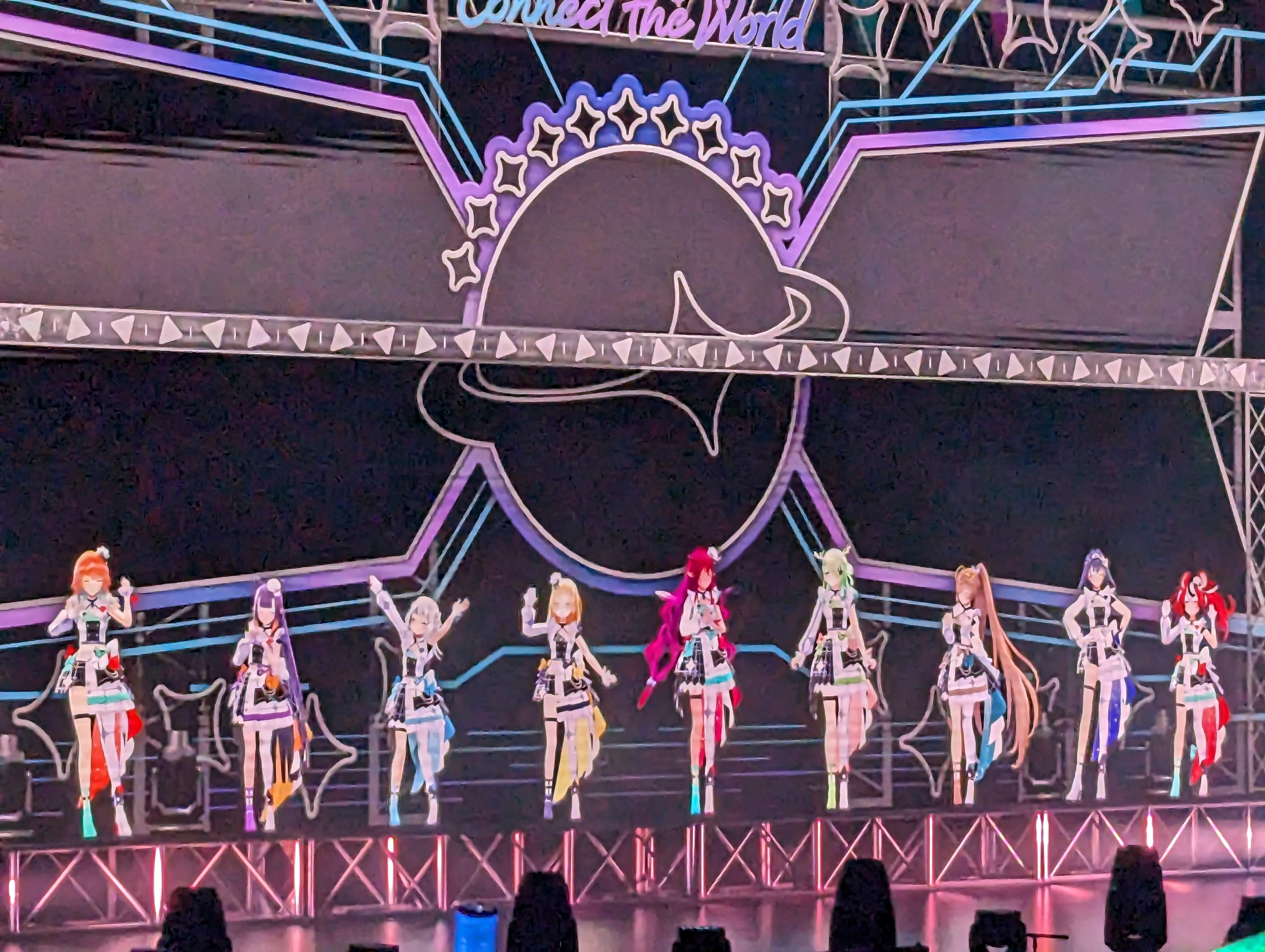
I Was There: Hololive EN Connect the World

Concerts are normally not my thing. I’ll attend them at anime cons as an extension of my greater fandom, but I typically don’t travel specifically for music events.

That all changed with Hololive English’s inaugural live concert, Connect the World. Well, sort of. Attending a Virtual Youtuber concert can be viewed as a natural consequence of being an otaku, but it’s also akin to seeing a KPop and J-Idol group. Either way, my fondness for the stars’ antics outside of musical performance was just as much a motivation to see them as the concert stuff. And as the very first Hololive concert to be held in the US, I felt that I had to at least try to go. I might never have such an opportunity again, because as much as I’d love to attend the Holo Fes events in Japan, it’s just not realistic for me. 

So with a bit of luck and perseverance (and lots of angry cursing at Ticketmaster), I managed to secure myself a ticket and a pretty decent seat. Fast forward a few months later, and there I was with penlight in hand, cheering alongside 5,999 other Holo fans. It was a fantastic overall experience, and I’m grateful to have been a part of this moment in VTuber history.

Summary

Connect the World began with a message in English from A-chan, whose role in Hololive can be described as the ultimate behind-the-scenes pillar. A central figure in the development of Hololive from its humble beginnings, she has garnered a fandom of her own that made itself known through enthusiastic cheers. The concert then went into full swing with a full-roster performance of the Hololive signature theme “Shiny Smily Story,” followed by ten individual performances from the EN girls, two guest numbers by reps from Hololive Japan and Hololive Indonesia, three generational songs, the titular  “Connect the World,” and then an encore with “Kirameki Rider.”

Unlike later Hatsune Miku concerts with full-on 3D holograms, this was done with a flat projection screen and additional monitors on the side—similar to what is done even in the Japan events. So it wasn’t the fully immersive experience one might expect, but I think part of the “live” feel actually comes from being shoulder to shoulder with one’s fellow fans. In other words, we help make it “real” just as much as the VTubers.

The Opening Acts Were Made for Me

I feel incredibly blessed that the first couple of solos were by two of my favorites in EN. The first, Hakos Baelz, is nearly undisputed as the best dancer in Hololive EN (as well as being one of the strongest in Hololive as a whole), and I couldn’t help but be drawn to her as she killed the dance floor. Even basic movements, like swaying left and right during “Shiny Smily Story,” carried a sense of poise and confidence when executed by Bae, and she continued that same spirit into her original song “Psycho.” Almost as impressive was her singing, which possessed a powerful throatiness that I enjoyed a lot and fit the song well. Someday, I’d love to see her more energetic movements alongside the amazing rhythm and fluidity of fellow dancer extraordinaire La+ Darknesss

I’ve read people’s complaints about how the camera work didn’t do Bae’s self-designed choreography justice, and I can sympathize. Seeing it live really drove home how beautifully she moves, and I feel fortunate to be among those who could witness it straight on and uninterrupted. That being said, I feel like the criticism of the camera can be overly harsh, not only because I think it has its moments but also because the approach taken is meant to play it safe. In other words, it’s better at hiding flaws than accentuating strengths—sometimes it works, and sometimes it doesn’t.

The second star on stage, Amelia Watson, went with her first and only original song, “Chiku Taku.” For Amelia, neither singing nor dancing have ever been her strong suits, but part of the joy of witnessing Amelia on stage is in experiencing her energy and seeing the strides she has made with respect to the “idol” aspects of being a Hololive VTuber. The highlight for me was the kicking motions in her dance—what I’ve since learned is ska dancing, or “skanking.” 

Having both of the above performances be in the free YouTube preview works out in my favor, as it means I get to revisit them as much as I want. The fact that Bae was also part of the free preview at the Holo 4th Fes Deco*27 stage makes me think that they know full well what a draw she is.

Other Favorites

One stand-out moment was IRyS’s “Gravity,” which is my favorite of her originals, as well as one of the Hololive songs I love most. I was happy to hear IRyS herself say that she’s partial to “Gravity” as well. The song just accentuates her talents as a vocalist, especially because it has that illusion of effortlessness that only comes when someone is immensely skilled at something. I feel like I achieved something just by hearing it live. 

Later when the EN girls did their group songs, IRyS actually ended up with another solo performance just because she’s technically a generation unto herself. This has led to multiple jokes from fans and from IRyS alike—“Who do you like more, IRyS or IRyS?” Incidentally, prior to the start of the concert, I was chatting with a friend about her, where I mentioned wanting to hear “Gravity,” and in response, he said that he really wanted her to sing “Caesura of Despair.” That just so happened to be her second song, and while we had no actual say in the song list, it’s fun to pretend that we willed it into existence. Between both tunes, they really show off the crystal clarity of IRyS’s voice.

I expected that we’d get some surprises at Connect the World, but I didn’t expect the debut of two new original songs, one by Gawr Gura and the other by Ouro Kronii. Truth be told, I don’t listen to enough Hololive songs to always know what is a cover, what is an original, and what is brand new, but they both sounded unfamiliar to me at the time. Gura’s “Full Color” and Kronii’s “Souten ni Moyu” both fit their respective characters, personalities, and voices very well, and I think they’re each VTuber’s best songs to date. Neither has an official release yet, but I’m definitely looking forward to them.

The Teaser

After the encore was a mysterious teaser that had the audience clamoring. Featuring stills of fiery imagery and ending with a symbol that somewhat resembles a toothy grin, the natural assumption is that this is the long-awaited next generation of Hololive—the first since 2021. With no other info at this point, it’s anyone’s guess as to what it all means.

Given the dark tones of the teaser, my hope is that it’s some kind of heel faction. Obviously it wouldn’t work quite like pro wrestling—you don’t actually want the viewers to despise them—but I imagine them dropping in to interrupt songs as they begin and talking smack as they belt out some tunes. Hololive EN also has a tendency to start with elaborate lore that then falls by the wayside, so I don’t know if they could maintain that sort of gimmick for long.

Issues

There were a few hiccups at the event, and I don’t just mean Amelia’s at the end of “Chiku Taku.” 

The first was that the monitors on each side were off-sync from the main screen, which made looking back and forth between them kind of awkward. The second was that the singing could sound a bit chimpunky at times. Was it the audio equipment at the venue or maybe something else, like use of pitch correction? I don’t have the knowledge to diagnose that sort of thing, so I’ll leave it to the experts.

Technical problems aside, I had also hoped to see more interactions between the different branches English, Indonesia, and Japan, but there wasn’t any mingling. I suspect that they wanted to just do the basics and save stuff for future concerts. I recall a similar situation with JAM Project’s first US appearance at Otakon 2008, where it was almost like an introduction to the American audience.

None of these things are deal breakers, particularly because I understand that the sheer complexity of trying to pull off a huge concert with 3D models means something might not work as intended. Take these as minor quibbles among an overall great experience.

Final Thoughts

I’m proud to have been part of this first Hololive concert in the US. I feel content knowing that I got to see some of my favorite entertainers shine on stage. I do hope we get a blu-ray soon, though, as I would like to have a permanent physical way to re-watch it. Then again, the 4th Fes blu-ray isn’t even out yet, so we might be waiting a good while longer. 

I hope we get to see more international concerts in the future so that others have the opportunity to go in person, even if I end up being personally unable to attend them. Of course, depending on location and lineup (Haachama and La+ in particular), I might just have to find a way again.

And now that I’ve gone to a concert for virtual idols, who knows what’s next? Maybe I’ll attend some concerts by 100% flesh-and-blood musicians as well. Ironically, the VTuber rabbit hole might just lead me back to the real world.

Hololive 3D Concerts and Bringing Different Fans Together

Laplus Darknesss and Amane Kanata from Hololive singing and dancing on stage

I’ve watched the recent anniversary streams of holoX, and in light of the announcement of the Hololive 4th Fes, I’ve been thinking about how holding 3D concerts can carry different types of significance depending on the individual member and what their fans are looking for. Hololive seems to celebrate their stars in a manner inclusive to every Hololive member’s diverse fanbase, and I’m all for it.

It’s no secret that Hololive members can vary tremendously in terms of where their talents lie. Some clearly establish themselves as great performers as soon as they have the chance, like Hoshimachi Suisei. Others don’t necessarily have the background but have worked hard and come into their own, such as Oozora Subaru. And then there are those who don’t reach the level of their fellow VTubers in terms of singing and dancing, but they might have engaging personalities that just make for a special experience.

However, when there are 3D concerts or other major events that bring Hololive members together, they potentially become places where all respective fans can come together and appreciate their favorites for their own particular reasons. Take the Hololive 3rd Fes concert, which was the 3D debut of Hololive English’s first generation. Gawr Gura showcased the singing talent that brought so many fans to her, along with a cute dance. Takanashi Kiara brought a more polished idol flair. Ina came with a soothing voice in a subdued performance. Amelia Watson is definitely not a strong singer, but her choice of music (a weird fictitious anime opening from the show Welcome to the NHK!) put her personality on full display. And Calliope Mori put her well-established rap skills (that have since led to a contract with Universal Music Group) to good use. Hololive Indonesia’s first generation also made their 3D concert appearances, with Moona’s diva-like poise, Iofi’s adorableness, and Risu’s ridiculous vocal range all on full display.

With holoX, there is a similar range of strengths and quirks on display in their anniversary concerts. La+ Darknesss (see above) is a ridiculous total package whose impressive vocals and unmatched dance skills both support and defy her “bratty alien demon lord” concept. Takane Lui doesn’t fit the typical image of an idol, but she’s very good at singing while also staying “in-character,” and her choice of songs conveys a sense of maturity. Hakui Koyori is a jack of all trades who also leans into her character the most by adding in puzzles and brain teasers to her concert. Sakamata Chloe is arguably the best singer in the group, with a voice that can seem unreal; she was also the only one to do exclusively solo performances, as if to prove a point. Kazama Iroha’s cuteness shines through in her energetic performances, and it’s clear that she put in a lot of effort to improve her dancing.

It all reminds me of an essay I once read about the differences in presentation between Japanese idols and Korean pop stars: part of the appeal of J-idols is seeing them grow into the role, whereas K-pop stars appear before fans already fully formed. In the context of Hololive, it’s like there’s a purposeful and perhaps even inevitable contrast. While you might have your “J-idol fan” types who want to see their favorites grow and your “K-pop fan” types who love to see perfection in action, a single banner like Hololive allows these groups (and many more) to all thrive in the same general space. 

The power that comes from the variety Hololive has to offer is the way it encourages respect for diversity of talent. People can be fans of different members for different reasons. There are certainly talents whose appeal lies in their sheer skill, and the fans want to see their favorites put their abilities and/or progress on full display. However, there are also Hololive members who aren’t necessarily the greatest performers in one way or another, but their presence on stage makes for a kind of “we made it” moment for their fans. No matter the reason, it emphasizes the idea that there’s no one “right” way for a performance to be, and it encourages the different fanbases to coexist.

La+ Darknesss, Dance, and True Power Levels

Since her debut, Hololive’s La+ (pronounced Laplus) Darknesss has become one of my favorite Virtual Youtubers. Her premise states that she’s both a mighty alien (?) demon (?) whose power has been sealed off—as well as the founder of Secret Society HoloX, an organization with designs for world domination. In practice, however, La+ comes across as a cheeky and overconfident brat. It’s within this context that the biggest surprise about her characters was revealed: the fact that she’s actually a fantastic dancer. I find myself re-watching her dancing clips, even though I normally don’t do that—not with VTubers, not with flesh-and-blood performers, and not even with the many anime dances over the years.

To those who are unfamiliar with Hololive and specifically the process by which its Vtubers go from “2D” to “3D,” most start off as flatly animated characters. In this “2DLive” format (named after the program used to rig their animations), La+ and others like her are able to move and tilt their bodies and heads to some degree, but it’s generally not meant to track the entirety of the performer’s physical movements. Over time, a Hololive member receives a 3D polygonal model, and can use more robust motion capturing to match the movement of their entire bodies. In other words, you generally can’t tell how comfortable a VTuber is with physical activity like dancing before they make their so-called 3D debut.

La+ was the last of HoloX to become 3D. Prior to that, she was primarily defined by two things. First, despite being the leader of her clandestine group, she’s actually the smallest; her oversized horns further emphasizing La+ as a relative pipsqueak. Second, she has an extreme amount of ego that swings wildly between being justified and unjustified. So when she started busting a move, I felt a degree of cognitive dissonance. “Wasn’t she supposed to be bad at this sort of thing?” In a later collaborative stream with the rest of HoloX, the sheer contrast in dancing ability between La+ and her subordinates (who are usually her betters in a variety of ways) hammered home that she’s a cut above the rest.

I think the reason this aspect of La+ works so well is that it ends up making her feel even more like a being of contrasts. She has that aforementioned “shortest but most important” quality, but in terms of competence, it’s like you never know if she’ll be a Hellmaster Fibrizo (Slayers) or a Katyusha (Girls und Panzer). If this really were an anime or something, La+’s dance reveal would be that moment where Yoda or Shifu from Kung Fu Panda gets serious. It’s a winning trope, generally speaking.

La+ Darknesss is neither fully an anime character or a fully flesh-and-blood performer, which is why the combination of her character background plus her strength as a dancer shine through. Like other VTubers, she lives in that transitional space between the real and fictional worlds. The fact that she’s so physically talented is inevitably to the credit of the performer, but it’s the surrounding setting that gives La+ the stark contrast to render her moves to be even more unforgettable.

Hololive Alternative, TakaMori, and the Speed of Memes

Hololive Alternative is a 2d animation project depicting the Virtual Youtubers of Hololive as active characters within a world. Two “teasers” are out currently, and they’re a treat for fans and newcomers alike. But while watching the second, the depicted interaction between Takanashi Kiara and Mori Calliope made me hyper-aware of how internet culture and its memes evolve at lightning speeds.

Kiara the Phoenix and Calliope the grim reaper are both part of HoloMyth, the Hololive brand’s first foray into the English-speaking market. Early on in their careers, they were known for having a rather flirtatious and tsundere-esque relationship, which in turn spawned the ship known as TakaMori. It was a prominent part of both character identities—even making it into Can You Do the Hololive?, a song based on all the members’ signature greetings. In it, Kiara states, “Of course the two of us come together,” and Calli responds, “Shut your mouth, Kusotori [Stupid Chicken].” 

Similarly, the second Hololive Alternative teaser shows the two eating together. Kiara eagerly takes photos of everything (Calli included), and the reaper responds by grabbing her scythe and taking swipes at Kiara. The whole interaction describes the original basis for TakaMori to a tee. 

The only problem: the nature of the pairing has changed over time. It still has fans, of course, and the two even recently had an in-person stream together that was made all the more impressive by the fact that one had to travel from Japan to Austria. However, both Kiara and Calli have talked about the fact that they decided to emphasize their solo identities more. The fans in the Youtube comments for that collaboration have remarked even on how the duo’s dynamic has changed (and arguably for the better).

Granted, this isn’t quite the same as a meme naturally morphing into something unrecognizable. The fact is, one can point to a conscious decision as the reason TakaMori isn’t quite the same as it used to be: a purposeful shift in direction. Nevertheless, it feel indicative of the rapid pace at which VTuber in-jokes are formed feels indicative of the general speed of the current internet. In contrast, elaborate animations—even short ones like the teasers for Hololive Alternative—take time to be made. In that gap, the ground shifted underneath TakaMori, and its depiction in animated form can feel like a relic of the past. In reality, it’s only been a little over a year, but the fact that a year sounds like forever in VTuber time makes that difference all the more stark. Online empires rise and fall in less time, and I have to wonder what else might end up coming across as a “yesteryear meme” by the time the next teaser is done.

Cut, Cut, Cut: Pompo the Cinephile (Anime NYC 2021)

THIS IS A REVIEW FOR A SCREENING AT ANIME NYC 2021, WHICH HAS A REPORTED CASE OF OMICRON-VARIANT COVID-19. IF YOU ATTENDED THIS CON, GO GET TESTED.

When it comes to making movies, editing is often seen as one of the least glamorous elements. The image of filmmaking pop culture conveys to us often eschews that process. The anime film Pompo the Cinephile chooses instead to celebrate the nitty gritty of film editing and the painful decision of what to leave on the proverbial cutting room floor, all while being a vibrant and creative work itself.

Pompo is the nickname of Joelle D. Pomponette, a prodigy film producer in “Nyallywood” who has been responsible for one box office hit after the next. Her assistant, the perpetually haggard Gene Fini, is a lover of movies who can’t understand why Pompo seems to work only on schlocky blockbusters—or why she hired an untalented wreck of a human being like him. But Pompo sees that Gene has what it takes to work behind the camera, and when she picks him to be the newbie director and editor of her new project, Gene falls deeper into the world of filmmaking than he thought was possible.

A movie about making movies can feel like an exercise in pretentious navel-gazing, but Pompo the Cinephile manages to strike a tricky balance between “the artist and their oeuvre” and “films are for the enjoyment of others” that gives merit to the indie arthouse piece, the Academy—excuse me, Nyacademy Award winner—and the popcorn flick. Much of Pompo the Cinephile is about exploring the emotions one experiences when involved in different parts of a production, and while there is a good amount of anime-style melodrama and bombast, those feelings read as genuine. The characters feel like both people unto themselves and the conduits to deliver a simultaneous celebration and criticism of filmmaking, but without seeming overly preachy. For example, Pompo is very insistent that films should never exceed 90 minutes, but her argument is shown to come from a very personal place while also being quite reasonable. The viewers are left to decide whether to disagree, but the movie itself doesn’t shy away from making assertive statements.

Pompo the Cinephile doesn’t try to flip filmmaking inside out or challenge it to be more experimental. Rather than challenge the status quo of what works and doesn’t, from tropes like the manic pixie dream girl to the notion of killing your darlings as a tenet of artistic creation, the film doesn’t seek a revolution. It shows but doesn’t discuss the difficulties of overwork. Rather, it portrays characters finding imaginative ways to work within the system, even including a strangely engaging side story about investment banking (another conceptual quaalude) and the film industry. 

Even if the kind of filmmaking Pompo the Cinephile showcases isn’t one’s cup of tea, I find it encourages active discussion of how we as people see and regard the act of creating movies. At times, it can feel both insightful and shallow—which is exactly the kind of film Pompo herself excels in. Perhaps most importantly, it’s exactly 90 minutes.

Haachama vs. Brian Pillman: VTubers and Evolving Gimmicks

“What do the virtual youtuber Akai Haato and the late pro wrestler Brian Pillman have in common?”

As I’ve continued to fall down the VTuber rabbit hole, I constantly find similarities to pro wrestling. When VTubers stream, they get immediate feedback from their live chats. They’re not static performers, having to respond to and reciprocate with a chat that’s eager to make their opinions known. “That applies to all livestreamers!” you might be thinking, but the added virtual layer changes the streamer’s relationship with their audience. 

While stream viewers might seek authenticity, the VTubers themselves are not expected to be “real,” and there are no illusions about it. In my eyes, there’s a real resemblance to the concept of wrestler gimmicks—especially in how varied they can be, and how they can be embraced to such different degrees. Some VTubers are like the Undertaker, leaning fully into their outlandish characters. Others are like Kobashi Kenta, a more down-to-Earth approach meant to convey a more personal connection to the audience.

And over time, these gimmicks can undergo changes both great and small as the performers, both VTuber and wrestler, adjust to the audience reactions and refine their craft. One common theme in stories about wrestlers, especially in the old territory days, is the need to figure out what keeps the audience coming back to pay good money while avoiding overstaying your welcome. Similarly, it is fascinating to look back at how VTubers behaved in their introductory videos compared to how they present themselves in more recent material. Rarely is there a VTuber who manages to stay perfectly within the original boundaries set for themselves. 

That brings me back to the question I asked at the beginning, and the answer is this: Both Akai Haato and Brian Pillman began as more conventional performers who found themselves in difficult times, and ended up reinventing their personas into larger-than-life yet authentic-feeling identities that pushed the envelope of what is possible and accepted in their respective fields.

Brian Pillman was once most famously known as Flyin’ Brian Pillman—an astoundingly athletic wrestler who could dazzle audiences with his acrobatic moves. However, after a car crash, Pillman had to drastically alter his style. Instead of emphasizing his now-compromised high-flying moves, he decided to blur the boundaries between the real and the fictional as a “Loose Cannon,”  culminating in an infamous moment where he seemingly tries to shoot “Stone Cold” Steven Austin.

Hololive’s Akai Haato, in turn, first introduced herself to the world as a traditional tsundere character, and was even used as a model of how a conventional idol-esque virtual youtuber should behave. But then the COVID-19 pandemic hit, and the person behind Haato was stuck in Australia for months. Unable to stream the way she normally would have, her conventional tsundere self gave way to the more chaotic and creative “Haachama” persona. From talking about smelling her own feet to cooking a tarantula to split personalities and time-distortion, Haachama has developed an even wider fanbase. She’s currently on hiatus, but fans await her return. 

Given the commonalities between pro wrestling and virtual youtubers, an important question comes to mind: what if there was a virtual youtuber tournament of some kind? Plenty of them will compete with each other in video games, but what if there were promos and smacktalk and the like? What if the PekoMiko War was more than a song and a Minecraft video, and lines were drawn in the sand, with tickets sold for the event?

In conclusion, VTuber pay-per-views are the future.

The Perfect Storm of Virtual Youtubers

As the days go by, I increasingly find myself looking into the world of Virtual Youtubers. I watch the clips and highlights that go around, and I sometimes tune into the live streams of my favorites. I wouldn’t consider myself a devotee of the whole concept, but I’m entertained. I know I’m not alone, as the increasing success of VTubers is a sight to behold—Gawr Gura, one of the first members of the Hololive agency’s push into English-language streaming, hit one million subscribers in just a little over a month and has since surpassed two million.

The more I think about it, however, the more I realize that the success of Virtual Youtubers shouldn’t come as a surprise. They’re in many ways a perfect storm of things that appeal to people on the internet, bringing together different groups who tend towards obsession and converging them onto this amalgam of elements.

The first group is weebs. I generally avoid the term, preferring things like “anime and manga fans,” but I feel that its usage is accurate here—it’s not just about being into the media but being into that strain of Japanese pop culture. With few exceptions, Virtual Youtubers go for that anime aesthetic, recruiting famous artists and character designers to create these avatars. In a sense, they’re anime characters come to life, and that gives them a certain charm and universality that comes with being less realistic in terms of appearance. And while VTubers now exist across the world, they’re firmly rooted in that anime/manga/light novel realm, and expectations derive from the tropes found there. 

The second group is gamers. While streaming has had some presence on the internet for decades now, gaming has become one of its absolute pillars. Between the transformation of Justin.tv into Twitch, the prevalence of esports, the enduring popularity of Youtube channels like Game Grumps, and the rise of speedrunning as a spectator activity, there’s no denying the draw. Live streaming your play session is just an easy and reliable way to connect with potential fans, and while streamers usually need some kind of physical or personal charisma to get things going, the sleek designs of VTubers help bridge that gap.

The third group is idol fans. While it’s like every one of them eventually gets their own original songs, what attracts people to idols is that they feel somehow distant yet accessible, and Virtual Youtubers greatly exaggerate both sides of the fantasy by their very nature. The use of character avatars means there’s no mistaking their visual appearances for being the “real” individuals, but that also means being able to project onto them an idealized version. At the same time, unlike Hatsune Miku, they’re real people interacting from behind the curtain. Depending on what level of performativity vs. seeming authenticity a viewer wants, or popularity vs. obscurity (what’s more exciting than seeing your favorite personality grow from small-time to wild success?) there’s probably a VTuber for them. What’s more, the concept of superchats on YouTube allows fans to get instant gratification by giving money to have their messages read and acknowledged.

The fourth group, and there’s plenty of overlap with the other three, is those who are into celebrities. This is a more vague and generalized group, but it’s the same energy that fuels people to follow the goings-on of their favorite movie stars and singers.

A weeb might love all things anime-adjacent but dismiss Western-style game aesthetics. A fan of first-person shooters might love watching anything and everything related to their favorite games but think anime stuff looks weird as hell. But then a Virtual Youtuber who looks like an anime character come-to-life might play Apex Legends, and so now the weebs get their real-life anime girl and the Western-focused gamers get to connect to her through their favorite game. At the same time, even if she isn’t particularly good at what she’s playing, that gives her a kind of element of relatability that an idol fan might be drawn to. And even if someone isn’t an idol fan, seeing someone suffer through a game has an established history of bringing in eyeballs. The crossover appeal is hard to deny.

Thus, when the VTubers branch into areas other than gaming, they can bring all those different groups together. It’s why they can karaoke Japanese, English, and even German songs, all to praise and fanfare. When they do something completely out of the realm of entertainment, like cook, it doesn’t seem out of the ordinary even if the results can range from bizarre to horrifying. The fact that their fans don’t just come from one place also gives the VTubers the flexibility to try new things and see what sticks. Non-virtual streamers who get popular because of one game can sometimes have a hard time playing others because they might not get the viewer counts they normally would, but what makes people want to see Virtual Youtubers goes beyond specific games or titles. 

I think the concept of the VTuber allows it a certain degree of freedom that flesh-and-blood streamers do not. By virtue of their virtual natures (pun intended), they invite viewers into a kind of alternate reality. From there, the ability to take that anime character identity and apply it to various domains or interests means that even activities that normally might not appeal to a person can suddenly seem interesting. It’s a lot like how manga can make certain topics more appealing to those who are unfamiliar, but with Virtual Youtubers you get both the slice-of-life hobbyism and the gutsy competition at the same time. And unlike in manga, the wins and losses are real—even if everything is ultimately made up and the points don’t matter.

Thoughts on HoloModels

Augmented reality is a funny thing to me because its appeal feels somehow both obvious and yet elusive. Whether it was participating in Pokémon Go at the height of the craze or seeing people on Twitter post videos of their iDOLM@STER characters occupying “real” spaces, I end up thinking “that’s really cool” and “but do I really want to blur that line?” simultaneously. 

I was asked this month, by Patreon request, to discuss HoloModels, which is an AR figures app by the company Gugenka. Essentially, rather than having physical PVC or resin kit models, you collect virtual ones that you can pose and “place” wherever you want. I had actually seen images of it without realizing what exactly I was looking at, thanks to retweets of the Lina Inverse HoloModel that have been filling my Twitter timeline. “Was it some video game? Maybe a fan project?” I thought.

Before trying out the app itself, my understanding of HoloModels led me to think that the advantage was basically like that of ebooks: the ability to keep a bunch of models without any of them taking up physical space. They can be placed and posed any way you want, so there’s also a certain degree of freedom for creativity. However, when I saw that HoloModels can be resized to pretty much any scale, I realized that the potential I had pictured was too limited.

The versatility of HoloModels means you can have life-size models, as if they’re less figures and more characters who have entered our world. Perhaps you can even pretend that they’re a friend or a lover. And even if you’re not into that sort of thing, you can still use them in a variety of different ways. You can use them in virtual dioramas or even as action figures after a fashion. What’s more, you can’t really “damage” them by accident. And of course, even this view is still probably a drop in the ocean of possibilities.

Because of the proximity of HoloModels to Virtual Youtubers—they’re essentially two ways of blurring fiction and reality together through anime aesthetics—I also had to see if there was any stronger connection between the two. It turns out that the default model you get when you first install HoloModels, Shinonome Megu, has since become a Virtual Youtuber with 40,000+ subscribers as of December 2020. I believe the HoloModels figure came first, based on comparing news articles announcing HoloModels with the oldest video on her channel, but if anyone has more information, feel free to share.

Am I interested in sticking with them? Not really. HoloModel figures are awfully pricey in my view, as less expensive characters run around 3,500 yen, and the Lina Inverse mentioned above is 5,000 yen. I might just be the wrong person to understand the true value of these AR characters—I’d still rather have a physical one, even if I can’t make it Godzilla-sized. That all said, if we compare HoloModels to another form of “virtual character collection,” i.e. mobile game gacha, the luck element is completely removed. That does make me wonder if that gambling high is part of why mobile game character lotteries work in the first place, but that’s another conversation for another day.

This post is sponsored by Ogiue Maniax patron Johnny Trovato. You can personally request topics through the Patreon or by tipping $30 via ko-fi.