The Function of AKB48 Songs in AKB0048

The anime AKB0048 asks a simple question: “What if the J-pop AKB48 was in the future and its members fought with light sabers?” Essentially another marketing platform for an already extremely popular band, the anime uses a lot of existing AKB48’s songs, most of which are fluff pieces about falling in love or being young girls. The songs are part of their image and have factored into their popular and financial success, but within the context of AKB0048, I find that these same pop songs start to carry a different meaning.

AKB0048 takes place in a future where mankind has colonized space, and during which a movement to ban all entertainment and performance has grown increasingly strong. Successors to the “legendary AKB48,” the girls of AKB0048 fight in order to protect people’s rights to rock out, and in this setting the songs of AKB48 are near-ancient “relics” passed down through the generations. No longer acting as the supposedly genuine expression of young girls’ thought and feelings, the songs are “weaponized” within the context of a guerilla movement to restore entertainment in the universe. The songs act more like representative anthems of a better world, not so much in the actual lyrics, but in the way they promote the right to have lyrics so light and fluffy.

AKB48’s songs in AKB0048 act as symbols of change, revolution, and renewal. This is even more apparent when looking at the songs made for the anime. Compare the lyrics below:

First is “Heavy Rotation,” a popular preexisting AKB48 song used frequently in the anime:

I want you!
I need you!
I love you!
The blaring music
Playing in my head
Is on heavy rotation

The words “I love you” dance
Like popcorn
Popping
Just thinking
Of your face and voice
Makes me go crazy

I’m so lucky
To get to feel like this

(translation taken from Kiwi Musume)

Now compare it with “Dreams Will Be Reborn Again and Again,” the 1st ending theme for AKB0048:

The stars shining in the night sky
are billions of light-years away
Even if the deep despair
turns into endless darkness
The truth will be passed on
Who will be the one to accept
its message of light
that is entrusted to the flow of time?

People will be born
People will die
The flesh is mortal
What resurrects
from its ashes
is passion
that goes to the next generation

(translation taken from Words of Songs)

The lyrics writer for all of the AKB48 songs, as well as “Dreams Will Be Reborn Again and Again” is the famed AKB48 producer Akimoto Yasushi, so it’s not like AKB0048 is divorced from the creative forces which govern the actual band. Suffice it to say, however, the songs from the “future” seem cut from a different cloth than their predecessors, and this changes the meaning of “pop idol group,” at least for the anime.

It is difficult to regard the fictional group AKB0048 as simply girls who desire fan support within a specific section of the music industry. The girls begin to embody values beyond music, youth, and sexuality, such as social and political potential. Granted, this isn’t too surprising, seeing as the man directing AKB0048 is the creator of Macross. Kawamori Shouji has decades of experience in creating anime about pop idols changing the world, though I actually feel that the usage of pop music in AKB0048 surpasses Kawamori’s more established work because of the more thorough incorporation of the very idea of popular music into the anime’s narrative.

With the criticism and controversy surrounding AKB48 as a pop idol tour de force and all that it entails, the existence of AKB0048 is a curious thing. Is it in support of that system, does it go beyond, or does it sit somewhere in the middle? Is the “ideal” of AKB0048 different enough from the constructed space of AKB48 that it can be considered something more?

Jaoh Shingan: Genshiken II, Chapter 85

It’s back to basics in Genshiken II, Chapter 85 as  Sue, Yoshitake, and Yajima revive the old Genshiken tradition of spying on club members who think they’re alone. When it looks like Hato is getting unusually close to Madarame. Right when things seem to be getting to the point of no return, in comes Keiko, who quickly deduces that Madarame’s decision to quit his job comes from a desire to regress back to his old self now that he’s been rejected by Saki. When Keiko suggests that Madarame come to her Cabaret Club to “get dirty,” Sue interferes and inadvertently makes it known that they were being watched. An embarrassed Hato runs home, only to be met by Sue as the chapter ends.

The more I write these reviews, the more I worry that my constant references to the old chapters may be unfair to the new series. Perhaps if I engage the current Genshiken on its own terms, I’ll be able to do it justice. At the same time, I do actually feel that many of the ideas being explored in Genshiken II have their roots in the original manga, and that the new characters allow for a more complex elaboration.

Back when Ogiue’s own main storyline resolved, the message was one of acceptance. So what if others find your tastes weird? You’re who you are. While such a conclusion fit perfectly for Ogiue’ character, the question of whether the border between fantasy and reality is airtight or porous wasn’t answered to any great length. Not that it needed to be, but if we accept acceptance and remove moral and value judgments from the equation, how complex can that interaction be? This, I believe, is what is happening with Hato and his interactions with Madarame. Hato can go where Ogiue never could.

Hato is clearly emotionally confused in the current story, where everything he thought he knew about himself is being thrown into question. I don’t get a sense of a fear of homophobia from his situation, but that he is having trouble establishing the distinct barrier between his male self and female guise and that it means he doesn’t understand himself anymore. The breakdown hints at the power of imagination, of how we see and define ourselves, and invokes the idea that, while sexuality isn’t a learned behavior, that learning provides additional information for reflection.

Once again, if we go back to Ogiue, she once stated that the Sasahara of her yaoi fantasy is clearly different from his real self, but she also clearly enjoys and is even turned on by Sasahara when he role plays his imaginary “Strong Seme” self. For Hato, who not only includes a form of Madarame in his yaoi fantasies but is also becoming increasingly good friends with him, he almost provides a powerful thought experiment whose solution can’t be as simple as “he’s gay,” even if he turns out to be.

Something I find particularly interesting about Madarame’s portrayal in this chapter is the focus on his neck. The current Madarame looks different from when he was in college, and this is shown most overtly in his change in hairstyle, but when viewed up-close from behind, he still looks the same as he always had. Given that in this chapter he basically admits to wanting to regress, and the fact that Sue, Yoshitake, and Yajima did the old spying trick, I can’t see this callback as unintentional.

Keiko continues her role as a kind of substitute Saki in her own unique way. By that, I mean that where Saki has a natural pragmatism about her that Keiko lacks, Keiko seems to make up for it with sheer (mistake-filled) experience. I almost get the impression that her experience working at a cabaret club is actually increasing her perception skills far beyond what they already were, which even back when she was still attending college were still quite sharp (she’s the one who immediately noticed the sexual tension between Sasahara and Ogiue). I really can’t tell if Keiko is actually into Madarame or not, though the reveal that she’s been purposely mispronouncing his name as “Watanabe” the whole time says something. Even if Keiko is curious about Madarame, though, I can only see her interest being short term, even more than Angela’s.

As for the general idea of the “Madarame harem,” I think that it’s only a name. Take Sue, who both this chapter and last chapter was caught blushing in front of Madarame. The most obvious interpretation is a crush, but why did Sue stand back and watch when it looked like Hato was putting the moves on Madarame, but interfere when it looked like Keiko was about to do the same? For that matter, why did Sue interfere with Angela back when she was trying to get into Madarame’s pants? Given her appearance at Hato’s door at the end of the chapter, we’re probably going to find out more, but wish fulfillment fantasy with Madarame at the head this is not.

I am curious as to where Sue (who was super cute this chapter) is going. Is she going to get some real character development? She did start off as a kind of larger-than-life super fujoshi from another country, and to humanize her may either be an amazing decision or a terrible mistake. I have faith, though.

The last thing I want to point out is the significance of the Children’s Literature Society member we see in this chapter. In the past, that club was clearly on good terms with Genshiken given the whole spying thing, but I got the impression they were not exactly into anime and manga. The fact that this particular fujoshi chose to be part of the Children’s Literature Society in spite of the presence of not only Genshiken but also the Anime Society and the Manga Society (which has a large fujoshi contingent) has a connection with the recurring theme of  the generation gap between otaku that primarily manifests in the mainstreaming of the otaku and the rise of the fujoshi. The otaku are not limited to the clubs that are meant for them, which I think says a lot.

As for Ogiue ending the spying thing, it only makes sense given that she was already the victim of it in more ways than one.

If Only There Was an Angela Burton Spinoff

While I’m naturally excited about the new Genshiken anime that’s been announced recently, there’s one thing I wish could happen but most likely never will: a spinoff about Ohno’s American friend Angela Burton. I feel like it would be fun to see some of the quirks of American anime fandom accurately and painfully conveyed.

One big element of American fandom that for the most part doesn’t exist in Japan would be the convention scene, with its fan panels, industry Q&A, and AMV competitions, providing a unique venue and experience compared to the chapters about Genshiken‘s Comic Market analogue, Comic Festival, but also giving it a similar treatment concerning scale and impact. The huge otaku that she is, it would be no surprise to see Angela attending multiple conventions as a cosplayer, especially Anime Boston given that she’s from the area.

The Angela spinoff I’m picturing would have the same strong sense of characterization as Genshiken proper, giving the same sort of loving but at times harsh portrayal to the personalities that tend to crop up in college anime clubs in the US. I also see Angela herself making for an interesting main character, despite the fact that she has a fairly minor role in Genshiken because of her forward personality and her undeniable love of anime and manga.

One potentially serious topic could actually be the whole “fake geek girl” thing, as I can imagine Angela being subject to it fairly often. Angela is not only portrayed as extremely attractive to the point of being able to make guys nervous, but also as someone with relatively liberal views on relationships and sex (she doesn’t think one-night stands are that big of a deal) that might cause people who didn’t know her better to accuse her of not being “real.”

Incidentally, in reading Japanese comments about the new anime, it’s clear that the concept of the “fake geek girl” exists in Japan as well. There, it’s tied to the whole Densha Otoko boom and the “mainstreaming” of Akihabara, which at least a few commenters claim the Genshiken manga is reflecting.

The Day the Angel Fell…IN FLAAAAAMES

The 2012 Les Misérables movie was my first experience with the story in any format, and while watching it I had a thought that was probably the last one anyone would have: What if Gundam AGE were more like Les Misérables?

(Warning: Gundam AGE spoilers. Also for Les Miserables, but maybe that’s less of an issue because the book is quite old.)

flitoldyoung

I have a couple of reasons for comparing the two works. First, Gundam AGE, like Les Misérables, is a generational tale with a large cast of characters essentially centered around one strong-willed protagonist. Second, Flit Asuno, the hero of Gundam AGE, is extremely devoted to his quest to crush the enemy who has taken his family and his home, and over time it gets to the point that “eliminate the enemy” becomes a near-dogmatic mantra that he’s created for himself. His unerring path had me drawing parallels to Inspector Javert and his single-minded pursuit of Jean Valjean, while Javert’s personality that would have him rescue a man from robbers and then arrest the same man for not paying taxes further reinforces this comparison.

Gundam AGE suffers from not being able to properly bridge its generational shifts. The choice as to which characters remain and which ones leave (either by death or simply by never being on-screen again) feel rather arbitrary in that show, and so it loses the momentum that a work like Les Misérables manages to keep right until the end. So, if it were possible to revise Gundam AGE, I would make it more like Les Miserables but centered around Javert, with Flit of course being in that role of the straightforward devotee of justice, also reworking the enemy Vagans to be multiple characters playing the role of Jean Valjean-like antagonists, characters who challenge Flit’s black and white world view. However, I would also keep the element from the original Gundam AGE where Flit has a child and a grandchild who eventually rescue him from himself in his old age, so that his life doesn’t end as tragically as Javert’s. I’ve not read the book, but I know it is much more complex than the musical, and I could see a proper story existing somewhere between the two, depending on the audience desired, as well as other factors such as where exactly the broad strokes of the story should be focused.

Of course, there’s one last question to consider: would this version of Gundam AGE have singing? Maybe it wouldn’t be so bad.

The “Fake Geek” in “Fake Geek Girl”

The “Fake Geek Girl” is a topic that has been discussed extensively, mostly in terms of the sexism that arises from the designation and how it’s used. Certainly this criticism and discussion is warranted, but I think that understanding its connotative usages requires to some degree a removal of the “Girl” and a look at just the concept of the “Fake Geek” independent of gender. With that in mind, I’m going to lay out why I think the Fake Geek, or rather the concept of such, seems to engender bitter, defensive stances from those who would label themselves True, Legitimate, No Artificial Flavors Geeks (100% Authentic).

The idea of the Fake Geek (tied to the hipster) is someone who uses their feigned or marginal interest in a topic to gain some sort of advantage. That advantage may be an enhanced reputation or some form of cred, but generally the benefit is characterized as being able to increase one’s social circle, be it in the form of friends or otherwise. While I think that 1) any geek who has ever made good friends through their hobbies cherishes those friendships, and 2) we all to some extent have decided to check something out or keep up with something to a degree for social reasons, and thus I imagine the idea of friendships forged through nerd fires is not unappealing to people who are against “Fake Geeks,” what I believe to be the significant component in the creation of the “Fake Geek” as a symbol of disingenuous behavior has to do with the notion of “sacrifice.”

While geek friendship is more than possible, historically the label of geek came at a price, which is to say that it made friendship less possible with large groups of people instead of more. By being so engrossed in chosen, socially unapproved interests, geeks sacrificed their opportunities for social interactions and the friendships which would have been more likely to occur. When friendships were made through fandom or hobbies, it presumably required people who both (perhaps unconsciously) were aware of what they have given up. When you contrast this with the very idea that I talked about earlier, that the identify of the geek might be considered a clear and obvious way to make friends with others, that it no longer requires a “sacrifice” but may in fact be the opposite—something with socially inherent benefits—it comes across as a contradiction.

Imagine a guy who loves to eat eggs, but was told from the very beginning that eggs are high in cholesterol, bad for his health, and that anyone who ate them often would suffer. Wanting to remain healthy but also wishing to maintain his egg consumption, he adjusted every aspect of his diet, exercise, and daily habits to accommodate. Then, one day a report comes out that says the cholesterol in eggs are perfectly fine, and that everyone can benefit from eating eggs more often. Of course, the guy benefits from this information too, but he looks back and sees everything he gave up for the sake of his love of eggs, and then sees everyone around him now scrambling and poaching without a care in the world. The guy, understandably if also sadly, ends up accusing these newcomers of not being true egg connoisseurs.

Now, if you layer on the strange relationship geek culture has traditionally had with women, one which mixes reverence,  jealousy, and desire, I think you might start to see why the “Fake Geek Girl” is considered especially objectionable by those who decry their presence. A girl, with her “feminine charms,” is supposedly able to bridge the social gaps the old geek cannot, and on top of that is this notion that being a geek is a boon to social interaction instead of a disease, creating what is perceived as an “unfair advantage.” The Fake Geek Girl becomes a reminder of all the geek is not or could not have, and thus a bitter reaction is born from its conceptual existence.

The Japanophile Without Japan

Whenever we talk about the japanophile (or the wapanese or weeaboo or other terms), the rhetoric is that this person discovers anime (or something), starts to believe Japan is a superior country and culture to the one they currently live in, and if they stop believing, it’s because they realize that the ideal Japan of their imaginations does not match up with the truth. The assumption here is that because Japan is not simply the land of anime and Pocky, or ukiyo-e and sushi, that it trivializes the japanophile’s beliefs because there is this contradiction with reality. But what if we removed “Japan” from this process?

It makes logical sense for the japanophile to discover Japan, create a modified image of it in their head, and then desire it as a “superior” culture, but what of that potential for desire in the first place? Does Japan trigger this desire to be a part of a different culture, or is that sentiment already there to some degree, and that it takes Japan (or anywhere) to allow a person to focus those desires on a concrete example with a relationship to reality? As intelligent and visionary as human beings can be, there tend to be limitations as to how far we think or consider imaginary or hypothetical situations, and maybe this is just one version of that

If we remove “Japan,” then what we’re left with is a person who desires for a better culture and environment than the one they currently live in, where better means one more understanding, one which reinforces their beliefs and their wants. Whether that is out of some progressive vision or simply a venue to live out fantasies without consequence, I’m not stating any moral or intellectual prerogative to such feelings, but I almost find it to be a sort of utopian mindset.

Variety Limits

I’ve often been told that I cherish variety in my entertainment (particularly my anime) to an unusual degree,  and if there’s one anime I find myself getting into disagreements over more than anything else, it’s The Sky Crawlers (second might be Xam’d: Lost Memories).

Directed by Oshii Mamoru of Ghost in the Shell fame, I reviewed The Sky Crawlers favorably, noting that the way it’s able to effectively instill in the audience the same sense of mind-numbing monotony that the characters themselves experience is something quite impressive. Of course, that also makes it difficult to watch, something that can bore you beyond the point of no return, so the debates over the quality of The Sky Crawlers tends to come down to the following question: how entertaining should entertainment be?

The argument against The Sky Crawlers is that you can make a film which conveys that sense of monotony in its characters without having to drag the audience down with it, but my feeling has always been that this is just not the same effect. However, what I realize as well is that, as a person who highly values variety of content and concepts in my anime, it’s not so much that I think the approach taken by Oshii’s film is superior, that there is indeed something inherently more artistic about making the audience live that boredom, but rather that it is a valid approach to take in making a work of art (or entertainment). In other words, I would not want all of my anime to be like The Sky Crawlers, and I do not put it above other anime as I do not prize experimentation above all else: I simply like the fact that something like The Sky Crawlers exists.

Broadening the point of view to not just focus on something as esoteric as The Sky Crawlers, I have to wonder how much people are willing to welcome greater variety in anime provided they get enough of the types of anime they enjoy. We can talk about how there’s too much of X or Y genre of anime and how it might be stifling the kinds we enjoy, but what if that wasn’t the case, and the popular thing was the niche and vice versa? Is any imbalance problematic, or are “problematic” anime okay if they’re in small doses?

The Real Meaning of djWHEAT’s “Growing eSports”

In a recent video interview by Marcus “djWHEAT” Graham about the world of eSports, djWHEAT espouses his beliefs on how eSports can grow, and that in defiance to the doom and gloom that surrounds declining numbers in games such as Starcraft II there is steady growth in both the idea of video games as sport as well as streaming. One of the frequent criticisms I see from people towards djWHEAT’s philosophy is that for most people, eSports as a whole doesn’t matter, and that if their game is the one that’s doing worse, then little else matters because they are not going to jump ship to another game just because. However, I feel that this view is something of a shortsighted misunderstanding on djWHEAT’s viewpoint, and one that limits itself not only to an unfortunate a favored game vs. an evil usurper context, but to an ephemeral present too narrow in scope.

When I hear djWHEAT talk about how the growth of one game can benefit eSports as a whole, and that people leaving Starcraft II for League of Legends or other games is not such a bad thing, I do not interpret it as this idea that the games don’t matter, that they’re just interchangeable within this structure of the competitive gaming scene. Rather, it has more to do with increasing the presence of eSports as a concept to the point that it gets as close to a commonly understood idea as possible, not just among gamers but among non-gamers as well. While one can argue that there will always be economic limitations to how much eSports can grow, this does not mean that there is a limit on growth in terms of exposure and acceptance. The more people know about competitive gaming, whether that’s through friends or family, or seeing matches online, or through playing the games themselves, or even just from a random guy on the street, the greater the opportunity for eSports to never truly fade away.

The scene might wane. It might become a fraction of what it was. However, establishing a cultural foothold by just having enough people positively experience eSports through games—whether it’s StarcraftStreet Fighter, DOTAPokemon, or something else—creates a mental and emotional connection more difficult to take away than money and eyeballs. If we look at Japanese anime, for example, there are certain titles (again, such as Pokemon) which, regardless of how you judge their quality, made the idea of anime simply better known and more acceptable to a wider range of people than just an existing hardcore fanbase.

I find that djWHEAT’s vision is one for the future beyond the myopic squabbling we see now, one where the ground is more fertile for the potential growth of new eSports-capable video games in a way which does indeed benefit everyone. Let’s say for the sake of argument that Starcraft II is fated to die out in a year, that it is on a downward and unrecoverable spiral. In light of this scenario, I want to give two alternate realities where this could be happening: one is where Starcraft II is the only game in town, the only game people consider competitive in any way, and the other is where Starcraft II is but a fraction of a complex milieu of a society in which eSports is known and accepted.

In the first, when Starcraft II goes, so too does the notion of competitive gaming, and if ever some game developer wanted to make their own Starcraft, they would have to start from scratch in more ways than one. People would see Starcraft as an anomaly, something which fell with no viable alternatives, and the creators of this new game would have to convince people all over again that this was a worthwhile notion, that people enjoy spectating games just as much as they enjoy playing them, and that there are positives to creating a competitive video game for the benefit of viewers.

In the second, on the other hand, when Starcraft II dies out, the notion that competitive gaming is viable would still be part of the public consciousness. It may not have ended up working for this particular title due to some combination of reasons, but future game developers could look at it and ask, “Where did it go right, and where did it go wrong?” When they go to try and get funding and support, they can point to other games which have been successful, games which companies might even already know about as eSports, and say, “We know what mistakes Starcraft II made and we can adjust accordingly. And, as you well know, there are plenty of examples of this model working.”

In both cases, there is a chance for a new and better spiritual successor to appear and grab all of the fans who once supported that game, but where in the first reality a single company would have to struggle just to introduce the idea of competitive gaming, in the second reality the notion of eSports would be accepted enough that there wouldn’t just be one company trying to create the next Starcraft (or any game of your choice), but five or maybe even ten companies, all eager to re-capture and even improve upon the things that made it so widely viewed and adored in the first place. The potential would not only always be there, but it would be so visible that it would continuously inspire game creators, as well as players, casters, everyone, to seize that opportunity.

Essentially, what djWHEAT is advocating when he says that the growth of one eSport is beneficial to all is not simply the product of a “let’s all get along” mentality. Instead, it is based on the idea that the more “eSports” becomes a solid concept in people’s minds through exposure, the better chance future games and gamers will have of fostering and being fostered by that positive environment, an environment which benefits all competitive games past, present, and future, whether a game’s life span is 50 days or 50 years.

Pokemon as eSport

As an avid watcher of professional Starcraft I constantly hear of all the strengths and weaknesses of various video games as spectator sports. Starcraft, for instance, has tons of strategic depth and is also visually clear in many ways, but often times the complexity of a given player’s battle plan requires a commentator to explain it in detail, and differentiations in individual army units can be confusing for someone who’s never had experience with similar games. Compare this with soccer, where “kick ball into goal” is clear as day, or even fighting games, where life bars and graphical depictions of punches and kicks tell the story. So with all eSports, one issue is always, how far removed is the game from reality? If it’s too abstracted then it becomes a game mainly for the devoted or hardcore, which is fine, but spectatorship is the question here.

This got me to thinking, what about Pokemon? While Pokemon is pretty far-removed both in terms of its menu-based gameplay and the sheer number of Pokemon and attacks and the complex rock-paper-scissors chart that makes up the 17 types, I wonder if Pokemon can get around all of this by just being so internationally famous that a possible majority of people under a certain age have had some experience with Pokemon, be it through the video games or the anime or their friends/relatives telling them about how Rock beats Flying. If it’s a common-enough experience, then maybe there’s not as much immediate need for realism or explanation.

On top of that, Pokemon has always been quite robust when it comes to strategy, to the extent that not only have there been multiple tournaments over the years (see the recent Pokemon Video Game Championships for example), but there have been a number of sites dedicated to exploring strategy and tactics in Pokemon, whether that’s Smogon or predecessors such as Azure Heights. These forums manage to bring together the very young up to people well into their adulthoods.

Granted, there are a number of drawbacks and setback that could stifle Pokemon as eSport despite its popularity and penetration. The first is that it’s likely Nintendo would never entirely support a competitive Pokemon scene which fuels people’s salaries, especially because part of the appeal and atmosphere in Pokemon has to do with empowering players to feel strong and special and to bond with the Pokemon they catch and train. Ideally, a competitive version would just allow you to customize your Pokemon (and there have been online simulators over the years which allow this), but I doubt Nintendo would ever approve of such a thing themselves. The second problem is that Pokemon’s strategy and difficulty is purely in the mind, whether that’s coming up with ideas on the fly or memorizing statistics, and while plenty of games have those elements the fact that Pokemon is turn-based means there is no physical rigor involved. No one will mention someone’s fabulous micromanagement. No one will be impressed by 400 APM (actions per minute) when the game really only takes 1 APM.

In any case, while I’m not terribly optimistic of Pokemon Battling becoming a career, I still would like to think that some day there may be a game that is so commonly known that it’s a matter of course for it to enter a competitive realm accepted by many. I mean, more than League of Legends even.

I guess the only thing to leave you is an actual competition video of Pokemon, to see what people think.

The Future of iDOLM@STER is Gyrozetter

I have a theory: Chousoku Henkei Gyrozetter actually takes place in the same world as The iDOLM@STER many years into the future. I’m going to lay out my ideas for how this transition comes about while also providing ironclad proof of their shared universe.

1) Inaba Rinne is a Futami Descendant

It’s not clear which of the Futami twins Rinne is descended from, but most likely it’s Mami. It’s not clear just how many generations into the future Rinne is removed from Ami and Mami, but Futami genetics are undeniably strong.

The resemblance is uncanny.

2) The Success of 765 Pro and the Start of the AI Car Boom

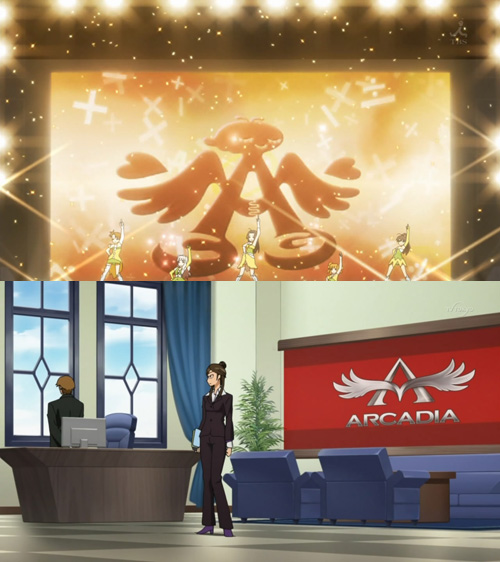
Thanks to a combination of talent, spirit, and camaraderie, 765 Productions becomes wildly successful. At first, they do only promotions for car companies, but thanks to rich girl Minase Iori’s connections and the advancement of technology 765 Pro manages to start their own automobile line. They name the car company offshoot “Arcadia,” modifying their logo along the way.


Assistants to the CEO continue to dress in black suits in honor of Akizuki Ritsuko.

3) Shijou Takane is Responsible for the Rosettagraphy

At first glance, the Rosettagraphy makes no sense. A mysterious stone tablet that tells humanity how to build advanced cars that turn into robots? It sounds like nonsense, until you remember that Takane is equally engimatic, and that she is capable of speaking in many tongues. As we can clearly tell now, it’s because she holds the secrets of not only technological growth but also of prophecy. If she had revealed it to humanity too soon, who knows what would’ve happened?

Takane was a Messenger in Many Ways.

4) Gyrozetter AIs are Actually Based on 765 Idols

How else would you explain this?

I rest my case.