Battle, Fever: Genshiken II, Chapter 64

When last we left the chaotic otaku gathering that is Comic Festival, Ogiue’s past and present were set to collide as Yabusaki and Sue came face to face with Nakajima, Ogiue’s old junior high classmate and the one in some sense responsible for Ogiue’s difficult life since then. While we don’t get the Ogiue-Nakajima confrontation that I expected, Chapter 64 still has a lot to chew on, and it does a lot for all of the characters involved, including Nakajima.

Nakajima (first name Yuuko) introduces herself to Yabusaki and Sue as an old friend of Ogiue’s, made all the more obvious by her Tohoku dialect. Not knowing what to make of each other, they decide to feel each other out, with Nakajima words subtly disparaging Ogiue or expressing mock-wonder at how Ogiue currently is, and Yabusaki not trying to overstep her bounds and say any crass remarks back (Sue is cryptic as always). During the conversation, Nakajima confirms that Ogiue is currently dating someone (Sasahara), and feigns concern in order to tell Yabusaki and Sue about Ogiue’s attempted suicide and how it stemmed from her interest in the boy Makita.

Before Sue can bite Nakajima’s head off, Yabusaki explains to Nakajima that this new information isn’t going to change her opinion of Ogiue at all, and that it’s not surprising that a girl who had a perpetual chip on her shoulder towards her fellow fujoshi and would try to win arguments by leaping out of windows would have some serious problems in the past. She still likes Ogiue as she is. Sue backs her up, giving probably her first heartfelt speech in Genshiken history, though she Sues it up by mentioning the Sasahara x Madarame material that Ogiue had drawn, and that Sasahara had accepted it. Even then, this actually has the effect of making it clear that Ogiue is no longer tied down by her past. At this point, Nakajima chooses to leave, and she barely misses the arrival of Ogiue, or rather, chooses to ignore it. Apparently Nakajima wanted to tell Ogiue about something concerning Makita that would put her at ease, but seems a little bitter that Ogiue managed to carve such a good life out for herself.

Ogiue meanwhile has a 39 degree C (102 F) fever, and is so out of it that she can’t even consciously hide her Tohoku accent. Being in no condition to be outside, Yabusaki dispatches Sue to take her home, where they watch after her until Sasahara can take over. When Yabusaki and Sue (with Nyaako) leave, Ogiue bursts into tears, overwhelmed by the fact that her friends have been so good to her. Sasahara provides gentle support, but also informs her that she can’t attend the rest of ComiFest because of her current condition.

While Chapter 63 was just filled with all sorts of goings-on, this chapter which concentrated mainly on Yabusaki and Sue vs. Nakajima was no less dense, with information both overt and somewhat subtle and examples of really fascinating character psychology from all sides. I think that Ogiue to some extent is still afraid of her past catching up to her, and it warms my heart to see her friends defend her so vigorously and from the heart. It’s actually unclear just how much if anything Ogiue overheard, or if she was even aware in her fever-induced haze that Nakajima was standing there, but either way Ogiue’s tears showed just how much she (correctly) values her friends. It’s not quite the close on Ogiue’s chapter that I had predicted would happen, but it’s still a resolution of sorts, and I’m happy with that.

Sue makes an Excel Saga reference this chapter (“Hail Ilpalazzo!”) While she’s sometimes hard to believe as an American anime fan, this is probably the closest she’s gotten to feeling like the real deal outside of her initial “Anta Baka?” She also seems to be a very good judge of character, as she immediately notices some bad vibes coming off of Nakajima, kind of like Shizuo from Durarara!.

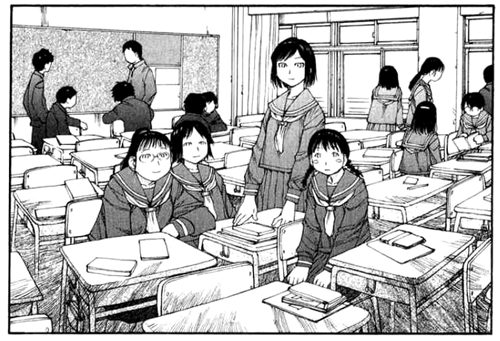
This chapter is also the first time we got to see Ogiue’s original debut scene in the manga from the perspective of Yabusaki and the other girls in the Manga Society. If it wasn’t obvious that the glimmer in Ogiue’s eyes was the result of her coming to terms with her inner demons and beginning her relationship with Sasahara (and not, for example, a stylistic change), this makes it crystal clear by showing Ogiue from Volume 4 with her eyes colored the flat black that used to characterize her.

Things start to get interesting when we read the lack of glimmer as signs of some kind of long-standing inner turmoil, as Nakajima’s eyes resemble Ogiue’s in that manner at certain key moments, particularly when mentioning anything troubling from Ogiue’s past, after which they revert back to normal. We actually don’t know much of anything about Nakajima, and this makes me wonder about her life since her years in junior high with Ogiue. Being a fujoshi (you don’t attend the first day of ComiFest just to torment an old friend), Nakajima may have had to hide that aspect of her life as well, and has been jealous of Ogiue all along, whether it was Ogiue’s ability to get a boyfriend back in junior high, or now with her life as a professional manga artist, where she has a strong group of friends and a supportive boyfriend. Suffice it to say, I think there may be some kind of trauma in Nakajima’s own life that she has yet to resolve for herself. She doesn’t seem like an entirely bad person, as shown by her interaction with her friend Shigeta (first name Mina), who was with her last year when she spotted Ogiue at ComiFest. Shigeta seems more level-headed, but there’s not much to go on, so I’ll reserve any judgment on her.

Trauma is just one possibility. Nakajima’s eyes during those moments could also be a reference to that creepy stare she and her posse laid on Ogiue back then.
What did Nakajima want to tell Ogiue about concerning Makita? It can’t be anything bad, as the reason Nakajima decides not to tell her is that she doesn’t want to make Ogiue’s life any better than it already is. If I had to fathom a guess, I would say that Makita actually did not transfer away because he found himself reading a comic where he was getting it from behind by his best friend, but for some unrelated reason. Does this mean that Makita actually will make an appearance again at some point in the comic? I’m not sure how I feel about that, but I am open to the possibility.

The chapter ends on Madarame, who is feeling not as excited about ComiFest as he thinks he should be. Is it a possible sign that he’s growing old, the beginning of the end for Madarame as otaku? That might be the case in a certain sense, as Angela seems to have him in her sights.

How do you feel about Americans, Madarame, particularly one who like both girls and boys?

Takekuma x Akamatsu, A Must-Read Discussion of the Future of Manga

Kransom over at 2chan.us (formerly known as Welcome Datacomp) has posted a translation of a fantastic discussion between Akamatsu Ken, author of Love Hina and Negima!, and Takekuma Kentarou, co-author of Even a Monkey Can Draw Manga, manga editor, and professor at Kyoto Seika University. The two of them talk about their mutual forecasts of a collapsing manga publishing industry, as well as their widely varying opinions on what they think should be done to correct that. I highly recommend reading all five parts.

They touch on a great number of topics, including the origin of Akamatsu’s J-Comi site and Takekuma’s research into how Shounen Jump became king as an indirect result of the 1973 Oil Crisis, but one of the particularly interesting topics they discuss how the roles of artists and editors may change in an age where big manga publishers such as Shueisha and Kodansha might not even exist. Akamatsu, rather than being the stereotypical artist who cares little for profit, is incredibly practical and sales-oriented, whereas Takekuma concerns himself more with thinking about what the artists want to do.

The danger of self-publishing, be it in a printed book format or as something viewed online or on an e-book reader is that there is a lack of quality control. While the environment that Takekuma and Akamatsu are thinking about is not quite at that point, the common idea here is that a lack of editorial feedback is something which can limit the success of both a weaker manga industry as well as a self-published title. Both Takekuma and Akamatsu agree to the importance of editors, and believe that the key will be an increase in freelance editors who, rather than being able to rely on a salaried position at a publishing company, will have to make a living by showing their skills at fostering talent. They’ll also have to act somewhat as agents for their independent artists, or if not, the artists themselves have to be their own agents. Those who can only draw will not survive, not only because they won’t know how to market themselves, but because they won’t be compatible with this new breed of editor.

I can’t help but think about the power structure that would exist should such a system come into existence. Ideally, the artists, editors (freelance or otherwise), and publishers will all regard each other as equally important in the whole process, but I get the feeling that it wouldn’t quite turn out that way. Granted, the role of editor and artist even now is not consistent across each publishing company, so it’s not like the manga industry would be changing from one universal form to another, but the fact that the manga industry would, in Takekuma’s view, become even more free-market, especially for editors, makes me picture some kind of wild west frontier for manga. Again, this has its benefits, but as Akamatsu points out, one of the benefits of manga is that compared to making a television series or even an anime, making a manga is much less expensive, and so a greater variety of ideas can be explored with less risk to those involved.

If the manga industry does get to a level where those involved with manga have to put more on the line to get published, there is a chance that it might stifle one of the great strengths of manga, and I doubt the artists who tend to be so overworked will have any less of a burden on them. In the face of this, Takekuma’s point that we may see many more manga artists with modest salaries instead of wealthier artists (Akamatsu, for example) may simply be the result of a changing perception of what it means to be “successful” manga.

Madoka Magica and…Sacrifice?

Puella Magi Madoka Magica has come and gone, and it’s going to be a subject of much discussion. Part of it may simply be that the delay caused by the earthquake in tsunami Japan magnified the anticipation for the finale even more than the already huge expectations for the show, but I think this anime is going to stick in people’s minds for at least the near future. Though the show has its flaws, overly expository dialogue and some contrived twists to name a couple, I found it to be an overall strong show and indeed an interesting twist on the magical girl genre that understands what magical girls are about.

I’m going to be discussing the show and its ending in depth, so take this as the Spoiler Warning.

Continue reading

Preventing Anime Burn-Out

Every so often I’ve been asked how not to burn out on anime, but I haven’t been able to formulate a proper response. Sure, I’ve talked about how to not burn out on anime blogging, but nothing tackling the beast itself. With the new season starting up though, I figured now was as good a time as any to address that malady which afflicts so many otaku and their disposition towards anime. It won’t be a sure-fire guide to preventing burn-out, but I think it’ll at least help get you somewhere in the realm of a right mind.

I’ve never really burned out on anime, so in the sense that I have never hit the bottom and risen back up to fight another day, I may not be entirely qualified to talk about avoiding burn-out. However, I do have times when the act of watching anime can seem overwhelming, as well as times when I just don’t feel like watching anything or feel myself not enjoying what I’m watching as much. One such moment occurred a couple of months ago, as I found my attention was drifting away while watching Creamy Mami. I had some other shows I was watching at the time, but I was feeling a stronger desire to check out competitive Starcraft II matches. I had to ask myself, was it really happening? Was I really getting tired of anime?

Then I remembered that just the day before I was being riveted by Legend of the Galactic Heroes. I had an untouched full series of Ojamajo Doremi Sharp that I know I would enjoy but hadn’t gotten around to yet. The fantastic Heartcatch Precure had just finished or was about to finish, and I’d just been enjoying Star Driver since the fall season. I also knew that some of the shows I was ignoring in favor of watching Nada siege tank someone to death were not shows I was chomping at the bit to follow…at that moment. Things could change given a couple of days. Rather than finding myself in the beginning stages of anime burn-out, I realized that I was simply being incredibly short-sighted.

It’s easy to trick yourself into dwelling on the negative experiences. Remembering the bad more than the good, it then can cause you to create unfair demands for anime because they’re based on a desperation to be knocked out of your funk, and when the next batch of shows don’t rescue you from yourself, the burn-out becomes that much worse.

So then, how do you stop that from happening?

If you’re worrying about the shows in the here and now, I think it’s a good idea to just take a mental step back and look at the shows you’d been watching previously. I know that on the internet and among anime fandom there’s a tendency to quickly forget anime after it has finished airing, but don’t be like me and get caught up in your own myopia. One year ago isn’t that long a period of time, let alone three to six months ago.

Don’t be afraid to stop watching those specific anime that seem to be dragging for you and to replace them with something you think you’d enjoy more. If you’re not sure whether you actually dislike a show or if you’re just not feeling it, put it on the back burner for a while. If it’s a current show that you’ve been keeping up with week after week, don’t get so attached to the rat race that watching it becomes more of a chore than anything else. See if you can come back to it a few weeks or even a few months later, when you’re feeling sharper. If you must keep up with it as it airs, and I have to again recommend you not fall into this trap, let it run as you’re doing other things. A lot of television in general is made with the assumption that its audience will not always be paying full attention.

Anime burn-out is largely psychological. How you define it is ultimately up to you. If you find the amount of shows you’re interested in dwindling, it doesn’t necessarily mean you’re not enjoying anime anymore, it can just mean you’re watching fewer shows. If you’re not feeling any of the shows currently running, don’t be afraid to look backwards, to older anime. If you’re really finding nothing to watch, perhaps think about what it is exactly you’re looking for. Whether you’re following ten shows or just one or are even deciding not to watch any anime for a little while, the quantity of anime doesn’t have to define your interest in anime or your identity as an anime fan.

Vistas: Final Fantasy Advent Children & Character Camera

I’ve written a post concerning Final Fantasy: Advent Children as part of our “multi-vistas” category at the Vistas blog, where everyone on the blog takes a look at the same work and writes a response. Mine is about the character-centric visuals of Advent Children as well as some personal elements, while my colleagues have written about Advent Children as Fantasy vs. Science Fiction and the lack of discrete visibility in its action scenes and its possibilities.

Hope They’re Okay

I do not have any relatives in Japan, and I’m grateful for that. No need to worry in that regard.

But I do have friends living in Japan, people I’ve met both in real life and online. I’m not sure if this qualifies as irony, but whereas the folks I know primarily through the internet I can more easily find through those channels (or at least try to), the people I met in real life first are the people I have less chance of contacting. Whether it’s through changing e-mail addresses or just lack of contact over time, I have people whom I would call friends who are probably in Japan right now and I have no idea if they’re okay or not, and I have no way of ever finding out. Part of me regrets my own lack of initiative to try and keep up with them in the first place.

It reminds me of the first time I ever ate udon and onigiri, at a small Japanese restaurant in the World Trade Center, back in about 1999 or so. The udon was amazing as far as I could tell with my limited experience, and the onigiri were $2 per ball and absolutely gigantic. I never really got to know the owners or anything, so when 9/11 hit I found myself wondering whether or not the people working there made it out okay. Of course, I have no way of ever knowing.

I do not have any amazingly close ties to Japan. I’m not going to lose much sleep over it. But I do hope my friends are okay.

I’m a Dreamer, Moeru Power: Genshiken II, Chapter 61

The newest chapter of Genshiken II hints at the most glorious team-up in otaku manga history. However, the antics of Battlehopkins and Double Asada are only for a few panels, and the real focus is split this time around between Ogiue’s precarious deadline juggling and Hato engaging in a Hato x Mada-themed thought exercise. This month’s theme is friendship!

Before we jump into the chapter though, I want to point out the next-chapter anime references that are at the end of each chapter. We’ve seen Occult Academy, K-ON!, and Heartcatch Precure, among others. This time it’s Jewelpet Tinkle. I didn’t even know that series had an otaku following.

Ogiue discusses her professional debut with Yabusaki, who is equal parts jealous and proud of her former enemy and current doujinshi collaborator. Ogiue’s challenge, as established a few chapters back, is to finish both the manuscript for her first published manga and the doujinshi she’s planning for Comic Festival (which we now know is Fullmetal Alchemist-themed), and though she has an insanely prolific work-rate (see her previous 80-page draft which she drew in about one night), it can be a double-edged sword; as we can see at the very end of the chapter, Ogiue can get so engrossed in her imagination that it can be difficult to put her professional responsibilities above her passions. I get the feeling Sasahara knows this better than anyone, which is why their unofficial editor-artist relationship can be so volatile.

During their discussion, Ogiue and Yabusaki speak in their respective Tohoku and Kansai dialects, which is nothing short of amazing. While Yabusaki does this all of the time, it is an incredibly rare case that we get to see Ogiue use Tohoku-ben out loud instead of just thinking in it, and I believe that this is the very first instance of Ogiue speaking in her native dialect for an extended conversation outside of flashbacks. I think this is a very important indication of not only how much more comfortable Ogiue has become with herself, but the extent to which Ogiue and Yabusaki get along now, even if their faces don’t show it. Ogiue doesn’t even use her Tohoku dialect in private with Sasahara! Her Tohoku talk, combined with her newer hairstyle, in a way reminds me of Heartcatch Precure, where we get to see girls change while discovering their true selves.

At the same time as Ogiue, Sue, Yabusaki, and Asada are talking art, Hato is taking respite from the heat in Madarame’s empty and air-conditioned apartment. Here, we get to see Hato’s gender-divided fantasy in action, as Hato the guy’s thoughts run practically parallel with Hato’s thoughts as a “fujoshi,” represented by an imaginary(?), naked, and decidedly feminine Hato floating nearby. Alternately called a Stand and an 801-chan among other things, Hato’s mind inhabits this unusual territory where he scrutinizes his own natural actions and provides a field day for psychologists of fictional characters. Hato turns out to be so tired that he ends up dozing off, and by the time he wakes up Madarame is already home. A potentially awkward situation to say the least, especially given Hato’s out-of-body musings.

Just as we were able to see a current Ogiue talking in her own dialect for an extended period for the first time in Genshiken, this is also the first time that Madarame gets to see Hato sans drag, but rather than making things more uncomfortable, Madarame just treats him as one of the guys. While sharing dinner, Hato brings up the fact that he does not consider himself to be homosexual, even though he likes BL as much as he does. Anticipating Madarame to react somehow, Madarame still doesn’t seem particularly fazed by this “revelation.”

Speculating as to why Madarame is able to take such a declaration in stride, I can only think that it’s because Madarame, as an otaku, knows the significant disparity that can exist between 2-D and 3-D. Ogiue is into yaoi, but she doesn’t expect Sasahara to be into other guys even when she uses him as “inspiration” for her own doujinshi. An even better example might be Madarame himself, whose taste in the erotic can skew a little young, and yet he finds himself in love with the very mature Kasukabe Saki. For that matter, Sasahara and Ogiue sometimes skew young in their preferences as well (young Ritsuko Kubel Kettengrad and Edward Elric, respectively), so I think the whole of Genshiken understands the divide well. Still, gender and sexuality is not the easiest of topics to talk about, and you might be surprised at how the complex lines of tolerance and understanding can fall within people’s own values.

Seeing how relaxed Madarame is being around Hato despite the possibility that an outsider observer (i.e. “herself”) could interpret all of this as fertile soil for romance, Hato can’t help but see Madarame as a weak bottom because of how open he leaves himself to “attack.” For some reason though, I feel like Hato’s logic behind the “hetare uke” Madarame “character” is different from Ogiue’s. I think Ogiue’s variant has more to do with how passive he is despite his passionate otaku outbursts and the like.

Speaking of Saki, Hato accidentally becomes aware of Madarame’s unrequited love, though Madarame himself is unaware that Hato knows. Maybe Hellsing creator Hirano Kouta is right after all and Madarame really is the most moe character in the series.

It’s Only Greater

Recently I was thinking about how great it is that I have friends and people with whom I can share my love of anime and manga, with whom I can discuss my feelings on specific works, trends among fans, and much more. Nowadays I think that it’s really, really wonderful to be an otaku.

It makes me consider the concept of anime fan gatherings that aren’t conventions or anything tied to specific activities or venues, but just something where everyone can sit back and enjoy themselves, like a relaxed discussion on the internet but in real life, so not everything has to be in words. Preferably this is all done over a big pot of chili (with vegetarian/vegan alternatives for whoever needs them), or I guess donburi if we want to stick to the whole Japan thing.

Surely there are disagreements among otaku all the time, and heated arguments about minutiae that seem many times larger, but just the fact that we can be so engrossed in something is itself a glorious thing.

If you want to know what makes the “geek” special, it’s not brains or looks (or lack thereof) or anything like that, it’s simply passion. I have a lot of it, and as it continues to grow I know I have you to thank.

THAT Anime Blog, Home of Utopian Philosophy

This past Valentine’s Day, ExecutiveOtaku over at THAT Anime Blog offered a service for all of the single ladies and gentlemen who found themselves alone on February 14th, a “Harem Finder” that would allow you to enter into a Love Hina-esque setting, custom-tailored to your specific wants and passions. Though obviously a joke, the Harem Finder is not without historical precedent, at least in literary terms. In particular, the concept resembles the writings of utopian philosopher Charles Fourier.

Fourier (1772-1837) believed that the denial of passion was the most major problem with the world, and in his utopian writings he proposed a society where everybody would be able to indulge in their passions in a way that would benefit their society. For instance, a man predisposed to death and slaughter would find a job as a butcher. Fourier (somehow) calculated that there are 810 character and personality types to be satisfied. This of course includes sexual passions, so a sadist would be able to meet a masochist, same-sex relationships would be condoned, and so forth.

Priests and priestesses would gather everyone together and initiate extensive tests involving multiple meetings between potential partners, keeping in mind that “love at first sight” does not always happen. And for those dorks who worry about their physical attractiveness, Fourier has them covered too.

In Harmony sheer physical attractiveness will not have the colossal influence that it has in civilization where everyone is transfixed by the sight of a beautiful woman. Of course the Harmonians will not fail to appreciate physical beauty; in fact their judgment will be considerably more discerning than ours. But when it comes to the selection of sympathetic patners their choices will not be determined by physical charm. For their desire for sensual gratification will be satisfied in several different ways.

In a way, the concept of the “harem” in anime and manga is a form of utopia, acting as a very localized, almost self-functioning society where happiness is being surrounded by women (or men) and everything that happens in the world comes from that harem setting. The same idea could be extended to the most slicey slice-of-life shows, especially when you factor in their utility as a form of cathartic escape. These are, after all, “better worlds.”

In a different era, I think Charles Fourier could have very well been an otaku. He would spend every day after work focused on writing about his utopia, and his devotion to passion is well-represented in anime and manga. He also had a thing for lesbians, making it very possible that he’d be a big yuri advocate, and his obsession with precise calculations seemingly pulled out of nowhere (he determined that there are 26,400 men in the world who also enjoy lesbians) would not be that far off with numbers-obsessed mecha or idol fans.

He was also a life-long virgin, but I’ll leave those jokes to you.

We Still Fight

Mazinkaiser SKL and Madoka Magica embody the spirit of 1990s anime and anime fandom.

That I included Mazinkaiser SKL in that statement is not much of a surprise, I imagine. It’s the robot whose name stands for “Skull” because it’s covered in skulls, and its plot, characters, and levels of ultra-violence are taken straight of the worst best OVAs of the era. Mazinkaiser SKL has what thrilled anime fans of the 90s, and it would not have looked out of place next to the likes of MD Geist and Bubblegum Crisis.

My choice of Madoka Magica might be more puzzling, but I insist that in some ways it houses the 90s anime (and anime fan) spirit even more than Mazinkaiser SKL. When you look at how the series has been captivating fans, you see recurring comments in regards to how dark it is, or how it subverts the genre. Even if people don’t necessarily have a good understanding of the original genre being addressed, when it comes down to it Madoka Magica is attracting fans because it feels “different” and worth discussing and thinking about at length. The way people talk about it reminds more of the way people discuss Akira, Ghost in the Shell, or Evangelion than the way conversations about Suzumiya Haruhi or Code Geass go. Madoka Magica has that certain something that thrills people into dividing anime into Madoka Magica and everything else. While the difference is that Akira drew in non-fans and Madoka Magica isn’t really going beyond the existing fandom, it seems to be hitting fans with the same shock that Goku’s death gave to me as I realized cartoon character’s could die after all.

So while Mazinkaiser SKL is aesthetically an anime ripped straight out of the 90s, a time traveler from a different era whose ways may seem at odds with the current day, Madoka Magica takes the effect anime had on anime fans in the 90s and translates that emotional impact across time onto the current fandom. Whether or not these shows will be remembered in another ten years is unknown, but at the very least in the here and now they connect the decades together.