Continuing Con Con

Over the past 9 years or so, I have gone to a number of conventions. Large or small, anime-focused or emphasizing other areas of geekery, I’ve gone from a relatively inexperienced con-goer to one with agendas. As I have grown as a geek, so too have my tastes developed, and I realize that as much as I find my growth to be a good thing, I sometimes wish I knew less.

When I went to my first convention, the science fiction-themed Lunacon, I recall there being quite a few things I wanted to see (Godzilla vs Megaguirus comes to mind), but at the same time I allowed myself plenty of opportunities to just wander into panels just to see what was going on. But now that I’ve developed my focuses as an anime fan, as a nerd and admirer of fiction and art, I feel myself less able to wander.

Sure, when it’s small and there aren’t very many good guests or must-see events it’s easy to remain the con flâneur. But when there are a ton of worthwhile things to see, then I start to feel like I’ve affixed myself to some rails. The rails may be of my own design, and I am capable of deviating from them, but they can still feel somewhat restrictive. I could try to just float through the convention, but then I’d be missing so much.

It’s kind of like going to a restaurant. If nothing on the menu looks familiar to you, you’re more likely to just try something new, but if you happen to see your favorite dish on the menu, then it takes no small amount of willpower to not order it and go for the new and the mysterious.

Another Kind of Radio Exercise

I don’t remember when exactly it happened, but at some point in the 2000s, New York City got a couple of new Chinese radio stations. Currently on AM 1480 (Cantonese) and AM 1380 (Mandarin), these stations provide much-needed entertainment and news to people who are not as comfortable listening to English language radio stations. But they also provide something else, something I can only describe as “mind-boggling song selections that appear half-born out of geekery.”

What do I mean? Well, back when the radio stations were first starting out, I noticed an oddly familiar song amidst the usual selection of Chinese-language pop music. It stood out for a number of reasons, not least of which was that it was purely instrumental. As the ominous tune played on, it suddenly hit me: It was Kefka’s Theme from Final Fantasy VI.

“What? Really?” What was this doing on Chinese radio? What absolute nerd was in charge of music programming?

But aside from the occasional Utada Hikaru song, there wasn’t much else. Not much else that is, until the station started playing the theme song from The A-Team.

And no, it was not that one song from Full Metal Panic!

Once again, I had to question just who was in charge of selecting the songs for the Chinese residents of New York City. I have no idea how popular The A-Team was or is with Chinese people, but I don’t even think that’s a factor.

Then yesterday, I heard the most unusual song of all. This time the song was entirely in Cantonese, but it sounded odd, or at least odd for a tune on the radio, resembling more the theme of a TV drama or 80s anime than anything else. Like Kefka’s Theme years earlier, it started to sound more and more familiar. Then the chorus hit and I realized that it was a Cantonese version of Sentimental Over the Shoulder from Megazone 23 (Part 1).

So here I am, trying to find this mysterious Chinese rendition of Eve’s famous song, and I simply cannot do it. I definitely did not imagine it, but I honestly have no idea what I should even be searching for. Does anyone out there listen to WZRC AM 1480? And are you a huge anime nerd? Because if so, maybe you can help me identify just where exactly this song came from and who exactly sings it.

On Powerful Female Characters

Seeing the comments I received on my post about strong female characters two days ago, I noticed that much of the difficulty in the discussion comes from people disagreeing on the very definition of the term (as is the case with so many anime arguments). Re-reading the examples given there and elsewhere, I’ve come to realize that the issue stems from the fact that when many people use the term “strong female character,” they actually mean “powerful female character.”

It’s a simple yet profound difference. Think about how you’d use the two words to describe a real person.

“That woman is strong.”

“That woman is powerful.”

It rings differently, doesn’t it? Power can refer to a number of things. Physical ability, political influence, knowledge, specialized skills, it all comes down something which gives a character the tools to do things better than others. But when you say someone is strong, you’re generally talking about something deeper inside, such as an iron resolve or strong convictions.

That’s not to say that just because a character is powerful can’t meant they’re strong or vice versa, of course. And many times a series can potentially undermine a strong character by intentionally or unintentionally placing emphasis on “power.” Even so, I think this is where most of the misunderstandings occur.

So I guess the real solution is to ask both questions.

What do you think of the status of strong female characters in anime and manga?

What do you think of the status of powerful female characters in anime and manga?

Chun Lead

To commemorate the different yet similar directions we’re all taking in life, kransom, Sub, and I decided to have a couple of sessions of 3-player mahjong yesterday. We sadly could not find a 4th person, but 3P does well in a pinch; this is exactly the kind of situation it was made for.

For the Otakon mahjong panel, Sub and I mentioned that he’s a little more of a “digital” player and I’m a little more “occult,” which is to say that he looks more towards statistics and probability and I play more with intuition. At least that’s what we like to think. I’m pretty sure we’re both actually pretty bad and these kinds of distinctions don’t apply to our low level. However, please humor me for a moment when I say that yesterday’s session made me realize that I am indeed more of an occult player than Sub.

In one hand, I ended up getting 3 of the Chun, or red dragon tiles, early on. This is a good thing, as it means my hand automatically has value and the ability to win. Then kransom discarded the 4th Chun, and in most cases I would have no reason to steal the tile as the action itself doesn’t make the Chun tiles any more valuable, and in fact in many situations is a bad idea. But I had a hunch, an odd feeling, that I should take the tile.

Now when you declare “kan,” or the fact that you have 4 of the same tile, you get to draw an extra tile. This turned out to be a dud, but soon I realized that my intuition was slightly off. The real surprise was when the next dora indicator was revealed, and it turned out that Chun was the new dora (dora being a sort of supplemental bonus multiplier in mahjong).

So suddenly my 1-multiplier hand became a 5-multiplier hand, bringing its minimum potential score from about 1300 points to 8000 points, and it all had to do with a sudden feeling. In the end, I ended up having a 16000 point hand.

Sometimes I talk to people who play Poker, and from what they’ve told me, the only approach to Poker is scientific or digital. I’m sure that’s fun, but I’ll stick to mahjong.

It was really a great game, and I’m glad to have comrades in both mahjong and anime.

Otakon 2010: I Don’t Believe It. That’s Unbelievable.

At this point, having gone to Otakon for the past four years, I feel it safe to call myself an Otakon veteran to some degree. In terms of what to expect, this year didn’t feel that different from all the previous times I went, but a lot of things have happened to me over the past year or so, makes me think I’ll reflect back on Otakon 2010 particularly fondly.

Ogiue Maniax’s Panelist Debut

Otakon 2010, from July 30th to August 1st, was the first time that I came to the convention as a panelist. And I had two to boot!  It may have been obvious from all the posts I made about panel preparations, but I really wanted to do a good job and I really wanted people to come to the panels, so up until I finished both of them, I had been very nervous.

The mahjong panel, titled “Riichi: Japanese Mahjong, Anime, and You” was a collaboration between me and Sub over at Subatomic Brainfreeze. With a 9:30am Friday timeslot when a good portion of the con hadn’t even been registered, and a fairly obscure topic like mahjong, we were both worried that our panel attendance would amount to our friends and acquaintances, and while we would have been glad to teach them about mahjong, our real goal was to reach those people who were only barely familiar with mahjong anime. Fortunately, the turnout was better than we had ever expected, and while I am to understand that our panel room was the smallest of the bunch, we still managed to pretty much fill the whole room, getting approximately 160 people to listen to us talk about an old Chinese tile game and the way it works in Japanese cartoons.

The Riichi panel itself also went far better than we expected. Knowing how much information there was to convey despite the fact that we had already decided to cut large amounts of information, we had practiced the panel on multiple occasions, barely finishing on time. But while our practice sessions felt kind of strange and awkward, the actual panel itself had an amazing energy to it. Both Sub and I were playing to our strengths, playing off of each other, and we managed to give all of the information we wanted to while also keeping the audience entertained. We even finished early and had a good amount of time for questions! From this experience, I have learned that Sub and I make a good paneling team and I look forward to the next opportunity we have to do a panel together.

By the way, for those of you who were at the mahjong panel but were unable to copy down the URL for the additional mahjong resources, here it is.

My second panel was also on Friday, but at the opposite end of the day at 11pm. Entitled “Portrait of a Fujoshi: The Psychology of Ogiue Chika,” this joint effort between myself and Viga the Otagal was in many ways a culmination of what I had been doing on this blog. Last year, Viga challenged me to do a panel all about Ogiue, and that’s how we ended up on stage.

I understoood well that even if a good portion of the convention was into yaoi and Hetalia and the like that they would not be interested in deep character analysis, so while the panel attendance wasn’t as high as it was for the mahjong panel, it was still quite impressive, and once again we managed to play off the energy of the audience and each other and give a good presentation, with me giving a more subdued approach. Also, once again, where practice netted us a panel that had about 10 minutes worth of Q&A, the actual thing gave us three times the amount. While I wish we had prepared more, I think we did a good job of expressing what makes Ogiue such a great character and why we connect so well to her (and why you should too!).

When I think about it, doing a panel on a single character is unusually rare at an anime con. You have panels about Evangelion, but never is it a panel specifically about Ayanami Rei. I hope we can start a trend at anime cons, as I think it’s a worthwhile way of running things.

I don’t know if any video recordings are available so I apologize for those of you who were unable to attend but wanted to see them. I also want to say thank you, thank you from the bottom of my heart, to all of you who attended my panels. I hope you enjoyed them.

Now having panels at both extremes of the day has its drawbacks, but it also had the great benefit of avoiding conflict with the majority of events, thus freeing up the rest of the con for me. As is the case with every year, my primary mode of entertainment at Otakon is the panels, both industry and fan. Fortunately or unfortunately however, I found that there was still too many entertaining things crammed into a single weekend and I still had to sacrifice one panel for another.

Industry Panels

In terms of guests, I was not looking forward particularly to any of them this year, but I’m glad I attended the Q&A’s that I did as all of them provided incredible insight into the industry, with Mitsuya Yuji’s panel perhaps being the most informative of all. Attending his Friday panel, the voice acting veteran told us how voice acting became a “profession” rather than a side job for dramatic actors and how voice acting should come from the entire body and not just the voice. He also talked about how in the old days, if you flubbed a line, rewinding the film reel and readjusting everything was a huge pain, so mistakes were a big deal.

Throughout the panel, Mitsuya showed us what it was to truly be a voice actor, from passionate yells (he delivered a passionate “CHOUDENJI SPIIIIIIN” on more than one occasion) to voice changes to even the change in jobs given to you as you age and can no longer be the handsome male lead. Also, seeing as his debut voice acting role was as Hyouma, the main character of Combattler V, I asked him the question I had asked of Macross director Ishiguro and Gundam creator Tomino: What were your experiences with legendary anime director Nagahama Tadao?

Mitsuya gave us the impression that Nagahama was an incredibly passionate man. Gentle and understanding, he took his role as director very seriously and pushed Mitsuya to improve his performance. Mitsuya had originally tried out for both the lead Hyouma and the rival Garuda, and Nagahama made him redo his Garuda takes ten times. When asked if this was typical of a mere audition, everyone said that this was highly unusual. Mitsuya would later find out that all of this, from the audition to the strict voice sessions, were all signs of the fact that Nagahama had seen the amazing potential Mitsuya had and wished to nurture it into something greater.

Maruyama Masao was back again this year. The head producer over at Studio Madhouse, in my opinion the best anime studio there is, Maruyama is a staple of Otakon, but despite the fact that he comes pretty much every year, I look forward to it every time. This year we finally learned that Redline, the series he had been working on for six years which he also mentioned at numerous past Otakons, is finally getting a theatrical release in October, though its director also passed away before it could debut. Redline is  high-intensity anime, resembling the most elaborate portrayal of F-Zero ever, and Maruyama claims it will be the last truly hand-drawn anime ever.

Otakon was also the American debut of Welcome to THE SPACE SHOW, a feature-length film from the animation team which brought us Read or Die and Kamichu. As such, the creators were also there at Otakon, and managed to have an informative Q&A session. I gave a question targeting mainly Ishihama, the character designer, asking if he felt there is a trend in anime films to move towards simpler character designs which lend themselves towards looser and more whimsical animation. Ishihama responded that he believed there is indeed such a trend, but that there is also a counter-trend present, where more detailed, less fluid animations are also becoming popular.

As for Welcome to THE SPACE SHOW itself, the movie is quite fun but is too unfocused. The story of kids who travel into outer space in a way reminiscent of Galaxy Express 999, the film had opened up many good directions the story could have gone but ended not taking very many of them and losing a good deal of its potential. The film also dragged on after a while in a way where even the expertly animated sequences and wonderful set of aliens felt less exciting overall. At the Q&A session, we learned that this was the team’s first feature-length work, and in hindsight it really showed.

The only American industry panel I ended up attending was the Vertical Inc. panel with Ed Chavez and Peepo Choo author Felipe Smith. Ed, responsible for all of those Vertical Vednesdays I keep talking about on the blog, is about the most personable marketing guy in manga. While giving hints at interesting new titles coming in the future (including another Tezuka title), he also showed that he has some strong opinions on manga, stating that Vertical would not license Yokohama Kaidashi Kikou because “I don’t like it.”

Fan Panels

I had a lot of fun with the fan panels I attended, which mainly focused on exploring elements of anime and manga but I also attended some fun ones too. In the “elements” category there were three panels:  “You Don’t Like Moe and Here’s Why,” “The Changing Faces of Anime,” and “The Life and Times of Akiyuki Shinbo.” In the “fun” category, there was Anime World Order‘s “10 11 Anime You’ve Never Heard of But Must See,” the “Mecha Fan Panel,” and Megaman in Anime and Manga.”

The moe panel focused on the concept as a phenomenon and the meanings it gains as it has become a part of the industry itelf. It took a while to get off the ground but eventually found its footing, and the best advice I can give to the panelists is that more can be done to bridge the gap between what they are talking about and what the audience understands.

The Changing Faces of Anime panel, run by Evan Minto of Ani-Gamers, was a literal look at faces in anime, discussing changes in character designs over the years. It was a good panel which generated even better discussion, and it’s a difficult topic to tackle in only an hour.

The Shinbo panel, presented by wildarmsheero, showed that he had clearly done his research on the eccentric director and took a look at all the stylistic elements Shinbo loves to employ in his works. It ran a big long, forcing the Q&A session to be cut.

The “Must-See Anime” panel was very entertaining, though it was focused less on recommending good shows to anime fans and more about showing amazingly obscure anime that were difficult to obtain and had a lot of excitement value (but could still be good shows). I know that I’m going to track down Natsuki Crisis and other titles. Also, while obviously the clips themselves say a lot, it also doesn’t always convey some of the more overarching positives of a title, so more talking might be a good idea.

The Mecha Fan and Megaman panels meanwhile were fairly similar, giving the history of mecha and Megaman in Japanese graphic fiction. I won an old issue of Nintendo Power at the Megaman panel, and enjoyed the liveliness of the mecha panel, but I think that both could benefit greatly from delving even more into their topics. The Megaman panel also suffered from everyone reading from their scripts too much. It was very obvious that everyone at the panel was an expert in the field of Megamen, and I think removing the script would have made it more personable. On the other hand, it also showed the best Rockman.exe opening, so it’s all good.

Entertainment

While neither was truly the start or the end of the convention, I find that the opening ceremony and the Home Made Kazoku concert act as nice bookends to the con proper, mainly because of the positive impression Home Made Kazoku made on the audience at the former, which led to great anticipation about their performance for the latter. A hip hop-oriented Japanese group, their music and live performance was really infectious, and I think that music-wise it was a great success for Otakon this year, especially when I found out that the shamisen-playing Yoshida brothers managed to fill the concert area so tightly as to nearly be a fire hazard.

Speaking of fire hazards, the talk of the town was clearly the fire alarm Saturday Afternoon which forced all of the nearly 30,000 attendees to evacuate the Baltimore Convention Center. Given the general immaturity of the con crowd (including whoever actually pulled the fire alarm), I was pleasantly surprised to see people doing the right thing in the even of the fire: leave in a calm and orderly manner. Even the most rambunctious anime teen knows not to mess with this sort of thing, which brings a smile to my face.

Food and Friends

But going to a con isn’t just about the anime or the guests, it’s about meeting people and having a great time doing so. The con begins on Friday, but the con experience truly begins the Thursday before, from the point the bus arrives, and only really ends when we get back home. This year’s Otakon featured the return of glorious Brazilian Buffet, being amazed at the evergreen awfulness of G-Saviour while watching it in the hotel room, large gatherings with people relaxing and joking about, and amazingly deep discussions about everything anime and manga.

As I rode the bus home with my travel companions, we discussed for about four hours straight the very nature of enjoying anime and manga, as well as their qualities as creative forms of expression, and it made me realize just how much better conventions are when you add the human element to it.

I love it, and love makes Otakon better, I can guarantee you that.

Easily Misconstrued Title: Taekwon V Invades Japan

On August 7th, Robot Taekwon V makes its Japanese theatrical debut.

A Korean animated film from the 1970s about a super robot utilizing the power of Taekwondo, Taekwon V was thought to be “lost” for many years, in the sense that no good copy of the film could be found. This all changed in 2007 when an excellent-quality print was discovered.

Though Korean in origin, Taekwon V is clearly based off of the Japanese Mazinger Z, a similarity that its creator Kim Cheong-gi acknowledges, stating that he wanted to create a Korean hero for Korean children and simply assuming that this was the way robots were supposed to look.

While the bad blood extends well past animation and into the irredeemable treatment the people of Korea faced at the hands of the Japanese occupation before and during World War II, in this narrow scope the issue has always been the idea that “Korea just copies Japanese animation.” My previous post about this topic generated quite a bit of controversy and discussion, so take a look if you feel so inclined. By the way, I still maintain my stance, even if the movie features animation ripped straight of Bambi.

This is why it’s all the more amazing that Taekwon V is actually getting shown in Japan, even if it’s at only a single theater. No doubt it’s going to generate more racial slurs on the internet, but in a way I feel like it’s a big step forward. Also, I don’t think anyone can really blame a 30+ year old cartoon from an era with an almost non-existent animation industry for having taken some shortcuts. Well actually, you can, but I think looking at it in terms of copying/not copying is only seeing one side of a much more complex shape. There’s plain old “making stuff people enjoy regardless of how it’s made,” also plain old “making profit,” and other aspects as well.

By the way, the movie will be in Korean with Japanese subtitles, so sorry English speakers living in Japan who might be able to actually see it.

The trailer for all of you cool cats:

As well as an incendiary video from a while back:

Manyax

Every so often, as I slowly swim through the vast expanses of anime and manga, I find characters who I think are just incredible. They’re not necessarily my absolute favorites, but they’re just such good characters that I hope that someone out there champions them the way I do with Ogiue. It’s not just about reveling in a favorite character, but feeling that the character is so well-developed and is portrayed so strongly that heaping praise upon them is the least you can do. I’m going to take this opportunity to list a few.

First is Koizumi Risa from Lovely Complex. In my review of the anime, I mentioned my  hope someone out there considers her to be their favorite character. My statement still stands. Risa is an incredibly human character, a girl who isn’t exactly the best looking and who doesn’t possess the most attractive of personalities, but is so unique and full of energy and character that she stands out in more ways than just her height. Koizumi Risa is totally great and I hope you think so too. If you think her more attractive than what normally passes for attractive out there in anime land, then all the better.

Second is Adachi Hana from Yankee-kun to Megane-chan.  On the surface she seems like any other glasses-wearing character, and that initial judgment certainly isn’t helped by the title of the manga itself, but almost immediately after you realize that Adachi Hana is a girl of comedic genius that few can live up to. Now the entire series itself is hilarious, but Adachi steals the show far more than anyone, and her blank, bespectacled stare the most killer punchline possible. But don’t think of her as a one-note gag. She’s a former delinquent who’s looking to turn her life around by acting the part of the responsible student in the hopes that she’ll actually become one. If you like Sakagami Tomoyo from Clannad but are looking for a more lighthearted character and story, then Adachi Hana might be right for you.

Third is Sumimura Toshimori from Kekkaishi. The youngest of the Sumimura siblings, with main character Yoshimori as the middle brother and redhat Masamori as the eldest, Toshimori has a long way to go before he can fight like the rest of his family. However, he’s in many ways the most responsible, and it’s especially refreshing to see a younger kid-type supporting character who is intelligent and capable and is able to remain primarily a side character. I look forward to where the story will take him, and how he will further distinguish himself from his brothers over time.

Last is perhaps the most deceptively awesome character of all. While Legend of the Galactic Heroes has the geniuses Yang Wen-Li and Reinhard Von Lohengramm at the forefront, Murai is almost equally deserving of praise, if not just as much. An officer in a galactic war, Murai doesn’t have matchlesss intellect, nor does he have youthful passion, and he isn’t even the most experienced veteran, but he makes up for it by being an incredibly good support person. Knowing how esoteric his leader Yang can be, Murai intentionally plays the straight man, asking the layman’s questions so that Yang can phrase his thoughts more clearly. He even makes a big move later on, but again masks it in simplicity. By being so lacking in immediate notoriety, Murai shows his true strengths.

Those are all the characters I’m listing for now. If you have characters who don’t rank in your top 10 but you think they deserve a place on someone’s, feel free to chime in.

Nandoga Nare: Let’s Get Ready for Otakon 2010

Otakon is this weekend, and I am psyched. Not only that, but if you didn’t know before, I’m doing two panels this year. You’ll find both of them on the Otakon Schedule, but just to make sure, I’ll highlight them below.

Riichi: Japanese Mahjong, Anime, and You
Time: Friday, July 30 at 9:30am
Location: Panel 4
(Hilton Key 11-12)

If you’ve watched such popular anime as Akagi and Saki, you’ve been witness to the ancient game of mahjong– and you had no clue what the players were doing. Maybe you’ve even tried the game and found the complicated rules too intimidating. We did too! But we managed, and today we’re here to show you that it can be done. Let us enlighten you on the basics of Japanese style, or “riichi” mahjong, its appearances in anime and the entire genre of manga devoted to it, and how to play this fascinating game!

Portrait of a Fujoshi: The Psychology of Ogiue Chika
Time: Friday, July 30 at 11:00pm
Location: Panel 4 (
Hilton Key 11-12)

Throughout the series “Genshiken,” the character of Ogiue Chika goes on a journey of development, tackling topics such as self-image, childhood trauma, and the many perils of being an otaku-in-denial. Come, if you want to really delve into the mind of Genshiken’s most psychologically complex character with a panel brought to you by the experts on angry fujoshi characters, Ogiue Maniax and Viga the Otagal!

Now I understand that the first panel is very early and the second panel is very late, but I think you’ll get a kick out of both, particularly if you are a fan of both Ogiue and mahjong (I’m sure there’s a lot of you out there).

I’ll also be running around with the above image around my neck. It’s a special badge for this year that I’ve put quite a bit of thought into. You might even be wondering, “Are those a random assortment of tiles below Ogiue to reference the mahjong side of things?” But they’re not.

The hand is a Hon Itsu, or Half Flush, signifying Ogiue’s self-image of “impurity.” It also contains bamboo tiles, as the Ogi in Ogiue means “reed,” with the added benefit of the 7 of bamboo resembling Ogiue’s paintbrush hairstyle. They’re all odd numbers because Ogiue herself is odd, and the east and north tiles are in reference to the fact that Ogiue is from “Tohoku,” the northeast region of Japan. Finally, the hand is also a Chii Toitsu, or Seven Pairs, because Ogiue is a fujoshi who likes to come up with pairings.

See you in Baltimore!

Sho Nuff Himself Would Be Scared

When I think of western anime fanart, the first thing that pops into my mind is something I call the “Deviantart style.” Characters are usually drawn fairly realistically, their bodies becoming canvases for a psuedo-airbrushed look, every shadow and every highlight blended so softly that characters can probably be best described as “glowing.”


Artist: Yanimator

Artist: Ramy


Artist: REIQ (NSFW)

Now I am fully aware that Deviantart is home to an incredible variety of artists, and that even among the anime-style artists this is not anywhere close to the sole artistic style present. Nor am I even saying that this style is bad. However, as far as I can tell, this glowing style tends to be the most popular and ubiquitous, especially at anime conventions.

So my questions are: Why is this style so popular, and how did people learn it?

When I look at the most popular manga artists, none of them actually color their images in this manner, not Kishimoto (Naruto) nor Kubo (Bleach), and especially not Oda (One Piece). Branching out, I can only think of a handful of artists who get anywhere close to that Deviantart style, and most of them cut their teeth in the world of adult doujinshi, such as Satou (High School of the Dead), so their styles end up being closer to visual novel CG than anything else.


Artist: Satou Shouji (aka Inazuma)

One major difference is that the aforementioned Shounen Jump artists all color using real tools, and when I think about it, the Deviantart style seems born out of an almost purely digital environment, where textures can be finely tuned to almost microscopic levels, and stroke lines can be edited down with the utmost precision. It is, perhaps, a style resulting from the ability to hit ctrl-z in Photoshop and Illustrator. Of course, I’m not saying that it’s an impossible thing to overcome, but that perhaps artists who have experience with traditional media may be better at transcending limitations and making that style their own.

When it comes to anime artwork among western fans, I feel like there is an obsession with “realism.” In OEL manga for instance, a great amount of attention is put on screentones for smooth shading and for perspective in building backgrounds. With fan artists, perhaps this manifests itself into a hyper-realism where vibrant gradients rule the land. Not to pick on him again or anything, but it feels like the “five-tone shading” concept taken to the extreme, where the number of tones approaches infinity and the whole thing turns into a calculus metaphor. In a way, it reminds me of superhero comics, where musculature is emphasized greatly because they similarly harken to reality through exaggeration.

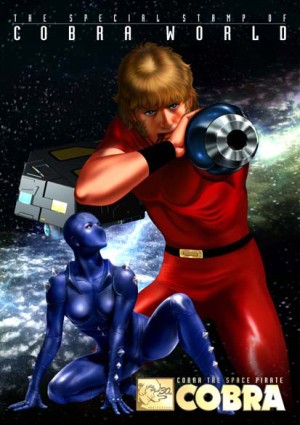
The closest artist I can think of which combines all of these elements is probably Terasawa (Space Adventure Cobra), but I get the impression that not very many artists on Deviantart take their inspiration from Terasawa.

Artist: Terasawa Buichi

But this is all speculation on my part. What do you think of the Deviantart style? Like it? Hate it? Do you use it? If so, what are you influences?

I just want to figure out how it came to be.

Man Cannot Live by Coke and Gushers Alone

With Otakon in less than a week and containing a packed schedule of activities, it can seem pretty overwhelming. Combined with the fact that Otakon panel rooms can be very far apart, you likely won’t be able to do everything. But even if you don’t succeed, you can at least try, and the best way to make sure that you have the energy to get to places quickly without tiring yourself out is to eat well.

It’s not like I’m telling you to count calories while at the con, but to remember that good, balanced nutrition goes a long way and helps you throughout the day, while fueling yourself with candy and soda only gets you so far. And when you try to replace the depleted candy and soda with more candy and soda, it compounds the negative effects, which include (but are not limited to) dehydration, lethargy, and headaches.

Water of course is a big deal, and is the essential of essentials (as it is in life in general). Think about your food groups, try to find some balance of protein, fruits, and grains. Granola bars for instance are a simple and easy way to get a boost, and it also has the added benefit of saving you money compared to eating out.

This year, my friends and I are taking things like grits and oatmeal for hot, healthy meals to start the day, cold cereals for variety, trail mix for a well-balanced boost of sugars and proteins and such, and even a bit of instant ramen because it’s not like we can be good all of the time. You don’t necessarily have to eat all of the food you bring, but it’s good to have just in case, and eating an apple when you’re feeling hungry in the middle of the day is still better than eating a Snickers bar.

Of course, you can eat an apple AND a Snickers bar too.

Last thing, check out the Reverse Thieves’ Con Survival guide, particularly their room and board section, as it also talks a fair deal about how to handle food at conventions.