Turds Smell Like Crap! Again!

So Anime News Network is previewing the new season of anime, as they always do. Some shows get positive ratings, some get negative, it’s the same old game. However, it’s gotten me thinking about just how often we go back to something even though it’s resulted in agony and torment in the past.

Among the new shows this season is Ikkitousen: Xtreme Xecutor, about Three Kingdoms-era figures reincarnated as fighting high school students where panty shots and exploding shirts are as plentiful as the air we breathe. The series is completely vapid fanservice and an exercise in selling lewd PVC figures. As expected, a number of ANN’s reviewers are rating the show pretty poorly. I don’t find anything wrong with that. What I do find wrong is that Xtreme Xecutor is the fourth season of Ikkitousen. By this point, the content of the series should be surprising to no one. Was it really that necessary to review?

I understand giving something a second chance and being burned twice over. I thought the first live-action Transformers movie could have been good if only a few tweaks were made, so I expected the sequel to be better. Boy was I wrong. I’ve also tried again and again to watch high level Warcraft III matches, thinking that this time I’ll be able to follow it! No such luck. And I’m not the only one who’s fallen into the shounen trap of waiting for a series to get “good again” while still following it regularly. This Ikkitousen thing however seems more like an exercise in futility.

I know it’s important for an operation like ANN to be thorough, and I can appreciate it on that level. Everyone’s putting on their best critic hats and trying to push something of value out. They’re talking about how the animation has changed, to what extent the series can draw in new fans, injecting song and dance and razzmatazz to their reviews, like the challenge is to write anything of value at all.

Actually, now that I think about it, that sounds like a pretty fun writing exercise.

The Otaku Diaries Hint at the Secretive Triumvirate of Hugpillow Enthusiasts

Now that the Otaku Diaries main events are over, the Reverse Thieves have seen it fit to hit us with all sorts of tidbits, from the number of people who were officers in anime clubs (13) to the number of man-crushes on Daryl Surat (greater than 0) to the number of people who own hugpillows.

Some of the trivia also sounds like it came straight out of anime. And assuming that everyone told the truth as they were expected to, that’s amazing. For example, the person who broke up with his girlfriend after canceling a date to watch Yu Yu Hakusho reminds me of a manga, Fujoshi no Honkai, where a closet fujoshi breaks up with her boyfriend by telling him that she’s “spending time with another man,” when in reality she bought a cake to celebrate the birthday of her favorite character. And when you realize that something like a manga based on the daily lives of otaku is trying to mirror the reality of the fandom, it’s almost like the beast feeding itself.

But really, looking at this trivia hodgepodge, I think it hits me harder than any of the previous Otaku Diaries posts just how similar/dissimilar we all are as fans of anime and manga. We are all united under the banner of Japanese comics and cartoons, but that sturdy felt cloth hanging high above us belies the sheer variety of places we come from. Gone are the days that anime fans all came from a single nerdy source of science fiction fandom or from watching the Pokemon on the TV. And though I use the term “anime fan” to encompass both those who watch anime and those who read manga, there are even people who almost exclusively focus on one or the other. All of it is surprising and yet none of it is.

Do You Truly Know What It Means to Draw the Right Card?

Last week while taking the train home, I saw a kid with his head buried in some kind of Bakugan guide, and it got me thinking. The first thing was that it reminded me of when I used to sit on the same train with a printed Pokemon pokedex, poring over move lists and trying to imagine new movesets and strategies. It filled me with a sense of nostalgia. The second thing was that it got me thinking about the future of anime.

Bakugan, one of those collecting and battling game franchises designed to separate kids from their money, has an anime to act as a half-hour commercial for the product. It’s one of the latest in a long line of merchandising engines, from Pokemon to Digimon to Yugioh to Beyblade and so on. The shows can still be pretty decent; there’s no illusion about their true purpose, but it doesn’t mean they can’t be entertaining.

That said, what if someone made a collecting and battling anime that wasn’t there primarily to push a product? “Impossible!” you might say. And to some extent you’d be right. Shows are made because they have some kind of chance at making money. But my response is, give it a decade.

In those ten years, the kids who grew up with those trading card games and battle tops will be getting older and older. They’ll be adults working full-time jobs and looking back fondly on their childhoods. It would mirror the progression mecha anime has had, with shows now being made for adults and having more advanced and mature concepts. In this situation, a collecting and battling anime which really takes an artistic and philosophical look at the nature of collecting and battling anime would be perfect.

It could look at the nature of probability and psychology. Perhaps it would ask what it means to play a game where you must collect to improve your chances of winning. There could be legitimately well-written characters and a skeptical eye, but still a love letter to the genres of TCGs and monster battles. It would really master and perfect the sense of timing and tension that would make the heroes’ actions seem all the more worthwhile. Actual rules to the game are optional.

It would be the Gurren-Lagann of collecting and battling anime.

You Get Off to… THOSE Drawings?

Occasionally I’ve run into people who have trouble understanding the concept of being sexually attracted to drawn images. In terms of anime fandom, this often comes in two forms, either disagreeing with a certain character design style or disagreeing with the very notion that anime characters look human enough to even warrant attraction. The latter appears to happen with people unfamiliar with anime and its depictions of sexuality, while the former, which I want to focus on, seems to occur when people from different areas of fandom encounter each other. “I don’t know how you could find Sayla Mass hot,” the Evangelion fan might say to the Gundam enthusiast, who will then fire off that Ayanami Rei is too anorexic and not like a “real woman” at all.

Some of the contention comes from the changes in prevailing trends in anime and manga art styles. For example, younger fans might not understand why other older fans think a certain character is “hot,” while the older fan may see newer characters and accuse them of looking freakish. And neither side is “wrong” in this case, their preferences are just different. Who’s to say which is closer to “human attractiveness?”

And so all of this recently got me thinking about the very concept of depicting humans sexually, and just how subjective it can be. Particularly, it reminded me of classic Japanese erotic woodblock prints known as “shunga.”


Artist: Miyagawa Isshou

Though they clearly do not look like anime or manga characters from the past fifty years, the women in shunga do share something in common with modern erotic stories such as Bible Black in that they all have faces which could not possibly exist in reality, but are still rendered depictions of a beautiful face concurrent with the trends of the time.

The other thing shunga has in common with erotic manga is that both are clearly designed for masturbatory purposes. I’ve intentionally chosen an image that’s relatively tame, but a trip to the NSFW wiki entry on the subject will make the “utility” of shunga that much more obvious. While you’re on the page , you might also notice that it’s not only the faces that are “unrealistic;” over-sized genitalia for both men and women and torsos contorted at angles physically impossible are common. While photographs did not exist in that period, they could have very well drawn people in more realistic poses, and yet they chose not to.

If you’re attracted to anime characters but at the end of the day look at shunga and think, “Man, I have no idea how anyone could find this hot,” then I think that can be a very good thing. On some level, it means that you can relate to those who have trouble with the idea of finding certain character designs sexy (or even the idea that drawn images of humans can be sexy at all without being photo-realistic) and so at the very least promotes a degree of understanding.

Spreading Cubeesm, Finally

I’ve actually been meaning to post about this for almost two years now, but have never gotten around to it until now.

The above image is from the site Cubeecraft, which provides free papercraft models of characters from anime and manga and other areas of nerd popular culture. While I haven’t taken the opportunity to construct any myself, which I understand limits the authority of my opinion a great deal, I’ve seen them in action firsthand. The really great thing about Cubeecrafts is that, unlike many other papercraft which require a lot of precision and know-how and exact details, Cubeecrafts are beautifully simplistic and easy to construct. They don’t even require any tape!

So naturally when it came to picking an image to lead this post, I had to go with my namesake.

So check it out when you have the chance. Having a color printer helps of course, but is not absolutely necessary. Also, I’m well aware that these things have been featured on Adult Swim in addition to Cartoon Network proper, so you’ve likely heard about it well before I ever got off my lazy ass and made this post, but I wanted to do this, just in case.

Now It’s Partially for Consistency’s Sake

Back in 2007 when I first posted about  Mousou Shoujo Otakukei (aka Fujoshi Rumi), I complained about how the price difference between buying the Japanese language version from a Japanese bookstore was nearly at the point where it wasn’t actually worth it. At that point, it was about $8 or $9, very close to the typical $10 price of an English-translated manga.

Now it’s 2010 and six volumes in the problem is bigger than ever. Stopping by Kinokuniya the other day, the price for the current volume is about $10.50, compared to the English releases’ $12 per volume. What makes this sting extra hard is that the death of Asahiya last year means Kinokuniya basically has no competition and can sell its Japanese-language manga whatever price it wishes. Granted there’s Bookoff for low-price manga, but that consists entirely of used books, and I have this strange feeling I’m the only person in New York City buying Mousou Shoujo.

At this point you may be wondering why I’ve stuck with the series even after I said “meh” to its Volume 1, aside from keeping up with the Fujoshi Files. Well, after having read further, I realized that it’s not until Volume 2 that the series and its characters really begin to find their voices. It’s a fun series with nice developments, and I’m eager to see what happens next. Though out of all the fujoshi-themed manga I’ve read so far, I think I like Fujoshissu! best.

There Are Two Kinds of People in This World: Winners and Trolleys

In Anime World Order’s look back at the previous decade of anime, guest Matt Alt talks about how the true successor to giant robot anime isn’t current giant robot anime, instead bestowing that title to those shows which spawn trading cards and games revolving around collecting. Essentially, the true spirit of super robots lies not in the continuation of the aesthetics of giant robot anime, but rather in their ability to push merchandise.

Considering this point, I can only think about how much more today’s anime for boys fosters a sense of competition, with trading card games and the like being at the center of children’s entertainment. The kids don’t have to be competitive “high-level” players, and they don’t even have to necessarily know the rules, and I still think these games, even if their shows talk about friendship and honor, still push the theme of competition more than anything else. Just the fact that there are  specific rules and stats and points means that, in a given activity, there will be winners and losers, even if it’s just cheap plastic being spun in an enclosed space. In contrast, that’s not really possible when you just have toy robots and the like. You can perhaps beat your friends by collecting more toys than them, or even create arbitrary rules of competition or even create fake competitions between your toys as Cobra Commander attacks with his vicious horde of My Little Ponies, but at the end of the day there’s no definitive way to become King of Make-Believe.


Well, almost no way.

This in turn got me thinking about the anime fandom and how we have figured out ways to compete via anime. The act of watching cartoons is not really an area in which you can determine winners and losers (unless you say that we’re all losers), so the community instead focuses their competitive spirits towards anime-related activities such as making music videos and cosplaying. These competitions are far more subjective in their criteria and human judgment is paramount in determining winners, but all the same we have taken a relatively passive activity and found ways to test our abilities against others.

I don’t really have a grand point I’m trying to reach, as I’m just laying down some thoughts. But be it through subjective judging or concrete goals, I don’t think an increase in competitive spirit is really a bad thing. That said, it can be taken too far.

I Thought We Liked Mahjong Series!

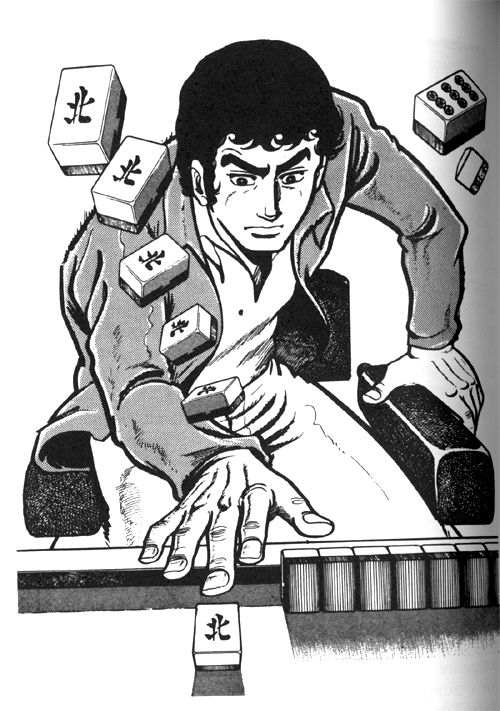
While Akagi and Saki were probably a lot of people’s introduction to the notion of manga based on the game mahjong, I don’t think I’m alone when I say that my first introduction to “mahjong manga” was from Frederik L. Schodt’s seminal book Manga! Manga! The World of Japanese Comics.

In it, Schodt explores the burgeoning genre and talks about popular titles such as Mahjong Houroki (“Tales of a Wandering Mahjong Player”) and Jigoku Mahjong (“Mahjong Hell”), even citing the author of Mahjong Houroki, Kitano Eimei, as the sort of “father” of mahjong manga, who showed that a comic about dealing tiles could look and feel exciting.

Truth be told, while I was fascinated by the idea of mahjong manga back when I first read Manga! Manga! ten years ago, I am not so different than the people who discovered it through Akagi, as that was the first mahjong series which I actually had the privilege to see. And while I don’t expect mahjong manga to become a runaway success in even the scanlation community, it’s clear that it has its devoted followers.

Here’s the odd thing though: Where are the scans of Mahjong Hourouki? If Akagi and Saki have resulted in people from all over the fandom getting into mahjong even at a periphery level, why hasn’t anyone bothered to look into these significant works which established the genre that so many are enjoying now? And it can’t really be the case where fans of these newer series might not like the older series due to the artwork. After all, we’re talking about Akagi fans here, and I’ve never seen anyone proclaim, “If the characters don’t have ultra pointy faces and noses and everyone looks shocked all the time, then I refuse to read it!” And I see you considering making a comment where you reiterate what I just said. I’m watching you.

Oh, and of course the reason I’m talking about it in the realm of scanlations and such is that no sane company would license a mahjong series in the United States. The closest you’d get to one that could conceivably do well is Saki which is streamed on Crunchyroll, and even that is a bit of a stretch when you consider the not-internet.

The most likely culprit is probably scarcity. It’s no doubt difficult to find these old series in the first place, especially with a niche genre like mahjong. And I’m as guilty of not contributing to the pursuit as any other. This is the first post I’ve made about it, and it’s only because I was re-reading Schodt’s book today. But still, I’m making the call out. We have to find these old works, titles like Mahjong Fuunroku (“Mahjong Crises”) and Gambler no Uta (“The Son of the Gambler”), and bring them to the forefront of consciousness.

Yes I Am Quoting Myself

For the Reverse Thieves’ second Speakeasy Podcast they compared Gurren-Lagann and Shin Mazinger, discussing why the former has a much more universal appeal among current anime fans than the latter. One of the topics that interested me was the false assumption that if a person likes Gurren-Lagann then the next step is Shin Mazinger, or similarly that if a person likes Gundam W that they will like the original Gundam as well. I thought of an analogous situation which I think sums up this problem quite well, and I wanted to have it on-hand and on-blog.

So consider, if you will, the following hypothetical conversation.

“Hey, what’s your favorite cereal?”

“Frosted Flakes!”

“Well if you like Frosted Flakes, I think you’ll enjoy CORN FLAKES! It’s the ORIGIN of Frosted Flakes!”

The person recommending Corn Flakes has his heart in the right place, but doesn’t realize that the reason why the other person likes Frosted Flakes so much might be mainly because of the sugar frosting, i.e. everything that Frosted Flakes have that Corn Flakes do not.

Reducing things down is not the answer for everyone, and just like Frosted Flakes vs Corn Flakes, I think people enjoy the total package of Gurren-Lagann, making it difficult to sell some fans on the idea of Gurren-Lagann stripped down to its bare essentials.

The Divide of Time, Space, and Imagination: A Look At the Concept of Nostalgic Merchandise

A few days ago, when I wrote about the direction giant robot designs have taken over the years, I received a comment pointing out to me the “Master Grade RX-78-2 Gundam 2.0,” which was a new model kit version of the iconic original Gundam, only designed to more closely resemble the mobile suit as it appeared in anime. When compared to previous RX-78-2 model kits, this means less details, different proportions, and a more “cartoonish” look overall.

Interested in how hobbyists took to this version of the classic Gundam, I looked at reviews of the kit. Any time its aesthetics were criticized, it was largely because the model was not as detailed as they liked. Being “anime accurate” was not a positive trait, and they would point out other kits, notably the “One Year War” version with a higher level of grittiness and detail, as a preferred alternative. In response to all this, I made my own comment, which was to point out that these fans appeared to be saying, “I don’t want the RX-78-2 to resemble the robot in the show, I want it to resemble the robot in my imagination!”

Then today, I saw the Toy Fair 2010 GI Joe toys. These action figures were designed based on the 80s version of GI Joe, the 3 inch figures instead of the giant doll-like ones. The only thing is, they are much more detailed and gritty than the 80s toys they were based on! It was also made clear that these toys are there partially for GI Joe collectors, adult men who look back fondly on their childhood toys, and I think it is all the more apparent that, like the One Year War RX-78-2, these GI Joes are trying to fill the gap between the actual toy and the collectors’ memories of what the toys were like as children, memories fueled by the power of childhood imagination. And there, in the attempts to make up for the loss of childhood creativity and thinking with skilled craftsmanship, lies the foundation of the nostalgic toy.

That is not to say of course that adults are incapable of having strong imaginations. Fiction as a whole would be incredibly boring if that were the case. Nor am I lumping everyone in as wanting more “realism” in their toys, as the original commenter I referred to above was all in favor of more toys like the MG RX-78-2 2.0. Instead, the issue is simply that the mind of an adult is simply different from the mind of a child. I am reminded of this fact whenever I look at drawings from my childhood and compare them to what I have done as an adult or even as a teenager.

When I previously touched on the subject of childhood imagination as it applies to animation, I talked about how children tend to ignore significant errors in animation and make up for these deficiencies through their imagination. But now when looking at a similar topic, that of toys and model kits, I realize that it’s not just a matter of childhood imagination “filling in the gaps,” but that childhood imagination, unlike adult imagination, cares little about “structure.”

If you look at the Soul of Chogokin series of toys, you will find everything I’ve been talking about, with its more solid and realistic redesigns of classic mecha targeted towards adult buyers, but if you want to really see what I mean by adults caring about structure, take a look not at the Soul of Chogokin line, but the original-style Chogokin toys, or rather, reviews of them by collectors. You will find that the way the reviewers talk about the features of the toy, about what is good and what is bad, is almost inevitably a very “adult-minded” way of looking at the toy, giving words to topics such as “points of articulation” and what-not. Even when referring to the nostalgia factor this happens, whether the topic is Chogokin, Jumbo Machinders, or Generation 1 Transformers.

It’s common knowledge among collectors, but the first generation of Mobile Suit Gundam toys, resembling the “neat gadgets”-style Chogokin toys that preceded it, were a marketing failure, as the toys did not really match up with what was on the screen. It really wasn’t until the concept of the giant robot “model kit” revolutionized giant robot figures that Gundam merchandise became the monster that it still is today, and people claim that this has to do with the fact that the audience for Gundam was skewing older than giant robot shows had in the past. I may be jumping the gun here, but what it looks like to me is that the older audience of younger and older teens were looking for more structure and accuracy in their toys, and that is what they got. As soon as Gundam hit that older demographic, I believe the Chogokin-style toys were dealt a serious blow, even putting aside the shoddy designs and inaccuracies of the original toyline. I think that the attitudes towards the 2.0 MG RX-78-2 are actually an extension of this over time and international waters.

Actually, more than even Chogokin reviews, if you really, really want to see the difference between child and adult mindsets and creativity, take a look at the webcomic Axe Cop. Promoted as being written by a 5 year old and drawn by his 29 year old brother, the artist admits to the story not being truly written by his significantly younger sibling, but that he asks the young child questions about the setting and events that occur, and then builds a story around it. The adult adds structure to the boundless imagination of the child, structure that is necessary to keep it all together, even if it doesn’t make sense entirely.

The child’s imagination says, “This is what happens.”

The adult’s imagination asks, “Why?”

But when it comes to reality, the child and adult’s responses reverse.