I recently wrote my initial thoughts on the new Granblue Fantasy anime, which you can find on Apartment 507.
In short, I think it’s off to a great start.

I recently wrote my initial thoughts on the new Granblue Fantasy anime, which you can find on Apartment 507.
In short, I think it’s off to a great start.

Whenever a group of people share a common interest, it’s easy to think of them as a cohesive unit of similar minds and opinions. Then reality sets in, and it becomes clear that they’re often from different homes, have different personalities, and even perceive their hobby or passion differently. For the music-themed anime Sound! Euphonium, I find that its character portrayals go a long way in emphasizing the subtle peculiarities of the members of the music club. Friendship and other complicated relations arise from these differences and help to further emphasize the fact that music is what unifies them.
There are large gaps in talent and experience between the core group of four in Sound! Euphonium, and each of their stories are made further complex with their reasons for playing. Reina is by far the most dedicated to the art of music, but it’s not from a pure love of song, as evidenced by her crush on her teacher. Sapphire (“Midori”) is not quite as skilled as Reina but still very strong, and her fondness for instrument mascot characters makes music a lifestyle of sorts. Kumiko has a love-hate relationship with her euphonium, which is gradually revealed to come from a love-hate relationship with her older sister. Hazuki starts off as a complete newbie in all respects who learns the tuba as a social experience.
In spite of these differences, all four characters feel like equals. Their individual relationships might not be evenly developed (Reina is more connected to Kumiko than the others, for instance), but they come across as a close group of friends whose perspectives play off of each other. There’s a vast chasm in ability between Reina and Hazuki, but the paths they take when it comes to their journeys with music feel just as emotionally significant to the individual characters. Although Kumiko is clearly the main character of the story, and Midori is never shown to be in any of the same awkward situations, she still comes across as vital to the quartet.
Sound! Euphonium has a lot of strengths, and chief among them with respect to what was written above was the balance between the development of its narrative and the environment created by its character interactions. Unlike K-On! (a series to which it is often naturally compared), which had being in a band as a theme but was more dedicated to showing slice-of-life comedy hijinks, the goal of reaching Nationals centers and grounds the story in a momentum of forward progression. Having its characters at widely varying skill levels helps to give that challenge of coming together a greater importance, while the sense of equality that exists between them in spite of those gaps creates an almost palpable sense of intimacy.
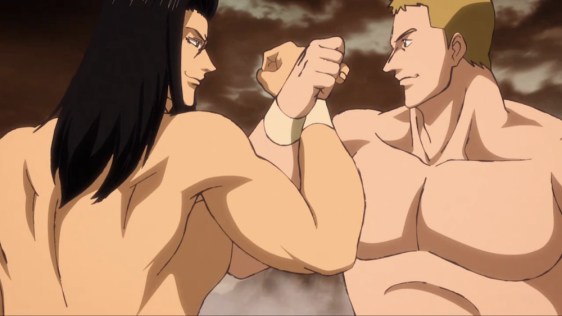
Pictured Right: The Best Guy
Both anime and pro wrestling are larger-than-life fantasy worlds, so it’s inevitable that a wrestling-themed anime like Tiger Mask W would be populated with big, bombastic personalities… some even based on real-world wrestlers! Among these characters, there’s one that at first seems easily forgettable, but as the show has progressed reveals himself to be the best man around: Kevin Anderson.
Kevin is a wrestler for the dastardly Global Wrestling Monopoly, the largest wrestling federation in the world and front for the Tiger’s Den, a clandestine organization that trains evil wrestlers. He does not have any appellations, like “Hitman,” or “the Ace,” or “Bigfoot.” With generic tights and a generic look, Kevin’s just Kevin. At best, he’s the guy always next to the GWM’s hot new wrestler, Tiger the Dark.
But it’s in the background where Kevin shines. Through thick and thin, Kevin rises to the occasion, especially when helping out Tiger the Dark. He knows he’s not quite as strong a wrestler, especially compared to the top echelon of GWM big-shots, but he’s loyal to this friends and will lend a hand in times of need. Over and over again, Tiger Mask W makes it seem like Kevin is just going to fade away into irrelevance as the other characters grow in power and intensity, but Kevin’s actually never far behind. When others look out for themselves, Kevin has an eye for the bigger picture.
In the anime and manga Monthly Girls’ Nozaki-kun, there’s a scene where the characters are playing a dating sim and trying to genuinely find the right partner for the protagonist. As they go through all the girls, they find in every single one of them a deal breaker that makes them not good enough for their precious player character. Suddenly, it dawns on them: it’s the best friend, a guy who’s always there to help out, lend an ear, and even give a shoulder. Kevin is Dating Sim Best Friend.
Kevin Anderson is a seemingly milquetoast character who defies his own design. In doing so, he might just secretly be the greatest supporting character around.
Did you know that Kinomoto Sakura’s birthday is April 1st?
Upon learning this, I realized that major spoilers for Watanuki in XXXHolic were staring me right in the face all along (his name means “April 1st”).
Do any of my Patreon supporters have an April birthday? Whether they do or not, I’m still just as grateful for their support:
General:
Johnny Trovato
Ko Ransom
Alex
Diogo Prado
Viga
Yoshitake Rika fans:
Elliot Page
Hato Kenjirou fans:
Elizabeth
Yajima Mirei fans:
Machi-Kurada
Here are the post highlights for this month:
Part 2 of my Genshiken re-read is up, and it’s amazing to see how many characters come and go in the second volume.
March also saw the end of the New York International Children’s Film Festival. Here are all the Ogiue Maniax reviews from the event:
Ancien and the Magic Tablet/Napping Princess
The runaway hit of the last season was definitely Kemono Friends. It was such a big deal I had to write about it twice… sort of.
I also got back on track on my chapter reviews of Kimi xxxru Koto Nakare. The series looks like it got delayed for a little while, but I hope it’s coming back. I really do think it’s an excellent series.
Lastly, it was a close call, but I wrote my thoughts on March Comes in like a Lion. I knew I’d like the show, but I’m even more impressed with how well the show makes its protagonist Rei relatable.
April means the end of the winter anime season and the start of some new shows. That means you’re likely going to see a bunch more reviews for anime that concluded this past season. Early on, I saw quite a few people online expressing their opinions that the winter was something of a disappointment. While this has turned around somewhat, thanks to the rising popularity of shows such as Kobayashi’s Dragon Maid and Kemono Friends, I feel like that idea still persists.
As for new shows, I’m looking forward to Love Rice a show about rice-themed idols. It’s as if Hanayo was allowed to make her own anime.

“Any sufficiently advanced technology is indistinguishable from magic.”
There are few quotes in science fiction more famous than Arthur C. Clarke’s above. While the idea largely has to do with how science fiction extrapolates the possibilities that can be envisioned from scientific development, Kamiyama Kenji’s new animated film, Ancien and the Magic Tablet, plays with the notion in an interesting way, using a blend of dreams and reality to fuse technology and magic together throughout its narrative.
As a warning, while I’ve done my best to avoid spoilers, the fact that this film is full of surprises only five minutes in means I can’t avoid talking about at least a few of the twists.
Ancien and the Magic Tablet begins with the story of a princess of a kingdom, Ancien, who is trapped in a cage above the royal castle. Her kingdom, known as Heartland, is ruled by her wise father, who is responsible for spreading the use of automobiles throughout their land. The reason Ancien is locked away is because she has a mysterious power to bring inanimate objects to life, including dolls and cars, an ability that would turn all of Heartland upside down.
…Except that it’s all a dream and the actual story is about a girl named Morikawa Kokone, a perpetually sleepy Japanese high schooler living in Okuyama Prefecture in the “far flung” future year of 2020—shortly before the Tokyo Olympics. Living with her widowed father, who works as a mechanic and programs self-driving car AI for the elderly residents of their town, Kokone learns that her father (or rather his computer tablet) holds valuable secrets worth a lot to some very important people. Kokone ends up on an adventure to Tokyo to get to the bottom of all this, all while she keeps having dreams about Ancien and Heartland—a world based on stories her father told her as a child—that mysteriously play out in reality as well.
One of the main thrusts of Ancien and the Magic Tablet (known in Japan as Hirune Hime: Shiranai Watashi no Monogatari, or “Napping Princess: The Story of the Unknown Me”) is a treatise on the benefits of self-driving cars. Ancien and her tablet are overt parallels to the AI technology that Kokone’s father possesses, and it’s portrayed largely in terms of its benefits. In regards to this stance, the film impresses me because it doesn’t try to remain neutral or passive in terms of the beliefs it’s trying to convey on such a controversial topic.
Given the writer and director Kamiyama’s previous works (Ghost in the Shell: Stand Alone Complex, Eden of the East), a certain level of love and faith in technology is expected. While Ancien could do more to address the repercussions self-driving cars could have on the global economy, I don’t hold it against the movie too much because it does emphasize certain benefits that don’t come up as often. For example, it can be argued that self-driving cars aren’t only about taking away control, they can be about ensuring safety because of loss of control or disability. A more nuanced approach would’ve been interesting in its own way, but I can live without it at least for one film.
Going back to Arthur C. Clarke, the dream world of Ancien, particularly the “magic tablet’s” ability to “bring things to life,” are basically a fairy tale metaphor for real-world technology. However, because the events in Ancien’s and Kokone’s sides of the story mirror each other and even seem to influence each other, it’s an ongoing mystery as to how the two narratives are related. Is it somehow possible that Kokone is tapping into an alternate reality? The film keeps you wondering right until the very end, and the ultimate explanation for the relationship between Ancien and Kokone’s worlds is actually very satisfying and makes absolute sense.
Ancien and the Magic Tablet feels like the start of a conversation rather than a definitive conclusion. I hope we continue to see its themes in future animated films.
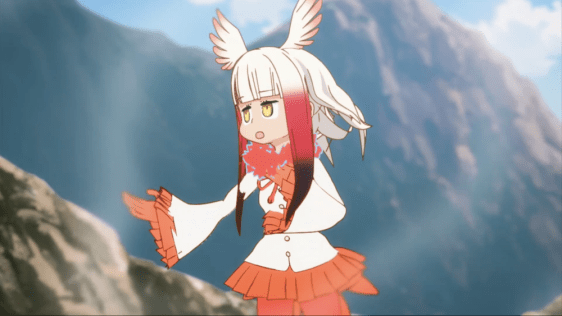
So you’ve watched the last episode Kemono Friends, and found it to be an excellent conclusion to a surprisingly good anime. Its portrayal of friendship and its exploration of defines humanity has left you with lots of laughs and maybe a couple of tears. Now you’re looking for more, and you find that the studio behind Kemono Friends, YAOYOROZU, only has one other anime to its name. Its title is confusing and maybe even a little difficult to pronounce. Should you watch it? Is it as good as Kemono Friends?
The answer is yes, yes, YES.
Tesagure! Bukatsumono does not take place in a mysterious zoo/amusement park. Its characters are not animal-human hybrids. What it does have in common with Kemono Friends, however, is a keen sense of humor that uses both excellent timing and a kind of anti-timing to great effect. To begin to get an idea of what this show is all about, I recommend watching the opening with subtitles on:
Perpetually tongue-in-cheek, the self-aware and often aimless Tesagure! Bukatsumono revolves around four girls in the same club, whose main activity is trying to imagine what other clubs are like. As they all talk through their preconceived notions and try to make up their own “new and improved” versions of other school clubs, their answers become increasingly absurd, providing much of the humor of the series. The title of the anime roughly translates to “Let’s Find a Club!”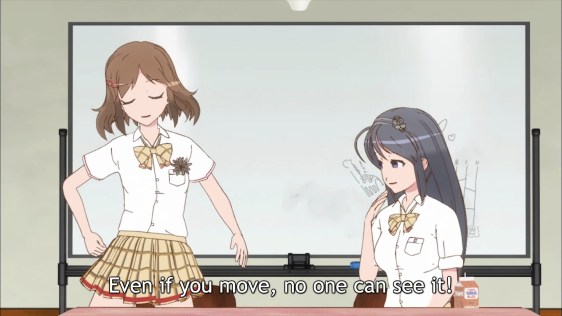
You might notice that something feels a little different about those “new and improved” suggestions that the girls of Tesagure! Bukatsumono make. The reason is that those sections are not scripted—they’re actually improv. The back-and-forth between the characters/actors is genuine, and any gaffes are kept in. If you enjoyed the next-episode previews of Kemono Friends with the penguin idol group PPP (or even their dedicated episode), Tesagure! Bukatsumono is that times ten.
Currently on Crunchyroll, each episode is roughly 13 minutes. Much like Kemono Friends, you’ll know if you enjoy the series after one or two episodes.
I thought it appropriate to talk about the anime March Comes in like a Lion on the very last day of March. Call me a sucker for that sort of thing.
Umino Chika is a creator who opened up my eyes to a new world of storytelling. In the past, another anime adaptation of one of her manga, Honey & Clover. Watching thathttps://www.youtube.com/watch?v=3u6lyeC5jOo series, I could relate to both the art school antics (I was attending art school myself at the time), and the rush of emotions positive and negative that could come from seemingly simple interactions with people and the world. Now, over a decade later, I find her more recent work, March Comes in like a Lion, to carry a similar weight even though I’m further in age from its protagonist compared to Honey & Clover.
March Comes in like a Lion follows Kiriyama Rei, a young shogi prodigy with a difficult past who befriends three sisters that take care of him as he tries to get through his shogi career and life in general. The series swings heavily between darkly depressing and frenetically cheerful in ways that mirror Rei’s own internal struggles.
I find Rei to be a fascinating character. When it comes to anime protagonists, he’s somehow both the clever genius many wish they could be, but also highly relatable in terms of how he thinks and feels. Rei is intelligent beyond his years, but he’s also only in high school and thus inexperienced not only in the ways of the world but also in shogi itself. He’s prone to both self-deprecation and arrogance, both looking too far ahead and staring at his own feet. Whether someone is a hard worker who tries to make up for a lack of talent, a genius who can’t seem to muster the will to push further, or even both or neither, it feels as if anyone who understands both the thrill of victory and the agony of defeat, in formal competition and in life, can connect to Rei’s joys and frustrations. Even if he isn’t perfectly relatable to everyone, there’s bound to be a character that viewers can connect to.
The anime is produced by SHAFT, a studio that for the past decade and change has been known for highly stylized visuals that utilize odd camera angles, unorthodox color palettes, and emphasis on both the flatness of 2-D images and their ability to convey a sense of three-dimensionality. For many of their series, this works fairly well, but the subdued pace of March Comes in like a Lion means the SHAFT style at times risks being too over-the-top for its own good. Fortunately, the March Comes in like a Lion anime is relatively restrained in its approach, especially in the more dark and moody moments and in the shogi matches themselves, which tend to be a mix of cerebral strategizing and emotional ping pong. Sometimes the visuals can go too far, but for the most part any sort of traditional SHAFT antics are reserved for the more light-hearted scenes, especially those involving the Kawamoto sisters mentioned above.
This is not the first shogi-themed series I’ve really enjoyed, but it is almost the polar opposite of my favorite, 81 Diver. If that manga is like a stick of dynamite strapped to an apple pie, then March Comes in like a Lion is like a wool blanket, warm yet occasionally itchy. I’m not sure how those two things are opposites per se, but I’ll just say that they are and leave it at that.
You can watch March Comes in like a Lion on Crunchyroll.

Name: N/A
Alias: N/A
Relationship Status: N/A
Origin: Happy Fujoshi: Fujoshi to Futsal
Information:
This fujoshi participates in a futsal game with other anime fans, some of which are cosplayers. Nothing else is known (because the artist actually forgot to make a manga about fujoshi despite the book being a fujoshi character anthology).
Fujoshi Level:
Other than that she is a fujoshi, there is no other information.
 Because Kimi Nakare went a couple of months without a new chapter, I kind of lost track of it. Turns out a new one came out in February! Apologies for the lateness, but I’m hoping to see this series get back into the swing of things.
As an aside, because the title of this manga has “xxxru” in it, I seem to get quite a few hits from people searching for Russian adult videos. My apologies to you visitors as well; you’re not going to see any of that here.
Summary
 Hayato’s serious about his confession to Nobuko—he even says he’ll quit being an idol if it’s to be with her! The class reacts in shock, while Nobuko runs away again to the nurse’s office. However, the nurse understands right away that love is at the heart of the matter, and the reason Nobuko hesitates is because she has feelings for him as well.
As previously announced, WARP has their final handshake event, and their most loyal fans show up. Surprisingly, despite the revelation that Jirou has a girlfriend (now fiancee), he hasn’t received any backlash. This is attributed to the fact that Jirou’s fans are mostly older, more mature women.
As for Shingo, he meets a girl holding a memorial photo of her older sister, the hospitalized girl who inspired him to keep working as an idol. Shingo finds out that the older sister had told the story of their encounter many times, but assumed that Shingo, busy celebrity that he is, wouldn’t have remembered. In the end, Shingo asks the other members of WARP if they can keep the group together after all.
The Paparazzi Rant

At one point in this chapter, a newly introduced character goes on a tirade about the evils of tabloids and how they turn fans against the idols. “It’s not the fault of the idols for having relationships, it’s the fault of the tabloids for reporting this information in the first place!” The reason this stands out is that it feels to me like this character is a mouthpiece for the author, but I can’t say one or way or another. Moreover, I’m not sure how much I should delve into breaking down this statement. On the one hand, it sounds a lot like “it’s okay if the idols do whatever, as long as the fans don’t know,” which seems ignorant. On the other hand, my ideal picture of idol fandom is akin to pro wrestling, where the fans know that the stars are putting on an act. Taken this way, it’s more a criticism of tabloids trying to arm the pitchforks of the fans, that the tabloids are less about journalism and more about exploitation.
Shingo’s Girl

I mentioned in the last review that each chapter always feels like it’s going to be the last, and this one was no exception. We only learned about that hospitalized girl a chapter ago in a flashback, and now she’s dead! That definitely felt like a climactic moment, but to have it come into play in the very next story makes Kimi Nakare feel like it’s barreling towards its conclusion yet again.
Still, I was moved by the interaction between Shingo and the younger sister. Okachimachi’s art does an excellent job of showing Shingo’s conflicted emotions.
“Nobuko-chan, Suteki Desuwa”
Another heart-tugging moment comes at the beginning, after Hayato’s open confession. Natsumi, seeing Nobuko’s paralyzed state in the face of that big ol’ “I love you!”, tries to help Nobuko calm down, despite being in love with Hayato as well. I get a strong Daidouji Tomoyo from Cardcaptor Sakura vibe from Natsumi, and it makes me feel for her every time she tries to nudge the two of them closer together. Fortunately for her, Hayato and Nobuko aren’t nearly as dense as Shaoran and Sakura, but that prioritization of her friends over herself makes me hope that she can find happiness in her own right.
Last Thoughts
By declaring his love in front of their classmates, I wonder if Hayato is setting up Nobuko to get bullied. I feel like Nobuko being less beautiful probably marked her as a “safe entity” in the eyes of any Hayato fans in school, a defense that has been further bolstered by Nobuko’s onscreen comical behavior with Hayato as his goofy, obsessed pursuer. Now that it’s the open, however, is Nobuko in trouble? Is Kimi Nakare even that kind of manga? I’d like to find out.
—
If you liked this post, consider becoming a sponsor of Ogiue Maniax through Patreon. You can get rewards for higher pledges, including a chance to request topics for the blog.

 OGIUE MANIAX