Crunchyroll recently announced a slew of new manga for its site, and given my interest in stories themed around fujoshi characters, Watashi ga Motete Dousunda by Junko stands out to me the most. Below is the official description:
Kae Serinuma is what you’d call a “fujoshi.” When she sees boys getting along with each other, she loves to indulge in wild fantasies! One day her favorite anime character dies and the shock causes her to lose a ton of weight. Then four hot guys at school ask her out, but that isn’t exciting to her at all — she’d rather see them date each other!
Also of note is the fact that there’s a naming competition for the official English title. The title literally means “What Am I Going to Do About Being Popular?” but the series also already has an alternate English title: Boys, Kiss Him Instead of Me.
I recall that this manga had some controversy surrounding it due to its basic premise and the message it might be sending to those with eating disorders. However, I hadn’t followed up on either that discussion or the actual manga itself so I can’t recommend it offhand, but I’ll definitely be checking it out.
Its characters will also eventually appear in the Fujoshi Files, my catalog for fujoshi characters in anime and manga (the list recently passed 100!).
As far as I know, Watashi ga Motete Dousunda would be the fifth fujoshi-themed manga to be licensed in English, following Mousou Shoujo Otakukei (aka Fujoshi Rumi), Fujoshi Kanojo (aka My Girlfriend is a Geek), Moehime (about a Heian period fujoshi, formerly on JManga), and of course, Genshiken Nidaime (or Genshiken Second Season).
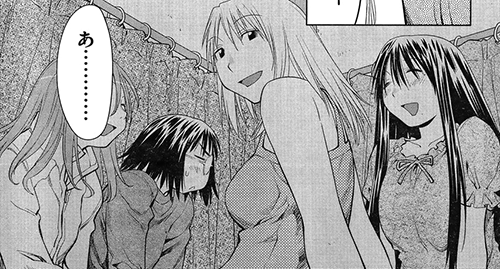
Name: Fukuda (福田) Alias: N/A Relationship Status: N/A Origin: Genshiken: The Society for the Study of Modern Visual Culture II
Information:
A friend and fellow history club member with Genshiken member Yoshitake Rika back in high school, Fukuda is a person of few words. She acts as a tsukkomi of sorts to Yoshitake and her other friend Sawatari antics, often responding to them in deadpan.
Fujoshi Level:
Unknown at this time, other than that she had otaku conversations in addition to history-related ones in high school.
Genshiken has portrayed elaborate fantasies, some nudity, and implied sex, but Chapter 103 may be the most erotic chapter the manga has ever seen.
At the end of the last chapter, Madarame was headed with Keiko to her apartment. While it was a little unclear (though heavily implied) that Keiko was using this situation to her advantage, all doubts are erased in Chapter 103 as Keiko does everything in her power to seduce Madarame. On the verge of success as she bids Madarame to feel some real skin, they are interrupted by a phone call from Keiko’s boyfriend, who plans to come over. After Keiko casually admits to having affairs pretty regularly, Madarame escapes, though Keiko expects for him to return.
When I say that this month’s chapter is especially erotic, it has a lot to do with the fact that this is the first chapter ever in Genshiken that has been primarily devoted to one person’s efforts to seduce another. Not only that, but this chapter creates an atmosphere of anticipation and sexual excitement through Keiko’s actions and gestures, going one step even further than the last chapter. Everything Keiko does, from her decision to shower to her choice of clothes, from her subtle choice of words that boost Madarame’s confidence to her serious bedroom eyes, implies advancement towards sex… not to mention that they’re in such a confined space. While I’m not typically one to analyze erotic manga (and this doesn’t quite count as eromanga in the typical sense), I would like to discuss the first panel in the image below, where Madarame’s hand is above Keiko’s open sweatshirt after she’s invited him to touch her breasts.
There’s a real sense of tension in the panel, created by its size, the lack of word balloons, and especially Keiko’s expression, which conveys excitement, anticipation, and even arousal. What’s also notable is that this eroticism is different from the fanservice scenes in the anime Genshiken 2 (not to be confused with Genshiken Second Season), which at times were virtually pornographic (the studio that made Genshiken 2 is best known for its work on Ikkitousen and Mezzo Forte, among other things). Instead, in terms of portraying sexual acts, this veers closer to what can typically be found in more adult josei manga in terms of buildup.
When looking at this chapter, I get the strong feeling that Kio Shimoku’s work on Spotted Flower is bleeding into his work on Genshiken. After all, he has a history of sorts with this, as the very first chapter of Genshiken II was made at a time when his latest work was Jigopuri, and characters looked much rounder and more in line with a moe aesthetic. One can think of Spotted Flower as essentially an alternate universe Genshiken where a man very much like Madarame is married to a woman very much like Kasukabe, and it has been an opportunity for Kio to portray adult sexual desire with far more detail than Genshiken is known for. Whether that’s through depictions of nudity, scenes about the wife trying to get the husband erect, or just the general expression of romantic lust, Spotted Flower has distinguished itself from Genshiken by being a more mature and sexually explicit series. Keiko’s interactions with Madarame venture deep into that territory, and I wonder if this will have a long-term effect on Genshiken going forward.
I think it’s useful to compare Keiko to Angela, not only because Angela once attempted to seduce Madarame herself, but that they have much in common when it comes to men. In my review of Chapter 93, I mentioned that Angela and Keiko look like they could be friends, and I think it’s no accident that Kio has portrayed them as both aiming for the boob grab as the lynchpin of their pursuits of Madarame. Both of them are quite experienced with sex, and both are aware that, for guys in general but especially a virgin like Madarame, breasts are placed on this grand pedestal. Keiko is even shown planning to moan erotically as soon as Madarame makes his move as a way to draw him in further, a bit of characterization in a sexually charged scene that indicates Keiko’s understanding of Madarame and further shows that she and Angela are of similar minds.
Now, I think a fair number of people, upon reading my description and analysis of Chapter 103, might feel that Genshiken has hit the point of no return. “Seriously? A scene where Madarame is basically about to have sex with Sasahara’s sister? What is this harem stuff? What happened to this manga?” Interestingly, the chapter features an explanation as to how Madarame finally started being viewed as attractive. At one point, Keiko says that seeing an otaku like Madarame in love with a person like Kasukabe who is (from Keiko’s perspective) completely out of his league actually makes him pretty cute in her eyes. In other words, as Keiko puts it, it’s thanks to Kasukabe that Madarame was able to exude his awkward charms. Not only that, but Keiko is sort of fond of no-good, pathetic types as well.
When thinking about the other characters, Sue, Hato, and Angela, they’ve all been shown to have also come from similar angles, either implicitly or explicitly. Sue’s wild denial that she has feelings for Madarame is the direct result of Saki seeing her kiss him. Angela already had a thing for sou-uke characters in anime and manga, and she began making her move upon learning that Madarame was feeling heart-broken. Hato, why, much of the series at this point is about his growing affections for Madarame’s character flaws, and it was even prompted by him learning about his unrequited love for Kasukabe. Of course, with Keiko it’s not as if she only has eyes for Madarame; he’s but one of many that she wouldn’t mind sleeping with. The fact that not everyone interested in Madarame has the same view of sex and relationships (which is often the case with actual harem anime and manga) is part of what makes this story arc intriguing. I do have to wonder if Keiko’s boyfriend is of a similar personality in spite of his greater financial success (he’s a subordinate of the president of an IT company).
Next chapter will be about Hato, but the question on my mind is, how will Sasahara react when he finds out about this?! I’ve read comments where people think it’s all over for Keiko x Mada, but I get the feeling that she’s not quite yet done.
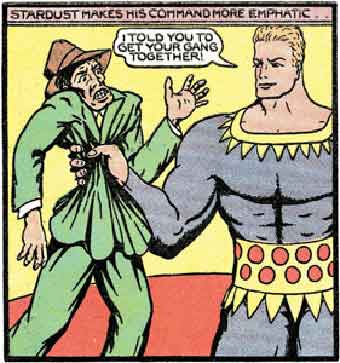
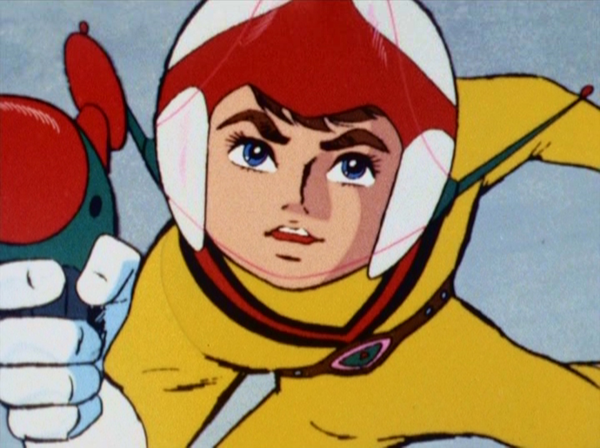
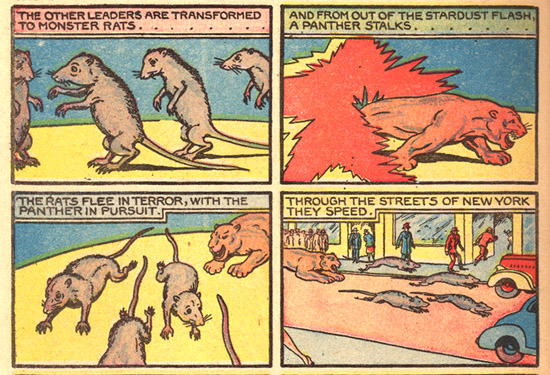
I had an epiphany recently: Stardust the Super Wizard is the American superhero comics equivalent of the anime Chargeman Ken!
Even if you’ve never heard of either title there’s nothing to worry about, as their first point of similarity is that they’re both obscure titles which have garnered fanbases specifically due to their lack of quality. Their second point of similarity is that little effort is made to expand on the characters themselves, as both Ken and Stardust can be defined as 1) heroes 2) who kill villains and 3) that’s it.
The third point of similarity is what allows them to be spoken of in the same breath (not that I think people have), which is that both titles are utterly irresponsible when it comes to the stories they present. I don’t mean that they glorify violence or that they don’t send the proper moral messages or that they’re limited by the cultures in which they were created. The reason why I use the word “irresponsible” is that both Chargeman Ken! and Stardust the Super Wizard consist of adventures where, if one were to stop and think about what goes on in them, they break down into a kind of pure spectacle that isn’t so much morbid or horrific as it is just somewhat…thoughtless.
Chargeman Ken‘s most infamous episode is titled “Dynamite in the Brain.” I’d recommend you watch the video above first (it’s only 5 minutes long) to get the full impact, but to summarize: the episode is about an innocent scientist with a bomb implanted in his head, but rather than trying to figure out a way to remove the bomb, Ken decides to just unceremoniously dump the scientist out of his personal jet. As Ken activates the trap door underneath the scientists, he quickly says, “Professor Volga, please forgive me!” as Volga lands on an enemy aircraft and explodes. The thing that really drives home the sense of thoughtlessness though is the fact that at the end of the episode the characters are talking about how Volga, the man Ken literally ejected out of his ship and watched as he exploded in mid-air, is looking down from the skies above. It’s like giving a eulogy for someone you shot to death five minutes ago and expecting people to take you seriously.
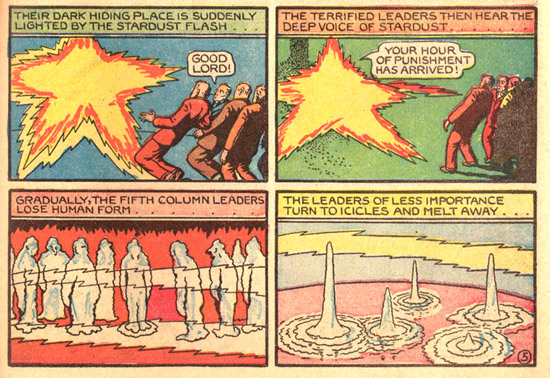
Stardust the Super Wizard, unlike Ken, has a seemingly infinite array of superpowers which have little rhyme or reason, but similar to Ken his application of them shows little in the way of foresight by the character or the creator. Just look at the punishment he dishes out to the villains of his story, where the issue isn’t that his solutions are strangely grotesque but that they almost exist in another dimension of thought.
Both Chargeman Ken and Stardust the Super Wizard operate on a level beyond even GI Joe‘s image of sanitary militarism or the violent works of Nagai Go. And this is why they’d be the best crossover ever.
Name: Sawatari (沢渡) Alias: N/A Relationship Status: N/A Origin: Genshiken: The Society for the Study of Modern Visual Culture II
Information:
One of Genshiken member Yoshitake Rika’s friends from high school, she attended the same History Club as Yoshitake. She enjoys challenging Yoshitake with history trivia, and is still good friends with their other history club member Fukuda. She appears to have an outgoing personality similar to Yoshitake’s.
Fujoshi Level:
Unknown at this time, other than that she had otaku conversations in addition to history-related ones in high school.
Sign wa V! (The V Sign!) by Mochizuki Akira, is among the most popular volleyball manga ever. Debuting in 1968, the same year as Attack No.1 (the volleyball series in terms of notoriety), both of these titles capitalized on the success of the volleyball boom that had began in 1964 when the Japanese national women’s team won the gold at the Tokyo Olympics. Sign wa V! even received not one but two live-action television dramas over the yesrs. Like Attack No.1, Sign wa V! is a “sports guts” story, where intense training and passion are the keys to victory. At one point, the main character tries to smash her hand with a rock because playing volleyball might mean ruining her mom’s life, but she just can’t…because she loves volleyball that much.
The main reason I’m writing this post, however, is not to review or promote Sign wa V! (although you can read it online here), but to talk about a particular character, Jun Sanders, and her possible influence on anime and manga.
A few volumes into the series, Sign wa V! introduces Jun (pictured above). Half-black, half-Japanese, she’s characterized by an intense desire to compete in volleyball and sensitivity over her skin color. Her name is a mix of Japanese and English, though Jun sounds similar to “June,” and Sanders is not her real last name but taken from the orphanage where she was raised. When Jun first appears, she has a fierce rivalry with the main character. Curiously, in the 1969 drama she was played by an actress of Taiwanese descent.
The first sign that Jun Sanders may have had some impact on Japanese media, at least as far as I can find, is the 1974 anime and manga Great Mazinger. A sequel to the seminal giant robot series Mazinger Z, this follow-up focuses on a new hero, a new demonic threat, and a more powerful robot to fight them. In this series, the protagonist has a female assistant (pictured above) who aids him in battle using her own giant robot, Venus A. Her name is Honoo Jun (written surname first), and she’s half-black, half-Japanese, with a strong and fiery personality. Though perhaps merely a coincidence, her default outfit looks similar to one worn by Jun Sanders.
Fast forward to 1999 and the release of the video game Gate Keepers, which also received an anime and a manga. I have no experience with Gate Keepers myself, but according to plot summaries, it’s about an alternate-universe post-WWII Japan with alien invaders.This series features an American character named Jun Thunders (pictured below) who, just like Jun Sanders and Honoo Jun, has relatively dark skin and long, dark hair. What makes Jun Thunders even more clearly a reference to Sign wa V! is that “Thunders” and “Sanders” are written the same way in Japanese (サンダーズ). Moreover, Gate Keepers takes place in 1969, the same period in which Sign wa V! is set (which was the “present” at the time). The Gate Keepers Jun might also be a reference to the Great Mazinger Jun because honoo means “flame,” so there’s a thunder-flame elemental connection.
There might be more characters in the Jun Sanders lineage, but these are the only ones I can find at this point. If anyone has any more information or knows other characters influenced by Jun, feel free to leave a comment.
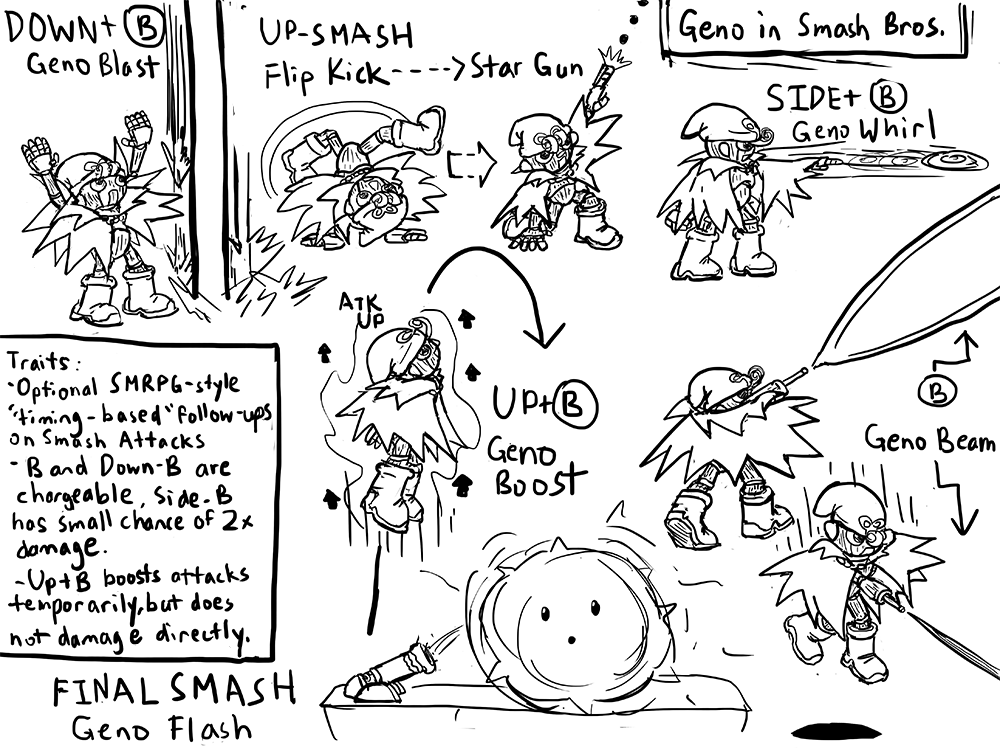
Geno is quite a popular choice when it comes to character requests for the Super Smash Bros. series, and so there is plenty of fanart out there in support of his inclusion. While this makes my drawing a bit redundant (and the special moves are all pretty much what everyone else has for Geno’s attacks), I felt that the concept of Geno as a playable character could be taken an extra step beyond simply having his moves map 1:1 with his Super Mario RPG techniques.
In particular, I had this idea that Geno could utilize the “timing” system from Super Mario RPG where pressing or releasing a button at the right time makes the characters’ attacks stronger in some way. This is demonstrated not only in the depiction of Geno Beam and Geno Blast, but also in Geno’s smash attacks. As shown with Geno’s up-smash, the idea is that Geno’s smash attacks have an additional secondary component that Geno can chain into, similar to Kyo Kusanagi in the King of Fighters series or Fei Long in the Street Fighter series. Because it wouldn’t be terribly strategic to have the follow-up be automatically better every single time, the secondary part of every Smash Attack would have its own strengths and weaknesses (like leaving Geno vulnerable if the first part doesn’t connect properly, or not hitting at the desired angle at high percentages), so it would be an active choice at all times whether or not to use the timed attack system.
Other than that, Geno would have two other main features. The first would be his space control due to the fact that many of his attacks are ranged and come in at odd angles instead of straight-on (Geno Beam shoots diagonally upwards on the ground but diagonally downwards in the air, for example). The second would be that Geno’s normal moves emphasize the fact that his body is that of a doll, so it is extremely flexible, as demonstrated in that up-smash. This would give Geno a lot of unusual hitboxes on his attacks or allow him to slip past attacks by suddenly collapsing low to the ground, for example.
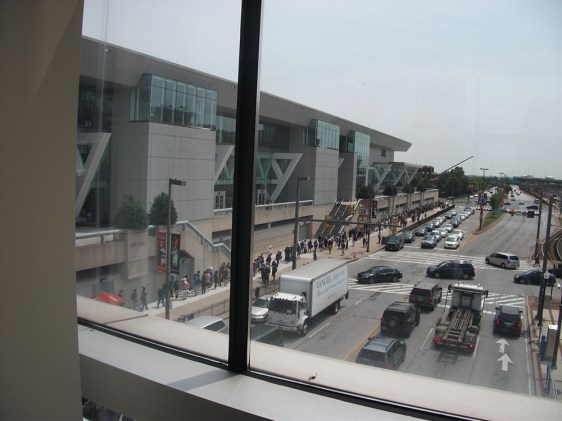
Fortune and misfortune came in roughly equal parts at this year’s Otakon, as the best weather in years for the convention mainly served to provide some reprieve for the long and grueling ticket line. Some technical difficulties forced the registration to extend all the way until Friday at 4pm (registration began Thursday). Being press I did not have to deal with this myself, so I don’t want it to sound like I am speaking entirely from personal experience, but I did accompany a couple of friends as they moved through what was a seemingly unending parade of otaku before giving up at roughly the 2-hour mark and waiting for the next day.
Some panel room shuffling this year meant that panels could hold larger audiences, while little details like dividers helped traffic flow along. The bottleneck sky bridge between the Baltimore Convention Center and the Hilton could still get backed up at times, but not quite as much as last year. Again, the weather was a major boon as it meant that even if certain parts of the con got jammed, it was a simple matter of leaving the con center and entering at a different point. Unfortunately, many of the presentations also had tech issues that mostly seemed to stem from the Otakon equipment rather than presenters’ laptops and such. However, Otakon smartly implemented 15-minute breaks between panels, which gave people time to set up and mostly work through any problems, and even if things still went awry it at least only ate into their time somewhat.
Once people actually got into the convention though, Otakon turned out for the most part to be as great as ever.
Industry Panels
This year, due to still recovering from jetlag, I took a more relaxed pace compared to previous Otakons. Having no panels to run for myself made this easier, and while the guests were good, none of them were must-see for me. Of course, even simply picking and choosing means that there are still a number of interesting panels. The best industry panels this year had to be the Q&As with director Katabuchi Sunao (Mai Mai Miracle), Otakon mainstay Maruyama Masao, founder and former producer of the anime studio MADHouse and current founder of MAPPA (Kids on the Slope, Teekyuu), and character designer/animator Matsubara Hidenori. Their new project is a film adaptation of the manga In this Corner of the World (previously released on JManga as To All Corners of the World) by Kouno Fumiyo, about a young girl living in Hiroshima during World War II. Kouno previously received critical acclaim over the similarly themed Town of Evening Calm, Country of Cherry Blossoms, and having read In This Corner of the World myself, I have to say that I am extremely looking forward to this project.
I managed to ask a couple of questions of Katabuchi. One had to do with some criticism of Kouno’s work I’ve seen in the past, where people accused her of not being directly critical enough of the Second World War and issues such as Japan’s militarism at the time. While it’s clear upon reading the manga that the work is actually quite critical and is merely subtle in its approach, I wanted to know if 1) they were aware of this criticism 2) they were prepared to address it. Katabuchi’s response was quite satisfying in this regard, as he himself gave an example of how the original manga does portray a larger world with many political issues but through the eyes of a young girl who isn’t necessarily aware of everything around her but is nonetheless affected by it in her everyday life.
In particular, Katabuchi pointed out how the main character’s desire for a yo-yo is actually a reference to the fact that yo-yos had become popular in Japan at the time, but the manga does not bother to mention this because a little girl would not be thinking about the significance of popular trends to a society. In other words, while this yo-yo example says nothing directly about the political climate at the time, it shows the awareness that the work has about what was happening in society. Given this response, and the fact that an elaborate art exhibition of their layout and design work for the movie showed just how much research they were putting in to depict a pre-atomic bombing Hiroshima, it gives me confidence that the movie will properly tackle its difficult subject matter. While Miyazaki Hayao’s The Wind Rises drew a similar kind of controversy (the criticism that it had whitewashed Japan’s role in history), I feel that, similar to Miyazaki’s film, that this will not be a simple black-and-white anti-war film.
The other question had to do with the fact that he actually worked on the, shall we say interesting, American Street Fighter cartoon. No, not the anime film with the dub soundtrack featuring Korn, nor Street Fighter II V, but the one best known for its M. Bison memes. I basically asked if he had any recollection of his experience there, and he said that it had been so long ago that all he remembered was drawing Chun-Li at some point and eventually feeling like he should have been in charge of the whole thing. At another point in the panel, Katabuchi also mentioned how he has an advantage over Miyazaki because Miyazaki is never allowed to direct something like Black Lagoon but everything is fair game for Katabuchi himself.
As for Maruyama, it’s more or less the case every year, but the man is arguably the most important person at Otakon every time he attends. In This Corner of the World is a MAPPA production and so a lot of the focus was on that, but he was of course open to questions in general. I asked him if his production style had changed now compared to his early days at MADHouse on shows such as Aim for the Ace!, but he responded that his approach to production has changed little in the 3+ decades since, as he prefers to give the creators themselves freedom to work. The only drawback is that it means he’s not the best with finances, which is why MADHouse was eventually purchased by Nippon TV.
Another interesting question courtesy of Kate from the Reverse Thieves was whether the subject matter of the current anime Terror in Resonance (terrorism and nuclear weapons) had caused any controversy or run into any problems. Maruyama responded that both he and the director Watanabe Shin’ichirou (Cowboy Bebop, Samurai Champloo, Kids on the Slope) had concerns that the TV stations would refuse to air the show, but that the two of them went forward with it anyway because that’s their style. It reminds me of the production issues that the Coppelion anime ran into that caused it to cover up all overt references to radiation, and I’m personally happy that the same fate has not befallen Terror in Resonance, or at least not yet. Overall, I have to stress that going to a Maruyama panel is always worth it, and as sad as it sounds the man is not getting any younger. That said, he did joke that he’s the same age as Miyazaki but whereas Miyazaki retired Maruyama is doing more work than ever before. Maybe it’s a MAPPA trend to make jokes referencing the famed Ghibli director.
The last guest to attend the convention that was related to In This Corner of the World was Matsubara Hidenori, known for his character design work on the Sakura Wars games and more recently for his animation work on the Rebuild of Evangelion films. He was a guest in 2009 as well, and after having heard how interesting his Q&A was at the time I made sure not to miss it. Sadly I couldn’t ask him any questions myself, but his responses in general were quite informative. In particular, he talked about how glad he was to not have to necessarily draw young, cute girls all the time anymore, and that one of the works most influential to him is the World Masterpiece Theater series En Famille or The Story of Perinne. He also mentioned that while he once tried to switch to using a drawing tablet, in the end he had to go back to pencil and paper.
I briefly mentioned the In This Corner of the World art exhibition, but it really deserves at least is own paragraph to talk about how amazing it is. I’m actually a little sad that photos weren’t allowed because the amount of work and research that went into them is nothing short of astounding. In order to properly capture the Hiroshima area of World War II Japan, they did things like find out how seaweed was dried using bamboo instead of reeds, and they even looked into the train schedules at the time to see what times would be accurate for trains in the backgrounds in certain scenes. A lot of this work would arguably be unnecessary and very few people are even alive today who remember that period, but it shows just how much they want to capture the feeling of living in that environment.
I also attended the panel for character designer Kozaki Yuusuke, and while I’m not quite the fan that others are (having only barely played No More Heroes and never having played Fire Emblem: Awakening), it was fun to see him take audience drawing requests. The two images above were the result of this, and it turns out that Kozaki even drew the cover art for the Otakon guidebook this year. This was quite noticeable as generally the artwork for Otakon stuff has traditionally ranged from subpar to mediocre. It also made me really want to read his manga Donyatsu, which is about donut-shaped dogs and cats in an apocalyptic world; in one of the images above, Donyatsu is featured being eaten by a Fire Emblem character. The main reason Kozaki was at Otakon, however, was to promote a new anime project, Under the Dog, which based on its initial material is trying to invoke a Ghost in the Shell: Stand Alone Complex-type feel but with more action. In fact, at the panel they mentioned getting an animator who worked on GitS. If you want to help make it happen, a Kickstarter went up just this past week.
Fan Panels
While the guests are generally great at Otakon, it’s the fan panels that are in my opinion the heart and soul of the experience. Compared to Anime Expo, for example, Otakon boasts a much larger set of non-industry panels, which results in a general sense of genuine enthusiasm over the experience of watching, reading, and thinking about anime, manga, and related topics.
The first panel of the convention that I attended was the Intro to Josei panel, and it was clear that they were inexperienced as presenters. The panel had two parts to it, a brief history and rundown of the significance of josei (manga for older women), and then some examples of interesting titles. Their intentions were good, but the panel had two main problems. First, it felt like two panels in one, with the seam between the history and the examples made especially visible by the fact that the first and second halves just felt completely different. Second, it was more of an introduction to J-Drama panels than one about josei anime and manga, as all of their visual examples came from dramas, even in cases where anime counterparts were available (like Nodame Cantabile). The result was that the panel didn’t feel like an introduction, but more a brief gleaning of what’s available. If they could include more anime and manga and really figure out what they want to say, then I think it would be much improved for the future.
I’ve known Daryl Surat for a long time now, and have listened to the Anime World Order podcast for even longer. As was the case last year (and possibly the years before that, I can’t remember), Daryl was a featured panelist at Otakon, and he always manages to have a strong mix of smart and stupid that keeps things fresh, entertaining, and even educational. While his Anime’s Craziest Deaths panel is an Otakon mainstay at this point and pretty much always delivers exactly what its title states, he also did a panel on ninja in anime, one on the long relationship of influence that exists between pro wrestling and anime, and one on showing some of the many references in Kill la Kill. The ninja panel was the lightest in terms of content and was more about seeing how wide and varied the perception of ninja has become to include just about anyone doing anything as long as they’re called a ninja. The pro wrestling/anime panel approached that connection from a unique angle, positing the idea that, more than simply being about one referencing the other and vice versa, some of the very fundamental storytelling aspects of anime and manga (particularly shounen fighting works) are influenced by the wrestling storylines that were popular when television first emerged in Japan. It also went into detail about the female pro wrestling scene in Japan and how it was for a long time not about appealing to men through sexy outfits but about giving girls idols to aspire to, which then created certain archetypes in anime and manga as well. Really great panel, I recommend going even if people don’t have an interest in pro wrestling.
The Kill la Kill references panel 1) made me want to watch Sukeban Deka, the show about a yo-yo-wielding delinquent girl that inspired much of Kill la Kill 2) emphasized that what makes Kill la Kill work is that it does not live or die by its references but uses them to enhance the experience (something I agree with). It was fun to see the audience’s brains light up as they realize how many things went over their head, and also great to see how many Kill la Kill fans were at Otakon (more on that later). I have to give a very personal thanks to Daryl, because while he mentions appropriating this post of mine on the puns and wordplay in Mako’s spotlight scenes, he gave me full credit for it and even encouraged people to come read Ogiue Maniax. The applause I got at the panel was one of the best moments of the con for me.
I also attended two of the fan panels run by members of the Reverse Thieves, “The Visual Stylings of Kunihiko Ikuhara” and “The Measure of a Man. The Nature of a Hero: A Fate/Stay Night Panel.” The Ikuhara panel focused on the Revolutionary Girl Utena and Mawaru Penguindrum director and the unique flair he brings to his work, tracing his visual motifs from his days on Sailor Moon to his more recent work. One thing that they really emphasized was how important pattern and repetition were for Ikuhara, which along with his use of visual cues from dramatic theater really shows how Ikuhara values graphic design in his animation work, and doesn’t treat it simply as “drawn film.” As they mentioned, it’s easy to believe that Ikuhara does things purely for style’s sake and that it doesn’t contribute to the overall narrative at all when in fact it very much does, but it could have been highlighted even better. Although there were some technical mishaps, Alain’s Fate/Stay Night panel was also quite successful. In showing how each of the three main story paths in Fate/Stay Night follow a different philosophy in terms of what it means to be a “hero,” Alain pointed out how attempting to mash them all together for the first TV series led to its downfall because it was literally putting three conflicting sets of ideas together. I remember years ago seeing fans of Tsukihime being similarly upset over that anime, and given that it is also a Type-Moon property I can’t help but feel a similar thing happened there.
Other Panels
This might not sound especially different from the panels I normally attend, but by being less focused on must-see events, I also was able to be more experimental in my con experience. For example, while a former boss of mine was big into sumo, I had never really gotten into it myself. However, being somewhat aware of the fact that sumo takes a lot of skill, going to the Sumo Demonstration on Saturday was actually pretty informative. There, five-time US sumo champion Kelly Gneiting took on the world’s largest Japanese man, Yamamotoyama Ryuuta, and showed the flexibility and strength required to be a sumo wrestler. To give you an idea of what it takes, imagine trying to lift 500 lbs. that is actively trying to push itself against you, adding more weight and stress to your attempt. It’s no wonder that matches last only a short while and require long breaks.
Another unusual panel that leaped out of the schedule was something titled “Gunma Prefecture Office” with no description to accompany it. What could it be? Was it actually people from Gunma’s tourism division? It turns out that it was something along those lines (though not in an official capacity), as former Otakon president Alice Volkmar introduced the crowd to the Gunma Prefecture and all of its little details. The things I got most out of it were that hot springs are a big deal there (which of course makes me want to visit), and it’s known for its three mountains, all of which are featured in the intense races of Initial D. Truth be told, I was originally considering just asking Initial D questions the entire time.
The last panel I will mention is the Otakon Game Show, a perennial Otakon feature that has both contestants and audience participating in a battle of who knows more about anime. It’s generally fun, though I feel like the questions are too geared towards knowledge of minutiae from popular shows and not so much a well-rounded knowledge of anime, and the ask the audience section needs to go. I also had problems registering my phone for the audience participation section, and many of my answers did not go through. Other than that, it was a fine time.
I do have to say, though, and this might just be me nitpicking, but yaoi does not rhyme with kazowie. That’d be like saying Aoi rhymes with Howie.
Concerts
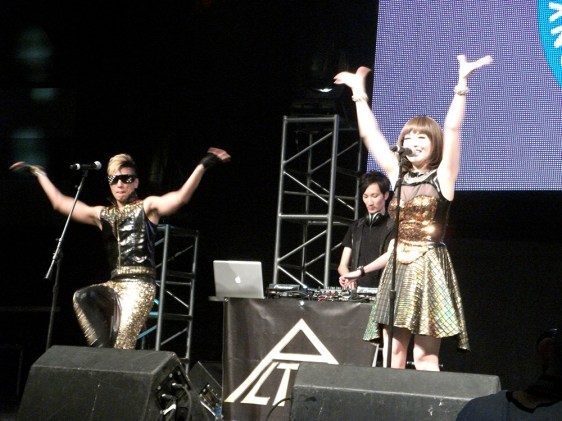
I was originally not planning on attending any concerts this Otakon, but upon remembering that the band Altima consisted of not only one of the singers from Fripside (A Certain Scientific Railgun) but also motsu from the recently disbanded group m.o.v.e. (Initial D), it meant I had to check it out if only for a little while. This wasn’t the first time I got to see motsu as I actually attended another con where he was a guest, Anime 2012 in the Netherlands, so I knew that the man brings the hype. The music really got me pumped up, but I actually had to leave the concert early as I could feel it destroying my ears (I failed to bring earplugs).
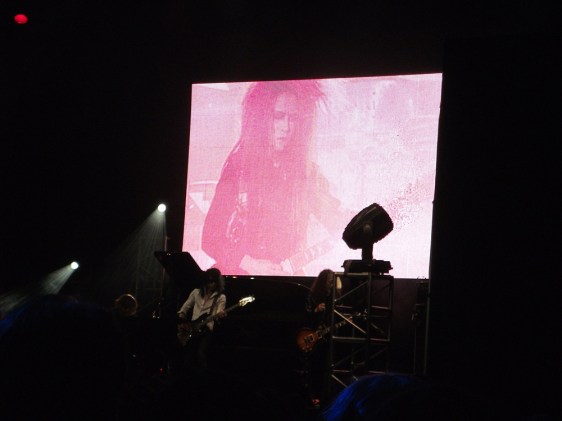
I am also not big into J-Rock, but X-Japan member Yoshiki has such a reputation about him that when I managed to get a ticket for the concert I also decided to see what he’s all about. You may have to forgive me for being ignorant when it comes to X-Japan, but I had no idea that their style was a mix of heavy metal and classical. Yoshiki was there more for the latter side, performing primarily classical-style pieces on piano while accompanied by a string quartet and a singer. The highlight of the concert was when he played a song in tribute to two members of X-Japan who had passed away over the years, a long, 10+ minute torrent of emotions that culminated in Yoshiki smashing the keys as if he was trying to shove them through the piano itself. This was actually a transition from his classical self to his metal self, as suddenly two other X-Japan members made a surprise appearance and rocked out. I apologize for not knowing their names.
Overall
Because of the fact that I personally did not approach Otakon as frantically as I had in previous years, in a way it would have been difficult for the convention to have disappointed me. That’s not to say that Otakon made no effort to make this year as enjoyable and as comfortable as they could, but I did not run into any major problems that ruined the con experience. The only thing that is a concern is the gradual countdown until the move to Washington D.C. in a few years, and the farewells we’ll have to bid to Baltimore and its food.
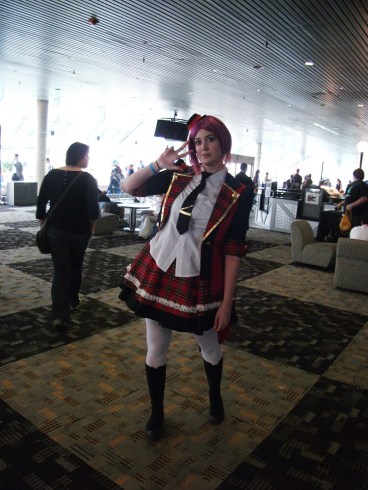
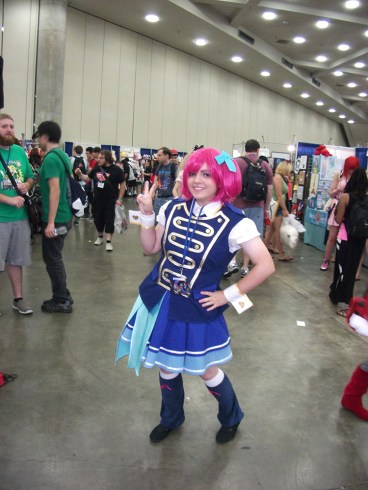
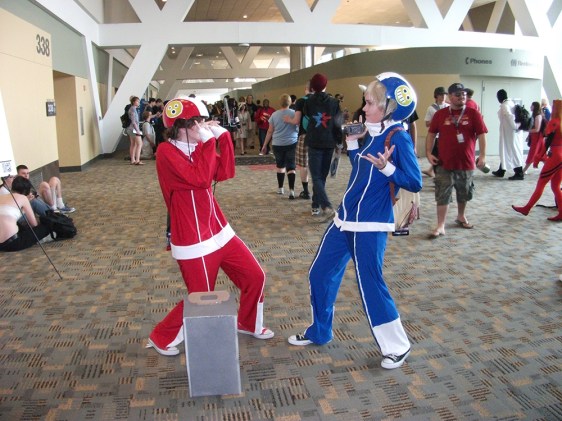
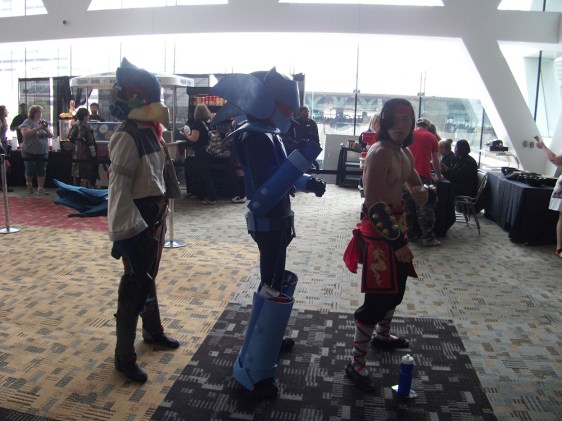
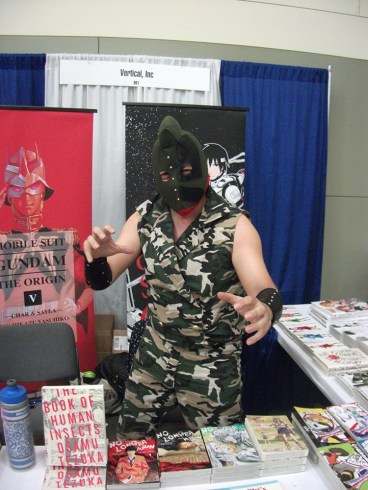
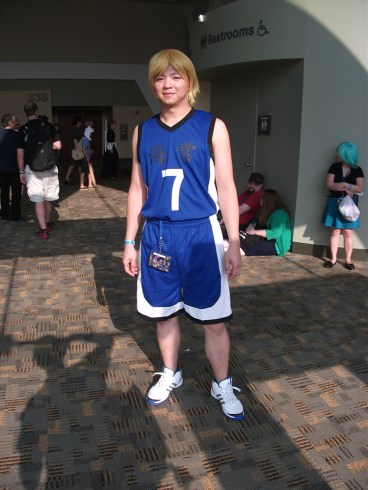
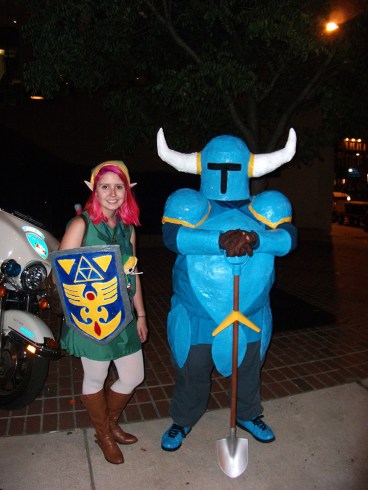
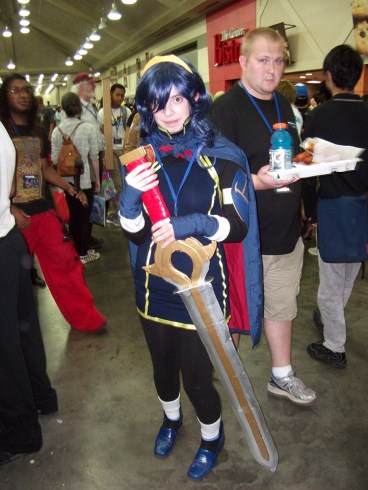
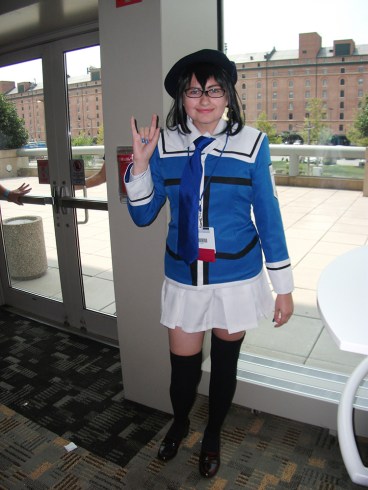
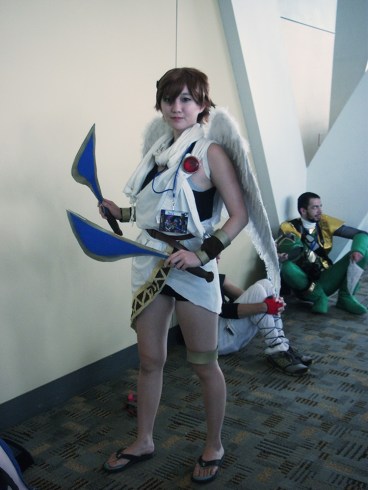
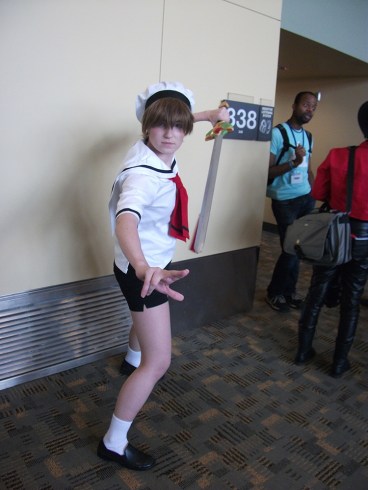
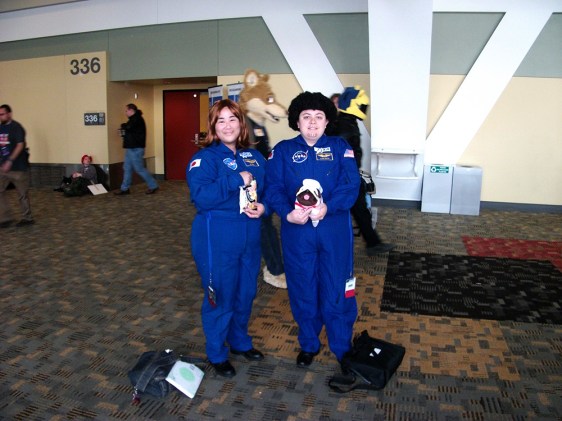
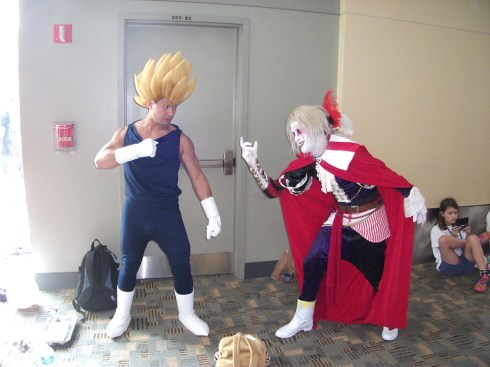
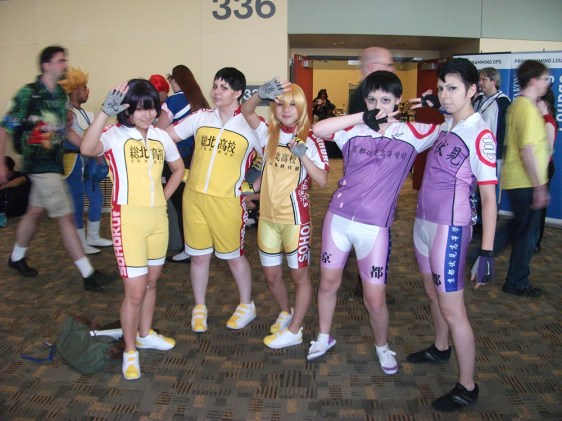
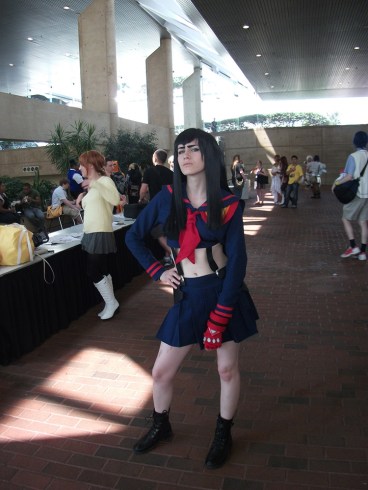
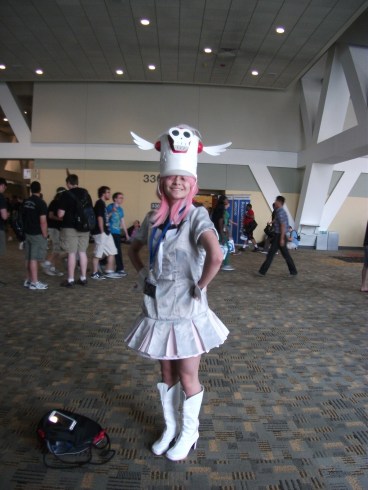
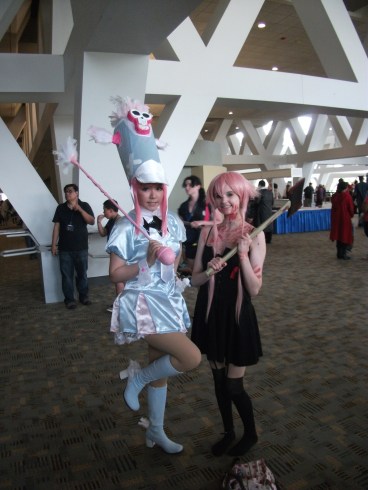
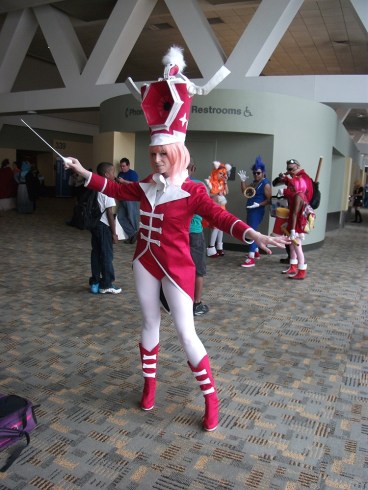
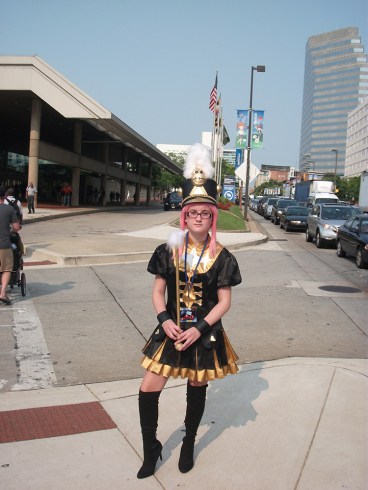
I’ll sign off here with a collection of cosplay photos. Shout outs to the Nogami Aoi cosplayer for referencing something as cool as Zettai Karen Children, the Yazawa Nico and Koizumi Hanayo (Love Live!) cosplayers in the photo all the way up top, the impromptu and unintentional VGCW match, and all the various Jakuzure Nonons that attended. Given that she has more outfits than just about anyone else, it was fun seeing how many variations of Nonon I could photograph.
Having finally seen Future Boy Conan, I’ve come to the conclusion that this 1977 anime is probably the work that most directly represents two of the major themes in Miyazaki Hayao’s earlier works, environmentalism and Marxism. People are likely more familiar with the former, which figures prominently into works such as Nausicaa, My Neighbor Totoro, and Princess Mononoke, while the latter tends to be a bit more subtle. While the characters of Future Boy Conan aren’t rolling out banners with pictures of Karl Marx on it, the criticism of capitalism and the dangers of “unthinking” technological progress as associated with a post-industrial society are too strong to ignore in Future Boy Conan. It makes for an interestingly political work, though perhaps what is equally impressive is that the series does not neglect to build up a rich cast of characters, an interesting world, and a sense of fun and wonder, whether is characters are traveling on land, sea, or air, that perhaps even contributes to that Marxist underpinning.
Future Boy Conan takes place on a post-apocalyptic Earth that has had most of its land masses submerged due to the use of “super electromagnetic weapons,” said to be even more powerful than nuclear weapons. At the center of the narrative is Conan, a boy whose life of hunting and fishing has granted him unusual (almost superhuman) strength and swiftness, and Lana, a telepath girl who holds the secret to reviving the limitless power source that is “solar energy,” and together the two must evade capture by the technological city of Industria, whose leader Lepka wants to use solar energy for his own selfish desires. Here, the series’ warnings about the abuse of technology and issue of greed are clear, but this is also contrasted with scenes of Conan using his nature boy powers to baffle his enemies like a freakishly powerful Dennis the Menace tormenting Mr. Wilson. The result is a work that is clearly in its championing of communal lifestyles and living closer to nature, but I can’t tell if the series’ own sense of action and adventure make for a “Trojan Horse” through which these political concepts are introduced, or if those fun and more lighthearted elements are the very means by which these arguments are made.
Much like some of the more lighthearted Studio Ghibli films, Future Boy Conan can be approached in a variety of ways. Certainly it can be seen as this highly political work. It can even be watched for historical or cultural significance, being an early work from not only Miyazaki but also the other big Ghibli director Takahata Isao. However, these need not be the primary reasons to watch Future Boy Conan, as it’s just as strong in terms of its sprawling sense of epic adventure and its attention to animation and even just the fact that it’s a simply an engaging story. Outside of its original context or the Marxist and environmentalist themes, Future Boy Conan is extremely approachable without needing to be a fan of older anime.
If you do pay attention to the political aspects of Future Boy Conan, however, then there is much to chew on. Nowhere is the criticism of capitalism stronger than in Lepka’s characterization. His problem isn’t just that he is clearly a horrible human being, but rather that his time spent at the “top” means that he has no conception of how people really are. To him, the masses comprise an amorphous engine meant to serve him, and he has no idea what it really means to be a leader. This also ties in with the series’ warnings about abuse of technology, as it is through his reliance on technology as a means to control the lower classes that he is increasingly both literally and metaphorically distanced from them. in this respect, it’s especially noteworthy that the prospect of a renewable energy source, a dream of humanity both inside and outside of fiction, is viewed with skepticism in Future Boy Conan. Although I don’t agree entirely with its message, the fact that it encourages us to be wary of the possibility that limitless energy might not satisfy those whose ambitions are to always have more is a warning message that’s still relevant today.
I find it kind of funny that I finished Future Boy Conan not long after having seen The Wind Rises, which is said to be Miyazaki’s final feature-length film. Whereas The Wind Rises is partly about the costs of living according to one’s passions, Future Boy Conan strongly exhibits a more youthful sense of idealism with its post-apocalyptic environment that makes way for what is more or less a communist agrarian utopia. Here is a man who has changed, and if we take his works each as their own “Miyazaki,” I wonder what kind of debate they would get into.






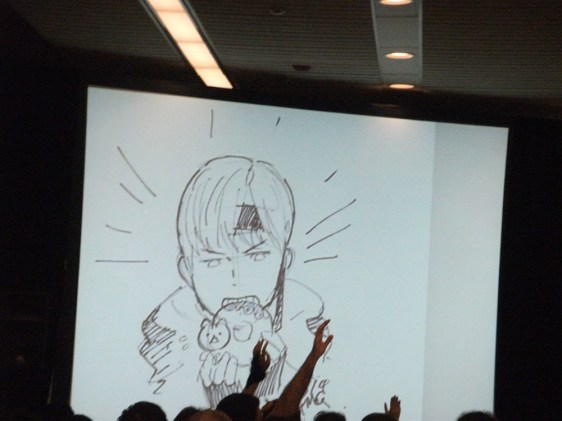
 I also attended the panel for character designer Kozaki Yuusuke, and while I’m not quite the fan that others are (having only barely played No More Heroes and never having played Fire Emblem: Awakening), it was fun to see him take audience drawing requests. The two images above were the result of this, and it turns out that Kozaki even drew the cover art for the Otakon guidebook this year. This was quite noticeable as generally the artwork for Otakon stuff has traditionally ranged from subpar to mediocre. It also made me really want to read his manga Donyatsu, which is about donut-shaped dogs and cats in an apocalyptic world; in one of the images above, Donyatsu is featured being eaten by a Fire Emblem character. The main reason Kozaki was at Otakon, however, was to promote a new anime project, Under the Dog, which based on its initial material is trying to invoke a Ghost in the Shell: Stand Alone Complex-type feel but with more action. In fact, at the panel they mentioned getting an animator who worked on GitS. If you want to help make it happen, a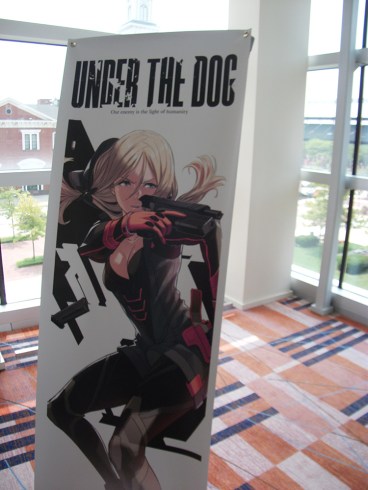















 OGIUE MANIAX