Call from Mighty No. 9, a Focal Point of Projected Ideals

mightyno9-call-e

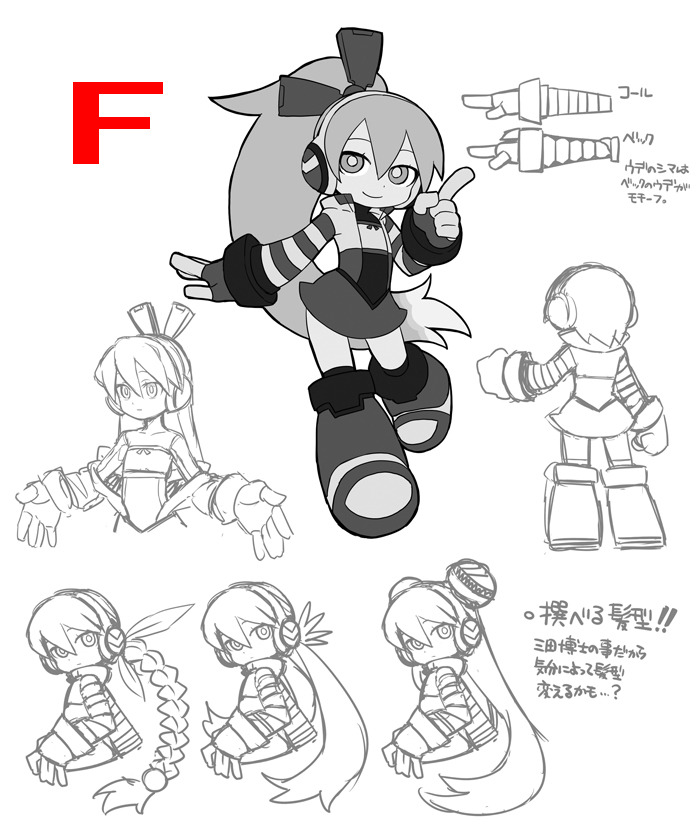
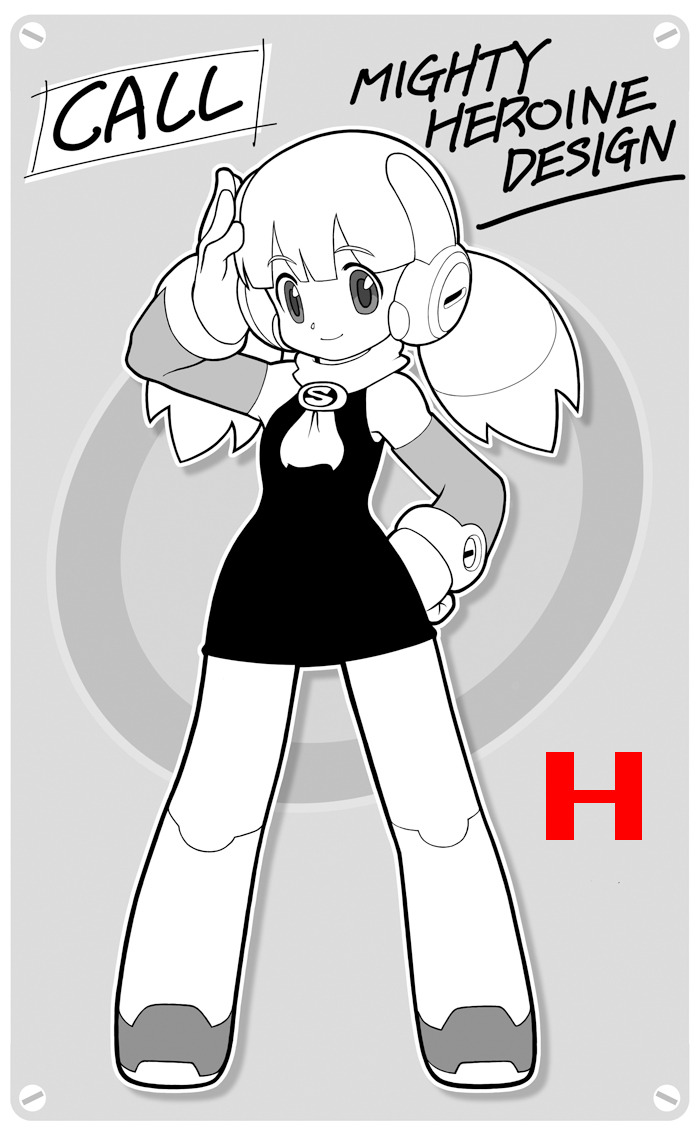
Given the success of its Kickstarter, it’s highly likely that you’re already aware of Mighty No. 9. The brainchild of Inafune Keiji, co-designer of Mega Man, it’s very much a successor to Mega Man, starring a robot with variable powers named Beck. While there are plenty of things to discuss when it comes to Mighty No. 9, one of the more fascinating topics is the “Roll” of the game, a female character named Call. Garnering enough fan support for a “Call gameplay stage” stretch goal to be reached, what is curious about Call is that her popularity was achieved well before we knew really anything about her.

From the very beginning of the Mighty No. 9 project, it was announced that there would be this female supporting character. However, she had no definitive design (though a few possibilities were shown), no determined color scheme, and very little information about her background or personality. Even her actual name was a later addition to the campaign, while these were the only notes eventually provided about her:

  • Call is a female robot originally created by Dr. White’s friend, Dr. Sanda, to help assist him with his research; she somehow avoided being infected by the virus causing all the other robots to go berserk and has pledged to help Beck.

  • Call was not imbued with the human characteristics that make Beck unique, so she’s more of a pure robot — as you might imagine, this contrast can lead to some interesting differences and misunderstandings whenever they interact!

And yet, even with this utter lack of information about Call, she developed a fanbase, such that the vote to decide what will become her finalized look has become a big deal among Mighty No. 9 fans.
mightyno9-call-f

A common answer these days for this sort of thing involves referencing Hiroki Azuma’s database narrative concept in a reductive fashion by pointing to how disparate features such as blue hair or a tsundere personality act as patchwork parts to create characters appealing to otaku, but I don’t think you can even refer to Call’s initial concept as a “database character.” It was less of a database and more of a less-than-1kb .txt file, and I think Call’s popularity actually comes from something else entirely.
mightyno9-call-h

My own guess is that the reason Call gained fans before we really knew anything about her is that her basic position, as a female character in a new video game which has as one of its guiding principles heavy interaction with the community during development, made her an open canvas for fans’ perspectives. Whether fans see Call as someone to potentially relate to, or an opportunity to establish a strong female character who can go a step beyond Roll in Mega Man, or even just as “the cute girl,” Call’s initial lack of features combined with faith in Inafune and the staff of Mighty No. 9 allowed people to project onto Call their various ideals. In this prototype state Call fans see in her the very best.

The Fujoshi Files 87: Akai Ringo

Name: Akai, Ringo (赤井林檎)
Alias: N/A
Relationship Status: Single
Origin: Okami-san & Her Seven Companions

Information:
Akai Ringo is a high school student at Otogi Academy in Otogibana City, where she works for the “Otogi Bank,” a school organization which helps with student requests in exchange for future favors. Patterned after Little Red Riding Hood and ending all of her sentences with the syllable “no,” Ringo exudes an image of youth and innocence. In reality, Ringo is a “rotten apple” with a cunning and manipulative personality, albeit loyal to her friends.

Ringo is best friends with her fellow Otogi Bank member, the wolf-like Ookami Ryouko, while supporting Ryouko’s burgeoning relationship with the timid Morino Ryoushi. Her feelings towards Ryouko are somewhat complex in that she would be very comfortable with a romantic relationship, but does not desire her normally otherwise. Ringo is also the half-sister of Shirayuki Himeno, a poor but beautiful fellow student who cares for seven younger siblings.

Fujoshi Level:
Akai once created a fictionalized movie where Ookami, Morino, and she fight the three terrorist Tonda brothers. The story called for the pig-like brothers to do possibly indescribable things to each other as the result of a penalty game.

I Heart Ira x Mako

I’m not really a big “shipping” sort of person, but I love the idea of having the giant Gamagoori Ira and the hyperactive Mankanshoku Mako from Kill la Kill as a couple. So far, the show’s featured various interactions between them, and the surprising level of respect Ira shows for Mako as well as Mako’s own ability to catch Ira off guard makes them come across to me as “equals” even if you can’t call them opposites. They do both operate heavily on loyalty, so maybe they have some similarities after all.

If only Mako had kept her 2-star uniform and its delightful delinquent-ness, they’d be a pretty fearsome combination. Of course there’s always still hope for them to bring it back.

Though, don’t ask me how that masochism stuff is supposed to fit in.

Coppelion Anime, Smooth and Round

I’ve come to the conclusion that the Coppelion anime feels like the Coppelion manga with its edges filed down. I don’t mean just that they’ve removed all references to nuclear radiation, or that if you add up all of the elements of each version that one is more “serious” than the other, but that there’s a distinct difference in presentation.

Though the manga is more overt with its criticisms of nuclear energy, at least at first, it’s also wackier in a lot of ways. Amidst the tragedy, characters make wild and contorted faces almost like they’re One Piece characters, and there’s even more fanservice to boot. Aoi, who comes across as more cutesy in the anime, has a greater degree of comic relief in her in the manga, and I think it just has to do with that sense of exaggeration.

Here’s Aoi in the anime:

And here she is in the manga:

Also note the difference in Ibara’s facial expressions.

I think in some ways, this difference in feel does more to change the contents of Coppelion than even the censoring, like the wackiness adds a certain element of permeating ugliness to the story which helps to foreground the social and environmental issues a bit more. That might just be my personal preference though, and I find as the show gets into the second arc it starts to adapt the original material better.

On the Use of “Special Attacks” in Shin Mazinger

One of the defining traits of director Imagawa Yasuhiro’s adaptive works is the way in which he takes a large mass of disparate information pertaining to a particular work and organizes it such that the themes and concepts are strengthened and made more vibrant through cohesion and consistency. With Giant Robo, it’s an amplification of the history of legendary manga creator and Tezuka contemporary Yokoyama Mitsuteru. With Tetsujin 28 (also originally by Yokoyama) it’s  about highlighting Tetsujin 28 as a connection between post-war Japan and the militarism which had preceded this period. With G Gundam, in spite of the fighting tournament setting, it’s about the effects of continued conflict on the Earth. Shin Mazinger Shougeki! Z-Hen takes Mazinger Z’s iconic status as the super robot and shows just how much influence it’s had on the genre as a whole while also providing an argument for how Mazinger as a whole gives much food for thought if only one delves a little deeper.

What I find particular interesting about Shin Mazinger as an adaptation is the way in which Mazinger Z’s attacks themselves have been reorganized to strengthen the image of Mazinger. For example, take the Photon Energy Beam, Mazinger Z’s eye lasers. Generally they’re considered one of its weaker attacks, even often being the first and least-damaging move for Mazinger Z in the Super Robot Wars franchise. In Shin Mazinger, however, it is initially Mazinger’s strongest weapon When taking into consideration what Mazinger Z is supposed to be, a robot whose basic power comes from a combination of its Super Alloy Z (which the bombastic narration is very keen on making the viewer remember by deliberately repeating its name) and its miraculous Photon Energy power source. Tapping directly into the very thing that moves Mazinger Z only makes sense as a highly destructive attack.

When it comes to Mazinger Z’s arsenal and its cultural influence, however, there is nothing in all of the history of super robots with more imitators, successors, and homages than the Rocket Punch. What does Shin Mazinger do? For one, it makes the Rocket Punch the very first attack that Mazinger Z does in the show while giving it a fanfare worthy of the gods, but Imagawa doesn’t even leave it at that. He adds new elements to Mazinger Z so that the Rocket Punch, or a variation of it, is the greatest, most visually striking, and memorable thing that Mazinger Z can do. When Mazinger Z performs the Big Bang Punch, it literally transforms its entire body into a massive fist and becomes one with the Rocket Punch, such that Mazinger Z’s most lasting legacy (outside of the act of actually having someone control the robot from within) is also its most potent weapon.

Shin Mazinger takes Mazinger Z’s attacks and asks, “Why are these moves fun and exciting?” In doing so, it is able to play around with Mazinger Z as a cultural object and bring attention to not only what made it conceptually interesting to its fans in the first place, but also what potential still lies within it.

AdviceFujoshi: Genshiken II, Chapter 94

Hato is back home in order to try and sort out his feelings. Kaminaga and Hato’s brother Yuuichirou are there too, and though Kaminaga (who now insists of being called “sister”) does her best to give advice to Hato about Madarame, her fujoshi brain interferes with her words and intent quite a bit. Eventually, thanks to a meeting with Konno and Fuji, Hato realizes that his feelings for Madarame mean he doesn’t want to leave Genshiken, and resolves to head back to Tokyo.

Chapter 94 is the first time in Genshiken that we’ve actually seen a character’s hometown life elaborated upon to this extent. Sure, there have been flashbacks, like Ogiue in junior high or Madarame discovering doujinshi for the first time, but ask yourself this: how many of the characters’ parents have we seen? The answer is just Hato’s.

Hato’s thought process shows that part of his turmoil is his desire to try and justify his own feelings, to try and compartmentalize everything internal into a consistent emotional map. It doesn’t appear to be a matter of latent homophobia, and if I had to venture a guess it might have more to do with trying to defy his past reputation when gossip spread about him reading yaoi and his classmates constantly made reference to how gay he is. It reminds me of a documentary I watched recently where a girl raised by two gay men talked about how she spent most of her life strongly insisting she was 100% heterosexual as a way of fighting back against the people who assumed that gay men would inevitably raise gay children, but eventually realized she was bisexual. Of course, I don’t know if Hato’s situation is quite the same, but I sense similarities. Kaminaga’s advice to essentially not sweat the small stuff, albeit filtered through her fujoshi self, is perhaps the moral of this chapter.

Kaminaga has grown on me more with this chapter. Her new hairstyle (did she dye it or un-dye it?) gives her a real “classical Japanese beauty” look reinforced by panels like the one above, which then clashes heavily with her ever-“rotten” personality. It’s an interesting contrast, and when I think more about it, the fact that Kaminaga is the way she is but has married (or is about to marry? it’s not entirely clear) a super normal guy in Yuuichirou speaks to something a bit different from the other relationships in Genshiken, even Kohsaka and Kasukabe’s. I think it’s because Yuuichirou and Kasukabe are different kinds of “normal.” One is a straight and narrow type, the other is socially successful, and it speaks to how “normal” is a kind of spectrum in itself.

Being Konno is suffering. Her own feelings for Hato turn this into a kind of love triangle, but Hato doesn’t even realize she likes him, and the fact that her advice of “if it’s causing you so much suffering, why not leave the club?” actually helps Hato realize that, yes, he does like Madarame after all. Not too long ago I wrote that a common form of moe we see is a normal life filled with a series of tiny tragedies, and I think that describes Konno’s situation quite well. I can only imagine how Konno would slide further into despair if she knew the person Hato likes is a guy. After all, when Konno originally learned about Hato’s crossdressing, she assumed that her responsibility as the root of all the gossip that had spread about Hato in high school had actually turned him gay, in turn sabotaging her own chances at romance. Of course, this isn’t resolved yet and Hato x Konno might actually become a thing in the end.

The best moment of the chapter in my opinion comes at the very end. We find Kaminaga drunkenly watching Yuuichirou and his old judo club buddies grapple each other under the influence of alcohol, clearly enjoying the fantasies inspired by reality. It’s unclear to what extent the redness of her face is due to alcohol versus perversion. Juxtaposed on the page next to a reference to a Whisper of the Heart reference (for Hato) and a Samurai Troopers reference (for Kaminaga’s own entertainment), it encapsulates her character pretty much perfectly, the manga panel equivalent of a bumper sticker saying “801 Fujoshi 4 Life.”

For any enterprising business folk, that one’s for free.

Speaking of business, Kio’s comments this month are about how Sue is a DLC skin for Akihabara’s Trip, a game where you search through Akiba and find witches by stripping them. Questionable qualities of the game aside, Sue is somehow incredibly appropriate for this, and would probably make the proper Those Who Hunt Elves and Doki Doki Majo Shinpan! references to boot.

The Fujoshi Files 86: Mihara Touko

Name: Mihara, Touko (三原塔子)
Alias:
Mihara Touko (三原とうこ)
Relationship Status:
N/A
Origin:
Fujoshissu!

Information:
Mihara Touko is a doujinshi artist turned published manga author hailing from Yamagata prefecture in the Tohoku area of Japan. A long-time fujoshi, she regularly attends doujin events, and as a result has met a variety of like-minded individuals, including the fujoshi of Ryouhoku High, Megumi, Yuki, and Eri. In addition, she is high school friends with Ishioka Yuri, to whom she introduced BL. As a native of Yamagata, Touko speaks in a thick Tohoku dialect.

Wise to the point of slyness, Touko was able to offer advice to Satou Megumi when she was in doubt over how seriously she should take her own hobby. Notably, she pointed out the major difference between making comics for oneself and revising one’s own work for the sake of fostering serialization. Her own work, Hana to Kaminari (“Flowers and Thunder”), debuted in the magazine Sylph, known for titles such as Fujoshissu!

Fujoshi Level:
The specifics of Touko’s fujocity are unclear other than the fact that she has devoted much of her time and energy to fujoshi-minded work both amateur and professional. A better indicator however may be the way she has tried to foster a fujoshi mindset in not only her friend Yuri but other girls as well. In this sense, Touko’s abilities as a fujoshi may be greatest in her ability to sense potential.

Kill la Kill = Exploitation + Empowerment?

Kill la Kill for all of its visual creativity is a pretty controversial show, if only for its main heroine’s outfit and how it’s used in the series.  Whether Ryuko’s uniform (or lack thereof) is a symbol of feminine power or yet another case of women being objectified in media is the point of contention. I find that it can be difficult to navigate the intersection between “exploitation” and “empowerment” in Kill la Kill, partly because when we think of those ideas we usually find them mutually exclusive to the extent that one can only grow at the expense of the other, whereas I actually believe Kill la Kill is honestly and genuinely trying to do both at once.

Kamui_Senketsu

One of the key examples of this duality is in Ryuko’s transformation sequence, which ends in the pose shown above. Her uniform is ridiculously skimpy, but her actual stance exudes power and confidence, sharing more in common with the type of posing done by a tokusatsu hero rather than the almost fashion model-esque poses common to magical girl shows (and also JoJo’s Bizarre Adventure). It’s showing her body off to the world at the same time it shows off her will and determination.

Outside of Kill la Kill, of all the series I’ve seen which attempt this combination the one that tries the hardest is probably Shinkon Gattai Godannar. There, the fanservice is arguably more extreme and pretty impossible to avoid in its own right, but I find that its ideas and themes resonate with a desire for women to be the heroes of their stories. With either Kill la Kill or Godannar, it’s possible to “look past” the sexualization (or not), but neither the image of exploitation nor empowerment are necessarily merely in service to the other, as if one is an “excuse” and the other is the underlying true meaning.

It’s easy to think of the people who made Kill la Kill as perverts, and it’s maybe even true, but I wonder if the show is actually saying something along the lines of, “Hey, perverts can be feminists too!” Whether this approach is okay or not is of course still up for debate, and differs from show to show, or perhaps even episode to episode. Personally, I’m pretty okay with it but recognize the potential, positive or negative, in combining this imagery in that it can be appropriate and used according to the viewer’s wishes.

The Ending of The Legend of Korra Season 2, or Let’s Talk About Setup

With the recent conclusion of season 2 of Avatar: The Legend of Korra, I’ve seen a number of complaints that a lot of the finale seemed to come from “out of nowhere.” Notably, the two aspects fans appear to take issue with involve Jinora and Korra herself. While I have my own issues with the writing, characterization, and pacing of the series, I find that Korra set up the pieces in fairly obvious ways which make me find it so surprising that people are accusing the show of employing Deus Ex Machinas.

Before I go on, obviously there’s a spoiler warning here.

First, in regards to Jinora, she was shown throughout the second season to have a strong connection to the spirits. When Tenzin rescues her, she disappears as a spirit separated from her body, then reappears during Korra and Unalaq’s fight still as a spirit, and uses her strong affinity for the spiritual realm to locate and draw out Raava’s diminished being from Vaatu where Korra (who is not as spiritual as Jinora) could not. There’s no need for an elaborate explanation as to “how she did it,” except perhaps that one needs to remember that neither Raava or Vaatu can truly destroy each other and that there must always be the tiniest fragment of one in the other. Yin and yang and all that.

Second, when it comes to Korra I find that people think that Korra as a giant blue spirit somehow didn’t make sense or work as a part of Korra’s narrative. When Tenzin explains to Korra that before people bent the elements, they bent the energy within themselves, it’s a callback to the The Last Airbender and how Aang learns how to energybend from the last lion-turtle. Korra’s spirit has become imbued with that very same energy, and it’s no coincidence that the shade of blue that Korra’s spirit becomes in order to fight Vaatu is the same blue that can be seen within Aang when he takes someone’s bending away.

The other crucial component of Tenzin’s explanation is that Korra needs to find within herself not Raava but her own spirit, the very core of who she is. This giant spiritual form of Korra wears her standard outfit instead of the coat she came in, showing that this is her default self-perception, but what’s even more notable is the way that Spirit Korra fights. Rather than doing any sort of elaborate bending moves or showing any signs of formal training, Korra is a brawler at her roots, and there’s probably nothing more indicative of this than the fact that giant blue Korra performs an Argentine backbreaker on Vaatu/Unalaq. Korra from the very beginning of her show is portrayed as a very direct, confrontational individual, and though her spiritual side is lacking, by the end she is able to connect to it in a way that suits her, a way which strengthens her identity.

I think the other elements of The Legend of Korra Season 2 are more contentious, but I hope that people critical of those two aspects of the show look back and see that they were not so sudden after all.

The Legend of Korra and the Conflict of Fighting Styles

Avatar: The Last Airbender was an enormously popular show, but its sequel The Legend of Korra has been a bag of mixed opinions among fans. Although there are many reasons for this discontent towards the new Avatar, including the writing, characterization, and the different format (seasons are shorter), the one that I find most intriguing is the general complaint that the quality of the fighting went downhill in the transition. I find that it speaks a lot to the difficulties of creating a sequel which is trying to progress the world of its story, to change its status quo, but also maintain the status quo which brought fans to it in the first place.

The Last Airbender exhibits Wuxia-esque action scenes, informed by many classic Chinese martial arts styles (waterbending is tai chi for instance), which gives the fights in the first series an overall grandiose quality. Movements are elaborate, meant to evoke a sense that the very motions benders take are part of what give them such mystical strength.

The Legend of Korra, however, involves much more straightforward uses of bending. Here, amidst the large population of Republic City and the popularity of pro-bending, the manipulation of the elements comes across more as a sport, a structured system within the bounds of the law (though still easily abusable in its own way), much like what judo is to jujitsu. Gone are the classical gestures and poses, replaced by simple and direct actions.

Given that the new series is meant to take place 70 years after the original and highlights how a number of social and technological developments have impacted everyday life, it’s clear that the less majestic qualities of “modern” bending are meant to also be a sign of this change. Even when I mentioned that on Twitter, however, one of the responses I received basically said that it didn’t matter if there was a story reason for the change, if it’s less fun to watch then that’s the end of it.

Certainly the guy had a point, and the new type of fighting could be seen as a kind of downgrade, but of course this depends on your definition of what a good fantasy martial arts fight scene should be like. Contemplating this aspect of individual perception, I’ve come to realize that perhaps part of the difficulty The Legend of Korra faced in its bending was that it had established a way of visual presentation which captured the hearts of fans in the previous series, but then tried to fight against the very entrenchment of accepted visual style they created. The wuxia style in The Last Airbender is one of the many reasons the series garnered fans, defining for many what “cool fight scenes” are meant to be, and to remove that aspect is to undo in their eyes the very identity of Avatar‘s combat.

Essentially, if fighting in The Last Airbender is classic Chinese martial arts, then fighting in The Legend of Korra is modern mixed martial arts. Though I can’t say to what extent the fanbases between Avatar and MMA overlap, the disagreements over the style in Korra remind me a lot of the arguments I’ve seen concerning MMA as an optimized style ideal for the very sport it created and fostered, a scientific approach to what has for a long time carried an almost metaphysical connotation. Though effective, neither modern bending nor standard MMA look “pretty” by the standards of fans of the more classical styles. Consider that good old question of  MMA: “why are those fighters humping each other on the ground?” Probably if The Legend of Korra were less modern Ultimate Fighting Championship and were more like the first UFC, which was meant to be a clash of various martial arts styles from Karate to Greco-Roman Wrestling, then perhaps it would have found greater appeal.