Non-Desire for Exoticism in Anime

The impression I generally have of My Little Pony: Friendship is Magic is that it possesses attractive qualities similar to anime, especially when it comes to the more episodic types of magical girl anime. The way MLP respects its assumed younger audience while presenting a variety of characters with fleshed-out and admirable personalities who show many valid ways for girls to be girls and more generally for people to be people reminds me most strongly of Ojamajo Doremi. However, it is the case that not every MLP fan is an anime fan nor vice versa, and it is even the case that some anime fans found themselves more attracted to My Little Pony, undergoing a transformation from otaku to brony. While this could be argued as a failure of anime to retain its audience, and sometimes fingers are pointed at whatever current trend there is, I think it is important to not just look at what anime “had then” and what it “lacks now,” but to also consider the possibility that different anime fans came to anime in the past with varying expectations and areas of adaptation.

Picture two anime fans of the same show who love the story and the characters equally much. The first fan loves the fact that anime is from Japan. It’s different, perhaps even exotic, and to view animation from another country with its own tropes and cultural assumptions and elements is part of the fun. He’s not necessarily a Japanophile, nor does he think that things are better if they’re from Japan, but the fact that it isn’t his own culture adds to the appeal.

For the second fan, however, that cultural difference feels more like a barrier. Rather than it possessing an inviting quality, the culture gap is something which the second fan feels he must work through in order to get to the story underneath. Certainly this fan genuinely enjoys this anime, but if he could get the same show only with the cultural elements naturally familiar to him, then he would much prefer that.

There’s plenty of middle-ground between these two types, but I think this hypothetical scenario is one example of what has happened with people who might have been anime fans but aren’t, or at least anime fans who have found greater resonance with cartoons which are not anime. My Little Pony is similar to Ojamajo Doremi in a number of respects, but MLP assumes an American audience first where Doremi assumes a Japanese one, and having the characters behave in ways more culturally familiar can have a significant impact on the connections people make with a show, even if it were basically the same work as the one that is less culturally close. This can even be as simple as information and access just being easier in your own language.

I can’t find the source, but I recall at an interview or a pnael for Avatar: The Last Airbender and its sequel The Legend of Korra, the creators stated that when making the series, they specifically had their Korean animators look at American body language and mannerisms. Like MLP, Avatar is a show which bears similarities to anime in a number of ways, but this cultural consideration was seen as a way to convey some of those “anime-like” qualities to people who are not necessarily receptive to anime, and perhaps by extension, those who are tolerant of anime’s differences but could do without them either way.

This is not an indictment of the first fan for prioritizing Japan too much, or the second one for not being open to other cultures, nor do I think that this explains everything about the landscape of fandom between anime and other cartoons. There is plenty more to discuss, including fans of both anime and American cartoons in other countries (including Japan!). Instead, I wanted to just bring up the idea that fandom can be quite a malleable thing, and that we may assume there are more connections within a fandom than there might actually be.

Free Comic Book Day Netherlands 2013

fcbdnl2013-allcomics

May 4, 2013 marked the second anniverary of Free Comic Book Day in the Netherlands. An American institution which I’ve participated in for over a decade now, I was amazed last year to see it brought over to other countries as well.

This year the full selection of free comics was raised from 7 to 10, far less variety than what was offered in the US, but at the same time had many of the charms and stylistic tendencies associated with European comics (even if they may not have been made in Europe!). The comic book store owners I did talk to all seemed to make it a point to tell me that they lose money participating in Free Comic Book Day, and urged me to buy something alongside. In my opinion, this kind of goes against the spirit of Free Comic Book Day in the sense that it isn’t supposed to be a guilt trip, but it might just be a difference in population/costs/other factors which make it not as sustainable as the American FCBD.

Sadly I am mostly illiterate in Dutch so I can’t really talk about the quality of narrative, but I can at least talk about some of the comics which caught my eye, or which most likely would catch yours.

fcbdnl2013-gameofthrones

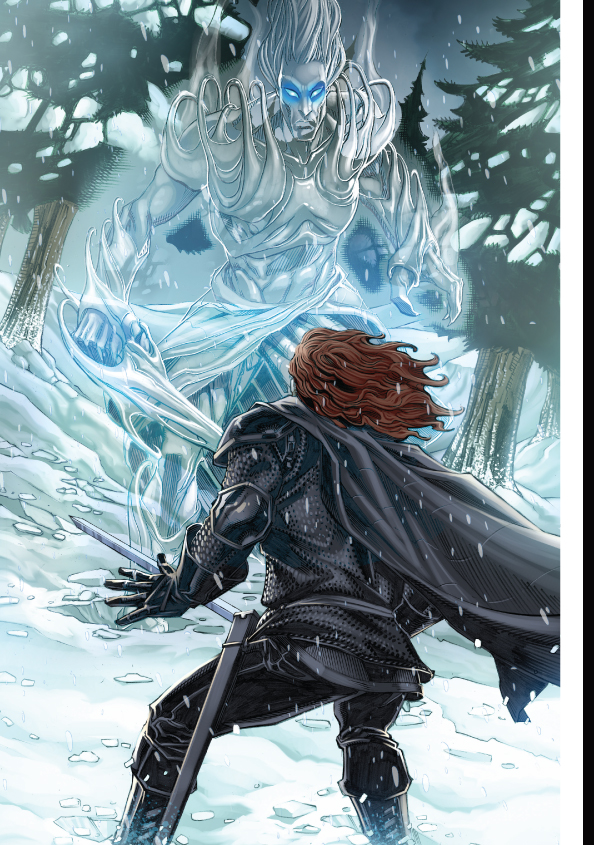
Probably of greatest interest to people would be the Game of Thrones comic, adapted by Tommy Patterson, and actually available in English. I have not read A Song of Ice and Fire, nor have I seen the HBO Game of Thrones, so in terms of accuracy or spirit I can’t really say anything. At the very least the art is vibrant, and I like it way more than Patterson’s previous work on series like Grimm’s Fairy Tales.

Next is Sienna, by Desberg, Filmore, and Chetville, about a female government agent. “Sexy women of action” as far as I’ve seen is quite a popular genre here, at least in terms of comics made, and this one takes a more mature and dramatic angle. The art is quite nice, and there’s plenty of violence and (I assume) conspiracy. You can see a small preview here.

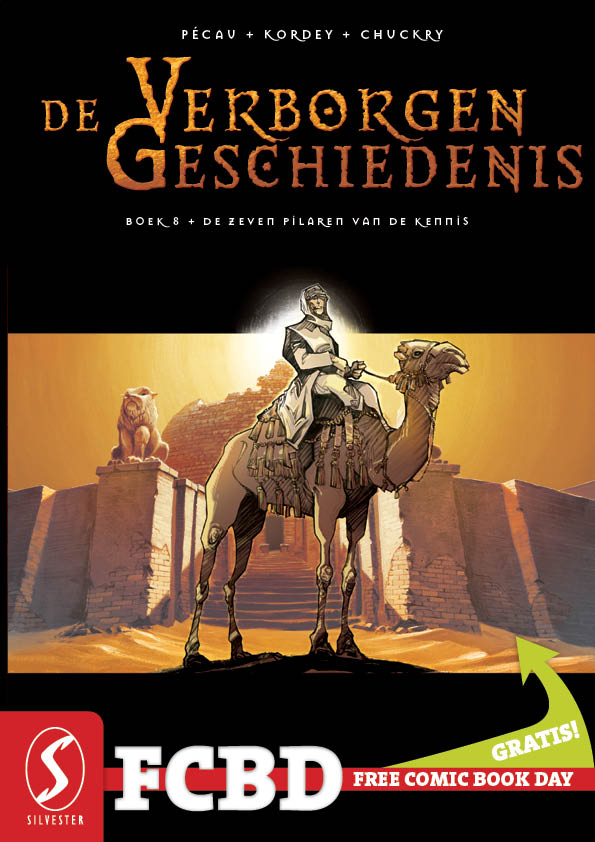
De Verborgen Geschiedenis (“The Hidden History”) by Pécau, Kordey, and Chuckry stands out immediately just because of the camel on the cover. As far as I can tell (and please correct me if I’m wrong), the comic appears to mainly be about what its title implies: some mix of conspiracy and secrecy spanning decades. Like both Sienna and even Game of Thrones, it goes for a more serious art style. There’s also a prominent English (?) female military officer in this issue whose name I can’t find. With a prominent scar on her face, she  toes the line between sexy and legitimately frightening (more the latter), as her expressions go from cold to menacing throughout the comic. Overall, she comes across as like a female Golgo 13, especially because one scene has her casually waking up surrounded by a pile of naked bodies both male and female.

fcbdnl2013-delegendariers

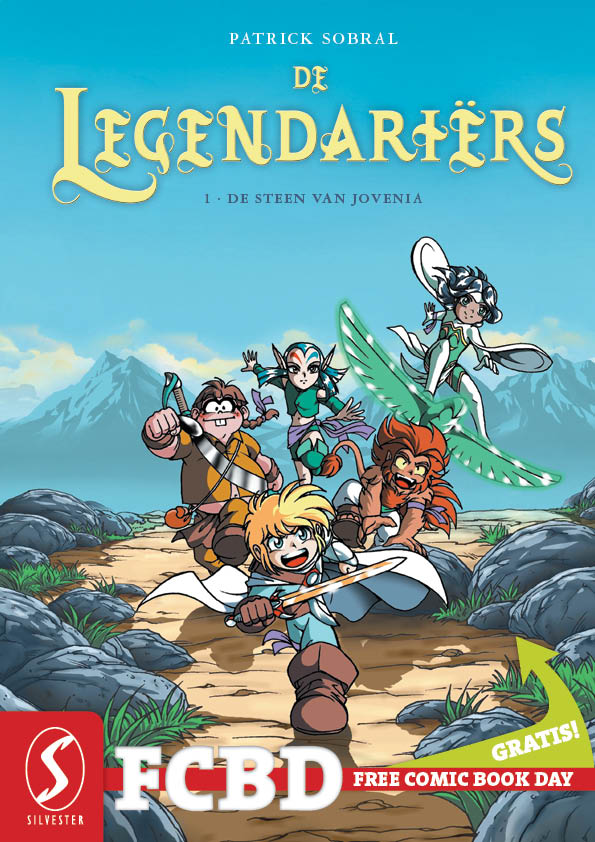
The last one I want to point is De Legendariërs by Patrick Sobral, due to its overt stylistic influence from anime and manga. Unlike the other three, this one has much more light-hearted feel. Its super-deformed characters and fantasy setting give me the impression of a pre-Playstation Japanese RPG. In fact, the characters look more like a late-80s/90s anime characters instead of current ones anyway, which really harkens back to that era. Anyway, the villain is named “Darkhell.”

So that’s a (very) cursory view of Free Comic Book Day 2013 in the Netherlands. Take my opinions with a grain of salt here, as I can’t give you a true impression of any of them.

And I must ask, for those of you who can read French or Dutch and picked some of these up, which ones impressed you the most?

Girls und Panzer is the Best Show of Its Kind

Girls und Panzer is one of the latest in a long line of anime and manga which mix a unique activity or concept with a cast of cute girls, in this case World War II-era tanks. I’ve enjoyed many such shows over the years, but I think Girls und Panzer is actually the strongest anime I’ve seen in this genre because it possesses qualities which give it the capacity to reach an audience beyond the fanbase one would normally expect. More than the spectacle and the juxtaposition of girls and tanks, Girls und Panzer delivers a good story.

In the world of Girls und Panzer, the act of piloting tanks is considered a traditional feminine martial art and widely revered sport, much like archery. Referred to as senshado, or “way of the tank,” in a fashion similar to how bushido is “way of the samurai” and judo “the gentle way,” and tankery in the official subtitles (invoking the similarity in reputation to archery), the main character Nishizumi Miho comes from a prestigious family and school of senshado. Because of an event in her past, Miho has deliberately transferred to a school without any tankery in order to escape it, but has the unfortunate timing of coming in right when the school decides to bring it back. As the only person in the entire school with experience in senshado, Miho gets roped into participating so that they can compete in a national tournament, and along the way rediscovers her passion for the art.

It’s a strange premise to be sure, though not that different from girls playing mahjong in a world where the game is enormously popular (Saki), or one where girls use magic to become half-human/half-airplane (Strike Witches). Also, while Girls und Panzer may not be as firm in establishing extremely distinct personalities and quirks for its characters as those other shows, it also goes beyond simply being a large cast of cute girls by doing three things especially well. First, it establishes a protagonist with a solid sense of purpose and desire in Miho, who becomes the moral, narrative, and strategic anchor for all of the other characters (of which there are many; it’s a cast of dozens). Second, it has well thought-out narrative arcs for its characters which give the story a clear sense of direction. Third, it knows how to create tension and anticipation to keep interest in both the characters and the premise of the show itself.

Compare Girls und Panzer to Saki, for instance. In both stories, the main heroines have the problem that, in spite of their talents in the specialty of their series, neither of them find it particularly enjoyable, and part of both Girls und Panzer and Saki is that they discover what it means to have fun doing either tankery or mahjong. What does it mean to have fun, though? What do they achieve by learning this? For Miyanaga Saki, it’s never really clear. She plays a lot of people who are as strong as she is, and learns that mahjong is fun, but the idea just seems to end there. For Nishizumi Miho, on the other hand, Girls und Panzer shows how moving to a different school, breaking from her family and their established methods of senshado, and discovering the fun of tanks all have a significant impact on her because Miho’s greatest strength as a commander—adaptability—is given room to grow in a way it wouldn’t be able to otherwise. In this way, Miho’s character becomes somewhat of a poster child for the philosophy of  Bruce Lee, particularly the following quote:

“In memory of a once fluid man, crammed and distorted by the classical mess.” 

It was a criticism of traditional martial arts schools for being too caught up in perpetuating restrictive rules which could prevent people from reaching their true potentials. Girls und Panzer as Jeet Kune Do analogy.

Even before all that, though, the very first episode works to establish the idea that Miho is something special, building up that sense of anticipation which pays off when you see her in action. In this regard, Girls und Panzer reminds me a lot of Initial D and how it would hint at its main character Takumi’s skill at racing, so that when he finally gets behind the wheel you’re already invested in him. The show also follows the Initial D school of stopping an episode right in the middle of action and never giving a good point to walk away, which makes it hard to watch just one episode at a time, unless you were delayed for the week, or even months as the case may be, as Girls und Panzer‘s final episodes aired after a long break.

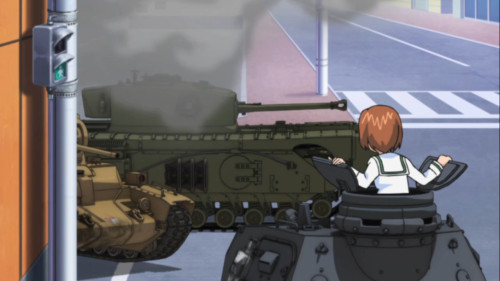
As for the tanks themselves, I am not a tank fanatic or particularly knowledgeable about them, so I can’t comment in that regard, but what I can say is that the series does an excellent job of portraying the tank battles in terms of thrill and excitement. Each of the tanks are shown to have particular strengths and limitations, and seeing the utilization of these qualities in terms of strategy and tactics, especially positioning, invokes the same feel one can get from the battles in Banner of the Stars or even Legend of the Galactic Heroes, where the unorthodox strategist Yang Wenli is in some ways similar to Miho. The actual animation of the tank battles is also very impressive, and is probably the best integration of 3D and 2D animation that I’ve ever seen. Very rarely does the show make its use of 3D appear awkward, which makes it easier to stay focused on what’s happening and not how strange everything looks.

Another thing I want to say is that with a show like Girls und Panzer which glorifies a well-known and still relevant weapon of war, it is easy to criticize it as promoting militarism in a very direct manner. However, I think it isn’t so simple, as the transformation of tanks into a “martial art” resembles the origins of many sports, including judo, which was specifically modified from its combative origins to be a way for self-improvement and healthy competition. It’s possible to criticize all competitive sports for promoting aggressive tendencies in people, but I think  Girls und Panzer has the potential to separate the beauty of machinery from its function of war.

For some, the premise of Girls und Panzer sells itself, but for the skeptical, or those who avoid this type of show like the plague, I would dare say that this is your best bet for finding something you’ll actually want to watch. Either way, it has the potential to become the standard by which all shows of its kind will be judged.

The Fujoshi Files 72: Shigeta Mina

Name: Shigeta, Mina (重田三奈)
Alias: N/A
Relationship Status: N/A
Origin: Genshiken: The Society for the Study of Modern Visual Culture

Information:
Shigeta Mina is a former classmate of Ogiue Chika’s from their middle school days in Yamagata Prefecture in Tohoku. She was a member of the same Literature Club as Ogiue and Nakajima Yuuko, where they collaborated to create BL stories, though her friendship with Ogiue apparently soured after the incident with Ogiue’s then-boyfriend discovering the extremely graphic yaoi doujinshi they made of him.

Shigeta is still close friends with Nakajima, eveident from the fact that the two regularly attend Comic Festival together. Shigeta appears more quiet and relaxed than the more talkative Nakajima, which also appears to have been in the case in their younger days.

Fujoshi Level:
Other than the fact that Shigeta used to collaborate in the Literature Club’s BL works and that she has remained a yaoi fan, nothing else is known about the extent of her fujoshi fandom.

Strength in Precure

With its combination of cute characters, kid appeal, and detailed fighting scenes, the Precure metaseries is presently the most popular and prominent magical girl anime. Though each series has its own share of unique features, one constant that always impresses me is the approach Precure takes to showing strength in its heroines.

When it comes to depicting strong female characters, there is a lot of media out there which relies on some sort of conflict revolving around a character’s gender. Confronted with a sexist/condescending/ignorant adversary, the idea is that the girl then shows what she’s made of and proves her equality/superiority. This is not inherently a problem, and there are many examples out there which make such scenes empowering, but there are also many cases where this becomes lazy or uncreative shorthand for conveying “girl power” as a way of achieving the bare minimum of inspiration.

Precure completely circumvents this issue by depicting its heroines as capable in a way where gender doesn’t really matter. Villains will mock them for inexperience, or talk about how hopeless they are for struggling, but the fact that they are girls and not boys is never really considered. When confronted with the question of whether or not girls can be strong, Precure simply says, “Of course they’re strong, why is that even a question?”

The gradual building of inner strength and emotional resolve in Heartcatch Precure! is the obvious example, but let’s instead take a rather stereotypically feminine-looking character such as Kise Yayoi (aka Cure Peace) from Smile Precure! Yayoi can be described as a crybaby who’s full of enthusiasm but lacking in confidence, a point which the villains will constantly bring up to taunt her. In regards to strength, Smile Precure! does two things. First, it provides four other girls to show how crying is not just something girls “do,” but something specific to Yayoi as an individual person. Second, it has Yayoi prove that being a crybaby doesn’t mean you’re incapable, it just means you can be capable while also crying a lot. Even with a character such as this, where it wouldn’t be surprising to see a show  convey her as “strong, for a girl,” Yayoi’s gender is never the issue.

This is not to say that Precure is devoid of traditional notions of femininity, as other signature features are brightly colored frilly outfits and cosmetics/accessories-based merchandise, not to mention the rare romance. With respect to the potential and capability of of girls, just as there’s no need to spend time in a film or cartoon to show that the sky is blue or that fire is hot, this approach treats the existence of strong female characters as such an obvious non-question that it becomes capable of normalizing the very notion that girls are strong. Without the need to “prove” anything, it can tell stories without being bogged by the classic obstacle that is the gender-centered confrontation.

Proof-of-Concept Singapore Mahjong Manga

Note: the page is is read left to right.

Further reading:

For my thoughts (and a summary) of Singapore-style mahjong, go here, as well as here.

The American-style mahjong conceptual narration and comic page (the two are somewhat unrelated).

My initial idea of having manga about all styles of mahjong.

Genshiken Nidaime Voice Cast…and a NEW OGIUE?!

UPDATE: Small point made below.

genshikennidaime-image

Ever since the announcement of the new Genshiken anime, I’ve speculated about the voice cast. Courtesy of one Anonymous Spore and the official anime website, the new cast for the Genshiken Nidaime (or Genshiken II as I prefer to call it) has been revealed, and the big, big shocker is that Mizuhashi Kaori will no longer be playing Ogiue, that most grand of angry, once-traumatized hair-brushed fujoshi.

My initial reaction has been genuine surprise and confusion, as I thought she fit the role tremendously well, and seemed to be well-established as Ogiue. Her Ogiue felt genuinely conflicted about everything, and it’s my favorite role of hers (biased perhaps). She even participated in the Genchoken radio shows with Madarame’s voice actor Hiyama Nobuyuki, and drew a comic about how she landed the role as Ogiue. Even putting aside my own Ogiue fandom I’ve thought for a long time that Mizuhashi ranks among the best voice actors out there.

ogiue-newvoice

That said, I think it would be a bit unfair to judge Yamamoto Nozomi before I even get to hear her voice the part of my favorite character. She’s pretty new, but she’s also already played roles such as Yukimura in Boku wa Tomodachi ga Sukunai, and Tetora in Joshiraku. When I think about Tetora’s voice in particular, it may actually be a bit closer to how I imagined Ogiue’s voice in my mind when I first read the manga. Actually, Gankyou’s voice would have been even closer, but that’s maybe getting too off-topic.

As for the rest of the cast, you have Uesaka Sumire  (Dekomori in Chuunibyou demo Koi ga Shitai!) as Yoshitake Rika in addition to performing the opening theme, Uchiyama Yumi as Yajima Mirei (Davi in Dokidoki! Precure, Arata in Saki: Episode of Side A), and a combination of Kakuma Ai and Yamamoto Kazutomi handling the female and male voices of Hato Kenjirou, respectively. If you look at their list of works, all of them are pretty new voice actors, so perhaps there was something on the production side that required the use of newer voices. I read that they may be changing the old characters as well? Or maybe there was just a good old-fashioned scheduling conflict, which even happened with the Genshiken 2 anime and Keiko’s voice actor. In the end, it’s all just speculation, unless someone more familiar with the seiyuu scene could inform me otherwise.

Based on the previous roles of the actors for Yoshitake and Yajima, I can imagine them fitting their roles well, especially if they go for more naturalistic and awkward voices. I think Yajima especially will be a challenge.

In addition, voices aside, the art and character designs look probably the nicest they’ve ever been for Genshiken anime. I guess it all remains to be seen (and heard).

miz84-1 miz84-2

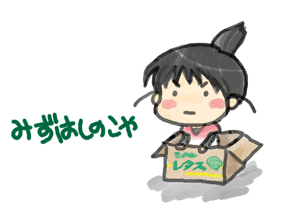
UPDATE: I decided to look at Mizuhashi Kaori’s official site, which isn’t really updated anymore, and what’s really curious is the fact that where once the front page image was of Ogiue in an empty cardboard box, now Ogiue has been replaced by a different character. I’m unsure if it’s meant to be Mizuhashi specifically or if it’s meant to be another one of the characters she played, but just the fact that she used to use an Ogiue image on her front page as early as September 2012 may indicate that she was rather close to the character of Ogiue.

The Fujoshi Files 71: Nakajima Yuuko

Name: Nakajima, Yuuko (中島裕子)
Alias: N/A
Relationship Status: N/A
Origin: Genshiken: The Society for the Study of Modern Visual Culture II

Information:
Nakajima Yuuko is a fujoshi from Yamagata Prefecture in the Tohoku region of Japan. An old classmate of Ogiue Chika’s from their middle school days, the two would collaborate on their own amateur BL manga along with the rest of their school’s “Literature Club” with Nakajima as one of the writers. However, the two had a falling out when their last collaboration, an extremely graphic depiction of Ogiue’s secret boyfriend Makita with his own best friend, became known to Makita, which caused Makita to transfer schools. Though there is no direct evidence, it is likely that Nakajima and her friends are the ones who showed it to Makita in the first place, being aware of what was actually going on between Ogiue and him.

In the present, Nakajima still lives in Tohoku, and remains friends with at least one of the girls from her middle school days, Shigeta Mina. Though Nakajima is very stylish and fashionable, her regular trips to Comic Festival indicate that she is still very much into yaoi. In addition, her current feelings about Ogiue are not entirely clear, as she exhibits signs of jealousy and resentment towards her, and seemingly revels in reminding Ogiue (and Ogiue’s friends) of her past, but at the same time also appears to show a certain degree of concern for her.

Fujoshi Level:
There are no clear details about Nakajima’s fujocity other than that she has some experience writing BL stories, and that she is at least to some extent still a fan of yaoi.

Spring 2013 Robot Variety Extravaganza!

Despite its iconic nature, mecha is often considered a dying genre of anime these days due to a number of different forces, from kids’ changing tastes in entertainment to a shifts in demographic. This is why this season of anime is quite a surprise, as three new giant robot anime have debuted for the Spring: Ginga Kikoutai Majestic Prince, Gargantia on the Verdurous Planet, and Valvrave the Liberator. That’s not even counting the still-running Chousoku Henkei Gyrozetter, and the Mobile Suit Gundam SEED Destiny HD remake. All of them have been out for a few weeks now, and I’m enjoying all three, but what is especially impressive is the fact that all three shows are different enough from each other that they end up fitting rather different tastes to the extent that I can’t necessarily recommend all of them to every single person.

Ginga Kikoutai Majestic Prince is basically animated tokusatsu, a mostly silly show with some serious undertones akin to Magiranger or Kamen Rider Fourze. Featuring a group of five heroes (surprise) known as the “Failure Five” due to their repeated screwups, they’re given extremely powerful prototype robots to fight off a mysterious enemy that seems to have overwhelming numbers as one of its many advantages. The oil-and-water nature of the heroes’ personalities makes for some good albeit cheesy laughs, while on the mecha side each of the robot designs are so varied both in look and function that they each have their own unique flair. For example, the main character’s unit is specially designed to monitor the others, making it actually fit for someone in the lead position. Also, the character designs are by Hirai Hisashi of Gundam SEED fame, who is known for his tendency to draw very similar-looking characters, but who here has more variety than I’ve seen out of him in a long time.

Gargantia on the Verdurous Planet is the most robustly science fictional out of all of them, and probably the one that will appeal most to fans of older 80s mecha anime due to its world-building and clash of cultures. Featuring a setting where humanity has spread into the galaxy and is at constant war, the main character Ledo is a boy who like so many of his peers has been trained to fight from childhood. During a battle, he is flung far off course to another world, where both he and the strangers he meets must adapt to the others’ extremely alien mindsets. The central robot has a very slick yet conventional design, and its rounded look and artificial intelligence remind me of the titular robot from Blue Comet SPT Layzner. It also boasts some serious hard-hitters when it comes to production, with Urobuchi Gen (Madoka Magica, Fate/Zero) on writing and Murata Kazuya as director (Fullmetal Alchemist: The Sacred Star of Milos), as well as Naruco Hanaharu (Kamichu! manga) on character design, who is more famous for his less “mainstream” work. Urobuchi, who is generally criticized for being overly expository, seems to be tempered n this case, making it so far maybe his best writing in anime to date (though of course that remains to be seen).

Lastly, Valvrave the Liberator appears to be a textbook case of the modern giant robot anime, cut from the same cloth as Code Geass. Like the other two shows, Valvrave concerns a future of conflict, but the overtly dramatic personalities of its characters, as well as the focus on them amidst this war, gives it an appeal that the other two don’t quite approach in the same way. The similarities to Code Geass should come as no surprise as Sunrise is also responsible for Valvrave, and the character-centric motivations are capable of pulling in people who are more interested in that character drama. The mecha have some unique yet familiar designs, and the relationship between the main robot Valvrave and the protagonist looks to be an important factor in the story. Personally speaking, I also quite like the character designs in this show.

Given that I consider variety to be a valuable asset of the ever-changing entity that is the giant robot genre, I think this spread of shows is a very good thing. What’s even more important is that even though I compared and categorized the shows according to familiar examples, none of them seem to necessarily be absolute retreads of previous works. Majestic Prince, Gargantia, and Valvrave are not nostalgia grabs pining for a better mecha yesteryear, but are firmly contemporary anime that take their influences from different areas. I can’t say for now how any of these shows will turn out in the end, but the unique flavors of each leave me looking forward to continuing with all three of them.

I’m also still watching Gyrozetter.

SEED Destiny HD… we’ll see.

Wacomplex: Genshiken II, Chapter 87

First thing first, Genshiken anime info dump! it’s been confirmed that the Genshiken II (or Nidaime) anime will be starting this summer, with a different studio but with a lot of old staff. I do find it kind of funny that Genshiken can’t seem to get a consistent animation studio or anime character designer, and given the sheer variation of work that the character designer Taniguchi Junichirou has worked on, it’s hard to predict how they’ll look exactly. Also, Uesaka Sumire will be singing the opening. Next month is the voice cast reveal, so let the speculation begin!

Anyway.

In Chapter 87, Hato continues to try to be one of the boys, but the fact that he is unable to draw properly for the sake of Ogiue’s ComiFes doujinshi when not in drag causes him to go back to it, at least in private. At the same time, Ogiue has decided to charge into the 21st century by buying a pen tablet monitor in order to save time and manpower, but the transition isn’t as simple as she hoped for. As ComiFes is drawing near, familiar faces appear as Angela makes her return to Japan and Keiko is looking to take another stab at the event.

I literally laughed out loud when I saw the pen tablet monitor. It was clearly introduced by Kio Shimoku as a metaphor for not only Hato’s current situation, but also the Genshiken club itself and even the manga as a whole. In this regard, I think it does an excellent job of representing the dimensions of a generational divide.

By showing Ogiue struggling with her tablet despite purchasing it to alleviate her work schedule, Genshiken touches upon the idea that transition can be a difficult thing because of how much we must acknowledge and rework our assumptions. The strengths and limitations of the zoom function, referenced during Ogiue’s little rant, is the perfect example. On the one hand, it lets you get up close and put detail into even the smallest part of a drawing, but on the other hand it can be stifling if one is obsessed with detail.  Ogiue’s plight somewhat mirrors the difficulty by which the manga itself has transitioned into its new cast and their very different values, not only in terms of the content of the manga, but also for a good portion of the manga’s readerbase which seems to see the new Genshiken as “not Genshiken.”

However, I think it would be a mistake to say that the ideas implied by the tablet transition are narrowly limited to Genshiken as a topic, as I really think it goes beyond this one manga. What really adds to the tablet metaphor is the conversation between Hato, Yajima, and Yoshitake where they mention the simple fact that, for some artists, digital drawing is all they’ve ever known.

Drafting, cleaning, paneling, for them, everything is done on the monitor, and it highlights this idea that, rather than this newer generation of artists being untrained in the old ways, that their “environment” is simply different and they have adapted to it in kind. Instead of the tablet being a facsimile of “real” drawing by mimicking pen on paper, for them the tablet is real drawing. That difference in mindset is so central to the changes between generations, whether it be music and art, dance, technology, or any other topic, and it shows how neither the old or new generation are “bad,” but that people are the product of their experiences.

I get the sense that, as the manga continues, Ogiue will continue to use the tablet, but that it will require her to adjust her current work habits to better fit it, or to make it more of a supplementary tool. In either case, if she does incorporate it, it means that her work may never be the same again. The impossibility of returning to the “old way” is also shown in the beginning of this chapter, when we see Madarame, Hato, and Kuchiki discussing anime much in the same way the club used to, with mentions of sakuga, seasons (cour), and the economic side. While definitely similar to the old Genshiken, something’s not quite right, especially in terms of how Yoshitake and Yajima appear a bit alienated by it because it’s not the atmosphere they’ve participated in and even helped to create. It feels a bit artifical and out of step with time, which also has implications in regards to Hato, who is trying to act like a “proper” male otaku.

If we look at the notion of the “proper” otaku (and perhaps even the whole debate over fake geeks), it’s kind of funny that people prescribe a certain set of behavior as “proper” for a group that has been traditionally stereotyped as behaving improperly by virtue of being otaku. I think Hato’s vain attempt to quit crossdressing and yaoi may be a sign of how ridiculous this can be, as if the manga is saying that it’s not as simple as getting rid of the girly stuff to bring back the “true” Genshiken, and that there has been a change in environment that the manga has been trying to address.

I may have gone a little too crazy with that analysis, but I honestly think that I haven’t completely or properly explained the intricacies of the tablet metaphor, though I’ll leave it as is for now. It’s been a while since we’ve had this much Ogiue in a chapter, so I’m pleased in that regard, and I’d been wondering when Angela would show up again a she’s a significant factor in the whole Madarame-Hato story. The fact that Keiko is planning to go to ComiFes out of her own free will may actually say everything about how much the world in and around Genshiken has changed.

(A bit of Ogiue Tohoku-ben inner dialogue teaching us that Ogiue is still not used to Kanto winters.)