Lovely Charming: Genshiken II, Chapter 73

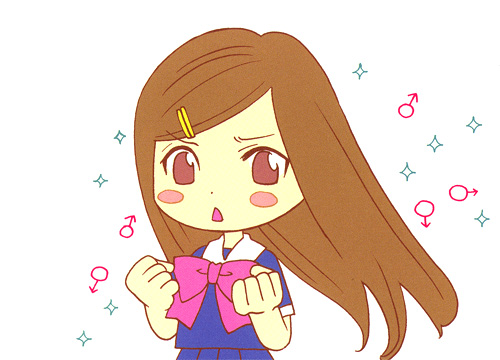
When you ask a group of fujoshi (+1 fudanshi) for personal stories of high school romance, you get anything but. That’s Genshiken II, Chapter 73.

Chapter 73 of Genshiken II opens up right where the last chapter left off. In an effort to both have a story that can complement Hato’s drawing style and to also get out of her own creative rut, Ogiue is looking to write a shoujo manga with a high school campus festival setting. However, just as Ogiue is unable to draw on her own experience to write the story (“Actually, I didn’t even have any friends,” as she bluntly states), the only thing she gets from the freshmen are tiny pockets of sadness.

First up is Yajima, who recalls a boy who used to insult her drawings and then rub salt in the wound by actually being a better artist than her. The closest this gets to anything resembling “romance” is that the guy originally came up with a bizarre and insulting nickname for her (Hetakuso (Crappy) -> Hetappy -> Tappy) but eventually stopped using it. As Yoshitake points out, that seems more like bullying than anything else.

Second is Yoshitake, who went to an all-girls’ school and spent all her time in the history club. There, she debated history through the lens of a fujoshi. While plenty of girls in her school had boyfriends, Yoshitake certainly did not.

Last is Hato, who also claims that nothing happened with him. He’d never confessed to anyone, he was never confessed to, and talking about high school makes Hato increasingly nervous. Yajima tries to stop Yoshitake from prodding further by reminding her of what Hato said about being bullied, but this triggers the inner detective in Yoshitake. According Yoshitake, Hato’s difficulties in high school couldn’t possibly just be the result of revealing his interest in yaoi, but that romance was a factor. Before Yoshitake can pressure Hato into telling everything though, Kuchiki comes in and inadvertently rescues Hato from the interrogation through the power of his embarrassing awkwardness.

The chapter ends with Kuchiki revealing that unlike the rest of them, he actually had a girlfriend in high school (though it only lasted a day), and the shock is so great all-around that any remote chance of continuing the discussion fizzles out entirely. Ogiue declares that the high school romance idea is to be scrapped, and that she’ll be writing the cheesy overwrought stories (chuunibyou, or something an 8th grader would find deep) she usually does. Somehow, this whole fiasco may have inspired her to work again after all.

So at the end of the last review, I predicted that Sue would be the one to stun everyone with a tale of teenage love, but it turned out to be Kuchiki. I don’t think I was that far off, so I’m giving myself partial credit. And who knows, maybe we’ll still learn something about her in an upcoming chapter.

I’ve written a good deal about the generation gap that exists between the old and new Genshiken but seeing Yajima and Yoshitake’s respective pasts makes me feel that as much as things have changed, they’re still quite familiar in terms of the social troubles of being an otaku. Neither of them have had anything even closely resembling a relationship, and while you can chalk up some of the bullying to the fact that Yajima isn’t exactly the prettiest girl out there, it’s interesting to see that Yoshitake had to learn something about fashion along the way. If we compare Yoshitake’s style in high school to her sister Risa’s current look, there’s a noticeable difference, even putting aside their extremely different heights, faces, and body types.

At first I thought that the guy from Yajima’s past bore some resemblance to Risa (in the guise of “Rihito”), and that her initial attraction to the latter was somehow influenced by her experience with the former, but when I look at them side-by-side, I’m not sure if they’re similar enough to warrant that comparison. Perhaps if you consider the fact that they’re both tall and have bangs parted to the side, “Rihito” ends up looking like a more handsome version of that guy. Whether or not there’s a direct connection though, altogether I think it puts Yajima’s unease in the presence of the opposite sex into perspective.

While it’s kind of difficult to interpret the behavior of Yajima’s “friend” as him being attracted to her, I think this scenario is essentially the truth behind Hato’s own hidden teenage years. In the chapter, Sue points out that just as Yajima was mentioning the guy being better at drawing than her, Hato’s face turns a shade of red that would make a certain Zaku II Commander Type look subdued. There’s not much information to go on at this point, but I get the feeling that Hato’s inability to draw well when not in women’s clothing is a product of his failed high school romance, and that telling everyone about it may be the key to resolving his art problems. Perhaps he tried to get closer to a girl he liked by showing her his BL drawings, and his talent made her feel small by comparison.

And then there’s Kuchiki, who I think probably comes from the same lineage as Kimura from Azumanga Daioh. Both are extraordinarily creepy individuals, but they have perks in their lives that make the people around them feel worse. For Kimura, it’s a lovely wife and daughter, and for Kuchiki it’s having had a girlfriend at all, as well as having a well-paying job lined up after college thanks to nepotism.

The last two things I want to talk about are kind of small, but I feel the need to point them out.

First, the above panel is actually the first time we’ve seen the high school iteration of Ogiue in an actual chapter, and the second time we’ve seen her in a Genshiken book at all (third if you count Ogiue’s disguise at ComiFest). If you’re wondering about that other time, open up Volume 6 to the first page, and look kind of carefully.

Second, there are of course a number of references strewn throughout. Ohno mentions “HTT” or “Houkago Tea Time,” the band from K-On! Upon seeing Kuchiki, Sue says, “Hyoro-kun?”, a character from Chihayafuru (translated in the Crunchyroll subs as “Retro-kun”). Finally, the next chapter preview quote this time is “Next time, the Culture Festival draws near! That’s not what happens, but look forward to it anyway!” This is actually a reference to gdgd Fairies, which I reviewed previously. Now if you listened to me and watched the show, then you would’ve gotten the joke.

Probably.

The Fujoshi Files 37: Takako

Name: Takako (タカコ)
Alias: N/A
Relationship Status: Single
Origin: Fujoshi no Honkai

Information:
Takako is 15 years old and a fan of the Nanairo no Shacho series. Being the younger sister of a fellow fujoshi, Takako has had the benefit of growing up with her older sister Takayo’s vast BL archives, though Takayo’s decision to move in with her boyfriend (and to take her collection with her) leaves Takako having to fend for herself.

Takako is very comfortable talking with fellow otaku no matter their age, and believes that the best approach to being a fujoshi is to have as many cherished pairings as possible. She is good friends with Shu Mei, a Taiwanese exchange student and fellow fujoshi, and also eventually befriends the closet fujoshi Ageha. Together, they delight in having conversations about anime and manga, as well as pairing a couple of their fellow classmates who greatly resemble the characters of the Shacho franchise.

Fujoshi Level:
Owing to her sister’s influence, Takako has been a fujoshi since birth. While playing with dolls at the age of 4, Takako would wed her male dolls to each other.

“Smile Precure!” Transformations Are Widescreen as Hell

Smile Precure! began this month, and it’s bringing back the five-man team back to the Precure franchise. Incidentally, Yes! Precure 5 was also the first Precure to use a widescreen perspective, and when you compare Smile to Yes 5 and its other widescreen predecessors, Smile’s transformation scenes really stand out in terms of how they utilize screen space, particularly with the individual transformations.

Let’s take a look at the old ones first.


Cure Dream, Yes! Pretty Cure 5


Cure Dream, Yes! Pretty Cure 5 Go Go


Cure Peach, Fresh Pretty Cure


Cure Blossom, Heartcatch Precure!


Cure Melody, Suite Precure

Now here’s Smile Precure!‘s heroine, Cure Happy.

Cure Happy’s pose fills the screen in a way that I very rarely see in any sort of transformation sequence, whether it’s Precure, mahou shoujo, anime in general, or even live-action tokusatsu. Happy is not only shot closer, but her body is also slightly angled with both her arms and her hair spread out wide. This makes it so that her body is contact with all four sides of the screen while also occupying the majority of the space in between.

Then we have Cure Sunny, who doesn’t take up quite as much space as Happy does, but still has a body which cuts the shot in half diagonally almost perfectly, again emphasizing the length of the screen.

Granted, not all of the transformation poses in Smile Precure! are done in this manner, as can be seen by Cure Peace above. But whereas the previous series in the franchise stuck to the single figure in the middle of the screen as almost a rule of thumb, the large amounts of empty space on either side of her becomes more of an individual character flourish, and is perhaps even an indicator of her personality. Though I’m not 100% on this, I get the feeling that leaving that much space around Peace has the effect of emphasizing her clumsy, crybaby personality. In contrast, Happy’s personality is the kind that can fill an entire room just as her image fills the screen during her pose.

I actually think there’s a practical reason for this change, and that is the fact that Japan is finally going to switch over (almost) entirely to digital TV in about a month. Older series had to take into account a large amount of people with analog signal TVs, whereas now they can rightfully assume that most of their viewers will be watching in widescreen.

The Adventures of Tsunacon 2012 ~New Wings~

This year was my second time at the Dutch anime convention known as Tsunacon. As a one-day event I won’t have a ton of things to say about it, but there were some significant differences this year, not least of which is the move from the town of Sliedrecht over to the more well-known city of Rotterdam to make room for the ever-growing con attendance numbers.

Naturally, the first difference was transportation. Whereas last year required me to transfer to a rather small and adorable train, Rotterdam is one of the largest cities in the country and so took only one train to get there (getting back was a different story, but more on that later). This also means that for other people living around the country, there is a far likelier chance that the trains will be relatively more convenient for them as well. But unlike in Sliedrecht where it took only a short walk from the station to the convention, going to the new location required an additional bus or tram. Well, you could still walk but it would probably take you over an hour, and if you’re like me and European cities and streets confuse you, then it would take you about twice that amount. The trams and buses are both very close to the train station though, so it isn’t really a hassle.

The actual site of the convention this year was the Social Sciences building of Erasmus University, and it was, as promised, significantly larger than the old place. With three floors available as opposed to just one, and a significant amount of space per floor, it seemed just the right size for the convention, providing enough room for people to move around, but not being so spacious as to dwarf the crowd and make the place seem barren. Cosplayers were naturally everywhere, and as is common here, the dealer’s room is combined with the artists’ alley, with dealers and artists all mixed together. Overall, the university was lacking some of the charm of the old location in terms of its coziness and warmth, but I think it was a fair (and of course necessary) trade.

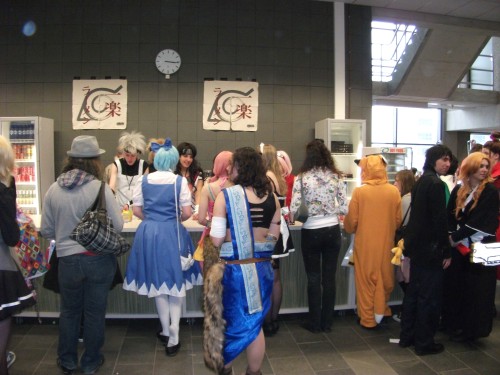
One major difference with the new location was the way in which food was handled. The spot in Sliedrecht was something of a fitness and recreation center, so it had both a small bar in the main area, as well as a bar with seats where karaoke had taken place. One of the most vivid memories for me at my first Dutch con was seeing a fairly large crowd chowing down on cup noodles like they were the best thing ever made (a claim that is supported to some extent by the fact that it has its own museum). This year however, cup noodles were practically a thing of the past, as Tsunacon saw it fit to serve actual bentou and bowls of ramen straight out of Naruto (with signs saying “Ichikaru Ramen” hanging above the serving area). Though the lack of a bar limited the food options (no bitterballen or Japanese beer as far as I could tell), this did not seem to bother the patrons at all, because the line was gigantic.

Even though I passed by the line repeatedly over the course of many hours, not once did the line ever die down, as if the people’s desire for ramen was insatiable. Honestly, I can relate, because unless you live in Den Haag, Rotterdam, or Amstelveen, it can be quite difficult to get a half-decent bowl of Asian noodle soup in the Netherlands, whether it’s ramen, wonton noodles, or pho. I know it’s a hunger that never fully dies down, and maybe on a different day I would have joined them.

There’s some obvious advice for you: serve Japanese food at an anime convention and you’re sure to be a smash hit. Think Pocky is the talk of the town? Why not hit them with some udon?

The larger space also allowed for something new this year: panels. Whereas last year the closest thing you could get to a panel was a cosplay/AMV competiton or an arts and crafts workshop or two, Tsunacon dedicated a room to the endeavor. Seeing as the panels were in Dutch, I couldn’t exactly get the most of them, but I did attend the one panel I could actually follow along with: Name that Anime. Divided into categories such as “openings,” “action scenes,” and “traps” (yes, that kind of trap), the panelists showed footage from a large variety of anime. As far as I could tell, most of the anime were from the last decade or so, with a sprinkling of Ghibli as the primary representation of anime 20 years and older. As I wasn’t sure of the exact nature of the panel going into it, I didn’t participate for fear that my inability to speak or comprehend Dutch would hold me back, but I might try next year. Overall, the panel was 90 minutes, which might either be too much or not enough for this kind of “game show,” but it seemed like it was on a good track to improvement for next year.

The last thing I did at the con was go to the karaoke room, as anyone who knows me is aware of the fact that I enjoy singing anime songs even though I can’t sing. It’s also fun to see people really get into the songs they love, which ranged from Vocaloid tracks to the popular shounen titles to the English Pokemon theme, which seems to be universally popular among singing anime fans. I spoke about this last year, but the people responsible for karaoke at Dutch cons have an entire fancy system set up to mimic a proper set. With a monitor displaying words in-sync with the song, just about anyone can follow along if they know the basics of the song, something that not even Otakon has. As for myself, I recognized a lack of burning passion in people’s selections, so I went with the go-to song for both me and one Astro Toy columnist: Kanjite Knight. Though quite off-key, the crowd was still nice enough to applaud my endeavor.

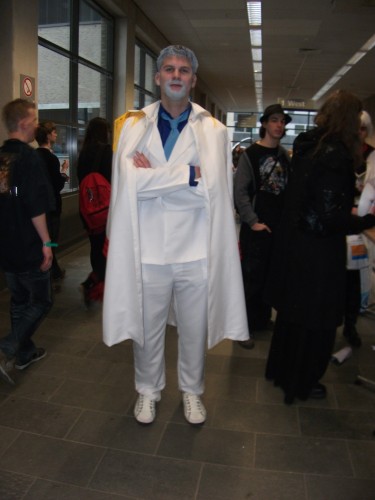
When I look at the attendees at these conventions in the Netherlands, I get the feeling that, while tastes are largely similar between the US and Dutch fans, there seem to be some major differences as well. Most notably, One Piece seems to be more well-loved among the Dutch anime fans. Does anyone else get this impression? People sang One Piece songs at karaoke, One Piece merchandise seemed to be popular in the dealer’s room, and I even saw a Garp cosplayer, which is something I have never seen at an American con (though I may have just not been paying attention). How popular is Monkey D. Luffy and his merry band of pirates among Dutch otaku, anyway?

In any case, cosplay:


(To the cosplayers above who asked me to send you this photo, my apologies as I seem to have lost your card!)


The famous combo of Chii & Stocking

I would have stuck around longer, but by 4pm noticed that it had began to snow. As I have learned during my time here, snow + Dutch trains = not fun, and what was once a 30-minute trip turned into 2 hours. Obviously, that’s no fault of the convention itself, and in hindsight I can only imagine how much worse the delays would have been going to and from Sliedrecht. In spite of those troubles, it was overall a fun convention where people just enjoyed being anime fans.

More Powerful than Freeza and Aizen Put Together

Manga and anime can be known for having some plot arcs that seem to go on forever.

Namek? Probably the most notorious long arc ever in anime and manga.

Soul Society? Hueco Mundo? Also pretty long.

But none of them are any match for Akagi‘s “Washizu Mahjong.”

For those of you who’ve never read the manga or watched its anime adaptation, Akagi is the story of a genius/psycho who risks his life in high-stakes games of mahjong, where his superior gambling ability, keen perception of the psychological, and his blatant disregard for his own life make him a legend from as young an age as 14. Eventually, he ends up playing an extremely wealthy and sadistic man named Washizu Iwao, pitting his own blood (literally) against Washizu’s vast fortunes. To top it all off, the game is played with 75% of the tiles transparent. Imagine playing Poker or Yu-Gi-Oh! with 75% of your hand showing at all times.

The anime devotes its entire second half to Washizu. That’s 13 episodes, or 1/4 of a year. When you look at the manga though, the Washizu arc began in 1997, and it still hasn’t concluded even to this day. That’s 15 years on the Same. Exact. Opponent.

While it’s easy to call this filler, it’s probably not so simple. One rumor I’ve heard is that Akagi is so popular that it’s the main reason the magazine it runs in (Kindai Mahjong, home to many, many other mahjong-related titles) is able to stay afloat.  Also, when your long arc is one and a half decades, it goes from being a stalling tactic to probably what the readers actually want.

Now what I find kind of amazing about this is that Akagi actually does quite a good job of keeping the Washizu mahjong interesting. It probably shouldn’t, but like Akagi and the magical sands of hell, it can reverse fortune in an instant. And I think the reason why it’s able to stay readable far longer than any single arc probably has any right to is that the manga can rely on the rules of mahjong (albeit modified with transparent tiles) to keep it grounded in some sense.

Bleach can come up with an ultra final bankai, and Yu-Gi-Oh! can make up cards on the spot with never-before-seen abilities. There’s no such thing as inventing new hands in mahjong. Akagi can play somewhat fast and loose with how the game turns out due to the luck factor (just like when Yugi pulls out the Black Magician at the right moment), but he can’t pull out something which doesn’t exist in the game of mahjong, otherwise it would ruin the integrity of it. Keep in mind though that this is the type of “integrity” where cheating is A-OK, as I think that also explains the appeal. Even in a never-ending game of mahjong, the thrill of Akagi the deceiver is still ripe.

Manga and Women in Refrigerators

Introduction

If you were to ask an avid and informed fan of superhero comics about controversies surrounding the portrayal of women in the cape-and-mask genre, you might get answers having to do with the male gaze, or the number of female protagonists, or perhaps even whether or not comics need to do more to attract female readers. In every case though, the focus can potentially lead to the phenomenon known as “Women in Refrigerators.”

Coined in 1999 by comics writer Gail Simone (probably most famous for her work on Birds of Prey, a series starring a team of female superheroes), “Women in Refrigerators” refers to a tendency for female characters in superhero comics to be either killed, abused, raped, or depowered in what seems to frequently be a move to anger or inspire a male superhero into action, or to intensify the hatred between the hero and his nemesis. Named after the Green Lantern character Kyle Rayner depicted above (who not only literally finds one of his girlfriends in a fridge but has also lost a number of significant others in his career), WiR has been an on-going discussion among comic fans for the past 12 years. In spite of the age and scope of the topic though, the conversation has not really penetrated the realm of anime and manga.

Given arguments over things like moe and lolicon and how Japanese society treats women, what of “Women in Refrigerators in Manga?” Furthermore, whether they’re informed or ignorant, with the number of people who have spoken or written about WiR in the superhero comics community, what would happen if they all focused their attention more towards manga?

Casca from Berserk, a strong female character horribly traumatized by brutal rape

When initially thinking about the topic, a number of questions came to mind. Would they look at manga and find it to be more sexist than superhero comics? Is the lack of a similar phrase or concept in manga a potential problem for it and any movements towards improving manga? However, I soon realized that WiR and its surrounding discourse are very much shaped by the superhero genre itself; evidence of this includes the whole idea of being “depowered,” something which holds a lot more weight in a setting where super powers are the x-factor in the story.

Of course, comparing one genre to the entirety of manga makes things quite unfair, but even when you narrow it down to, say, shounen fighting and action series, or even a single magazine such as Shounen Jump, the setup of superhero comics has particularly unique consequences.

Conceptual Paradox in the Superhero Genre

The basic superhero (of which Superman is probably the most well-known example) is someone who is somehow stronger, faster, and overall better than the average human, and this allows them to right wrongs. Where the regular authorities falter, the superhero-as-vigilante can come in and thrash the bad guys and make the world a better place. These settings rely on an environment fairly close to our own, one grounded in a similar default reality so that we can compare the ideal of the superhero to the everyday, but it also makes for a world that can start to unravel if the concept is pushed too far.

Adding a superhero to an otherwise normal world can transform it entirely, and when you begin to really question the effects a particular superhero can have on his environment,  you wind up with questions like “If Mr. Fantastic is so smart, why hasn’t he found a cure for cancer?” While there are comics which do explore in detail the influence superheroes can have on society (Watchmen, for instance), and the Mr. Fantastic question isn’t some magic contradiction that destroys the superhero genre, it does point to the idea that a typical superhero story has to set its boundaries if it doesn’t want such questions jumping out at its readers.

The idea of boundaries isn’t limited to superheroes, as just about any story which adds something “superhuman” while wishing to maintain a semblance of normalcy has to draw the line somewhere. The tricky thing with superhero comics, however, is that the manner in which they have developed over the years encourages readers to find those limits through the prominent usage of a shared universe. When a comic is just about Batman, you can see how he fights crime and strikes fear into the seedy underbelly of Gotham City. When you cross him over with Superman though, suddenly Batman is put in contrast with a near-omnipotent alien who can outclass him fifty different ways. The reason to join them together is not to just make Batman look bad but rather to afford both heroes sufficient respect, so it requires Batman to have something extra to make up for it.

Where once he could just be a clever and ingenious individual, Batman is now the smartest man on Earth, armed with the most complex contingency plans ever conceived by man, all to make him Superman’s equal. In manga terms, this would be the equivalent of putting Monkey D. Luffy and Son Goku in the same universe and having to find a way for Luffy to be as powerful and influential as the Dragon Ball protagonist, like saying that Luffy’s rubber body makes him more resistant to ki blasts or something. As Marvel and DC actively promote their shared universes, this type of comparison becomes almost inevitable, and when you’re comparing, then the superhero universe comes under at least a certain degree of scrutiny.

If you then add the on-going saga aspect that is “continuity” to that mix, then the world of the hero can be scrutinized not just in terms of space, but also time. Superhero comics encourage a long-term view of its characters, where the events build on top of each other to create a loose history. And given the longevity that some of these characters possess, an action 30 years ago can continue to be associated with that character. In a comic from 1981, Avengers character Hank Pym hit his wife Janet , and it became a recurring topic all the way up until she died a few years ago. If they were to just ignore it and have the two characters act like nothing had ever happened, then it would have been perhaps silently condoning spousal abuse. However, because they kept it, it wound up defining the characters in certain respects. Although one can argue that this enriched their characters, it also meant that once it was done, neither of them could return to what they were prior to it. And while things are re-written or counteracted on a somewhat regular basis in superhero comics, this shared universe setup means that just one bad decision by one creator can potentially define a character to the point that no amount of reboots or retcons can undo its influence.

One Woman, One Refrigerator, One Universe

Let’s go back to manga for a little bit and pick a title that most definitely has female characters that are WiR candidates: Fist of the North Star. Now I love this series and consider it among my all-time favorites, but its female characters range from essentially cheerleaders to useless. Going in the style of the original Women in Refrigerators post, I’m going to list them with a list of ways they’ve been “fridged.”

Yuria (above) abused, forced to become Shin’s lover, kills herself (not really), contracts a fatal illness from long-term radiation exposure

Mamiya turned into a sex slave, her lover Rei dies, stops fighting entirely

Lin almost forced to have Kaioh’s baby, brainwashed into falling in love with another man

And so on and so forth.

Women are kind of a non-factor in Fist of the North Star no matter what they say about love and no matter how many women nobly sacrifice themselves. But at the same time, the fact that Fist of the North Star ran in Shounen Jump doesn’t mean that its portrayal of women exists in the same environment as One Piece or Toriko or City Hunter. Misogyny can exist, and it can even exist in multiple titles from the same publisher in the same magazine to the extent that you could call the whole thing sexist, but there is less of a risk of the comics congealing into an entrenched, constantly self-reinforcing “super misogyny.”

With superhero comics and their long continuity and shared universes, it can be incredibly easy to permanently “poison the well.” In this environment, a single instance of a WiR does not stand alone in its own conceptual space, but ends up existing in a greater universe, and then stays there in the timeline potentially forever. While this is not inherently a bad thing, it means that more innocent and simplistic stories and concepts have a harder time maintaining that innocence. If someone said The Cat in the Hat and Schindler’s List occupied the same continuity, it would be very hard for Dr. Seuss’s characters to be quite the same when the idea of genocide hangs over them.

This can even apply to the degree to which women are sexualized in comics. Somewhat like how “Hollywood Ugly” requires you to believe that the attractive celebrity in baggy clothes and glasses is meant to be homely, if you take a title where the aesthetic portrayal of women is geared primarily towards the sexual gratification of men and put it in the same world as a comic where the attractiveness of women is depicted in a more neutral fashion, then there is bound to be a conceptual clash, especially if the two were to cross over directly. Either the overt “butt and breasts out” poses would have to be acknowledged directly with respect to how a woman would normally pose herself (accounting of course for stylistic flourish), or the more neutral design would have to be subsumed by the overtly erotic aesthetic. If respect is supposedly afforded to both portrayals, then there winds up being a compromise, much like Superman and Batman’s situation, that generates at least a certain degree of schizophrenia.

It can also be easy to poison the well of a shared universe because once that idea takes root in one corner of the world, it becomes easier for it to spread to other parts as well, and I think this is what ends up really shaping Women in Refrigerators in terms of the superhero genre. While I may be assuming things too much, I think it’s far easier to corrupt an innocent idea than it is to make a corrupted idea turn innocent, and so every time another woman gets killed or raped or depowered, it means less and less of a chance for that whole thing to be turned around entirely, which means the rate at which the universe becomes “darker” winds up being far faster than the rate at which it becomes “lighter,” unless deliberate steps are taken to work against it.

Given everything I’ve said about the danger of a shared universe, does this mean that any sort of shared universe will lead to similar problems? Not necessarily, but I think that regardless of which direction that universe goes, compromise is almost inevitable. When Neon Genesis Evangelion with its emphasis on psychological turmoil enters the crossover environment of the Super Robot Wars games, its story and characters end up less traumatized overall. When Lupin III meets Detective Conan, his role is more of a lovable scamp than a hardened thief. Even taking darker series and making them lighter to fit in another work is a form of compromise. However, neither of those bother to maintain their continuities for prolonged periods. Moreover, while a shared universe does not guarantee Women in Refrigerators, the way that superhero comics have turned out means that it is constantly poised to do so, and as far as I can tell, the discussion surrounding WiR is very much about a concerted effort to turn things around, to deal with what may very well be a case of inertia.

Towards Methods for Manga?

A quote from Gail Simone in 1999 clarifies one of the original purposes of Women in Refrigerators:

My simple point has always been: if you demolish most of the characters girls like, then girls won’t read comics. That’s it!

This is not as much of a problem for manga, even titles and magazines designed for boys, as many publishers in Japan have learned ways to court a female audience. Some titles in Shounen Jump are especially known for their sizable female readerships: Saint Seiya, Katekyou Hitman REBORN!, and The Prince of Tennis, to name a few. Granted, most of these titles have primarily male casts and so the portrayal of female characters is not the primary draw, but that is also getting into another more complex issue of gender-based character identification. I’ll leave this as something of an aside for the sake of not going too off-course, but will say that this might mean that it doesn’t take outstanding portrayals of women to attract a female audience, but at the very least ones that won’t make them feel uncomfortable to be women.

As it is, the “Women in Refrigerators” discourse is especially suited for the superhero genre. Its concerns and the manner in which it can quickly spread to other stories are at least partly predicated on the structure set out by decades of development. If WiR is to be applied to manga, or even a certain genre or magazine/publisher, then it likely needs to be modified to fit a very different history, both in terms of manga itself and the Japanese culture surrounding it. Personally, I’m not entirely sure what changes need to be made. It’s probably an endeavor that is too big for one post, but I can throw out some possible directions.

I think the killing, rape, and abuse aspects probably translate adequately as is, but to go back to the “depowered” aspect of WiR as something very particular to superheroes, perhaps it would be a good idea to find something that is not quite so specific. If we’re dealing with a genre like shounen action, your Dragon Ball‘s and Naruto‘s and such, then maybe it’s not so much a matter of depowering as it is being quickly outclassed or made irrelevant. A lot of characters in these works often get some kind of improvement to their abilities, but that is made obsolete by the fact that every other hero gets stronger at a quicker rate. While this is not exclusive to female characters, it may be something worth tracking among female characters to see how they’re made to be functionally useless.

If we’re looking more at sexually-charged (but not necessarily pornographic) titles, maybe it would be wise to keep an eye out for degradation or humiliation. For example, how often are characters made to do something or wear an outfit that not only embarrasses them, but sexualizes them in the process? What of humiliation as a sexual tool, even when it’s meant to be light-hearted prodding and not something more extreme like torture?

Maybe it would also be a good idea to take a look at one popular title and to note where the female characters are mistreated solely to advance the male characters’ stories. After that is done, the next step would be to look at works that may have come about as the result of its popularity, whether it was because there was a clear influence, there was a blatant attempt at riding the wave, it was the next title readers flocked to, or even if there was some kind of editorial mandate to feature more of those stories. Do some of those WiR-esque ideas and portrayals still exist? Are they getting weaker or stronger? This may be a way to track things across one magazine or one genre without having the shared universe of superhero comics.

Of course, this is all assumes that WiR is not an issue when the female readership has been established and sustained sufficiently, but what about the possibility that the phenomenon not only exists in shoujo and josei, but that such events might occur in greater numbers compared to manga geared towards male readers?

What I’ve provided in the ideas above would not comprise a complete framework, but then again neither did the original list of Women in Refrigerators. There is a distinct possibility that with each genre of manga, even if you were to narrow it to titles somehow similar to superhero comics, that it would require its own adjustments be they subtle or broad. It may even be the case that in the end, we find out that WiR cannot be applied to manga no matter how many modifications are made, but I think it would still be a worthwhile endeavor to figure that out in the first place. I’m sure we’d learn something along the way.

The Fujoshi Files 36: Hina

Name: Hina (ひな)
Alias: N/A
Relationship Status: Single
Origin: Tonari no 801-chan

Information:
Hina is a junior high school student and younger sister of 801-chan. Relatively inexperienced as an otaku, let alone a fujoshi, Hina often makes rookie mistakes such as shortsightedness when it comes to the history of things. She has even gone so far as to believe that Aslan from The Chronicles of Narnia had his name based on Athrun Zala from Gundam SEED. For this reason, Hina can often get on her older sister’s nerves.

More generally, Hina is at the perfect age to suffer from Chuunibyou, the delusional illness that comes from being a junior high student otaku and thinking that a number of things are fantastically cool and deep. Like her sister, she is fond of the Prince of Tennis, but has differing tastes otherwise.

Fujoshi Level:
Although one might suspect that her older sister’s influence is responsible for Hina becoming a fujoshi, this is not the case. Hina was able to reach that mindset entirely on her own, even while 801-chan was trying to hide that aspect of her own life.

The New and Improved Fate/Zero Opening

Though they got a little confused about past and future.

To Tsunacon This Weekend

This Sunday, February 12, I will be attending the Dutch anime convention Tsunacon in its new location in the city of Rotterdam, which so happens to be where I was a couple of weeks ago watching the premiere of the Ace Attorney movie.

Seeing as I’m generally bad at finding my way to places, I expect to get lost at least a couple of times on my way to the convention center, but hopefully things will turn out all right.

I’ll likely have a badge to identify me in case anyone wants to say hi, though as for some kind of unique clothing, it all depends on the weather (for those of you not currently in Europe, it is so unbelievably cold here!).

If you want, you can also read my coverage of last year’s Tsunacon in its old location in Sliedrecht.

(I’ll miss that tiny train.)

Genshiken II (Nidaime, Second Season, Whatever) Due Out in the US in (Probably) September

I’m really just referencing Anime News Network referencing me (who in turn found out via Brian Ruh) about Genshiken Second Season, as well as informing anyone who is still not aware of the fact that Kodansha USA has the license for the new Genshiken.

This was all based on this Amazon page by the way. It says it’ll be out by September 4th, but I think we all know how Amazon dates can shift around. At the very least, we know who has it (and it makes sense, seeing as Kodansha USA is reprinting the original Genshiken).

I already buy the volumes in Japanese, but I am not entirely against buying them once more in English. That way I can share them with people!

Lastly, “De Maniax van Ogiue” indeed.