Utena via Gurren-Lagann

This isn’t really anything mind-blowing, but I find that one of the themes of Tengen Toppa Gurren-Lagann can be used to explain a certain aspect of the ending to Revolutionary Girl Utena in a rather straightforward fashion. As I’ll be discussing the ending to Utena, I think a spoiler warning is more than implied, but I’ll put one here anyway because I think both Utena and Gurren-Lagann have final conclusion that shouldn’t be experienced in the form of a paragraph. I advise you not to read this post unless you’ve seen both.

In the “epilogue” of Revolutionary Girl Utena, we see Ohtori Academy only nearly everyone has forgotten about Utena. At first, it seems like Utena ultimately had no impact on the students there despite everything that happened in the series, but little by little the show reveals subtle differences in the characters’ behavior, such as the fact that Wakaba now has a friend who looks up to her as much as Wakaba herself looked up to Utena. Then we see Anthy with Akio, where Akio is trying to revive the rose duels once more. Anthy, however, ends up walking away and (we presume) permanently out of Akio’s life.

If we look at Gurren-Lagann, the drill is one of the very overt themes of the series. The titular robot pulls them out of thin-air, the concept of the infinite power source that is “spiral energy” is derived from the same shape, and it appears in the show’s most famous quotes (“Your drill is the drill that will pierce the heavens!”). From that whole drill motif (though I can’t remember if it’s from a production interview or if it’s said in the actual show) comes the following idea: humanity is like a drill in that it moves forward with every revolution.

Now I believe that the Japanese word Gurren-Lagann uses for “revolution” is different from the one that Utena uses (回転 kaiten, revolving vs. 革命 kakumei, life-changing), but I think it explains the ending to Utena quite well. In the end, Utena did not defeat Akio, she did not permanently undo the rose duels, Ohtori Academy still stands, and Utena is gone from the world. However, it’s clear that she did indeed bring forth a revolution, and in that one revolution all of the characters were able to grow a little. All of the characters, that is, except for Akio. While Anthy is able to finally will herself to break free of the cycle that Akio has built up, Akio himself is shown to be a man who can no longer learn, who is doomed to repeat the mistakes of the past. Like the drill of the  Gurren-Lagann, for the revolution that Tenjou Utena induces, (nearly) everyone moves one step forward.

The Ups and Downs of Suite Precure

With Smile Precure set to debut it’s a good time to look at Suite Precure. I’ve seen the series lambasted a fair amount, and while I believe Suite Precure to be a flawed series and perhaps one that in the end couldn’t quite overcome a good deal of its problems, I find that a good deal of these criticisms kind of miss the mark as to what exactly went wrong, conflating one mistake for another kind. Thus, I intend to give a fairly thorough assessment of the series, especially in terms of characterization and character development.

I will not just be comparing it to Heartcatch Precure! (which is unfair for most shows in the first place), nor will I be trying to ask Suite to be any more than the children’s show that it was meant to be.

Also, this post is FULL OF SPOILERS.

When the previews for Suite Precure started coming out, they advertised the series as being about a couple of girls who have to fight together but have trouble getting along due to being total opposites. While the franchise has always dealt in contrasting personalities, it was never quite to this degree, and the premise stood out to me. And so begins the first episode, where we’re introduced to Hibiki the energetic athlete and Kanade the organized and studious baker, former friends who have since grown apart. Inevitably, they gain the ability to transform into the legendary warriors known as Precure (Hibiki as “Cure Melody” and Kanade as “Cure Rhythm”),  help the good guys (Major Land) defeat the bad guys (Minor Land), and begin to mend their friendship, though not without some trouble.

Hibiki and Kanade’s personalities start the series with a fairly interesting dynamic, and at first it’s fun to see their little clashes here and there. Once the show decides that they’ve become good enough friends, however, the two seem to forget their past tension almost entirely, like it had never happened at all. As the show progresses, the way it irons out the “wrinkles” in relationships once development has occurred turns out to be a major recurring flaw in Suite Precure. This problem is most apparent with the villainous cat Seiren, whose turn to the side of good  as “Cure Beat” is a satisfying story arc, but who suddenly turns into an almost entirely different character afterward.

That is not to say that the show is devoid of strong and consistent characterizations. Kanade, for one, seems to hold onto her personality much more tightly. In addition, there is the character of Ako, who is revealed in the second half of the show to be not only the mysterious “Cure Muse” but also the princess of Major Land. While Seiren had the more powerful story arc leading up to her reveal, Ako’s revelations manage to build on her existing character rather than rewriting it, resulting in a character who not only sensibly knows more about fighting the enemy (being the princess of the land from which the Precures derive their power), but also works hard to make up for the age difference (at 10 years old when the average Precure heroine is 14, Ako is the youngest Cure ever). She also acts as a potential wish fulfillment character for the younger girl audience.

A special mention needs to be made for the mascot character Hummy, whose ditzy and optimistic personality sets her apart from other previous magical companions in the franchise, and honestly makes her one of the more entertaining parts of the show (something I probably would’ve never expected). Still, the fact that this more thorough and long-term characterization was unable to extend to all of the characters, especially Hibiki (who is the lead of the series), remains a problem.

The Precure franchise for the most part has never had “overarching narrative” as its strong suit and Suite is certainly no exception, but past titles were able to use memorable characters to make the plot feel more involving even when its story is paper-thin. The biggest side-effect of the way character resolution in Suite Precure induces selective amnesia is that the characters’ personalities sometimes end up either under-developed or insufficiently defined, which then results in less emotional investment in the characters’ struggles. As such, towards the end when Hibiki as Cure Melody begins to act the role of a serene savior who expresses the idea that music is better for comforting sadness than eliminating it outright, it feels like an abrupt development in Hibiki’s character that just can’t be explained sufficiently by what had happened up to that point. It is certainly possible for a sudden display of maturity to make sense*, but that wasn’t quite the case here.

Overall, Suite Precure is a series that is capable of both good characterization and good character development, but can’t seem to bridge the gap between them. When it tries to, it often ends up compromising both. Because of the way it seems to not have a firm grasp on its own characters, the buildup of the series towards its climax feels weaker, and I think it makes for a show that, while okay, could have been much stronger had it simply been able to maintain a better long-term memory.

———————————

*Episode 40 of Ojamajo Doremi # concerns Doremi’s little sister Pop wanting to play the piano, only to find out that the family had sold theirs years ago. During the episode, we find out that their mother was once a concert pianist whose career was ended by an injury, and whose her lingering regrets ended up making Doremi reject the piano when she tried to learn it. Rather than being against Pop playing piano though, the normally wacky Doremi not only gives Pop the chance the opportunity to practice, but also brings a piano back into their household. Doremi’s mature attitude about the whole thing definitely stands out as unusual for someone who is typically more of an airhead, but comes across as “uncharacteristic” rather than “out-of-character.”

THE COMIPO TRIAL EXPIRES TODAY SO HERE IS ONE LAST HURRAH


In case this somehow convinces anyone to purchase it: Official Site

If you want to see true mastery of Comipo, head over to Dave‘s Kawaiikochan Gaming no Korner.

No Objections Except the Good Kind: Miike Takashi’s Ace Attorney

Last week was the beginning of the Rotterdam International Film Festival, and with it came the international premiere of Miike Takashi’s film, Ace Attorney, or “Gyakuten Saiban” as it’s known in Japanese. Based on Capcom’s video game franchise of the same name, Ace Attorney follows a bumbling wet-behind-the-ears defense attorney named Phoenix Wright and is quest to figure out the truth behind a string of murders leading back 15 years (and defend his clients along the way) using a combination of wit, courage, and irrefutable evidence. Opposite him is prosecutor Miles Edgeworth, a former friend of Phoenix’s from childhood whose ruthless approach to justice is a far cry from both Phoenix’s ways and how he used to be.

(Note that the film was English-subtitled with the official English-language names, so I’ll be referring to the characters as such (Phoenix Wright instead of Naruhodo Ryuuichi).)

The Ace Attorney video games utilize a very “anime” aesthetic, and for anyone who saw the preview images or the trailer, the first thing that stands out is the fact that all of the characters’ costumes and even the sets are very close to the original source. Phoenix looks like he practically stepped out of the tiny DS screen, and when someone wins a court case in the film, even the way the background actors clap like stock animation looks like it came straight out of the games. However, what isn’t so obvious from the previews is the fact that, while the faithfulness of the dress results in distinctly spiky hair, frilly collars, and unique color combinations, the actual colors of the backgrounds and even the clothing itself are quite subdued. Phoenix Wright’s suit may be blue, but it’s a very toned-down blue that is a far cry from the bright, primary colors that mark the video games, and rather than clashing with the anime elements in the film, the more realistic use of color actually helps to bridge the gap between the iconic anime elements and the use of live actors. Whereas the original games’ aesthetic presents a world and motif unto itself, with the way the film looks there is a sense that our world could possibly someday turn into the larger-than-life world of Ace Attorney, however small those chances are.

In a way, this gives the film a rather prominent science fictional element, as if it’s asking, “What if the criminal justice system were like this?” Indeed, Ace Attorney even presents the unique gameplay of the video games (using evidence to find contradictions in witness testimony) as a transformation of Japan’s court system. In the story of the Ace Attorney film, the Japanese government has set up a new judicial method in order to deal with the increased amount of criminal cases. This “Bench Trial” is a court where evidence is king and which must conclude after a maximum of 3 days, giving both prosecution and defense a limited amount of time to make their cases before the judge (not a jury) makes a verdict. Moreover, in this court, evidence is presented in the form of Minority Report-esque holographic projections, flown to the center of the courtroom through the signature cries of “Objection!”, “Take That!”, and “Hold It!”, helping to bolster that larger-than-life feel. Just in case I’m giving the impression that the film is mainly serious business though, I have to point out that the movie will make the occasional sudden tonal shift like in a Tezuka manga in order to lighten the mood (and succeeds in doing so without disrupting the pacing of the movie).

The storyline and court cases of Ace Attorney is familiar to anyone who played the original, though it combines a few of them together, both for the sake of time and for all of the characters involved to have their own denouements by the end. As I have played those games and thus pretty much knew how the cases would go, I cannot comment on whether or not the narrative events of the film would be a surprise or difficult to figure out for someone new to the series. However, what I can say is that the actors do a very good job of portraying their characters, conveying a strong sense of both their personalities and their approaches to handling trials. For me, the two most outstanding performances in the film are by Phoenix Wright’s actor Narimiya Hiroki and by Ishibashi Ryou, who plays the wily veteran Manfred von Karma. Narimiya does an excellent job portraying Wright as a very clever and observant but inexperienced attorney; when he sees evidence of a clear contradiction, you can see him struggling to connect the dots that he knows have to be there, gradually forcing the words out until the crucial element comes to the surface of his mind. Ishibashi meanwhile comes across almost perfectly as a man who cannot be fazed, a man with a 40-year undefeated prosecution record, and who can even take some of the anime mannerisms from the game and actually make them look perfectly natural. If that isn’t amazing, I don’t know what it is.

Overall, the Ace Attorney movie is fun and exciting, and never feels all that awkward combining the anime aesthetic with the live-action atmosphere. While fans of the game will almost certainly enjoy it, I think people unfamiliar with the franchise and even people have been turned off by Miike’s work in the past (perhaps due to their ultra-violence) have a very strong possibility of coming out of the theater satisfied.

One thing that made this showing of Ace Attorney special was that Miike himself was in attendance. Before the film began, there was a 15-minute interview session with the director where he spoke about this film as well as his experience in filmmaking in general. Miike had actually last visited the Rotterdam International Film Festival 12 years ago with Ichi the Killer and some other movies, and he claims that the extremely positive reaction he received in Rotterdam back then was actually the launching point for his international success and why he’s able to do bigger-budget movies today. He spoke about his use of extreme violence not for the sake of violence but to show the strong emotions which drive his characters, and his desire to make films which surprise himself (something I find he has in common with the creative process of Getter Robo and Devilman creator Nagai Go). He also showed great respect for the original source material of Ace Attorney, but pointed out that a good deal had to be done to convert that game format to a film. I have to say that he did a good job in that regard, transferring the excitement of figuring out the cases as a player to watching the characters work to reach their conclusions.

After the interview was over, the person next to me turned to me and asked, “Spreekt u Nederlands?” After I responded “Nee,” we then had the following conversation:

“What was that word he said, ‘man…gu?'”

“Manga.”

“Yes, manga. What is that?”

“It’s Japanese comics.”

“Oh, like Pikachu.”

“Yes, like Pikachu.”

Like Pikachu, indeed.

The Fujoshi Files 35: Akagi Sena

Name: Akagi, Sena (赤城瀬菜)
Alias: N/A
Relationship Status: Single
Origin: Ore no Imouto ga Konna ni Kawaii Wake ga Nai

Information:
Akagi Sena is a high school student and member of the Computer Research Club. Adept at not only playing computer games but also analyzing and programming them, she seeks to create games of her own, albeit ones involving muscular men having intimate relationships with one another. Akagi is a hardcore fujoshi, and though she at first attempted to hide this fact from others by presenting herself as a regular girl mildly interested in anime, manga and games, was not able to keep the charade up for long. When pushed to the limit, Sena loudly proclaims her love of all things homo.

Sena has a very close relationship with her older brother, bordering on a brother complex (which matches his own sister complex), and is the only one capable of calming her down after one of her fujoshi tirades. She is also friends with fellow otaku Gokou Ruri, though they were at one point quite antagonistic towards each other.

Fujoshi Level:
Akagi proudly boasts of her ability to pair almost anything. In addition to fantasizing about the members of her own club having sexual relations with each other, Sena claims that she is able to find potential in even the relationship between a spoon and a fork.

Walk that Aisle with Style and Profile: Genshiken II, Chapter 72

In this month’s Genshiken II, Madarame and Hato have an awkward but heartfelt man-to-man talk and Ogiue springs possibly the worst question could ask a room of otaku.

The chapter opens up right where we left off with Madarame and Hato, with Hato asking to come inside Madarame’s apartment so that they can have a talk. Hato’s main goal is to apologize, as he believes his actions have led to Madarame not coming to the clubroom anymore. Situated right on his desk however is a copy of the game Kohsaka’s company was selling at ComiFest, inevitably drawing the discussion towards it. As they discuss its rather unique contents (though all the characters you romance are actually otoko no ko, you can also get them pregnant and marry them), they also begin touching upon the doubts and dilemmas that are currently bothering them. In the end, Madarame’s nonchalant attitude towards Hato being unable to draw anything but BL (his advice is essentially, “do what you want”) actually helps Hato resolve to work on the planned manga with Ogiue for the school festival.

At the club, both Ogiue and Hato independently decide to do something different and decidedly not BL, going with Sue’s proposed plan of Ogiue on script, Hato on art, with no crossover. Ogiue, looking to do a high school shoujo love story, asks the members of Genshiken if they have any stories of romance in their own high school experiences to share (also making the best face ever in the process). The chapter ends with a collection of dumbfounded stares, which shows that when it comes to teenage romance, no one in there can call themselves experienced.

During Madarame and Hato’s conversation, Madarame wonders aloud if it might be time for him to stop being so attached to his old college life. Hato thinks that he’s the cause for Madarame wanting to leave the club for good, but I think it’s clear that he’s probably one of the less significant factors, if really one at all. Madarame’s lingering feelings for Saki bleed through during their discussion of Kohsaka’s game, and it’s evident from his tone that the decision to move on is more tied to a rather more complex set of feelings. On the one hand, moving on means letting go of Kasukabe and deciding that it’s over. On the other hand, it can also mean that it’s time to “grow up” and stop being the otaku he was during college. Too many strong emotions are bundled together to not make this anything less than a growing concern for Madarame.

The fact that Madarame played a game centered around otoko no ko is both surprising and not. We already knew that his tastes could be pretty off-the-wall, and in terms of what’s out there, girl-boys aren’t anything special by comparison. However, this does further emphasize the idea that what one finds attractive in actual people may not be what they enjoy in their fictional characters, like with Madarame and Saki.

What is bizarre though is the whole thing about one of the characters being based on Kohsaka. Madarame mentions in the chapter that, not only is the character also named Kohsaka Makoto (with different kanji), not only does he look like Kohsaka, but his dialogue also closely resembles Kohsaka’s way of speaking. Now imagine you’re playing a visual novel, and you know for a fact that the character in front of you is based on a person you’ve known for years. It’s actually a step beyond finding out a friend of yours does porn now, and it’s one of the stranger kinds of familiarity that I can imagine.

Hato in this chapter is also revealing more about himself, particularly that his fantasies aren’t necessarily restricted to “just” BL. It may be about 95% of what’s going on there, but he begins to entertain the thought of Kasukabe turning to Madarame, though it ends up being aborted part-way through because of something that the old members of Genshiken determined back at the last graduation party in Volume 9: Saki isn’t moe, or more specifically, Saki’s personality and demeanor are such that it’s hard to turn her into a character type (“chara”) without significant changes. As Hato starts to try and think of something, he immediately remembers his first meeting with her, where she instantly saw through his disguise and called him a crossdresser.

Kasukabe’s too sharp, too real, which again emphasizes the contrast between Madarame as otaku and Madarame as a man of unrequited love. Have I ever said that Genshiken‘s really good at characters? Like fifty times? Okay, just so you know.

Going over to the Ogiue side of the chapter (which still involves Hato anyway, so I guess we could more call this a Hato chapter?), let’s talk about that face. Perhaps more than anything else I’ve seen, this expression is a sign that Ogiue’s changed deep inside, because I could not possibly imagine her making that face even up to the point where Hato, Yoshitake, and Yajima join the club. Even with her current problems, it just seems like a great weight has not only been lifted off her shoulders, but it’s also been tossed far away and mined for ore.

It’s also good to see that Ogiue and Hato have resolved to work together for the school festival, and that in doing so they’ve also resolved to work through their respective mental blocks. The fact that they’ve decided to go with a high school shoujo story is an interesting challenge, not only because it means new and unfamiliar territory, but because they’re otaku trying to write what is (probably) going to be a typical teenage romance. This is obviously where Ogiue’s last question in the chapter is coming from; as someone whose only pre-college romance ended in the worst trauma of her life, she can’t use her own experiences to fuel the story.

I think this chapter leaves with us wondering just who among the people in the club actually dated in high school? While Yoshitake might be the most obvious one given her personality, I’m basing my prediction on those last two panels of the clubroom.

Of all the people in there, only one is not shown to be reacting incredulously to Ogiue’s question.

That’s right. I get the feeling that we’re going to find out about the romantic life of Susanna Hopkins.

Whoo!

#1 in the Forest, G: gdgd Fairies

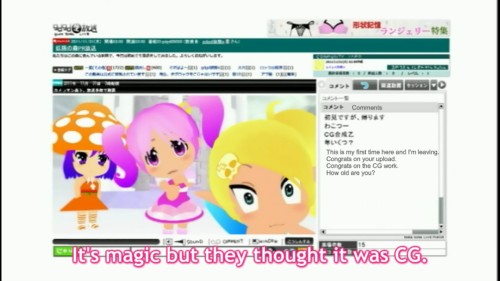
A couple of years ago when Panty & Stocking with Garterbelt was airing, the show would often be compared to American cartoons on account of its clearly influenced style. People even speculated as to whether or not Panty & Stocking would fit on Adult Swim. Since then, a show has emerged which I think is truly worthy of the moniker of “Adult Swim-esque anime.” That anime is gdgd Fairies.

gdgd (gudaguda) Fairies is ostensibly about three fairies living and playing in the Fairy Forest, but like Aqua Teen Hunger Force (which originally had Frylock, Master Shake, and Meatwad fighting crime), the premise is just an excuse for bizarre conversations and even more absurd misadventures. If the unusual nature of the production wasn’t clear enough by the end of an episode, each episode is initially titled “Title Pending.”

The main (read: only) characters are the naive pkpk (pikupiku, center), airheaded shrshr (shirushiru, right), and darkly humored krkr (korokoro, left). An episode is typical divided into three parts, where part 1 involves a conversation between the fairies that usually spirals out of control, Part 2 has them practicing magic in the “Room of Spirit and Time,” and Part 3 has the three fairies peering into a magical spring to see people in other worlds and then ad-libbing their dialogue.  During these sequences, a discussion about being late turns into one about the tragedy of time slips, the girls challenge each other to see “who can fly over the most old men,” and they even get to see this:

Part 3 (the “Magical Spring Dubbing Lake”) is where the show gets serious and pulls out the big guns. And if a bald man in his underwear farting through the sky or a fat woman in lingerie dancing as the city around her crumbles weren’t enough, after a couple of episodes it becomes very clear that, while the other parts of gdgd Fairies may play fast and loose with the show’s contents, in part 3 the actors themselves are entirely without scripts or preparation. Here, the show takes on a Space Ghost: Coast to Coast or Home Movies vibe, where the actors have to improv their lines on the spot. The actors will fall out of their voices without realizing it, unable to hold in their chuckles long enough to maintain character and will mention other anime roles they’ve done without even considering the 4th wall. These aren’t clever nudges and winks for the audience, but evidence that just as you’re seeing that farting man for the first time, so were they. You are literally hearing them joke around with only the thinnest of pretext, and it makes you laugh whether or not what they said was actually funny or a spectacular failure.


I had a conversation with Dave (of Astro Toy and Subatomic Brainfreeze) and we agreed that gdgd Fairies would actually work on Adult Swim. There’s no need to do anything to it, just put it on the air with subtitles at 2am and let the post-Family Guy and Squidbillies audience enjoy. If you don’t want to wait that long for it, you can actually catch all of the episodes on Crunchyroll.

Carl x Fusako 4ever.

A Look at Genshiken Volume 11’s Extras

The latest volume of Genshiken came out towards the end of 2011, and I was fortunate enough to get a copy by intentionally pre-ordering it twice (they say we make our own luck). As with every other Genshiken, there are a bunch of extra little things like 4-koma to give us more insight into the world of the characters. While not as packed with new information as Volume 10, there are still plenty of things to discover.

For reference, Volume 11 covers the following chapters, which I have reviewed before.

Chapter 62
Chapter 63
Chapter 64
Chapter 65
Chapter 66
Chapter 67

Sue’s Ogiue collection: The first new thing is the inside cover, behind the dust jacket. Here we see Sue surrounded by Ogiue merchandise. While the PVC figure with its changeable clothing is real, I can tell you with the utmost confidence that the vast majority of the stuff in this room are “what-ifs” at best. You’ll note the Ogiue dolls hanging above, one for each of her “eras,” not counting junior high flashbacks or ComiFest disguises. Interestingly, the picture of Ogiue’s Lilith-esque demon cosplay on that wall scroll is the first time we ever get to see why exactly Ogiue was so intent on hiding her chest when Sasahara came into the room. Lilith-esque indeed.

Women and body hair: A 4-koma where Yoshitake talks about the fact that she has rather long arm-hair makes me realize just how much body hair is a thing in Genshiken, and how much this has to do with the mostly female cast. I think it’s no surprise that it wasn’t really an issue when the club was mostly men, but now we have Yajima talking about how she only shaves her pits when she has to, and Hato accidentally showing his “smoothness.” While it’s not like you can see tufts of hair on their arms or mustaches, the fact that Genshiken has bothered to make this into an on-going topic shows that it’s not afraid to go some places. Then again, this is from the man who screen-toned veins onto breasts for Jigopuri.

Speaking of breasts: A good number of the 4-koma in Volume 11 are concerned with bust sizes, owing to the fact that Hato wore a large chest for his Yamada from Kujian cosplay. Of these, the ones that I think are most interesting are the one where Yajima points out that you can’t exactly say she’s “busty” when her figure resembles a sumo wrestler’s (her own self-disparaging words), and the one where Nakajima mentions that she’s smaller than Ogiue (which she begrudges). Upon reading Nakajima’s 4-koma, I realized that I did not notice this at all in any of her appearances, which is to say that Kio has drawn and characterized Nakajima well as someone who knows how to dress.

Hato’s ultimate cosplay: Hato dresses up as Charles from Infinite Stratos. In other words, a man cosplays as a woman disguising herself as a man.

Ogiue’s Sasa x Mada doujin is a big hit: The freshmen like Ogiue’s doujinshi so much that they all end up making copies of it. The fact that there are people in the club with whom she can really share it is a big step from where she was back when she drew it, and again I have to perhaps point to how different the new generation of club members has turned out to be. That said, it’s clear from just this one panel that it’s equal parts comforting and disconcerting for her.

Heroic Spirit Hopkins: I know a certain Hisui of the Reverse Thieves is going to get a kick out of this one. In the end-of-volume extra, the members of Genshiken discuss the endless enigma that is Sue, trying to figure out the source of her power, both physical and mental. In the end, Sue clarifies for everyone when she says, “I ask of you, are you my master?”

Totally off-topic but: There’s an insert in the volume for Kodansha’s line of light novels, and one of them is a continuation of the Ojamajo Doremi series with the characters now 16 years old! Aptly titled Ojamajo Doremi 16, it features artwork by the original character designer, Umakoshi Yoshihiko, who also did the designs for Heartcatch Precure! and whose art book you should purchase, because it’s totally awesome. As I haven’t finished the Doremi series, I won’t check it out just yet.

The Hato figure: While I own it (as well as the version from the latest issue of Afternoon), I don’t have it on me, so I can’t show it to everyone. Give me a few months.

Kind of Lumpy But Also Swell: Abobo’s Big Adventure

Double Dragon for the NES is a game that somewhat exemplifies the 8-bit era of video games. Lacking the multiplayer co-op of the original arcade, the game makes up for it with a combination of tight controls and absurd glitches. Whether it’s beating up on an invisible enemy for experience, watching an enemy fall through solid rock, or defeating opponents by climbing up or down until you can’t see them anymore, it had that right amounts of notorious difficulty and sheer fun. It’s with this spirit in mind that Abobo’s Big Adventure was developed, and as one of many who grew up with games of the NES generation, I decided to try it out when it debuted last week. Starring the physically largest enemy in Double Dragon, the game is an elaborate homage to that era, packed with references to an almost innumerable amount of games.

The (very) basic story has Abobo going through various worlds, from Mario to Pro Wrestling, all in order to rescue his son, and the cut-scenes often make light of the fact that Abobo is an unlikely hero, being a boss character originally. In this regard, I find Abobo’s Big Adventure to be at its best when it fulfills more than just an itch for the Nintendo days of yore and actively makes you feel like you’re controlling a beefy “master” (remember when bosses were sometimes called masters?) whose normal job is to make a protagonist regret his path in life. The first stage, a remake of the original Mission 1 from the NES Double Dragon, has Abobo giving nasty overhead chops which take out giant chunks of health in a way a puny martial artist’s spin kicks never could. Stage 3 pits Abobo against one of the characters from rudimentary fighting game Urban Champion, only the situation is entirely unwinnable by the opponent. Try as he he might, the poor “Urban Champ’s” fists cannot make a dent in Abobo’s rock-hard abs. Obviously the difficulty in this section is absolutely zero, but NES homages don’t always have to be about “NES-difficulty,” and it provides a feeling similar to the Wario games, where Wario bowls over enemies where Mario would typically lose lives and in doing so shows how much tougher he is by comparison. The final stage may be the epitome of expressing the power of Abobo, as it literally sets you in the boss position against a good guy in a scenario I think many fans of video games have wondered about for years.

On the flip-side, the biggest shortcoming of Abobo’s Big Adventure is that in some stages it just feels like the original game with an Abobo skin on top. The Zelda and Mega Man sections are especially bad at this, as they do not even bother to give Abobo anything functionally special, other than increased health. Giving the massive Abobo the ability to walk through solid doors in the Zelda level for instance would’ve been a way to emphasize his power and girth. The Mega Man level brings in the infamous Quick Man lasers, and Abobo is just as vulnerable to them as anyone else (i.e. he dies instantly). While I understand something of a desire to be faithful to the originals, these examples could have used as much care as the other parts of the game.

Overall, I think the game is worth a shot, especially given that it’s absolutely free and can be put down at any time. It has a good deal of heart in it, and that shows more prominently in some parts than others.

The Fujoshi Files 34: Fujoko

Name: Fujoko (ふじょこ)
Alias: N/A
Relationship Status: Single
Origin: Fujoshi no Hinkaku

Information:
Fujoko is a 24-year-old recent hire at her office who is experienced as a fujoshi, but significantly less so when it comes to managing her work along with her otaku lifestyle. Luckily for her, she befriends an older fujoshi at her office named Takayo, who takes Fujoko under her wing and guides her on the path to being a fujoshi capable of handling all tasks. Like Takayo, she is fond of the Shacho franchise, even owning a Shacho hug pillow.

Though Fujoko does not know as much as Takayo, she has a tendency to take Takayo’s advice to the next level. For instance, a simple anime character bentou by Takayo inspires Fujoko to make a full-out lunch shaped like two men in a loving embrace.

Fujoshi Level:
Fujoko’s fujoshi capacity is perhaps best expressed by her room, which is decked out in BL-related merchandise (notably Shacho fan items) on the surface but also hides even deeper, more hardcore items underneath, all specifically arranged so as to avoid suspicion from those who are obliviously unaware.