You’re Magical: Ojamajo Doremi

On the surface, Ojamajo Doremi is a relatively simple series. Its plot isn’t particularly complex, and it can hardly be called a controversial series that creates divisive opinions. However, I also find it remarkably difficult to review because it is really, really good. Its strengths are many while its faults are few, and it represents some of the best that not just the magical girl genre but anime in general has to offer.

Ojamajo Doremi centers around a trio of 3rd-graders and their path from witch apprentices to their ultimate goal of becoming full witches with mastery of magic. The titular heroine Harukaze Doremi is an energetic motormouth, easily lovestruck, who calls herself “the world’s unluckiest pretty girl.” Fujiwara Hazuki, shy, intelligent, and a connoisseur of bad puns, is the only daughter of a wealthy family and Doremi’s best friend. Rounding out the core group is Aiko, a tomboy from Osaka with a penchant for takoyaki and money who lives with her single father. Along the way, they use their magic to help out friends, family, and various others around town, though their magic often backfires in a humorous fashion.

The show is mostly episodic, with a few ongoing plot elements, most significantly the periodic “witch exams” the girls have to take in order to move up in rank and gain more powerful magical abilities, and on a basic level Ojamajo Doremi feels very comfortably like any other magical girl show with its cute mascots and brightly colored wands and transformation sequences. However, it uses those trappings to great effect, telling genuinely heartfelt stories with strong and enriching messages without going out of its way to diverge from convention. This desire to motivate, combined with the show’s incredibly rich characterization, gives a strong sense of not just how well-developed the characters’ personalities are, but that they’re inspirations to those watching.

The first really solid example of the show’s approach to characterization—and the first instance where Ojamajo Doremi begins to exhibit its full strength—is the portrayal of Aiko’s relationship with her father. When the girls’ elementary school has its “Take Your Parents to School Day,” everyone is excited. Aiko, though, purposely chooses not to tell her father about it. The reason? Having only recently moved from Osaka, Aiko’s father is a new face at his current job, and she doesn’t want to harm his reputation at his taxi company for what she considers a selfish purpose by having him take the day off so soon after starting.

When I first saw this, I was just so impressed by how this little bit of information addresses and reveals so much. It establishes Aiko as a strong, mature, and practical girl who really loves and supports her father, all without explicitly bringing up any of those attributes. It also shows the difficulties that go along with being a single parent working a job with long hours and presents a real situation which father and daughter have had to face together.

The show’s excellent treatment of its characters does not end with Aiko, and while Aiko might have the best introduction, it is perhaps Hazuki who grows the most. When Hazuki is first seen, she is a wallflower whose kind, soft-spoken nature complements the louder Doremi well. Over the course of the series, while Hazuki never stops being an overall quiet girl, she slowly learns how to be more assertive, sometimes even being the first to act. However, I must point out that Hazuki does not “gain” any strength of character, as it’s clear from the very start that her best qualities were with her all along, and that she merely needed the confidence to express herself more readily.

Doremi herself is not to be outdone in terms of characterization, either. Not only does she have about as much development as Aiko and Hazuki, but her infectious personality alone would be capable of carrying the show without the rest of the series being so good. Doremi is a clumsy girl who frequently gets outsmarted by her much younger sister, but she’s also very unorthodox and her straightforward personality is endearing. In a magical girl series aimed primarily at young girls, she is an exemplary heroine with whom they can learn and grow themselves.

As a series aimed towards kids, Ojamajo Doremi has the added concern of not only being entertaining but also delivering a good message to the children watching. Fortunately, this is where the series really excels, most notably through its tempered optimism and its approach to magic.

Ojamajo Doremi‘s is a message of positivity, but it is not so afraid to expose its viewers to some of the sadder, potentially more hurtful aspects of life to the point that it would pretend they do not exist. The problems that the girls help out with can range from rescuing a boy who fell into a hole to helping a girl come to terms with her own guilt over killing a pet. This also extends to the main characters themselves, such as the fact that Aiko’s mother walked out on their family. It’s quite a sensitive topic for Aiko, but Aiko doesn’t let it get her down, and it’s this emphasis on enjoying life, bumps and all, that also contributes to Ojamajo Doremi‘s success as a children’s show that has much more substance than other anime like it.

As for magic, Ojamajo Doremi places great importance on how it is utilized. As is the premise of the show, Doremi, Hazuki, and Aiko regularly use their spells to aid others, but the more you watch it the more you realize that the magic does not solve anyone’s problems for them. As a hypothetical example, if two friends are fighting, rather than making them less angry, the three girls’ magic will place them in the same room so that those friends can talk it out and clear up any misunderstandings. Thus, instead of eliminating the problem outright, the magic in Ojamajo Doremi acts as a guide, nudging people in the right direction so that they can find the answers for themselves. It’s a message that a lot of kids’ shows in general fail to deliver, let alone magical girl anime, and it’s really the kind of thing that can get a child (or an adult!) to think, even if they don’t realize it at first.

Now if the show has any real flaw, it’s that the show is by necessity designed to sell toys. It isn’t a big problem at first, but about halfway through the series it becomes clear that the toys weren’t selling quite enough, and the new animations for the girls’ magic spells really place the merchandise dead center for the kids at home to see. But as I said, it’s necessary for this sort of program, and the show manages to overcome this limitation in spades. Another lesser flaw is that the English dub for it is really, really bad, changing dialogue and stripping away much of the charm of the series.

Overall, Ojamajo Doremi is an amazing series. It is an almost perfect case of how to execute a proper magical girl anime that creates strong emotional connections with the characters that has you looking forward to more of their adventures. It leaves you not only satisfied with the quality of the work itself, but happy that the show was able to relay its messages of personal growth, positivity, and friendship to children and adults of all ages. Whether you’re 10 years old or somebody’s parent or just someone who appreciates good anime, Ojamajo Doremi is simply worth watching.
When It Comes Pouring Down and It Burns Inside

Every so often in anime you get a character who is not just American but fabulously so. The internet’s most famous example would probably be “Bandit” Keith Howard of Yu-Gi-Oh! fame, but he’s also joined by fellow Yu-Gi-Oh! characters Pegasus J. Crawford and Rebecca Hopkins, as well as true patriots such as the super robot pilots Jack and Mary King, anime fans Sue Hopkins and Angel Burton, and bakers Spencer Henry and Monica Adenauer, Italian-American and German-American respectively. There’s so many of these excellent individuals that I even made a club dedicated to them.

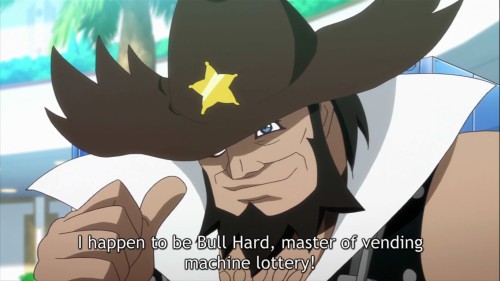
But there’s a new inductee to the club that stands out in particular, a man among men. I’ll let him introduce himself.

Seen in the best fanservice anime based on a blackjack-themed pachinko slot machine ever, Rio: Rainbow Gate, Bull Hard as you can tell is quite American. Hearing him talk, he has about the same level of Janglish as the illustrious Jack King mentioned above. But what makes him rather special is that most of the other characters, from Hollywood star Rosa Canyon to Rio Rollins herself are in fact American, and none of them have the tendency to say, “OH MAI GOD!” or other random English phrases. On top of that, the show most likely takes place in America.

So what we have here with Mr. Hard is an AMERICAN-type anime character in a show where everything already is American. Which is to say, Bull Hard must be some kind of transcendental American. Perhaps like how Spencer Henry is Italian-American or Monica Adenauer is German-American, he would best be considered an American-American, or maybe even a DOUBLE American.

In any case, I hope he makes a return (not likely).

The Fujoshi Files 19: Katou

Name: Katou (藪崎)
Alias: N/A
Relationship Status: N/A
Origin: Genshiken: The Society for the Study of Modern Visual Culture

Information:
Katou is a member of the Manga Society (Manken) at Shiiou University in Tokyo, where she is often seen in the company of fellow club members Yabusaki and Asada. She is also an acquaintance of Genshiken member Ohno Kanako due to their common preference for older men.

Although not apparent at first glance, Katou is actually extremely beautiful but normally chooses to hide her face behind long bangs. Her hairstyle also works to obscure her personality; while she can be seen as quiet and even a little dark, her actual charisma and keen perception of group dynamics make her quite suited to inter-club diplomatic relations where even the aggressive Yabusaki fears to tread.

Fujoshi Level:
Little is directly known about Katou’s fujocity, but as Ohno considers her an ally it is safe to say that she is quite strong. In addition, like Ohno, she seems to be a guiding force for the other members of her club.

The REAL Truth of Madoka Magica

Seeing the Darkness of Madoka Magica

Ever since episode 1 of Puella Magi Madoka Magica, many bloggers have been making confident statements about how the show looks to be a dark subversion of the magical girl anime. While that is certainly accurate on some level, it seems to be the case that a lot of people don’t quite understand how exactly Madoka Magica is a subversion, simply because they don’t understand the subject itself. In other words, a good number of people writing about Madoka Magica don’t actually know the magical girl genre, despite the broad statements being made. Thus, I am going to address at least a few misconceptions.

Misconception #1: Magical Girl Anime Are About Good vs. Evil

Correction: Magical girl anime are about “before” vs. “after.”

While there are some shows which pit our heroine(s) against a dark force, the vast majority of magical girl anime and manga do not even factor in the good/evil dichotomy. Instead, they will focus on how the magic changes their own lives or how it changes the lives of those around them. Those shows which do have a good deal of fighting often have it in service to something else; in those instances, it’s generally more about protecting others than it is vanquishing villains. So when someone says that Madoka Magica is different because it doesn’t have “Good vs Evil,” they are basically incorrect in the sense that magical girl shows were never really about good and evil in the first place.

Misconception #2: Magical Girl Anime Say, “You Don’t Have to Change a Thing!”

Correction: Magical girl anime say, “the magic isn’t as important as who you are!”

Yes, the “Be Yourself!” message is fairly common in magical girl shows, but there’s a distinct difference between this statement and the misconception. One implies a static existence, while the other points to an active one. The self-improvement thus happens with the help of magical powers, but it is usually the catalyst for change, with the real reason coming from within.

Misconception #3: Sailor Moon/Nanoha is a Typical Magical Girl Show

Correction: Sailor Moon is more of a typical fighting magical girl anime and Nanoha is an atypical fighting magical girl anime, while a typical magical girl anime is more along the lines of Ultra Maniac or Fushigiboshi no Futagohime.

This ties in directly with misconception number 1 and it’s fairly understandable why people make this mistake. Sailor Moon is a very significant show in the magical girl genre, and for many anime fans the very first mahou shoujo anime they ever watched (myself included), but it wasn’t really typical for its time. Certainly it has had its influence on later series, probably most notably Pretty Cure, but Sailor Moon combined the magical girl anime with the team dynamic popular in live action tokusatsu and to a lesser extent giant robot anime, and used that as a platform to deliver action-packed fights, but don’t confuse what Sailor Moon added to the genre with what the genre is fundamentally about.

Similarly, Nanoha is a show made for otaku, taking the magical girl formula and targeting it directly towards an older male audience–much like Madoka Magica itself–but it draws a lot from Sunrise action and mecha shows and adds a cup of moe. It’s also understandable why this might be an anime fan’s main exposure to magical girls, as fans who might have avoided the genre as a whole may have been pulled in by what Nanoha did differently, but that is the Nanoha formula, not the magical girl one.

“So what exactly is Madoka Magica subverting, then?”

To understand the answer to this question, we have to know the basic theme of the magical girl anime, which is how magic can make your wishes come true, or let you do things you couldn’t before. This can be portrayed by having a character, generally a normal girl, come across their magical abilities, or it can directly target the audience (which it generally assumes to be young girls) and have a girl who already has magical powers from the start. Either way, a magical girl show typically says, “Wouldn’t it be great to be a magical girl?” You can see this in pretty much every magical girl show aimed at girls, be it Cardcaptor Sakura, Majokko Megu-chan, Shugo Chara, Minky Momo, Ojamajo Doremi, and yes, even Sailor Moon. If the show is geared more towards male otaku, then the theme might turn into “Wouldn’t it be great to know a magical girl?” but the opportunity magic gives you to change/better your life is the crux of it all.

On some level magical girl anime are about the exploration wish fulfillment, and when you keep that in mind the true nature “dark” element of Madoka Magica becomes clearer. The dreary aesthetic of the witch realms, the violence, and the ambiguous morality in the characters play a role, but the most important point to consider is how the magical mascot Kyubey offers the chance to make your wish come true at the “price” of becoming a magical girl. The fact that the wish-granting comes with some sort of unknown, unquantified, and unqualified cost is where the direct subversion is strongest.

“How much are you willing to sacrifice to make your wish come true?”

The Fujoshi Files 18: Yabusaki Kumiko

Name: Yabusaki Kumiko (薮崎久美子)
Alias: Yabu-Hebi (やぶへび), Yabuu (ヤブー)
Relationship Status: Single
Origin: Genshiken: The Society for the Study of Modern Visual Culture

Information:
Yabusaki is a college student at Shiiou University, where she participates in the school’s Manga Society, or “Manken.” Hailing from the Kansai region of Japan, she is quite proud of her background and purposely does not hide her Kansai dialect when speaking to others. However, she can also be somewhat easily embarrassed, namely when dealing with situations outside of her comfort zone such as the eccentric American fujoshi, Sue. She has some close friends, namely fellow club members Asada and Katou. She also often butts heads with former Manga Society member Ogiue Chika, namely due to the latter’s disparaging remarks about female otaku. Despite their initial animosity, they have become friends of a sort.

Yabusaki draws doujinshi, and while not much is known about Yabusaki’s taste in anime and manga, she appears to at least share some common interests with Ogiue. In time, much like Ogiue and her role in Genshiken, Yabusaki seems to have also assumed some position of authority within Manken. Her circle name, “Yabu-Hebi,” refers to someone who does too much to the point of inviting disaster.

Fujoshi Level:
While an artist who focuses her talents towards fujoshi interests, her fujoshi level is perhaps best exemplified by her staunch defense of the fujoshi lifestyle. Her frequent conflicts with Ogiue in the Manga Society show that she takes her identity as both an otaku and a fujoshi very seriously.

The Decision of Kyon, The Disappearance of Suzumiya Haruhi

The Disappearance of Suzumiya Haruhi does a lot for the popular franchise, giving significant development to its characters, most notably narrator and central protagonist Kyon. The film gives a lot to think about on both intellectual and emotional levels, and I find both my thoughts and feelings on it to be surprisingly intense, so I want to organize them to see if I can give myself some clarity and perhaps insight to others.

Just as a warning, while I am calling this a review, it is going to be EXTREMELY SPOILER-HEAVY.

Continue reading

Kine-Sis: Ore no Imouto ga Konna ni Kawaii Wake ga Nai

Back when I wrote my initial thoughts on Ore no Imouto ga Konna ni Kawaii Wake ga Nai (My Little Sister Can’t Be This Cute), I felt unsure of just how the show would turn out. While definitely an otaku-pandering show, it seemed to be capable of much more, and so I refrained from posting about it again until I finished the series right and proper. Now that the series is over I feel I can lay down a firmer opinion.

So, did Oreimo live up to its potential? And would it indeed have been better off if it wasn’t so focused on the “little sister” thing?

The answer to the first question is “not quite.”

Whenever I was asked what I thought of Oreimo as it was airing, I could only summarize my opinion by saying that for every good thing the show did, it also did something bad, and this didn’t really change too much as I kept watching. That doesn’t mean that the show didn’t improve some over time, but that every improvement was met by an equal and opposite reaction. Originally, the reason the show caught my attention was that underneath all of the basic little sister stuff, it seemed to address a deeper issue that concerns the otaku that are inevitably its own fanbase, that of self-confidence and self-image in otaku. It’s one of the themes that made me love Genshiken so much, so perhaps I was somewhat biased in seeing that, but little sister Kirino and the show at large brings forth the question, “Can I show my otaku self to others?”

In one episode, Kirino tries to make friends with fellow anime fans she’s met on the internet, but her initial attempt is stymied by the fact that her stylish clothes and lack of interest in bishounen and pairings creates an incompatibility with those with whom she was trying to speak. “We’re otaku, but we have nothing in common.” In another episode, Kirino has to face her best friend Ayase discovering Kirino’s obsession with little sisters and the pressure of having someone close to you, someone who genuinely wants the best for you, try to help but come across as attacking the very core of your being with very hurtful words. Her dad also discovers her collection, and will have no part of it. I know these problems. I’ve felt them myself and I’ve seen others struggle with them, and when Oreimo is on, it can really hit home for the anxious geek, at least in bringing those sore spots into the light.

Unfortunately, the resolution left something to be desired fairly often. While Kirino’s plight with making otaku friends turns out well with her eventually befriending Kuroneko and Saori Bajeena and showing that incompatible anime tastes doesn’t mean you can’t be friends, the solutions for the non-otaku finding out about her hobby essentially came out to going around them. In both the case of Ayase and her father, the problem was resolved by older brother Kyousuke purposely taking the blame for everything. This was noble of him and all, but the issue is that the problem itself is not confronted. I worried about this for a while, wondering what would come of it, if anything. In a later episode you see Ayase trying (and failing) to understand Kirino’s obsession and overcome some of her own prejudices so it didn’t completely disappear, but overall moments like those made the show feel like while it could bring the big guns to the party, it couldn’t actually fire them.

I know I might get criticized for expecting too much, and that I should have just treated it as an otaku-pandering fanservice anime, but it was not I who brought up the aforementioned otaku problems, but the show itself. If it had ignored those points or not have presented them as well as it did, I wouldn’t be basing on my opinion on that aspect, but it did. At its best, the show seemed genuinely heartfelt. Seeing Kuroneko “out of character” and just interacting with her younger siblings showed a very human side of her. It provided a contrast with the title of the show nicely, Kuroneko herself being the older sister and not in the “onee-san” character type kind of way, which complements Kirino’s own status as a not-quite “imouto character-type” little sister. At its depths however, Oreimo was like a show that talked realistically about cancer and the financial burden it can cause on the family around a cancer victim, only to magic the cancer away at the end or fall back on the same old stereotypes and tropes.

I don’t really regret watching Oreimo, as I feel that even though it didn’t do as much as it could have, it still accomplished something, and I can only hope that the otaku that could be helped by its message, however distorted, can benefit from it even a little. If it can do that, then I might just recommend it. As for the second question of whether the “little sister” aspect helped or hurt the show, I think it would have been a little better off if the show encouraged us more to see her as a girl first and a little sister second.

I also thought it could be pretty funny.

Mysterious Madarame X: Genshiken II, Chapter 59

This month’s Genshiken II focuses on club alumnus Madarame. If you’re the kind of person who likes to pair anime characters up, then this chapter has a lot for you to chew on. Romance! Sort of.

Madarame has always been a fan-favorite, due in part to the fact that he seems the “Truest Nerd 4 Life” and thus the one closest to us. This is especially evident in his unrequited love for Kasukabe; sinking back into the recesses for fear of not ruining your friendship is the hallmark of the nerd with heartache, that “noble nerd” mindset with which many deceive themselves. I don’t know about you, but I’ve definitely felt that before, even if it wasn’t directed at any girl in particular.  So when Sasahara’s sister Keiko confronts Madarame about his feelings towards Saki in the tactless way that only Keiko can (as opposed to the tactless way only Sue can), Madarame gets taken for a psychological ride and we’re taken along with them.

Keiko, who has herself shown affections for the other half of the Kohsaka-Kasukabe Combination, makes it very clear that not only is she well aware of Madarame’s crush on Kasukabe, but that just about everyone else is too, possibly even including Saki herself. Of course, this comes as a complete shock to Madarame, who failed to realize that in his concerted efforts to minimize his longing gazes at Saki actually made his feelings completely obvious. Though this has very much to do with the fact that Madarame is such a huge dork, believing you’re subtle when you’re really not is a problem many guys have, and I can really empathize with him. Madarame has a track record of doing this, too. I mean, let’s not forget the “nose hair” incident.

By the way, I’m unsure of how popular it is among English-speaking fandom, but I know there’s a decent amount of Japanese Genshiken fans who are way into Madarame x Keiko (or Keiko x Madarame). I wonder if Kio Shimoku is aware of that?

Madarame and Keiko’s conversation never quite resolves. Sue walks in at an (in-) opportune moment, suggesting that not only do Sasahara and Keiko have more in common than expected, but that perhaps Sue is actually a cosmic being who takes strength from the meta-fabric of Genshiken itself, particularly in channeling Ogiue references. I hope that Sue gets her own dedicated chapter at some point in this run. Shifting character focus from chapter to chapter seems to be the direction of Genshiken II, so I think there’s a fair chance of it happening. Maybe Angela will make a brief return.

In any case, despite Sue’s interruption, Keiko leaves Madarame with a profound message: the only reason he can continue to spin in place is because he’s never had his heart broken. And again, if we look at Genshiken history, right there on-panel in the beach chapter was Keiko confronting an old boyfriend. Whether that bad outcome was the result of “heartbreak” or not is unclear, as is whether Keiko has truly given up on Kohsaka, but the comparison between then and now shows the kind of maturity that Keiko’s developed since we first saw her trying to wrangle money from her brother, incomplete as that maturity may be.

So while the chapter was Madarame-centric, Keiko also got a lot of development, or at least we see that she’s developed some since her last appearance.

Book-ending the chapter is Madarame’s interactions with Hato, who has been using Madarame’s apartment to change in and out of his feminine clothing. The impossibly attractive Hato is messing up Madarame’s wiring a bit, and even he can’t tell whether his friendliness with Hato is more of the male companionship he clearly misses from his club days or if it’s something else entirely (or possibly both). Again, for you shippers out there, I’m sure this chapter pleases Caesar. Interestingly, Hato himself seems to be getting the most consistent amounts of page time. I wonder if it just has to do with the fact that he is the biggest mystery of Genshiken.

Ogiue meanwhile is poised to make her published manga debut, and I am continually fascinated by her relationship with Sasahara, notably in the way they butt heads due to their respective professions of artist and editor, and how it ultimately results in better work. Ogiue’s experience with Sashara-as-editor, which we’ve seen ever since the last volume of Genshiken, is itself likely influenced by Kio Shimoku’s own time at Kodansha’s Monthly Afternoon, and seems to confirm Peepo Choo artist Felipe Smith’s own account of creating manga for sister Kodansha publication Morning Two. I’m also curious as to whether or not Sue stays over at Ogiue’s place often and interferes with Sasahara and Ogiue’s alone time, as the chapter seems to imply.

But the real story is that Ogiue’s manga schedule is conflicting with her Comic Festival schedule, and that seems to be the focus for the next chapter.  As you might expect, I’m looking forward to it quite a bit.

Vistas: What Is That Funny S-Shape?

I’ve got another post up that the Vistas Asiascape blog. This time it’s about comics and literacy. Well, sort of.

See it now.