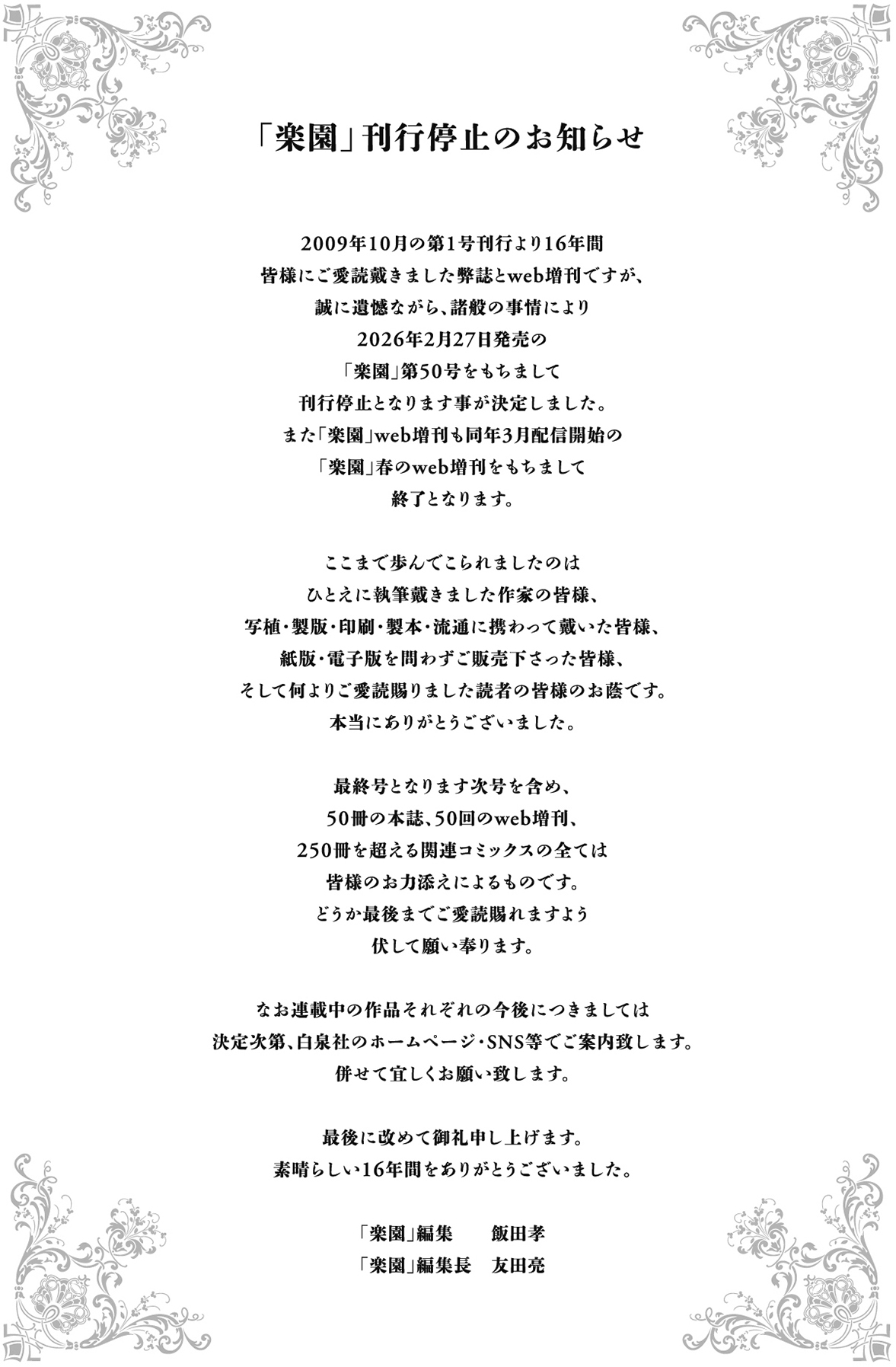
Rakuen: Le Paradis, the manga magazine that runs Spotted Flower by Kio Shimoku, announced that it will be ending in February with its 50th issue, with its web supplements going to March. While nothing is definite forSpotted Flower, the chances of it allso ending then are pretty high.
Rakuen has been a truly unorthodox publication. Rather than running weekly or even monthly, issues are released every quarter. The content is intended for mature readers, but that idea really runs the gamut. It’s been home to sexually charged adult dramas such as Spotted Flower, but also visually experimental works from panpanya (Guyabano Holiday), fetish territory like that of Kurosaki Rendou, and even gentle high school romances. In terms of different demographics as genres, Rakuen really defies easy categorization.
I hope that a spiritual successor emerges in some form. Just having something that takes the idea of “adult manga” and embraces all possible definitions of the idea was a real breath of fresh air.
It’s anniversary month for the blog again! I’m mentioning it here in the hopes that I don’t forget to write a milestone post in time (like I did a few times in recent years).
I’ve also been enjoying the new anime season. I feel conflicted about Tojima Tonzaburo Wants to Be a Kamen Rider, though. Great show so far, but as a big fan of Shibata Yokusaru’s previous work 81 Diver, the anime art isn’t ugly enough to capture his full power. I’ll still probably keep watching it, though.
As for the Patreon, here are my sponsors for the month. Many thanks to them all.
Also, V4Mirai’s DJing, retro game–loving VTuber turns out to be a Genshiken fan. Check the video!
Closing
I have been considering doing Patreon-exclusive or at least early previews/rough drafts of posts on Patreon. Is that something readers would be interested in?
PS: People shouldn’t go hungry because the powerful want to escape accountability.
Kio drew a short comic about one of the model kits from the 1/00 scale Volks Super Modeling Series: Daccas the Black Knight from The Five Star Stories.
At first, Kio talked about how it feels like he was doing nothing, and all of a sudden the release date of the adult video adaptation of Zenbu Sensei no Sei. 2. is almost out. But then he realized that he was definitely not “doing nothing,” and was drawing a manuscript, doing research for it, revising it, and even scrapping the whole thing sometimes. (NSFW)
He also made a drawing of his own replicating the ad for Zenbu Sensei no Sei. 2. There’s currently a sale going for both the prequel and the new stuff until November 23. It’s also available on DVD.
In 2023, I went to the first hololive English concert, Connect the World. In my review, I ended off with some idle thoughts:
And now that I’ve gone to a concert for virtual idols, who knows what’s next? Maybe I’ll attend some concerts by 100% flesh-and-blood musicians as well. Ironically, the VTuber rabbit hole might just lead me back to the real world.
Two years later, I finally made good on this by seeing Pat Metheny at Carnegie Hall on his Dream Box/MoonDial Tour. Given how more and more of my favorite creators and artists have been shuffling off this mortal coil, I considered him a top priority, and I’m glad I finally got the chance.
While Metheny does have a connection to anime thanks to “Last Train Home” being used as a JoJo’s Bizarre Adventure ending theme, my fondness for his music goes all the way back to my early childhood, when I first heard in a commercial what I would later learn was “It’s For You.” I watched the film Fandango earlier this year specifically because I knew that song was featured in it.
I’m the definition of casual fan—I didn’t even realize quite how much music Metheny has made, or that he’s a 20-time Grammy winner, or that he still puts out songs on a fairly regular basis. I knew he was a beloved musician, but not that he’s in the running for greatest jazz guitarist of all time. Though in hindsight, I don’t think anything could have prepared me for the live experience.
Metheny just seems fundamentally different from most musicians I’m familiar with—he seems to be less focused on making individual songs and more about exploring music and sound itself. It might be because I’m not very familiar with his very extensive discography, but it felt like I never knew where he was going or what he was going to try next. At one point, he mentioned a guitar maker he works with often, and how she takes his ideas for instruments and makes them a reality. In fact, this entire concert was dedicated primarily to his recent decision to use the baritone guitar more, and this included his custom designs. In his last few songs, Metheny used a bunch of contraptions to record his own guitars on the spot and then played them back to become a kind of one-man band while colorful meters flashed and shined. It was an aural and visual cornucopia.
Helpfully for a newbie like myself, he actually took time to delve into his life and history. Metheny explained how he came from a family of trumpet players, but that he didn’t take to the instrument nearly as well. It was seeing the Beatles on the Ed Sullivan Show that exposed him to electric guitars and changed his life forever, despite his family’s initial dislike of the newfangled instrument. At a young age, he started playing at famous spots in his home state of Missouri. Metheny mentioned that he rarely ever talks this much during concerts, so I consider myself fortunate in this regard.
This was both a culmination of a journey as a listener and the start of something new. I wonder where I might go next.
Phantasy Star is a series whose name has always floated around in the background of gaming history for me, yet was something I never engaged with directly. I knew it was significant without really knowing why. However, I watched Jeremy Parish’s Segaiden episode where he covers the original Phantasy Star. That’s where I learned that it’s basically the first JRPG to focus completely on defined characters and an established narrative (as opposed to customizable characters and an emphasis on player choice), and that it features the first female protagonist in the genre. Knowing this and seeing the Sega Ages remaster on sale, I decided to give it a try.
Unlike many RPGs of the time, Phantasy Star includes a science fiction aspect alongside the more standard swords and sorcery. The heroine is Alis Landale, a girl who sets out to avenge her dead brother after he’s killed by the oppressive forces of Emperor Lassic. Her adventures take her across planets, where she encounters allies who join Alis on her quest.
The game is gorgeous even today, and while I don’t have a firm tack on the general aesthetics of the Sega Master System, the graphics blow its contemporaries on the NES out of the water. The faux-3D of the dungeons, the excellent music, the look and feel of the environments (especially from planet to planet), and the detailed enemy sprites all contribute to an immersive experience. Little hints or story points that crop up at the beginning don’t pay off until much later, making figuring out various mysteries very rewarding. It’s no wonder that Phantasy Star is generally regarded as one of the best titles of the Master System.
Phantasy Star is very much of its time, and it reminds me of a conversation I saw on social media recently. A younger person was trying out older Pokémon games (pre–Black and White), and they were puzzled by the fact that “important NPCs” weren’t always obvious. They questioned the need to arbitrarily talk to literally everyone in the game, but others pointed out that this is what RPGs used to be like. You were expected to approach the game as an explorer and check out every nook and cranny to find hints on how to move forward. In the context of Phantasy Star, I did feel stymied by this at times despite my familiarity with this type of gameplay, like when I couldn’t remember the names of individual random towns, making backtracking much more tedious.
The Sega Ages version comes with a mode that has a few quality-of-life changes: fewer enemies, faster leveling, more gold earned per battle, faster walk speed, and auto-drawn maps. I felt two ways about this, as I often don’t like having extra hand holding for older games, but what ultimately tilted me in favor of the Sega Ages version were the maps. If I were playing this back in the day, I would have to bust out the graph paper and make them myself, and that is something I don’t enjoy. The faster leveling also helped speed up the game and allowed me to fit it into my schedule, but I definitely think I was overleveled for most of the game in a way that allowed me to accomplish things I wouldn’t have otherwise. As a result, I’m not sure I necessarily got an entirely authentic Phantasy Star experience, even if I enjoyed the game.
From what I understand, the Phantasy Star franchise only got more elaborate and complex over time. This first game acts as an introduction to the ideas and feel that would help define Sega RPGs as a whole, but I do think it’s fun as a standalone title. It also took me back to my younger days, almost like I was experiencing an alternate timeline of how my taste in games could have gone if a few circumstances had changed. Perhaps I would have been the world’s biggest Phantasy Star fan, talking about how I never tried any Final Fantasy games.
In July this year, I attended the Dokibird birthday concert at Anime Expo—the same one that was just uploaded to her YouTube. It had a lively atmosphere, and a group of fans had assembled in front of a screen to do their wotagei performances. Others shouted with excitement. But next to me was a guy who remained silent throughout. It was clear he was a fan. He just wasn’t expressing it loudly.
The contrast had me thinking about how there are challenges to being a quiet fan. So much of how we “show” fandom these days is through very visible and very vocal gestures. Online, we have react videos and social media platforms that thrive on “virality.” Offline, we have enthusiastic crowds drawing the cameras to them. It makes sense that they would get so much attention, much in the same way that cosplayers are the most photographed element at conventions. But it can create this notion that this is the way fans “should” be, when that’s not true.
I think it’s important to remember that being quiet doesn’t make you less of a fan. You might not get all the positive affirmation or even the attention that more vocal fans do, but that doesn’t mean the passion inside you is somehow not as vibrant. I’m not a terribly expressive person myself, and it’s probably part of why I started blogging—I’m full of thoughts and emotions, but they just don’t necessarily come out through pronounced physical actions.
At the same time, the fans who do go out there and make their presence known are expressing themselves in their own way. Unless they’re disruptive to the point of ruining the experience entirely for others, it shouldn’t be an issue. Everyone is their own person. There’s no specific “right” way to be a fan, and I salute my fellow quiet types because I know the passion is there.
Back in 2019, manga artist Kotoyama was just coming off of his snack-themed comedy series, Dagashi Kashi. So when a new series of his launched, I wondered what it would be like. Would it also be a kind of silly comedy fueled by character interactions related to a specific gimmick and a dash of romance? Or would it be something more standard for a shounen manga, with superpowers and greater drama?
The answer turned out to be “Yes, and also yes.”
Call of the Night (Yofukashi no Uta in Japanese) is the story of Yamori Ko, a boy who has stopped going to middle school and is suffering from insomnia. One night, he decides to leave his apartment to see what his town is like around in the late hours. There, he encounters an eccentric girl named Nanakusa Nazuna, who seems older than she looks, and offers to help him sleep. Ko agrees to try out her services, but soon discovers that she’s actually a vampire. Rather than being scared for his life, however, he gets an idea: If life right now sucks, why not become a vampire? The only problem: In order to turn, one must fall in love with the vampire first, and Ko has no idea what love is supposed to feel like.
Unlike the eight-volume Dagashi Kashi, which is largely short and episodic vignettes, Call of the Night has a serial narrative over a whopping 20 volumes. The relationship between Ko and Nazuna somewhat resembles the dynamic between Kokonotsu and Hotaru in Dagashi Kashi, but it’s really its own thing—a dynamic geared towards momentum and development, rather than stasis.
While Call of the Night initially feels it can go on forever at a pace reminiscent of another favorite series in Mysterious Girlfriend X, it then proceeds to break its own “rules” time and again. As it adds interesting twists and wrinkles to its story, the manga achieves a nice balance between genres and the emotions it invokes. Because the series keeps adding ingredients and formulating new recipes in itself, I find it to be a very Shounen Sunday manga. This is historically the magazine of Touch!, Inuyasha, Detective Conan, etc., and Call of the Night feels like it exists in the space between these and other iconic Sunday series.
The everyday hijinks make way for a genuine friendship, and the answer to whether it will turn into romantic love always feels like it’s right around the corner yet also somehow far in the distance. And as the story progresses, the cast of characters expands and details about how vampires like (and unlike) Nazuna move through human society help to expand the world and create new stakes. There are even some supernatural brawls straight out of a battle manga. And through all these events, Call of the Night still manages to feel grounded and low-key, and also still tapped into that initial malaise that plagues Ko.
Silly yet serious, simple yet full of intriguing little complexities—Call of the Night is worth a read. I think it has something even for those who aren’t fans of vampires and the supernatural. It’s ultimately the story of a boy and a girl who come from very different circumstances who find common ground in the late evening hours, and the world that unfolds before them.
PS: It really is awesome that the anime version got the ending theme to be its namesake, “Yofukashi no Uta” by Creepy Nuts.
Mono Monet, a VTuber from the agency V4Mirai, recently revealed herself to be a Genshiken fan.
What’s more, I was directly involved in this reveal! During a chat about a different topic, I was specifically called out by Mono for having “Ogiue” in my name. It spurred her on to start talking about the series, and the possibility of doing a Genshiken watchalong at some point.
This is the second time I’ve seen a VTuber explicitly express a fondness for Kio Shimoku’s title. (The first was when FUWAMOCO from hololive sang “Kujibiki Unbalance.”)
The above clip is over 20 minutes long because Mono talks about not just her love of Genshiken itself, but also Evangelion and what she looks for in fiction. It’s quite interesting overall, and Mono is just full of good takes, particularly when it comes to the appeal of flawed and messy characters.
Maho Girls Precure!! ~Mirai Days~ (also known as Witchy Precure!! ~Mirai Days~) is the second case of the Precure franchise creating a direct sequel anime that features its heroines many years after their original stories. While it might be a bit unfair to compare this series and Precure Full Bloom, their diverging approaches to portraying their respective characters as adults is noteworthy for how they connect to the concept of “youth” and all it entails.
Ever since the end of their original story, heroines Asahina Mirai and Izayoi Liko have each been living in the non-magical and magical worlds respectively. Mirai is a college student now, but she also continues to secretly use her witch powers to help people as the mysterious “Maho Girl.” Liko has become a teacher at her old school, training a new generation of magic users. When a new enemy threatens both worlds, the two reunite to become Cure Miracle and Cure Magical once more.
To me, the biggest difference between Full Bloom and Mirai Days can be summed up in the transformations. While the Yes! Pretty Cure 5 and Pretty Cure Splash Star girls revert back to their middle school selves when transforming, Miracle and Magical remain adults. In the former, the power of Precure is locked to the youth of the past, but in the latter, that power continues forward.
One aspect that might have influenced these diverging approaches is the fact that they are targeting different age demographics. Yes! 5 and Splash Star are around 10 years older than Maho Girls, and that means one sequel is targeting women around 30, as opposed to those closer to 20. Thematically, the first group are adults worn down by society and the clash between the dreamy ideals of your youth and the harshness of the “adult world.” In contrast, Mirai and Liko have to fight those who want to remain in an ideal past where they felt happiest.
Even then, I liked the way Maho Girls did it even more. I want to see how adults might look in magical outfits, and how they would carry their life experiences in their actions. Why can’t we see women in their mid to late 20s (and beyond) undergoing full, proper magical transformations that acknowledge their maturity?
When Baelz Hakos of hololive made a promotional video for a convention appearance in Hong Kong earlier this year, she gave an abbreviated version of her standard self-introduction. Naturally, it was subtitled in Cantonese, and the word used for “chaos” was wandeon—or hundun in Mandarin Chinese.
English: I am Chaos, the End of Ends.
Cantonese: 我喺混沌、萬物終結。
Cantonese Jyutping: Ngo hai Wandeon, Maan Mat Zung Git.
Literal translation: I am Chaos/Hundun, the Termination of All Creation
Hundun (混沌) refers to primordial chaos, but it can also be the name of a legendary creature from Chinese mythology that existed before the universe was created. It’s typically depicted as a faceless beast with many wings and feet. Incidentally, I became aware of it myself through the anime Lazarus, where it’s a plot point for a certain character.
The Hundun from Lazarus
Bae is Cantonese, and the fact that her original lore also describes her as Chaos itself makes the similarities between Bae and the Hundun more striking—both are “chaos” as concept as well as being. So I got to thinking: What if in the lore of hololive, Baelz Hakos is the Hundun under a different guise?
The backstories of Bae and her fellow members of hololive EN Promise updated a couple years ago to be simpler. All of them are essentially about how these representatives of primal forces (chaos, time, hope, etc.) have integrated more thoroughly into the human world, with Bae in particular focusing on her desire to perform on new and different stages.
Playing off this, I could see some kind of written piece about how Baelz Hakos is what the Hundun became out of a desire to interact more directly with the mortal realm. Dance (Bae’s specialty) is also a creative art that feels both controlled and chaotic, and perhaps her multiple wings and feet could manifest through her amazing dance moves.
This has just been some random fanfic-tier speculation on my part. I’m looking forward to the Promise 2nd year 3D concert in a few hours:



 OGIUE MANIAX